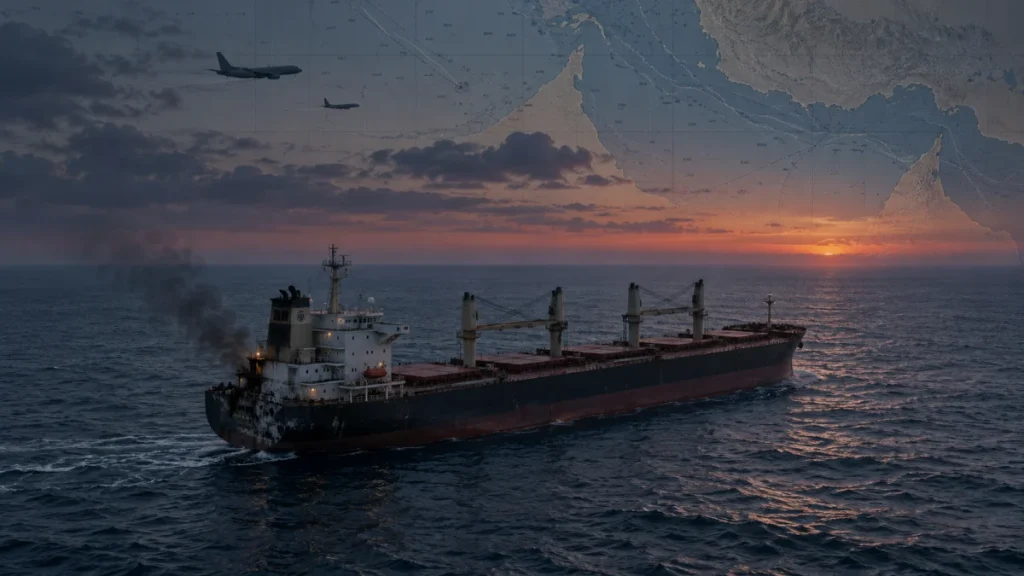

Bab el-Mandeb is not closed. Commercial vessels are still passing through the strait, and there is no verified evidence that the Houthis currently control the entire waterway.
What changed on September 10, 2026, is the geography of the threat.
Houthi forces captured the Yemeni Red Sea port city of Mokha, also spelled Mocha, and subsequently reached the strategically important Hanish Islands, according to Yemeni government military sources cited by Reuters. Government-aligned forces withdrew farther south toward Dhubab, directly overlooking Bab el-Mandeb and opposite Perim, or Mayyun, Island inside the strait.[1][2] (Investing.com Australia)
That does not mean the Houthis have closed Bab el-Mandeb. It means they have moved substantially closer to positions from which they could exert greater pressure on it.
The timing is what makes this much more important than another battlefield change inside Yemen.
The Strait of Hormuz is already severely disrupted, forcing Saudi Arabia to move more crude oil west across the kingdom to its Red Sea terminals. U.S. Energy Information Administration data show oil and petroleum-liquid flows through Bab el-Mandeb surged to 8.1 million barrels per day in the second quarter of 2026, up from 5.4 million in late 2025. During the same period, Hormuz flows collapsed from 21.6 million barrels per day to 4.9 million.[3] (U.S. Energy Information Administration)
In other words, one of the global energy system’s principal workarounds for the Hormuz problem now faces a potentially serious chokepoint problem of its own.
That is why Mokha matters to Americans who may never have heard of it.
Is Bab el-Mandeb closed right now?
No.
The best available evidence shows commercial traffic continuing through Bab el-Mandeb.
Reuters reported that 28 commodity vessels crossed the strait on September 9, almost exactly matching the previous 10-day average of 27. Sixteen entered and 12 exited. The numbers are based on ship-tracking data and therefore may miss vessels operating with their Automatic Identification System transponders turned off.[4] (Internazionale)
The Houthi-run humanitarian operations coordination center also said on September 10 that Red Sea navigation remained open to shipping companies other than Saudi vessels.[1:1] That statement comes from the Houthis themselves and should not be treated as an independent guarantee of safety. It is nevertheless important because even the group threatening the route is not currently claiming a universal closure. (Investing.com Australia)
The Houthis declared a maritime blockade against Saudi-linked shipping in July. That is different from closing Bab el-Mandeb to the world’s merchant fleet.[5] (AP News)
Current status
| Question | Best-supported answer as of Sept. 10, 2026 |
|---|---|
| Did the Houthis capture Mokha? | Yes. Reuters, AP and other reporting independently confirm it. |
| Have they advanced toward strategic Red Sea islands? | Yes. Reuters says they reached the Hanish Islands. |
| Do the Houthis control Dhubab? | Not established. Government forces were reported relocating there. |
| Do the Houthis control Perim/Mayyun Island? | Not established. |
| Is Bab el-Mandeb closed to international shipping? | No. Commercial traffic continues. |
| Are Saudi-linked ships being threatened or blockaded? | Yes. That is the announced Houthi policy. |
| Can the Houthis threaten commercial traffic through the strait? | Yes. Their demonstrated missile, drone and uncrewed-boat capabilities make this a real risk. |
| Does Iran now “control” Bab el-Mandeb? | No. That goes beyond the available evidence. |
Why is Mokha strategically important?
Mokha lies about 80 kilometers, or 50 miles, north of Bab el-Mandeb on Yemen’s Red Sea coast.[2:1]
Its capture does not itself give the Houthis command of the strait. But it moves their territorial position significantly south and gives them access to another coastal city and port along the approaches to the waterway.
More consequential geographically are Dhubab and Perim/Mayyun.
Dhubab sits directly beside the strait. Perim lies inside Bab el-Mandeb and separates its major navigational passages. Government military sources told Reuters that control of Dhubab and the island would be important to gaining substantially greater leverage over the waterway.[1:2] (Investing.com Australia)
The Hanish archipelago lies farther north in the Red Sea. Reuters reported later Thursday that Houthi forces had reached Hanish after taking Mokha.[1:3]
There is an important distinction here:
Controlling territory beside a maritime chokepoint is not the same as legally or physically controlling the chokepoint.
Bab el-Mandeb also borders Djibouti and Eritrea on the African side, and international shipping lanes run through the strait. Even possession of additional Yemeni coastline would not turn Bab el-Mandeb into Houthi territorial property.
It could, however, make threatening ships much easier.
Three different things people mean when they say a strait is “closed”
Much of the confusion surrounding Bab el-Mandeb comes from treating three different situations as if they were the same.
1. A physical closure
This would mean ships genuinely cannot transit in meaningful numbers because of sustained military interdiction, mines, wrecks, blockships or continuing attacks.
That is not the situation today.
2. A selective blockade
A belligerent threatens or attacks particular countries, vessel affiliations or cargoes while allowing other ships to pass.
This most closely describes the Houthis’ stated current policy toward Saudi-linked shipping.
3. A commercial or de facto closure
Ships may technically be able to pass, but shipping companies, charterers and insurers conclude that doing so is too dangerous or expensive.
This third scenario matters enormously because a militant group does not have to stop every ship to disrupt world trade.
Shipping companies already demonstrated that behavior during previous Houthi attacks. By April 2026, the International Monetary Fund noted that Bab el-Mandeb transits remained roughly half their pre-attack level, even after more than two years of adaptation to Red Sea insecurity.[6] (IMF)
The economic effect can therefore become severe long before anyone can accurately say that the strait has been militarily sealed.
Why Hormuz changes everything
Bab el-Mandeb has always mattered. What makes the current situation unusual is that the world’s more important Persian Gulf chokepoint is already severely constrained.
The EIA’s newest estimates show the scale of the shift:
| Maritime chokepoint | Q4 2025 | Q2 2026 |
|---|---|---|
| Strait of Hormuz | 21.6 million b/d | 4.9 million b/d |
| Bab el-Mandeb | 5.4 million b/d | 8.1 million b/d |
| Suez Canal and SUMED | 5.9 million b/d | 5.8 million b/d |
| Cape of Good Hope | 9.9 million b/d | 9.4 million b/d |
The EIA specifically attributes Bab el-Mandeb’s increase to Saudi Arabia rerouting crude away from Hormuz through its East-West Pipeline to Yanbu on the Red Sea.[3:1] (U.S. Energy Information Administration)
That creates a feedback problem.
When Hormuz became dangerous, Saudi Arabia could move some oil west instead of sending it through the Persian Gulf.
But oil leaving Yanbu for many Asian destinations still has to move south through the Red Sea and Bab el-Mandeb.
So if Bab el-Mandeb also becomes commercially unreliable, part of the workaround for Hormuz becomes unreliable too.
That is the central strategic fact behind the current story.
What happens if Bab el-Mandeb actually closes?
A sustained closure would affect both energy and ordinary cargo.
Ships traveling between Asia and Europe through the Suez Canal depend on the Red Sea route. Block the southern entrance and much of that traffic has to sail around Africa’s Cape of Good Hope instead.
That does not make global trade impossible. It makes it slower, more expensive and more complicated.
UN Trade and Development estimates that roughly 10% of global maritime trade by volume and 22% of containerized trade normally pass through the Suez Canal.[7] Bab el-Mandeb is the southern maritime gateway to that route. (SDG Pulse)
More ship-days are then required to move the same amount of cargo. Ships consume additional fuel. Crews remain underway longer. Insurance can become more expensive. Container and tanker capacity gets tied up on longer voyages.
Those effects eventually work their way into the price and availability of traded goods.
The IMF has warned that Middle East shipping disruptions raise supply-chain costs and disproportionately hurt import-dependent and lower-income economies, where food and essential goods occupy a larger share of household spending.[8] (IMF)
Would Bab el-Mandeb closing raise U.S. gas prices?
Probably, especially if the disruption were prolonged—but not because the United States depends heavily on Saudi oil.
That distinction matters.
The United States imported an average of about 490,000 barrels per day of crude from Middle East Gulf countries in 2025, representing only 8% of total U.S. crude imports.[9] Domestic production and imports from Canada are far more important to U.S. supply. (U.S. Energy Information Administration)
But crude oil prices are set in a globally connected market.
If millions of barrels become harder or more expensive to move, international crude prices can rise. U.S. refiners then face higher market prices even if the specific barrel they purchase was produced in Texas, Canada or elsewhere.
Crude oil remains the largest single component of the retail gasoline price. EIA data show crude represented roughly half of the pump price over much of the recent period.[10] (U.S. Energy Information Administration)
Americans therefore do not need to personally consume Saudi crude for a disruption to Saudi exports to matter.
The market reaction on September 10 illustrates that sensitivity. Reuters reported Brent crude trading above $107 per barrel during Thursday’s session as attacks on regional shipping intensified and the fall of Mokha added another threat to Red Sea supply routes.[11] It would be misleading to blame the entire price increase on Mokha: renewed attacks around Hormuz and the wider U.S.-Iran war were major simultaneous drivers. (Euronext Live)
That distinction is important. Mokha is an additional risk, not the sole cause of current oil prices.
Diesel may matter as much as gasoline
The more underappreciated U.S. vulnerability may be diesel.
The EIA’s September forecast expects American distillate-fuel inventories—primarily diesel and heating fuel—to fall below 100 million barrels in September and remain below the 2021–2025 five-year low through the end of 2026 and much of 2027.[12] (U.S. Energy Information Administration)
Diesel is embedded throughout the economy.
It powers trucks, farm machinery, construction equipment and parts of the industrial and freight system. Higher diesel costs can therefore reach consumers indirectly through the price of transporting food, materials and manufactured goods.
A Bab el-Mandeb crisis would not automatically produce a particular diesel price. But it would hit a market that is already unusually tight.
The United States also has a direct shipping exposure
This is not only an oil story.
Maersk’s own 2026 routing decisions show how Bab el-Mandeb security can directly affect U.S.-bound container traffic.
In March, deteriorating Middle East security caused Maersk to suspend Bab el-Mandeb and Suez transits for its MECL service connecting the Middle East and India with the U.S. East Coast, sending ships around the Cape of Good Hope instead.[13] (Maersk)
When conditions improved, Maersk announced in July that MECL would return to the Red Sea and Suez route. The company estimated the change would improve transit times by an average of seven days westbound and 14 days eastbound.[14] (Maersk)
That provides a concrete measure of what the route means to American supply chains.
If security deteriorates enough for major carriers to divert again, the impact is not theoretical: some U.S.-bound cargo simply takes longer to arrive and occupies ships for more days.
Why Bab el-Mandeb matters militarily to the United States
The United States also has substantial security interests immediately around the region.
Camp Lemonnier in Djibouti, the primary U.S. operational base in the Horn of Africa, supports about 4,000 U.S., joint and allied military and civilian personnel and Defense Department contractors.[15] (CNREURAFCENT)
The U.S. Maritime Administration currently maintains an active advisory for the Red Sea, Bab el-Mandeb, Gulf of Aden and surrounding waters because of the Houthi threat to commercial vessels.[16]
The advisory documents capabilities including missiles, unmanned aerial systems, uncrewed surface vessels and attempts to compel ships to provide voyage information or alter course. It specifically warns U.S.-flagged ships operating in the region to take precautions against Houthi targeting. (Maritime Administration)
The United States has also repeatedly used military force against Houthi missile, drone, radar and weapons infrastructure in previous efforts to protect commercial shipping and freedom of navigation.[17] (Central Command)
That history does not tell us what Washington will do next.
It does show why a serious attempt to shut Bab el-Mandeb would immediately become more than a Saudi-Yemeni dispute.
Could the Houthis really close the strait?
They can plausibly disrupt it. Completely sealing it for a prolonged period is a harder proposition.
The two should not be confused.
The Houthis have already demonstrated the ability to attack merchant vessels using multiple systems. The current MARAD advisory identifies anti-ship threats and warns vessels about missiles, drones, uncrewed surface craft and attempted boardings.[16:1]
Recent incidents also demonstrate that this threat is not historical. UK Maritime Trade Operations recorded attacks near Mokha during August, including an August 4 incident involving an uncrewed surface vessel and another cargo-vessel strike off Mokha on August 11.[18] (UKMTO)
That is enough capability to frighten commercial operators.
But physically maintaining a complete blockade is different. Bab el-Mandeb has more than one navigable passage, has African states on the opposite coast, and sits in an area where multiple international naval forces operate.
The more plausible danger is therefore not necessarily an impenetrable wall across the sea.
It is persistent enough attacks that commercial operators decide passage is not worth the risk.
That could produce many of the economic effects of closure without the Houthis ever achieving uncontested military command of the strait.
Does Iran control the Houthis?
This is where both extremes of the political argument become misleading.
Iran’s support for the Houthis is extensive and well documented. New Reuters reporting on September 10 goes significantly further: Iranian, Yemeni-government and regional sources told Reuters that the current western-coast offensive received direct strategic guidance from Iran’s Islamic Revolutionary Guard Corps.[19]
Two Iranian sources told Reuters that Tehran had encouraged the Houthis to intensify attacks against Saudi Arabia and promised additional weapons, financing and support from senior officers. Yemeni government military sources separately alleged IRGC oversight of the coastal offensive. (Boursorama)
Those are important allegations from multiple source groups, but much of the reporting relies on anonymous officials and cannot presently be independently verified from public documents.
And Reuters also reported an important counterpoint: a third Iranian source said that although Tehran discussed Mokha with its allies, the decision to attack the city was made by the Houthis themselves rather than Iran.[19:1]
Iran publicly denies directing Houthi military operations.
The strongest conclusion supported by the evidence is therefore narrower than “Iran controls the Houthis” but stronger than “Iran merely sympathizes with them”:
Iran appears to be materially supporting and strategically coordinating with the Houthis in the present escalation, while the available evidence does not establish that Tehran dictates every Houthi tactical decision.
That distinction matters when assessing claims that “Iran now controls two global chokepoints.”
It does not.
Iran has enormous ability to disrupt Hormuz, and its Houthi ally has increasingly dangerous leverage around Bab el-Mandeb. Neither statement means Tehran possesses uncontested sovereign control over both waterways.
Why this matters particularly to Saudi Arabia
Saudi Arabia has an unusual exposure because its principal alternative to Hormuz runs directly into the Red Sea.
The kingdom can move crude from its eastern oil fields through the East-West Pipeline to Yanbu, avoiding Hormuz entirely.
That is extremely useful when Persian Gulf shipping is disrupted.
But once crude reaches Yanbu, geography still matters.
Cargo headed north can move toward Suez and the Mediterranean. Cargo moving toward many Asian destinations generally needs to travel south through Bab el-Mandeb or take a much longer route.
The EIA’s 8.1-million-barrel-per-day figure demonstrates how heavily Red Sea oil flows have increased as Saudi Arabia adapted to the Hormuz crisis.[3:2]
That is why Houthi pressure on Saudi maritime traffic has outsized strategic value now.
It targets not simply another Saudi export route, but one of Saudi Arabia’s principal mechanisms for reducing its dependence on Hormuz.
What would a simultaneous Hormuz and Bab el-Mandeb disruption mean?
This is the true worst-case scenario.
A crisis at Hormuz limits the normal exit from the Persian Gulf.
A crisis at Bab el-Mandeb impairs a principal alternative route and simultaneously disrupts the Asia-Europe shipping path through the Red Sea and Suez.
The two effects are therefore not fully independent.
One can make the other worse.
The global system normally deals with chokepoint problems through alternatives: different pipelines, ports, cargo origins, destination changes, storage inventories and longer shipping routes.
But every workaround has a capacity limit and a cost.
When multiple chokepoints become unreliable at the same time, the number of easy substitutions shrinks.
That does not mean world trade stops or that all Middle Eastern oil disappears.
It means increasingly expensive alternatives have to carry increasingly important loads.
What would Europe feel?
Europe is particularly exposed through the shipping side of the problem.
Bab el-Mandeb connects the Indian Ocean trade system to the Red Sea and Suez Canal. If vessels approaching from Asia cannot safely use Bab el-Mandeb, the most obvious alternative is to sail south and west around Africa.
That adds transit time and shipping costs.
Containers, manufactured goods, energy products and commodities moving between Europe and Asia are affected.
UNCTAD’s estimate that Suez normally handles about 22% of global containerized trade demonstrates why even partial avoidance of the corridor can reverberate through freight markets.[7:1]
What would Asia feel?
Asia’s exposure is especially large on the energy side.
Before the current war, Asian buyers were overwhelmingly the largest destination for Persian Gulf oil. EIA estimates that 89% of crude oil and condensate moving through Hormuz in the first half of 2025 went to Asian markets, with China, India, Japan and South Korea accounting for most of those flows.[20]
Hormuz disruption has already forced the energy system to find alternative routes and supplies.
Greater uncertainty at Bab el-Mandeb removes flexibility from that same system.
The precise consequences would vary by country, refinery configuration, inventories and access to alternative suppliers. But Asia would have strong reason to care even though Bab el-Mandeb lies thousands of miles from most Asian consumers.
What poorer countries would feel
The secondary effects may be most painful in countries that neither produce oil nor control major shipping fleets.
Higher freight and fuel costs translate into more expensive imports.
Countries dependent on imported food, fertilizer, fuel or basic manufactured goods have less ability to absorb those increases.
The IMF has specifically warned that transport disruptions hit import-reliant economies hardest and that lower-income households are disproportionately exposed because food and other necessities consume much more of their household budgets.[8:1]
This is one reason a maritime crisis that begins with missiles and oil tankers can eventually become a food-price problem somewhere else entirely.
What should we watch next?
The most important indicator is not another dramatic statement about “controlling the strait.”
It is whether conditions actually change for ships.
The critical developments are territorial movement around Dhubab and Perim/Mayyun, independently verified attacks on commercial vessels, a sustained decline in Bab el-Mandeb transit counts, new carrier diversions around Africa, rapidly rising war-risk insurance costs, and any widening of Houthi targeting beyond Saudi-linked shipping.
A single missile launch would not necessarily close the strait.
Likewise, capturing another town would not automatically close it.
But if vessel traffic drops sharply because companies conclude that passage is unsafe, the economic outcome could begin resembling a closure before the military map ever does.
The bottom line
The Houthi capture of Mokha is significant, but not because Bab el-Mandeb suddenly became Houthi-controlled on September 10.
It did not.
The more consequential development is that an armed movement with demonstrated anti-ship capabilities, increasingly strong evidence of Iranian strategic support and a declared campaign against Saudi shipping has moved farther down Yemen’s Red Sea coast at precisely the moment Saudi Arabia is relying more heavily on that route to compensate for severe disruption at Hormuz.
Bab el-Mandeb handled about 8.1 million barrels per day of oil and petroleum liquids in the second quarter of 2026, up sharply as Saudi crude was rerouted west.[3:3]
For the United States, a serious disruption could mean higher global oil prices, pressure on gasoline and diesel, longer shipping routes for some U.S.-bound goods, and another military-security challenge in waters Washington has repeatedly treated as strategically important.
For Europe, it threatens the efficient Asia-Suez trade route. For Asian economies, it could further constrain an already disrupted Middle Eastern energy system. For poorer import-dependent countries, higher fuel and freight costs can eventually show up in food and basic-goods prices.
And the most important distinction remains simple:
Bab el-Mandeb does not have to be literally sealed to become a major economic problem. It only has to become dangerous enough that enough ships stop using it.
As of September 10, that has not happened.
But after the fall of Mokha, the possibility is substantially harder to dismiss.
Endnotes
References and Further Reading
Primary government and maritime sources
U.S. Energy Information Administration — World Maritime Oil Chokepoints. The strongest quantitative source for understanding why Bab el-Mandeb matters more now than it did before the Hormuz disruption, including the increase to 8.1 million barrels per day. Read the EIA analysis
U.S. Maritime Administration — Houthi Attacks on Commercial Vessels Advisory. Current U.S. guidance on Houthi maritime capabilities and risks to commercial shipping around Bab el-Mandeb and the Red Sea. Read the MARAD advisory
UK Maritime Trade Operations — Recent Incidents. Operational incident reporting useful for separating verified maritime attacks from unconfirmed social-media claims. View UKMTO incidents
U.S. Navy — Camp Lemonnier, Djibouti. Official information on the principal U.S. operational base in the Horn of Africa and the approximately 4,000 personnel it supports. View the Navy installation page
Energy, trade and economic consequences
U.S. Energy Information Administration — September 2026 Short-Term Energy Outlook. Current official U.S. projections for crude markets and unusually low American diesel inventories. Read the EIA petroleum-products outlook
UN Trade and Development — Maritime Trade Through Suez. Useful baseline for the scale of trade exposed when Bab el-Mandeb disruption forces vessels away from the Red Sea/Suez corridor. Read the UNCTAD analysis
International Monetary Fund — Global Disruptions Are Testing How the World Moves Goods and People. Explains the longer-lived economic effects of Red Sea shipping disruption and why transport shocks can persist after fighting subsides. Read the IMF analysis
Maersk — MECL Red Sea Routing Updates. A concrete example of how Bab el-Mandeb conditions affect shipping between India and the Middle East and the U.S. East Coast, including measured transit-time differences. Read the Maersk MECL update
Current reporting and Iran’s role
Reuters — Houthis Advance Along Yemeni Coast, Threaten Saudi Oil Exports. The most useful current account of Mokha, Hanish, Dhubab, shipping policy and the immediate strategic situation. Read the Reuters report via Investing.com
Reuters — Iranian Arms and Advice Helped Houthis Seize Key Red Sea City. Important multi-source reporting on alleged IRGC strategic direction, while also documenting evidence that the decision to attack Mokha itself may have remained a Houthi decision. Read the Reuters investigation
Associated Press — Houthis Take Strategic Port City in Yemen. Independent corroboration of the capture and broader context surrounding the renewed Yemeni conflict. Read the AP report
Editorial currency note: Territorial control, maritime security conditions, oil prices, vessel-transit counts and government responses are changing quickly. The operational-status statements in this article reflect the strongest information available as of late September 10, 2026, U.S. time. Claims that Dhubab, Perim/Mayyun or Bab el-Mandeb itself have subsequently fallen should be independently rechecked before updating the article.
Reuters. “Houthis Advance Along Yemeni Coast, Threaten Saudi Oil Exports in the Red Sea.” September 10, 2026. Reuters report via Investing.com ↩︎ ↩︎ ↩︎ ↩︎
Associated Press. “Iran-Backed Houthi Rebels Take Strategic Port City in Yemen, Raising Threat to Red Sea Shipping.” September 10, 2026. Associated Press report ↩︎ ↩︎
U.S. Energy Information Administration. “Energy Security and World Oil Transit Chokepoints.” September 2026. EIA chokepoint analysis ↩︎ ↩︎ ↩︎ ↩︎
Reuters. “Hormuz Shipping Traffic in Single Digits, Data Shows.” September 10, 2026. Reuters vessel-tracking report ↩︎
Associated Press. “A New Threat by Yemen’s Houthis Could Widen the Iran War and Put Another Trade Chokepoint at Risk.” July 2026. Associated Press blockade explainer ↩︎
International Monetary Fund. “Global Disruptions Are Testing How the World Moves Goods and People.” April 29, 2026. IMF analysis ↩︎
UN Trade and Development. “A Tenth of Global Maritime Trade Transits the Suez Canal.” UNCTAD maritime-trade analysis ↩︎ ↩︎
International Monetary Fund. “How the War in the Middle East Is Affecting Energy, Trade, and Finance.” March 30, 2026. IMF trade and energy analysis ↩︎ ↩︎
U.S. Energy Information Administration. “The Middle East Gulf Was Source for 8% of 2025 U.S. Crude Oil Imports.” April 6, 2026. EIA U.S. crude-import analysis ↩︎
U.S. Energy Information Administration. “Factors Affecting Gasoline Prices.” EIA gasoline-price explainer ↩︎
Reuters. “Oil Surges 6%, Brent and U.S. Crude Both Surpass $100 on More Tanker Attacks.” September 10, 2026. Reuters oil-market report ↩︎
U.S. Energy Information Administration. “Short-Term Energy Outlook: U.S. Petroleum Products.” September 9, 2026. EIA distillate outlook ↩︎
Maersk. “Rerouting of ME11 and MECL Service Around the Cape of Good Hope.” March 1, 2026. Maersk customer advisory ↩︎
Maersk. “Structural Changes to MECL.” July 9, 2026. Maersk MECL route update ↩︎
U.S. Navy. “Camp Lemonnier, Djibouti.” Official Camp Lemonnier installation page ↩︎
U.S. Maritime Administration. “2026-006: Red Sea, Bab el-Mandeb Strait, Gulf of Aden, Arabian Sea and Somali Basin — Houthi Attacks on Commercial Vessels.” March 26, 2026. MARAD maritime security advisory ↩︎ ↩︎
U.S. Central Command. “U.S. Forces, Allies Conduct Joint Strikes in Yemen.” February 2024. CENTCOM release ↩︎
UK Maritime Trade Operations. “Recent Maritime Incidents.” August–September 2026. UKMTO incident reporting ↩︎
Reuters. “Iranian Arms and Advice Helped Yemen’s Houthis Seize Key Red Sea City, Sources Say.” September 10, 2026. Reuters investigation via MarketScreener ↩︎ ↩︎
U.S. Energy Information Administration. “World Oil Transit Chokepoints.” 2026. EIA international chokepoint analysis ↩︎