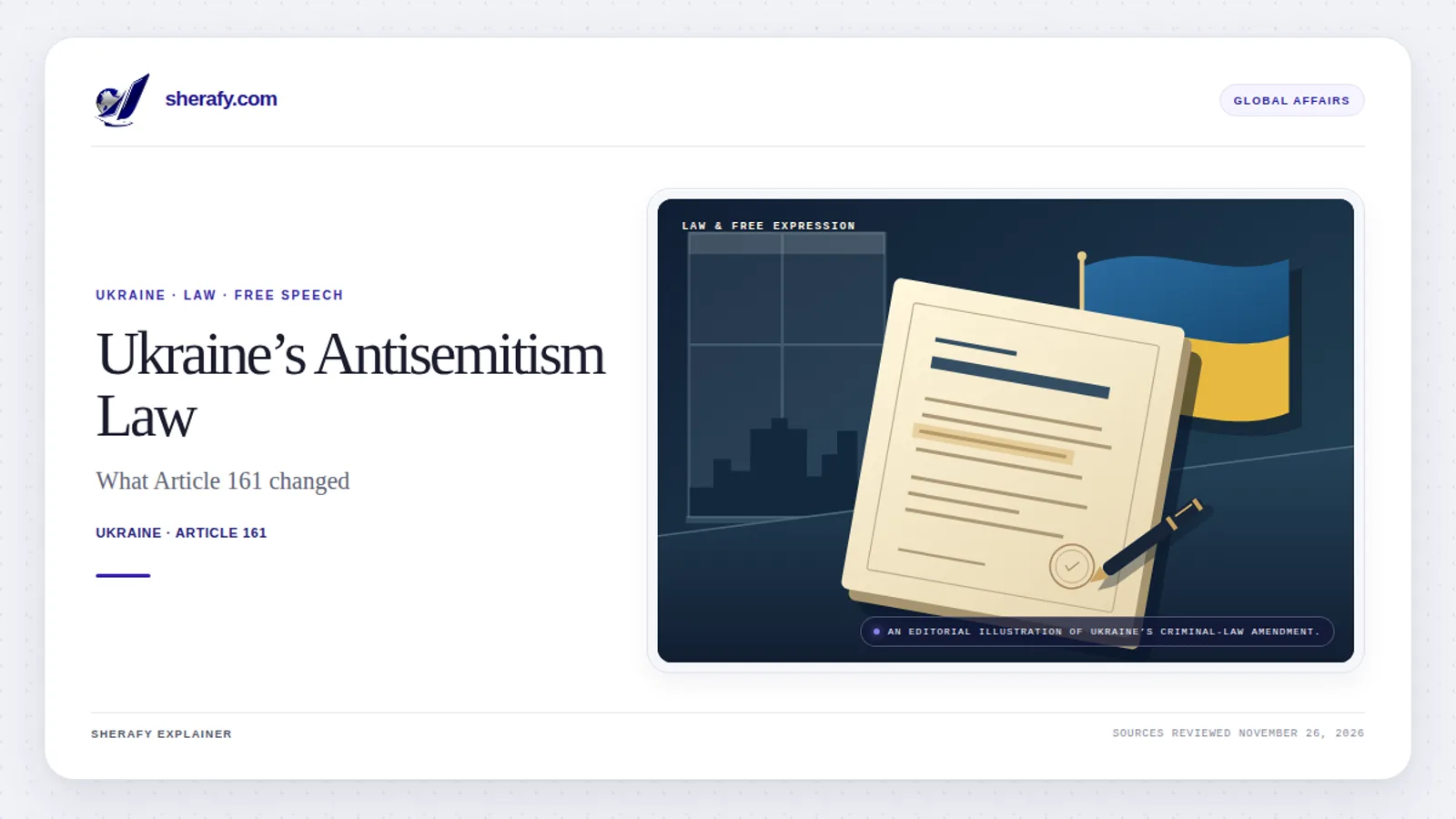
Ukraine has explicitly criminalized manifestations of antisemitism under Article 161 of its Criminal Code. President Volodymyr Zelensky signed the amendment on April 14, 2026, and it took effect the following day. The most serious offenses can carry up to eight years in prison.
However, the law does not expressly ban criticism of Israel, and the eight-year prison maximum is not new. Ukraine added antisemitism to an existing criminal provision. Its separate 2021 antisemitism statute draws on the International Holocaust Remembrance Alliance (IHRA) working definition, but does not reproduce or expressly incorporate all of its examples concerning Israel.
There is also an unusual political question: why did Zelensky sign this legislation during a war that threatens Ukraine's existence? Parliament passed it in February 2022, nine days before Russia's full-scale invasion. It remained unsigned for more than four years. Reporting from inside Ukraine points to concerns about Russian propaganda and relations with Israel as relevant to its eventual signature.
The law is real, the timing deserves scrutiny, and its broad language raises legitimate free-speech questions. But understanding what Ukraine actually criminalized requires separating the legislation from what people have been told about it.
What antisemitism law did Zelensky sign?
Two separate Ukrainian laws form the basis of the current legal framework.
| Law | Parliamentary adoption | Presidential signature | What it does |
|---|---|---|---|
| Law No. 1770-IX | September 22, 2021 | October 7, 2021 | Defines and prohibits antisemitism, lists its manifestations and provides for liability and compensation under applicable law. |
| Law No. 2037-IX | February 15, 2022 | April 14, 2026 | Explicitly adds manifestations of antisemitism to Article 161 of the Criminal Code. |
The 2021 antisemitism statute established a domestic legal definition. Article 4 recognized civil, administrative and criminal liability under applicable legislation, but the statute itself did not specify criminal sentencing ranges. Article 5 also recognized the right to compensation for material and nonmaterial harm.
The criminal-code amendment, Law No. 2037-IX, is remarkably short. Its substantive change consists of adding two Ukrainian words to Part 1 of Article 161: прояви антисемітизму, meaning manifestations of antisemitism.
Article 161 already addressed intentional incitement of national, regional, racial or religious hostility, degradation of national honor and dignity, insults relating to religious beliefs and various discriminatory restrictions or privileges. The amendment expressly inserted antisemitism into that framework. It did not replace the existing offenses or rewrite the penalties.
The distinction is important. Antisemitic incitement could be prosecuted under Ukrainian law before April 2026, as actual court judgments demonstrate. The amendment nevertheless has legal significance because prosecutors now have an expressly named category of conduct to invoke, linked to a separate statutory definition.
Why is Ukraine prioritizing an antisemitism law during a war?
The more revealing question is not why Ukraine passed this law during a war. It is why a bill that had been sitting on the president's desk since before the full-scale invasion suddenly became worth signing four years later.
The official parliamentary records for Bill 5110 establish the following sequence:
| Date | Event |
|---|---|
| February 19, 2021 | The two antisemitism bills, Nos. 5109 and 5110, are introduced. |
| May 5, 2021 | Parliament's Freedom of Speech Committee announces its support for advancing both bills. |
| September 22, 2021 | Parliament passes the original antisemitism statute. |
| October 7, 2021 | Zelensky signs the original statute. |
| December 16, 2021 | Parliament approves the criminal-code bill at first reading. |
| February 15, 2022 | Parliament passes the criminal-code amendment. |
| February 21, 2022 | The amendment is sent to Zelensky for signature. |
| February 24, 2022 | Russia launches its full-scale invasion. |
| April 14, 2026 | Parliament records the return of the signed amendment. |
| April 15, 2026 | The amendment takes effect. |
Both measures passed with substantial legislative support. The 2021 roll-call vote recorded 283 votes in favor and six against. The February 2022 vote recorded 295 in favor and one against. There were also abstentions and legislators who did not vote.
This was not a new presidential initiative conceived in 2026. The United Jewish Community of Ukraine says it proposed dedicated legislation in 2020, and the parliamentary bill records identify Maksym Buzhanskyi among the lawmakers who introduced it. Ukraine had been at war with Russia since 2014, but the initiative predates the full-scale invasion and the October 2023 escalation of the Israel-Palestine conflict.
Why did the law remain unsigned for four years?
The strongest specific evidence comes from BBC News Ukraine's April 15, 2026, reporting, by Nataliia Patrikieieva. An unnamed source in the president's circle said the administration had previously been reluctant to give Russian propaganda grounds to depict Ukraine as having an exceptional antisemitism problem. The source said that reservation no longer applied.
Olga Vasylevska-Smahliuk, a legislator from Zelensky's Servant of the People party and co-chair of Ukraine's parliamentary friendship group with Israel, offered another relevant piece of evidence. In comments to the BBC, she placed the signature alongside renewed intergovernmental cooperation and Israeli votes favorable to Ukraine at the United Nations as developments reflecting improved bilateral relations.
The signature also coincided with Israel's Holocaust Remembrance Day, Yom HaShoah, on April 14. Israel's foreign minister, Gideon Sa'ar, publicly thanked Zelensky two days later.
Taken together, these facts support treating the signature as a potentially useful diplomatic and symbolic gesture, not simply a technical correction to criminal law. They do not establish a negotiated exchange, an Israeli ultimatum or a particular promise of military assistance. Nor do they establish a presidential intention to suppress criticism of Israel over Gaza.
There is a constitutional issue as well. Article 94 of Ukraine's Constitution ordinarily gives the president 15 days to sign and promulgate legislation or return it to parliament for reconsideration. If it is not returned within that period, it is deemed approved and must be signed and promulgated. That does not mean an unsigned law automatically becomes enforceable. The BBC also reported that numerous other parliamentary measures had been left unsigned, indicating a broader institutional problem rather than a delay unique to this bill.
Did this divert resources from Ukraine's war effort?
There is no evidence in the legislative record that this signature diverted military funding, weapons or personnel from the war effort. The bill had already passed parliament. Signing it in 2026 did not require reopening the legislative debate or establishing a new sentencing system.
Indeed, the explanatory memorandum, quoted in Interfax Ukraine's contemporary reporting, said implementation would not require additional state-budget expenditure. That was the bill's stated fiscal assessment, not proof that enforcement is costless. Investigations, prosecutions and imprisonment consume public resources, and their eventual cost depends on how frequently the law is used.
There are practical reasons a country at war might continue civil-rights legislation: maintaining domestic institutions, protecting minorities, meeting European integration commitments and managing foreign relations. Those are not inherently incompatible with military defense.
Nor does the available evidence establish a sudden domestic antisemitism emergency that necessitated this particular signature. The European Commission's 2023 Ukraine report recorded no antisemitic violence in the monitoring data for 2022 and the lowest recorded vandalism in two decades. Paragraph 43 of ECRI's October 2026 report notes perceived improvements in attitudes toward Jews among people consulted in 2025, while acknowledging continuing antisemitic expression online. Those findings do not establish that antisemitism has disappeared; incomplete reporting also limits what can be inferred. They do, however, provide little support for interpreting April 2026 as a response to a demonstrated sudden surge in antisemitism.
The broader justifications for wartime legislation do not answer why this particular bill needed to be signed on that particular date. Given the four-year delay, the diplomatic context and the demonstrated ability to prosecute antisemitic incitement under existing law, the government has a legitimate question to answer about the urgency and intended effect of this amendment.
The signature does not establish that Ukraine placed antisemitism above military defense. But the available record provides a clearer explanation for its diplomatic significance than for its sudden domestic urgency.
Can you really get eight years in prison for antisemitism in Ukraine?
Yes, but only under the aggravated circumstances specified in Article 161, Part 3. Eight years is not the standard penalty for antisemitic speech, nor was that maximum introduced in 2026.
The current text of Article 161, which also provides access to historical versions, establishes three levels of criminal liability.
| Circumstances | Fine (UAH) | Restriction of liberty | Imprisonment |
|---|---|---|---|
| Part 1: Underlying offense | 3,400–8,500 | Up to 5 years | Up to 3 years |
| Part 2: Offense involving violence, deception, threats or commission by an official | 8,500–17,000 | Not specified | 2–5 years |
| Part 3: Offense committed by an organized group or resulting in grave consequences | Not specified | Not specified | 5–8 years |
The fines use the statutory non-taxable income unit of 17 Ukrainian hryvnias, which produces the amounts shown. Parts 1 and 2 also provide for possible disqualification from certain jobs or activities for up to three years.
Restriction of liberty is a separate criminal punishment from imprisonment. The two should not be confused simply because both impose restrictions on a person's freedom.
Being an official does not independently establish guilt. If a legally qualifying official commits an Article 161 offense, the conduct can fall under Part 2. That does not automatically trigger the eight-year maximum, and the statutory category of official does not necessarily include every government employee.
The amendment did not introduce mandatory imprisonment for every offense. An individual convicted under Part 1 may receive a fine instead. Actual sentences depend on the facts, the applicable criminal-law provisions and the court's determination.
What counts as antisemitism under Ukrainian law?
Ukraine's 2021 statute defines antisemitism in terms of a perception of Jews expressed as hatred toward them. Its scope includes verbal and physical manifestations directed at Jews, non-Jews, their property and Jewish community institutions or religious sites.
Article 2 identifies ten principal categories. The following table is a condensed English rendering of the enacted Ukrainian text, not an official English translation.
| No. | Manifestation identified by the statute |
|---|---|
| 1 | Denial of the right of people of Jewish origin to self-identify. |
| 2 | Encouraging, concealing or justifying their killing or harm. |
| 3 | False information and hateful or inflammatory statements about people of Jewish origin. |
| 4 | Publicly blaming Jews collectively for actual or imagined wrongdoing by individuals or groups. |
| 5 | Denial of the persecution and mass extermination of Jews during the Holocaust. |
| 6 | Making or distributing materials containing antisemitic statements, or publicly using antisemitic materials, symbols or images. |
| 7 | Intentional damage or destruction of Jewish-owned, community or religious buildings on antisemitic grounds. |
| 8 | Intentional damage, destruction or desecration of Jewish graves, memorials or monuments on antisemitic grounds. |
| 9 | Intolerance toward non-Jews perceived to be Jewish. |
| 10 | Calls for antisemitism. |
Several categories involve physical harm, property damage or discrimination. Others concern expression itself. The latter include allegations about Jewish people, Holocaust denial, dissemination of materials and calls for antisemitism.
This means the new criminal-code wording cannot be dismissed as applying only to violent hate crimes. It reaches into an area of law in which speech can itself be part of the alleged offense.
However, the 2021 statute's broad prohibition and the 2026 amendment do not establish that every listed manifestation automatically results in criminal conviction. The relationship between those categories, Article 161's intentional-conduct language, general criminal-law requirements and constitutional protections requires judicial interpretation.
Did Ukraine adopt the IHRA definition of antisemitism?
Ukraine's domestic definition was based on the IHRA working definition. That is documented, not speculation.
In May 2021, the Ukrainian parliament's Freedom of Speech Committee reported that the bill's author identified the IHRA definition as its basis.
But adopting a related domestic definition is not equivalent to incorporating the entire IHRA framework into criminal law.
The IHRA working definition, adopted in 2016, is nonbinding in itself. It is accompanied by eleven illustrative examples whose applicability depends on context. Several deal specifically with Israel. Its core definition also differs slightly from the Ukrainian wording: IHRA refers to a perception that may be expressed as hatred, while the enacted Ukrainian definition describes a perception expressed as hatred.
The eleven examples are reproduced on the European Commission's antisemitism resource page. The comparison below shows where the two frameworks overlap and where they differ.
| IHRA example or principle | Relationship to Ukrainian Law 1770-IX |
|---|---|
| Encouraging or justifying harm to Jews | Expressly covered. |
| Dehumanizing stereotypes and conspiratorial allegations about Jews | May fall within the broader false-information and hateful-expression provision. |
| Blaming Jews collectively for wrongdoing | Expressly covered. |
| Denying the Holocaust, including its extent, intent or methods | Holocaust denial is expressly covered, but not every IHRA formulation is separately listed. |
| Alleging that Jews or Israel invented or exaggerated the Holocaust | Not separately enumerated. |
| Alleging that Jewish citizens owe greater loyalty to Israel than their own countries | Not separately enumerated. |
| Denying Jewish collective self-determination, including certain claims about the existence of Israel | Not separately enumerated; individual Jewish self-identification is separately addressed. |
| Applying double standards to Israel | Not separately enumerated. |
| Applying traditional antisemitic imagery to Israel or Israelis | No corresponding Israel-specific example; antisemitic imagery is addressed generally. |
| Comparing Israeli policies to Nazi policies | Not separately enumerated. |
| Blaming Jewish people collectively for Israel's conduct | Potentially covered by the general collective-responsibility provision. |
| Criticism of Israel comparable to criticism of other countries | IHRA expressly distinguishes this from antisemitism; Ukraine's statute contains no equivalent Israel-specific clause. |
The last row is a qualification accompanying the IHRA framework rather than a twelfth example.
Neither Ukrainian statute incorporates all eleven examples by reference. Neither mentions Israel or Zionism expressly. Conversely, Ukraine separately enumerates several categories, such as the desecration of Jewish graves and memorials, that are not equivalent standalone entries in the IHRA list.
The United Jewish Community of Ukraine's legislative overview provides additional context concerning its role in the legislative initiative. Some organizations have characterized the result as IHRA adoption, but the European Commission specifically reported on page 42 of its 2023 Ukraine assessment that Ukraine had not adopted the IHRA definition, despite enacting its own law in 2021. No separate nationwide instrument incorporating the full framework was established in this research. The legislative record establishes IHRA influence; it does not establish wholesale statutory incorporation.
This distinction matters because a nonbinding definition can acquire legal or institutional consequences when adopted by a government. Whether those consequences include criminal liability depends on the domestic instrument, not on the IHRA document alone.
Is criticizing Israel or opposing Zionism illegal in Ukraine?
Neither the 2021 antisemitism statute nor the 2026 criminal-code amendment expressly prohibits criticism of Israel, opposition to Zionism or advocacy of Palestinian rights as such.
Jewish identity is an ethnic, cultural, religious and personal identity. Judaism is a religion. Israel is a state, its government is a political institution, and Zionism is a family of political and national ideas. These categories overlap for some people but are not interchangeable. Criticism of a government cannot automatically be treated as hatred of a people.
At the same time, political language is not an automatic exemption from laws against threats, discriminatory conduct or incitement. The target, content, intent and surrounding circumstances matter.
| Expression or conduct | What can be established from the legal text |
|---|---|
| Criticizing Israeli government or military policy | Not expressly prohibited. |
| Alleging Israeli violations of international law | Not prohibited as a category. |
| Supporting Palestinian statehood or equal rights | Not expressly prohibited. |
| Opposing Zionism as a political ideology | Not expressly prohibited. |
| Advocating a peaceful boycott of Israeli goods | Not expressly prohibited; relevant European free-expression protections apply. |
| Comparing Israeli policies with historical regimes | Not specifically enumerated in the Ukrainian statute; context remains relevant. |
| Investigating named political lobbying organizations | Not prohibited as a category. |
| Blaming Jewish individuals for Israeli government actions solely because they are Jewish | Potentially covered by the collective-responsibility provision. |
| Advocating violence against Jewish people | Expressly addressed. |
| Holocaust denial | Expressly addressed. |
| Reproducing antisemitic materials in academic or documentary work | Requires consideration of context, intent and applicable protections; no categorical guarantee is established by the statute. |
These are assessments of the written law, not predictions of how every prosecutor or court will treat a particular statement.
There is also a concrete example of Ukrainian political criticism of Israel after the amendment entered into force. On April 28, 2026, Zelensky publicly accused Israel of accepting grain taken from Russian-occupied Ukrainian territory and announced preparations for sanctions. Israeli officials disputed elements of the Ukrainian account. Ukraine's Foreign Ministry documented its diplomatic objections.
The merits of that dispute are a separate question. Its relevance here is that Ukrainian authorities openly criticized Israel after the law took effect. This is incompatible with the claim that all criticism of Israel is forbidden. It does not demonstrate that ordinary citizens enjoy the same practical freedom in every circumstance.
Could Ukraine's law be used to restrict legitimate political speech?
The risk cannot be dismissed merely because Israel is not named in the statute.
Article 161 already contains broad language concerning national dignity and religious offense. The addition of antisemitic manifestations introduces another category whose boundaries depend on interpretation. The separate definition includes broadly described false or hateful statements and dissemination of materials, not only threats or deliberate advocacy of violence.
A legal prohibition that is insufficiently precise can create uncertainty about what speakers are permitted to say. It can also leave room for selective enforcement. Even an investigation that ends without conviction may impose substantial costs on the person investigated.
This is not evidence that such misuse has already occurred under the new wording. It is a reason to examine how the law is drafted and applied.
The concern about precision is not unique to critics of the new amendment. In paragraph 37 of its October 2026 report on Ukraine, the European Commission against Racism and Intolerance (ECRI), a Council of Europe monitoring body, recorded existing criticisms of Article 161's broad scope and unclear distinction between types and severity of offenses. It also identified shortcomings in protected grounds and recommended a more proportionate framework combining criminal, administrative and civil remedies.
The main monitoring period ended in March 2026. The report therefore documents problems with the underlying Article 161 framework, not a proven record of misuse of the amendment that took effect in April.
The unanswered legal question is whether the new wording will be interpreted narrowly, with meaningful attention to intent and context, or more broadly. There is not yet sufficient published judicial evidence to settle that question for all ten manifestations.
Has anyone actually been prosecuted for antisemitism in Ukraine?
Yes. Ukrainian courts prosecuted antisemitic incitement under Article 161 even before it expressly named antisemitism.
Two publicly available judgments demonstrate the distinction between the existing law and the amendment.
| Case | Date of conduct | Judgment | Sentence |
|---|---|---|---|
| 676/4657/25, Kamianets-Podilskyi | November 2024 to January 2025 | October 16, 2025 | UAH 3,400 fine |
| 303/2879/26, Mukachevo | December 23, 2025 | April 27, 2026 | UAH 8,500 fine |
The first case involved Facebook publications expressing antisemitic hostility and advocating harm. The second involved a Facebook video advocating violence against Jewish people. The courts convicted both defendants under Article 161, Part 1. Both defendants admitted guilt. The courts also assessed procedural costs separately from the fines.
The second judgment is particularly instructive. Although issued after the new amendment entered into force, the underlying conduct occurred in December 2025. Proceedings were registered on February 14, 2026, before the amendment took effect.
Under Article 58 of the Ukrainian Constitution and the Criminal Code's temporal-application rules, criminal legislation that increases liability generally cannot be applied retroactively. A post-amendment judgment date is therefore not enough to show that the new wording was used to prosecute new conduct.
These cases demonstrate that antisemitic incitement was already punishable, that fines were available and that criminal liability was not contingent on someone actually carrying out the advocated violence.
They do not establish how the 2026 amendment will be applied to peaceful political speech. The judgments are first-instance decisions available through a commercial database reproducing court records; their appellate status was not independently established.
As of November 26, 2026, this research did not identify a verified conviction under the April amendment solely for peaceful criticism of Israel or opposition to Zionism. This is a limitation of the available evidence, not proof that no such investigation or prosecution has occurred.
How often is Article 161 enforced?
The Ukrainian Office of the Prosecutor General supplied updated statistics in the government comments appended to ECRI's October 2026 report, on printed pages 50 and 51. They cover Article 161 generally, not antisemitism alone.
| Period | Offenses registered | Proceedings closed | Offenses recorded after specified exclusions | Offenses referred to court, including older cases |
|---|---|---|---|---|
| 2022 | 160 | 58 | 102 | 34 |
| 2023 | 207 | 57 | 150 | 77 |
| 2024 | 177 | 21 | 156 | 118 |
| 2025 | 136 | 13 | 123 | 64 |
| January–June 2026 | 57 | 4 | 53 | 31 |
Source: ECRI Sixth Monitoring Report on Ukraine, government statistical appendix.
Registrations are not convictions. Court referrals can involve offenses registered in earlier years. The partial 2026 period is not directly comparable with an entire calendar year. The table does not identify the share of cases involving antisemitism or the new statutory wording.
Separately, paragraph 55 of the ECRI report records 55 court decisions concerning Article 161 during 2022–2024, more than half involving plea agreements. That is a different measure from the prosecutor's registration and referral figures.
Procedural barriers also matter. Article 477 of Ukraine's Criminal Procedure Code lists Part 1 of Article 161 among offenses ordinarily initiated through private-prosecution procedures following a victim's complaint. This should not be extended to the aggravated provisions in Parts 2 and 3 without a separate legal basis.
These figures establish that Article 161 was actively used before the amendment, but cannot establish whether the law increased prosecutions for antisemitism after April 2026. That requires disaggregated data and examination of the actual charging documents and judgments.
Does Ukraine give Jewish people special legal protection?
Ukraine now expressly names antisemitism in a dedicated statute and in Article 161. That is a real difference in statutory treatment, and it is worth examining rather than pretending it does not exist.
However, Article 161 continues to cover hostility and discrimination on numerous other grounds, including nationality, race, religion, regional affiliation, political beliefs, disability, sex, ethnic origin and language. The amendment did not remove protections for Ukrainians or create a sentencing scale reserved exclusively for offenses against Jews.
The more difficult question is whether a separately defined category makes it easier to prosecute certain conduct directed at one group than comparable conduct directed at others. Identical maximum penalties do not, by themselves, establish identical offense elements or identical enforcement practices.
Ukraine has also considered broader reforms. Bill 13597, introduced in August 2025, proposes changes to administrative and criminal anti-discrimination law. Bill 13597-1 and Bill 13597-2 offer alternative approaches. Bill 16022, introduced in September 2026, proposes additional Article 161 changes concerning Ukrainophobia, hostility toward national minorities and racism.
These are legislative proposals, not enacted changes to the law described here. They demonstrate that reform of the wider anti-discrimination framework remains an active policy question.
What does international law say about political speech and antisemitism?
Ukraine is not governed by the United States' First Amendment. Its applicable framework includes domestic constitutional law, the European Convention on Human Rights and the International Covenant on Civil and Political Rights.
Article 34 of Ukraine's Constitution protects expression subject to specified restrictions. Article 24 provides for equality and nondiscrimination. Article 64 allows certain restrictions during martial law or emergencies. Ukraine has also filed derogation notices under the European Convention, including notices affecting freedom of expression. A wartime derogation is not unlimited authority to restrict speech; emergency restrictions remain subject to applicable legal requirements.
Under Article 10 of the European Convention on Human Rights, restrictions on protected expression must meet the Convention's standards of legality, legitimate purpose and necessity. Article 15 addresses emergency derogations, while Article 17 prevents abuse of Convention rights.
European court precedent on boycotting Israel
In Baldassi and Others v. France, decided on June 11, 2020, the European Court of Human Rights found a violation of Article 10 when France criminally convicted activists who advocated a boycott of Israeli goods in the circumstances of that case.
The Court treated peaceful boycott advocacy as political expression in principle. It also recognized that particular boycott-related actions could amount to prohibited discrimination depending on the circumstances. It distinguished the activists' conduct from an earlier case involving a mayor acting in his official capacity.
The judgment is relevant to Ukrainian political-speech cases, but it is not a ruling on the Ukrainian antisemitism law itself.
When does expression become incitement?
Articles 19 and 20 of the International Covenant on Civil and Political Rights distinguish protected expression from certain advocacy of national, racial or religious hatred that constitutes incitement to discrimination, hostility or violence.
The UN Human Rights Committee's General Comment No. 34, particularly paragraphs 48–49, cautions against sweeping prohibitions on religious criticism and historical opinions beyond what the Covenant permits. This guidance does not make Holocaust denial historically credible or establish that every restriction on it is unlawful.
The Rabat Plan of Action threshold framework provides six considerations for evaluating incitement: context, the speaker, intent, content and form, extent of dissemination, and the likelihood of resulting harm, including imminence.
These are relevant interpretive standards, not six elements expressly written into Ukrainian Article 161. Whether a particular prosecution satisfies international human-rights standards must be assessed on its facts.
How does Ukraine's law compare with Italy's new antisemitism law?
A contemporary European comparison illustrates why distinctions between definitions and criminal offenses matter.
Italy's Law No. 215 of November 23, 2026 was published on November 24 and is scheduled to take effect on December 9, 2026. It expressly adopts the IHRA definition and its associated indicators for purposes of the legislation. Article 1 preserves constitutionally protected political criticism, expression, assembly and association. The measure establishes an institutional framework but does not itself introduce new criminal offenses or sentencing ranges.
| Legal feature | Ukraine | Italy |
|---|---|---|
| Definition | IHRA-inspired domestic statutory definition | Express IHRA adoption for purposes of the law |
| Full IHRA indicators incorporated by reference | No, in the two statutes examined | Yes |
| Criminal Code amended by latest measure | Yes | No |
| New sentencing ranges introduced by latest measure | No | No |
| Express political-criticism safeguard in dedicated law | No express political-criticism clause | Express general safeguard |
| Latest measure effective | April 15, 2026 | Scheduled December 9, 2026 |
This does not mean Italy has no criminal hate-speech laws, nor that its incorporation of IHRA has no practical consequences. It means the two countries used different legal instruments. Ukraine expressly expanded the categories named in a criminal provision, while Italy incorporated the full definition and indicators into a separate statutory framework.
What the evidence establishes
Ukraine has made a consequential criminal-law change. It expressly added antisemitic manifestations to a provision that already carried imprisonment of up to eight years for its most serious offenses. It enacted a domestic definition inspired by IHRA without incorporating all of the international framework's examples concerning Israel.
The four-year signing delay deserves scrutiny. The available evidence points to propaganda concerns, diplomatic signaling and the broader problem of unsigned legislation. It does not establish that the measure displaced Ukraine's military priorities or that it was designed to criminalize criticism of Israel. A previously available criminal offense also makes it reasonable to ask what the dedicated amendment was expected to achieve that existing law could not.
The most serious remaining question is how Ukraine's prosecutors and courts will interpret the broad expression-related provisions. Neither reassurance from the government's supporters nor speculation from its critics can substitute for the text, charging decisions and judicial record.
Protecting Jewish people from hatred does not require shielding the Israeli government from scrutiny. Whether the law maintains that distinction will depend on how it is enforced.
References and Further Reading
Ukrainian legislation and parliamentary records
- Law No. 1770-IX: On Prevention and Counteraction to Antisemitism in Ukraine. Full Ukrainian statutory text reproduced by a legal database; establishes the definition, ten manifestations, prohibition, liability and compensation. Official legislative register entry.
- Law No. 2037-IX: Amendment to Article 161 of the Criminal Code. Reproduction of the enacted two-word amendment and commencement provision. Official legislative register entry.
- Verkhovna Rada: Bill 5110 legislative record. Primary source for the amendment's sponsors, supporting documents and 2021–2026 parliamentary chronology.
- Verkhovna Rada: Committee on Freedom of Speech, May 5, 2021. Records the bill author's identification of IHRA as the basis for the proposed definition.
- Verkhovna Rada: Bill 5109 adoption announcement. Official confirmation of the September 2021 legislation. The September 2021 vote and February 2022 voting results establish legislative support.
- Article 161 of the Ukrainian Criminal Code, current and historical versions. Accessible legal text documenting the sentencing tiers, protected characteristics and April 2026 revision.
- Criminal Procedure Code of Ukraine, Article 477. Establishes the scope of private-prosecution procedures, including Article 161, Part 1.
- Constitution of Ukraine, Chapter II and Chapter IV. Primary constitutional provisions concerning equality, expression, non-retroactivity, martial-law restrictions and presidential legislative action.
- Bill 13597: Broader anti-discrimination reform and Bill 16022: Proposed Article 161 amendments. Official records of proposed reforms, not evidence of enactment.
Judicial records and enforcement data
- Kamianets-Podilskyi City District Court, Case 676/4657/25. October 2025 judgment documenting an Article 161 conviction and UAH 3,400 fine before the amendment.
- Mukachevo City District Court, Case 303/2879/26. April 2026 judgment involving a December 2025 offense and UAH 8,500 fine.
- Council of Europe: ECRI Sixth Monitoring Report on Ukraine, October 21, 2026. Independent monitoring of hate-speech law and enforcement. Paragraphs 37 and 51–59 are especially relevant. The government appendix, printed pages 50–51, supplies updated prosecutor statistics through June 2026.
Definitions, human rights and comparative legislation
- International Holocaust Remembrance Alliance: Working Definition of Antisemitism. Original international framework; the European Commission's reproduction provides accessible wording and all accompanying examples.
- European Commission: Ukraine 2023 Report. Page 42 documents the distinction between Ukraine's domestic legislation and formal IHRA adoption, alongside historical monitoring findings concerning antisemitism.
- European Convention on Human Rights. Articles 10, 15 and 17 establish relevant principles concerning expression, emergencies and abuse of rights. The Council of Europe treaty register for Ukraine documents derogation notices.
- European Court of Human Rights: Baldassi and Others v. France. Final judgment addressing the criminal punishment of political boycott advocacy under Article 10.
- International Covenant on Civil and Political Rights. Articles 19 and 20 address expression and incitement.
- UN Human Rights Committee: General Comment No. 34. Interpretive guidance concerning Article 19, including religious criticism and historical expression.
- OHCHR: Rabat Plan of Action Threshold Test. Six considerations for assessing serious incitement.
- Italy: Law No. 215 of November 23, 2026, Official Gazette. Official publication and scheduled effective date of Italy's IHRA-based statutory framework.
Original reporting and additional context
- BBC News Ukraine: The antisemitism law and Zelensky's record signing delay, April 15, 2026. Original reporting by Nataliia Patrikieieva on the delayed signature, the administration's reported propaganda concerns and a parliamentarian's account of diplomatic considerations. An accessible reproduction was consulted where the original was unavailable.
- Interfax Ukraine: Zelensky signs law establishing criminal liability for antisemitism, April 14, 2026. Contemporary reporting reproducing the bill's stated purpose and fiscal assessment.
- United Jewish Community of Ukraine: Combating antisemitism in Ukraine. An involved organization describes the legislative initiative, its own contribution and the relationship between the two laws. Its interpretation should be checked against the enacted text.
- The Times of Israel: Israeli foreign minister thanks Zelensky, April 16, 2026. Contemporary record of the diplomatic response and the signature's coincidence with Holocaust Remembrance Day.
- The Kyiv Independent: Zelensky criticizes Israel over Ukrainian grain, April 28, 2026. Documents post-amendment public criticism of Israeli government conduct. The Ukrainian Foreign Ministry's account provides a primary record of Ukraine's diplomatic objections, not independent proof of its underlying allegations.
Editorial currency and methodology: This article reflects the legislative and publicly accessible judicial record reviewed through November 26, 2026. Ukrainian statutory summaries are editorial translations or paraphrases; the original Ukrainian text controls. Where the official legislative register or court registry was not directly accessible, the research used parliamentary records and accessible reproductions of the underlying documents. The reviewed judgments' appellate status and comprehensive post-amendment prosecution data remain unconfirmed. Future judicial interpretations and legislative changes may alter the analysis. This article is a legal explainer, not individual legal advice.