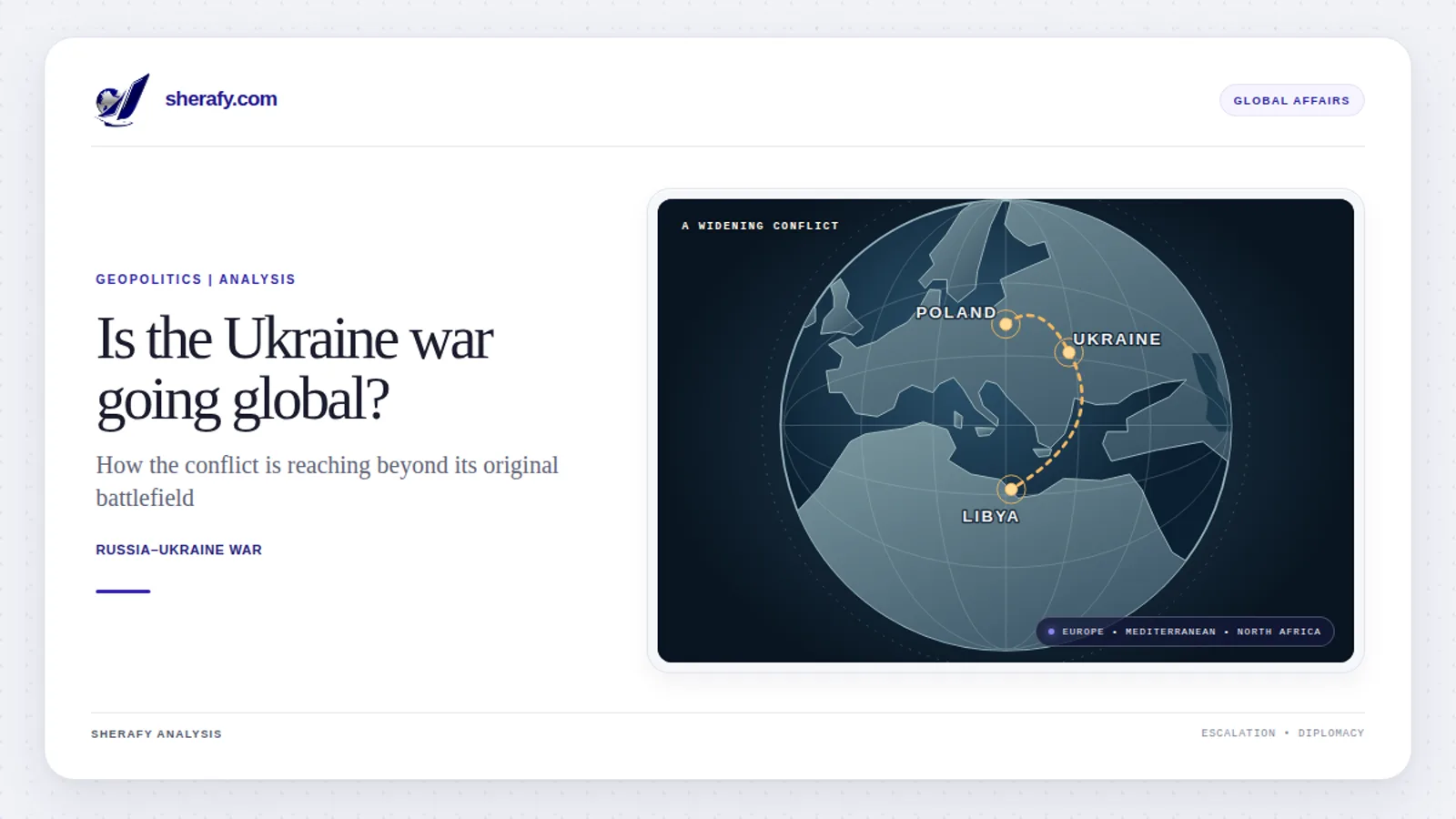
The Russia-Ukraine war is increasingly becoming an international conflict in its geographical reach, military participation and economic consequences. Russian missiles have landed in Poland, Ukrainian forces have attacked Russian vessels in Libya, British military officials have acknowledged offensive cyber operations against Russia and other countries, and European governments are preparing for potential military deployments to Ukraine.
On November 25, 2026, Libyan military authorities announced that two of their naval officers had died from injuries sustained during a Ukrainian attack on a Russian warship in Benghazi. Libya's eastern military leadership subsequently threatened retaliation against Ukraine.
These developments come despite renewed American-mediated peace negotiations and a November 19 declaration by U.S. President Donald Trump, Russian President Vladimir Putin and Chinese President Xi Jinping committing themselves to international security and strategic stability.
Has World War III begun? No. Is the Russia-Ukraine war creating conditions that could lead to a substantially wider international conflict? Increasingly, yes.
Understanding the danger requires distinguishing geographical expansion from direct military participation, defensive preparations from offensive intentions, diplomatic declarations from enforceable agreements, and legitimate self-defense from military operations that may violate international law.
It also requires examining whether the governments involved have a realistic strategy for ending the war, rather than simply improving their position within it.
What Is Happening in the Russia-Ukraine War?
The internationalization of the war did not begin in November 2026. Foreign military assistance, sanctions, intelligence sharing, overseas military procurement and the involvement of North Korean personnel have progressively expanded the conflict's international dimensions.
However, the developments of November 2026 demonstrate how rapidly military escalation can occur alongside diplomatic negotiations.
| Date | Development | Significance |
|---|---|---|
| November 3 | Britain announces multinational military exercises in Poland | European governments prepare for a potential postwar deployment to Ukraine |
| November 10–11 | Russia, Ukraine and the United States hold negotiations in Abu Dhabi | First direct Russian-Ukrainian negotiations in approximately nine months |
| November 12–13 | American negotiators meet Putin and Zelensky separately | Significant disagreements remain over territory and security guarantees |
| November 16–19 | Ukraine attacks the Kerch Strait Bridge connecting Russia and occupied Crimea | Putin threatens retaliation and rejects proposed limited military moratoriums |
| November 19 | Trump, Putin and Xi issue a declaration toward peace in Shenzhen | Major powers announce broad commitments without establishing a Ukrainian ceasefire |
| November 20 | Russian missiles land in Poland during a major assault on Ukraine | NATO territory is directly affected |
| November 20 | Denmark attributes an alleged assassination plot to Russian intelligence | Highlights the expansion of covert hostile activity across Europe |
| November 20 | Estonia announces the closure of road crossings with Russia | Security concerns increasingly affect civilian movement |
| November 20 | Britain's senior cyber commander acknowledges offensive cyber operations | Public confirmation of hostile activity below the threshold of conventional war |
| November 21 | A Russian military-linked cargo vessel is attacked in the Baltic Sea | Finland becomes involved in maritime rescue and security operations |
| November 22–23 | Ukraine attacks Russian vessels in and near Libya and acknowledges responsibility | The conflict extends further into North Africa |
| November 23 | NATO holds an emergency meeting at Poland's request | Allies strengthen defensive surveillance |
| November 25 | Libyan authorities report the deaths of two naval officers and threaten retaliation | A third country's military leadership threatens action against Ukraine |
The chronology establishes that diplomatic engagement and military escalation are occurring simultaneously. It does not establish that all these incidents are coordinated or that every country involved intends to enter a wider war.
The distinction is fundamental.
What Did Trump, Putin and Xi Agree to in Their Peace Declaration?
On November 19, 2026, the leaders of the United States, Russia and China met in Shenzhen and issued a joint declaration concerning international peace and security.
The original declaration published by the White House and the version published by the Chinese government contain four principal commitments.
| Subject | Stated commitment |
|---|---|
| United Nations | Reform the organization to improve its ability to address international challenges |
| Energy | Increase refined petroleum supplies and maintain stable energy flows |
| International criminal jurisdiction | Emphasize state consent and the immunity of state officials |
| Nuclear weapons | Conduct discussions aimed at reducing nuclear risks and preventing proliferation |
Neither Ukraine nor Iran is explicitly named in the declaration.
There is no agreement requiring Russia to withdraw from Ukraine, Ukraine to surrender territory, either country to cease military operations, or the United States to end its military confrontation with Iran.
There are also no specified implementation deadlines or enforcement mechanisms.
Consequently, the military escalation that followed the declaration did not constitute a demonstrated violation of a newly agreed Ukrainian ceasefire. No such ceasefire had been established.
The declaration is better understood as a statement of overlapping strategic interests among three major powers than as a comprehensive agreement to end ongoing wars.
Why the International Criminal Court provision matters
One of the declaration's most revealing provisions concerns international criminal jurisdiction and the immunity of government officials.
The United States, Russia and China are not parties to the Rome Statute of the International Criminal Court.
Their shared opposition to certain exercises of international criminal jurisdiction reflects an area of institutional agreement despite their broader geopolitical differences.
It is reasonable to interpret this provision as an effort by major powers to defend their preferred limits on international legal authority.
However, the declaration does not invalidate existing arrest warrants, amend the Rome Statute or independently establish new rules governing international criminal jurisdiction.
Is the nuclear commitment meaningful?
Potentially.
The commitment to nuclear-risk reduction comes amid renewed concerns about strategic competition and the expiration of the New START arms-control treaty in February 2026.
The Stockholm International Peace Research Institute's nuclear weapons assessment documents the continuing importance of American and Russian nuclear arsenals, alongside China's expanding capabilities.
Dialogue between these countries could reduce the risk of catastrophic miscalculation.
But expressing support for nuclear stability is not equivalent to negotiating an arms-control treaty, just as expressing support for peace is not equivalent to ending a conventional war.
The Shenzhen declaration may be diplomatically useful while remaining insufficient to resolve the immediate conflicts threatening international security.
Why Did Russian Missiles Land in Poland?
On November 20, Russian military projectiles entered Polish airspace during a major Russian aerial assault against Ukraine.
Initial reports described two missiles and a suspected drone. By November 23, Polish authorities had identified the objects as Russian cruise missiles.
According to the Polish government's account of the subsequent NATO meeting, Polish military and intelligence officials presented their investigative findings to allied representatives and requested additional security measures.
The incident occurred while European military forces were participating in exercises in Poland associated with preparations for a potential future deployment to Ukraine.
Polish Prime Minister Donald Tusk characterized the incident as a likely deliberate Russian provocation. President Trump publicly suggested that the projectiles had entered Poland accidentally.
These are competing assessments of Russian intent, not competing evidence about the established Russian origin of the missiles.
Did Russia deliberately attack Poland?
There is a credible basis for Polish suspicions.
The proximity of the incident to European military exercises, its timing and the broader pattern of Russian airspace violations are relevant circumstantial evidence.
The Institute for the Study of War's November 20 assessment interpreted the incident as a likely effort to discourage European military involvement in Ukraine and test NATO's response.
That interpretation is plausible, but it remains an analytical assessment.
The publicly available evidence does not conclusively establish whether Russia intended to strike Polish targets, deliberately violate Polish airspace as a warning, or experienced a failure during operations against Ukraine.
These possibilities have different implications.
An intentional airspace violation designed to intimidate NATO is dangerous. An intentional attack on Polish military or civilian targets would represent a substantially more serious escalation.
An accidental incursion would still expose Poland to the consequences of Russian military operations and demonstrate the risk of miscalculation.
None should be dismissed merely because the incident did not immediately produce a wider war.
Why Hasn't NATO Invoked Article 5 Against Russia?
One of the most common misconceptions about NATO is that any foreign military projectile entering a member country's territory automatically obligates every other NATO country to declare war.
That is not how the alliance works.
The North Atlantic Treaty establishes several mechanisms for responding to threats and attacks.
NATO Article 4 vs. Article 5
| Provision | Article 4 | Article 5 |
|---|---|---|
| Primary purpose | Security consultations | Collective defense |
| Threshold | A member considers its security, territorial integrity or political independence threatened | An armed attack covered by the treaty |
| Military action automatically required? | No | No specific form of military action is automatically required |
| Assistance obligation | Consultation | Allies must assist the attacked member |
| Automatic declaration of war? | No | No |
| Does Ukraine receive protection as a NATO member? | No | No |
Under Article 4, a member may request consultations when it considers its security threatened.
Under Article 5, allies recognize a qualifying armed attack against one member as an attack against all and are obligated to provide assistance. However, each ally determines the action it considers necessary, which may include military force.
NATO's official explanation of collective defense also makes clear that Article 5 is not an automatic mechanism activated by every security incident.
The circumstances of an incident, its nature and the affected government's position all matter.
Following the November 2026 incident, NATO held an extraordinary meeting and deployed additional airborne surveillance support to Poland. Article 5 had not been invoked as of November 25.
Russian and Ukrainian projectiles have entered Poland before
In November 2022, an explosion in eastern Poland prompted fears of direct NATO-Russia confrontation.
NATO's preliminary assessment indicated that the incident was likely caused by a Ukrainian air-defense missile fired in response to Russian attacks.
In September 2025, Poland requested Article 4 consultations following Russian airspace violations.
The November 2026 incident differs from the 2022 incident because Polish investigators identified the projectiles as Russian missiles.
Nevertheless, the treaty does not require NATO to respond identically to every incident. Defensive reinforcement, investigation, diplomatic pressure and collective military action represent different possible responses.
The absence of an Article 5 invocation does not mean NATO considers the incident harmless. It means the alliance has not chosen to treat it as requiring that particular collective-defense response.
Is Europe Preparing to Go to War With Russia?
European military preparations have become increasingly visible, prompting concerns that NATO countries are preparing for a direct confrontation with Russia.
However, three separate organizations and initiatives are frequently conflated:
- NATO itself.
- The British- and French-led Coalition of the Willing.
- The Multinational Force-Ukraine, the coalition's military component.
According to the British Ministry of Defence, the Coalition of the Willing was established in March 2025 and comprises 35 countries. As of November 3, 2026, its multinational military force had secured commitments from 24 countries.
The proposed force is not formally a NATO operation. Nor is it classified by Britain as a traditional peacekeeping or ceasefire-monitoring mission.
Its stated purpose is to strengthen Ukraine's military capabilities after hostilities have ended, deter future aggression and support the restoration of economic activity.
Deployment would require Ukraine's invitation and the fulfillment of necessary political and military conditions.
This is more substantial than a symbolic peacekeeping arrangement. It represents preparation for a foreign military presence that could significantly affect the future European security environment.
Russia opposes such a deployment.
The security dilemma
Political scientists use the term security dilemma to describe a situation in which measures taken by one government to improve its security make another government feel less secure.
The process can become self-reinforcing:
- One country perceives a military threat and strengthens its defenses.
- Another country interprets those preparations as potentially offensive.
- The second country increases its military capabilities.
- The first country sees that response as confirmation of its original concerns.
- Both countries become increasingly militarized.
Each government may believe its actions are defensive, yet their combined behavior can increase the probability of confrontation.
This does not mean every government is equally responsible for creating the situation. Nor does it mean defensive preparation is inherently unnecessary.
Russia's invasion gives neighboring European countries legitimate reasons to strengthen their defenses. At the same time, the possibility that military preparations will be interpreted as threatening cannot simply be ignored.
European leaders face a difficult challenge: developing sufficient military capability to deter an attack without creating an uncontrolled escalation cycle.
Russia's stated security concerns deserve examination, but they do not erase the security concerns of the countries Russia has invaded or threatened.
Military preparedness is not proof of an intention to start a war. It is also not a substitute for diplomacy.
Why Is Ukraine Attacking Russian Ships in Libya?
On November 22, Ukrainian forces attacked Russian vessels in and around Benghazi, a major Mediterranean port in eastern Libya.
The principal targets were the Russian naval corvette Merkury and the cargo vessel Angara.
President Volodymyr Zelensky acknowledged Ukrainian responsibility in his November 23 presidential address, describing the operation as a legitimate response to Russian aggression.
Independent satellite imagery analysis published by The National supports the sinking of the Merkury and confirms damage associated with the operation.
The Angara was also struck, but the available evidence does not establish that both vessels sank.
Ukraine claims the cargo ship was transporting weapons for Russia. Its military-linked history is relevant, but the precise cargo and operational purpose of the voyage require independent verification.
The attack demonstrates Ukraine's willingness and ability to pursue Russian military interests beyond the immediate European battlefield.
Why does Russia have military forces in Libya?
Libya has become an important component of Russia's military presence in Africa.
Following the overthrow of Muammar Gaddafi in 2011 and subsequent civil conflicts, Libya developed rival political and military authorities.
Broadly, the country remains divided between the Government of National Unity in western Libya and an eastern political and military establishment associated with Khalifa Haftar and the Libyan National Army.
The division is considerably more complicated than a simple conflict between Western-backed and Russian-backed governments.
Turkey, Egypt, the United Arab Emirates, Russia and other foreign powers maintain overlapping interests and relationships with Libyan actors.
The Congressional Research Service's overview of Russian security operations in Africa identifies Libya as one of the important centers of Russian military activity on the continent.
Russia's presence provides geopolitical influence, access to the Mediterranean and logistical support for activities elsewhere in Africa.
Reporting by Le Monde further examines Libya's role in Russia's African military network.
From Ukraine's perspective, attacks against Russian military assets abroad may weaken Russian capabilities, disrupt overseas logistics and increase the broader costs of continuing the war.
However, Russia's presence in Libya does not make Libya itself an enemy country.
That distinction has now become particularly consequential.
Libya's military leadership threatens retaliation against Ukraine
On November 25, the Associated Press reported that two Libyan naval officers had died from injuries sustained during the Ukrainian attack.
The eastern-based Libyan National Army subsequently threatened retaliation against Kyiv.
Ukraine previously maintained that Libyans were not the intended targets of the operation.
Nevertheless, the deaths create a new political and military dispute between Ukraine and a powerful Libyan military authority.
The United Nations Support Mission in Libya had already called for an independent investigation and warned against turning Libya into a battlefield for foreign conflicts.
It also emphasized the importance of respecting Libya's sovereignty and protecting its population.
Libya's interests deserve consideration independently of those of Russia, Ukraine or their foreign supporters.
Libyans are not merely inhabitants of a convenient location in which foreign governments can conduct military operations against one another.
Can Ukraine Legally Attack Russian Military Assets in Other Countries?
A country's right to defend itself is not necessarily limited to military operations within its own territory.
However, it does not follow that a country may lawfully attack its enemy wherever that enemy happens to be located.
International law distinguishes several different questions.
| Legal principle | Relevant question |
|---|---|
| Right of self-defense | Is the state's use of military force justified? |
| Military necessity and distinction | Is the specific object or person a lawful military target? |
| Proportionality | Would expected civilian harm be excessive relative to the anticipated military advantage? |
| Precautions | Were feasible measures taken to minimize civilian harm? |
| Territorial sovereignty | Did the operation unlawfully violate another state's territory? |
| Maritime neutrality | What restrictions apply to hostilities in neutral waters? |
The United Nations Charter recognizes the inherent right of individual and collective self-defense while establishing restrictions on the use of force against other states.
International humanitarian law separately regulates how hostilities may be conducted.
These bodies of law operate together, but they answer different questions.
A government exercising a legitimate right of self-defense can still conduct an unlawful military operation.
Attacking a Russian warship in Libya is not the same as attacking one in Russian waters
A Russian naval warship will generally qualify as a military objective during an international armed conflict involving Russia.
However, the location of the warship introduces additional legal considerations.
The San Remo Manual on International Law Applicable to Armed Conflicts at Sea outlines restrictions on hostile military activities in neutral waters.
Although the manual is an influential expert restatement rather than a binding international treaty, it provides an important framework for examining such operations.
A legal assessment of the Libya attack would need to consider the vessels' status, the applicable maritime jurisdiction, Libya's political and legal circumstances, any relevant consent, and the consequences for people and property belonging to the third country.
The legality of attacking a merchant vessel also requires a separate assessment of its military contribution. A vessel's nationality, ownership or sanctioned status alone does not automatically establish that it is a lawful military target.
Ukraine's assertion that its operation was lawful is therefore not sufficient to resolve the question.
Nor does the presence of Russian military assets automatically establish that Libya has become a party to Russia's war against Ukraine.
An object can be a legitimate military target without every attack against that object being lawful.
This principle applies equally to Russian operations.
Was Ukraine's Attack on the Kerch Bridge Justified?
The Kerch Strait Bridge, also known as the Crimean Bridge, connects the Russian mainland with the Crimean Peninsula.
Russia annexed Crimea in 2014 following a referendum whose validity was rejected by the United Nations General Assembly in Resolution 68/262 on Ukraine's territorial integrity.
The bridge has considerable economic, logistical, political and symbolic importance.
Ukraine has repeatedly described it as part of Russia's military logistics network. Putin maintains that it serves civilian purposes and has denied that it was being used to transport military equipment.
Following Ukrainian attacks in November 2026, Putin threatened substantial retaliation and announced that Russia would no longer consider proposed moratoriums covering maritime and energy-sector attacks, according to Reuters' reporting of his November 19 remarks.
Can civilian infrastructure also be a military target?
Yes, under certain circumstances.
The Geneva Conventions' Additional Protocol I, Article 52 establishes the criteria for identifying military objectives.
An object must make an effective contribution to military action, and its destruction, capture or neutralization must offer a definite military advantage under the circumstances.
Bridges, roads, communications facilities and other infrastructure may serve both civilian and military functions.
However, identifying an object as a military objective does not remove the obligations concerning civilian protection, proportionality and precautions under Article 51 and Article 57.
The same considerations apply to Russian attacks against bridges and other infrastructure in Kyiv.
A military operation is not automatically lawful because its government describes it as retaliation.
The relevant legal standards do not change depending on which country's flag is attached to the attacking force.
Did the Kerch Bridge attack destroy an opportunity for peace?
Putin explicitly connected Ukraine's bridge attacks to his decision not to pursue certain limited military agreements.
That establishes a documented diplomatic consequence.
It does not establish that Russia and Ukraine were previously on the verge of a comprehensive peace agreement.
Fundamental disagreements over territory, military capabilities, security guarantees and the future of Ukraine existed before the attacks.
It is reasonable to examine whether Ukrainian military operations weakened the prospects for specific agreements. It is not reasonable to conclude, solely from Putin's explanation, that Ukraine destroyed an otherwise achievable peace settlement.
Are Britain and Russia Already at War?
On November 20, British military commander General Sir Rob Magowan publicly acknowledged that Britain was conducting offensive cyber operations against Russia, China, Iran and North Korea.
His interview with Sky News represents an unusually explicit acknowledgment of hostile cyber activity against several geopolitical adversaries.
However, British offensive cyber capabilities and operations were publicly acknowledged before this interview.
In April 2023, the British government released Responsible Cyber Power in Practice, explaining the role and operating principles of its National Cyber Force.
The November 2026 interview therefore provides greater public specificity concerning Britain's adversaries. It does not establish that these operations began recently.
What is hybrid warfare?
Hybrid warfare broadly describes the use of conventional and unconventional methods to achieve strategic objectives, often while avoiding open military confrontation.
These methods may include cyber operations, espionage, sabotage, disinformation, political interference, economic coercion and covert military activity.
Not every hostile cyber operation constitutes an armed attack under international law.
Its legal classification depends partly on its nature, scale and consequences.
A cyber operation causing severe physical destruction may raise substantially different legal questions from one involving intelligence collection or temporary disruption.
NATO recognizes that particularly serious cyberattacks can potentially trigger collective defense.
Britain has not disclosed sufficient details about its current offensive operations to determine whether individual activities cross that threshold.
The existence of offensive cyber operations therefore establishes hostile confrontation, but not necessarily a conventional state of war between Britain and Russia.
Why Did Denmark Accuse Russia of an Assassination Plot?
On November 20, the Danish Security and Intelligence Service publicly attributed an alleged assassination attempt against a Ukrainian-American citizen to Russian intelligence.
The Danish investigation concerned an earlier incident that authorities said they had prevented.
The assessment described the alleged use of criminal networks to conduct an operation on Danish territory.
This is a serious allegation supported by an official intelligence investigation. However, the intelligence service's public attribution should not be confused with a final judicial determination of criminal responsibility.
If substantiated, the operation would illustrate how governments can attempt to pursue hostile objectives inside other countries without deploying conventional military forces.
Such activities also complicate diplomatic relations because they expose foreign populations to the consequences of conflicts in which their governments may not be direct military participants.
Why Is Estonia Closing Its Border With Russia?
The Estonian government announced on November 20 that it would suspend road-border crossings with Russia beginning December 1, 2026.
The decision covers all five road crossings. Restricted rail freight can continue under the existing arrangements.
Estonia cited security concerns associated with Russia's hostile activities.
The measure is therefore a significant restriction, but describing it as the closure of every possible border connection is imprecise.
It also illustrates how geopolitical confrontation affects people far removed from the battlefield.
Families separated by borders, commercial operators and civilians with personal connections in neighboring countries can experience substantial consequences without being involved in military activities themselves.
How Are Finland, Iran and North Korea Connected to the Ukraine War?
The events in Poland and Libya are part of a wider pattern of international involvement.
However, the nature of that involvement differs substantially by country.
Finland and the Baltic Sea
On November 21, a Russian cargo vessel with reported military connections, the Sparta II, was attacked in the Baltic Sea.
According to Reuters' reporting, Finnish authorities considered Ukraine the likely party responsible.
The vessel was attacked outside Finnish territorial waters and subsequently drifted into them.
Finland became involved in the resulting maritime emergency.
This distinction matters because an attack in international waters followed by a maritime rescue operation does not automatically constitute an attack against Finland.
Nevertheless, the incident illustrates how military operations can impose security, environmental and humanitarian obligations on neighboring states.
Iran and the Caspian Sea
In July 2026, Iran condemned a Ukrainian attack on an Iranian commercial vessel in the Caspian Sea.
Ukraine alleged that the vessel was involved in military transportation between Iran and Russia.
Reuters' contemporaneous reporting and Deutsche Welle's subsequent analysis describe the emerging intersection between the conflicts involving Iran and Ukraine.
These connections are strategically important.
However, the evidence does not establish that Ukraine conducted the operation specifically to draw the United States, Israel and Iran into a unified war against Russia.
Military cooperation, overlapping adversaries and geographically intersecting operations do not necessarily establish a coordinated global conflict.
North Korean military involvement
In October 2024, NATO publicly confirmed the deployment of North Korean military units to Russia.
Direct participation by foreign military personnel is distinct from supplying military equipment, providing intelligence or imposing sanctions.
North Korea's involvement demonstrates that the Ukraine war had acquired a significant international military dimension well before the November 2026 escalation.
It is therefore inaccurate to suggest that the war was previously confined entirely to Russia and Ukraine.
Was NATO Expansion Responsible for the Ukraine War?
Russia has consistently argued that NATO expansion and Western military influence in Ukraine threatened its security.
Those concerns predate the full-scale invasion of February 2022.
A British parliamentary briefing published before the invasion documents Russia's demands for changes to European security arrangements, including restrictions on NATO's future expansion and military presence.
It would be historically inaccurate to dismiss Russia's NATO-related grievances as having been invented entirely after the invasion.
However, recognizing a government's security concerns does not establish that its response was legally justified, strategically necessary or motivated exclusively by those concerns.
Ukraine has its own security interests, including the right to exercise political independence and determine its foreign relationships.
Russia's invasion also strengthened the very security concerns that encourage neighboring countries to seek NATO protection.
Finland and Sweden subsequently joined the alliance.
This is an important illustration of how military action intended to address a perceived security threat can produce geopolitical consequences that intensify that threat.
Russia's objections to NATO expansion deserve serious analysis. They do not provide a legal entitlement to invade neighboring countries or acquire their territory by force.
Who Is Preventing Peace in Ukraine?
The most consequential question is not which leader claims to want peace. Nearly every government involved claims to support peace under some conditions.
The relevant question is whether their conditions are compatible.
On November 10 and 11, American, Russian and Ukrainian negotiators met in Abu Dhabi. American representatives subsequently held separate discussions with Putin in Moscow and Zelensky in Dublin.
According to the House of Commons Library's November 23 research briefing, the negotiations produced progress concerning a proposed prisoner exchange but did not resolve the principal disagreements over territory and security guarantees.
What Russia and Ukraine want from a peace agreement
| Issue | Russia's documented position | Ukraine's documented position |
|---|---|---|
| Territory | Seeks recognition or acceptance of territorial gains and further territorial concessions | Rejects imposed territorial surrender and seeks preservation of sovereignty |
| NATO membership | Opposes Ukrainian membership | Seeks credible external security guarantees and retains NATO aspirations |
| Ukrainian military | Seeks limitations on Ukrainian military capabilities | Opposes restrictions that would leave Ukraine vulnerable |
| Foreign forces | Opposes Western military deployments in Ukraine | Supports external military assistance and security arrangements |
| Ceasefire | Has resisted an unconditional general ceasefire without broader agreements | Has called for a ceasefire to facilitate negotiations |
| European security | Seeks broader changes to NATO-related security arrangements | Opposes allowing those broader demands to displace negotiations over Ukraine |
These are summaries of documented positions, not exhaustive final treaty proposals.
The disagreement concerns much more than the location of a future border.
It concerns whether postwar Ukraine would be militarily independent, politically aligned with Western institutions, protected by outside powers or subject to restrictions intended to satisfy Russian security demands.
Why security guarantees are so difficult to negotiate
Ukraine fears that a ceasefire without credible security guarantees would allow Russia to rebuild its military capabilities and resume hostilities later.
Russia argues that a heavily armed Ukraine protected by Western military commitments would perpetuate the security problems Moscow claims helped cause the war.
This creates a fundamental contradiction.
The arrangements that Ukraine considers necessary to prevent another invasion are among the arrangements Russia considers unacceptable.
For further context, the November 23 Institute for the Study of War assessment examines Russian objections to proposed Article 5-style security guarantees for Ukraine.
Any durable settlement must confront this disagreement rather than simply announce that both governments should negotiate.
Is Zelensky refusing peace?
There is insufficient evidence to conclude that Zelensky has rejected an otherwise mutually acceptable and enforceable peace settlement.
He has rejected specific territorial concessions and military restrictions. Those decisions can be debated, particularly given the human costs of continued warfare.
However, rejecting particular peace terms is not the same as rejecting peace itself.
Similarly, Putin's participation in negotiations does not independently establish that Russia is willing to accept a settlement compatible with Ukrainian sovereignty.
The strongest available evidence indicates that the governments remain divided over the substance of a settlement, not simply whether negotiations should take place.
Russia bears responsibility for launching the full-scale invasion. That responsibility does not make every subsequent Ukrainian military or diplomatic decision immune from criticism.
The evidence must support each judgment independently.
Do Ukrainians Actually Want the War to Continue?
Ukrainian public opinion has changed considerably since the full-scale invasion.
The majority of surveyed Ukrainians now favor negotiations, but that finding is frequently interpreted without examining what Ukrainians are willing to concede.
How Ukrainian public opinion has changed
Gallup's 2026 survey of Ukrainian attitudes documents a substantial reversal since 2022.
| Survey year | Favor negotiating an end to the war | Favor continuing until victory |
|---|---|---|
| 2022 | 22% | 73% |
| 2023 | 27% | 63% |
| 2024 | 52% | 38% |
| 2025 | 69% | 24% |
| 2026 | 66% | 24% |
Remaining respondents were undecided or did not provide an answer.
The trend is clear: support for seeking a negotiated end has increased dramatically.
But the question becomes more complicated when respondents are presented with specific peace conditions.
What peace terms would Ukrainians accept?
The Kyiv International Institute of Sociology conducted separate surveys in September 2026 and October 2026.
| Survey finding | Percentage |
|---|---|
| Open to negotiating with Russia immediately | 75% |
| Reject surrendering all of Donbas in exchange for security guarantees | 61% |
| Willing to accept that territorial concession | 35% |
| Prepared to endure the war for as long as necessary | 62% |
These percentages come from different questions and should not be interpreted as mutually exclusive groups.
The October survey interviewed 1,031 adults in government-controlled Ukrainian territory. Its coverage excluded people living in occupied areas and citizens who had left Ukraine following the full-scale invasion.
Wartime polling also presents methodological challenges that may affect representativeness.
Nevertheless, the findings reveal an important distinction.
Many Ukrainians want negotiations and an end to the war while remaining unwilling to accept some of Russia's territorial demands.
Wanting peace is not necessarily the same as accepting the terms offered by the opposing government.
Is Zelensky unpopular in Ukraine?
The October 2026 KIIS presidential trust survey found that 54% of respondents trusted Zelensky, compared with 41% who did not.
That represents a divided political environment, not overwhelming public rejection.
Trust is also distinct from electoral voting intention, approval of individual policies and support for continuing the war.
Claims about the government's popularity should identify the specific measure being used.
Why hasn't Ukraine held presidential elections?
Ukraine's martial-law legislation prohibits presidential and parliamentary elections while martial law remains in effect.
The Ukrainian parliament has established a working group to address the legal and practical challenges surrounding future elections.
The absence of elections raises legitimate questions about democratic accountability, emergency powers and the conditions under which normal political competition can resume.
However, describing it simply as Zelensky's personal decision to cancel elections omits the statutory framework.
The practical challenges also include military participation, displaced voters, refugees abroad and residents of occupied territories.
Is Ukraine running out of soldiers?
Ukraine faces significant manpower and recruitment pressures after years of warfare.
These pressures are relevant when evaluating the feasibility of continued military operations and the potential costs of rejecting proposed settlements.
However, claims that women are only now being brought into the Ukrainian military are misleading. Ukrainian women have served voluntarily for years, and compulsory military registration requirements for certain professions are distinct from compulsory mobilization.
Reliable comparisons of military manpower, desertion and battlefield losses remain difficult because the governments involved have strategic incentives to conceal or selectively disclose military information.
The existence of recruitment problems is important evidence. It is not, by itself, proof that military collapse is imminent.
Is Ukraine Losing the War?
The answer depends partly on how military success is defined.
Russia controls a substantial portion of internationally recognized Ukrainian territory. Ukraine has not achieved the complete territorial restoration it seeks.
At the same time, recent Russian territorial gains have been comparatively limited relative to the scale of the war.
The Russia Matters November 24, 2026 War Report Card, using DeepState battlefield mapping data, provides the following estimates.
| Territorial measure | Estimate |
|---|---|
| Ukrainian territory currently controlled by Russia | Approximately 19% |
| Net territory gained by Russia since February 2022 | Approximately 12% of Ukraine |
| Net Russian territorial gains over the preceding year | Approximately 606 square miles |
| Annual gains as a share of Ukraine's internationally recognized territory | Approximately 0.3% |
The total occupied territory includes Crimea and parts of Donbas seized before the full-scale invasion.
Battlefield mapping involves uncertainty, and different organizations may use different definitions of territorial control.
Nevertheless, these figures reveal why two apparently contradictory statements can both be true:
Russia occupies a substantial portion of Ukraine, but its recent net territorial advances have been relatively slow.
Neither an imminent Russian victory nor an imminent Ukrainian reconquest of all occupied territory is established by the territorial data alone.
Military sustainability also depends on manpower, equipment, economic capacity, industrial production, external assistance and political willingness to continue fighting.
For a more detailed analysis of military outcomes and territorial negotiations, see our investigation, Has Ukraine Lost the War? Putin's Peace Talks Explained.
The humanitarian situation is worsening
A relatively stagnant battlefield does not necessarily mean that the war is becoming less destructive.
The United Nations Human Rights Monitoring Mission in Ukraine has documented worsening civilian harm and increasing disruption to essential infrastructure.
| January through October | Verified civilian deaths | Verified civilian injuries | Combined casualties |
|---|---|---|---|
| 2024 | 1,805 | 7,704 | 9,509 |
| 2025 | 2,127 | 10,254 | 12,381 |
| 2026 | 2,957 | 17,218 | 20,175 |
The combined number of verified civilian deaths and injuries increased by approximately 63% between the first ten months of 2025 and the corresponding period of 2026.
These figures represent verified cases, not necessarily the full extent of civilian harm. The United Nations has limited access to certain affected areas, and military casualty figures are separate.
Attacks affecting electricity, heating and water infrastructure also impose consequences on people who do not appear in casualty statistics.
This is one of the most important realities of a prolonged war: the battlefield may move relatively little while the human cost continues to accumulate.
Is Western Military Aid Prolonging the Ukraine War?
The United States and European governments have provided substantial assistance to Ukraine since the full-scale invasion.
However, broad claims about hundreds of billions of dollars being sent to Ukraine frequently combine fundamentally different categories of expenditure.
These may include military equipment, weapons procurement, grants, loans, humanitarian assistance, civilian budget support, refugee-related expenses inside donor countries and future funding commitments.
A pledged amount is not necessarily an amount already delivered. Domestic spending associated with the war is not necessarily money transferred to Ukraine.
Is aid to Ukraine still increasing?
According to the Kiel Institute's November 2026 analysis:
| Assistance measure | Reported change |
|---|---|
| Military aid allocations during the first ten months of 2026 compared with 2025 | Down approximately 18% |
| Projected budget support for 2026 | Down approximately 25% |
| EU institutions' projected share of foreign budget support | More than 60% |
The available evidence does not support the characterization of foreign assistance as an unlimited and continuously increasing financial commitment.
Instead, Ukraine faces substantial pressure arising from declining assistance and uncertainty over future financing.
How much of the money actually reaches Ukraine?
An October 2026 Kiel Institute analysis of Germany's reported €100 billion in assistance illustrates the importance of distinguishing expenditure categories.
| Category | Amount |
|---|---|
| Bilateral assistance to Ukraine | €41.7 billion |
| Spending within Germany | €35.9 billion |
| Future military commitments | €22 billion |
The categories are rounded and do not total exactly €100 billion.
This does not mean that domestic refugee assistance or future commitments have no value. It means they should not be represented as money already transferred directly to Ukraine.
Would ending military assistance end the war?
Possibly, but the consequences cannot be established with certainty.
Reducing assistance could pressure Ukraine to accept concessions and accelerate negotiations.
It could also enable further Russian territorial advances, encourage Moscow to demand additional concessions or leave Ukraine less capable of defending itself against renewed attacks.
Continued military assistance could strengthen Ukraine's negotiating position.
It could also sustain a prolonged conflict without producing a realistic pathway toward a decisive military outcome.
Both are plausible causal mechanisms. Neither proves the counterfactual outcome.
The more productive policy question is whether assistance is accompanied by clearly defined, achievable political and military objectives.
Military expenditure should be evaluated not simply by how much equipment it provides, but by whether it contributes to an attainable and sustainable outcome.
What about Western weapons reaching far-right groups?
Concerns about weapons accountability should also be examined independently.
The historical far-right origins of Ukraine's Azov movement are documented. The contemporary Azov Brigade's organizational status and the eligibility of its personnel to receive foreign assistance involve separate questions.
In 2024, the United States lifted restrictions on assistance to the brigade following a State Department review under the Leahy framework.
That decision does not erase the movement's history. Equally, the movement's history does not establish that the entirety of Ukraine's government, military or population shares its ideology.
Evidence concerning weapons diversion, extremist activity and human rights violations should be investigated on its own merits rather than used as a substitute for analysis of the war itself.
What Would Actually Trigger World War III?
There is no universally recognized legal threshold at which a conflict becomes a world war.
The term is principally a historical and political classification.
The number of countries affected by a conflict is not sufficient to determine whether it constitutes a world war.
A war can produce worldwide economic consequences, involve international military assistance and extend into multiple geographical regions without becoming a unified war between major powers.
The following framework distinguishes the dimensions of international escalation.
A framework for understanding global military escalation
| Dimension | Meaning | Current assessment |
|---|---|---|
| Regional armed conflict | Direct warfare between Russia and Ukraine | Established |
| International material involvement | Foreign weapons, financing, training, sanctions and intelligence assistance | Established |
| Additional foreign military participation | Military personnel from other countries directly participating in hostilities | Documented |
| Geographical expansion | Military operations extending into third countries and distant maritime areas | Documented |
| Hybrid confrontation | Cyber operations, sabotage, intelligence activity and other hostile actions outside conventional war | Documented |
| Sustained Russia-NATO conventional combat | Direct and continuing military confrontation between Russia and NATO member forces | Not established |
| Unified multi-theater great-power war | Major powers engaged in interconnected direct military conflicts across several regions | Not established |
This is a descriptive analytical framework developed by sherafy.com, not an official military classification or a numerical prediction.
These dimensions do not necessarily develop in a fixed sequence.
A conflict can expand geographically without producing direct great-power warfare. Hybrid confrontation can intensify while conventional escalation is restrained. Governments can also reverse escalation through diplomacy and negotiated agreements.
How close are we to World War III?
There is no defensible percentage probability that can be calculated from the November incidents alone.
Anyone presenting an exact numerical probability without a transparent forecasting methodology, clearly defined event and specified time horizon is offering a level of precision the evidence cannot support.
The danger can nevertheless be evaluated qualitatively. For a broader look at military warning signs, see Is World War III About to Start?.
The principal concerns are the increasing geographical reach of military operations, the growing number of governments affected by them, the possibility of misattributing attacks, deteriorating diplomatic relationships and the potential for retaliation to generate additional conflicts.
The Libyan response illustrates this particularly clearly.
Ukraine attacked Russian assets. Libyan military personnel subsequently died. A Libyan military authority then threatened retaliation against Ukraine.
The original conflict has thereby created a separate dispute involving another country's military establishment.
This is one mechanism by which a regional war can acquire additional international dimensions without any government necessarily intending to start a world war.
Could the United States Be Pulled Into a War With Russia?
Yes, but American involvement is not automatic simply because Russia conducts military operations near NATO territory.
The United States is a NATO member and has collective-defense obligations under the North Atlantic Treaty.
A qualifying armed attack against a NATO ally could trigger those obligations. The nature of the American response would depend on the circumstances and decisions made through applicable alliance and domestic processes.
Ukraine, however, is not a NATO member.
American military assistance to Ukraine does not itself establish that the United States is engaged in conventional armed conflict with Russia.
Likewise, intelligence sharing, financial assistance and economic sanctions do not automatically create the same legal or military relationship as direct combat.
The danger lies in the possibility that military confrontation could develop through escalation, miscalculation or deliberate decisions, rather than through an automatic treaty mechanism.
Are the Wars in Ukraine and Iran Becoming One Global Conflict?
The conflicts increasingly intersect through military procurement, diplomatic relationships, energy markets, international sanctions and overlapping strategic interests.
Iran's military relationship with Russia, American military involvement in the Middle East and Ukrainian operations affecting Iranian-linked shipping demonstrate that the confrontations are not entirely isolated.
However, these connections do not establish a unified military command structure, a single coordinated global war strategy or sustained direct warfare among all major opposing powers.
It is more accurate to describe the present situation as several interconnected conflicts operating within an increasingly confrontational international system.
The distinction is important because it identifies both the danger and the remaining opportunities for containment.
A government may be able to reduce tensions in one confrontation without resolving every other international dispute simultaneously.
What Could Prevent a Wider War?
A comprehensive peace settlement remains difficult because Russia and Ukraine disagree over territory, sovereignty, military capabilities and future security arrangements.
However, reducing the danger of international escalation does not necessarily require resolving every disagreement at once.
Several forms of limited cooperation remain possible.
| Measure | Potential benefit |
|---|---|
| Localized humanitarian ceasefires | Allow civilian evacuations and delivery of essential supplies |
| Prisoner exchanges | Reduce human suffering and maintain channels of communication |
| Agreements protecting energy infrastructure | Limit disruption to electricity, heating and water |
| Maritime deconfliction arrangements | Reduce risks to commercial shipping and third countries |
| Transparent investigations of cross-border incidents | Reduce misattribution and unnecessary retaliation |
| Military communication channels | Reduce the possibility of accidental confrontation |
| Enforceable security guarantees | Address concerns about renewed aggression after a ceasefire |
| Nuclear arms-control negotiations | Reduce the risk of strategic miscalculation |
Limited agreements are not merely theoretical.
In October 2026, Russia and Ukraine agreed to a temporary localized humanitarian ceasefire in Oleshky, facilitated through American diplomatic efforts. Reuters documented the agreement, which enabled humanitarian assistance and civilian evacuation arrangements.
The November negotiations also produced an agreement in principle concerning another prisoner exchange.
These achievements are limited relative to the scale of the war. But they demonstrate that practical cooperation can occur even when a comprehensive settlement remains unavailable.
The challenge is to build upon such arrangements rather than treating every diplomatic setback as justification for abandoning them entirely.
The Bottom Line: A War Without a Geographical Boundary or an Agreed Endgame
The Russia-Ukraine war has become extensively internationalized. Its military, economic, political and humanitarian consequences now extend across Europe, North Africa, the Middle East and other regions.
Russia's invasion initiated the full-scale conflict. Ukraine has a legitimate right to defend itself. European governments have legitimate reasons to fear further Russian aggression.
None of those facts eliminates the obligation to examine whether individual military operations are lawful, whether particular escalation decisions are strategically beneficial, or whether governments are pursuing realistic conditions for peace.
The evidence does not establish that World War III has already begun.
It does establish that additional governments and populations are increasingly being exposed to the consequences of a war they did not initiate.
The deaths of Libyan military personnel, the missile incidents in Poland, the expansion of maritime hostilities and the public acknowledgment of offensive cyber operations demonstrate that the conflict's geographical and political boundaries are becoming less reliable.
Meanwhile, recent negotiations have not resolved the fundamental disagreements preventing peace.
Continuing to fight is not necessarily a strategy for winning. Continuing to negotiate is not necessarily a strategy for ending a war. Both must be evaluated against achievable objectives and the consequences imposed on ordinary people.
The international community should be able to recognize Russia's responsibility for the invasion, Ukraine's right to defend itself and the dangers of uncontrolled escalation simultaneously.
The question is no longer simply whether the war in Ukraine will end. It is whether it can end before it creates additional wars that require negotiations of their own.
Frequently Asked Questions
Has World War III started in 2026?
There is insufficient evidence to conclude that World War III has started. Several conflicts are increasingly interconnected, and the Russia-Ukraine war has expanded internationally, but sustained direct warfare between the major opposing powers has not been established.
Did Russia attack Poland in November 2026?
Russian missiles landed in Poland on November 20, 2026. Polish authorities identified their Russian origin, but whether Russia deliberately targeted Poland, intended a threatening airspace violation or experienced a military failure remains a separate evidentiary question.
Why hasn't NATO invoked Article 5?
Article 5 is not automatically triggered by every violation of NATO airspace. Allies assess the circumstances and whether the incident constitutes a qualifying armed attack. NATO responded to the November Polish incident with consultations and increased defensive surveillance.
Did Ukraine sink Russian ships in Libya?
Ukraine acknowledged attacking the Russian naval corvette Merkury and cargo vessel Angara. Independent imagery supports the sinking of the Merkury, but the sinking of both vessels has not been established.
Is Libya going to war with Ukraine?
Libya's eastern military leadership has threatened retaliation following the deaths of two Libyan naval officers. This is a significant escalation, but a threat of retaliation does not establish that Libya as a whole has entered an armed conflict with Ukraine.
Can Ukraine legally attack Russian ships anywhere?
No. Ukraine's right to self-defense does not provide unlimited authority to attack Russian assets in every jurisdiction. Military-objective status, territorial sovereignty, maritime neutrality, proportionality and civilian protection must all be considered.
Did Trump, Putin and Xi agree to end the Ukraine war?
No. Their November 19, 2026 declaration establishes broad commitments concerning international security, United Nations reform, energy supplies, international criminal jurisdiction and nuclear-risk reduction. It does not establish a Ukrainian ceasefire or peace settlement.
Do most Ukrainians want peace negotiations?
Yes. Gallup and KIIS polling indicate substantial majority support for negotiations. However, many Ukrainians also oppose territorial concessions demanded by Russia.
Is Europe preparing to invade Russia?
The available evidence does not establish that Europe is preparing to invade Russia. European governments are strengthening military readiness and developing plans for a potential postwar military deployment to Ukraine. Russia objects to those plans.
Is Britain already at war with Russia?
Britain has acknowledged offensive cyber operations against Russia. This establishes hostile cyber activity, but it does not independently establish that Britain and Russia are engaged in conventional armed conflict.
Can the Ukraine war still end peacefully?
Yes. Although substantial disagreements remain, limited humanitarian agreements and prisoner exchanges demonstrate that cooperation remains possible. A durable settlement would require addressing territorial disputes, security guarantees and the risk of renewed hostilities.
References and Further Reading
Primary Government Records and Diplomatic Documents
- The White House: U.S.-Russia-China Heads of State Declaration Toward Peace, November 19, 2026 — Original declaration establishing the commitments made by Trump, Putin and Xi.
- Chinese Government: Full Text of the Trilateral Declaration Toward Peace — The Chinese government's published version of the agreement.
- Government of Poland: North Atlantic Council Emergency Meeting, November 23, 2026 — Polish investigative findings and NATO's response to the Russian missile incident.
- UK Ministry of Defence: The Multinational Force-Ukraine — Official description of the proposed multinational force, its purpose and deployment conditions.
- UN Support Mission in Libya: Statement Concerning the Benghazi Attacks — The United Nations' response to the attacks and concerns regarding Libyan sovereignty.
- President of Ukraine: November 23, 2026 Presidential Address — Zelensky's acknowledgment and characterization of the Ukrainian operation against Russian vessels in Libya.
- Danish Security and Intelligence Service: Russian Intelligence and the Alleged Assassination Attempt — Original Danish intelligence assessment concerning the alleged operation.
- Estonian Government: Suspension of Road-Border Crossings With Russia — Official description of the border restrictions and their scope.
- UK Government: Responsible Cyber Power in Practice — Background on Britain's publicly acknowledged offensive cyber capabilities and policy framework.
International Law and NATO
- United Nations Charter — Foundational international legal provisions governing sovereignty, the use of force and self-defense.
- The North Atlantic Treaty — Original treaty establishing NATO's consultation and collective-defense obligations.
- NATO: Collective Defence and Article 5 — Official explanation of the operation and limitations of collective defense.
- NATO: Statement on the November 2022 Explosion in Poland — Historical precedent illustrating the importance of investigating cross-border incidents before determining a response.
- UN General Assembly Resolution 68/262: Territorial Integrity of Ukraine — International legal and diplomatic context concerning Crimea.
- ICRC: Additional Protocol I, Article 52 — Criteria for distinguishing military objectives from civilian objects.
- ICRC: Additional Protocol I, Article 51 — Protections afforded to civilian populations during armed conflict.
- ICRC: Additional Protocol I, Article 57 — Requirements concerning precautions during military attacks.
- ICRC: San Remo Manual on International Law Applicable to Armed Conflicts at Sea — Expert restatement concerning neutral waters and restrictions on maritime hostilities.
Peace Negotiations and Geopolitical Research
- House of Commons Library: Ukraine, A New Push for Peace — November 23, 2026 research briefing examining negotiations, unresolved disagreements and European security proposals.
- House of Commons Library: Russia's Security Demands and the Situation Before the Invasion — Contemporary documentation of Russian security demands before February 2022.
- Congressional Research Service: Russian Security Operations in Africa — Background on Russia's military relationships and deployments across Africa.
- Congressional Research Service: Libya and U.S. Policy — Background on Libya's political fragmentation and foreign involvement.
- NATO: Statement on North Korean Military Deployments to Russia — October 2024 official acknowledgment of North Korean military involvement.
- Stockholm International Peace Research Institute: SIPRI Yearbook 2026, Nuclear Weapons — Research concerning global nuclear arsenals and strategic security.
- Institute for the Study of War: November 20, 2026 Russian Offensive Campaign Assessment — Independent analytical assessment of the Polish incident and Russian military activity.
- Institute for the Study of War: November 23, 2026 Russian Offensive Campaign Assessment — Analysis of Russian negotiating positions and objections to proposed Ukrainian security guarantees.
Public Opinion, Military Trends and Economic Data
- Gallup: Ukrainians Sour on U.S. Leadership as Views on the War Stabilize — Longitudinal polling on Ukrainian preferences for negotiations and continued fighting.
- Kyiv International Institute of Sociology: September 2026 War and Peace Survey — Survey examining Ukrainian attitudes toward negotiations and possible peace arrangements.
- Kyiv International Institute of Sociology: October 2026 War and Peace Survey — Detailed polling on territorial concessions, endurance and public perceptions of the war.
- Kyiv International Institute of Sociology: October 2026 Presidential Trust Survey — Original data concerning public trust in Zelensky.
- Russia Matters: Russia-Ukraine War Report Card, November 24, 2026 — Current territorial-control estimates based on open-source battlefield mapping.
- United Nations Human Rights Monitoring Mission: Protection of Civilians in Armed Conflict, October 2026 — Verified civilian casualty data and documentation of infrastructure damage.
- Kiel Institute: Ukraine Support Tracker — Research database tracking international assistance to Ukraine.
- Kiel Institute: Ukraine's Aid Squeeze, The European Union as the Last Big Donor — November 2026 analysis of declining assistance and future financing pressures.
- Kiel Institute: Only €41.7 Billion of Germany's €100 Billion Went to Ukraine — Examination of the differences between bilateral assistance, domestic expenditure and future commitments.
Independent Reporting and Additional Evidence
- Associated Press: Russian Missiles Land in Poland During European Military Exercises — Contemporary reporting on the Polish missile incident.
- Associated Press: Zelensky Acknowledges Ukraine's Attack on a Russian Warship in Libya — Independent reporting on Ukrainian and Libyan accounts of the operation.
- Associated Press: Libyan Army Vows Retaliation After Naval Officers Die of Wounds — November 25 reporting on the Libyan casualties and subsequent threat of retaliation.
- The National: Visual Analysis of the Benghazi Port Attacks — Independent analysis of satellite imagery and visual evidence.
- Le Monde: How Ukraine Is Disrupting Russia's African Operations — Examination of Russian military logistics through Libya.
- Reuters: Putin Rules Out Black Sea and Energy Truce After Crimea Bridge Strikes — Contemporary reporting of Putin's statements concerning retaliation and limited ceasefire arrangements.
- Reuters: Russian Cargo Ship Attacked in the Baltic Sea — Reporting concerning the Sparta II incident and Finnish authorities' response.
- Reuters: Iran Condemns Ukrainian Attack on Vessel in the Caspian Sea — Contemporary reporting on the intersection of Iranian and Ukrainian military interests.
- Deutsche Welle: Are the Iran and Ukraine Wars Becoming Entangled in the Caspian Sea? — Additional geopolitical analysis of the interconnected conflicts.
- Sky News: Britain Conducting Offensive Cyber Operations Against Russia, China, Iran and North Korea — Original interview with General Sir Rob Magowan.
- Reuters: Russia and Ukraine Agree to a Localized Humanitarian Ceasefire — Evidence that limited humanitarian agreements remain possible despite wider military hostilities.
Editorial currency note: This investigation reflects evidence available through November 25, 2026. Military attribution, vessel damage assessments, casualty figures, territorial-control estimates and diplomatic positions remain subject to revision as additional evidence becomes available. Official statements are used to establish the positions and findings of their issuing institutions and are not automatically treated as independent confirmation of contested claims.