
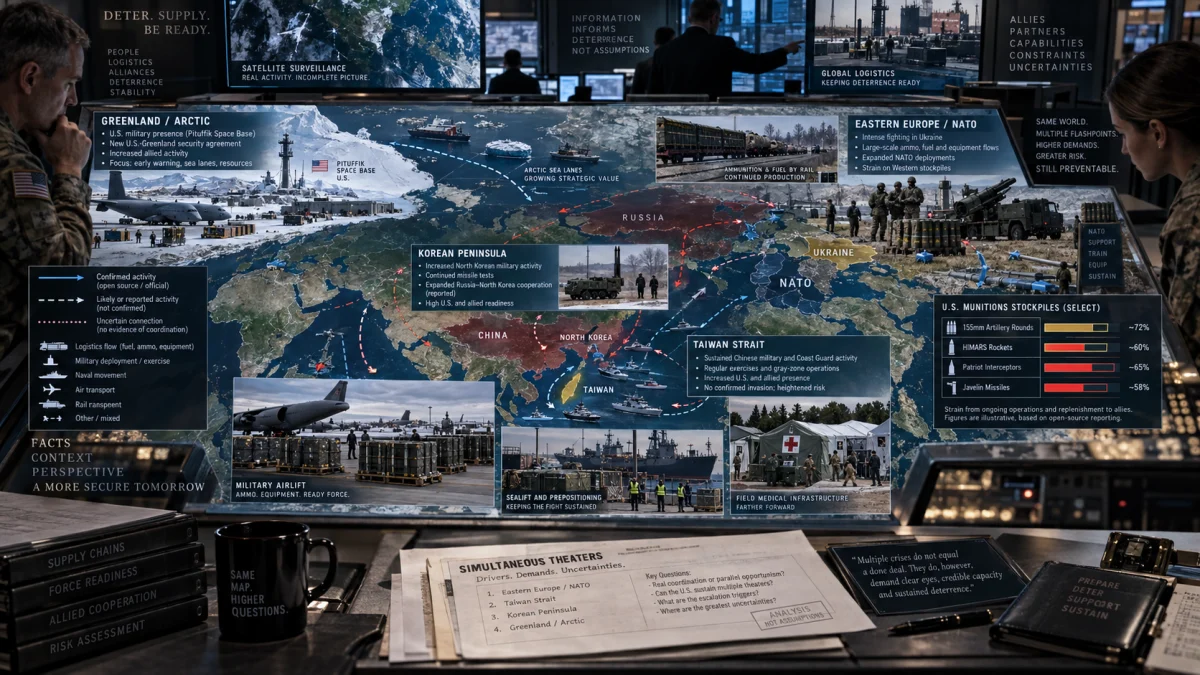
There is currently no public evidence establishing that Russia, China, North Korea and the United States have agreed on a synchronized plan to invade or absorb neighboring territories.
But several developments fueling the current wave of World War III speculation are real and deserve to be examined on their own terms.
U.S. intelligence reportedly assesses that Russian President Vladimir Putin may be increasingly willing to authorize provocative actions extending onto NATO territory. French President Emmanuel Macron has ordered stronger protection of critical infrastructure against drone and cyber threats amid what he called an intensifying Russian hybrid threat. China continues sustained military activity around Taiwan. North Korea has already sent troops and weapons to support Russia. Denmark, Greenland and the United States are preparing a new Arctic security agreement. And a newly released U.S. inspector-general report says the Iran war has produced strategic munitions shortfalls while drawing ships and other military resources from the Pacific.
More importantly, the Pentagon itself has a name for the underlying strategic problem.
The 2026 National Defense Strategy calls it "The Simultaneity Problem": the possibility that one or more potential opponents could act in a "coordinated or opportunistic fashion across multiple theaters."
That is a more useful framework than asking whether several alarming headlines appearing at the same time prove that a secret world war has already been scheduled.
The better question is:
If a multi-front war really were being prepared, what physical evidence should exist?
Large military operations require people, ammunition, fuel, transportation, maintenance, medical capacity, command networks, intelligence assets, industrial production and, in some cases, civilian mobilization.
Political intentions can remain secret.
Logistics usually leaves evidence.
Evidence reviewed through September 20, 2026. This article distinguishes verified facts, reported intelligence assessments, reasonable inference and claims that remain unsupported or unknown.
Why People Are Suddenly Asking Whether World War III Is Starting
A viral social-media argument has connected several recent events into one sweeping theory.
The basic argument goes like this: U.S. intelligence recently warned about possible Russian action affecting NATO territory. Macron raised warnings about Russian hybrid activity. Greenland and Denmark are negotiating a larger U.S. security role. President Donald Trump has posted a map depicting neighboring territories under the U.S. flag. Trump met Putin in Alaska in 2025. North Korean soldiers have fought Ukrainian forces while supporting Russia. China continues pressing Taiwan while Trump prepares for another meeting with Chinese President Xi Jinping.
Put together, the theory proposes that major powers may have reached some kind of understanding to redraw their respective spheres of influence.
The historical analogy is the 1939 Molotov-Ribbentrop Pact between Nazi Germany and the Soviet Union.
There really was a secret protocol to that agreement. The surviving Secret Additional Protocol explicitly divided portions of Eastern Europe into German and Soviet "spheres of influence," including arrangements concerning Poland.
So the historical concept itself is not fictional.
What requires evidence is the enormous additional claim that something comparable exists today.
Several unusual events occurring close together can reasonably justify asking whether they are connected.
Their coincidence does not establish that they are coordinated.
What the Viral World War III Theory Gets Right, Gets Wrong and Cannot Yet Prove
The fastest way to evaluate the theory is to separate the underlying facts from the conclusions being built on top of them.
| Claim | What the evidence actually shows | Evidence status |
|---|---|---|
| U.S. intelligence warned Russia may act against NATO | CBS News reported that U.S. intelligence assessments indicate Putin may be increasingly willing to authorize actions extending onto NATO territory, particularly hybrid, cyber and other deniable measures short of a conventional military campaign. | Verified, but overstated in the viral version |
| The warning resembles what happened before Russia invaded Ukraine | In December 2021, U.S. intelligence was publicly tracking an invasion-specific buildup potentially involving about 175,000 personnel, armor and artillery. Russia invaded in February 2022. | Broad comparison valid, but the 2021 evidence was much more invasion-specific |
| France is raising its defensive posture | On September 18, Macron said the Russian hybrid threat had intensified and ordered stronger protection of critical infrastructure and sensitive defense sites against drones and cyberattacks. | Verified |
| Denmark gave the United States control of Greenland | Denmark, Greenland and the United States expect to sign a strengthened Arctic security agreement. Denmark says the agreement recognizes Danish sovereignty, territorial integrity and Greenlandic self-determination. The complete agreement has not yet been published. | Real agreement; a U.S. territorial takeover is not established |
| Trump posted a map showing neighboring countries under the U.S. flag | Reuters reported that Trump posted an image showing the United States, Canada, Greenland, Iceland, Mexico, Central America and the Caribbean under the U.S. flag. Iceland summoned the U.S. ambassador afterward. | Verified political signaling; not evidence of military mobilization |
| Trump and Putin met in Alaska | They met in Alaska on August 15, 2025. Reuters reported that the summit ended without an agreement to resolve or pause the war in Ukraine. | Verified |
| Trump and Putin secretly divided territories at that meeting | No public document or corroborated reporting located for this article establishes such an agreement. | Unsupported by presently available evidence |
| North Korean troops are participating in Russia’s war | Russia and North Korea confirmed that North Korean troops fought Ukrainian forces in Russia’s Kursk region. Pyongyang has also supplied weapons and other military support. | Verified |
| North Korea is therefore preparing to invade South Korea with Russian help | Military cooperation and battlefield learning are real, but no evidence reviewed establishes a scheduled invasion of South Korea. | Unsupported inference |
| Trump has treated Taiwan as a bargaining chip | Trump specifically described a delayed roughly $14 billion Taiwan arms package as a "very good negotiating chip." | Verified, but narrower than saying Taiwan itself was offered away |
| China is applying military pressure around Taiwan | Taiwan’s Ministry of National Defense continues to report PLA aircraft, Chinese naval ships and other official vessels operating around the island. | Verified |
| Russia, China and North Korea operate under one unified war plan | Their relationships are deepening, but recent analysis finds no demonstrated China-North Korea joint operational plan or joint military exercises, and Russia-North Korea cooperation has not become a trilateral operational structure involving China. | Not established |
This produces a more complicated picture than either extreme.
The viral theory is not constructed entirely from imaginary events.
But real events do not automatically validate the theory connecting them.
The Pentagon Already Has a Name for the Real Danger: the "Simultaneity Problem"
The most important document in this story may not concern Trump, Putin, Xi or Kim Jong Un individually.
It is the Pentagon’s own strategy.
The 2026 National Defense Strategy explicitly says the United States and its allies should prepare for the possibility that one or more potential opponents could act across multiple theaters in a "coordinated or opportunistic" fashion.
Those are two very different scenarios.
Coordinated simultaneity
This is closest to the viral theory.
Russia, China or North Korea would deliberately coordinate actions according to a common strategy or timetable.
Evidence supporting that scenario would ideally include operational planning, intelligence sharing tied to specific operations, synchronized attack preparations, documented agreements or independently corroborated intelligence demonstrating coordinated intent.
We currently have extensive evidence of some bilateral military relationships.
We do not have public evidence establishing one unified Russia-China-North Korea war plan.
Opportunistic simultaneity
This requires no secret treaty.
Imagine Russia creates a serious NATO crisis.
China observes American ships, aircraft, munitions and political attention moving toward Europe.
Beijing then decides that the changed circumstances make additional pressure on Taiwan more advantageous.
North Korea independently reaches a similar conclusion about the Korean Peninsula.
Nobody needed to meet beforehand and divide the world with a ruler.
Each government simply reacts to opportunities created by the others.
That is why the Pentagon’s use of "opportunistic" matters.
It describes a multi-front strategic problem that can emerge even when the most sensational version of a secret master plan is false.
How Do You Know When a Country Is Actually Preparing for a Major War?
This is where military logistics becomes more useful than geopolitical storytelling.
A government can hide a decision.
It is much harder to hide everything required to implement that decision.
A major conventional campaign may require some combination of:
- troop mobilization and leave restrictions;
- repositioned combat formations;
- ammunition and missile stockpiling;
- fuel and lubricant staging;
- transportation surges;
- increased tanker-aircraft activity;
- medical facilities and blood supplies;
- mobile command posts;
- intelligence, surveillance and reconnaissance assets;
- air-defense repositioning;
- maintenance capacity;
- civilian shipping or transportation requisition;
- reserve mobilization;
- economic stockpiling and sanctions preparation;
- changes in industrial production;
- civilian-defense preparations.
Not every operation requires every indicator.
Hybrid attacks, cyber operations, blockades and limited territorial seizures can create much smaller signatures.
That distinction is critical.
We Have a Current Example of What Large-Scale War Preparation Actually Looks Like
There is an unusually useful 2026 comparison: the United States’ own preparation for Operation Epic Fury against Iran.
The September Lead Inspector General report on Operation Epic Fury describes what happened in the months before combat began.
According to the report, the U.S. military systematically repositioned personnel and key assets before the February 28 operation.
That included thousands of service members, hundreds of advanced fighter aircraft, dozens of refueling tankers, the USS Abraham Lincoln and USS Gerald R. Ford carrier strike groups, a sustained flow of munitions, fuel and supplies, and supporting command-and-control and intelligence, surveillance and reconnaissance assets.
Once the campaign was underway, more than 50,000 U.S. personnel were deployed across U.S. Central Command’s area of responsibility in support of the operation. U.S. Transportation Command conducted more than 1,500 air missions and at times surged to 30 to 40 daily missions directly into the theater.
That gives us something valuable.
We do not have to guess what preparations for a large 2026 military campaign can look like. We just watched one happen.
That does not mean another country’s preparations would be identical.
China attacking Taiwan would be different from the United States attacking Iran. Russia testing NATO would be different again.
But the basic principle survives:
Large operations generate logistical demand.
Russia and NATO: The Warning Is Real, but the Type of Attack Matters
The August 7 intelligence reporting deserves to be taken seriously without turning it into something it did not say.
CBS News reported that U.S. intelligence assessments indicate Putin may be increasingly willing to authorize provocative actions extending onto NATO territory.
The reported possibilities included hybrid operations, cyberattacks and other deniable measures short of a conventional military campaign.
That is quite different from:
Russia is preparing to send armored divisions across NATO’s border next month.
The distinction becomes clearer when compared with late 2021.
Before Russia’s full-scale invasion of Ukraine, The Washington Post reported that an unclassified U.S. intelligence document described Russian plans potentially involving 100 battalion tactical groups and up to 175,000 personnel, along with armor and artillery. Satellite imagery showed forces and equipment concentrating around Ukraine.
The current NATO warning described by CBS is not the same kind of public evidence.
Europe nevertheless sees the threat increasing
France is responding to something real.
On September 18, Macron said the Russian hybrid threat against Europeans and France had intensified. The Elysee Palace’s official account says France raised its vigilance and ordered preparation of stronger protections for critical infrastructure and sensitive defense-industrial sites against drone and cyberattacks.
Dutch military intelligence has meanwhile assessed that Russia is preparing for the possibility of a future conflict with NATO.
Its assessment also contains an important constraint. As long as Russia remains heavily engaged in Ukraine, a conventional war against NATO was described as "virtually out of the question." Under favorable conditions for Moscow, the service assessed that Russia could regenerate enough combat power for a regional challenge within roughly a year after fighting in Ukraine ended, according to Defense News’ summary of the MIVD annual report.
These findings are not contradictory.
Russia can pose a serious NATO threat without currently being positioned for a continent-wide conventional invasion.
Cyberattacks, sabotage, deniable operations or a deliberately ambiguous limited confrontation require much less visible preparation.
China and Taiwan: Invasion Is Not the Only Scenario Worth Watching
China produces the same analytical problem.
When someone says "China attacks Taiwan," people often imagine an enormous amphibious invasion.
That is one possibility.
It is not the only one.
What is happening now
Chinese military pressure around Taiwan is persistent.
For the 24 hours ending at 6 a.m. on September 20, Taiwan’s Ministry of National Defense reported five PLA aircraft, 11 Chinese naval ships and six other official ships operating around Taiwan. All five aircraft crossed the Taiwan Strait median line or entered Taiwan’s central, southwestern and eastern air-defense identification zone.
A day earlier, the ministry reported 20 PLA aircraft, 11 naval ships and three other official ships.
Those numbers establish continuing military pressure.
They do not establish that a full-scale invasion has entered its final countdown.
What a full invasion could look like before it starts
Former CIA China analyst John Culver laid out a useful framework in a detailed Carnegie Endowment analysis of the warning signs that could precede a Chinese invasion.
A genuinely massive mobilization could produce extraordinary changes beyond routine exercises: increased munitions production, economic stockpiling, personnel restrictions, movement of field hospitals and command posts, transportation disruptions and requisition of civilian ships, aircraft, trains and trucks.
Culver argued that China’s government would probably have to begin broad military-civil mobilization months before a full invasion.
We have not located public evidence establishing that complete mobilization pattern today.
That wording matters.
It would be irresponsible to say that every classified or difficult-to-observe preparation has been disproved.
Public evidence has limits.
A blockade could look very different
There is another scenario that may require fewer unmistakable invasion signatures.
In July, the U.S.-China Economic and Security Review Commission highlighted China’s effort to normalize Coast Guard patrols east of Taiwan.
The commission wrote that a persistent Coast Guard presence could help establish the presence necessary for a future blockade while allowing Beijing to portray its activities as law enforcement rather than immediate military escalation.
That does not mean a blockade is imminent.
It means an analysis based only on "Where is the invasion fleet?" can miss other ways coercion could escalate.
Is Taiwan Actually Being Used as a Bargaining Chip?
There is a real fact behind this part of the viral argument, but precision matters.
Reuters reported on September 19 that Trump had delayed approval of a roughly $14 billion Taiwan arms package. After a May summit with Xi, Trump said he was holding the package in abeyance and described it as a "very good negotiating chip."
That establishes that Trump has explicitly described arms sales as bargaining leverage.
It does not establish that the United States has agreed to transfer Taiwan to Chinese control, approve a Chinese military operation or abandon Taiwan in a secret agreement.
Those are separate propositions requiring separate evidence.
This is a good example of why small differences in wording matter so much in geopolitical analysis.
North Korea: Russia Is Giving Pyongyang Real Wartime Experience
North Korea’s involvement in Russia’s war is substantially deeper than ordinary diplomatic support.
Russia and North Korea confirmed in 2025 that North Korean troops had fought Ukrainian forces in Russia’s Kursk region.
A Reuters explainer published in August 2026 reported that Ukrainian estimates placed about 9,500 North Korean troops in Kursk at that time, although the source said they were not then directly involved in military operations against Ukraine. Reuters also reported Ukrainian claims of a North Korean missile unit deploying to western Russia, while noting that it could not independently verify those claims.
North Korean forces have nevertheless gained exposure to a modern high-intensity battlefield involving drones, electronic warfare, artillery, surveillance and complex logistics.
That matters for future North Korean military capability.
But another distinction is essential:
Capability is not intent. Intent is not a timetable.
Nothing reviewed for this article establishes that North Korea and Russia have scheduled an invasion of South Korea.
Are Russia, China and North Korea Becoming One Military Alliance?
There is substantial cooperation among parts of this grouping, but the evidence does not currently support treating it as a single integrated military command.
China and Russia cooperate militarily.
Russia and North Korea have developed an unusually deep military relationship.
But a 2026 CSIS assessment notes that China and North Korea do not appear to possess a joint operational plan and have not conducted a joint military exercise. It also concludes that expanded Russia-North Korea cooperation has not developed into trilateral military cooperation involving Beijing.
That weakens the simplest version of a unified master-plan theory.
It does not eliminate the simultaneity problem.
If anything, it explains why the Pentagon distinguishes coordination from opportunism.
Three governments do not have to share a command center for one government’s crisis to create an opportunity for another.
Greenland: Something Important Is Changing, but "America Took Over" Goes Too Far
Greenland may be the easiest current development to overstate because the complete new agreement is not yet public.
On September 18, the governments of Greenland and Denmark announced that Greenland, Denmark and the United States expected to sign an agreement the following week to strengthen security in the Arctic and North Atlantic.
The official Danish announcement says the arrangement recognizes the sovereignty and territorial integrity of the Kingdom of Denmark and the Greenlandic people’s right to self-determination. The agreement will also require national parliamentary procedures before entering into force.
Until the complete agreement is published, claims about its exact limits should be treated cautiously.
The U.S. military was already in Greenland
The new agreement is also not America’s first military access to the island.
The United States and Denmark have maintained a Greenland defense framework since 1951. A 2004 agreement amending and supplementing that framework was negotiated with Greenland’s home-rule government and updated the longstanding U.S. military presence.
The meaningful 2026 question is therefore not:
Why did Denmark suddenly let the American military into Greenland?
It is:
What additional authority, presence or security responsibility does the new agreement actually create?
We should be able to answer that more precisely once the agreement itself is released.
Editor’s note: This section should be re-reviewed when the final Greenland-Denmark-U.S. agreement text becomes public.
What About the Alleged Trump-Putin "New Molotov-Ribbentrop Pact"?
This is the most dramatic part of the theory and the part requiring the strongest evidence.
The historical analogy has a factual foundation.
On August 23, 1939, Nazi Germany and the Soviet Union signed their nonaggression pact.
A Secret Additional Protocol separately divided parts of Eastern Europe into German and Soviet spheres of influence. Poland was explicitly addressed.
Trump and Putin also unquestionably met in Alaska on August 15, 2025. Reuters reported that the summit ended without an agreement to pause the war in Ukraine.
What we do not have is evidence bridging those two facts.
For this article, we found no public agreement, authenticated document or corroborated independent reporting establishing that Trump and Putin secretly agreed to divide Canada, Greenland, Europe, Cuba, Mexico or other territories between American and Russian spheres.
That does not prove that every private conversation is known.
It means the allegation has not met its evidentiary burden.
There is still a useful way to test the hypothesis
A good hypothesis should make predictions.
If Washington and Moscow had actually divided territories into reciprocal spheres of influence, we might expect downstream behavior that is unusually difficult to explain otherwise: reciprocal noninterference, systematic abandonment of particular security commitments, matching territorial concessions, coordinated military behavior or eventually documentary or independently corroborated insider evidence.
Those observations could strengthen or weaken the hypothesis over time.
A viral map cannot substitute for them.
One Major Variable the Viral Theory Largely Misses: America’s Existing War
The most important logistical development may be occurring outside every theater discussed above.
The United States is already consuming large quantities of military resources in the Iran conflict.
The September Lead Inspector General report on Operation Epic Fury estimated that the operation had cost $33.4 billion as of June 29, including $22.3 billion in expended munitions and $3.7 billion in equipment losses.
More consequential for the simultaneity question, the report says the Office of the Under Secretary for Acquisition and Sustainment assessed that Operation Epic Fury’s munitions expenditure had resulted in "strategic inventory shortfalls." It also says the defense industrial base requires "significant lead time" to expand production capacity.
The effects were not contained to the Middle East.
The same inspector-general report says at least six U.S. warships were retasked from the Pacific to the Middle East, including the Abraham Lincoln carrier strike group and components of the Japan-based Tripoli Amphibious Ready Group.
That does not establish that another government is preparing to exploit the situation.
It establishes the underlying condition:
A major active conflict is consuming finite American munitions, ships, aircraft, logistics capacity and industrial production while the Pentagon’s own defense strategy explicitly plans around the possibility of simultaneous crises.
That connection is much more firmly supported than a secret global partition treaty.
The Global Mobilization Indicator Matrix
The following matrix is not a "WW3 probability meter."
There is no responsible way to turn incomplete public intelligence into a precise percentage.
Instead, it tracks whether broad categories of evidence expected before major military operations are visible in the public record.
| Indicator | Russia/NATO | China/Taiwan | Korean Peninsula | U.S./Allied capacity |
|---|---|---|---|---|
| Routine or heightened military activity | Observed | Observed | Observed | Observed |
| Hybrid/cyber preparation or activity | Observed | Observed in broader coercive environment | Relevant capability exists | Defenses active |
| Large attack-specific conventional force concentration | Not publicly established against NATO at Ukraine-2021 scale | Not publicly established at full-invasion scale | Not publicly established for an invasion of South Korea | Observed before the Iran operation |
| Major munitions/fuel/sustainment staging | Russia maintains wartime production for Ukraine; NATO-specific attack staging not established | Full invasion-specific pattern not publicly established | Attack-specific pattern not publicly established | Documented for Iran |
| Civilian transportation mobilization | No comparable NATO-invasion pattern established publicly | Full national requisition pattern described by analysts has not been publicly established | Not publicly established | Large military transport surge documented for Iran |
| Medical/field-hospital preparation tied to attack | Not publicly established for a NATO invasion | Not publicly established at expected full-invasion scale | Not publicly established | Part of operational sustainment and contingency planning |
| Economic insulation/war stockpiling | Russia already operates a wartime economy in significant respects | Long-term resilience efforts exist; extraordinary invasion-specific package not publicly established | Highly militarized economy complicates this indicator | Industrial replenishment efforts underway |
| Operational cooperation with another power | Russia-North Korea cooperation observed | China-Russia cooperation observed | Russia-North Korea cooperation observed | Extensive allied coordination observed |
| Unified Russia-China-North Korea operational plan | Not publicly established | Not publicly established | Not publicly established | N/A |
| Industrial or inventory constraint affecting another theater | N/A | N/A | N/A | Documented: strategic munitions shortfalls and Pacific warship retasking |
The matrix illustrates why both absolutist conclusions are premature.
There are enough real indicators to justify serious attention.
There are also major pieces of evidence one would expect before several of the most dramatic scenarios that have not been publicly established.
What Evidence Would Materially Change This Assessment?
One military exercise would not do it.
One speech would not do it.
One map posted on social media certainly would not do it.
More concerning would be clusters of independent indicators beginning to appear together, particularly across multiple theaters.
For a large conventional operation, those could include:
- unusual reserve mobilization;
- mass cancellation of military leave;
- movement of formations away from normal training areas;
- extraordinary munitions and fuel staging;
- large field-medical deployments;
- unusual military transport surges;
- mobile command infrastructure moving forward;
- broad civilian ship, rail or trucking requisitions;
- economic emergency measures;
- unusual restrictions on capital or exports;
- increased strategic stockpiling;
- simultaneous civil-defense preparations;
- significant changes in nuclear posture;
- attack-specific force dispersal that persists rather than ending with an exercise.
The exact indicators differ by operation.
A Russian sabotage campaign does not require an invasion army.
A limited territorial probe requires less than a continent-wide offensive.
A Chinese blockade would not necessarily produce the same signatures as a full amphibious assault.
That is why the correct analysis must keep asking:
What operation are we actually hypothesizing, and what would that operation physically require?
So, Is World War III About to Start?
The public evidence reviewed through September 20, 2026 does not establish a synchronized global invasion plan or a secret agreement dividing neighboring countries among the United States, Russia and China.
Several developments underlying those fears are nevertheless real.
Russia is associated with a growing pattern of hybrid threats affecting NATO countries. China continues sustained military and law-enforcement pressure around Taiwan. Russia-North Korea military cooperation has given Pyongyang real combat experience. A new Greenland security arrangement is being negotiated. And the United States is already consuming significant military resources in Iran while its own defense planners explicitly warn about simultaneous crises.
The most important distinction is between a secret master plan and a strategic environment capable of producing several crises at once.
The first requires evidence we currently do not have.
The second is important enough that it appears explicitly in current U.S. defense strategy.
And the best evidence to watch from here is not rhetoric.
It is mobilization.
People. Ammunition. Fuel. Transportation. Medical capacity. Command networks. Industrial production. Economic preparation. The physical movement of the machinery required to turn political decisions into military operations.
If those signatures begin appearing together, the evidence changes. Until then, they should not be invented.
References and Further Reading
Primary Strategy, Government and Oversight Documents
2026 National Defense Strategy – U.S. Department of Defense
The Pentagon’s current strategy. Its "Simultaneity Problem" section explicitly discusses potential opponents acting across multiple theaters in coordinated or opportunistic fashion.
Operation Epic Fury: Lead Inspector General Report to Congress, April-June 2026 – U.S. Department of State Office of Inspector General
Primary oversight report documenting prewar force repositioning, campaign costs, munitions expenditure, logistics activity, Pacific warship retasking and strategic inventory shortfalls.
September 20, 2026 PLA Activity Around Taiwan – Taiwan Ministry of National Defense
Primary Taiwanese military reporting on current Chinese aircraft and vessel activity around Taiwan.
China Bulletin, July 23, 2026 – U.S.-China Economic and Security Review Commission
Examines China’s normalization of Coast Guard activity east of Taiwan and its possible relevance to future blockade capabilities.
Expected Agreement on Strengthened Security in the Arctic and North Atlantic – Danish Prime Minister’s Office
Primary announcement describing the expected U.S.-Denmark-Greenland agreement and explicitly addressing sovereignty, territorial integrity and Greenlandic self-determination.
2004 Agreement Amending and Supplementing the 1951 Defense of Greenland Agreement – U.S. Department of State
Primary treaty record showing that substantial U.S. military access and defense cooperation in Greenland long predates the 2026 negotiations.
Macron’s September 18, 2026 International Security Statement – Elysee Palace
Primary French government source describing the intensification of Russian hybrid threats and additional protection of critical infrastructure against drone and cyberattacks.
Russia and NATO
U.S. Intelligence Agencies Warn Putin Could Test NATO – CBS News
Reports current U.S. intelligence assessments concerning possible Russian hybrid, cyber and other deniable actions affecting NATO territory.
Russia Planning Massive Military Offensive Against Ukraine Involving 175,000 Troops – The Washington Post, December 3, 2021
Documents the much more invasion-specific physical buildup that U.S. intelligence was observing before Russia’s February 2022 full-scale invasion.
Russia Could Be Ready for NATO Conflict Year After Ukraine, Dutch Warn – Defense News
Summarizes the Dutch MIVD assessment distinguishing Russia’s current constraints while fighting in Ukraine from its potential ability to regenerate forces afterward.
China and Taiwan
How We Would Know When China Is Preparing to Invade Taiwan – Carnegie Endowment for International Peace
Former CIA China analyst John Culver’s detailed framework for the military, economic and civilian mobilization signatures that could precede a full invasion.
Defense Firm Anduril Says U.S. Delay on Taiwan Arms Sales Is Affecting Its Business – Reuters, syndicated by Investing.com
Establishes the precise context of Trump’s "negotiating chip" statement: he was referring to a delayed Taiwan arms package.
North Korea, Russia and China
What We Know About North Korean Forces Joining Russia’s War Against Ukraine – Reuters, syndicated by Investing.com
Summarizes confirmed North Korean combat participation in Kursk, troop estimates, weapons transfers and Ukrainian claims concerning additional missile personnel.
China and CRINK: Implications for Japan and the United States – CSIS
Important counterweight to claims of a single integrated Russia-China-North Korea military bloc; discusses the limits of demonstrated trilateral operational cooperation.
Trump, Territorial Signaling and the Alaska Summit
Iceland Summons U.S. Ambassador After Trump Posts Map Showing Island Under American Flag – Reuters, syndicated by Investing.com
Documents the September 2026 map depicting multiple neighboring countries and territories under the U.S. flag and Iceland’s diplomatic response.
Trump-Putin Summit Yields No Deal on Ending War in Ukraine – Reuters
Confirms the August 15, 2025 Alaska summit and that it ended without an agreement to resolve or pause the Ukraine war.
Historical Comparison
Secret Additional Protocol to the 1939 German-Soviet Nonaggression Pact – Yale Avalon Project
Reproduces the historical secret protocol dividing portions of Eastern Europe into German and Soviet spheres of influence.
Editorial currency note: This is a rapidly developing subject. The Greenland security agreement has not yet been published in full, Trump and Xi are expected to meet again, military activity around Taiwan changes daily, and intelligence assessments concerning Russia and NATO can change as new information emerges. This article should be updated when primary evidence materially changes the assessment.