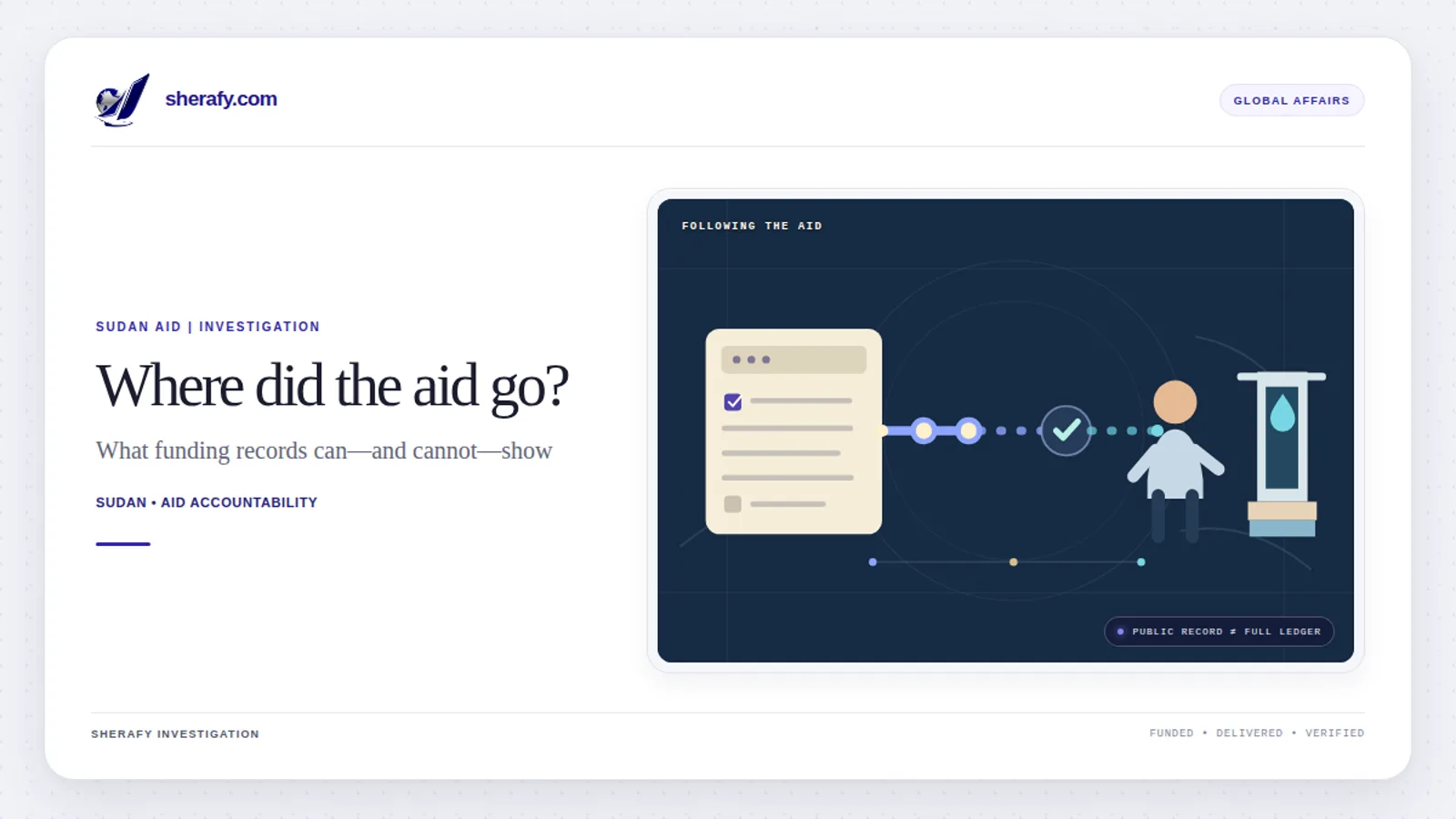
Billions of dollars have been requested for Sudan, and substantial humanitarian assistance has been delivered. But an appeal is not a payment, a grant to an aid organization is not necessarily a payment to Sudan's government, and a reported delivery is not a complete audit of what a family received. Official records document food, water, healthcare, and nutrition assistance. They also document stolen or damaged supplies, serious monitoring failures, and financial losses between international funders and Sudanese community groups. What they do not establish is that billions of dollars have been stolen.
That distinction matters when people ask a reasonable question: We keep sending money. Why is Sudan still struggling to provide clean water, food, and shelter?
The answer requires following the money through five different stages: requested, received, allocated, delivered, and independently verified. Treating those stages as interchangeable creates a misleading picture of both corruption and humanitarian effectiveness.
This investigation examines official United Nations and U.S. oversight records, a World Food Programme inventory-loss report, and new research into how funds reach Sudanese responders. All figures are dated and scoped so readers can distinguish evidence from assumption.
How much humanitarian aid has Sudan actually received?
Sudan's civil war began in April 2023, when fighting erupted between the Sudanese Armed Forces (SAF) and the Rapid Support Forces (RSF). The conflict spread across the country, damaged essential services, disrupted food markets, and forced millions to flee. For the military and foreign-support networks underlying the crisis, see sherafy.com's separate investigation into foreign support networks in Sudan's war.
Humanitarian organizations publish an annual response requirement, the estimated budget for a defined package of aid. They also publish contributions reported against that plan. These are different quantities.
| Response year | Amount requested for the in-country response | Reported funding at the cited snapshot | What the figure means |
|---|---|---|---|
| 2023 | Approximately $2.6 billion after the war-driven revision | Approximately $1.1 billion, reported in a February 2024 UN summary | About 43% funded at that reporting date |
| 2024 | Approximately $2.7 billion | Approximately $1.76 billion in end-of-year reporting | About 65% funded |
| 2025 | $4.16 billion in the original plan | Approximately $1.67 billion in July 2026 reporting | About 40% of the original requirement |
| 2026 | $2.87 billion | About 47% funded as of November 6, 2026, equivalent to roughly $1.35 billion against that requirement | An approximate current-year funding snapshot, not a final annual expenditure figure |
Sources and important qualifications: The UN's February 2024 joint response summary gives the 2023 snapshot. The 2024 plan and an independent humanitarian financing compilation document the 2024 requirement and funding. The UK government's September 2026 assessment, drawing on OCHA data, reports $1.67 billion against the original 2025 requirement. The November 6, 2026, UNHCR/IOM statement reports approximately 47% coverage of the 2026 response. The 2026 dollar amount above is a calculation using rounded figures.
Do not add these numbers into a purported audited total. Their reporting dates differ, plans are revised, later contributions can be back-reported, and some separate regional appeals cover Sudanese refugees in neighboring countries. The 2025 appeal was also reprioritized to approximately $3.01 billion during the funding crisis, changing the denominator used in some contemporaneous coverage. The UN Office for the Coordination of Humanitarian Affairs (OCHA) Financial Tracking Service is the appropriate starting point for a like-for-like comparison, with dates and geographic scope held constant.
The broader point is already established: the international response has received significant funding but has repeatedly fallen far short of its own stated requirements. As of November 2026, the UN said 33.7 million people needed humanitarian assistance in Sudan, while its $2.87 billion plan targeted 20.4 million, and only about 47% of that plan was funded.
What about the claim that Sudan has already received $5 billion?
The question is incomplete without specifying which $5 billion, from whom, over what period, and for what purpose. A combined fundraising goal is not money received. Money reported by multiple implementing agencies is not necessarily distinct from the donor contributions recorded by OCHA. Nor does humanitarian assistance automatically constitute a transfer to Sudan's national treasury.
There is, however, a striking figure in the UN's own published material. The UN Sudan Annual Results Report 2025 charts humanitarian funding reported by the UN Country Team as approximately $922 million for 2023, $2.907 billion for 2024, and $1.238 billion for 2025. Those three displayed amounts add to approximately $5.067 billion.
That arithmetic does not verify $5.067 billion in unique, nonduplicated payments. The underlying reporting needs reconciliation.
For example, the UN's 2024 annual results report, financial table on pages 42–43 lists approximately $1.761 billion under OCHA's humanitarian-funding row, alongside separate funding figures for WFP, UNICEF, UNHCR, and other agencies. The report's foreword also says humanitarian organizations received approximately $1.8 billion in support that year. The OCHA row closely resembles the overall in-country 2024 appeal's funded amount.
That raises a legitimate accounting question: Does the $1.761 billion OCHA entry represent funding already reflected, at least in part, in the other agencies' rows, or a separately defined amount? The report does not provide a reconciliation sufficient to settle that question from the public table alone. Different reporting populations or accounting conventions may explain it. The existence of a possible overlap is not proof of an error, deception, or theft.
Until the issuing agencies explain the classification, presenting the $5.067 billion chart sum as a verified ledger of distinct money spent would be irresponsible. Equally, citing it as evidence that $5 billion was stolen would be baseless.
The figure offers a useful public-record question, not a verdict.
Where does the money go after someone donates?
There is no single account into which all money labeled "Sudan aid" is deposited. Assistance may be provided through government donors, UN agencies, international charities, Sudanese nongovernmental organizations, or community-led networks. Some contributions buy and transport supplies; others finance medical staff, mobile clinics, cash assistance, water treatment, logistics, monitoring, or local projects.
A simplified funding chain can look like this:
Donor government or private contributor → UN agency or aid fund → implementing organization → local partner or supplier → food, water, medical care, cash, or shelter reaching people.
Not every project passes through every intermediary. Some donors fund Sudanese organizations directly. Some aid arrives as food or medical commodities rather than cash. Some operations are administered from outside Sudan because of insecurity. Each arrangement has different accounting records and different risks.
Five terms are particularly easy to confuse:
| Term | What it establishes | What it does not establish |
|---|---|---|
| Requested | The cost of a proposed response | That the money was pledged or received |
| Committed or pledged | A donor's stated funding intention or obligation | That the full amount was transferred |
| Received or allocated | Funding reported to an agency, fund, or implementer | That intended beneficiaries obtained the service |
| Delivered or reached | A reported service, cash transfer, commodity distribution, or beneficiary reach | That every cost was optimal or that the service lasted |
| Independently verified | A specified result or transaction checked against supporting evidence | That all other projects and transactions were also audited |
This is why counting the same $1 million when it leaves a government, reaches a UN fund, and is granted to a nonprofit would triple-count one flow of funding. An accountability ledger must follow the same money, not add every recorded handoff.
What did Sudan's humanitarian funding actually accomplish?
The claim that the money produced "nothing" is contradicted by documented program results. That does not mean Sudan's humanitarian needs have been met, or that all reported achievements have been independently audited.
| Reporting period | Organization | Reported result | Important interpretation |
|---|---|---|---|
| 2025 | UNICEF and partners | 14.7 million people reached with access to safe drinking water | A service-access measure, not a count of permanently connected homes |
| 2025 | UNICEF and partners | 612,134 children admitted for treatment of severe acute malnutrition | Admissions for treatment, not a claim that every child fully recovered |
| 2025 | WFP | 12.1 million people assisted across its activities | An annual program-reach figure; it cannot be added to UNICEF's as unique beneficiaries |
| 2025 | WFP | Over 324,000 metric tons of food delivered and $153.7 million in cash-based transfers | Different forms of assistance; neither is a reconstruction budget |
| January–June 2026 | UNICEF and partners | 6.6 million people reached with access to safe water | A separate reporting period; not an additional unique count across 2025 and 2026 |
These figures are drawn from UNICEF's detailed 2025 Sudan situation report, WFP's 2025 Sudan Annual Country Report, and UNICEF's January–June 2026 situation report. UNICEF's 2025 summary page uses a broader rounded water-reach figure; the 14.7 million above comes from the detailed report's water, sanitation, and hygiene section.
These outputs matter. Families were given treated water, children entered lifesaving nutrition programs, and food assistance reached millions. Sudanese workers and community responders performed much of that work, often at substantial personal risk.
But an agency's activity report is not a receipt from every household. Access to water might mean water trucking, treatment at a facility, a repaired distribution point, or an improvement to a network. Assistance can last days, weeks, or longer. A household receiving one type of support can still lack medicine, electricity, a functioning school, or a safe home.
Moreover, funding shortages can reverse gains. On November 12, 2026, WFP reported that its Sudan caseload had fallen from more than four million people in August to just over three million, with an estimated 900,000 people losing food assistance as funding constraints intensified.
A service delivered last year does not guarantee that service is available today.
Why is there still no reliable water or infrastructure if billions were spent?
Because emergency survival and national reconstruction are different jobs, and Sudan is trying to perform the first while the war continues to damage the foundations needed for the second.
Consider water. An emergency program can truck potable water into a settlement, chlorinate a well, distribute purification supplies, or temporarily restore a pumping station. That can prevent disease and save lives. It does not create a permanently functioning citywide water network.
In a November 11, 2026, report on repairing Khartoum's water system, UNICEF said an estimated 60% of the city's water network was affected by leaks after prolonged conflict, damage, shutdowns, and corrosion. Engineers were using robotic inspections and acoustic equipment to locate buried pipe damage without unnecessarily excavating roads. Repairing these systems also requires water treatment, electricity, pumps, operating personnel, maintenance materials, and safe access.
This is an example of infrastructure work actually happening. It is also an example of how immense the rebuilding task is.
The 2024 Sudan Humanitarian Needs and Response Plan explicitly defined its planned activities as humanitarian, excluding general development and resilience-building activities from that plan's budget. Subsequent plans have included emergency repair and recovery elements, but their central purpose remains lifesaving assistance.
For scale, the entire $2.87 billion requested under Sudan's 2026 humanitarian plan, divided by its 20.4 million targeted people, works out to approximately $141 per targeted person for the year, or 39 cents per day. That is a division of a proposed program budget, not a payment each person receives, a measure of actual spending, or a claim that aid costs only 39 cents per day. The budget also finances procurement, distribution, security, staff, transport, and other operational needs.
It illustrates the mismatch in the criticism. A limited, underfunded, year-long emergency plan cannot reasonably be evaluated as though it were a fully funded national program to reconstruct water utilities, roads, housing, hospitals, and power systems.
This is not an excuse for inefficiency. Donors and agencies should still explain what was purchased, whether repairs worked, and how long services lasted. But damaged infrastructure is not, by itself, proof that money disappeared.
Has humanitarian aid been stolen or diverted in Sudan?
Yes, losses and diversion-related incidents are documented. But the available public evidence does not establish that billions have been stolen, or provide a reliable nationwide percentage of humanitarian aid lost to theft.
The clearest way to understand the distinction is to compare an agency's recorded commodity losses with a government inspector general's unresolved allegations.
WFP recorded $3.38 million in post-delivery food losses in Sudan in 2025
The World Food Programme's June 2026 global losses report, including its Sudan country table, identifies the following figures for Sudan in calendar year 2025:
| WFP Sudan food-accounting measure | Reported figure |
|---|---|
| Food commodities handled | $256.79 million in value |
| Food commodities handled | 357,844.5 metric tons |
| Post-delivery commodity losses | $3,383,937 |
| Post-delivery commodity losses | 4,109.9 metric tons |
| Losses as a share of value handled | 1.32% |
Scope matters: In WFP terminology, post-delivery refers to food already in the recipient country but not yet distributed to beneficiaries. This is a measure of losses within WFP's commodity-handling system. It does not count all forms of aid, cash assistance, services provided by other organizations, or every loss after distribution. The 1.32% is not Sudan's national humanitarian-aid theft rate.
The report describes multiple reasons for losses, including quality problems, transport incidents, damaged stock, spoilage, theft, armed attacks, and inventory discrepancies. They are not synonymous.
One incident is particularly revealing. WFP reported that 1,668.212 metric tons of wheat flour intended for Zamzam camp were not delivered under five transporters' contracts. Some flour had been taken off the route and stored in Al Dabbah without WFP being notified. After approximately three months, WFP retrieved the goods, but they had become infested and unfit for human consumption. WFP said it held the transporters liable, initially suspended them, then re-engaged them under enhanced controls while pursuing financial recovery through deductions from invoices.
That is a concrete failure of delivery and safeguards. Recovering physical possession of spoiled flour did not make it edible. Nor does an announced recovery mechanism establish how much money WFP ultimately collected. The final financial recovery amount is not resolved by the cited report.
Other reported incidents included a drone attack on a food convoy, food taken by an unidentified armed group, and a substantial warehouse inventory discrepancy in Kassala. WFP described corrective actions and referrals to appropriate authorities. The mechanisms and evidentiary statuses differ, and they should remain separate.
A U.S. inspector general found 47 unresolved program irregularities
The USAID Office of Inspector General's June 1, 2026, Sudan evaluation found 47 program irregularities across 23 awards that were open or unresolved as of June 30, 2025. The tracker recorded:
- 29 incidents concerning alleged loss, damage, safety, or quality problems;
- 13 incidents classified as allegations of fraud or abuse; and
- 5 other incidents, including robbery and access or security problems.
Among the examples in the underlying inspector-general report, three looting allegations had an associated estimated value of approximately $244,000. Another incident alleged the seizure of $62,438 in medical supplies by Sudanese military intelligence. Fuel records raised a potential loss of up to $250,000, alongside a separate reported seizure of $45,000–$50,000 in fuel by armed fighters.
Those are incident-tracker allegations and potential losses, not a finalized national fraud judgment. Do not add them into a purported theft total: they involve different forms of harm, may overlap in the underlying program history, and their final dispositions were not established in the evaluation.
The report's most consequential conclusion concerned the ability to detect and resolve problems. USAID had planned 21 third-party monitoring visits between January and June 2025 for awards with a combined value described as $1.04 billion, but only 11 visits were completed. A tracker containing the unresolved irregularities was not transferred to the U.S. Department of State when program oversight shifted there, and important monitoring documents were not preserved or handed over consistently.
That $1.04 billion is the value of awards covered by the monitoring review. It is not a finding that $1.04 billion was missing or stolen. The federal oversight database lists $0 in questioned costs for this evaluation, which did not attempt to calculate a total theft figure. Zero questioned costs in a monitoring evaluation should not be misread as proof that every transaction was clean.
The missed monitoring also has a documented explanation that deserves attention: the 2025 U.S. foreign-assistance pause and stop-work instructions disrupted the third-party monitor's activities, while insecurity, access restrictions, staffing changes, and the transition of responsibility further complicated oversight. These circumstances explain part of the failure without eliminating its consequences.
The strongest conclusion is narrower and more serious than a slogan: some aid was lost, some diversion allegations remained unresolved, and important oversight systems failed precisely when independent verification was needed.
How much Sudan aid actually reaches Sudanese organizations?
Humanitarian financing has a second accountability problem. International systems can record a grant as delivered to an intermediary even when the Sudanese organization performing the work receives only a portion, receives it late, or pays substantial costs to access it.
The Sudan Humanitarian Fund's 2025 annual report says donors contributed approximately $169.3 million to the fund, enabling about $167.5 million in allocations. Of those allocations, $10.4 million, or about 6%, went directly to national NGOs. The Fund said 37% of allocations reached local and national actors when direct and indirect funding were counted.
But an October 22, 2026, investigation by Refugees International, using OCHA's standardized pooled-fund data, found about 6% direct funding and 27% including subgrants.
These statistics do not describe all international aid to Sudan. They concern one UN-managed pooled fund, and the 27% and 37% measures should not be treated as competing totals for all aid.
Why the ten-point difference? Refugees International's report explicitly acknowledges it. Its endnote describes possible reporting-period differences and disagreement over how mutual-aid grants are classified. In particular, some transfers to informal community groups are counted differently in the pooled-fund data, and the annual report may credit a full program envelope as indirectly supporting local actors even though only part reaches groups as direct cash grants. Without matching the grant-level records and classifications, neither figure should be presented as the one universally correct percentage.
The partner-selection system offers more context. Refugees International found that 62 Sudanese NGOs were invited to the Fund's 2024 onboarding process but only two were accepted by year-end. Barriers included financial systems, safeguarding documentation, digital records, and mandatory government registration. Some standards protect beneficiaries and donors. Others can be difficult or dangerous to satisfy in contested territory. The fund has pursued reforms in 2026, including dedicated local-partner allocations and support for institutional capacity.
This is not an argument that every intermediary is unnecessary. International organizations may contribute procurement capacity, supply chains, technical assistance, oversight, and some protection from political pressure. The test is whether each layer delivers measurable value, and whether the final responder retains enough money and authority to do the work.
The overlooked cost: Aid can lose purchasing power before it is used
An important October 26, 2026, study by ODI Global and Sudanese co-researchers examined 31 mutual-aid groups across five Sudanese states. These groups include community responders and Emergency Response Rooms that provide food, water, evacuation, and other essential assistance.
The researchers described funding chains where intermediary deductions ranged from 7% to 22%. They also documented high transfer or cash-withdrawal costs, formal-receipt requirements that could trigger 17% VAT, and rules requiring some groups to exchange money at rates that substantially reduced purchasing power.
The exchange-rate example is especially instructive. On October 4, 2026, ODI recorded a bank conversion rate of approximately 4,200 Sudanese pounds per U.S. dollar, compared with a market rate of about 8,200. In a simplified illustration, a $10,000 grant converted at those rates would produce 42 million Sudanese pounds at the bank rate versus 82 million at the cited market rate. If the goods being purchased were priced effectively against the market rate, the bank-converted grant could buy approximately half as much.
That example is not a claim that every dollar of aid loses half its value. Currency access, procurement contracts, location, transaction rules, and local prices vary. Nor can a 22% intermediary deduction, 17% VAT, a 20–30% cash-out cost, and an unfavorable exchange rate simply be added as if each applied to the same transaction. Such a calculation would create a fictional nationwide loss estimate.
The study illustrates a deeper accounting problem: a donor can accurately record a $10,000 grant while the recipient group has substantially less than $10,000 of usable purchasing power. And if that final-stage cost is not reported, upstream financial transparency will still leave the reader with the wrong answer.
The researchers also documented unpaid labor and out-of-pocket costs among local volunteers. One group reported contributing approximately $24,600 of its own resources alongside $109,000 in grants. A low apparent administrative cost can therefore conceal expenses borne by the very people delivering the aid.
ODI warned that a December 31, 2026, bank-registration deadline could threaten access to accounts used by some local aid groups. The underlying Central Bank directive, any extensions, and exemptions should be checked as the deadline approaches; the study establishes the reported risk, not the final outcome.
Who is least likely to be reached?
Access is not determined by need alone. Armed checkpoints, destroyed roads, insecurity, unavailable documentation, restrictions on local organizations, discrimination, and the absence of safe complaint channels can all affect whether assistance reaches a person.
That is particularly important for people whose identities expose them to additional danger. The European Union Agency for Asylum's 2026 Sudan Country Focus documents continuing legal penalties for same-sex conduct and reported discrimination and harassment affecting LGBTQ people. Sudan's 2020 legal changes removed statutory flogging and death sentences for the offense addressed under Article 148 but did not decriminalize it; imprisonment and other protection risks remain.
For displaced LGBTQ Sudanese people, access to shelter, identity documents, healthcare, and safe disclosure can therefore raise risks beyond the general scarcity of assistance. However, the available evidence does not establish a reliable nationwide number of LGBTQ Sudanese people who were denied humanitarian aid specifically because of their identity. That should not be invented to strengthen the case.
The same principle applies more broadly to women-led groups, unregistered community responders, people stranded in contested areas, and displaced families who cannot easily use formal banking or registration systems. Equal treatment on paper does not necessarily translate into safe and equal access at the point of need.
Private crowdfunding campaigns also require separate verification of their organizers, beneficiaries, and transfers. They should not automatically be associated with the billions tracked under UN-coordinated response plans.
What would real accountability look like?
A credible financial account for Sudan should not stop at the announcement of a grant or a total number of people reportedly reached. It needs to connect financial flows to practical results while protecting people whose identities or locations could endanger them.
For each major funding channel, the public should be able to determine:
- What was requested, pledged, and actually received, with the same reporting period and geography.
- Who controlled the funds and who implemented the activity, distinguishing prime recipients, subgrantees, suppliers, and final service providers.
- How much was transferred at each stage, including justified administrative costs, exchange-rate effects, transaction fees, and amounts still outstanding.
- What was delivered, when, where, and to whom in appropriately aggregated terms.
- How outputs were checked, including third-party monitoring, inventory reconciliations, complaints, and follow-up visits.
- Which incidents were confirmed, alleged, or closed, including recovered value and unresolved claims.
- How local organizations and affected communities participated in decisions and could challenge inaccurate reporting.
Not every person's name, address, transaction route, or aid distribution site should be public. Publishing identifiable details can expose refugees, LGBTQ beneficiaries, local volunteers, or aid workers to retaliation. Independent confidential verification can provide accountability without turning a disclosure into a security risk.
What donors can check before contributing
For an established agency or charity, look for audited financial statements, a clear emergency appeal, the organization responsible for implementation, program results, an explanation of indirect costs, and a mechanism for reporting misuse. For smaller community fundraisers, confirm the organizer and intended recipients, whether a fiscal sponsor is involved, how transfers will be handled, and whether updates or receipts are provided without endangering beneficiaries.
No reputable financial report can guarantee that emergency assistance in an active war zone is risk-free. The realistic standard is evidence of appropriate safeguards, honest loss reporting, and credible corrective action.
The question should not be reduced to donate or don't donate. It should be which delivery route meets the need, who can verify it, and how problems are handled when something goes wrong.
Frequently asked questions about aid to Sudan
Did Sudan receive $5 billion in humanitarian donations?
There are official UN reporting figures that add to more than $5 billion for 2023–2025, but the accounting categories have not been reconciled sufficiently to treat that arithmetic sum as verified, nonduplicated expenditure. The figure also does not imply that the Sudanese government received $5 billion. Specific donor payments, response plans, and reporting periods must be identified before the claim can be tested.
How much humanitarian aid has been stolen in Sudan?
No credible, comprehensive nationwide total was established by the public records reviewed here. WFP documented $3.38 million in Sudan post-delivery food losses in 2025, but those losses include causes other than theft. USAID's inspector general documented open diversion and fraud allegations, but did not quantify a national theft total. Neither dataset can be generalized to all aid.
Does UN humanitarian aid go directly to Sudan's government?
Not necessarily. Humanitarian assistance frequently flows through UN agencies, pooled funds, international organizations, national NGOs, suppliers, and community responders. Some arrangements may involve government systems, public facilities, or locally administered services. The destination of each grant must be established from its actual funding and implementation records.
Why are people still without clean water after so much aid?
Emergency provision of treated water is different from restoring a permanent water network. War damage, electricity failures, inaccessible pipes, unsafe routes, maintenance shortages, and ongoing destruction can prevent reliable service even where emergency interventions have reached millions. UNICEF's 2026 account of Khartoum's damaged network documents both serious need and repair work.
What are Sudan's Emergency Response Rooms?
They are Sudanese community-based networks and volunteer groups that organize local responses such as communal kitchens, water access, evacuations, and other assistance. Their work can reach neighborhoods where large organizations struggle to operate, but their informal structure may also make grant eligibility, banking, safeguarding, and reporting harder. The ODI investigation provides detailed evidence of the funding obstacles they face.
If there are theft allegations, is it pointless to donate?
No. Documented problems justify scrutiny and better donor choices; they do not erase documented food, water, medical, and nutrition assistance. A responsible donor should evaluate the specific recipient's governance, delivery channels, reporting, and safeguarding rather than assume that every aid organization is effective or every organization is fraudulent.
The bottom line
Sudan's aid money did not all disappear. Nor has every dollar been adequately traced to the people who needed it.
The public record supports both measurable humanitarian results and serious accountability weaknesses: millions reached with essential services, specific documented commodity losses, unresolved diversion allegations, incomplete monitoring, and funding chains that can substantially reduce what local responders can spend.
The right demand is not blind trust in an aid agency, or a blanket accusation against everyone trying to save lives. It is a ledger that distinguishes money promised from money received, money transferred from services delivered, and what can be proven from what remains unknown.
If billions are being raised in the name of Sudan's people, Sudan's people deserve an accounting that follows the money all the way to them.
References and Further Reading
UN funding records and humanitarian response plans
- United Nations in Sudan, Annual Results Report 2025. Provides the UN Country Team's multi-year funding chart and agency-level reporting, including the reported 2024 figure requiring careful reconciliation.
- United Nations in Sudan, Annual Results Report 2024. Includes the 2024 agency funding table and the separate description of approximately $1.8 billion received for humanitarian assistance.
- OCHA, Financial Tracking Service. Primary portal for reported humanitarian contributions, requirements, donors, and appeals. Figures change as funding is reported or revised.
- United Nations, Sudan 2024 Humanitarian and Regional Refugee Response Plans: Joint Summary. Records the early 2024 snapshot of the previous year's response funding and explicitly distinguishes the in-country and regional appeals.
- UK Home Office, Country Policy and Information Note: Humanitarian Situation, Sudan (September 2026). Compiles recent OCHA-derived funding, access, sectoral, and humanitarian response data with source references.
- UNHCR and IOM, Millions in Sudan Risk Losing Emergency Shelter as Funding Runs Out (November 6, 2026). Gives the 2026 plan requirement, target population, shelter need, and approximately 47% funding snapshot.
Delivery results, recorded losses, and oversight
- UNICEF, Sudan Humanitarian Situation Report 2025. Detailed program reporting on safe-water access, nutrition treatment admissions, and other interventions. Use the detailed report for precise category definitions.
- UNICEF, Sudan Humanitarian Mid-Year Situation Report 2026. Describes January–June 2026 water, health, education, and nutrition activities and funding gaps.
- WFP, Sudan Annual Country Report 2025. Agency-reported beneficiary reach, food deliveries, and cash-based transfers in Sudan in 2025.
- WFP, Report on Global Losses for 1 January–31 December 2025 (June 2026). Original Executive Board document containing Sudan's post-delivery food losses, the Zamzam flour incident, and methods and limitations of commodity-loss accounting.
- USAID Office of Inspector General, Sudan: USAID Did Not Continuously Monitor Humanitarian Assistance… (June 1, 2026). Original federal evaluation documenting 47 unresolved irregularities, incomplete site visits, and the failure to transfer key monitoring information to the State Department.
- UNICEF, Finding Invisible Leaks (November 11, 2026). Illustrates the engineering work and scale of damage involved in restoring Khartoum's water network.
- WFP, Executive Director Calls for an End to Fighting in Sudan (November 12, 2026). Documents current reductions in food assistance linked to funding constraints.
Local financing, independent assessments, and protection
- OCHA, Sudan Humanitarian Fund Annual Report 2025. Gives donor contributions, allocations, direct funding to Sudanese NGOs, and the Fund's own localization measures.
- Refugees International, The Sudan Humanitarian Fund: A Pooled Fund in Transition (October 22, 2026). Independent analysis of fund governance, local NGO eligibility, direct versus indirect financing, and methodological reasons for differing localization percentages.
- ODI Global, Funding Mutual Aid Groups in Sudan: Routes, Losses and What Needs to Change (October 26, 2026). Original research with 31 community groups on financing chains, exchange rates, transfer costs, and local volunteers' contributions. Findings are not national loss-rate estimates.
- UK Independent Commission for Aid Impact, UK Aid to Sudan (2025). Independent assessment of the UK's aid program and the wider tension between emergency assistance, accountability, local partnership, and longer-term support.
- European Union Agency for Asylum, Sudan: Country Focus (2026). Country-of-origin research on legal and practical protection risks, including those affecting LGBTQ Sudanese people.
Editorial currency note: Reviewed through November 15, 2026. Funding totals, allegations, case dispositions, bank requirements, operational access, and reported service results may change. Reported outputs are identified as organizational results unless an independent evaluation is specified. The 2024 UN Country Team funding-aggregation question remains unresolved in the documents reviewed, and no agency explanation has been obtained for this article.