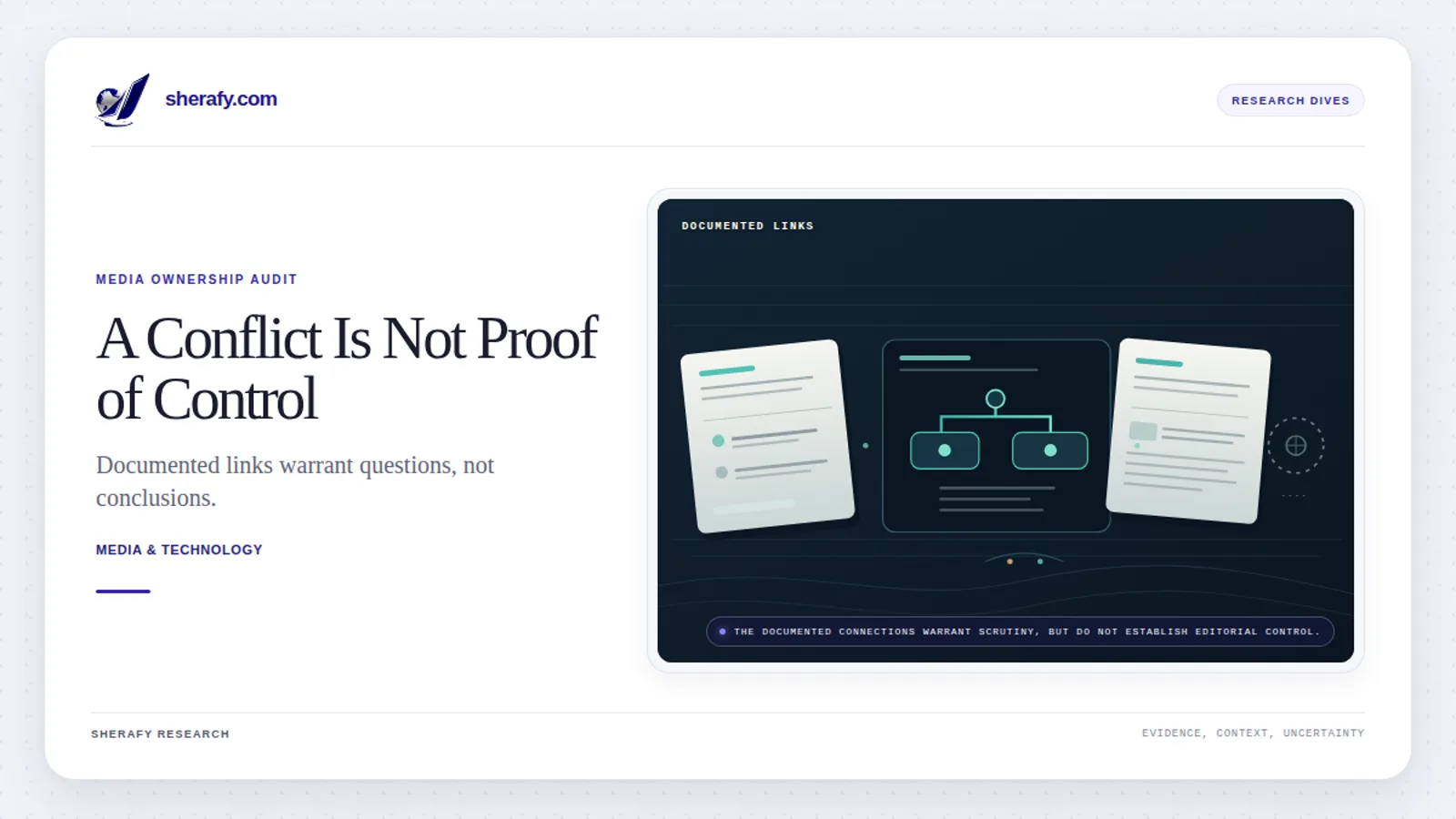
James Li identified a real professional relationship. The ownership records reveal a real potential conflict. Neither establishes the covert media operation he suggested.
Audrey Henson, the independent journalist behind The Drey Dossier, was described in a February 2026 profile as represented by United Talent Agency (UTA) and Anonymous Content. She now says she is no longer with UTA but retains a manager at Anonymous Content. The latter company is controlled by Emerson Collective, founded by billionaire Laurene Powell Jobs, who joined the board of the media company chaired by David Ellison in October. Drey has investigated the Ellisons and their media interests.
That overlap deserves disclosure and scrutiny. It does not, on the evidence available, establish that anyone instructed Drey to alter her journalism, suppress an investigation or mislead her readers. Conversely, the absence of evidence of interference does not remove the potential conflict or excuse any errors in her reporting.
The controversy also turns on a separate claim: that Israel orchestrated NVIDIA's leadership transition. James has made unusually strong assertions about that alleged takeover. NVIDIA's corporate filings document the executive changes, but they do not establish Israeli state control, an intelligence operation or the purported three-person Israeli shortlist.
Why we investigated: Hundreds of sherafy.com readers asked us to examine the dispute involving James Li, Drey Dossier and Ginny Said So. We have previously credited Drey's work. In our September investigation of newborn Social Security paperwork and Trump Accounts, her reporting prompted a review of federal records: we confirmed that Social Security announced an automatic-account pathway, while finding no adequate public evidence that requesting a newborn Social Security number through the ordinary published process, by itself, already opened an account nationwide. We disclose that history because we must scrutinize reporting we value as rigorously as reporting we question. We have not established that a formal contributor relationship with Drey remains active.
Help complete the record: If we missed a material document, misread a source or overlooked a relevant response, use the Cite/Challenge Article button at the top of this page. Evidence-based challenges are part of how sherafy.com keeps its reporting accountable and correctable.
Evidence reviewed through November 15, 2026. Verified documents, the parties' own statements and our inferences are distinguished throughout. This article does not claim to establish the contents of private management contracts or intelligence investigations.
What did James Li actually allege?
In a November 14 Instagram video, creator James Li questioned why a self-described independent investigative journalist would be represented by two prominent Hollywood companies. He cited UTA and Anonymous Content, described their entertainment-industry clients, and suggested that Drey might be part of a calculated effort to win an audience's trust before redirecting it at a critical moment.
His immediate complaint concerned the NVIDIA controversy. James portrayed Drey as resisting the conclusion that Israel was taking over the chipmaker. In his account, she argued that the Oracle and Larry Ellison connections were fundamentally an American accountability issue rather than evidence of Israeli corporate ownership.
James used the word honeypotted and asked whether she might be an op. Those were suggestions of possible covert manipulation, not findings supported by evidence presented in the video. The video established an avenue for investigating her representation; it did not establish the purpose or control of that relationship.
There was also a personal dimension. James said he had previously collaborated with Drey on coverage of Larry Ellison's media ambitions and recommended her reporting to his audience. His concern was framed as disappointment with someone he had publicly trusted. That history explains the dispute's intensity, not the truth of either side's claims.
The exchange continued on November 15. In Drey's public response, she acknowledged management through Anonymous Content, said her UTA relationship had ended, and explained that professional management could help connect a solo investigator to resources and support normally available within a newsroom. She denied that the arrangement had shaped her reporting and said she had discussed it publicly before.
In his subsequent response, James said his intention was to raise a potential conflict involving a billionaire-backed management company. But he also presented two speculative explanations: that Drey might be naive about her manager's interests, or that her explanation might conceal a covert media role. He acknowledged that he did not know which, if either, was true.
This progression matters. A question about professional conflicts became an allegation about hidden motives without the intervening proof. The question deserves an answer. The allegation requires additional evidence.
Was Drey Dossier represented by UTA and Anonymous Content?
Yes, at least as of February 2026. In a profile published February 27 by The Ankler, Natalie Jarvey identified Henson by name, described her earlier work at Verve Talent Agency and reported that she was then represented by UTA and Anonymous Content.
That report predates James's video by more than eight months. The historical relationship was therefore not merely an anonymous social-media rumor. It was documented in a named profile about Drey's career.
It is equally important not to freeze a February description in November. Drey says she is no longer with UTA but continues to have a manager at Anonymous Content. We found her public statement confirming that position; we did not independently examine termination notices or contracts. Accordingly, the accurate present-tense description is "Drey says Anonymous Content manages her and UTA no longer represents her," not "she currently has two Hollywood agencies."
An agent or manager can negotiate opportunities, arrange partnerships, coordinate business affairs and help a creator obtain professional support. Having one is not inherently inconsistent with producing independent reporting. The relevant question is whether the arrangement gives another party a financial or contractual ability to shape editorial decisions, and whether those interests are adequately disclosed.
That is where the ownership trail becomes significant.
Who controls Anonymous Content?
The chain is documented, and it is more substantive than a vague suggestion that Hollywood knows Hollywood.
In an October 20, 2026 report, Axios described how Emerson Collective acquired a substantial minority interest in Anonymous Content in 2016 and subsequently became its controlling investor. The article was based in part on an interview with Anonymous Content president and CEO Darren Walker about the company's willingness to consider outside investment.
Emerson Collective's own profile of Laurene Powell Jobs calls her its founder and president, identifies her as a lead investor and board member of Anonymous Content, and separately identifies her as a Skydance board member.
On October 6, Skydance announced that Powell Jobs was joining its board as an independent director. David Ellison remained chairman and chief executive of the newly combined company following Paramount's merger with Warner Bros. Discovery. Skydance listed CNN, CBS and HBO among the properties in its portfolio. Its board roster also included Safra Catz, Oracle's former CEO and executive vice chair.
The relationships are best stated precisely:
| Relationship | What is documented | What it does not establish |
|---|---|---|
| Emerson Collective → Anonymous Content | Controlling investment, according to Axios; Powell Jobs is identified as an investor and director | Which individual client articles, if any, an investor can influence |
| Anonymous Content → Drey | Drey acknowledges an ongoing management relationship | An editorial veto, instructions to suppress a story or a payment for particular conclusions |
| Powell Jobs → Skydance | Board membership confirmed by Skydance | That she speaks for all shareholders, directs CNN's coverage or controls Drey |
| David Ellison → Skydance | Chairman and CEO of the combined media company | Any communication with Drey or her manager about NVIDIA |
| Skydance → CNN and CBS | Corporate ownership of those media properties | A secret relationship between their editorial departments and Drey |
This is the key finding James's original video did not fully explain. The potential conflict is not simply that Drey has a Hollywood manager. It is that the manager's controlling investor has a governance role in a media company Drey has scrutinized.
That does not make Drey an employee of Skydance. It does not make Powell Jobs the owner of Drey's reporting. It gives readers a concrete reason to ask about editorial safeguards, financial incentives and disclosure.
Does the ownership overlap mean Drey is compromised?
Not on the present evidence. The relationship establishes the possibility of competing institutional interests, not proof that those interests changed a particular piece of reporting.
There are at least four distinct questions that should not be collapsed into one:
- Was the relationship real? Yes. The management relationship is acknowledged, and the ownership and board links are independently documented.
- Could interests overlap or conflict? Yes. An investor in a journalist's management company also sits on the board of a media business that journalist investigates. That creates an identifiable potential conflict.
- Did anyone possess contractual editorial authority? Unknown. We have not reviewed the management agreement or related communications.
- Was editorial pressure actually applied? Not demonstrated by the public records reviewed.
The distinction between questions three and four is important. Even if a contract eventually showed some form of approval right, a reporter would still need to establish its scope and whether it affected editorial work. Conversely, the absence of a contractual veto would not by itself exclude informal pressure. Neither outcome should be assumed.
The Society of Professional Journalists' Code of Ethics advises journalists to avoid or disclose conflicts, resist special-interest pressure and be accountable for errors. It is professional guidance, not a legal test or a finding that a particular journalist has violated it.
Applied here, the useful questions are straightforward: Does management have a right to review unpublished reporting? Can it veto publication, negotiate sponsors or receive compensation from entities under investigation? What happens when a story concerns one of the manager's investors or board-connected companies? Which relationships does Drey disclose to readers, and where?
Those are questions about mechanisms. They can be investigated. A generalized allegation that someone is controlled by billionaires cannot substitute for the answers.
What does Drey disclose?
Drey's public political disclosure policy, updated August 31, promises to disclose material relationships in political, governmental, public-policy and advocacy coverage. It says sponsors, guests and political organizations do not control her editorial conclusions and lists no current reportable political relationships at the date of the update.
The policy is relevant, but it is not a complete accounting of all professional service agreements. Its scope and language do not allow us to conclude automatically that the Anonymous Content arrangement breached it. Equally, a disclosure made once on a YouTube community page may be difficult for readers of a later investigation to find.
Drey says she disclosed the management relationship multiple times, including in a YouTube community post about a month before the dispute. We have now traced her response to the specific earlier post she cited. Its publicly displayed link preview refers to her recently obtaining additional professional support, but we could not retrieve the complete original text, independently verify that it explicitly named Anonymous Content, or establish the date and prominence of the disclosure. We can verify the post she pointed to, not its complete wording. It would therefore be inaccurate to describe the relationship as secretly concealed on this record. It remains reasonable to ask whether a durable, prominent disclosure would better serve readers when reporting touches companies linked to a manager's investors.
Did Drey abruptly stop criticizing Larry Ellison or Israel?
The published chronology complicates that accusation.
Drey's reporting on the Ellison media business preceded the dispute. Her February 25 investigation into CNN's future questioned the Ellison-led acquisition campaign. She also published work about Oracle's Israeli infrastructure and political relationships in 2025. Those pieces included her own strong claims and inferences; citing them here does not independently validate every assertion they contain.
More consequentially, she published Russia Is Coming for the Midterms on October 16, 2026, ten days after Powell Jobs joined Skydance's board. That article criticized the Ellisons' position in American media and explored concerns about the influence of CNN and CBS.
That is direct counterevidence to the narrow proposition that Drey stopped criticizing Ellison-linked media interests after the Skydance appointment. It is not proof that her manager has never exerted influence, nor does it establish that her treatment of every Israel-related claim has been consistent.
James portrayed Drey as saying the Oracle story should be understood as American accountability rather than an Israeli takeover. Taken literally, those are not mutually exclusive subjects. Oracle can be an American company and have significant business, political and personal connections to Israel. Larry Ellison can have substantial influence over an American corporation without Israel owning that corporation.
According to Oracle's September 2026 proxy statement, Ellison beneficially owned approximately 38.2% of the company's stock as of September 21. That is a substantial ownership position, not evidence that Oracle is an Israeli-owned company. It also does not negate the importance of documented Israeli business or political relationships.
The real disagreement may concern which level of causation best explains a particular event: American owners and directors, Israeli state institutions, private financial networks, or some documented combination. Each proposed explanation requires its own evidence.
We could review James's description of Drey's rebuttal and her published archive. We could not authenticate a complete original recording or transcript of the specific rebuttal he excerpted. For that reason, we do not declare that she made a complete ideological reversal, or that his excerpts necessarily represented her full argument.
What did James Li claim about NVIDIA, and what do the filings show?
Before James accused Drey of possibly redirecting public attention, he had already advanced a strong theory about NVIDIA's leadership.
On November 12, he claimed that the company's interim CEO was an Israeli asset and that the three leading candidates for permanent CEO were all Israeli. That allegation was far more specific than saying Israeli technology firms or investors have ties to NVIDIA.
The November 11 NVIDIA Form 8-K, filed with the SEC on November 12, says the board accepted Jensen Huang's resignation as president, CEO and director, effective November 11. It appointed Colette Kress, the company's chief financial officer since 2013, as interim CEO. The board also appointed Harvey Jones as chair.
The attached November 12 company announcement said the search for a permanent CEO would consider internal and external candidates. Neither filing supplies an Israeli-controlled shortlist, states that Kress works for Israeli intelligence or attributes the board's action to the Israeli government.
The filings do not necessarily reveal every private conversation among directors. But a gap in public disclosure is not evidence that a particular secret decision occurred. A claim of intelligence control requires affirmative corroboration, not an inference from an executive's supposed connections or a sequence of events.
Where did the claim about three Israeli candidates come from?
A Ynet successor analysis discussed three Israelis with relevant semiconductor backgrounds: Michael Kagan, Eyal Waldman and Johny Srouji. The same analysis also discussed other possibilities, including Ian Buck, Colette Kress and Lisa Su. It did not establish that NVIDIA's board had selected three Israeli finalists, ranked them above everyone else or made offers to all three.
We cannot establish that James relied on that article. It does, however, demonstrate a plausible claim-provenance problem: a news analysis about people who might be considered can become, in retelling, an assertion about people the board has selected. Add an unsupported intelligence allegation and speculation starts to masquerade as a verified takeover.
| Proposition | Evidence status |
|---|---|
| NVIDIA has important operations and technology relationships in Israel. | Documented corporate background; not evidence of takeover by itself. |
| Jensen Huang left NVIDIA's CEO and board positions on November 11. | Established by NVIDIA's SEC filing. |
| Colette Kress was appointed interim CEO. | Established by the same filing. |
| NVIDIA publicly confirmed three Israeli finalists. | No such confirmation identified. |
| Kress was acting for Israeli intelligence. | No substantiating evidence identified. |
| Israeli state actors directed the leadership transition. | Not established by the materials reviewed. |
This is not a reason to avoid investigating foreign influence in American technology. It is a reason to distinguish influence, commercial relationships, espionage allegations and demonstrated control. They are not interchangeable.
Our separate, already updated investigation, Did Israel Replace Jensen Huang at NVIDIA?, traced the viral Colette Kress quotation to a 2023 interview about NVIDIA's Israeli operations, examined her long-established corporate career, documented NVIDIA's substantial Israeli technology relationships, and found no evidence in the reviewed records that Israeli intelligence directed Huang's removal or Kress's appointment. It is the fuller reference for the leadership and takeover claims. This article focuses on how those claims became a test of trust between investigative creators.
Was Drey's own NVIDIA investigation accurate?
Drey's November 10 article, The Nvidia Spy Scandal Is Worse Than It Looks, centered on Megaspeed, a major buyer of NVIDIA computing equipment operating through Singapore and Malaysia. She connected the story to possible chip diversion to China, corporate ownership structures and questions about oversight.
Those are real subjects of official investigation. They should not be dismissed merely because James and Drey disagree over an Israeli takeover theory. But several steps in her analysis must be distinguished from established findings.
Our earlier investigation of Jensen Huang, Alice Huang and NVIDIA's $4.8 billion chip trail examined the reported trade records and Singapore inquiry, then compared Megaspeed-related concerns with the U.S. Commerce Department's 11 chip-diversion warning signs. It found reasons for closer due diligence, not proof that $4.8 billion in equipment was smuggled into China. Its November 12 update incorporated the subsequent leadership change and Singapore's official clarification.
1. The Megaspeed investigation is real; the alleged violations remain unresolved
In a November 12 statement, Singapore's Ministry of Home Affairs confirmed that police and customs authorities opened investigations in February 2025 involving Megaspeed and suspected false declarations about servers. Officials said they were examining whether equipment declared for Malaysia was subsequently sent elsewhere.
That is concrete government evidence that the supply-chain concern is not simply a rumor.
Malaysia offered a complementary official account on November 13. Its Ministry of Investment, Trade and Industry stated that Megaspeed's Malaysian affiliate, Speedmatrix, was a tenant at data centers, brought in its own servers and AI chips, and had not been cleared of wrongdoing by government inspections. The ministry said it was checking whether any chips were reexported and, if so, whether the transfers complied with Malaysian law. This helps distinguish the tenant, the data-center owner and the company operating the equipment. It is not a finding that a prohibited reexport occurred.
The same Singapore statement also sets crucial limits. Singapore says Alice Huang, also known as Huang Le, was not investigated there for espionage. Authorities concluded in February 2026 that evidence was insufficient to establish her involvement in the suspected declaration offenses, although she received a stern warning for knowingly providing inaccurate information to police about her role. Investigations concerning Megaspeed and six other individuals continued.
On November 15, the Associated Press reported Megaspeed's new statement that Alice Huang had left the company in August 2025 and that outside lawyers were conducting a company-commissioned investigation. Those are Megaspeed's assertions, not independently established findings or a substitute for government oversight.
Those facts do not clear every company of wrongdoing. They also do not permit an article to call Huang a proven spy or a convicted participant in chip diversion.
Separately, The Straits Times reported on a financial arrangement involving an Alibaba-owned Singapore company and Speedmatrix, a Malaysian Megaspeed subsidiary that pledged equipment and other assets. That is evidence of a financing relationship, not proof by itself of illegal reexports or of who ultimately operated particular chips.
2. The Malaysian land deal was previously reported
Drey wrote that Megaspeed's land purchase was a development she had not seen others cover. However, DataCenterDynamics reported the proposed sale on September 3, 2025, more than a year before her investigation. It identified a conditional agreement involving MSFusion, a Megaspeed subsidiary, for approximately 52 acres in Johor at roughly RM263.2 million ($62.2 million).
The original report said completion was subject to conditions, including approvals and a proposed 300-megawatt power allocation. The existence of a conditional power requirement should not be converted into a claim that power was already supplied to an operational data center.
The correction here is limited but real: the transaction was not previously unreported. It would be unfair to claim Drey knowingly concealed the earlier article. Her actual wording was that she had not seen the reporting. What she did with the public records may still amount to useful synthesis, but the land transaction itself was not an exclusive discovery.
3. A Chinese company name does not establish Chinese control of a facility
Drey said she examined Megaspeed's website source code and found references to Chinese data-center firms GDS and Chindata. She linked Chindata to Bridge Data Centres, a landlord associated with Megaspeed's facilities, and described buildings run by Chinese companies.
The two internal comment strings, Data Center 1 - Wanguo and Data Center 2 - Qinhuai, were subsequently reproduced by Desmond Shum and in a separate Chinese-language account published November 10. We also verified that Megaspeed's public data-center page labels its facilities DC1 and DC2 and gives the vague location "East South Asia." But the visible webpage does not expose HTML comments, and we could not independently inspect a preserved copy of the original page source. The republished strings corroborate that this observation circulated in published reporting; they do not establish that these authors each obtained the source code independently. The source-code finding remains attributed rather than independently authenticated by sherafy.com.
There is also a corporate-control distinction. Bridge Data Centres describes itself as a Singapore-headquartered operator backed by Bain Capital. Its historical relationship with Chindata does not alone establish that Chinese shareholders currently controlled a given facility, that the facility owner had access to customers' chips or that a data-center tenant violated export regulations.
Several relationships must be proven separately: who owns the land, who operates the facility, who owns the servers, who pays for access, who may access the computing power and who ultimately controls the customer. Similar corporate names are leads, not answers to all six questions.
4. The export-control mechanism is more complicated than a physical border
Drey characterized overseas rental of advanced chips as permissible if the equipment stayed in the data center. That is too categorical. In a May 2025 policy statement, the U.S. Bureau of Industry and Security explained that transfers of covered computing equipment to data-center providers can trigger licensing requirements when the relevant parties have knowledge of specified military-intelligence or weapons-related end uses. Export-control treatment can depend on the specific hardware, destination, controlling entities, licensing requirements, end users and nature of access. Physical shipment, reexport and remote cloud use also raise different questions.
For this story, the strongest conclusion is narrower: the risk of access by restricted end users requires investigation even when the chips are physically located outside China. Whether any specific transaction violated a particular rule cannot be inferred merely from renting a facility or using cloud computing.
5. What did Jensen Huang know?
Drey wrote that she found it difficult to believe Huang did not know what Megaspeed was doing. That expresses a suspicion about his knowledge. It does not establish he knew of unlawful diversion, authorized it or participated in it.
The concern is reasonable to examine given the scale of the transactions and the reported relationship between Huang and Alice Huang. But the proof would need to come from corporate communications, compliance warnings, meeting records, testimony or other corroboration. The existence of a commercial relationship does not settle knowledge of a suspected offense.
The result of this audit is not that Drey's reporting was fabricated. It identified genuine leads, drew on reporting about a real investigation, and raised questions worth answering. It also combined documented facts with inferences about ownership, legality and personal knowledge that require clearer limits. That is the same standard applied to James's NVIDIA theory.
The timeline: What was known, and when?
| Date | Event | Why the sequence matters |
|---|---|---|
| September 3, 2025 | DataCenterDynamics reports the proposed Megaspeed-linked land deal in Johor. | Establishes earlier public reporting of a transaction later discussed by Drey. |
| February 27, 2026 | The Ankler reports Drey's UTA and Anonymous Content representation. | Establishes that both were documented historically, not necessarily still active in November. |
| August 31, 2026 | Drey updates her public political disclosure policy. | Provides a dated statement of her disclosure commitments. |
| October 6, 2026 | Powell Jobs joins Skydance's board. | Creates the documented overlap between her management company's investor and a media company Drey investigates. |
| October 16, 2026 | Drey publishes further criticism of Ellison-controlled media. | Complicates the claim that she abruptly stopped scrutinizing the Ellisons. |
| October 20, 2026 | Axios describes Emerson as Anonymous Content's controlling investor. | Confirms the ownership relationship before James's video. |
| November 10, 2026 | Drey publishes her Megaspeed/NVIDIA investigation. | Supplies the reporting and inferences that deserve independent review. |
| November 13, 2026 | Malaysia clarifies that Speedmatrix is a data-center tenant and says it is checking possible reexports. | Distinguishes government inspection from clearance and facility tenancy from equipment ownership. |
| November 15, 2026 | Megaspeed tells AP that Alice Huang left in August 2025 and that it has commissioned an outside investigation. | Adds the company's latest position, not a regulatory finding. |
| November 11–12, 2026 | NVIDIA's board changes leadership; SEC documents are filed. | Establishes what the corporation officially disclosed. |
| November 12, 2026 | James alleges an Israeli intelligence asset and three Israeli CEO candidates. | Shows the takeover theory preceded the agency accusation. |
| November 14–15, 2026 | James questions Drey's representation; Drey responds; James expands on the conflict claim. | Shows how a documented business relationship became a dispute about alleged covert influence. |
Chronology is not proof of motive, but it can test a claim. If the alleged explanation requires Drey to have gone silent about the Ellisons after October 6, the October 16 publication matters. If a story is framed as previously unreported, the September 2025 article matters. If a confirmed shortlist is alleged, the company's actual November 12 disclosure matters.
What can we reasonably infer from the combined evidence?
A useful investigation does not stop at cataloging documents. It identifies what follows from them and where the logic breaks.
Inference one: There is a material potential conflict worth disclosing
Premises: Drey acknowledges management through Anonymous Content. Emerson Collective controls Anonymous Content. Its founder, Laurene Powell Jobs, serves on Skydance's board. Drey investigates the media businesses of Skydance's leadership.
Deduction: A journalist's professional intermediary is financially connected to a person with governance responsibilities at a company the journalist covers.
Reasonable inference: That arrangement creates a potential conflict of interest and a legitimate basis for asking about editorial safeguards and reader disclosure.
Unsupported leap: Therefore, Powell Jobs or Anonymous Content ordered Drey to reject an Israeli takeover explanation. The known facts do not demonstrate that instruction or its mechanism.
Inference two: James's interpretation goes beyond his strongest evidence
Premises: His original agency allegation was supported by contemporaneous reporting. His additional allegation was that this relationship might make Drey part of a covert influence operation. His own follow-up acknowledged uncertainty.
Deduction: The documented professional relationship cannot logically establish the covert-operation allegation without independent evidence connecting the parties to the alleged acts.
Reasonable inference: The suspicion developed from a real conflict question into a much broader explanation of motive and control than the available documents justify.
Unsupported leap: Therefore, James was deliberately dishonest. Overconfidence, mistaken reasoning, selective presentation and intentional deception are different explanations. The record does not establish his private intent.
The evidentiary standard for a real influence operation is not impossible to meet. In our investigation of Israel-linked Stagwell communications work and a separate STOIC fake-account campaign, the available evidence included identifiable contractors, a filed statement of work and independent platform attribution. We distinguished proposed messaging activities from actions known to have occurred. Those separate operations do not implicate Drey, James, Anonymous Content or NVIDIA. They illustrate why identifying an actual operation requires more than mapping professional acquaintances and financial connections.
Inference three: Drey's public conduct complicates the simplest censorship theory
Premises: Powell Jobs joined Skydance's board on October 6. Drey publicly criticized Ellison-linked media interests on October 16.
Deduction: She did not stop all criticism of that business after the appointment.
Reasonable inference: A theory of blanket suppression is inconsistent with at least one observable publication.
Unsupported leap: Therefore, her management relationship could never influence a narrower editorial decision. One counterexample cannot prove complete independence in every circumstance.
Inference four: The NVIDIA takeover theory needs a causal mechanism
Premises: NVIDIA has Israeli business relationships. Israeli executives were discussed as possible CEO candidates. The board removed Huang and appointed Kress on an interim basis.
Deduction: Those facts establish relationships and a corporate leadership transition.
Not established: That Israeli state actors exercised control over the board, chose Kress, selected three Israeli finalists or directed the outcome.
The missing information is not a technicality. It is the central causal link. Without it, several individually true facts have been assembled into a conclusion they do not prove.
What about the accusations of grifting and the sale of merchandise?
James sells branded merchandise and promotes commercial offerings. Drey offers paid subscriptions and works with professional management. Those are different business arrangements, but neither is automatically disqualifying.
A commercial interest becomes relevant when it can plausibly affect coverage: undisclosed sponsorship, payment linked to favorable reporting, editorial approval by a financial backer, withheld corrections, or a demonstrable pattern of changing claims to serve a paying interest.
Selling a shirt is not proof of deception. Receiving professional management is not proof of institutional capture. A creator's business model deserves scrutiny where it intersects with reporting decisions, not as a substitute for checking those decisions.
That principle applies to independent publishers, including sherafy.com. Revenue and audience alignment must not decide the result of an investigation.
Where does Ginny Said So fit into this dispute?
Readers have also cited Ginny Said So's commentary about NVIDIA and Israel as a reason they requested this investigation. Her involvement helps explain the public attention, but we could not authenticate the complete original video and exact allegations relevant to this dispute.
We therefore do not attribute a specific factual allegation to her merely because another creator or a third-party commentary account described it. A complete audit of her claims would require the original material, its date and any supporting records. This is an acknowledged limitation, not an implied endorsement or dismissal of her position.
The evidence matrix: What is verified, disputed or unsupported?
| Reader question or circulating claim | Our finding | Basis and limit |
|---|---|---|
| Was Drey represented by UTA and Anonymous Content? | Verified historically. | The Ankler, February 27, 2026. |
| Is she currently represented by both companies? | Not established. | Drey says UTA ended and Anonymous Content management continues; private records not inspected. |
| Is Emerson Collective Anonymous Content's controlling investor? | Supported. | Axios reporting and Emerson's own description of Powell Jobs's role. |
| Does Powell Jobs sit on Skydance's board? | Verified. | Skydance's October 6 corporate announcement. |
| Is there a potential conflict when Drey covers Skydance-linked interests? | Reasonable inference. | Documented overlap between professional management and media-company governance. |
| Has Powell Jobs or Anonymous Content instructed Drey to change reporting? | Not demonstrated. | No contract, instructions or firsthand account of interference obtained. |
| Did Drey stop criticizing the Ellisons after Powell Jobs's appointment? | Contradicted as a blanket claim. | Drey's October 16 criticism is a public counterexample. |
| Did Drey necessarily breach her disclosure policy? | Unresolved. | The policy's scope and materiality must be interpreted against the actual arrangement. |
| Was Kress identified in public records as an Israeli intelligence asset? | No substantiation identified. | NVIDIA filings document her executive position, not the allegation. |
| Did NVIDIA confirm three Israeli CEO finalists? | No. | Official documents describe an open internal/external search; speculation is not a board shortlist. |
| Is the Megaspeed chip-diversion investigation real? | Verified. | Singapore's official statement and independent reporting. |
| Was Alice Huang found guilty of espionage by Singapore? | No. | Singapore specifically said it did not investigate her for espionage and found insufficient evidence for the suspected declaration offenses against her. |
| Was Megaspeed's Johor land transaction first reported by Drey? | No. | DataCenterDynamics reported it in September 2025; Drey said only she had not seen earlier coverage. |
| Do historical Chindata connections prove current Chinese control of Megaspeed's landlord? | No. | Bridge's current disclosed ownership and operational structure require separate analysis. |
| Does a financial arrangement with an Alibaba affiliate prove illegal exports? | No. | The relationship is reported, but its legality and actual uses require additional evidence. |
| Does James's merchandise business establish dishonesty? | No. | Monetization is not evidence of a false factual claim or bad-faith intent. |
What remains unknown, and what evidence would change the picture?
The decisive questions are not answered by the public corporate documents alone.
On Drey's independence: Her current management agreement, any editorial-review provisions, sponsorship arrangements, relevant correspondence, and the exact earlier disclosure she says she made could establish stronger safeguards or reveal forms of influence. The record we reviewed does not contain them.
On James's NVIDIA allegation: Documentary evidence of a board-directed foreign intervention, an authentic internal candidate shortlist, an attributable intelligence finding, or communications showing a coordinated operation would materially change the assessment. Assertions about nationality, timing or business ties do not supply that proof.
On Drey's reporting: The company's public DC1/DC2 presentation, Malaysian government statement and independently published reproductions of two alleged HTML comments are now documented, but the actual preserved source-code file is not. A dated view-source: capture, dated ownership filings, facility contracts, compliance communications and evidence identifying actual chip end users would permit firmer conclusions about her November 10 investigation.
On the public dispute: We could verify the supplied timestamped transcript of James's Instagram video, Drey's November 15 public response and James's subsequent written reply. We also recovered a direct link to the earlier YouTube post Drey cited, but not its full text or independently authenticated posting date. We could not independently review the complete original Drey NVIDIA rebuttal excerpted by James, Ginny's complete relevant video or private management contracts. No direct interviews or private responses are represented as having been obtained for this article.
We welcome substantive responses from Drey, James, Ginny, Anonymous Content, UTA and any other party whose documents or firsthand knowledge can clarify these points. Material new evidence will be assessed against the same standard and reflected in the article's update record.
What should readers conclude?
There is a real story here, but it is not the one that can be established by calling a journalist an operative.
James raised an identifiable concern. Drey has a professional manager whose controlling investor is connected, through a documented board role, to a major media company she investigates. Readers are entitled to ask what protections preserve her independence and how those connections are disclosed. That inquiry should not be waved away because of her past investigative work or sherafy.com's familiarity with it.
At the same time, public records do not establish that Drey's management company dictated her NVIDIA coverage or that she was planted to mislead an audience. Her continued criticism of Ellison-linked media interests is relevant counterevidence to the simplest version of that theory.
James's own claims about an Israeli intelligence asset and a three-person Israeli CEO shortlist have not been substantiated by NVIDIA's filings or the candidate reporting examined here. Drey's Megaspeed investigation, meanwhile, identifies genuine oversight questions while making some inferences about corporate control, legality and personal knowledge that go beyond what the cited records prove.
Readers do not have to confer blanket trust on either creator to recognize when one of them is right about a document and wrong about what follows from it.
The proper conclusion is narrower than the accusations and more useful than choosing sides: the relationships are documented, the potential conflict is real, the alleged covert control remains unproven, and both creators' factual claims remain open to independent challenge.
No person, company, government or publication earns an exemption from that standard. Including this one.
References and Further Reading
Original statements and disclosures
- James Li, November 14 Instagram reel. The original video that prompted reader requests, alleging Drey's representation and suggesting possible covert influence. Our analysis uses the supplied timestamped transcript.
- James Li, November 12 NVIDIA allegation. The original post asserting an Israeli intelligence asset and three Israeli CEO candidates, neither established by the corporate records reviewed.
- Drey Dossier, November 15 response to James Li. Her account of ending UTA representation, retaining Anonymous Content management and denying editorial influence.
- Drey Dossier, earlier YouTube community post cited in her response. Exact post URL traced through her public reply. Full original text and posting date could not be independently verified; it is evidence of the post she invoked, not conclusive proof of the disclosure's wording.
- James Li, November 15 follow-up. His explanation of the conflict allegation and more speculative covert-influence alternatives.
- The Drey Dossier, Political Disclosure Policy. The August 31 policy describing disclosure of material political and advocacy relationships and commitments to editorial independence.
Ownership, governance and professional representation
- Natalie Jarvey, The Ankler: She Quit Hollywood. Now They Subscribe to Her in Secret. February 27, 2026 profile identifying Audrey Henson's prior agency work and then-current UTA and Anonymous Content representation.
- Sara Fischer and Christine Wang, Axios: Anonymous Content CEO Says Firm Is Open to Outside Investment. Documents Emerson Collective's progression from a 2016 minority investor to Anonymous Content's controlling investor.
- Emerson Collective: Q&A With Founder and President Laurene Powell Jobs. Official statement of her Anonymous Content investment and board involvement, as well as Skydance board service.
- Skydance: October 6, 2026 Board Announcement. Corporate documentation of Powell Jobs's appointment, Ellison's leadership and the combined media portfolio.
- Oracle Corporation: 2026 Proxy Statement. SEC disclosure of Larry Ellison's reported beneficial share ownership.
The creators' investigative records and NVIDIA documents
- The Drey Dossier: Russia Is Coming for the Midterms. October 16 criticism of the Ellison-controlled media business, useful for testing allegations of a categorical change in coverage.
- The Drey Dossier: We Should All Be Freaking Out About CNN. Earlier examination of the Ellison bid for CNN's parent company.
- The Drey Dossier: The Nvidia Spy Scandal Is Worse Than It Looks. November 10 reporting audited for source provenance, corporate ownership claims and inferential limits.
- NVIDIA: November 11, 2026 Form 8-K. Primary record of Huang's resignation and Kress's interim appointment.
- NVIDIA: November 12 CEO Transition Announcement. The board's public description of its succession search.
- Raphael Kahan, Ynet: After Jensen Huang: The Israelis Who Could Inherit Nvidia's AI Empire. A speculative successor analysis that also names non-Israeli candidates; not a confirmed board shortlist.
Megaspeed, data centers and official investigations
- Singapore Ministry of Home Affairs: Investigations Into Alice Huang and Megaspeed. November 12 official account of the suspected declaration offenses, Huang's questioning and warning, and the ongoing investigation.
- Malaysia Ministry of Investment, Trade and Industry: November 13 Megaspeed/Speedmatrix statement (PDF). Confirms Speedmatrix was a tenant, inspections did not clear wrongdoing, and reexports were under review.
- Associated Press: Megaspeed's November 15 account and external legal review. Reports the company's assertions about Huang's departure and its commissioned investigation, without treating them as official findings.
- Dan Swinhoe, DataCenterDynamics: Malaysia's Crescendo Corp Sells Land in Johor for Data Center. September 3, 2025 report establishing an earlier public account of the conditional MSFusion land purchase.
- Bridge Data Centres: Who We Are. The operator's current corporate description as Singapore-headquartered and Bain-backed, relevant to distinguishing corporate origins from control.
- Megaspeed: Data Center page. Public DC1/DC2 descriptions and "East South Asia" location wording; publicly displayed text does not independently authenticate the alleged HTML comments.
- Desmond Shum: Alice Huang, the Spy Narrative and Her Business. Reproduces the reported Wanguo/Qinhuai comments but does not publish an authenticated original source-code snapshot.
- Chinese-language discussion reproducing reported Megaspeed comments. A second account of the same reported HTML strings; not proof of independent capture or a contractual data-center relationship.
- U.S. Bureau of Industry and Security: May 2025 Policy Statement on Advanced Computing Access. Official explanation of situations in which supplying computing equipment through foreign data-center providers can still implicate export authorization requirements.
- The Straits Times: Alibaba–Megaspeed Financing Link Traced Via Singapore and Malaysia Units. November 12–13 reporting on a financial arrangement involving a Megaspeed subsidiary, without establishing illicit chip exports.
Related sherafy.com investigations
- Katrina Vide, Does Newborn Social Security Paperwork Automatically Open a Trump Account?. A reader-oriented example of how we credited Drey's reporting lead, confirmed an underlying federal-policy concern, and independently qualified claims the public record did not establish.
- Sherafgan Khan, Jensen Huang, Alice Huang and NVIDIA's Espionage Allegations: The $4.8 Billion Chip Trail Explained. Our review of the Megaspeed imports, Singapore findings, Commerce Department warning signs and unresolved questions about chip diversion, updated November 12.
- Sherafgan Khan, Did Israel Replace Jensen Huang at NVIDIA?. Our investigation of Kress's biography, NVIDIA's Israeli operations, the leadership filings and claims of Israeli intelligence control.
- Elle Dayan, Israel, Stagwell and “Radical Jihadism”: Did Israel Use Fear of Muslims to Rebuild Support?. An unrelated, document-backed investigation illustrating the evidentiary difference between filed communications plans, actual influence operations and unsupported allegations about particular people.
Editorial standards
- Society of Professional Journalists: Code of Ethics. Nonbinding professional guidance on independence, conflicts of interest, source verification, transparency and corrections.
Editorial currency note: This investigation reflects publicly available material reviewed through November 15, 2026. Corporate representation, investigations, legal proceedings and additional public statements may change. New primary evidence or substantiated challenges should be incorporated into the dated article record rather than silently replacing earlier findings.