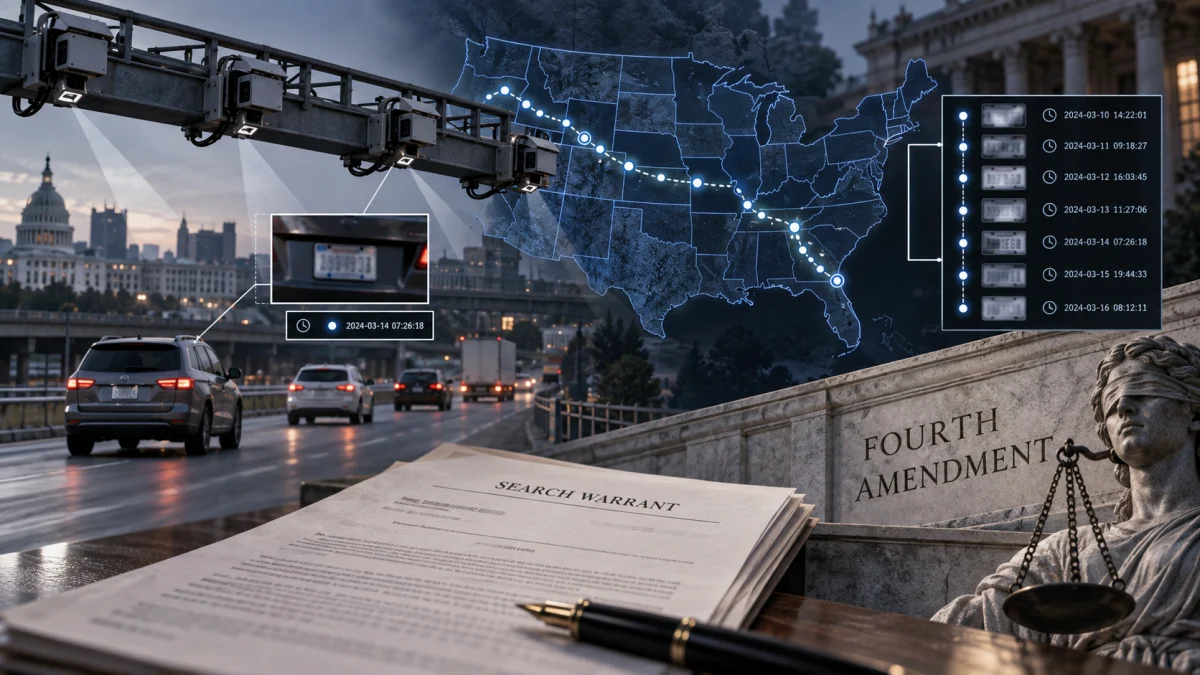
Police do not currently face a nationwide rule requiring a warrant every time they search Flock Safety or another automated license-plate-reader database.
But a new federal ruling has moved the constitutional debate in an important direction.
On October 1, 2026, U.S. District Judge Sara E. Hill of the Northern District of Oklahoma held that a deputy conducted a Fourth Amendment search when he used automated license-plate-reader systems to retrieve an entire month of a vehicle’s historical movements. The search returned more than 50 sightings across multiple states. Because the deputy searched without a warrant, probable cause or an identified exception to the warrant requirement, Hill held the search unconstitutional and suppressed the resulting evidence.
The 38-page opinion in United States v. Kyle uses unusually strong language, describing the technology at issue as a form of “indiscriminate mass surveillance.”
But the viral version — “a federal judge ruled Flock cameras unconstitutional” — is too broad.
The court did not hold that installing a Flock camera is itself unconstitutional. It did not say that photographing a visible license plate is always a Fourth Amendment search. It did not decide that every real-time hotlist alert requires a warrant. And because Kyle is a federal district-court ruling, it does not create binding nationwide precedent or even binding Tenth Circuit precedent.
What Hill did decide is narrower and potentially more consequential:
When police can enter a plate number and retrospectively reconstruct a substantial portion of a vehicle’s movements from a large, continuously populated ALPR network, the fact that each individual plate observation occurred in public may no longer end the Fourth Amendment analysis.
Recent courts have reached the opposite result on materially narrower ALPR uses. The Supreme Court, meanwhile, issued a major location-privacy decision in June 2026 that those earlier ALPR decisions did not have when they were decided.
That is why the answer to “Do police need a warrant to search Flock?” is now more complicated than a simple yes or no.
The short answer: when does police use of Flock require a warrant?
As of October 4, 2026, the answer depends heavily on what police are doing with the system, how much historical information the query reveals, and which court’s law applies.
| Police use | Current legal picture |
|---|---|
| Officer visually sees and runs one license plate on a public road | Generally not treated as a Fourth Amendment search merely because the plate itself was visible in public |
| Sparse local LPR network generates an alert tied to a person with an outstanding warrant | The Fifth Circuit held on the facts of United States v. Porter that the LPR use was not a search and no warrant was required |
| Police conduct a narrow Flock query around a specific crime and obtain one relevant vehicle image | The Virginia Court of Appeals held on the facts of Robinson v. Commonwealth that the query was not a Fourth Amendment search |
| Police retrieve an entire month of historical ALPR locations, including more than 50 sightings across multiple states | The Northern District of Oklahoma held in United States v. Kyle that the query was a Fourth Amendment search and that the warrantless search was unconstitutional |
| Police obtain a person’s historical Google Location History | The Supreme Court held in Chatrie v. United States that obtaining the location history is a Fourth Amendment search, even though the requested period at issue was roughly two hours |
| Every future Flock or ALPR query nationwide | No national rule says every query requires a warrant |
Even where a court says an ALPR query is a Fourth Amendment “search,” that does not mean a warrant is literally required in every imaginable circumstance. Ordinary Fourth Amendment exceptions, including exigent circumstances in appropriate cases, can still matter.
The increasingly important question is not whether a license plate is visible in public. It plainly is.
The harder question is whether aggregating large numbers of public observations into a searchable historical movement database creates a constitutionally different form of surveillance.
Kyle says that, at sufficient scale, it can.
What actually happened in United States v. Kyle
The facts matter because Judge Hill’s ruling was not based on an abstract challenge to Flock cameras.
Tulsa County Deputy Sheriff Freddie Alaniz was parked beside a highway when he saw a Mazda SUV with a California license plate. According to the court’s factual findings, he began following the Mazda “for no apparent reason other than” the California plate.
Alaniz had access to at least two ALPR systems:
- Flock
- VehicleManager
The court said the products had different capabilities but performed the same essential function relevant to the case: gathering and organizing historical vehicle-location observations from larger camera networks.
At the time of the incident, Alaniz could access at least 30 days of vehicle-location information from many states, although the systems available to him did not include California data.
Before the traffic stop, Alaniz queried the Mazda’s plate. The systems asked him to enter reasons for the searches; he entered “traffic violation” and “investigation.”
Hill found that when those queries were run, all Alaniz actually knew was that the Mazda had a California plate.
The search supplied information he did not have before. It showed that the Mazda had traveled from the Locust Grove, Oklahoma, area toward the California-Arizona border and was heading back toward Missouri after a relatively short trip.
Alaniz continued following the Mazda and then observed traffic violations. He stopped the vehicle.
That distinction matters: Hill held that the initial traffic stop itself was lawful. The court found an objectively reasonable basis for stopping the Mazda because the driver had followed another vehicle too closely.
The constitutional violations occurred elsewhere.
The evidence was suppressed for two independent Fourth Amendment violations
This is one of the most important parts of the decision, and much of the early discussion has compressed the case into a single “Flock search was unconstitutional” story.
Hill found two separate Fourth Amendment violations, each supporting suppression.
First: the deputy unlawfully prolonged the traffic stop
Alaniz questioned driver Melisa Susan Kyle about her trip while completing a written warning. He then returned her license and gave her the warning.
At that point, the traffic mission was complete.
Kyle initially agreed to answer additional questions. Alaniz explained that he worked highway criminal interdiction, discussed the short California trip and asked for permission to search the vehicle.
Kyle refused.
Alaniz then told her she was being detained so he could conduct a dog sniff.
Hill analyzed the government’s claimed indicators of drug trafficking — including the short trip, travel explanation, amount of luggage and nervousness — and concluded that, taken together, they did not provide reasonable suspicion sufficient to continue detaining Kyle after the traffic stop was over.
The court called the suspicion “inchoate rather than reasonable.”
Hill therefore held that the continued detention violated the Fourth Amendment and suppressed the evidence obtained afterward.
Second: the historical ALPR query was itself an unconstitutional search
Hill then separately analyzed the plate-reader query.
The court held that retrieving the historical vehicle-location records was itself a Fourth Amendment search. The query reached an entire month of history and returned more than 50 sightings across multiple states.
Because the search was conducted without probable cause, without a warrant and without an applicable exception identified by the government, Hill independently held that the ALPR search violated the Fourth Amendment.
The court again reached suppression, concluding that evidence obtained after the ALPR search was fruit of the unconstitutional search.
That procedural structure matters.
If an appellate court eventually rejected Hill’s ALPR analysis, prosecutors would still have to overcome her separate ruling that the traffic stop was unlawfully prolonged. Conversely, if the traffic-stop ruling were reversed, the ALPR ruling currently supplies a separate basis for suppression.
This was not a one-issue suppression order.
What the court did — and did not — declare unconstitutional
| Claim | Verdict |
|---|---|
| “A federal judge ruled a warrantless month-long historical ALPR search unconstitutional.” | Correct. |
| “A federal judge ruled all Flock cameras unconstitutional.” | Incorrect. |
| “Police now need warrants for every Flock search nationwide.” | Incorrect. No such nationwide rule exists. |
| “The judge ruled that photographing any visible license plate is itself a search.” | No. The opinion focuses on retrieving and aggregating historical location records. |
| “The ruling involved only Flock.” | No. The deputy used both Flock and VehicleManager, and the court analyzed the ALPR systems collectively. |
| “The judge held that a month of searchable vehicle history can implicate privacy in a person’s movements.” | Yes. |
| “The ruling decides whether every real-time hotlist alert needs a warrant.” | No. That issue was not before the court. |
| “The initial traffic stop was unconstitutional.” | No. Hill found the initial stop justified; the later extension was unlawful. |
| “The ruling proves Kyle was innocent.” | No. Suppression addresses how evidence was obtained, not whether the charged conduct occurred. |
The U.S. Attorney’s Office for the Northern District of Oklahoma says Kyle, 46, of Crane, Missouri, was charged with possessing more than 500 grams of methamphetamine with intent to distribute. An indictment is an accusation, not a conviction.
Why courts traditionally allowed license-plate-reader searches
The government’s argument in Kyle is familiar and has prevailed in many earlier cases.
A license plate is displayed on a public road. Anyone standing beside that road can see it. Drivers ordinarily do not have a reasonable expectation that their plate number, vehicle color, make or direction of travel will remain invisible to observers.
That reasoning draws heavily from the Supreme Court’s 1983 decision in United States v. Knotts.
Knotts involved police using a radio beeper to help follow a vehicle carrying chemicals associated with drug manufacturing. The Supreme Court held that a person traveling on public roads generally has no reasonable expectation of privacy in movements that could be observed by people along the route.
But Knotts also contained an important reservation.
The defendant warned that electronic tracking might eventually permit dragnet-style, round-the-clock surveillance without judicial oversight. The Supreme Court said the relatively primitive technology before it did not present that situation and left open whether different constitutional principles could apply if such surveillance eventually emerged.
Hill treated large networked ALPR databases as raising the problem Knotts left for another day.
The legal issue is therefore increasingly about aggregation.
An officer seeing a car outside one store is one observation.
A database that can tell an officer where the same vehicle was observed more than 50 times across several states during the previous month is a different surveillance capability.
Carpenter changed the location-privacy framework
The Supreme Court made that aggregation problem much harder to ignore in Carpenter v. United States in 2018.
There, the government obtained historical cell-site location records tracing a person’s movements over time.
The Court held that people retain a reasonable expectation of privacy in the whole of their physical movements, even though individual movements occur in locations visible to others.
The importance of the dataset was not that every individual point was secret. It was that the accumulated records allowed the government to reconstruct a person’s movements retrospectively.
Ordinary physical surveillance usually requires police to choose someone to follow before the surveillance occurs and devote personnel to the task.
A historical location database can invert that sequence: collect first, identify a target later, then reconstruct where the target had already been.
That distinction sits at the center of the modern ALPR dispute.
Then the Supreme Court decided Chatrie in June 2026
The biggest doctrinal development separating Kyle from the recent appellate decisions in Porter and Robinson is the Supreme Court’s June 29, 2026 decision in Chatrie v. United States.
Chatrie involved Google Location History obtained through a geofence warrant, not Flock cameras.
That difference matters. Google Location History can be substantially more precise and comprehensive than ordinary ALPR records and can follow a phone into places a car cannot go.
But the Supreme Court held that police conduct a Fourth Amendment search when they acquire a person’s Google Location History because people have a reasonable expectation of privacy in that location information.
Most importantly for the ALPR debate, the Court rejected the government’s argument that the approximately two-hour period at issue was categorically too short to receive Fourth Amendment protection. The Court also rejected the idea that the location information lost constitutional protection merely because it was held by a third-party technology company.
There is an important limit to what Chatrie decided.
The Supreme Court held that obtaining the Location History was a search, but it did not finally decide whether the particular geofence warrant was reasonable under the Fourth Amendment. The Court vacated the judgment and remanded for further proceedings on that issue. The Supreme Court docket reflects the June 29 judgment.
So Chatrie does not say “Flock is unconstitutional,” and it does not eliminate the distinction between dense cellphone data and intermittent plate-reader observations.
What it does strengthen is a broader proposition: modern location surveillance cannot always be analyzed by isolating each data point and asking whether that single observation occurred in public.
Judge Hill expressly relied on that reasoning in Kyle.
Why the Fifth Circuit reached the opposite result in United States v. Porter
The strongest recent federal appellate precedent cutting the other way is the Fifth Circuit’s March 17, 2026 decision in United States v. Porter.
An officer received an LPR alert for a vehicle associated with criminal activity. Dispatch told him the vehicle was associated with Elijah Porter, who had an outstanding aggravated-assault warrant.
The local system was comparatively sparse. The officer estimated that no more than ten LPR cameras operated around Gautier, Mississippi.
The Fifth Circuit held that the LPR use was not a Fourth Amendment search and therefore did not require a warrant.
Its reasoning emphasized the system’s limits. The cameras produced periodic vehicle-location observations only when a car happened to pass one of a small number of camera sites. The system could not continuously follow a person, could not track someone inside buildings and was materially less comprehensive than the cellphone records involved in Carpenter.
That is important precedent, especially within the Fifth Circuit.
But it did not involve the same surveillance capability or investigative posture as Kyle.
And the chronology matters:
- March 17, 2026: Fifth Circuit decides Porter.
- June 29, 2026: Supreme Court decides Chatrie.
- October 1, 2026: Judge Hill decides Kyle.
Porter therefore did not have the benefit of the Supreme Court’s later Chatrie opinion.
That does not mean Chatrie automatically overruled Porter. Porter remains published Fifth Circuit precedent unless the Fifth Circuit or Supreme Court displaces it. The technologies and factual records are also materially different.
But Kyle is an early example of a lower court applying Chatrie’s location-privacy reasoning to the ALPR context.
Virginia also reached the opposite result — on a narrow query
The Virginia Court of Appeals reached another anti-warrant result on April 7, 2026 in Robinson v. Commonwealth.
Norfolk had installed 172 Flock cameras. That sounds much closer to the network-scale concern in Kyle than the roughly ten-camera system described in Porter.
But what investigators actually searched was much narrower.
Police were investigating burglaries. Surveillance footage showed a white BMW SUV with black rims, but not its plate. A detective searched Flock using vehicle characteristics and a roughly two-hour time window. The query returned one relevant image, which revealed the license plate and allowed police to identify the registered owner.
The Virginia Court of Appeals held that the query did not amount to the kind of comprehensive tracking addressed in Carpenter. It emphasized that the cameras captured intermittent exterior images of vehicles on public roads and that the particular search did not create a complete chronicle of Robinson’s movements.
Again, chronology matters: Robinson was decided in April, more than two months before Chatrie.
That does not erase Robinson. It does mean that both major appellate decisions currently cited against treating ALPR access as a Fourth Amendment search were issued before the Supreme Court’s latest location-privacy ruling.
Four cases, four materially different surveillance problems
| Case | Data police accessed | Scope | Investigative posture | Result |
|---|---|---|---|---|
| United States v. Kyle — N.D. Oklahoma, Oct. 1, 2026 | Flock and VehicleManager historical ALPR data | Entire month; more than 50 sightings; multiple states | Query began when deputy essentially knew only that vehicle had a California plate | Fourth Amendment search; warrantless query unconstitutional |
| United States v. Porter — 5th Cir., Mar. 17, 2026 | Local LPR system and alert | Roughly ten cameras; periodic hits | Vehicle associated with Porter, who had an outstanding aggravated-assault warrant | Not a search on those facts; no warrant required |
| Robinson v. Commonwealth — Va. Ct. App., Apr. 7, 2026 | Norfolk Flock database | 172-camera network, but narrow query returned one relevant image | Specific burglary investigation using vehicle characteristics and a short time window | Not a search on those facts |
| Chatrie v. United States — U.S. Supreme Court, June 29, 2026 | Google Location History | Precise cellphone location; roughly two-hour period at issue | Geofence investigation | Acquiring Location History is a Fourth Amendment search; reasonableness of the warrant was remanded |
The key variable is increasingly not the brand name printed on the camera.
It is the surveillance capability created by the network, the database and the query.
Kyle is better understood as an aggregation ruling than a “license plates are private” ruling
Nothing in Kyle makes an individual license plate secret.
If an officer is sitting beside a road, sees a blue Honda with a particular plate and writes the number down, the Fourth Amendment analysis is very different from querying a database of millions of automatically collected observations.
The harder constitutional problem appears when cameras preserve comparable observations at scale and software allows an officer who was never present at those locations to reconstruct past movement on demand.
Hill acknowledged that ALPR data does not provide the same fine-grained tracking as a cellphone. The vehicle in Kyle was not continuously tracked mile by mile.
But the systems still returned more than 50 records spanning a month and multiple states. Hill concluded that the aggregate implicated the protected interest in the whole of a person’s movements.
That is why the ruling should not be summarized as “license plates are private.”
The argument is that a sufficiently revealing historical compilation can raise a privacy interest even when each underlying observation happened in public.
The fact that Kyle involved two ALPR products matters
Public discussion understandably focuses on Flock because Flock Safety is the best-known national ALPR vendor.
The court’s analysis was broader.
Alaniz had access to both Flock and VehicleManager, and Hill repeatedly discussed the challenged conduct in terms of the ALPR systems and the historical movement records they produced.
That matters because the constitutional question is not inherently tied to Flock’s proprietary technology.
If another vendor gives police the same functional capability — a searchable retrospective history of a vehicle’s movements across many jurisdictions — the same Fourth Amendment question can arise.
Conversely, a Flock deployment producing only a few isolated observations may look more like the limited systems discussed in Porter or Robinson.
The relevant variables include coverage, duration, precision, aggregation, retention and the purpose and scope of the query.
For a deeper technical explanation of what the network can and cannot reconstruct, see sherafy.com’s Can Flock Cameras Track You? What They Record and Who Can Search It.
Flock changed its retention policy — but that does not settle the constitutional issue
Flock announced substantial privacy-policy changes in August 2026.
The company’s current Evidence Policy, last updated August 12, states that its standard retention period is seven days and that data is hard-deleted after the retention period. The policy also says customer agreements or applicable laws can specify different periods. If a law-enforcement customer wants a longer period that is not already required by local law, Flock says it can offer retention of up to one year after approval by an elected official or governing body.
A separate August 13 company announcement describes additional controls, including mandatory misuse detection, proactive lockouts, required case codes, audit assistance and multi-factor authentication.
Those are relevant changes, but they should be understood for what they are: company policies and product controls, not constitutional rulings.
They also do not change the historical facts in Kyle. Hill found that at the time of the incident, the deputy had access to at least 30 days of location information in many states.
A seven-day retention period may reduce the amount of retrospective history available in many future cases. It does not automatically answer whether a sufficiently dense seven-day movement history can become a Fourth Amendment search.
Chatrie is especially important here because the Supreme Court rejected the idea that a short duration is automatically outside Fourth Amendment protection when the underlying location data is sufficiently revealing.
Flock says Kyle is an outlier — and it has a real precedent argument
Flock disagrees with Hill’s ruling.
In a statement reported by The Washington Post, company spokesperson Paris Lewbel said the decision ran against the weight of authority in similar cases and that Flock expected it to be appealed and overturned.
That is not an invented defense.
Hill herself acknowledged that nearly every court she found had previously concluded that ALPR use was not a Fourth Amendment search, including other federal courts in Oklahoma.
That precedent is a major reason not to describe Kyle as settled national law.
There is also an important procedural point: Flock is not a party to the criminal prosecution.
The case is United States v. Melisa Susan Kyle. Under 18 U.S.C. § 3731, the United States may appeal qualifying pretrial suppression orders if the statutory conditions are satisfied. The statute says such an appeal is to be taken within 30 days of the order.
Flock can criticize the ruling, advocate for reversal or potentially participate as an amicus if an appeal proceeds. It does not control whether federal prosecutors appeal the suppression order.
As of October 4, 2026, no appellate decision has displaced Hill’s October 1 order.
The Supreme Court has a pending ALPR petition — but Porter has a procedural wrinkle
Porter has asked the Supreme Court to review the Fifth Circuit’s ruling.
The official Supreme Court docket in Porter v. United States, No. 26-5121, shows that the petition was filed July 15 and distributed for the Court’s September 28 conference. As of October 4, the docket does not list an order granting or denying review.
The first question presented asks whether accessing an ALPR database that indiscriminately collects and stores identifying and historical location information for retrospective use constitutes a Fourth Amendment search.
That makes Porter directly relevant to the national Flock debate.
But the petition is not an ALPR-only case.
It also presents a separate Second Amendment question involving the federal machine-gun ban. In an August 6 memorandum, the Solicitor General asked the Court to hold Porter because two other pending Supreme Court gun cases could affect that separate issue.
That procedural wrinkle matters. The Court could act on Porter for reasons that have little or nothing to do with ALPR privacy, or it could eventually take up the Fourth Amendment question. The docket does not yet tell us which path, if any, the Court will choose.
If the Court ultimately grants review on the ALPR question, it could provide the first nationwide Supreme Court ruling squarely addressing retrospective ALPR database access.
If it denies certiorari, that would leave the Fifth Circuit’s judgment intact but would not amount to Supreme Court approval of the Fifth Circuit’s reasoning. A denial of certiorari does not decide the merits.
Another major Flock challenge is pending in the Fourth Circuit
A separate constitutional challenge to Norfolk, Virginia’s Flock network is on appeal in Schmidt v. City of Norfolk, No. 26-1227.
A federal district court ruled for Norfolk in January 2026, concluding that the city’s network did not capture enough of the plaintiffs’ movements to amount to a Fourth Amendment search under the record before it. The plaintiffs appealed.
The public Fourth Circuit docket mirror shows extensive briefing, including briefs from the United States, Virginia, civil-liberties groups and law-enforcement organizations. Later public docket reporting also reflects continued activity in September 2026.
Schmidt is important because it involves a dense citywide Flock network rather than the roughly ten-camera deployment at issue in Porter.
A Fourth Circuit ruling after Chatrie could therefore become another major appellate marker in the ALPR debate.
Why Flock’s “reason for search” field is not the same thing as a warrant
One detail in Kyle deserves more attention than it has received.
Flock and VehicleManager asked the deputy to state why he was running the searches. Alaniz entered “traffic violation” and “investigation.”
But Hill found that when those reasons were entered, all Alaniz actually knew was that the Mazda had a California plate.
That does not make audit trails useless. Quite the opposite: records of who searched, when they searched and what justification they entered can help reveal misuse after the fact.
But the episode demonstrates the difference between two safeguards.
A case-code or justification field asks the user to document why the search is being run.
A warrant process ordinarily requires a neutral judicial officer to decide whether the government has sufficient legal justification before the protected search occurs.
Those are not equivalent forms of oversight.
The strongest argument against a broad warrant rule
The strongest government-side argument is that ALPR systems still capture a categorically different kind of information from the technologies the Supreme Court has treated as especially revealing.
A cellphone can accompany a person into homes, hospitals, religious institutions, political offices and countless other places a vehicle cannot go. Cellphone location systems can also generate far denser records than a network of roadside cameras.
ALPR cameras generally record a vehicle only when it passes a camera capable of seeing it. A network can miss large portions of a trip.
The Fifth Circuit emphasized those limitations in Porter. A system of roughly ten cameras produced occasional observations, not a continuous map of Porter’s movements.
The Virginia Court of Appeals made a similar point in Robinson: despite Norfolk’s much larger network, the actual query at issue returned one relevant exterior image and did not reconstruct a comprehensive travel history.
There are also substantial law-enforcement benefits. ALPR systems can identify stolen vehicles, locate wanted suspects, generate leads and help reconstruct which vehicles passed a location near the time of a crime.
Hill acknowledged those benefits. Her conclusion was not that useful or efficient technology is unconstitutional.
It was that scale can change the privacy calculation.
The strongest privacy argument is not that driving is secret
No one needs to pretend that a vehicle on an interstate is invisible.
The privacy argument is about what ordinary public exposure historically allowed the government to know in aggregate.
Before networked ALPR databases, dozens of people might separately see a vehicle during a road trip without any one observer possessing a month-long, searchable record of all those sightings.
The observations were public but dispersed.
A large database can eliminate that practical obscurity. It can allow investigators to search first and reconstruct the past later.
That inversion — from targeted observation to retrospective querying of pre-collected movements — is what makes Carpenter, Chatrie and now Kyle relevant.
The constitutional question is not merely:
Could a police officer lawfully see the car at each individual location?
It is also:
At what point does the government’s ability to assemble those observations into a historical movement record become a Fourth Amendment search?
American courts have not yet given one nationwide answer.
Federal scrutiny now spans lawmakers from both parties
The court ruling arrived during an unusual burst of federal attention to ALPR networks.
On September 30, Republican Sen. Josh Hawley announced the proposed Stop Flock Abuse Act. His office says the proposal would require written approval for searches, preserve audit logs, limit ordinary data retention to ten days with narrow active-investigation exceptions, require encryption and U.S.-based data storage, and prohibit facial recognition in ALPR networks.
Two days later, Sens. Bernie Sanders and Jeff Merkley and Rep. Alexandria Ocasio-Cortez released the substantially more restrictive Ban Flock Act. According to the sponsors, the proposal would prohibit federal agencies from using ALPRs or accessing ALPR data, restrict federal grant funding to state and local governments that use or contract for the technology, and create a cause of action for certain federal violations. The sponsors also published the proposed statutory text.
Neither proposal is current law.
The significance is political rather than doctrinal: federal concern about networked plate surveillance now spans lawmakers with very different political constituencies, even though they are proposing very different remedies.
The constitutional question is moving through the courts while the policy question is moving through Congress.
Could police simply get warrants for historical Flock searches?
Where a court concludes that a retrospective ALPR query is a Fourth Amendment search, a warrant will often be the most straightforward route when no recognized exception applies.
A warrant ordinarily requires investigators to establish probable cause before a neutral magistrate and describe with sufficient particularity what they are authorized to search or seize.
That would not ban ALPR investigations.
It would change when judicial review occurs.
Under the approach reflected in Kyle, police could still observe visible plates and use ALPR technology, while sufficiently revealing retrospective searches would require advance constitutional justification unless an exception to the warrant requirement applied.
Hard cases would remain:
- How dense must a camera network be before its historical record becomes constitutionally significant?
- Does seven days of highly dense data reveal more than 30 days from a sparse network?
- Is a real-time stolen-car alert different from searching a month of past travel?
- How narrow must a crime-scene query be before it resembles Robinson rather than Kyle?
- When do exigent circumstances permit immediate access without a warrant?
- How should courts treat cross-jurisdictional searches that combine records from many agencies?
Kyle does not answer all of those questions.
It makes them much harder to avoid.
What happens next?
Three proceedings could materially change the answer.
First, the United States may appeal the suppression order in Kyle if the requirements of 18 U.S.C. § 3731 are satisfied. The statute authorizes qualifying government appeals from suppression orders and provides a 30-day appeal period.
Second, the Supreme Court may act on Porter. The petition squarely presents an ALPR Fourth Amendment question, but it also contains a separate Second Amendment issue that complicates the case’s procedural path.
Third, the Fourth Circuit can decide Schmidt, giving another federal appellate court an opportunity to evaluate a much denser Flock network in the post-Chatrie legal landscape.
The law is therefore still being built.
The bottom line
The October 1 ruling does not mean Flock cameras are illegal nationwide, and it does not establish that every police Flock query requires a warrant.
It establishes something narrower:
A federal judge has held that police crossed the Fourth Amendment line when they used networked ALPR systems, without probable cause or a warrant, to retrieve more than 50 historical vehicle-location records spanning an entire month and multiple states.
That matters because the traditional defense of license-plate readers has been straightforward: cars and plates travel on public roads, where they can be seen by anyone.
Judge Hill’s answer is that the visibility of each individual observation does not necessarily resolve the constitutionality of a database capable of retrospectively assembling many observations into a movement history.
Recent appellate courts reached the opposite result on materially narrower facts. The Fifth Circuit upheld use of a roughly ten-camera system in a case involving a vehicle tied to a person with an outstanding warrant. Virginia’s appellate court upheld a targeted short-window Flock query that returned one relevant image.
Then the Supreme Court decided Chatrie, holding that acquisition of historical Google Location History is a Fourth Amendment search and rejecting the idea that the roughly two-hour duration at issue was automatically too short for constitutional protection.
That chronology is why the responsible answer to “Do police need a warrant to search Flock?” is now:
Not for every query under current law. But for sufficiently revealing retrospective searches of historical ALPR data, Kyle says the Fourth Amendment can require judicial authorization, absent a recognized exception — and higher courts have not yet supplied one nationwide rule.
The constitutional line is no longer only about whether a camera can see a car.
It is increasingly about what the government can learn after thousands of cameras remember where it went.
References and Further Reading
Primary Court Decisions
United States v. Kyle, No. 26-CR-00189-SEH, ECF No. 62 (N.D. Okla. Oct. 1, 2026) — Filed 38-page suppression order. This is the primary source for the factual sequence, the two independent Fourth Amendment violations, the scope of the historical ALPR query and Judge Hill’s constitutional analysis.
United States v. Porter, No. 25-60163 (5th Cir. Mar. 17, 2026) — Published federal appellate decision holding that the particular LPR use before the court was not a Fourth Amendment search. The opinion emphasizes the comparatively sparse network and intermittent nature of the records.
Chatrie v. United States, No. 25-112 (U.S. June 29, 2026) — Supreme Court decision holding that acquiring Google Location History is a Fourth Amendment search and rejecting a categorical two-hour cutoff. The Court vacated and remanded rather than deciding the ultimate reasonableness of the geofence warrant.
Robinson v. Commonwealth, Record No. 1912-24-1 (Va. Ct. App. Apr. 7, 2026) — Published Virginia appellate decision holding that a narrow Flock query returning one relevant vehicle image was not a Fourth Amendment search on the facts presented.
United States v. Knotts, 460 U.S. 276 (1983) — Supreme Court decision establishing the traditional public-road tracking rule while reserving the possibility that dragnet-style surveillance could present a different constitutional question.
Carpenter v. United States, 585 U.S. 296 (2018) — Landmark location-privacy decision recognizing Fourth Amendment protection in the whole of a person’s physical movements as revealed by historical cell-site records.
Pending Appellate Proceedings
Porter v. United States, No. 26-5121 — Supreme Court docket — Official docket for Porter’s pending petition. As of October 4, 2026, it shows the petition distributed for the September 28 conference with no listed disposition.
Memorandum for the United States in Porter v. United States — Important procedural context: the government asked the Court to hold Porter because of its separate Second Amendment question, illustrating why the petition’s next step may not turn solely on ALPR privacy.
Schmidt v. City of Norfolk, No. 26-1227 — public Fourth Circuit docket mirror — Pending appeal challenging Norfolk’s citywide Flock network. The appeal gives the Fourth Circuit another opportunity to address the constitutional significance of a much denser ALPR deployment.
Statutes and Government Records
18 U.S.C. § 3731 — Appeal by United States — Governs federal prosecutors’ ability to appeal qualifying suppression orders and provides the relevant 30-day appeal period.
U.S. Attorney’s Office for the Northern District of Oklahoma — Melisa Susan Kyle indictment notice — Government record identifying the pending charge against Kyle. The indictment remains an allegation unless proven in court.
Flock Policies and Current Safeguards
Flock Evidence Policy — updated August 12, 2026 — Flock’s current stated retention rules, including a seven-day standard period and conditions for longer retention. This is an interested-party source useful for establishing the company’s policies, not for deciding the constitutional question.
Flock Updates Privacy, Accountability, Security, and Transparency Safeguards — August 13, 2026 — Company announcement describing the seven-day default, misuse detection, lockouts, case-code requirements and other safeguards. Again, this establishes Flock’s stated practices rather than their constitutional sufficiency.
Current Legislative Context
Sanders, Ocasio-Cortez and Merkley announce the Ban Flock Act — October 2, 2026 — Official congressional announcement describing a proposal to prohibit federal ALPR use and restrict federal funding to state and local governments using the technology. It is proposed legislation, not current law.
Ban Flock Act — proposed bill text — Primary legislative text released by the sponsors.
Sen. Josh Hawley announces the Stop Flock Abuse Act — September 30, 2026 — Official announcement of a separate proposal centered on search approvals, audit logs, retention limits, security requirements and a facial-recognition prohibition.
Independent Reporting and Company Response
The Washington Post — “A police search using Flock was a form of ‘mass surveillance,’ judge rules” — Independent reporting containing Flock’s response to the ruling and additional context about the case and the broader legal dispute.
Related sherafy.com Research
Can Flock Cameras Track You? What the Nationwide Network Can — and Can’t — Actually Do — sherafy.com’s broader technical and legal explainer on how Flock observations become searchable vehicle-location histories, what the network can reconstruct and where the constitutional litigation stands.
Editorial currency note: This article reflects the public legal record reviewed through October 4, 2026. The answer could change quickly if the United States appeals the Kyle suppression order, the Supreme Court acts on the Porter petition, or the Fourth Circuit issues a decision in Schmidt v. City of Norfolk.