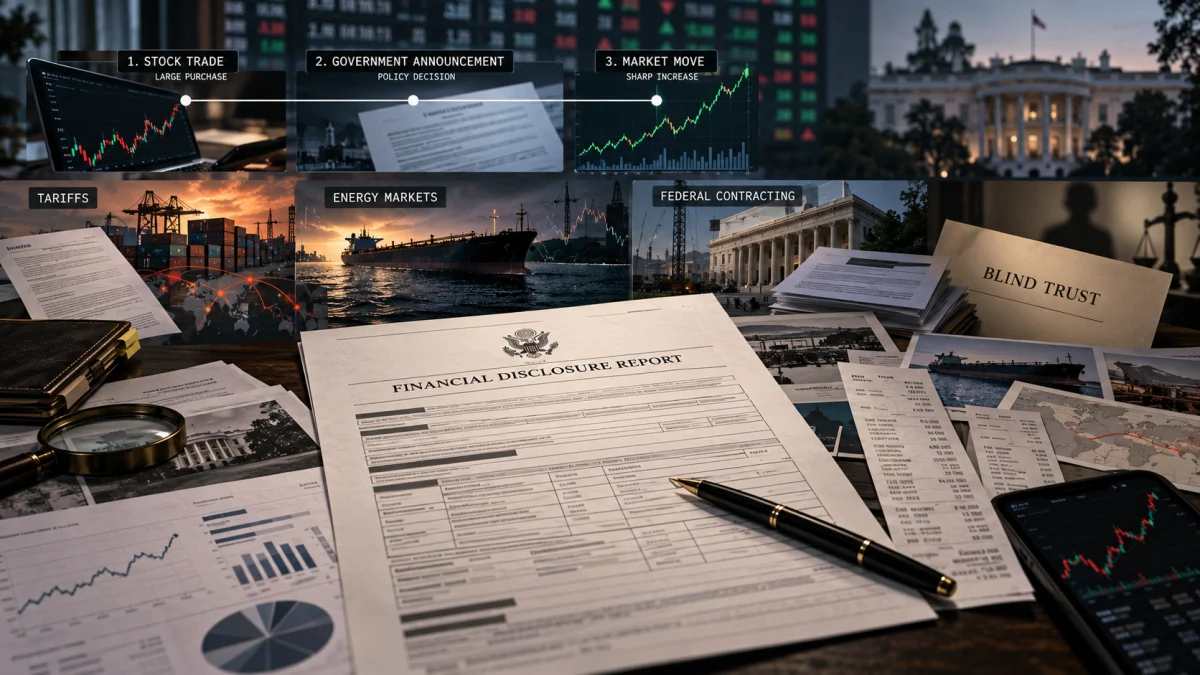
Donald Trump’s official financial disclosures really do document more than 21,000 securities transactions during 2025. A later Bloomberg analysis counted nearly 28,700 trades from January 20, 2025 through June 30, 2026. Those numbers are extraordinary for a sitting president, but they do not mean Trump personally sat at a trading screen and made 21,000 individual stock picks. The White House says outside financial institutions independently manage the accounts using model portfolios, and some of the disclosed trading patterns are consistent with automated direct indexing, rebalancing and tax-loss harvesting.
That explanation matters. It is also not the end of the story.
The disclosures show Trump retaining financial exposure to hundreds of companies whose fortunes can be affected by tariffs, wars, sanctions, federal contracts, regulation, procurement and other decisions made by his administration. Several transactions occurred close enough to major government actions to deserve scrutiny. Notable examples include hundreds of stock purchases on April 8, 2025, one day before Trump paused much of his “Liberation Day” tariff regime, and the sale of $500,000 to $1 million of ExxonMobil stock on April 7, 2026, before Trump announced an Iran ceasefire that evening and Exxon opened sharply lower the next morning.
But the same public records that reveal those dates generally do not reveal the exact execution time, when the order was entered, who made the investment decision, what algorithm or portfolio rule triggered it, or what government information that decision-maker knew.
That is the central finding. The disclosures establish unusually large financial exposure and some striking timing. They do not, by themselves, establish insider trading. They also leave the public without much of the information needed either to prove or confidently rule out an improper information advantage in any particular trade.
Did Trump Really Make More Than 21,000 Stock Trades?
Yes, with an important terminology correction: they were securities transactions, not necessarily 21,000 discretionary individual-stock bets personally chosen by Trump.
The Office of Government Ethics released Trump’s certified 2025 annual financial disclosure on June 30, 2026. Bloomberg’s review of that filing counted more than 21,000 securities trades during 2025, with the disclosed value ranges adding up to somewhere between about $600 million and $1.86 billion. The filing reports dollar ranges rather than exact transaction values, so no precise total can be calculated from the public forms.
The activity continued in 2026. A CBS News analysis of the first three months of 2026 counted 3,642 purchases and sales across stocks and other securities, representing between $212 million and $695 million in disclosed transaction ranges.
By September, Bloomberg had expanded the review and counted nearly 28,700 transactions between Trump’s second inauguration and June 30, 2026.
The scale is real. The interpretation is where the argument begins.
Is Trump Personally Choosing All of These Stocks?
There is no public evidence establishing that Trump personally selected each of these transactions.
The White House has told reporters that the securities are held in discretionary accounts managed by outside financial institutions and that Trump and his family cannot direct individual trades. In its response to CBS News reporting on Trump’s oil and gas transactions, the White House said the managers use computer-based model portfolios designed to replicate indexes such as the Schwab 1000.
That explanation is plausible for at least some of the activity.
Professional money managers interviewed by CBS said the pattern can resemble direct indexing, in which an account owns many of the individual stocks that make up an index rather than holding only an index fund. Combined with rebalancing and tax-loss harvesting, that strategy can generate hundreds or thousands of transactions without a client choosing each stock one by one.
The filings themselves contain evidence consistent with that explanation. Large groups of securities are bought or sold on the same day, and Trump’s separate accounts sometimes move differently in the same security. Bloomberg found more than 200 instances in 2025 in which one account bought a stock while another account sold the same stock on the same day.
That looks very different from a simple narrative in which one person repeatedly makes directional bets on individual companies.
But independent management does not eliminate every conflict. Trump still reports the financial interests. A manager can make the immediate trading decision while the president remains economically exposed to companies affected by presidential decisions.
Those are two different questions:
- Who selected the trade?
- Who benefits or loses financially from the investment?
The White House’s explanation speaks directly to the first. It does not make the second disappear.
The Trump Transactions With the Clearest Public Timelines
The useful way to examine the controversy is not to treat every trade as suspicious. It is to reconstruct the transactions that coincide with important government actions and then ask what the public record actually establishes.
| Company / event | Disclosed account activity | Government or market event | What the record establishes | What remains unknown |
|---|---|---|---|---|
| Broad stock purchases / tariffs | 327 stock purchases reported for April 8, 2025 | Trump announced a major tariff pause April 9 after saying it was a “great time to buy” | Large buying day occurred immediately before a market-moving reversal | Exact execution times, decision-maker, whether the manager knew the pause was coming |
| ExxonMobil / Iran | $500,000–$1 million sale April 7, 2026 | Trump announced an Iran ceasefire that evening; Exxon opened about 6.5% lower April 8 | Same-day sale preceded the public announcement and next-day price drop | Trade time, order-entry time, decision-maker, information available to manager |
| Palantir / federal business | Large sale Feb. 10; later purchases in March, April and June | USDA Palantir SNAP pilot began April 6; Palantir has broader federal business | Trading and federal contracting overlap, but the portfolio moved in both directions | Whether any trade was event-driven rather than routine rebalancing |
| MP Materials / Pentagon | Trump-linked accounts traded MP Materials before the July 2025 DoD expansion | DoD entered a major equity, loan, price-floor and offtake package in July 2025 | Trump had financial exposure before a major expansion of an existing DoD relationship | Whether managers possessed nonpublic information about the July agreement |
| Robinhood / Trump Accounts | Robinhood purchases disclosed April 27, May 22 and June 3, 2026 | Treasury publicly announced Robinhood’s program role April 6 | Purchases followed the public announcement; financial exposure overlaps with a company earning revenue from a federal program bearing Trump’s name | Whether other earlier trades are materially relevant; economic significance of the program to Robinhood |
| Abbott / infant formula litigation | Trump accounts traded Abbott during the broader disclosure period | DOJ reached a $384.999 million settlement with Abbott in September 2026 | The claim that Trump’s DOJ simply “dropped” the Abbott matter is contradicted by the later settlement | Whether any particular Abbott trade had any connection to enforcement decisions |
The table makes an important point: not all of the viral examples survive the same level of scrutiny.
April 8, 2025: 327 Purchases Before the Tariff Pause
This is one of the clearest timing questions in the 2025 filing.
A CNBC analysis reported that Trump’s accounts made 327 stock purchases on April 8, 2025, after markets had fallen sharply following his April 2 “Liberation Day” tariff announcement. The purchases included major technology companies such as Apple, Alphabet, Amazon, Microsoft and Nvidia. The Wall Street Journal separately reported that the April 8 activity shifted toward high-value purchases and did not include sales.
The next morning, Trump posted that it was a “GREAT TIME TO BUY!!!” Later that day he announced a 90-day pause on many of the newly imposed reciprocal tariffs, and the stock market rallied sharply.
The chronology is legitimate news. It is also not proof of insider trading.
The annual filing gives the transaction date, but it does not tell us whether the orders were placed by an outside manager using a predetermined strategy, whether they were triggered by a broad-market selloff, or whether anyone controlling the account knew that Trump intended to announce a tariff pause the next day.
A properly designed investigation therefore stops short of converting “bought the day before” into “bought because he knew.” The first statement is supported by the record. The second requires evidence the disclosure does not provide.
April 7, 2026: ExxonMobil Sale Before the Iran Ceasefire Announcement
The ExxonMobil sequence is even tighter.
CBS News found that Trump’s investment accounts sold between $500,000 and $1 million of ExxonMobil stock on April 7, 2026. Trump announced an Iran ceasefire later that evening.
Exxon closed April 7 at $163.91 and opened the next morning at $153.52, about 6.5% lower, as oil prices fell on the ceasefire news.
Here, too, the timing is established while the intent is not.
The disclosure does not identify the intraday execution time. It does not identify the portfolio manager who made the sale. It does not show when the order was entered. And it does not show whether that person had any advance knowledge of the ceasefire.
Those missing details matter because an April 7 sale can mean very different things depending on whether it was entered automatically at 9:35 a.m., placed late in the afternoon after a private communication, or generated by a portfolio rule unrelated to Iran.
The public filing cannot distinguish among those possibilities.
Palantir: The Viral Version Is Too Linear
Palantir is a good example of why this story requires transaction-level reconstruction rather than a montage of company names.
Trump’s filings show substantial trading in Palantir, but not a simple sequence of buy stock → award contract → profit.
A transaction report records a $1 million to $5 million Palantir sale on February 10, 2026. CBS later identified Palantir purchases during March. An official White House periodic transaction report records a $1 million to $5 million Palantir purchase on April 17. Another official transaction report records another, much smaller Palantir purchase on June 3.
Meanwhile, the federal government was doing business with Palantir. A USASpending record shows a $250,000 Department of Agriculture Palantir award beginning April 6, 2026 for a SNAP fraud-identification and case-workflow pilot.
The dates do not support a clean accusation that Trump’s accounts simply bought Palantir in advance of that specific USDA award. One of the largest disclosed Palantir transactions before it was a sale, and the $1 million-to-$5 million purchase documented in the June report occurred after the USDA pilot had begun.
There is still a real conflict-of-interest question because the president retained exposure to a major federal contractor. But the public evidence is stronger for overlapping financial interests than for a transaction-specific insider-trading theory.
MP Materials: A Major Government Expansion, but Not a New Relationship
MP Materials is another case where the underlying facts are significant but the viral version often removes important history.
Trump’s 2025 disclosures show trading in MP Materials before the Pentagon announced a major new public-private partnership with the company in July 2025. The Wall Street Journal identified those pre-announcement trades when it reviewed Trump’s brokerage activity.
The July agreement was consequential. According to MP Materials’ SEC filing, the Department of Defense agreed to a package that included a $400 million preferred-stock investment, warrants, a $150 million loan, a 10-year price-floor arrangement for neodymium-praseodymium products and a long-term magnet offtake commitment. On an as-converted and as-exercised basis, the preferred shares and warrant represented about 15% of MP’s outstanding common stock at the time of the agreement.
But the federal relationship did not begin with Trump’s 2025 deal.
The Defense Department awarded MP Materials $35 million in February 2022 to build heavy rare-earth separation capacity at Mountain Pass. In 2024, the Pentagon publicly described MP as part of its broader domestic “mine-to-magnet” rare-earth strategy.
The Trump administration’s 2025 package was therefore a large expansion of an existing strategic relationship, not the sudden discovery of a previously unconnected company.
That historical context weakens one exaggerated version of the allegation while leaving the central question intact: Trump had reportable financial exposure to a company that later received a highly consequential expansion of federal support.
What the records do not establish is whether the outside managers who made the relevant trades had any advance knowledge of the July agreement.
Robinhood: A Conflict Overlap, Not a Strong Timing Case
Robinhood illustrates the same distinction even more clearly.
On April 6, 2026, the Treasury Department publicly announced that BNY had been designated as the government’s financial agent for the new Trump Accounts program and that Robinhood would serve as the brokerage and initial trustee.
Trump’s official transaction reports then show Robinhood purchases on April 27, May 22 and June 3. The May 22 purchase was reported in the $15,001-to-$50,000 range; the other two were in the $1,001-to-$15,000 range.
Those dates are important because they come after the April 6 announcement, not before it.
Robinhood later told investors in its second-quarter SEC filing that it would earn revenue from its role developing and operating infrastructure for Trump Accounts.
That creates a visible financial-policy overlap: the president’s reported investment accounts held and purchased shares in a company participating in a federal program closely associated with his administration.
But the disclosed post-announcement purchases are not evidence that his portfolio anticipated the appointment before the market knew about it. Treating them that way would reverse the chronology.
Abbott: The “DOJ Dropped It” Claim Does Not Survive the Current Record
One viral version of the broader stock-trading story linked Trump’s Abbott Laboratories investments to the claim that his Justice Department effectively let the company off the hook over infant-formula problems.
That framing is no longer sustainable.
On September 14, 2026, the Justice Department announced that Abbott agreed to pay $384,999,040 to resolve federal and state allegations arising from the manufacture of certain powder infant-formula and nutritional products between 2018 and 2022. DOJ said the federal government had filed its complaint in intervention in November 2025.
The settlement does not prove that every earlier enforcement decision was proper, and DOJ emphasized that the resolved claims were allegations with no determination of liability. But it plainly contradicts a present-tense narrative that the Trump Justice Department simply buried the matter and allowed Abbott to walk away untouched.
That claim should not be used as a centerpiece of the stock-trading case.
Did Trump Admit His Children Were Insider Trading?
No. The quotation is real, but the strongest viral interpretation goes beyond what he actually said.
During a July 2 CNBC interview, Trump was discussing how difficult it is for his children to avoid conflicts because presidential decisions can touch almost every industry. He used examples involving a cupcake company, energy policy and an energy-efficient truck before saying his children have “inside information.” The CNBC transcript and the Roll Call Factba.se transcript preserve the context.
That is not an admission that his children received material nonpublic information about a particular public company and traded on it. He did not identify a security, a trade, a tip, a confidential corporate fact or any other element needed to establish a securities-law violation.
The quotation is still revealing in a different sense: Trump was acknowledging the breadth of the conflict problem himself. A president’s decisions can affect energy prices, transportation, tariffs, government contracts and many other sectors in ways that matter to private investments.
That observation supports scrutiny of the financial structure. It does not transform the CNBC interview into a confession of insider trading.
Does the Timing Prove Insider Trading?
No.
Illegal insider trading is not simply “someone traded before news moved the price.” The legal analysis turns on facts such as whether the trader possessed material nonpublic information, whether the information was obtained or disclosed in breach of a duty or through misappropriation, and whether the trade or tip was connected to that information. The SEC has long described those concepts as central to insider-trading law in its enforcement guidance and cases.
The Trump disclosures generally do not answer the questions an enforcement investigation would need to answer:
- Who made the trade?
- When was the order entered?
- At what exact time was it executed?
- What information did the portfolio manager have?
- Did Trump or anyone in government communicate with the manager?
- Was the trade generated automatically under a standing strategy?
- Did the account make comparable trades in many unrelated securities at the same time?
- What duty, if any, governed the information being used?
A suspicious-looking date is evidence worth investigating. It is not a substitute for those facts.
That is why the Exxon and tariff cases should be described precisely: the chronology is real and potentially important, while the public record remains insufficient to establish an insider-trading offense.
Why Independent Account Management Is Not the Same as a Blind Trust
The White House’s independent-management explanation addresses one obvious concern: if Trump cannot tell a money manager to buy Exxon, sell Palantir or purchase Robinhood, then he is not personally making each transaction.
But a discretionary managed account is not automatically a blind trust in the federal ethics sense.
The Office of Government Ethics explains in its qualified-trust guidance that an asset initially placed into a qualified blind trust is not considered blind merely because an independent trustee now manages it. The original asset remains known and can continue to create a conflict until it is divested or reduced below the applicable threshold. Only assets later acquired by the trustee without the beneficiary knowing what was purchased become genuinely blind in the relevant sense.
That distinction matters here.
If a president knows that his portfolio owns Exxon, Palantir, MP Materials, Robinhood or hundreds of other companies, handing trading authority to an outside manager can reduce direct control without eliminating knowledge of the underlying financial exposure.
Divestiture, broad diversified funds and a true blind-trust structure solve different problems than discretionary management.
Why Ordinary Executive-Branch Officials Face a Conflict Rule the President Does Not
Federal law makes the structural issue unusually stark.
18 U.S.C. §208 generally prohibits executive-branch officers and employees from participating personally and substantially in particular government matters in which they, their spouses, minor children or certain associated entities have a financial interest, subject to statutory exemptions and waivers.
But Congress separately defined the covered terms. 18 U.S.C. §202(c) says that, for §208 and several related provisions, “officer” and “employee” do not include the President or Vice President. The Office of Government Ethics has likewise stated since 1983 that the president and vice president are not legally subject to those criminal conflict-of-interest provisions.
That does not mean presidents are exempt from every law concerning bribery, corruption, disclosure, securities fraud or other misconduct. It means something narrower but important: the ordinary §208 recusal framework that constrains many executive-branch officials does not apply to the president in the same way.
That creates an unusual governance structure. A Cabinet official holding stock in a company directly affected by a particular matter may need to recuse, divest or seek an exemption. The president can make decisions of vastly greater market significance while retaining broad financial interests that would be problematic for many subordinates.
The Trump trading disclosures show what that legal distinction looks like at scale.
What the Financial Disclosures Cannot Tell Us
The federal disclosure system provides important information. Without it, none of these timelines could be reconstructed.
But it is not designed to answer the most important questions raised by a president with thousands of securities transactions.
A typical transaction report can identify:
- the security or asset;
- whether it was bought or sold;
- the transaction date;
- a broad dollar-value range;
- and certain reporting or notification information.
It generally does not reveal:
- the exact dollar amount;
- the exact execution time;
- when the trade order was entered;
- the identity of the specific portfolio manager;
- the manager’s investment instructions or algorithm;
- communications between the manager and anyone in government;
- what nonpublic government information was known at the time;
- the exact profit or loss attributable to a later government action.
That gap is why the same disclosure can create two opposite reactions.
A critic can look at an Exxon sale on the day of a ceasefire announcement and reasonably ask how it happened. A defender can point out that the public filing does not prove Trump directed it or that the manager knew anything about the ceasefire.
Both observations can be true at once because the filing exposes the date and financial interest while withholding much of the evidence needed to establish decision-making and knowledge.
Claim-by-Claim Evidence Status
| Claim | What the evidence supports |
|---|---|
| Trump reported more than 20,000 securities trades in 2025 | Supported. Bloomberg counted more than 21,000 in the certified annual disclosure. |
| Trump personally made 21,000 individual stock-picking decisions | Not established. The White House says outside institutions manage the accounts, and trading patterns are consistent with automated portfolio strategies. |
| Trump’s accounts made 327 stock purchases on April 8, 2025, before the tariff pause | Supported. The purchases are reported for the day before the April 9 policy reversal. |
| Those April 8 purchases prove Trump traded on advance knowledge of the pause | Not established. The public record does not show who made the trades, exact execution times or what the manager knew. |
| Trump’s accounts sold Exxon on the day he later announced the Iran ceasefire | Supported. CBS identified a $500,000–$1 million April 7 sale; the ceasefire was announced that evening. |
| The Exxon disclosure proves insider trading | Not established. The chronology alone does not establish possession or misuse of material nonpublic information. |
| Trump admitted his children commit insider trading | Unsupported interpretation. He used the phrase “inside information” while discussing broad conflict problems, not a specific securities-law offense. |
| Trump simply bought Palantir before federal contracts | Misleadingly incomplete. The portfolio both bought and sold Palantir, including a large February sale; relevant purchases and federal actions occurred on both sides of the timeline. |
| Trump bought Robinhood before it was selected for Trump Accounts | Not supported by the 2026 purchases reviewed here. The April 27, May 22 and June 3 purchases followed Treasury’s April 6 public announcement. |
| Trump’s DOJ dropped the Abbott infant-formula matter | Contradicted by the current record. DOJ announced a $384.999 million settlement in September 2026, while noting there was no determination of liability. |
| Trump’s portfolio creates financial overlap with presidential policy decisions | Supported as a structural fact. His disclosures report investments in companies affected by federal policy, while §208’s ordinary executive-branch conflict rule excludes the president. |
The Bottom Line
The public record does not support either extreme interpretation of Trump’s securities disclosures.
It is not accurate to treat 21,000 transactions as 21,000 personal stock picks by Donald Trump, and the filings do not prove that the president or his family committed insider trading. The White House has offered a plausible explanation for much of the volume: independently managed accounts using computer-based portfolio strategies. The trading record itself contains patterns consistent with large-scale portfolio management rather than a person making one bespoke decision at a time.
But it is equally misleading to conclude that independent management resolves the conflict.
Trump remains financially exposed to companies whose value can be affected by decisions of his own administration. The public record includes transactions with genuinely notable timing, especially the April 8, 2025 stock purchases before the tariff pause and the April 7, 2026 Exxon sale before the Iran ceasefire announcement. Other viral examples become weaker when reconstructed carefully: the Palantir timeline contains large sales as well as buys; the reviewed Robinhood purchases followed the public program announcement; the Abbott “case dropped” claim is contradicted by a later $384.999 million settlement; and MP Materials had a federal relationship years before the Trump administration dramatically expanded it.
What remains is a transparency problem that is larger than any one transaction.
The public can see what security was traded, on what date and within what value range. It usually cannot see who made the decision, the precise time it was made, what information that person possessed, or whether a trade was generated automatically. At the same time, the president is excluded from the ordinary criminal conflict-of-interest rule that applies to many executive-branch officials.
That combination makes it possible for a presidential portfolio to produce legitimate questions that the disclosure system is not equipped to resolve on its own.
The responsible conclusion is therefore neither “the trades prove insider trading” nor “the outside managers make the issue disappear.” The records support a narrower and more consequential finding: the United States allows a sitting president to retain extensive, identifiable financial exposure to companies affected by presidential power while providing the public only limited information about how thousands of resulting trades are actually made.
References and Further Reading
Primary Financial Disclosures and Ethics Rules
- U.S. Office of Government Ethics — President Trump’s certified 2025 annual financial disclosure — OGE’s official release page for the president’s certified annual report.
- White House — June 25, 2026 Periodic Transaction Report — Primary transaction filing containing, among many other entries, an April 17 Palantir purchase and April 27 Robinhood purchase.
- White House — August 12, 2026 Periodic Transaction Report — Primary transaction filing containing June 2026 purchases including Robinhood and Palantir.
- 18 U.S.C. §208 — Acts affecting a personal financial interest — The principal federal criminal conflict-of-interest provision for covered executive-branch officers and employees.
- 18 U.S.C. §202(c) — Definitions — Statutory language excluding the president and vice president from the definitions used by §208 and several related provisions.
- Office of Government Ethics — Qualified trust guidance — Explains why assets initially placed into a qualified blind trust do not become “blind” merely because an independent trustee manages them.
- Office of Government Ethics — 83×16 advisory opinion — OGE’s longstanding interpretation that the president and vice president are not subject to 18 U.S.C. §§202–209.
Transaction and Market Reporting
- Bloomberg Law — “Trump Financial Disclosure Shows 21,000 Trades in 2025” — Analysis of the 2025 annual filing, including the more-than-21,000 transaction count and aggregate disclosed value ranges.
- Bloomberg — “Trump Has Made More Trades Than All of Congress Combined” — Later analysis extending the transaction count through June 30, 2026 to nearly 28,700 trades.
- CBS News — “3,600 stock trades in 3 months” — Detailed analysis of Trump’s first-quarter 2026 transactions and interviews with investment professionals about possible portfolio-management explanations.
- CBS News — Trump’s oil and gas stock trades during the Iran war — Reconstructs the April 7 ExxonMobil sale, the ceasefire announcement and the White House’s explanation of independent portfolio management.
- The Wall Street Journal — Trump’s brokerage accounts around the “Liberation Day” tariffs — Examines the dense trading around the April 2025 tariff shock, including the April 8 buying pattern and MP Materials activity.
Company and Government Records
- USASpending — USDA award to Palantir Technologies — Official spending record for the April 2026 SNAP fraud-identification pilot.
- U.S. Treasury — BNY and Robinhood selected to support Trump Accounts — Treasury’s April 6, 2026 announcement establishing the public timing of Robinhood’s role.
- Robinhood SEC Form 10-Q for Q2 2026 — Corporate filing describing Robinhood’s Trump Accounts role and stating that the company will earn revenue from the program.
- MP Materials SEC Form 8-K on the July 2025 DoD partnership — Primary corporate filing detailing the federal equity investment, loan, price-floor and offtake agreements.
- Defense Department — 2022 $35 million MP Materials award — Establishes that MP Materials had a significant federal defense relationship years before the July 2025 expansion.
- Defense Department — 2024 “mine-to-magnet” supply-chain strategy — Places MP Materials within the Pentagon’s preexisting rare-earth strategy.
- Defense Department — 2025 $150 million MP Materials loan — Official account of one component of the expanded July 2025 relationship.
- Justice Department — Abbott $384.999 million infant-formula settlement — The September 2026 settlement that materially changes claims that the Trump DOJ simply abandoned the Abbott matter.
Statements and Legal Context
- CNBC — July 2, 2026 Trump interview transcript — Primary transcript for Trump’s “inside information” remark and its surrounding conflict-of-interest discussion.
- Roll Call Factba.se — July 2, 2026 CNBC interview transcript — Searchable cross-checked transcript of the same interview.
- SEC — U.S. Experience of Insider Trading Enforcement — SEC explanation of the materiality, nonpublic-information and duty concepts central to insider-trading law.
Editorial currency note: This article reflects public financial disclosures, government records and reporting available through October 1, 2026. Trump’s accounts continue to file transaction reports, federal contracting relationships can change, and additional disclosures may materially alter individual company timelines. The article should be updated when new transaction reports or primary records become available.