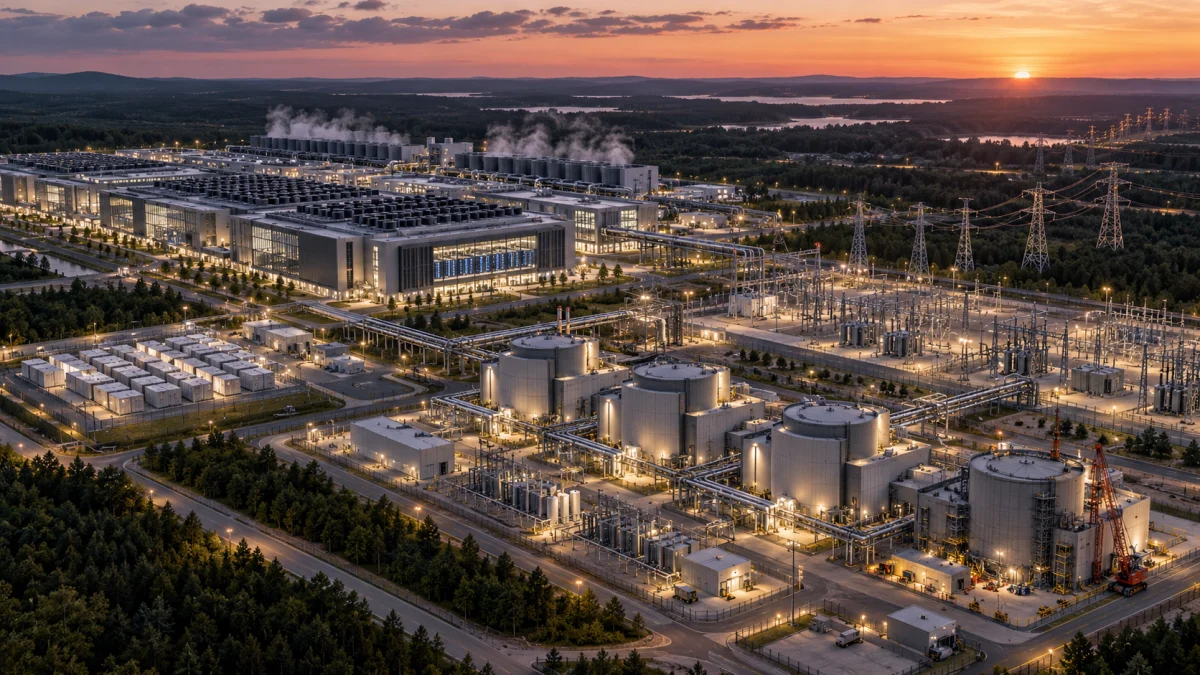
Yes, a data center can be powered by nuclear energy. The harder question is whether a large AI data center can rely on its own dedicated nuclear plant while meeting the continuous power, power-quality, cooling, and redundancy requirements expected of hyperscale computing.
The answer is technically plausible, but much more complicated than matching a reactor’s megawatt rating to a data center’s advertised IT load.
A credible nuclear-powered data center has to solve at least three different power problems:
- Instantaneous capacity: Can the generators supply the campus at peak load?
- Annual energy: Can they produce enough megawatt-hours over a full year after refueling and other outages?
- Continuity: Can the campus remain powered when a reactor module is unavailable?
Those are not the same problem.
That distinction matters because the U.S. nuclear fleet achieved an average 91% capacity factor in 2025, according to the U.S. Energy Information Administration. That is exceptionally high for a generating fleet, but capacity factor is an annual energy metric, not a promise that a particular generator will never be offline. EIA defines capacity factor as actual energy production divided by the energy that could have been produced by continuous operation at full power.
For data centers, planned refueling alone makes the difference important. The U.S. Department of Energy says current nuclear plants typically run for 18 to 24 months between refueling outages, which generally last several weeks. A data center designed to keep computing through that outage needs another source of power.
This paper builds a transparent screening model for three hypothetical AI campuses with 100 MW, 500 MW, and 1 GW of IT load. It also examines what today’s heavily publicized nuclear-data-center agreements actually are, because most are not fully isolated reactors feeding private server campuses.
The central finding is simple:
A nuclear-powered data center is not primarily a reactor-sizing problem. It is a systems-integration and reliability problem.
Key findings
- A 1 GW IT campus does not need only 1 GW of generation. At a Power Usage Effectiveness, or PUE, of 1.20, it represents about 1.2 GW of total facility load.
- A reactor’s nameplate output, annual energy production, and availability during outages are three separate constraints.
- Peer-reviewed nuclear-data-center research explicitly identifies N+1 and N+2 generating configurations as important options for high-availability computing.
- In the simplified sherafy.com model below, a 1 GW IT campus paired with hypothetical 80 MWe reactor modules needs 15 modules to cover nameplate load, 16 for a simple N+1 test, but 17 modules to cover annual energy if the existing U.S. fleet’s 91% capacity factor is used only as a benchmark.
- Batteries are valuable for UPS service, ride-through, frequency support, and short outages, but their energy requirement becomes enormous if they are asked to replace a nuclear unit for days or weeks. A 1 GW IT campus at PUE 1.20 would require an idealized 28.8 GWh for one day and 201.6 GWh for seven days, before storage losses or reserve margin.
- Nuclear-assisted cooling is technically interesting, but reactor heat is not "free cooling." A 2026 peer-reviewed thermodynamic study found that using light-water-reactor steam for absorption cooling creates a trade-off because steam extraction can reduce electrical output.
- Most high-profile technology-company nuclear deals today are grid-connected PPAs, grid-delivered nuclear projects, reactor restarts, or proposed future SMRs, not fully islanded nuclear data centers.
Why this question is becoming important
U.S. data-center electricity demand is rising fast enough to change generation and transmission planning.
Lawrence Berkeley National Laboratory’s United States Data Center Energy Usage Report: 2025 Update estimates a 2030 reference case of 649 TWh, or 11.8% of total U.S. electricity consumption. Its combined uncertainty scenarios span 521 to 843 TWh, or roughly 9.5% to 15.3%.
The exact 2030 number is uncertain. The important point is that data centers are becoming loads large enough to justify dedicated generation planning.
Nuclear power is an obvious candidate because it can produce large quantities of firm electricity from a compact site and operate at high capacity factors. That does not automatically make a dedicated nuclear campus easy, cheap, or optimal. It does make the concept worth analyzing as an engineering system rather than as a slogan.
First, what does "nuclear-powered data center" actually mean?
The phrase is used for several architectures that are physically and commercially different.
| Model | What actually happens | Is the data center electrically dependent on the public grid? |
|---|---|---|
| Nuclear-backed contract or PPA | A company contracts for nuclear electricity or its attributes while its data center remains part of the grid | Yes |
| Grid-delivered nuclear supply | A particular nuclear plant supplies the regional grid under a contract associated with the data center | Yes |
| Co-located data center | The data center sits near a nuclear station and may have a special electrical arrangement, but grid services can still be involved | Usually |
| Dedicated nuclear + grid | New reactor capacity is built primarily for the campus while the grid remains available for backup, startup, import, or export | Yes, by design |
| Fully islanded nuclear campus | The nuclear plant, storage, controls, and backup systems must keep the campus operating without relying on the external grid | No during islanded operation |
These categories should not be collapsed into one.
Google’s current Kairos Power arrangement, for example, does not mean a private reactor will directly feed a Google server hall. Under the Google-Kairos-TVA agreement, TVA is scheduled to buy up to 50 MW from Kairos Power’s Hermes 2 plant beginning in 2030 and place that electricity on the TVA grid serving Google’s regional data centers.
The distinction is not semantic. It determines who supplies power when a reactor is offline, who provides frequency and voltage support, how transmission costs are allocated, and whether the data center needs its own generation reserve.
The three numbers that should never be confused
A scientifically sound nuclear-data-center analysis has to separate power, energy, and availability.
1. Power: MW or GW
Power is the rate at which electricity is being produced or consumed at a particular time.
A 1,000 MW generator can theoretically supply a 1,000 MW load while it is operating at that output.
2. Energy: MWh, GWh, or TWh
Energy is power integrated over time.
A constant 1,000 MW load consumes:
- 1,000 MWh in one hour
- 24,000 MWh, or 24 GWh, in one day
- 8.76 TWh in a 365-day year
3. Availability and capacity factor
These describe different aspects of how generation performs over time.
EIA’s formal capacity-factor definition is the ratio of energy actually produced over a period to the energy that could have been produced at continuous full power.
A generator can therefore have a 91% annual capacity factor while still having periods when its output is zero.
That is why "nuclear has a 90%-plus capacity factor" does not by itself answer a data center’s continuity question.
A 2024 peer-reviewed analysis from Idaho National Laboratory, Navigating Economies of Scale and Multiples for Nuclear-Powered Data Centers and Other Applications with High Service Availability Needs, makes this distinction explicitly. Its modeling shows why a system designed for high daily availability may need extra reactor capacity even when the reactors have strong lifetime capacity factors.
The fourth number: PUE
Data-center power is often described using IT load: the electricity used by servers, accelerators, storage, and networking equipment.
The power plant has to serve the whole facility, not just the chips.
The U.S. Department of Energy defines Power Usage Effectiveness as:
PUE = Total data-center energy / IT-equipment energy
PUE depends on climate, cooling architecture, load, equipment, and measurement boundaries. DOE’s Better Buildings program has documented an optimized federal research data center that achieved a PUE of 1.20, so 1.20 is a plausible high-efficiency screening value rather than an assumed industry-wide average.
For the model in this paper, sherafy.com therefore uses a deliberately round PUE of 1.20.
That means:
Total facility load = IT load × 1.20
This is an analytical assumption, not a prediction that every future AI data center will achieve a 1.20 PUE.
A reproducible screening model
The purpose of this model is not to design a nuclear power plant. It is to expose the constraints that disappear when people compare only headline megawatts.
Assumptions
Data-center PUE: 1.20
Illustrative reactor module: 80 MWe net electrical output
The 80 MWe module is chosen because it is a convenient real-world scale for advanced-reactor discussion. Energy Northwest’s proposed Cascade Advanced Energy Facility is planned around Xe-100 units rated at 80 MWe each, with four units totaling 320 MWe in its first phase.
This paper is not modeling the Xe-100 design itself and is not recommending a particular vendor. The 80 MWe value is simply an illustrative module size.
Capacity-factor benchmark: 91%
That is the existing U.S. nuclear fleet’s 2025 average. It is used only to demonstrate the difference between installed MW and annual energy. It should not be interpreted as a forecast of future SMR performance.
Simple continuity test: N+1 at the reactor-module level
The model asks whether the remaining modules can still cover facility load with one 80 MWe module unavailable.
This is not equivalent to proving data-center uptime, nuclear safety, Tier certification, or full plant reliability. Real projects must account for shared turbines, switchgear, transformers, common-cause failures, maintenance, fuel cycles, protection systems, transmission, and many other dependencies.
Equations
Facility load
Facility MW = IT MW × PUE
Annual facility energy
Annual energy = Facility MW × 8,760 hours
Minimum modules by instantaneous nameplate capacity
Modules = ceiling(Facility MW / Module net MWe)
Minimum modules by annual-energy benchmark
Modules = ceiling(Facility MW / (Module MWe × Capacity factor))
Simple N+1 module count
Modules = Minimum nameplate modules + 1
The screening count below is the largest of the annual-energy and simple N+1 counts.
What the model produces
| IT load | Facility load at PUE 1.20 | Annual facility energy | Modules by nameplate MW | Modules by annual energy at 91% benchmark | Simple N+1 modules | Screening count* | Installed net capacity |
|---|---|---|---|---|---|---|---|
| 100 MW | 120 MW | 1.051 TWh | 2 | 2 | 3 | 3 | 240 MWe |
| 500 MW | 600 MW | 5.256 TWh | 8 | 9 | 9 | 9 | 720 MWe |
| 1,000 MW | 1,200 MW | 10.512 TWh | 15 | 17 | 16 | 17 | 1,360 MWe |
*The "screening count" is an arithmetic result under this paper’s assumptions, not a construction recommendation.
The screening count is deliberately conservative in one sense and incomplete in another. It takes the larger of a simple N+1 count and an annual-energy count, but it still does not prove hour-by-hour self-sufficiency. Annual energy can be sufficient even if two or more modules are unavailable at the same time. A real design therefore needs a chronological availability model using actual refueling schedules, forced-outage distributions, shared-system failures, maintenance constraints, and any grid or backup resources.
The table exposes three different regimes.
A 100 MW AI campus
A 100 MW IT campus becomes a 120 MW facility at PUE 1.20.
Two 80 MWe modules cover the instantaneous load, but a simple N+1 criterion pushes the system to three modules. That produces 240 MWe of installed capacity for a 120 MW facility load.
That large step-up is a consequence of module size. It does not mean every 100 MW data center should build 240 MW of nuclear generation.
It means an 80 MWe module may be an awkward fit for a relatively small campus if the project insists on reactor-only N+1 capability. Smaller reactors, a grid intertie, non-nuclear backup generation, storage, or demand flexibility could reduce that overbuild.
A 500 MW AI campus
A 500 MW IT campus becomes a 600 MW facility.
Eight 80 MWe modules provide 640 MWe of nameplate capacity, but nine modules are needed under both the simple N+1 test and the 91% annual-energy benchmark.
With nine modules, one module could be offline and the other eight would provide 640 MWe, about 6.7% above the 600 MW modeled facility load.
Again, that is not proof of six-nines reliability. It simply passes this paper’s first-order module test.
A 1 GW AI campus
This is where the difference between MW and MWh becomes especially visible.
A 1 GW IT campus at PUE 1.20 is a 1.2 GW facility load.
Fifteen 80 MWe modules equal exactly 1.2 GW of installed net output.
Sixteen modules satisfy the simple N+1 test because 15 modules remain after one module is lost.
But if the existing U.S. fleet’s 91% annual capacity factor is used as a benchmark, 16 modules average only about 1.165 GW across a year. That is less than the 1.2 GW continuous modeled facility requirement.
Seventeen modules are needed to cross the annual-energy threshold under that particular assumption.
This is the paper’s most important calculation:
A design can have enough nameplate MW and still fail the annual-energy test. It can also have enough annual energy and still fail the instantaneous outage test.
A real project might intentionally use fewer reactors and buy power from the grid during outages. It might use larger modules, smaller modules, another firm generator, demand curtailment, or a different capacity-factor assumption. The purpose of the model is to show why those choices must be stated rather than hidden.
Why modularity can matter more than the word "small"
The strongest engineering argument for multiple reactor modules is not simply that small reactors are easier to build.
It is that one unavailable module represents a smaller fraction of total campus generation.
The peer-reviewed INL study on reactor size and data-center availability models this explicitly. With multiple reactors and staggered refueling, individual outages can be prevented from removing the entire generating fleet at once.
A separate 2026 paper in Nuclear Engineering and Design, Accelerating nuclear-integrated data center pursuits in the USA, identifies N+1 and N+2 power-supply configurations as important design options and treats land, water, grid access, fiber connectivity, reactor technology, and thermal management as part of the same deployment problem.
That is a more useful way to think about a nuclear data center than asking whether "SMRs are reliable."
The relevant question is:
What fraction of campus capacity disappears when the largest credible component fails or goes offline for maintenance?
A single 1,200 MW generator serving a 1,200 MW campus loses 100% of its nuclear generation when that unit is unavailable.
Fifteen 80 MW modules lose about 6.7% when one module is unavailable.
The smaller-unit architecture therefore creates more options for planned maintenance and refueling, although it also creates more individual units, equipment, licensing work, interfaces, and operational complexity.
Batteries solve a different problem
Batteries are extremely useful in data centers. They can provide UPS service, ride-through, fast frequency response, and short-duration backup.
But a battery is an energy reservoir, so the required storage scales with both power and time.
Ignoring losses and reserve requirements:
Battery energy = Facility load × backup duration
Using the same PUE 1.20 model:
| IT load | Facility load | 1 hour | 4 hours | 24 hours | 7 days |
|---|---|---|---|---|---|
| 100 MW | 120 MW | 0.12 GWh | 0.48 GWh | 2.88 GWh | 20.16 GWh |
| 500 MW | 600 MW | 0.60 GWh | 2.40 GWh | 14.40 GWh | 100.80 GWh |
| 1,000 MW | 1,200 MW | 1.20 GWh | 4.80 GWh | 28.80 GWh | 201.60 GWh |
These are theoretical minimum energy quantities before conversion losses, degradation, state-of-charge reserves, emergency margin, or battery power limits.
The result explains why "just add batteries" is not a complete answer to nuclear refueling.
DOE says conventional nuclear refueling outages normally last weeks, not hours. Storage can bridge disturbances and short events; replacing gigawatts of generation through a multi-week outage is a very different storage problem.
A dedicated campus therefore needs some combination of:
- additional reactor modules;
- grid imports;
- other firm generation;
- storage;
- load curtailment or migration;
- or deliberately scheduled maintenance around reduced computing demand.
A fully islanded nuclear data center is harder than a co-located one
It is tempting to imagine an islanded campus as a reactor connected directly to servers with the grid removed from the picture.
Real electrical systems are not that simple.
A large islanded power system has to regulate:
- frequency;
- voltage;
- reactive power;
- load changes;
- generator trips;
- startup and shutdown sequences;
- black-start or restart capability;
- short-circuit protection;
- backup generation;
- energy storage;
- and coordination between nuclear safety systems and data-center electrical systems.
The grid normally helps absorb disturbances and provides an enormous external balancing resource.
Conventional U.S. nuclear-plant designs also historically incorporate offsite electrical power into their safety architecture. The Nuclear Regulatory Commission’s discussion of General Design Criterion 17 explains that offsite power is required in covered conventional designs to support safety functions under specified conditions.
Advanced reactors can use different safety philosophies and may seek different licensing treatment. The point is not that an advanced nuclear microgrid is impossible. The point is that "disconnect it from the grid" changes the nuclear plant’s design problem as well as the data center’s.
The grid may be an asset, not a compromise
A data center can derive most or all of its annual energy from nuclear power and still benefit from a grid connection.
The intertie can provide:
- reactor startup and station-service power;
- imports during refueling or forced outages;
- balancing during transients;
- access to reserve services;
- a destination for excess nuclear generation;
- and an alternative path if part of the private electrical system fails.
That makes the economics more subtle. A reactor that is deliberately oversized for reliability can sell surplus generation when all modules are available instead of wasting it.
Federal regulators are now explicitly writing rules around these hybrid arrangements.
In December 2025, the Federal Energy Regulatory Commission directed PJM to create clearer co-location rules for large loads such as AI data centers located with generators. The framework recognizes that a co-located load may obtain much of its energy from an adjacent generator while buying a smaller contracted amount of transmission service from the grid.
That is materially different from full islanding.
Amazon’s Susquehanna project shows why terminology matters
The evolution of Amazon’s relationship with Talen Energy is one of the clearest real-world examples.
An early arrangement involved an AWS data-center campus co-located with Pennsylvania’s Susquehanna nuclear station. But the structure later changed.
Under Talen’s expanded agreement, the company is to provide AWS with up to 1,920 MW of nuclear power through 2042. Talen’s 2026 SEC filing says the transition to the revised front-of-the-meter PPA occurred in April 2026.
Under that model, Susquehanna provides electricity to the PJM grid and the utility transmission system delivers electricity to AWS.
The servers can still be commercially supported by nuclear power. They are not operating as an electrically isolated private nuclear island.
That distinction should be preserved whenever someone cites the project as proof that hyperscalers are already running directly on dedicated reactors.
Could nuclear reactors follow AI data-center loads?
Yes, nuclear output can be flexible, but this question also needs careful wording.
Large data centers are often relatively steady loads at the campus scale, but individual AI workloads, cooling requirements, server utilization, and commissioning phases can change demand.
Some current advanced-reactor designs are specifically being developed with load-following capability. The proposed 80 MWe Xe-100, for example, is marketed as capable of both baseload and load-following operation.
That does not mean a reactor should be expected to chase every second-by-second GPU fluctuation by itself.
In an islanded system, batteries, flywheels, power electronics, synchronous machines, reserve modules, or other fast-response resources can handle rapid disturbances while the reactor and turbine operate on slower control timescales.
The engineering question is therefore not "Can nuclear load-follow?"
It is:
What combination of reactor controls and fast-response electrical resources keeps frequency and voltage within limits for the full range of campus events?
That requires project-specific dynamic modeling.
Cooling creates a second power plant
Almost all electricity consumed by IT equipment ultimately becomes heat that must leave the computing environment.
A 1 GW IT load therefore implies roughly 1 GW of IT heat to be captured and rejected, before considering additional heat from pumps, chillers, power conversion, and other facility equipment.
A nuclear station simultaneously operates its own thermal cycle and must reject large quantities of heat that are not converted into electricity.
Putting the two facilities together therefore creates an unusual thermal-design problem:
- the reactor must reject heat;
- the servers must reject heat;
- both systems may compete for water;
- and both systems are sensitive to ambient temperature and cooling architecture.
Site selection cannot be based on electricity alone.
The 2026 peer-reviewed paper Integrated process design strategies: Nuclear-powered hyperscale datacenter & cooling compared vapor-compression and lithium-bromide absorption cooling using a representative 77 MWe light-water SMR model.
Its conclusion is more nuanced than "use reactor waste heat to cool the servers."
For a light-water reactor, useful heat for an absorption chiller may need to be extracted from the steam cycle. That extraction can reduce the electricity produced by the turbine. The researchers therefore explicitly account for the electric-generation penalty associated with using steam for cooling.
Absorption cooling can still be attractive under some thermal and water constraints. It is simply not free energy.
Water could decide where the campus can exist
Both nuclear plants and data centers can require significant heat rejection.
Water use depends heavily on technology:
- once-through versus recirculating nuclear cooling;
- wet, dry, or hybrid heat rejection;
- air-cooled versus liquid-cooled IT;
- direct-to-chip cooling;
- chiller architecture;
- local climate;
- and whether water is consumed through evaporation or merely withdrawn and returned.
That variability is why this paper does not assign one universal "gallons per MW" value to a nuclear-powered data center.
The correct analysis is site-specific.
A location with excellent transmission and fiber but constrained water may favor dry or hybrid systems and accept higher equipment cost or reduced efficiency. A water-rich location may make a different trade.
The important SEO-era simplification to avoid is:
Neither "nuclear uses lots of water" nor "liquid-cooled AI data centers use lots of water" is a sufficient siting calculation by itself.
The cooling system and climate determine the answer.
SMR, microreactor, or conventional reactor?
There is no universally best reactor size for data centers.
Large conventional reactors
A large reactor offers strong economies of scale and uses technology with extensive operating experience.
Its weakness for a dedicated data center is unit size. If one large reactor represents most or all of the campus supply, a single refueling outage removes a large fraction of generation unless the grid or another large generator is available.
Small modular reactors
The International Atomic Energy Agency defines SMRs as advanced reactors with power capacity of up to 300 MWe per unit.
The attraction for data centers is not merely physical size. Multiple modules can be phased with demand and potentially staggered for refueling and maintenance.
The trade-off is that many proposed advanced designs are still moving through licensing, demonstration, supply-chain development, and first-of-a-kind construction rather than drawing on a mature commercial fleet.
The NRC’s NuScale US460 standard design approval illustrates the distinction. The approved design uses six 77 MWe modules for 462 MWe total, but NRC approval of a standard design is not permission to build and operate a particular plant. A project still needs its applicable site and operating approvals.
Microreactors
"Microreactor" is a less standardized size category. The IAEA describes microreactors as a subset of SMRs typically up to about 10 MWe, while DOE’s current DOME program describes microreactor concepts that typically provide roughly 1 to 50 MW of power. The difference is a useful reminder that "microreactor" is not one universally fixed electrical-size boundary.
Microreactors could make redundancy granular, but a hyperscale campus would need many units if each reactor is small.
They may therefore be better suited to smaller campuses, remote facilities, critical loads, or specialized microgrids unless manufacturing scale changes the economics.
Fuel is part of the data-center supply chain
Not all advanced reactors use the same fuel.
Existing U.S. commercial power reactors generally use low-enriched uranium below 5% uranium-235. Many advanced designs propose high-assay low-enriched uranium, or HALEU.
The NRC defines HALEU as uranium enriched to between 5% and 20% U-235. DOE says most U.S. advanced-reactor designs under development require HALEU for smaller cores, longer operating cycles, or other design objectives.
That does not mean every SMR requires HALEU. Some advanced and small-reactor concepts can use more conventional low-enriched fuel.
For projects that do need HALEU, fuel availability remains a real deployment constraint. DOE’s HALEU enrichment program says commercial U.S. enrichment services remain limited, although federal task orders and private capacity are being developed.
For a nuclear-powered data center, therefore, the energy supply chain is not just "buy uranium." It includes enrichment, fuel fabrication, qualification, transport, refueling strategy, and spent-fuel management.
What about spent nuclear fuel?
A dedicated data-center reactor does not remove the normal back end of the nuclear fuel cycle.
Spent fuel has to be handled, cooled, stored, secured, and ultimately managed under the applicable regulatory system.
DOE’s nuclear-powered data-center overview explicitly lists spent fuel as one of the challenges that remains regardless of the data center use case.
This is not a unique technical disqualifier for data centers. It is a normal nuclear-infrastructure obligation that must be included rather than omitted from a campus concept.
The economics cannot be reduced to "nuclear costs X per kWh"
A credible economic comparison needs more than levelized cost of electricity.
For a hyperscale data center, the relevant cost is closer to:
Cost of firm, deliverable, high-quality electricity at the campus boundary, with the required reliability and schedule.
That can include:
- reactor construction;
- financing;
- fuel;
- operations and maintenance;
- cooling;
- security;
- licensing;
- transmission;
- interconnection;
- substations and switchgear;
- UPS and batteries;
- reserve generation;
- land;
- water infrastructure;
- fiber;
- and the value or cost of excess electricity.
DOE’s advanced-nuclear commercialization analysis has used a rough first-of-a-kind overnight capital-cost range of about $6,000 to $10,000 per kW, with the expectation that repeat deployments could reduce costs. The DOE analysis is useful as a planning range, not as a 2026 contractor quote.
"Overnight cost" is also not the final financed cost of a project. Interest during construction, schedule risk, owner costs, transmission, data-center construction, and other infrastructure can materially change the bill.
That is why multiplying an 80 MW reactor rating by a single published $/kW figure would create false precision.
The timing mismatch may be as important as the cost
AI developers can add computing equipment much faster than a new nuclear project can typically be licensed and built.
That creates one of the strongest arguments for grid-connected nuclear arrangements in the near term.
A hyperscaler can:
- contract with an existing nuclear plant;
- support a restart or uprate;
- use the grid while a new reactor is developed;
- and add new nuclear generation later.
The nuclear plant also has a useful life far longer than one generation of computing hardware. A grid-connected reactor can keep selling electricity even if data-center hardware, ownership, or workload changes.
That flexibility is harder to reproduce in a fully islanded campus built around one customer.
What Big Tech’s nuclear projects actually are
As of October 1, 2026, the highest-profile U.S. technology-company nuclear deals cover several different architectures.
| Company / project | Nuclear capacity or target | What the arrangement actually is | Fully islanded data center? |
|---|---|---|---|
| Google / Kairos Power / TVA | First project up to 50 MW; broader collaboration up to 500 MW | TVA PPA; Hermes 2 output is planned for the TVA grid supporting Google’s regional demand, with first operation scheduled for 2030 | No |
| Amazon / Talen / Susquehanna | Up to 1,920 MW under the expanded PPA | Existing nuclear generation supplied under a front-of-the-meter arrangement; transition to revised PPA occurred in April 2026 | No |
| Amazon / Energy Northwest / X-energy | 320 MW initial, expandable to 960 MW | Proposed new SMR project using multiple 80 MWe units; targeted for the 2030s | No operating islanded campus today |
| Microsoft / Constellation / Crane Clean Energy Center | 835 MW | Twenty-year PPA supporting restart of the former Three Mile Island Unit 1; output returns to the regional grid; restart currently expected in 2027 | No |
| Meta / Vistra, TerraPower, Oklo, Constellation | Portfolio support totaling up to 6.6 GW by 2035 | Mix of existing-plant agreements, uprates, and proposed advanced reactors delivering power into regional grids | No |
The project terms above come from company or regulatory disclosures. They establish what has been announced or contracted; they do not guarantee that every future reactor will be completed on its current schedule or at its proposed cost.
The table also reveals something important:
The commercial market is currently treating the grid as part of the solution, not merely as an obstacle nuclear data centers must escape.
Google: advanced nuclear, but still grid based
Under Google’s August 2025 agreement with Kairos Power and TVA, TVA plans to purchase up to 50 MW from Kairos Power’s Hermes 2 plant beginning in 2030.
Google describes the power as supporting its data centers in Tennessee and Alabama, but the electricity goes to the TVA system.
That is a nuclear-supported data-center strategy, not an isolated nuclear microgrid.
Amazon: both existing nuclear and future SMRs
Amazon is pursuing both ends of the market.
Its Talen agreement uses the existing Susquehanna plant under a front-of-the-meter power arrangement.
Separately, Amazon’s partnership with Energy Northwest and X-energy is developing the proposed Cascade project. Amazon says the first phase is intended to use four advanced SMRs totaling 320 MW, with an option to expand to 960 MW.
That project is especially relevant to the modular-redundancy question because each proposed Xe-100 unit is 80 MWe.
It is still a future project, not evidence that a 960 MW SMR-powered AI campus is already operating.
Microsoft: restarting existing nuclear capacity
Microsoft’s nuclear strategy with Constellation demonstrates another path: bring back an existing plant.
Constellation says the Crane Clean Energy Center, formerly Three Mile Island Unit 1, is expected to return 835 MW to the grid in 2027 under a 20-year PPA with Microsoft.
This avoids some of the technology-development risk of a first-of-a-kind reactor, although a restart still requires major engineering, capital work, fuel, and regulatory approvals.
Meta: a portfolio rather than one private reactor
Meta’s January 2026 nuclear-energy agreements cover existing reactors, uprates, and proposed advanced reactors from Vistra, TerraPower, Oklo, and Constellation.
Meta says the portfolio could support up to 6.6 GW of nuclear capacity by 2035.
The projects are intended to add or preserve power on the grids serving Meta’s operations. They are not one giant nuclear plant wired only to one AI campus.
Regulation is part of the architecture
Nuclear-powered data centers intersect at least two highly regulated systems:
- commercial nuclear power;
- and bulk electric power.
A new reactor may involve NRC design review, site approval, construction authorization, operating authorization, security requirements, emergency planning, environmental review, fuel licensing, and other obligations depending on technology and licensing pathway.
A grid-connected campus can also trigger:
- transmission-service rules;
- generation and load interconnection requirements;
- utility tariffs;
- regional transmission organization rules;
- reliability standards;
- and state-level siting or utility regulation.
The FERC co-location proceedings are evidence that these are not theoretical edge cases. Regulators are actively deciding how a data center that sits beside a generator should pay for and use the transmission system.
Security has two meanings on a nuclear AI campus
A nuclear data center combines two kinds of critical infrastructure that already have demanding security requirements.
The nuclear side requires physical protection, access control, cybersecurity, material accountability, and regulatory security programs.
The data-center side requires its own physical and cyber protection for high-value computing and network infrastructure.
Combining the campuses may create efficiencies in perimeter planning, but it also creates interfaces that must be deliberately separated.
The electrical control systems that keep a reactor safe should not be casually integrated with general data-center IT networks merely because both facilities occupy the same site.
A viable architecture needs strong segmentation between nuclear safety systems, plant operational technology, data-center power controls, and computing networks.
What would a truly dedicated nuclear AI campus probably look like?
A realistic dedicated campus is unlikely to resemble one reactor sitting beside one warehouse.
A more defensible conceptual architecture would include:
- Several independently operable reactor modules or multiple generating units.
- A high-voltage campus electrical backbone with redundant buses and transformers.
- UPS and short-duration storage for instantaneous ride-through.
- Fast reserve or additional generating capacity for reactor trips and load transients.
- A grid connection where practical for startup, outages, imports, and surplus exports.
- Staggered refueling schedules so all reactor capacity is not removed at once.
- Separate but coordinated cooling systems for the nuclear plant and computing campus.
- Water, land, fiber, and transmission access selected as one integrated siting problem.
- Independent safety and cyber boundaries between nuclear systems and the data center.
- A commercial plan for excess generation when all modules are online.
The grid-connected version of this architecture is much easier to defend technically than an insistence on perfect islanding.
Could a completely off-grid nuclear AI campus work?
In principle, yes.
Nothing in electrical engineering requires a data center to be connected to a continent-scale grid if its private power system can provide all necessary generation, reserve, frequency control, voltage support, black-start capability, and contingencies.
But a hyperscale nuclear island would need to demonstrate that it can survive events such as:
- the sudden loss of the largest reactor module;
- turbine or generator trips;
- transformer failures;
- bus faults;
- reactor refueling;
- battery-system outages;
- abrupt computing-load changes;
- cooling-system failures;
- and startup from a de-energized condition.
A project that depends on the grid during those events is not a fully islanded campus. That is not necessarily a weakness. It may be the most rational reliability design.
How many nuclear reactors would a 1 GW AI data center need?
There is no single scientifically valid answer without specifying reactor output, PUE, capacity factor, reliability target, grid access, storage, outage strategy, and whether "1 GW" refers to IT load or total facility load.
Under this paper’s illustrative assumptions:
- 1,000 MW IT load
- PUE 1.20
- 1,200 MW facility load
- 80 MWe net modules
- 91% annual capacity-factor benchmark
the results are:
- 15 modules by instantaneous nameplate capacity;
- 16 modules for a simple N+1 module criterion;
- 17 modules to cover annual energy at the 91% benchmark.
That is not a vendor recommendation or plant design.
Change the assumptions and the answer changes.
A four-module 300 MWe-per-unit system, for example, behaves completely differently from seventeen 80 MWe modules. A grid-connected campus could also choose less dedicated generation because the grid supplies outage energy.
The value of the model is not the number 17. It is knowing why three reasonable calculations produce three different reactor counts.
What additional research would be required before this became a real project?
This paper is an exploratory screening analysis. A bankable or licensable project would require much deeper work.
At minimum:
Electrical studies
- hourly and sub-hourly load profiles;
- load-flow analysis;
- short-circuit analysis;
- transient stability;
- frequency response;
- voltage stability;
- protection coordination;
- black-start strategy;
- grid-forming requirements;
- UPS topology;
- common-mode failure analysis.
Nuclear studies
- actual reactor design and licensed net output;
- refueling schedule;
- planned and forced outage distributions;
- common systems shared between modules;
- fuel availability;
- station-service loads;
- startup requirements;
- safety-system power requirements;
- licensing pathway.
Data-center studies
- final IT-load profile;
- PUE by climate and load;
- rack density;
- commissioning sequence;
- cooling architecture;
- workload migration capability;
- acceptable curtailment;
- reliability objective.
Site studies
- water;
- heat rejection;
- geology and seismic conditions;
- emergency planning;
- transmission;
- fiber;
- land;
- security;
- environmental review;
- workforce;
- fuel logistics.
Economic studies
- reactor EPC cost;
- financing;
- construction schedule;
- cost of capital;
- transmission charges;
- market value of excess generation;
- backup power cost;
- storage cost;
- fuel-cycle cost;
- tax treatment;
- lifetime mismatch between computing infrastructure and power assets.
Only after those inputs exist can a project claim to know the "best" reactor count or electricity cost.
What this model tells us anyway
Even without pretending to be a detailed plant design, the screening model produces several useful conclusions.
1. "One gigawatt of AI" is not one gigawatt at the power plant
If 1 GW refers to IT load, facility overhead raises the electrical requirement.
At PUE 1.20, the power system sees about 1.2 GW.
2. Capacity factor does not solve outage continuity
A high annual capacity factor makes nuclear attractive for energy supply.
It does not remove the need to plan for refueling and forced outages.
3. Smaller independent modules can reduce the size of a single outage
That is a real systems advantage for high-availability loads.
Whether it outweighs the economics of a larger reactor depends on technology, financing, construction learning, operations, and the value of excess capacity.
4. Batteries are powerful but duration matters
A battery that carries a campus for minutes or hours is a completely different asset from one expected to replace a gigawatt-scale generator for days.
5. The grid can make dedicated nuclear more useful
A grid connection can turn surplus capacity into revenue and transform reactor outages from existential events into manageable imports.
6. Cooling cannot be treated as an afterthought
A gigawatt-scale AI campus and a nuclear station are both heat-rejection systems as much as they are electrical systems.
7. New reactor fuel and supply chains matter
An advanced reactor cannot power a data center if its qualified fuel cannot be manufactured at the required scale.
8. The leading commercial projects are still mostly grid-integrated
That is probably not accidental. Grid integration solves real reliability and commercial problems while new reactor technologies mature.
Frequently asked questions
Can a nuclear reactor power a data center?
Yes. Nuclear generators produce ordinary grid-quality electricity, and existing data centers can already consume electricity generated by nuclear plants. The harder problem is designing a dedicated reactor system that meets data-center reliability requirements through refueling, maintenance, and unexpected outages.
Is a nuclear-powered data center the same as an off-grid data center?
No. A data center can be contractually supported by nuclear power, co-located with a nuclear plant, or even primarily powered by a dedicated reactor while still using the grid.
A fully islanded campus is a much more demanding architecture.
How many SMRs would a 1 GW data center need?
There is no universal number.
You need to know whether 1 GW means IT load or total facility load, the reactor’s net MWe output, PUE, expected capacity factor, refueling schedule, reliability target, grid availability, and backup resources.
In sherafy.com‘s 80 MWe screening example, a 1 GW IT campus becomes 1.2 GW at PUE 1.20 and requires 15 modules by nameplate power, 16 for simple N+1, or 17 under the paper’s 91% annual-energy benchmark.
Could batteries cover a reactor refueling outage?
Technically, enough storage can cover any specified duration. The required energy becomes very large.
For a modeled 1.2 GW facility, one day requires an idealized 28.8 GWh. Seven days requires 201.6 GWh before losses and reserves.
That is why multi-week nuclear outages are more naturally addressed with spare generation, grid power, staggered modules, or multiple resources rather than assuming an ordinary UPS battery system will carry the campus.
Do small modular reactors require HALEU?
Not all of them.
Many advanced reactor designs require HALEU, defined as uranium enriched above 5% and below 20% U-235, but reactor fuel depends on the specific technology.
Can nuclear waste heat cool a data center?
Potentially, but the phrase is misleading if it suggests free cooling.
For light-water-reactor systems, useful steam extraction for absorption cooling can reduce turbine electricity production. A rigorous design must compare the thermal benefit with the lost electric output and site-specific cooling conditions.
Why keep a grid connection if the data center has its own nuclear plant?
Because the grid can provide startup power, reserve capacity, outage coverage, balancing, and a market for surplus nuclear electricity.
For many projects, grid connection may improve both reliability and economics.
Bottom line
A nuclear-powered AI data center is scientifically and technically credible.
The simplistic version of the concept is not.
A 1 GW data center cannot be responsibly matched to a 1 GW reactor without first asking what the 1 GW measures, how much facility overhead exists, what happens during refueling, what energy is available over a year, what fails when a reactor module trips, how fast backup resources respond, how cooling is supplied, and whether the grid remains part of the architecture.
The strongest near-term nuclear-data-center model is therefore not necessarily a sealed private reactor island.
It is likely to be a highly integrated energy campus in which nuclear supplies the bulk of firm energy while modularity, storage, redundant electrical infrastructure, and often the public grid provide the resilience that computing demands.
If advanced reactors eventually achieve their proposed manufacturing, licensing, fuel-supply, and cost targets, dedicated multi-module nuclear campuses could become a practical way to serve hundreds of megawatts or even gigawatts of AI load.
But the honest unit of analysis is not "reactors per data center."
It is the entire power-and-cooling system.
References and Further Reading
Data-Center Demand and Efficiency
-
United States Data Center Energy Usage Report: 2025 Update — Lawrence Berkeley National Laboratory — June 2026 update estimating U.S. data-center electricity consumption through 2030, including the 649 TWh reference case and uncertainty range.
-
Cooling Water Efficiency Opportunities for Federal Data Centers — U.S. Department of Energy — Defines PUE as total facility energy divided by IT-equipment energy and explains the role of continuous cooling.
-
Data Center Optimization at NLR Research Support Facility — DOE Better Buildings Solution Center — Documents an optimized federal research data center that achieved PUE 1.20, used here only to establish that the paper’s round 1.20 screening assumption is achievable.
Nuclear Performance, Reactor Design, and Fuel
-
What Are Small Modular Reactors? — International Atomic Energy Agency — Defines SMRs as advanced reactors up to 300 MWe per unit and discusses modular deployment and microreactors.
-
Demonstration of Microreactor Experiments (DOME) — U.S. Department of Energy — Current DOE program description illustrating the broader size range used for U.S. microreactor concepts.
-
U.S. Nuclear Industry — U.S. Energy Information Administration — Current U.S. nuclear-fleet statistics, including the 2025 average annual capacity factor of 91%.
-
Capacity Factor — U.S. Energy Information Administration Glossary — Authoritative definition used to distinguish annual energy performance from instantaneous availability.
-
Advantages and Challenges of Nuclear-Powered Data Centers — U.S. Department of Energy — Overview of reactor operating cycles, refueling, fuel supply, co-location, spent fuel, and deployment challenges.
-
NuScale US460 Standard Design Approval — U.S. Nuclear Regulatory Commission — NRC record for a six-module 77 MWe-per-module light-water SMR design; useful for distinguishing design approval from permission to construct and operate a particular plant.
-
High-Assay Low-Enriched Uranium — U.S. Nuclear Regulatory Commission — Defines HALEU and explains its proposed use in advanced reactor fuels.
-
HALEU Enrichment Services — U.S. Department of Energy — Current status of federal efforts to expand domestic HALEU enrichment capacity.
-
Adequacy of Offsite Power Systems and General Design Criterion 17 — U.S. Nuclear Regulatory Commission — Explains the role of offsite electrical power in covered conventional nuclear-plant safety designs.
-
Cascade Advanced Energy Facility — Energy Northwest — Official project description for the planned 320 MWe first phase using four 80 MWe Xe-100 modules.
Peer-Reviewed Nuclear-Data-Center Research
-
Navigating Economies of Scale and Multiples for Nuclear-Powered Data Centers and Other Applications with High Service Availability Needs — Energies — Models reactor-size trade-offs, refueling, capacity overbuild, and the difference between lifetime and daily availability for high-availability loads.
-
Accelerating Nuclear-Integrated Data Center Pursuits in the USA: SWOT Analysis, Power-Thermal Management Strategies and Demonstration Plan — Nuclear Engineering and Design — 2026 study covering N+1/N+2 supply options, reactor choices, grid connectivity, site selection, water, fiber, and thermal management.
-
Integrated Process Design Strategies: Nuclear-Powered Hyperscale Datacenter & Cooling — Energy — 2026 thermodynamic analysis comparing vapor-compression and absorption cooling on a common nuclear-energy basis and explicitly accounting for the electrical penalty of steam extraction.
Grid Rules and Current Commercial Projects
-
FERC Directs PJM to Create New Rules for Co-Located Large Loads — Federal Energy Regulatory Commission — December 2025 order addressing transmission service for AI data centers and other large loads located with generators.
-
Google’s First Advanced Nuclear Reactor Project With Kairos Power and TVA — Google — Primary corporate description of the 50 MW Hermes 2 / TVA arrangement and the broader up-to-500 MW collaboration.
-
Amazon and Energy Northwest’s SMR Project — Amazon — Primary description of the planned 320 MW first phase and possible expansion to 960 MW.
-
Talen Energy 2026 SEC Filing — Talen Energy — Confirms that the revised AWS nuclear PPA can reach 1,920 MW and that transition to the front-of-the-meter structure occurred in April 2026.
-
Crane Clean Energy Center — Constellation Energy — Current status of the 835 MW nuclear restart supported by Microsoft’s 20-year PPA.
-
Meta Announces Nuclear Energy Projects Up to 6.6 GW — Meta — Primary description of Meta’s agreements involving Vistra, TerraPower, Oklo, and Constellation.
Economics
- Commercializing Advanced Nuclear Reactors Explained in Five Charts — U.S. Department of Energy — DOE planning analysis discussing first-of-a-kind advanced-nuclear overnight capital-cost ranges and the potential impact of repeat deployments.
Editorial currency note: Commercial project schedules, reactor licensing status, fuel-supply programs, data-center demand forecasts, and FERC/PJM rules can change quickly. Project statuses and regulatory references in this article were checked through October 1, 2026. Corporate sources are used to establish the terms and status companies publicly report; proposed future capacity should not be treated as completed operating generation.