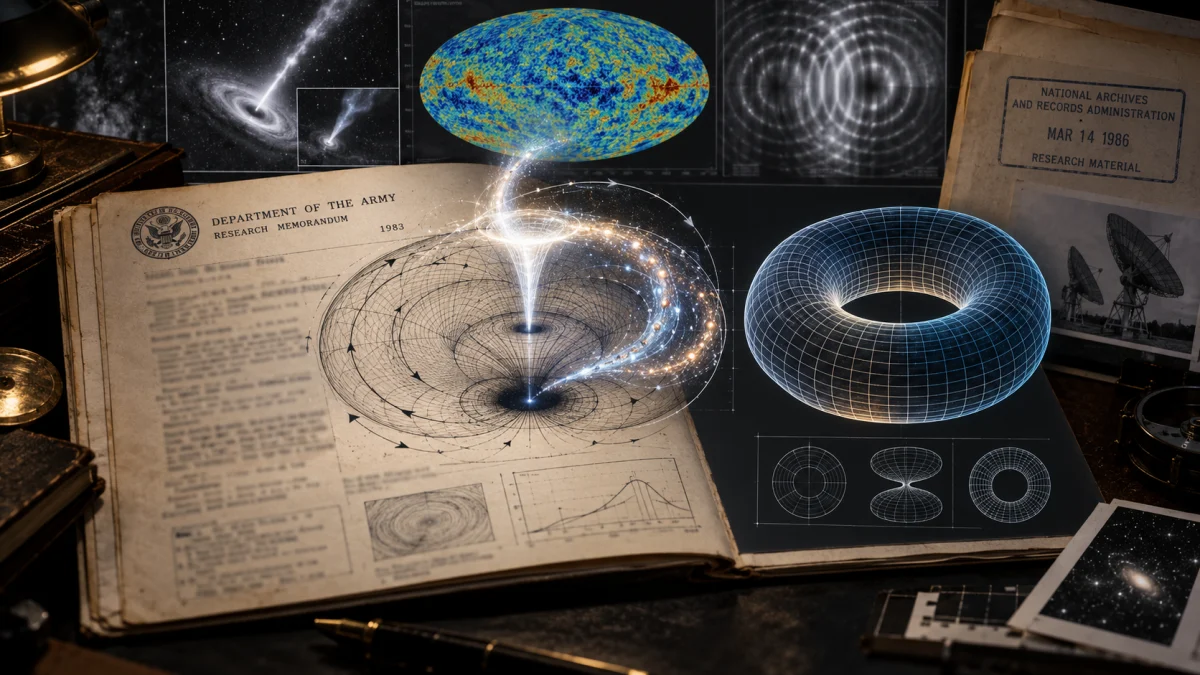
Yes, the famous Gateway Process “cosmic egg” diagram is real. And yes, the 1983 government document really describes a universe in which matter emerges through a white hole, circulates around an enormous torus-like structure, returns through a black hole, and contributes to a universal hologram containing the past, present and future.
The document goes even further. It argues that a sufficiently altered state of human consciousness might theoretically obtain information from that hologram, including information about future events.
But that does not mean CIA scientists discovered the blueprint of existence.
The document was actually written by U.S. Army intelligence officer Lt. Col. Wayne M. McDonnell for the U.S. Army Operational Group under Army Intelligence and Security Command at Fort Meade. The federal government’s preserved copy identifies it as a 1983 Army Department publication. Analysis and Assessment of Gateway Process — U.S. Government Publishing Office
And the most important cosmological model in the viral pages did not originate with McDonnell, the CIA or an intelligence-community physics laboratory.
McDonnell explicitly attributes it to Itzhak Bentov, an engineer and author whose 1977 book Stalking the Wild Pendulum attempted to construct a speculative model connecting cosmology, consciousness, altered states and intuition.
Bentov was unusually candid about where established science ended. When discussing the shape and creation of the universe, he wrote that the material “cannot be fully supported yet by scientific facts.” He said intuition and subjective experience would therefore have to serve as guides.
That sentence changes how the Gateway diagram should be understood.
The diagram is authentic. The government analyst genuinely took the model seriously. But the cosmology being circulated today as a secret government discovery began as a speculative model whose own author acknowledged that its crucial claims exceeded the scientific evidence available to him.
The modern physics is where the story becomes even more interesting.
Physicists really do investigate whether the universe could possess toroidal topology. They really do study a holographic principle connecting geometry and information. White holes are legitimate objects in theoretical relativity. And serious philosophical interpretations of relativity treat past and future events as parts of a four-dimensional spacetime.
But none of those facts establishes Bentov’s cosmic egg.
The same words appear in both stories.
The physics underneath them is often very different.
Yes, the Gateway Process “Cosmic Egg” Pages Are Authentic
The original federal document is titled “Analysis and Assessment of Gateway Process.”
It is dated June 9, 1983, addressed to the commander of the U.S. Army Operational Group at Fort Meade and signed by Lt. Col. Wayne M. McDonnell. In its opening paragraph, McDonnell explains that he was tasked with evaluating the Monroe Institute’s Gateway Experience in terms of its “mechanics and ultimate practicality.” He says he researched quantum mechanics, consciousness and theoretical physics while trying to construct what he considered a scientifically coherent explanation for how Gateway might work. Read the preserved federal Gateway Process report — GovInfo
That context matters.
This is not merely a paranormal book that somehow wound up in a government archive.
McDonnell was performing an official Army assessment, had personally participated in Gateway training, attempted to place its claims within a physical-science framework and ultimately recommended further experimentation.
But it is also not a peer-reviewed physics paper reporting an experimental discovery.
Those distinctions need to coexist.
First: It Says “Torus,” Not “Taurus”
A number of viral transcripts render the famous section as “From Big Bang to Taurus.”
The document actually says:
“24. From Big Bang to Torus.”
A torus is a mathematical/topological structure. “Taurus” is the zodiac constellation and sign.
The spelling error is trivial, but the distinction is useful because the word torus becomes central both to Bentov’s model and to the confusing comparison with modern cosmology.
What the Gateway Document Actually Says About the Universe
Section 24 begins by identifying the source of the theory:
McDonnell says Bentov presents a conceptual model for time-space evolution and the “relative position of the universal hologram.”
The model starts with the Big Bang, but Bentov proposes a very different geometry from the standard picture most readers have in mind.
In McDonnell’s summary:
- an extremely compressed nucleus ejects matter through a white hole;
- that matter travels outward and around an immense ovoid or “cosmic egg”;
- the stream eventually curves back toward itself;
- matter ultimately enters a black hole at the opposite end of the cycle;
- the black-hole/white-hole nucleus acts as both source and repository;
- the progression of matter around this structure provides the model’s physical basis for time.
McDonnell writes that, within this model, time begins as a measure of the cadence of the evolutionary movement of reality from the white-hole side around the egg toward the black hole.
The document’s Exhibit 4 is the image now circulating online.
It includes a quasar emitting a jet of matter, a hand-drawn “Diagram of the Cosmic Egg,” and a stylized simple torus. Crucially, the exhibit itself identifies its sources:
Figures A and B are from Bentov’s Stalking the Wild Pendulum. Figure C is from Jill Purce’s The Mystic Spiral.
That attribution is printed directly beneath the diagrams in the government document.
That immediately resolves one of the largest misconceptions surrounding the viral image:
The government did not create the cosmic-egg diagram as the result of a classified astronomical discovery. It reproduced an existing speculative model and incorporated it into an intelligence assessment.
The Document Really Does Place Our Galaxy Inside the Egg
The next section is titled “Our Place in Time.”
McDonnell follows Bentov in arguing that the observed distribution and motion of galaxies could indicate that our portion of the universe sits near a turning point in the flow of matter around the cosmic egg.
Exhibit 5 goes further and literally labels “Our Galaxy” on a cross-section of the torus.
The drawing places the galaxy near the portion of the structure where the stream is beginning to turn back upon itself.
Again, the internet did not invent that part.
What changes under scrutiny is where the claim came from and how much evidence supported it.
And Yes, Gateway Says the Hologram Contains Past, Present and Future
This is the part of the viral retelling that sounds easiest to dismiss.
It is also genuinely in the document.
McDonnell reasons that as matter traverses the torus through all phases of time, it generates an interference pattern that becomes the universal hologram.
Because that hologram is supposedly generated simultaneously from the various phases of cosmic evolution, he says it contains information corresponding to the universe’s past, present and future.
Then comes the extraordinary leap.
McDonnell argues that if human consciousness could enter a sufficiently altered or focused state, it might access information contained in this universal hologram.
He specifically says that future events could theoretically be predicted or “seen” with “total accuracy.”
That phrase is real.
But its evidentiary status is routinely changed in viral retellings.
“Total accuracy” was not the measured result of a government prediction experiment.
McDonnell did not report that Gateway participants were shown 1,000 unknown future events and correctly identified all 1,000.
It was a conclusion he inferred from the cosmological model:
If the complete consequences of past and present are already represented within a universal hologram, and if altered consciousness can access that hologram, then future information should theoretically be accessible.
Every part after that first if therefore depends on the model actually being correct.
That is a radically different claim from “the government proved people can see the future.”
The First Major Clue Is Printed on the Diagram Itself: Bentov
The internet version of this story often begins with the government memo.
The intellectual history begins earlier.
McDonnell’s bibliography lists Itzhak Bentov’s 1977 book Stalking the Wild Pendulum first, and the report repeatedly invokes Bentov’s models.
The original edition was published by E. P. Dutton in 1977. Stalking the Wild Pendulum — 1977 bibliographic record
Bentov was interested in constructing a unified picture connecting physics, biological rhythms, altered consciousness, intuition and cosmology.
That does not make the book meaningless.
It does tell us what kind of source it was.
And Bentov himself makes that unusually clear.
Bentov Warned Readers That His Cosmology Was Not Established Science
Near the beginning of Stalking the Wild Pendulum, Bentov distinguishes between material he thought could receive conventional rational support and the more ambitious cosmological ideas that followed.
When addressing the shape of the universe and the process of its creation, he says rational support becomes tenuous and describes the material as something that “cannot be fully supported yet by scientific facts.”
He says intuition and subjective experience become important guides.
That is not a hostile skeptic characterizing Bentov after the fact.
It is Bentov characterizing Bentov.
He was proposing a model and inviting speculation.
Decades later, the model’s appearance inside an intelligence document has often caused the order of evidence to reverse:
Bentov proposes a speculative cosmology → Army officer adopts it as part of a Gateway explanation → report enters a CIA-hosted archive → internet treats its presence in the archive as evidence that the government discovered the cosmology.
Once that provenance is restored, the document becomes easier to evaluate.
Bentov Built the Cosmic Egg Partly From Quasars
Bentov’s cosmology was not pure mystical imagery.
He attempted to anchor it to observations and contemporary physics.
One of the inspirations was the quasar 3C 273, which displays a spectacular jet.
Bentov reasoned by analogy: if an energetic object can eject matter preferentially in one direction rather than exploding symmetrically, perhaps the universe itself could have begun through a similar directional process.
From there he envisioned a cosmic jet emerging from the central nucleus, slowing, expanding, bending around an enormous structure and eventually returning.
McDonnell preserved essentially this reasoning in the Gateway report.
The problem is that an analogy is not a cosmological mechanism.
And the astronomical evidence Bentov used was already changing.
Bentov’s Own Book Says Some of Its Quasar Evidence Had Been Superseded
This detail deserves far more attention than it receives.
Bentov tried to infer our location within his toroidal universe partly from apparent asymmetries in the distribution of galaxies and quasars.
But in Stalking the Wild Pendulum itself, a footnote acknowledges that the quasar-distribution data he had cited had been superseded by newer observations indicating a more even distribution. Bentov then pointed to different velocity data that he thought could still support an anisotropy.
That does not mean Bentov concealed contrary evidence.
Quite the opposite: he disclosed it.
But it means a claim now presented online as an intelligence-community map of our position in the universe rested partly on an astronomical argument whose supporting observations were already moving underneath it.
What Modern Astronomy Says About Quasar Jets
Quasar jets are absolutely real.
But the modern explanation is not that quasars are miniature white holes demonstrating the architecture of the entire universe.
Quasars are associated with actively accreting supermassive black holes. Modern observations and models connect their powerful relativistic jets to the black-hole environment, including accretion, rapid rotation and strong magnetic fields.
NASA, describing research involving more than 700 quasars, explains that powerful jets are associated with rapidly spinning supermassive black holes and bright coronas threaded by magnetic fields. NASA: The Recipe for Powerful Quasar Jets
So Bentov started with a real phenomenon.
The speculative step was treating that phenomenon as a scale model for the creation and circulation of the universe.
Modern quasar physics does not provide evidence for that extrapolation.
Scientists Really Do Study Whether the Universe Is a Torus
This is where a lazy debunk would get the story wrong in the opposite direction.
A toroidal universe is a legitimate subject of modern cosmology.
In fact, on September 11, 2026, Nature Astronomy published a major review specifically examining the topology of the Universe.
Researchers have spent decades testing whether space could possess a non-trivial global topology rather than being simply connected and infinite in the most straightforward sense.
The new review describes searches using the cosmic microwave background, WMAP, Planck and other observational methods.
Its conclusion is nuanced:
No definitive evidence for a non-trivial cosmic topology has been found.
But current observations exclude only some topologies, parameter ranges and observer positions. Some possibilities remain open to future testing. The topology of the Universe — Nature Astronomy, September 2026
So saying “science proved the universe is not a torus” would be wrong.
The more important correction is that the torus studied by modern cosmologists is not Bentov’s cosmic egg.
Two “Toruses,” Very Different Physics
The word torus creates an illusion of agreement because it refers to two very different constructions.
| Feature | Bentov / Gateway cosmic egg | Modern cosmological 3-torus |
|---|---|---|
| What is being proposed? | A physical/evolutionary cosmic structure through which matter circulates | A possible global topology of three-dimensional space |
| Central nucleus? | Yes | No requirement |
| White-hole source? | Yes | No |
| Black-hole destination? | Yes | No |
| Matter flows around an outer shell? | Yes | No |
| Our galaxy has a special position in the flow? | Yes | No such requirement |
| Time corresponds to matter’s trip around the structure? | Yes | No |
| Universal consciousness/hologram built into model? | Yes | No |
| Scientific status | Speculative cosmology | Legitimate mathematical cosmology, observationally unconfirmed |
In one of the simplest cosmological examples, a 3-torus can be represented using a box or parallelepiped whose opposite faces are mathematically identified.
Leave through one side and, in the topology, you return through the corresponding opposite side.
A peer-reviewed Monthly Notices of the Royal Astronomical Society treatment describes the simplest hypertorus exactly this way: a parallelepiped with pairs of opposite faces identified. Topology of the Universe from COBE-DMR — Monthly Notices of the Royal Astronomical Society
That is topology.
It does not mean three-dimensional space is necessarily shaped like a literal donut floating inside some larger room.
And it certainly does not independently generate Bentov’s white-hole-to-black-hole circulation system.
Same word. Different claim.
That distinction is essential.
What About the White Hole?
Bentov’s model places a white hole at the source end of the universe and a black hole at the destination end.
White holes are not fictional terminology.
They appear legitimately in general relativity as theoretical time-reversed counterparts of black holes.
But their evidentiary status is very different.
A 2024 paper in the Journal of High Energy Physics summarizes the situation cleanly: black-hole candidates have extensive observational support, while theoretically viable white holes have nowhere near the same observational support. Black holes, white holes, and near-horizon physics — Journal of High Energy Physics
So the accurate formulation is neither:
“White holes are fake.”
nor:
“Physics says the universe comes out of a white hole.”
It is:
White holes are legitimate theoretical objects. We do not currently have observational evidence establishing a white hole as the source of the universe, much less the specific white-hole/black-hole circulation system proposed by Bentov.
Gateway’s “Universal Hologram” Creates Another Major Confusion
Modern physics really does contain something called the holographic principle.
That fact is frequently used to rehabilitate the Gateway report after the fact:
Gateway talked about a holographic universe in 1983. Modern physicists now say the universe is holographic. Therefore Gateway was right.
That conclusion does not follow.
The intellectual histories are different.
Gateway’s “universal hologram” came through Bentov and other consciousness-oriented material McDonnell cited, including discussion of neuroscientist Karl Pribram. McDonnell’s bibliography is visible in the original report and includes Bentov, Robert Monroe, Jill Purce, altered-consciousness literature and a 1978 article about Pribram.
The modern holographic principle in quantum gravity developed through a different line of work.
Gerard ‘t Hooft’s influential 1993 paper argued from gravitational collapse, entropy, quantum mechanics and degrees of freedom that physics at the Planck scale could admit a lower-dimensional description. Gerard ‘t Hooft, Dimensional Reduction in Quantum Gravity — 1993
Leonard Susskind’s 1994 The World as a Hologram developed ‘t Hooft’s idea further, describing how three-dimensional physics might be represented by data on a two-dimensional projection. Leonard Susskind, The World as a Hologram — 1994
Raphael Bousso’s major 2002 Reviews of Modern Physics review places the holographic principle within black-hole thermodynamics, entropy bounds and quantum gravity. The Holographic Principle — Reviews of Modern Physics
That is not Gateway’s theory of consciousness accessing a cosmic information interference pattern.
Did Gateway Predict the Holographic Principle?
Not in any useful scientific sense.
It is historically interesting that Gateway, Bentov and other writers used holographic analogies before ‘t Hooft and Susskind’s modern quantum-gravity formulation became influential.
But sharing an analogy does not make two theories equivalent.
An ordinary optical hologram has the unusual property that distributed interference information can reconstruct a larger image.
That makes holography an attractive metaphor for any theory proposing that information about the whole is distributed across parts.
But “both use the word hologram” is not evidence that both describe the same physical mechanism.
The modern holographic principle does not say:
- human consciousness can detach from the brain;
- the future is available for psychic retrieval;
- the universe is a white-hole/black-hole egg;
- individual minds can query a universal memory field;
- Hemi-Sync grants access to that field.
Those are additional Gateway propositions.
They require additional evidence.
What About the Claim That Past, Present and Future All Exist at Once?
This is the most sophisticated objection to simply dismissing Gateway.
Modern relativity really did destroy the intuitive Newtonian picture of one universal cosmic present.
In special relativity, observers moving relative to one another can disagree about which spatially separated events occur simultaneously.
Einstein Online explains the point cleanly: spacetime, understood as the total collection of events, is invariant in a way that separate slices of “space right now” are not. Different observers divide that spacetime into different snapshots of simultaneity. Einstein Online: Spacetime and the Relativity of Simultaneity
That has helped motivate philosophical views such as eternalism and the block universe.
Under eternalism, past and future events may be regarded as no less part of reality than present events.
But this is where another conceptual jump often occurs.
Relativity Does Not Simply Say “The Future Has Already Happened”
The relationship between relativity and the metaphysics of time remains a serious philosophical subject.
The Stanford Encyclopedia of Philosophy distinguishes among presentism, eternalism, growing-block theories and other positions rather than presenting one metaphysical interpretation as a settled experimental fact. Stanford Encyclopedia of Philosophy: Time
Relativity gives us strong physical results concerning spacetime and the relativity of simultaneity.
Exactly what those results mean for the ultimate ontology of past, present and future requires interpretation.
But even granting the strongest eternalist version does not solve Gateway’s problem.
Even a Block Universe Does Not Give You Tomorrow’s Information
This distinction is simple enough to state in one sentence:
Existence is not accessibility.
Suppose, for argument’s sake, that every event in your life can be represented as part of a four-dimensional spacetime structure.
That does not by itself create a mechanism allowing your present brain to retrieve information from an event tomorrow.
A useful analogy is a completed novel.
Page 300 can exist in the same book as page 100.
That does not mean a character on page 100 possesses a communications channel to page 300.
Physics still contains causal structure.
Einstein Online emphasizes that although observers disagree about simultaneity, spacetime retains observer-independent causal relationships. Einstein Online: Special Relativity and Spacetime
So these are different claims:
Claim A: Future events can be represented within a four-dimensional spacetime.
Claim B: A human consciousness at an earlier event can obtain information from those future events.
Claim B requires a mechanism Claim A does not provide.
And Bentov’s own book inadvertently makes that missing bridge unusually visible.
Bentov Explicitly Needed Faster-Than-Light Information
Near the end of Stalking the Wild Pendulum, Bentov asks how an “observer” or consciousness could access information distributed through his proposed universal system.
Before proceeding, he says his model requires two important assumptions.
One is coherence.
The other is that information can move faster than light.
On the following page, Bentov acknowledges the conflict directly: relativity says information cannot travel faster than light.
He hoped research into hypothetical faster-than-light particles known as tachyons might eventually offer a route around the limitation.
This is one of the strongest pieces of evidence for understanding the Gateway cosmology correctly.
The gap is not something modern skeptics invented in response to Gateway.
Bentov himself identified the gap and inserted an assumption to cross it.
Nothing in later mainstream physics has established the faster-than-light information channel his consciousness model requires.
McDonnell Did More Than Merely Quote Bentov
There is another mistake worth avoiding.
Once people learn that the cosmic egg came from Bentov, it becomes tempting to swing too far in the opposite direction:
So this was just some random theory an Army officer summarized. The government never took any of it seriously.
That is not what the document shows either.
McDonnell’s report is analytical and speculative, but he was not merely cataloging Bentov’s views at arm’s length.
He adopted major parts of the framework, connected them to Gateway and reached his own operational conclusions.
In Section 38, McDonnell writes that there was a “sound, rational basis” in physical-science terms for regarding Gateway’s essential objectives as plausible.
He then recommended a progression of experiments.
One proposal is extraordinary enough that it deserves to be stated plainly.
The Army Memo Proposed Comparing the Present, Past and Future
McDonnell suggested using three people in out-of-body states to examine the same target.
One would view it in ordinary time-space.
Another would view it as it moved into what the report called the immediate past.
A third would view it from the immediate future.
The three would then be debriefed and their information compared.
That recommendation tells us something important about McDonnell’s actual posture.
He did not demonstrate that future perception worked.
But he considered the premise plausible enough to recommend testing its intelligence usefulness.
So both common internet summaries miss something:
“The CIA proved humans can see the future.”
No.
“Nobody in government took this seriously.”
Also no.
A U.S. Army intelligence officer took it seriously enough to construct an elaborate explanatory model and recommend experiments based on it.
Why Is an Army Document Known as a “CIA File”?
Because provenance and authorship are being collapsed.
CIA really did participate in government research into paranormal and remote-viewing phenomena.
But the programs moved among agencies.
CIA’s own historical account says the agency conducted remote-viewing research beginning in the 1970s, later transferred the work to the Defense Intelligence Agency, and eventually received it back for review in the 1990s. When records were declassified, CIA says it worked with DIA and the Army to gather the collection and placed records from all three organizations into its electronic reading room. CIA: Did CIA Really Study Psychic Powers?
That explains why the Gateway report carries a CIA declassification identifier despite being an Army document.
The fairest shorthand is:
“A declassified Gateway document released through the CIA archive.”
Calling it a “CIA-authored scientific study” is inaccurate.
Did Later Government Research Validate Gateway?
Not in the sense required to validate the cosmic-egg theory.
The U.S. government’s broader remote-viewing effort continued for years.
In the mid-1990s, CIA commissioned an independent evaluation before deciding whether to restore the program.
CIA’s later historical summary says the review found enough anomalous accuracy to raise questions beyond simple randomness, but the results were too unreliable, inconsistent and sporadic to provide useful intelligence. CIA chose not to restore the program. CIA history of remote-viewing research and the 1995 evaluation
That history should not be oversimplified into “the government proved psychic perception” or “the government proved nothing unusual ever happened.”
More importantly for this article:
Remote-viewing statistics do not test the shape of Bentov’s universe.
Even an anomalous remote-viewing result would not independently demonstrate a cosmic egg, a white hole, a universal hologram or faster-than-light consciousness.
Those are separate propositions.
Hemi-Sync and Binaural Beats Are Real Phenomena. That Still Does Not Establish Gateway’s Cosmology
The Monroe Institute’s Gateway system relies heavily on audio techniques including binaural beats.
A binaural beat is a genuine psychoacoustic effect: present slightly different tones separately to each ear and a listener can perceive a beat corresponding to their frequency difference.
The much larger question is whether binaural beats reliably entrain brain oscillations in the strong way often claimed.
A 2023 PLOS ONE systematic review examined 14 EEG studies.
Five produced results consistent with the entrainment hypothesis, eight produced contradictory results and one was mixed. The authors found substantial methodological heterogeneity and concluded that the evidence remained inconsistent. Binaural beats to entrain the brain? — PLOS ONE systematic review
So there is no need to pretend Gateway’s underlying auditory phenomenon is imaginary.
There is equally no basis for moving from:
“binaural beats can affect perception or possibly some brain activity”
to:
“therefore consciousness can escape spacetime and retrieve future information.”
Those claims operate on entirely different evidentiary levels.
For the broader evidence audit of Gateway’s claims about eternal consciousness, Hemi-Sync, future perception, Schumann resonance and remote viewing, see sherafy.com‘s earlier investigation: Did the CIA Say Consciousness Survives Death? What the Gateway Report Actually Says
Out-of-Body Experiences Are Real Experiences. That Does Not Tell Us Where Consciousness Went
A similar distinction applies to out-of-body experiences.
People genuinely report episodes in which they experience themselves as located outside their bodies.
That subjective phenomenon is real.
What causes it is a separate question.
In a 2007 New England Journal of Medicine report, researchers repeatedly induced an out-of-body experience during stimulation of the right posterior superior temporal region in a patient with implanted electrodes. Imaging implicated areas around the temporoparietal junction involved in multisensory integration and self-location. Visualizing Out-of-Body Experience in the Brain — New England Journal of Medicine
That does not prove every OBE has the same explanation.
It does demonstrate something important:
Experiencing consciousness as located outside the body is not, by itself, proof that consciousness literally left the body.
The experience and the metaphysical interpretation of the experience are different pieces of evidence.
What About the Gateway Report’s Missing Page 25?
Yes, a numbered page was missing from the government copy that became famous online.
That absence helped produce an entire secondary mythology around the report.
In 2021, the Monroe Institute told VICE it possessed a complete copy of the report in its archives and supplied the missing page. VICE: Found — Page 25 of the Gateway Report
The important point for the torus story is simpler:
The cosmic-egg material was not hidden on Page 25.
“From Big Bang to Torus,” the cosmic-egg diagrams, the placement of our galaxy and the claim about past, present and future all appear earlier in the government-released document.
The supposedly missing page therefore cannot explain why those cosmological claims became public.
They were already there.
There is also no positive evidence in the document itself establishing that Page 25 was deliberately removed to conceal a scientific secret.
What the Viral “CIA Blueprint of the Universe” Claim Gets Right and Wrong
| Viral claim | What the evidence actually shows |
|---|---|
| “The CIA document is fake.” | False. The document is authentic and preserved by the U.S. Government Publishing Office. |
| “The CIA mapped the universe.” | Misleading. An Army intelligence officer incorporated an outside speculative cosmology into an assessment of Gateway. |
| “The cosmic-egg diagram is really in the file.” | True. Exhibit 4 contains it. |
| “The government invented the torus model.” | False. The report explicitly attributes its principal cosmic-egg diagrams and model to Itzhak Bentov. |
| “Bentov presented this as proven science.” | False. Bentov explicitly said the shape and creation portion could not yet be fully supported by scientific facts. |
| “Matter leaves through a white hole and returns through a black hole.” | True as a description of the model. Not established as cosmological fact. |
| “Gateway says our galaxy occupies a particular location inside the egg.” | True. The document even diagrams the proposed location. |
| “Gateway says past, present and future coexist in the universal hologram.” | True within McDonnell’s model. |
| “Gateway says the future can be seen with total accuracy.” | The words are real, but this was a theoretical deduction, not an experimental accuracy measurement. |
| “Scientists actually study torus universes.” | True. Cosmic topology is a legitimate research field. |
| “Modern torus cosmology proves Bentov’s cosmic egg.” | False. Modern 3-torus topology does not require Bentov’s physical egg, central white/black-hole system or matter circulation. |
| “White holes are pseudoscience.” | Too strong. They are legitimate theoretical solutions but lack black holes’ observational support. |
| “Modern physics says the universe is holographic.” | Modern quantum gravity contains a serious holographic principle, but it is not Gateway’s universal-consciousness hologram. |
| “Relativity says past and future exist.” | Some interpretations, particularly eternalism/block-universe views, say something close to this. Relativity itself does not settle every metaphysical question about time. |
| “If the future exists, consciousness can access it.” | Unsupported. Existence does not provide an information channel. |
| “Bentov supplied such a channel.” | He proposed one only by assuming faster-than-light information transfer, which he acknowledged as a theoretical problem. |
| “The Army officer merely mentioned these ideas and dismissed them.” | False. McDonnell regarded Gateway as plausible enough to recommend further experiments. |
| “The government scientifically proved Gateway.” | False. The memo is an explanatory and operational assessment, not experimental verification of its cosmology. |
So Did the CIA Discover the Shape of the Universe?
No.
But stopping there would erase the genuinely remarkable part of the story.
A real Army intelligence officer was tasked with evaluating an altered-consciousness training program.
He personally engaged with Gateway.
He drew heavily from Itzhak Bentov.
He combined Bentov’s speculative cosmology with ideas about holograms, consciousness, quantum mechanics, out-of-body states and Monroe’s Hemi-Sync system.
He produced an official memorandum containing diagrams of a white-hole/black-hole cosmic egg.
He argued that past, present and future could coexist within its universal hologram.
He concluded that altered consciousness might theoretically retrieve information from that structure.
And he recommended experiments that included attempts to examine targets from the immediate future.
None of that needs to be embellished.
It happened.
The mistake comes when the document’s existence is confused with scientific validation.
The Most Interesting Modern Twist: Gateway Accidentally Lands Near Several Real Physics Questions
This is why the Gateway document continues to feel uncanny more than four decades later.
Modern physicists really are asking questions about:
- whether space has a non-trivial global topology;
- whether the universe might be spatially finite while lacking an ordinary edge;
- how information relates to geometry;
- whether gravitational systems admit lower-dimensional descriptions;
- what black-hole thermodynamics tells us about information;
- whether white-hole solutions have any physical realization;
- what relativity means for our intuitive concept of a universal present.
Those are serious questions.
What has not followed is the chain Gateway needs:
toroidal topology → cosmic egg → white-hole circulation → universal hologram → nonphysical consciousness → access to that hologram → reliable knowledge of the future.
Every arrow is another claim.
Every claim needs its own evidence.
Real science occurring somewhere along the chain cannot be borrowed to validate everything after it.
That is the central error behind many modern readings of Gateway.
Frequently Asked Questions
Is the CIA Gateway Process document real?
Yes. Analysis and Assessment of Gateway Process is an authentic 1983 U.S. Army document preserved by the federal government and later included among intelligence-community records released through the CIA archive. U.S. Government Publishing Office record
Did the CIA write the Gateway Process report?
No. Lt. Col. Wayne M. McDonnell wrote it for the U.S. Army Operational Group under U.S. Army Intelligence and Security Command at Fort Meade.
Calling it a “CIA document” refers to its later presence in CIA’s declassified collection, not its authorship.
What is the Gateway Process cosmic egg?
It is a model, largely drawn from Itzhak Bentov, in which matter emerges through a white-hole side of a central nucleus, travels through an ovoid or toroidal universe and ultimately returns through a black hole. McDonnell uses this model to connect cosmic evolution, time and a proposed universal hologram.
Is the universe actually shaped like a torus?
Possibly in a very different mathematical sense, but there is currently no definitive observational evidence that our universe has non-trivial toroidal topology.
Modern cosmic-topology research does not use Bentov’s white-hole/black-hole cosmic egg. 2026 Nature Astronomy review of cosmic topology
Are white holes real?
White holes are legitimate theoretical solutions related to general relativity, but unlike black holes they lack comparable observational evidence. 2024 Journal of High Energy Physics review of black and white holes
Is the universe a hologram?
Modern theoretical physics contains a serious holographic principle in quantum gravity, but it concerns the relationship between information, entropy, gravity and lower-dimensional descriptions of physical systems.
It is not scientific confirmation of Gateway’s universal consciousness hologram.
Does physics say the future already exists?
Some interpretations of spacetime, especially eternalism or block-universe interpretations, treat past and future events as parts of a four-dimensional reality.
That remains partly a metaphysical question.
More importantly, even if eternalism is correct, it does not provide a known mechanism allowing a present human mind to access future information.
Did Gateway prove humans can see the future?
No.
McDonnell said his model implied that future information could theoretically be obtained and even described it as potentially visible with “total accuracy.” But this was an inference from the proposed universal-hologram model, not a demonstrated experimental accuracy rate.
Did the government at least take Gateway seriously?
Yes.
McDonnell concluded that Gateway’s essential objectives were plausible enough to justify further work and recommended experiments involving altered consciousness, out-of-body information collection and attempts to compare present, past and future observations.
That demonstrates government interest.
It does not demonstrate that the underlying theory was true.
The Bottom Line
The Gateway Process document does not show that the CIA secretly discovered the blueprint of existence.
What it shows is, in some ways, more interesting.
In 1983, a U.S. Army intelligence officer tried to construct one.
He took the Monroe Institute’s altered-consciousness techniques, Itzhak Bentov’s speculative cosmology, holographic analogies and pieces of contemporary physics and assembled them into a proposed mechanism for consciousness operating beyond ordinary space and time.
The diagrams are real.
The white hole is real to the model.
The black hole is real to the model.
The torus is real to the document.
The line about seeing the future with “total accuracy” is real.
And McDonnell really did recommend experiments based on those ideas.
But provenance matters.
Bentov himself warned that the cosmology at the center of the argument was not fully supported by scientific facts. One of its astronomical foundations was already being revised. Its consciousness mechanism eventually required an assumption of faster-than-light information transfer. Modern cosmology’s torus is a different proposition. Modern holography is a different physical framework. Relativity does not transform spacetime into a database the human mind can query.
The strongest evidence therefore supports a conclusion more precise than either internet extreme:
Gateway is not proof that the government mapped reality. It is evidence that a government intelligence officer seriously explored a speculative attempt to map it.
Forty-three years later, some of the questions around topology, information and time remain genuinely open.
The extraordinary bridges Gateway built between those questions remain unproven.
And that distinction is what makes the document worth reading.
References and Further Reading
Primary Government Records
U.S. Government Publishing Office — Analysis and Assessment of Gateway Process
Federal GovInfo record and preserved Army document
The primary federal record. It identifies the publication as a 1983 Army Department document and provides the preserved scan containing the torus discussion, diagrams, conclusions and bibliography.
CIA — Did CIA Really Study Psychic Powers?
CIA historical account of remote viewing and STARGATE records
CIA’s account of its paranormal-intelligence research, the transfer of the program among CIA, DIA and the Army, the 1995 review and the later assembly of records for declassification.
Original Source Behind the Cosmic-Egg Model
Itzhak Bentov — Stalking the Wild Pendulum: On the Mechanics of Consciousness (1977)
Google Books bibliographic record for the original 1977 edition
Bentov’s book is the central source McDonnell cites for the cosmic-egg cosmology. Bentov explicitly characterizes the universe-shape and creation portions as not fully supportable by scientific facts, describes the quasar analogy, acknowledges changing quasar observations and later assumes faster-than-light information transfer in his intuitive-knowledge mechanism.
Open Library — 1977 first-edition record for Stalking the Wild Pendulum
Open Library bibliographic record
Useful for verifying publication history, edition information and library identifiers for Bentov’s original book.
Cosmic Topology
Copi et al. — The Topology of the Universe, Nature Astronomy (2026)
Nature Astronomy review, published September 11, 2026
The most current major review located for this article. It explains how non-trivial cosmic topology can be tested through the CMB and matter distribution, notes that no definitive evidence has yet been found, and describes possibilities that remain observationally open.
Rocha et al. — Topology of the Universe from COBE-DMR — a Wavelet Approach, Monthly Notices of the Royal Astronomical Society
MNRAS discussion of the 3-torus and other compact topologies
Provides a useful technical description of a cosmological hypertorus as a parallelepiped with opposite faces identified, illustrating why mathematical toroidal topology should not be confused with Bentov’s physical cosmic egg.
White Holes and Quasars
Gaur & Visser — Black Holes, White Holes, and Near-Horizon Physics, Journal of High Energy Physics (2024)
Open-access JHEP paper
Explains the sharp distinction between the strong observational case for black holes and the much weaker observational status of theoretically viable white holes.
NASA — The Recipe for Powerful Quasar Jets
NASA explanation of modern quasar-jet research
Summarizes observations connecting powerful quasar jets with rapidly spinning supermassive black holes, bright coronas and magnetic fields.
The Modern Holographic Principle
Gerard ‘t Hooft — Dimensional Reduction in Quantum Gravity (1993)
Original ‘t Hooft paper on arXiv
One of the foundational works leading to the modern holographic principle, derived from questions involving quantum mechanics, gravitational collapse, entropy and degrees of freedom.
Leonard Susskind — The World as a Hologram (1994)
Original Susskind paper on arXiv
Develops ‘t Hooft’s proposal that three-dimensional physics may admit an equivalent lower-dimensional information description.
Raphael Bousso — The Holographic Principle, Reviews of Modern Physics (2002)
Peer-reviewed holographic-principle review
A major review explaining holography through black-hole thermodynamics, information, entropy bounds and quantum gravity.
Relativity and Time
Einstein Online — Spacetime
Max Planck Institute’s Einstein Online introduction to spacetime
Explains the relativity of simultaneity, four-dimensional spacetime and the causal structure that remains invariant between observers.
Stanford Encyclopedia of Philosophy — Time
Overview of presentism, eternalism, block-universe views and relativity
Useful for separating experimentally established features of relativity from philosophical claims about whether past and future events “exist” in the same sense as present events.
Gateway’s Altered-State Mechanisms
Ingendoh, Posny & Heine — Binaural Beats to Entrain the Brain?, PLOS ONE (2023)
Systematic review of binaural-beat EEG research
Reviews 14 EEG studies and finds inconsistent evidence for brainwave entrainment, with substantial methodological differences across studies.
De Ridder et al. — Visualizing Out-of-Body Experience in the Brain, New England Journal of Medicine (2007)
NEJM report on experimentally elicited disembodiment
Documents an out-of-body experience repeatedly elicited during brain stimulation and identifies neural activity associated with altered self-location.
Related sherafy.com Research
sherafy.com — Did the CIA Say Consciousness Survives Death? What the Gateway Report Actually Says
Read the companion Gateway investigation
A separate evidence audit covering Gateway’s claims about eternal consciousness, out-of-body perception, Schumann resonance, Hemi-Sync, future access and later government remote-viewing research.
The Missing Page
VICE — Found: Page 25 of the CIA’s Gateway Report on Astral Projection
VICE’s account of obtaining the complete report from the Monroe Institute archive
Documents how the Monroe Institute supplied a complete copy containing the numbered page missing from the government scan. The famous cosmic-egg material appears earlier in the report and was not contained on the missing page.
Editorial currency note: The 1983 Gateway report and Bentov’s 1977 book are fixed historical records. Scientific-status sections were checked against literature available through September 27, 2026, including the September 2026 Nature Astronomy review of cosmic topology. Future cosmological observations, quantum-gravity research or consciousness studies could change particular scientific conclusions, but they would not change what the historical sources originally claimed.