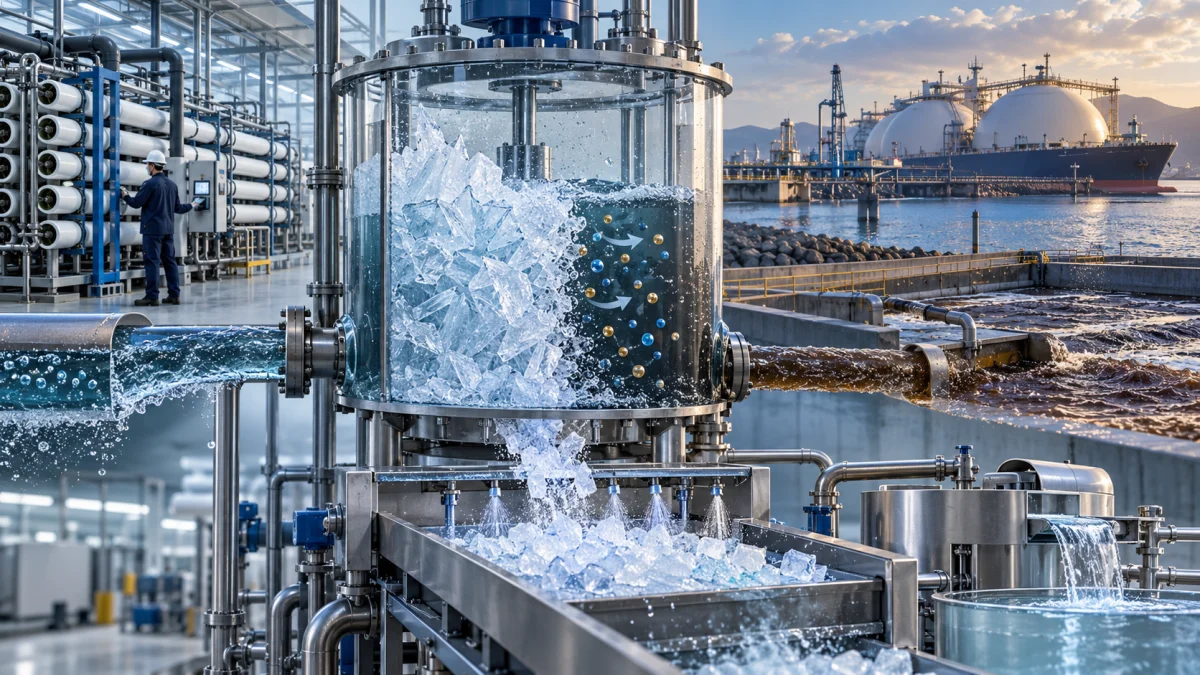
Yes. When salt water freezes, the growing ice crystals reject most of the dissolved salt into the liquid water that remains. That means seawater really can be desalinated by freezing it.
The reason we do not normally make drinking water this way is more complicated.
The difficult part is not convincing salt to leave the ice crystal. Nature already does that. The difficult part is producing enormous quantities of ice, separating that ice from extremely salty liquid brine, removing the brine trapped between or attached to the ice crystals, melting the purified ice, and recovering enough energy to make the entire process economically competitive.
That distinction matters because freeze desalination is sometimes presented as an overlooked trick that should obviously beat conventional desalination. It is neither overlooked nor new. Engineers have experimented with it for decades.
Modern reverse osmosis, meanwhile, avoids freezing and boiling altogether. Today’s seawater RO systems commonly consume around 2.5 to 4.0 kilowatt-hours of electricity per cubic meter of product water, according to a 2024 analysis of practical minimum energy use in seawater RO.
Freeze desalination therefore has to compete not against a giant kettle, but against one of the most heavily optimized membrane processes in modern water treatment.
The interesting part is that freezing may still have a role. Recent research increasingly points toward very salty brines, waste-cold systems and specialized industrial water streams as applications where freeze desalination could make more sense than trying to replace reverse osmosis for ordinary seawater.
What Happens When Salt Water Freezes?
Normal ocean water contains roughly 3.5% dissolved salts. Those salts also lower its freezing point.
According to NOAA, typical seawater freezes at about -1.9°C, or 28.4°F, rather than the 0°C freezing point of pure freshwater. When seawater begins freezing, however, most of the salt does not enter the growing water-ice crystal. NOAA: Can the Ocean Freeze?
The National Snow and Ice Data Center describes what happens in more detail. Tiny ice crystals form while highly saline liquid is expelled. Some of that concentrated liquid returns to the ocean, while some becomes trapped between ice crystals as brine pockets and channels. NSIDC: Science of Sea Ice
That distinction explains an apparent contradiction:
- The actual water-ice crystals can contain very little salt.
- A chunk of newly formed sea ice can still be salty because liquid brine is trapped inside it.
As sea ice ages, that brine can drain out through channels or be flushed away during melting and refreezing. Older multiyear sea ice can consequently become much fresher than newly formed sea ice.
So the scientifically useful statement is not that "salt cannot freeze."
It is that ordinary growing water ice strongly excludes dissolved salt ions from its crystal structure. Under much colder and more concentrated conditions, salts themselves can eventually crystallize too, which becomes important in a related process called eutectic freeze crystallization.
Can You Really Desalinate Seawater by Freezing It?
Yes. The process is called freeze desalination, or sometimes freezing desalination or freeze crystallization.
In its simplest form:
Salt water → partial freezing → ice + concentrated brine → separate the ice → clean the ice → melt it → lower-salinity water
The critical words are partial freezing and separate the ice.
If you simply put a sealed container of salt water into a freezer, freeze everything you can, and then melt the whole contents back together, you have not made the salt disappear. The salt remains somewhere in the system.
Freeze desalination works because the relatively clean ice is physically removed before it is melted back into water.
A simple 100-kilogram example
Imagine an idealized batch containing:
- 100 kg of seawater
- 3.5 kg of salt
- 96.5 kg of water
Now imagine 50 kg of essentially salt-free water crystallizes into ice and is removed.
The remaining liquid would contain approximately:
- 3.5 kg of salt
- 46.5 kg of water
That remaining 50 kg of brine would therefore be about 7% salt by mass, roughly twice the original concentration.
This is an idealized mass-balance example, not a claim about the performance of a real desalination plant. Real ice contains trapped brine, and real systems lose water during separation and purification.
But it demonstrates the basic physics: freezing does not destroy the salt. It concentrates it somewhere else.
So Why Isn’t Freeze Desalination Used Everywhere?
Because the process produces something much more awkward than a clean block of freshwater ice.
It produces ice mixed with concentrated brine.
A major 2026 review of freeze-desalination research identifies the central engineering challenge as continuously recovering low-salinity ice without excessive brine entrapment, water loss or auxiliary energy demand. 2026 review: Freeze Desalination Technologies for Sustainable Water Treatment
The problem isn’t making ice. It’s making clean ice.
The salt rejected by a growing ice front accumulates in the liquid next to it.
If freezing happens too quickly, or if many tiny crystals are produced, some of that salty liquid can become trapped between crystals or enclosed within the developing ice structure.
That means a freeze-desalination system has to control things such as:
- freezing rate;
- ice crystal size;
- liquid circulation;
- temperature gradients;
- brine drainage;
- ice adhesion to cooling surfaces;
- crystal separation;
- washing or centrifugation;
- melting and cold-energy recovery.
These are not minor details. They determine how salty the final water is and how much energy and equipment the process requires.
Washing the Ice Can Cost Water
One particularly revealing experiment was published in Water Research in 2016.
Researchers tested freeze desalination using both artificial and real seawater and investigated how much clean water was needed to wash concentrated brine from the newly produced ice.
Their optimized process produced ice melt with total dissolved solids around 300 mg/L, but the optimal quantity of wash water was approximately 50% of the raw ice mass. Once wash-water consumption was considered, overall ice recovery was greater than roughly 25% of the original seawater rather than the much larger raw-ice fraction initially produced. Water Research: Freeze Desalination of Seawater Using LNG Cold Energy
That is a perfect example of why the chemistry alone does not determine whether a desalination technology succeeds.
You can reject a great deal of salt during freezing and still face a difficult engineering problem getting the salty liquid away from the ice afterward.
A 2017 prototype using an ice-making system and simulated LNG cold energy reported only about 50% salt removal in one cycle, explicitly finding that a single freezing cycle was insufficient to produce drinking water in that configuration. 2017 seawater freeze-desalination prototype study
A Low Salt Number Does Not Automatically Mean Water Is Safe to Drink
There is another important distinction that is sometimes lost in freeze-desalination literature.
The 2016 Water Research experiment described its approximately 300 mg/L TDS product as meeting a supposed World Health Organization "500 ppm" potable-water salinity standard.
That wording should not be repeated without qualification.
The WHO does not establish a health-based guideline value for total dissolved solids in drinking water. Its guidance states that reliable evidence does not justify a health-based TDS limit at concentrations normally encountered in drinking water, although high concentrations can affect taste and acceptability. WHO guidance on total dissolved solids in drinking water
In the United States, 500 mg/L TDS is an EPA secondary drinking-water standard, meaning it primarily addresses aesthetic issues such as taste, deposits and staining rather than serving as a primary health limit.
More importantly, low TDS alone does not establish potability.
Water intended for drinking must also satisfy applicable requirements for microorganisms, toxic metals, organic contaminants and other relevant constituents.
That becomes especially important when freeze desalination is used on industrial wastewater rather than ordinary seawater.
But Doesn’t Freezing Require Much Less Energy Than Boiling?
At the phase-change level, yes.
Freezing or melting one kilogram of water involves roughly 335 kilojoules per kilogram of latent heat.
Vaporizing the same amount of water at its boiling point requires roughly 2,256 kilojoules per kilogram.
That means water’s latent heat of fusion is only about one-seventh of its latent heat of vaporization. This is a genuine thermodynamic reason freeze desalination has attracted researchers for decades.
But it can also produce one of the most misleading arguments about the technology:
Freezing requires one-seventh the phase-change energy of evaporation, therefore freeze desalination should require one-seventh the energy of conventional desalination.
That conclusion does not follow.
Reverse osmosis does not boil the water
Modern seawater reverse osmosis uses pressure to push water through a semipermeable membrane while leaving most dissolved salts behind.
It therefore avoids the massive phase-change energy associated with evaporation.
A 2024 Joule analysis reports typical seawater reverse-osmosis specific energy consumption around 2.5 to 4.0 kWh/m³, while estimating a thermodynamic minimum close to 1 kWh/m³ under the study’s representative seawater conditions. Joule: Practical Minimum Energy Use of Seawater Reverse Osmosis
Freeze desalination has to beat that real process, not an idealized boiling process.
Freeze Desalination vs. Reverse Osmosis
| Factor | Freeze desalination | Seawater reverse osmosis |
|---|---|---|
| Main separation principle | Water crystallizes as ice while salts remain concentrated in liquid | Pressure forces water through a membrane while salts are rejected |
| Phase change required | Yes | No |
| Typical commercial maturity | Mostly laboratory, pilot and demonstration development | Mature global technology |
| Major challenge | Ice/brine separation, salt entrapment, refrigeration and cold recovery | Pressure, fouling, scaling, pretreatment and membrane management |
| Reported energy use | Highly dependent on configuration and energy source | Commonly about 2.5–4.0 kWh/m³ |
| Very high salinity | Potentially attractive | Becomes increasingly difficult as osmotic pressure rises |
| Waste-cold integration | Potentially valuable | Little direct advantage |
| Direct replacement for normal seawater RO today? | Not established | Current benchmark technology |
The biggest mistake would be assigning freeze desalination one universal energy number.
A 2021 directional-freezing study calculated approximately 11.34 kWh/m³ for its freeze-desalination system. Desalination: Directional Freezing for Seawater Desalination
But published values vary dramatically depending on whether refrigeration is conventional, whether cold is recovered, how pure the product water becomes, and whether outside cooling energy is effectively supplied by another industrial process.
The August 2026 review found reported freeze-desalination energy consumption varying by more than an order of magnitude. Values near 3 kWh/m³ generally depended on favorable integrations or external cold sources, while conventionally refrigerated laboratory and pilot systems could require substantially more.
That is why energy comparisons need clearly defined system boundaries.
LNG Makes Freeze Desalination Look Much More Interesting
One of the most studied combinations involves liquefied natural gas, or LNG.
LNG is transported at cryogenic temperatures. Before natural gas enters ordinary pipelines, the LNG has to be warmed and converted back into gas.
That creates an unusual engineering opportunity: instead of paying a refrigeration system to make something cold enough to freeze seawater or brine, a facility may be able to capture some of the cold energy already available during LNG regasification.
A February 2026 study in Energy Conversion and Management modeled a multi-effect freeze-desalination system powered partly by LNG cold energy. It reported an electrical specific energy consumption of approximately 1.83 kWh/m³. 2026 LNG-driven multi-effect freezing study
That sounds better than conventional seawater RO until another number is considered.
The same study reports approximately 465.46 kWh of thermal/cooling energy per cubic meter supplied through the cold-energy side of the system.
That does not make the system pointless. If cold energy would otherwise be wasted during LNG regasification, capturing it can be economically sensible.
But it does mean the 1.83 kWh/m³ electrical number cannot be compared directly with the full electrical consumption of an RO plant and interpreted as proof that freezing inherently uses less energy.
The cold is still an energy input. The economic advantage comes from where that input came from.
Freeze Desalination Is Not a New Idea
Scientists did not recently discover that seawater ice rejects salt.
The U.S. government was experimenting with freeze desalination more than half a century ago.
In March 1969, the U.S. Department of the Interior’s Office of Saline Water published a report titled “Secondary Refrigerant Freezing Desalting Process: Operation of a 15,000 GPD Pilot Plant.” The documented pilot was designed around roughly 15,000 gallons of desalinated water per day. U.S. Office of Saline Water 15,000-GPD freeze-desalination pilot report
So the relevant question is not:
Why hasn’t anyone thought of freezing seawater?
They have.
The question is:
Why, after decades of experimentation, has freeze desalination not displaced reverse osmosis?
The answer is that the hard part has always been translating favorable ice chemistry into a reliable, continuous and economical industrial process.
New Research Is Attacking the Salt-Entrapment Problem Directly
The science has not stood still.
In August 2025, researchers writing in Physical Review Research investigated why ions sometimes become trapped during rapid freezing.
They described salt rejection as a competition between the movement of the freezing front and the ability of salt ions to move away from that interface. The researchers then used flowing seawater to improve ion transport and reported ion rejection exceeding 98.2% in a single freezing cycle under their experimental conditions. Physical Review Research: Factors Determining Ion Rejection and One-Step Freeze Desalination
That is an important result.
It is not the same thing as demonstrating a full-scale municipal drinking-water plant.
The study establishes improved ion rejection under controlled conditions. Commercial deployment still has to account for throughput, real-water chemistry, equipment costs, long-duration operation, cleaning, energy consumption and complete drinking-water quality.
The broader 2026 literature reaches essentially that conclusion: freeze desalination has progressed technically, but scale-up and stable continuous operation remain unresolved.
The Best Use for Freeze Desalination May Not Be Ordinary Seawater
This may be the most important recent shift in how the technology is being evaluated.
Ordinary seawater contains roughly 35 grams of dissolved salts per liter.
Reverse osmosis handles water in this range very well.
But RO becomes progressively more difficult as salinity rises because increasingly salty water has increasingly high osmotic pressure. A membrane system has to apply still more pressure to drive water in the desired direction.
A 2026 comparative analysis therefore argues that freeze desalination becomes more interesting for highly concentrated brines above roughly 70 g/L, where conventional RO faces increasingly difficult pressure requirements. 2026 comparative analysis of desalination technologies and freeze desalination
That 70 g/L figure should not be treated as a universal commercial crossover point. The paper combines published performance data and modeling, and the authors explicitly describe freeze desalination’s proposed role in hybrid zero-liquid-discharge systems as a working hypothesis requiring industrial-scale validation.
But the logic is important.
Instead of asking:
Can freezing replace RO for normal seawater?
researchers are increasingly asking:
Can RO remove the easier water first, then hand its increasingly concentrated waste brine to a technology better suited to very high salinity?
That is a much more plausible role.
A 2026 Experiment Tested Exactly That Kind of High-Salinity Brine
Researchers publishing in Chemical Engineering and Processing in February 2026 tested freeze desalination on brines ranging from 3% to 10% total dissolved solids.
For a three-stage system treating a 5% feed brine and using LNG cryogenic energy, they reported 50% overall product-water recovery and 96% desalination efficiency. 2026 multistage freeze desalination study for high-salinity brines
Again, that does not establish a universal commercial advantage.
But it demonstrates why concentrated industrial brines may ultimately prove more important to freeze desalination than ordinary ocean water.
Freeze Desalination Is Already Moving Into Larger Real-World Tests
There is also a noteworthy U.S. demonstration underway that goes beyond academic seawater experiments.
Texas Pacific Land disclosed in August 2026 that it had completed construction and begun commissioning a produced-water desalination test facility in Orla, Texas, with an anticipated inlet capacity of 10,000 barrels per day. Texas Pacific Land Q2 2026 SEC filing and results
Produced water from oil and gas operations can be substantially saltier and chemically more complicated than normal seawater.
Importantly, TPL’s disclosed treatment train is not freeze desalination alone. Company materials describe pretreatment, fractional freeze desalination, reverse osmosis, activated-carbon filtration, disinfection and other polishing steps.
That actually reinforces the larger point.
Freeze desalination’s emerging commercial role may be as one component in an integrated treatment system for difficult high-salinity water, not as a universal replacement for membranes.
The plant’s eventual economics and long-term operating performance remain to be demonstrated, and company statements about expected performance should be treated as company claims until independent operating data are available.
Could Freezing Help Create Zero-Liquid-Discharge Systems?
Potentially, but ordinary freeze desalination by itself does not eliminate the brine.
It makes the brine more concentrated.
A related technique called eutectic freeze crystallization, or EFC, cools the remaining solution toward its eutectic conditions, where ice and salt solids can crystallize.
For a simple sodium-chloride-and-water system, the eutectic point is around -21.1°C at roughly 23.3% salt by mass. At that point, ice and salt crystals can form as separate solid phases. npj Clean Water review of freeze desalination and eutectic freeze crystallization
That creates the possibility of recovering both more water and solid salts while reducing the remaining liquid waste.
But "possible pathway toward zero liquid discharge" is more accurate than saying freeze desalination already solves the brine-disposal problem.
Industrial-scale economics, salt purity, residual waste, equipment reliability and market demand for recovered materials still matter. The 2026 literature repeatedly identifies those questions as unresolved.
Is Freeze Desalination Better Than Reverse Osmosis?
For ordinary seawater today, the evidence does not establish that.
Reverse osmosis has decades of engineering optimization behind it, enormous installed capacity, mature equipment suppliers and well-understood plant economics.
Freeze desalination still has major unresolved questions involving:
- reliable ice/brine separation;
- continuous operation;
- refrigeration efficiency;
- water recovery;
- treatment of real multicomponent water;
- ice adhesion and heat transfer;
- capital cost;
- long-duration reliability;
- standardized energy accounting;
- industrial scale-up.
A major 2026 review therefore concludes that freeze desalination should not currently be viewed as a direct general replacement for RO, multi-effect distillation or multi-stage flash desalination.
Its strongest potential appears more specialized.
Where Freeze Desalination Could Actually Make Sense
Based on the current evidence, the most plausible applications include:
Highly concentrated brines. As osmotic pressure makes conventional RO increasingly difficult, freezing may retain useful operating flexibility.
LNG terminals and other sources of waste cold. Freeze desalination becomes much more attractive when refrigeration does not have to be purchased solely for water treatment.
Industrial produced water. Extremely salty wastewater may provide a more favorable target than ordinary seawater, particularly when disposal costs are already high.
Hybrid water-treatment systems. Freeze desalination may work alongside RO, thermal processes or crystallization rather than trying to replace all of them.
Eutectic or near-zero-liquid-discharge systems. Additional freezing and crystallization stages may help recover more water and potentially solid salts from brines that are already highly concentrated.
Cold-region or specialized decentralized systems. Local energy conditions could make freezing more attractive in certain locations, although these remain application-specific rather than universal advantages.
These are promising research and demonstration areas, not proof that a freeze-desalination revolution is imminent.
Frequently Asked Questions
Does freezing salt water remove all of the salt?
No. Growing ice crystals reject most dissolved salt, but concentrated liquid brine can become trapped between crystals or remain attached to the ice. Additional separation, washing, sweating, centrifugation or repeated freezing may be needed depending on the process.
What happens to the salt when seawater freezes?
Most of it becomes concentrated in the liquid water that remains unfrozen. Some concentrated brine can also become trapped inside pockets and channels within the ice.
What happens if you freeze salt water completely and then melt it?
If you keep everything together, essentially all of the original salt remains in the system. Freeze desalination only works as a separation method when cleaner ice is removed from the concentrated brine before melting.
Is sea ice salty?
Usually yes, especially when it is young. The individual water-ice crystals contain little salt, but young sea ice contains trapped brine. As the ice ages and the brine drains or is flushed out, the bulk ice becomes much fresher.
Can frozen seawater be used as drinking water?
Sea ice can become very low in salt, but low salinity alone does not guarantee that water is safe to drink. Drinking-water safety also depends on microorganisms, chemicals and other contaminants.
Is freeze desalination cheaper than reverse osmosis?
There is currently no solid basis for saying that freeze desalination is generally cheaper than modern seawater RO. Published freeze-desalination energy and cost estimates vary widely depending on design, purification requirements and whether waste or externally supplied cold energy is available.
Why might freeze desalination work better with very salty brine?
Reverse osmosis becomes increasingly difficult as salinity and osmotic pressure rise. Freezing relies on phase separation instead of forcing water through a membrane against that osmotic pressure, making high-salinity streams an area of particular research interest.
The Bottom Line
Yes, freezing salt water removes most of the salt from the growing ice. The basic science works.
The surprising part is that this was never the main obstacle.
Salt rejected by the ice does not disappear. It becomes concentrated brine that has to be kept out of the ice, separated from it and ultimately managed somewhere else.
That forces a freeze-desalination plant to do much more than make ice. It has to control ice growth, remove brine, purify the ice, move large quantities of solid and liquid material, melt the product and recover enough cold energy to keep the process economical.
Reverse osmosis became dominant because it learned to separate water from salt without having to manufacture and process mountains of ice.
But that does not make freeze desalination a dead end.
The more interesting possibility is that engineers spent decades asking it to compete for the wrong job.
For ordinary seawater, mature reverse osmosis remains extremely difficult to beat. For the concentrated brines RO leaves behind, extremely salty industrial water, or facilities where large quantities of otherwise-wasted cold energy already exist, freezing may have a much stronger case.
The answer to "Why don’t we desalinate seawater by freezing it?" is therefore not that freezing doesn’t work.
It does.
The question engineers are still trying to answer is where it works well enough to be worth building at scale.
References and Further Reading
Freezing, Sea Ice and Salt Rejection
NOAA — Can the Ocean Freeze?
National Oceanic and Atmospheric Administration. Plain-language explanation of seawater’s freezing point and the low salt content of the resulting ice.
National Snow and Ice Data Center — Science of Sea Ice
Detailed explanation of frazil ice, salt rejection, brine pockets, drainage and the declining salinity of aging sea ice.
Freeze Desalination Research
Castillo-Téllez et al. — Freeze Desalination Technologies for Sustainable Water Treatment: Advances in Crystallization, Brine Management, Energy Integration, and Scale-Up
Applied Sciences, August 2026. Current broad review of freeze-desalination mechanisms, energy accounting, brine management, scale-up and likely application niches.
Janajreh et al. — Freeze Desalination: Current Research Development and Future Prospects
Water Research, 2023. Major review of freeze crystallization, salt entrapment, LNG integration and technology-development challenges.
Shi et al. — Factors Determining Ion Rejection and One-Step Freeze Desalination
Physical Review Research, 2025. Experimental work investigating ion transport at the freezing front and reporting greater than 98.2% ion rejection under controlled flowing conditions.
Chang et al. — Freeze Desalination of Seawater Using LNG Cold Energy
Water Research, 2016. Real-seawater experiment documenting ice washing, water recovery and approximately 300 mg/L product-water TDS under optimized conditions.
El Kadi, Adeyemi and Janajreh — Application of Directional Freezing for Seawater Desalination
Desalination, 2021. Experimental and computational directional-freezing study reporting an estimated 11.34 kWh/m³ energy consumption for the studied system.
High-Salinity Brines and Waste-Cold Integration
Vasyliv, Kovalenko and Vasyliv — Comparative Analysis of Desalination Technologies: Energy, Environmental Impact, and Freeze Desalination Potential for Zero Liquid Discharge Systems
Desalination and Water Treatment, 2026. Comparative analysis proposing freeze desalination as a candidate treatment stage for highly concentrated brines while explicitly noting the need for industrial-scale validation.
Sahu et al. — Process Intensification of Multistage Freeze Desalination for High-Salinity Brines Utilizing LNG Cryogenic Energy
Chemical Engineering and Processing: Process Intensification, 2026. Experimental work on 3–10 wt% brines and a three-stage LNG-integrated configuration.
Zhang et al. — Performance Optimization of a Multi-Effect Freezing Desalination System Driven by LNG Cold Energy
Energy Conversion and Management, 2026. Useful for understanding both the low reported electrical consumption of an LNG-assisted design and the need to account separately for the external cold-energy input.
Reverse Osmosis Benchmark
Alnajdi et al. — Practical Minimum Energy Use of Seawater Reverse Osmosis
Joule, 2024. Analysis of current and practically achievable seawater-RO energy consumption, including the commonly reported 2.5–4.0 kWh/m³ operating range.
Historical Freeze Desalination
U.S. Office of Saline Water — Secondary Refrigerant Freezing Desalting Process: Operation of a 15,000 GPD Pilot Plant
U.S. Department of the Interior, 1969. Primary government report documenting an early freeze-desalination pilot plant and demonstrating that industrial experimentation with the concept dates back decades.
Drinking-Water Interpretation
World Health Organization — Total Dissolved Solids in Drinking Water
WHO guidance explaining that no health-based guideline value is proposed for TDS, although high TDS can affect drinking-water acceptability.
Current U.S. Demonstration
Texas Pacific Land — Second Quarter 2026 Results
Company SEC disclosure confirming completion and commissioning of a 10,000-barrel-per-day produced-water desalination test facility in Orla, Texas.
Texas Pacific Land — Produced Water Desalination Process Disclosure
Company presentation showing freeze desalination as one stage within a broader treatment train that also includes pretreatment, reverse osmosis, carbon filtration and disinfection.
Editorial currency note: Freeze desalination remains an active research and demonstration field. Energy-performance claims, technology-readiness assessments and the operating status of demonstration facilities may change as larger systems accumulate real-world operating data.