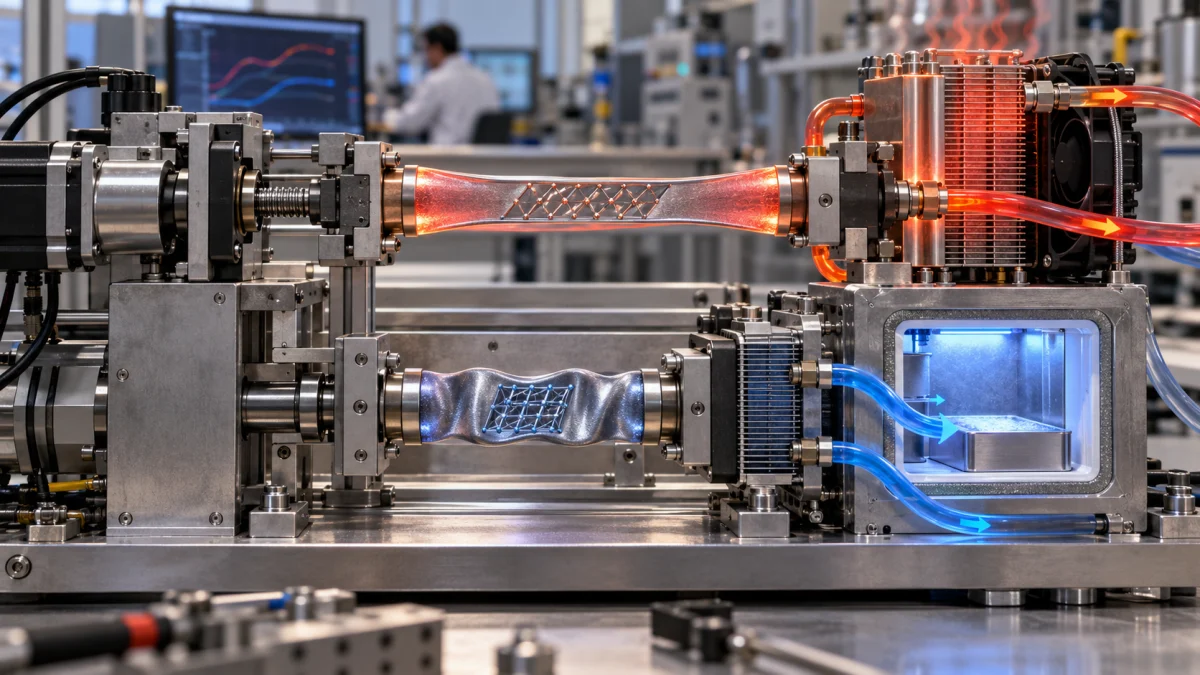
Elastocaloric cooling is a refrigeration method that moves heat by repeatedly stressing and relaxing a solid material, usually a nickel-titanium shape-memory alloy. Applying mechanical stress drives a solid-to-solid phase transformation that releases heat. After that heat is rejected, removing the stress reverses the transformation and absorbs heat, making the material colder so it can pull heat from a refrigerator, room or electronic device.
The easiest version to picture is a piece of metal being stretched and released, but modern elastocaloric machines may also compress, bend or twist the material. Several of the strongest recent prototypes use compression rather than tension.
And the technology is no longer limited to tiny temperature changes. Researchers have separately demonstrated a 75 K temperature lift, more than 1.2 kW of cooling power, operation down to -12 C, 3D-printed nickel-titanium surviving millions of material cycles, and a 400 W device that maintained its reported cooling performance over one million operating cycles. Those are meaningful advances.
But there is an equally important qualification: those records came from different systems and different operating conditions. A device that produces its maximum cooling power at nearly zero temperature lift is not simultaneously delivering that power across a 75-degree temperature difference. The headline numbers cannot responsibly be stacked together into one imaginary super-refrigerator.
That distinction is the key to understanding where elastocaloric cooling actually stands in 2026.
Does stretching metal really make it cold?
Yes, but not in the simplistic sense that stretching a metal bar immediately turns it into a refrigerator.
In a typical nickel-titanium, or NiTi, shape-memory alloy, applying enough mechanical stress drives a reversible change in crystal structure. The material moves from its high-temperature austenite phase toward martensite. That transformation releases latent heat, so the alloy gets warmer.
The cooling cycle then uses that heat in four basic steps:
- Stress the alloy. Stretching or compressing it drives the phase transformation and raises its temperature.
- Reject that heat. While the alloy remains loaded, heat is transferred to the system’s hot side.
- Release the stress. The phase transformation reverses and the alloy absorbs energy, making it colder.
- Absorb heat from the cold side. The chilled alloy or a heat-transfer fluid removes heat from the refrigerator, room or device being cooled.
Then the cycle repeats.
The U.S. Department of Energy described the same basic thermoelastic, or elastocaloric, cycle more than a decade ago: stress causes the shape-memory alloy to reject heat, and unloading lets it absorb heat as it returns toward its original state.
A more recent 2026 Nature Communications paper on elastocaloric drive systems likewise describes devices based on tension, compression, bending and twisting. So "stretching metal" is an excellent way to explain the idea, but it is not the full technical definition.
What is the elastocaloric effect?
The elastocaloric effect is the reversible temperature change that certain materials undergo when mechanical stress changes their internal phase or molecular arrangement.
In shape-memory alloys such as NiTi, the useful effect is tied to a stress-induced martensitic transformation. Because the transformation involves latent heat, changing the material’s mechanical state can make it release or absorb a relatively large amount of thermal energy without melting, boiling or changing from solid to liquid.
That is what makes elastocaloric refrigeration fundamentally different from an ordinary vapor-compression refrigerator.
A conventional refrigerator usually circulates a fluid refrigerant through compression, condensation, expansion and evaporation. An elastocaloric system instead uses a solid refrigerating material whose thermal state changes when it is mechanically loaded and unloaded.
What metal does an elastocaloric refrigerator use?
The best-known material is nickel-titanium, commonly written NiTi and often called nitinol.
NiTi is attractive because it can undergo a large, reversible shape-memory phase transformation while surviving repeated mechanical loading. Researchers can also tune its composition and microstructure to change the temperature range, stress requirements, fatigue life and size of the elastocaloric effect.
That does not mean every system uses ordinary binary NiTi. Some of the most important recent advances involve modified alloys.
For example, the August 2026 Joule durability study used a quaternary TiNiCuCo alloy designed to resist functional fatigue. Other research is exploring different NiTi compositions, copper-based alloys, iron-based materials and elastomeric polymers.
For now, however, NiTi-family shape-memory alloys remain central to many of the highest-performing elastocaloric prototypes.
Does "solid-state refrigeration" mean there are no moving parts?
No.
This is one of the most common ways the technology gets oversimplified.
Elastocaloric cooling is called solid-state refrigeration because the refrigerating material remains solid. That is different from saying the entire machine has no moving components.
Current prototypes may still use:
- electric motors or mechanical actuators;
- cams, rollers or compression mechanisms;
- pumps;
- valves;
- fans;
- heat exchangers; and
- circulating heat-transfer fluids.
The 2025 Nature kilowatt-scale prototype, for example, used compressive NiTi tubes and a fluid-based heat-transfer architecture. The 2026 sub-zero Nature device used a calcium-chloride aqueous solution so heat transfer could continue below 0 C.
So the accurate statement is:
Elastocaloric cooling uses a solid-state refrigerant, but today’s complete elastocaloric machines can still contain motors, pumps and other moving parts.
Does elastocaloric cooling use no refrigerant?
It is more precise to say that elastocaloric cooling can eliminate the need for a conventional volatile refrigerant.
The shape-memory alloy itself performs the refrigerating function. In that sense, NiTi or another elastocaloric material is the solid refrigerant.
A system may still circulate water, brine or another liquid to move heat between the solid refrigerant and the hot and cold sides. That liquid is a heat-transfer fluid, which is not the same thing as the phase-changing refrigerant in an ordinary vapor-compression loop.
This distinction also matters environmentally. Elastocaloric cooling can avoid direct emissions caused by leakage of conventional fluorinated refrigerants, but that does not make the entire technology "zero emissions." Electricity use, alloy production, manufacturing and the rest of the system still have environmental impacts.
Where elastocaloric cooling actually stands in 2026
The fastest way to understand the field is not to ask whether one paper "solved refrigeration." It is to look at the separate engineering barriers researchers have been attacking.
| Milestone | What was actually demonstrated | What it proves | What it does not prove |
|---|---|---|---|
| 75 K temperature lift, Nature Energy, 2024 | A multi-material NiTi cascade achieved a 75 K water-side temperature lift. | Large hot-to-cold temperature differences are achievable with cascaded elastocaloric regenerators. | That the same device delivers kilowatt-scale cooling while maintaining a 75 K lift. |
| 1,284 W cooling power, Nature, 2025 | A multi-cell compression device reached 1,284 W on the fluid side at zero temperature lift during its initial 500,000 cycles. | Elastocaloric cooling can reach kilowatt-class cooling power. | A 1.284 kW household refrigerator operating across a large useful temperature difference. |
| -12 C operation, Nature, January 2026 | A cascaded compression system produced a -12 C cold-side heat source from a room-temperature heat sink. | Elastocaloric systems can operate below the freezing point of water. | That a commercial freezer with competitive efficiency, cost and lifetime is ready. |
| 3D-printed NiTi, Nature Communications, April 2026 | The printed alloy survived 3 million material cycles; a separate five-unit prototype delivered 50 W and a 20 C temperature span and was run for 31,500 cumulative device cycles. | Additive manufacturing can produce durable, geometrically useful elastocaloric material and working hardware. | That the complete 50 W prototype itself survived three million operating cycles. |
| High-force work recovery, Nature Communications, May 2026 | A drive-system test using spring assemblies representative of elastocaloric loads recovered about 70% of mechanical work at forces up to 40 kN; validated simulations projected up to 88% with force amplification. | High-force actuation does not necessarily have to waste all of the mechanical energy put into loading the material. | A complete refrigerator already achieving 70% or 88% whole-system efficiency. |
| 400 W with no reported cooling-power degradation, Joule, August 2026 | A TiNiCuCo device maintained 400 W cooling power and a 41 K temperature span over one million operating cycles. | Functional fatigue, one of the field’s major durability problems, can be dramatically reduced at device scale. | A decade-long field test of a mass-produced refrigerator or air conditioner. |
| Heat-driven elastocaloric cooling, Nature Energy, August 2026 | A miniature device used a thermally activated shape-memory actuator to drive a second elastocaloric material; with an external 130 C heat source it produced a 2.2 K device-level span and 2.09 mW at zero lift by the counter-heating method. | Thermal energy can directly provide the actuation needed for elastocaloric cooling in a proof of concept. | A practical waste-heat refrigerator or electricity-free air conditioner. |
The pattern matters more than any single record.
Cooling power, temperature range, manufacturability, fatigue resistance and actuation efficiency have all improved. What remains unsolved is making all of those advantages coexist in one inexpensive, efficient, reliable appliance.
Why 1,284 W and a 75 K temperature lift are not the same kind of record
This is the most important caveat in the entire topic.
A cooling machine has a performance curve. The amount of heat it can remove usually falls as the required temperature difference between the cold side and hot side grows.
That means two common record claims measure different ends of the curve:
- Maximum cooling power is often measured when the hot and cold sides are at nearly the same temperature.
- Maximum temperature span or lift is often measured when the system is removing little or no external heat load.
The 2025 kilowatt-scale Nature paper is explicit: its 1,284 W maximum was measured at zero temperature lift. The same paper also reported that the device’s maximum cooling power later stabilized at 762 W after two million cycles when using the tested commercial NiTi, illustrating the functional-fatigue problem that later research has tried to solve.
Likewise, the 2024 cascade paper’s 75 K result was a temperature-lift achievement, not evidence of 1.284 kW of cooling across that entire span.
So whenever an article says elastocaloric technology can deliver "1.3 kW and a 75-degree temperature difference," the immediate question should be:
Were those numbers measured at the same operating point in the same device?
In these landmark studies, they were not.
Four performance terms worth keeping separate
| Metric | What it actually means | Common mistake |
|---|---|---|
| Adiabatic temperature change | How much the elastocaloric material itself changes temperature during rapid loading or unloading. | Treating it as the refrigerator’s usable hot-to-cold temperature difference. |
| Temperature span / temperature lift | The temperature difference the device establishes between its hot and cold sides. | Assuming the maximum span occurs while the machine is also delivering maximum cooling power. |
| Cooling power | The rate at which the device removes heat, usually measured in watts. | Quoting the maximum watts without stating the temperature lift at which they were measured. |
| Coefficient of performance (COP) | Useful cooling delivered divided by the energy or work required to produce it. | Comparing material-level COP with complete appliance COP as if they were the same thing. |
This is why elastocaloric record headlines can all be technically true while still giving readers a misleading picture when the test conditions are omitted.
How cold can elastocaloric cooling get?
A major barrier fell in January 2026 when researchers reported the first elastocaloric system to reach sub-zero Celsius operation.
The Nature study used low-transition-temperature NiTi tubes in a cascaded, compression-based regenerative device. With a room-temperature heat sink, it produced a cold-side heat-source temperature of -12 C.
The experiment matters because refrigeration below 0 C opens applications that ordinary room-cooling demonstrations cannot reach, including freezing and portions of the cold chain.
It does not establish that elastocaloric technology is already competitive with a commercial freezer. A freezer has to deliver useful cooling power across a temperature lift for thousands of hours while meeting cost, efficiency, safety, packaging and reliability requirements. Reaching -12 C proves that the thermodynamic operating range is expanding; it does not solve the entire appliance problem.
How much cooling power can elastocaloric systems produce?
Kilowatt-scale cooling has now been demonstrated in a laboratory device.
The 2025 Nature multi-cell system used thin-walled NiTi tubes under compression, arranged so the shape-memory-alloy cells were mechanically in series while the heat-transfer fluid flowed in parallel. At a high operating frequency, the researchers reported 1,284 W of cooling power on the fluid side at zero temperature lift during the initial 500,000 cycles.
That is important because earlier elastocaloric prototypes generally operated at much lower cooling powers. It shows that the technology is not inherently confined to milliwatt or single-digit-watt demonstrations.
But again, zero temperature lift is an idealized operating point. A practical refrigerator or air conditioner has to move heat from a colder place to a warmer one. The useful question is therefore not simply "Can elastocaloric cooling exceed 1 kW?" It is how much cooling it can deliver at the temperature lift, efficiency, noise, size, cost and lifetime required by a real application.
Does the metal wear out?
Historically, this has been one of the most serious problems.
Elastocaloric materials repeatedly undergo stress-induced phase transformations. Over many cycles, that can cause two different forms of fatigue:
- Structural fatigue: cracking or mechanical failure.
- Functional fatigue: the material still moves, but its useful phase transformation and cooling effect gradually weaken.
The distinction matters. A refrigerator does not have to snap in half to become commercially useless; it can simply lose cooling capacity over time.
The 2025 kilowatt-scale device illustrates the problem. Its maximum cooling power fell from 1,284 W during the initial 500,000 cycles to 762 W after two million cycles, which the authors attributed to functional fatigue of the commercial NiTi refrigerant.
The August 2026 Joule paper attacked that problem directly. Researchers used a fatigue-resistant TiNiCuCo alloy with a double-layer fin structure and reported a device maintaining 400 W cooling power and a 41 K temperature span through one million operating cycles without degradation in cooling power.
There are additional durability numbers circulating around that work, and they should not be collapsed into the same claim.
According to HKUST’s September 2026 announcement, accelerated testing of the refrigerant material showed no functional degradation after 100 million cycles, while the fin-type refrigerant structure exceeded 10 million compressive cycles. HKUST says the material is expected to support more than a decade of operation under real-world cooling conditions.
Those are encouraging results, but the evidence levels are different:
- One million cycles: demonstrated in the complete reported cooling device.
- 100 million cycles: accelerated fatigue testing of the refrigerant material.
- More than a decade: an expected service-life projection, not a decade-long field trial.
That is the responsible way to read the durability breakthrough.
Can 3D printing make elastocaloric refrigerators easier to manufacture?
Potentially, and 2026 produced an unusually important result here too.
Traditional NiTi manufacturing can require extensive thermomechanical processing followed by machining. That limits the internal shapes engineers can make, even though heat-transfer area and flow geometry are crucial to a useful cooling device.
In April, researchers reported 3D-printed NiTi alloys engineered for elastocaloric cooling. The alloy samples withstood three million compression cycles without fracture while retaining strong elastocaloric performance.
The same study integrated printed NiTi tubes into a five-unit macroscopic cooling prototype. It delivered 50 W of cooling power and a 20 C temperature span under ambient conditions. The device was demonstrated in a one-hour continuous run and over 31,500 cumulative cycles.
That last distinction is important. The material endured three million test cycles; the complete 50 W prototype was not reported as operating for three million device cycles.
The larger opportunity is geometric freedom. Additive manufacturing could eventually let engineers print complex channels and high-surface-area structures directly into the refrigerating material instead of fabricating the alloy first and then machining away material to create the heat exchanger.
Why the actuator is almost as important as the alloy
An elastocaloric refrigerator has to load and unload its refrigerant over and over. At useful scales, the required forces can be large.
The 2026 Nature Communications drive-system study notes that scaling into hundreds of watts or kilowatts can require actuation forces above 30 kN. Simply forcing an electric motor to repeatedly do that work and then throwing away the energy released during unloading would destroy much of the efficiency advantage.
The researchers therefore built a constant-torque cam system designed to transfer mechanical work between phase-shifted loaded elements. In tests using disc-spring assemblies that mimicked elastocaloric loads, the mechanism achieved about 70% mechanical-level work recovery at forces up to 40 kN. Experimentally validated simulations using force amplification projected work-recovery efficiency as high as 88%.
That is a drive-system result, not an 88%-efficient refrigerator.
The experiment did not even use actual NiTi regenerators as the loaded elements in the validation rig; it used spring assemblies designed to reproduce their mechanical response. The result nevertheless matters because practical elastocaloric cooling needs an actuator that is compact, efficient and capable of recycling as much loading energy as possible.
Can elastocaloric cooling run on waste heat instead of electricity?
A striking August 2026 experiment showed that heat itself can drive the mechanical actuation needed for elastocaloric cooling.
The Nature Energy study coupled two shape-memory-alloy functions. One SMA film acted as a thermal actuator: heating it created mechanical motion. That motion then loaded and unloaded a second elastocaloric refrigerant film to produce cooling.
Under Joule-heated actuation at 86 C, the integrated prototype reached a 12.9 K temperature span at the refrigerant-film level and 4.0 K at the device level.
The more interesting configuration replaced Joule heating with an external thermal source. At a 130 C heat-source temperature, the miniature device maintained a 2.2 K device-level temperature span. Using the paper’s counter-heating measurement, cooling power at zero temperature lift was 2.09 milliwatts.
Those numbers make the correct interpretation clear.
This is not yet a refrigerator powered by free waste heat. It is a proof of concept showing that thermal energy can provide the actuation rather than relying entirely on a conventional electrically driven mechanical actuator.
The authors explicitly describe the current device as a proof-of-concept platform for studying scalability. Potential future energy sources could include industrial waste heat, electronics waste heat or solar thermal energy, but turning that principle into useful cooling power is still an engineering problem.
Does heat-driven cooling violate thermodynamics?
No.
The system is not converting a hot object into "free cold." The thermal input drives a shape-memory actuator, which performs mechanical work on another material. That second material then pumps heat from the colder side toward the hotter side.
Energy still enters the system, and waste heat still has a finite thermodynamic value. The novelty is in how the mechanical work required for the cooling cycle is produced.
Is elastocaloric cooling more efficient than a normal refrigerator or air conditioner?
Potentially, but current evidence does not support the blanket claim that today’s elastocaloric refrigerators are already more efficient than commercial vapor-compression systems.
This is where material-level performance is frequently confused with system-level performance.
A shape-memory alloy can have an excellent intrinsic thermodynamic efficiency. The complete machine still has to pay for:
- actuator losses;
- mechanical friction;
- material hysteresis;
- pumps and fluid pressure drop;
- imperfect heat transfer;
- fans and controls;
- heat leakage; and
- structural components that do not themselves produce cooling.
A useful example comes from the 2024 roller-driven elastocaloric refrigerator in Nature Communications. The TiNiCu material had a reported material COP of 11.5, but the measured plugged-in system COP was 1.27 at zero temperature span, even with substantial work recovery.
That gap is the commercialization problem in miniature. A highly efficient material does not automatically make a highly efficient appliance.
The 2026 Chinese Physics B review of elastocaloric cooling systems reaches the same broader conclusion: the technical maturity of elastocaloric cooling is not yet comparable with commercial vapor-compression systems in overall COP and practicality, despite rapid progress in materials and devices.
So the best current answer is:
Elastocaloric cooling has strong theoretical and material-level efficiency potential, but researchers have not yet established a general real-world system-efficiency advantage over mature commercial refrigeration and air-conditioning equipment.
That could change. It has not been demonstrated broadly enough to state it as a present fact.
Elastocaloric cooling vs. conventional vapor-compression refrigeration
| Feature | Elastocaloric cooling | Vapor-compression refrigeration |
|---|---|---|
| Main refrigerating medium | Solid elastocaloric material, often a shape-memory alloy | Volatile refrigerant fluid |
| Main thermodynamic change | Stress-driven solid-to-solid phase transformation | Compression/condensation/expansion/evaporation cycle |
| Compressor required | Not necessarily, but an actuator is generally required in current systems | Yes in conventional systems |
| Moving parts | Often yes in current prototypes | Yes |
| Refrigerant leakage | No volatile SMA refrigerant to leak | Possible, depending on system and refrigerant |
| Heat-transfer fluid | Often used in larger prototypes | Refrigerant itself circulates; secondary fluids may also be used |
| Current maturity | Research and prototype stage | Highly mature, mass-produced technology |
| Major unresolved issues | System COP, actuation, fatigue, manufacturing, heat transfer, cost and integration | Efficiency, refrigerant impacts, maintenance and application-specific tradeoffs |
| Consumer availability | No mass-market household elastocaloric refrigerator or AC | Ubiquitous |
The important point is not that one technology is inherently "good" and the other is inherently "bad." Vapor compression has benefited from more than a century of engineering optimization and an enormous manufacturing ecosystem. Elastocaloric cooling is competing against that mature baseline, not against a laboratory compressor from 1910.
Why can’t you buy an elastocaloric refrigerator yet?
Because a useful refrigerator has to solve several difficult problems at the same time.
A September 2026 Progress in Energy review of the path toward practical elastocaloric cooling describes the field as moving from basic materials research toward device and application engineering, while still identifying unresolved tradeoffs in materials, heat transfer, manufacturing and system integration.
1. The material has to survive enormous numbers of cycles
A household cooling system may cycle or actuate millions of times over its service life. A material that produces a large temperature change but rapidly loses performance is not useful enough.
The newest fatigue-resistant alloys are a major step forward, but long-duration field reliability still has to be demonstrated in complete products.
2. The actuator has to be powerful without wasting the efficiency advantage
Hundreds of watts or kilowatts of elastocaloric cooling can require tens of kilonewtons of mechanical force. The actuator, bearings, frame and energy-recovery system therefore matter almost as much as the refrigerating alloy.
3. Heat has to move into and out of the alloy quickly
A material can have a huge elastocaloric temperature change and still make a poor refrigerator if heat cannot move through its surface fast enough.
That is why modern devices use thin tubes, fins, printed channels, nanofluids, regenerative architectures and other methods designed to increase heat-transfer area while limiting pressure loss and dead thermal mass.
4. Manufacturing has to become cheap and repeatable
NiTi is not useful simply because it works in a carefully prepared university sample. A commercial system needs large volumes of material with reproducible transformation temperatures, fatigue properties, geometry and mechanical tolerances.
The 3D-printing work is interesting precisely because it could combine material fabrication and complex heat-exchanger geometry in ways conventional machining struggles to achieve.
5. The whole appliance has to work outside the laboratory
A residential air conditioner has to handle changing outdoor temperatures, humidity, dust, vibration, startup and shutdown, controls, noise, maintenance and years of service.
A refrigerator has to hold a stable cabinet temperature while doors open, food is added and ambient conditions change.
Those are not secondary details. They are what separates an excellent physics demonstration from a product.
When will elastocaloric refrigerators and air conditioners be available?
There is no defensible mass-market date yet.
The September 2026 Progress in Energy review concludes that compact niche applications such as portable cooling appear nearer-term, while residential and automotive applications remain longer-term prospects that require further advances in materials and system design.
There are active efforts aimed directly at larger applications. The European Commission’s SMACool project is developing a functional elastocaloric air-conditioning device for residential buildings. Its stated efficiency goals are project targets, not demonstrated commercial product specifications.
HKUST also says the team behind the 400 W fatigue-resistant prototype is developing an air conditioner based on the technology.
Those projects show that commercialization work is real. They do not establish when a homeowner will be able to buy one, what it will cost or whether it will outperform a high-efficiency heat pump.
So is elastocaloric cooling finally a breakthrough?
The strongest case is not that one laboratory just invented a refrigerator made of metal.
The elastocaloric effect has been studied for years, and experimental cooling devices are not new.
What changed is that several different barriers have started moving at once:
- Temperature lift: cascaded systems have reached 75 K.
- Cooling power: multi-cell systems have crossed the kilowatt threshold at zero lift.
- Operating temperature: a regenerative device has reached -12 C.
- Manufacturing: 3D-printed NiTi has reached multi-million-cycle material durability and powered a working prototype.
- Actuation: high-force work-recovery systems are becoming substantially more efficient.
- Fatigue: a TiNiCuCo device maintained its reported cooling performance through one million operating cycles.
- Energy source: researchers have experimentally driven elastocaloric cooling using thermal actuation rather than only a conventional electric actuator.
That convergence is why the field looks more credible in 2026 than a list of isolated record temperatures might suggest.
But three questions still matter more than the hype:
Can one integrated system combine useful cooling power, a practical temperature lift, competitive system COP and long life?
Can it be manufactured cheaply enough to compete with compressors, heat exchangers and refrigerants produced at enormous scale?
Can it survive years of real operation rather than a carefully controlled laboratory test?
Until those questions are answered, elastocaloric cooling should be described as a rapidly maturing refrigeration technology, not a finished replacement for the refrigerator or air conditioner you can buy today.
Frequently asked questions
What is elastocaloric cooling?
Elastocaloric cooling is a solid-state refrigeration method that uses the temperature and entropy changes produced when certain materials are mechanically stressed and relaxed. Shape-memory alloys such as NiTi are the most prominent current refrigerants.
Does stretching metal actually make it cold?
Releasing stress after the material has first been loaded and allowed to reject heat can make an elastocaloric alloy colder. During loading, the phase transformation generally heats the material; cooling occurs during the reverse transformation on unloading.
Is elastocaloric cooling the same as solid-state cooling?
It is a type of solid-state cooling. Other solid-state approaches include magnetocaloric, electrocaloric and barocaloric refrigeration. Elastocaloric systems specifically use mechanical stress.
Is nitinol the refrigerant?
In many prototypes, yes. NiTi, or nitinol, is the active solid refrigerating material. Some systems also circulate a separate liquid solely to transfer heat.
Does an elastocaloric refrigerator need a compressor?
Not a conventional refrigerant compressor. It does, however, need some method of repeatedly applying and releasing mechanical stress, which can involve an electric or thermal actuator and substantial mechanical hardware.
Does elastocaloric cooling need electricity?
Most current devices use electrically driven actuators, pumps or controls. A 2026 Nature Energy experiment demonstrated that heat can directly drive the shape-memory actuator in a miniature proof-of-concept system, but practical heat-powered refrigeration has not yet been demonstrated at appliance scale.
How cold can elastocaloric cooling get?
A 2026 Nature study demonstrated a cold-side temperature of -12 C using a regenerative compression-based NiTi system with a room-temperature heat sink.
How powerful is elastocaloric cooling?
A 2025 Nature device demonstrated 1,284 W of cooling power at zero temperature lift. That number should not be interpreted as 1,284 W delivered across the technology’s maximum reported temperature span.
Does the alloy wear out?
It can. Both structural and functional fatigue have been central problems. A 2026 Joule device using TiNiCuCo maintained 400 W cooling power through one million operating cycles without the cooling-power degradation seen in earlier NiTi systems.
Is elastocaloric cooling more efficient than normal air conditioning?
Not yet as a general demonstrated system-level fact. Elastocaloric materials can be intrinsically efficient, but actuators, friction, heat transfer, pumping and other losses can reduce complete-system COP substantially.
Can I buy an elastocaloric refrigerator or air conditioner?
Not as a normal mass-market household product in 2026. Research groups and funded commercialization projects are developing appliance-scale systems, but broad consumer availability, price and real-world efficiency remain unresolved.
The bottom line
Elastocaloric cooling sounds almost impossible when reduced to one sentence: stress a piece of metal, release it, and use the temperature change to refrigerate something.
But the physics is real, and the engineering progress is becoming substantial.
The important story in 2026 is not that researchers discovered a metal can get hot and cold under stress. It is that they are increasingly solving the much harder problems that determine whether the effect can become a useful machine: cooling power, temperature range, fatigue, manufacturing, heat transfer and energy recovery.
The field still does not have a single consumer-ready system that combines every laboratory record. A 1.284 kW result at zero temperature lift is not the same thing as a 75 K temperature-lift record. A 100-million-cycle alloy test is not the same thing as a refrigerator that has operated for a decade. A 2.09 mW heat-driven proof of concept is not an electricity-free household appliance.
Keeping those distinctions straight does not make the technology less impressive.
It makes the real progress easier to see.
References and Further Reading
Primary research: major device and materials results
-
Hsiau et al. — Heat-driven elastocaloric cooling with shape memory films, Nature Energy (2026). Primary paper for the August 2026 thermally actuated proof of concept, including the 12.9 K material-level span, 4.0 K device-level span under Joule-heated actuation, and the externally heated 2.2 K / milliwatt-scale demonstration.
-
Li et al. — A zero-degradation elastocaloric cooling device using fatigue-resistant refrigerant, Joule (2026). Primary source for the TiNiCuCo device reporting 400 W cooling power and a 41 K span maintained through one million operating cycles.
-
Zhou et al. — Sub-zero Celsius elastocaloric cooling via low-transition-temperature alloys, Nature (2026). Primary source for the regenerative compression-based system reaching -12 C from a room-temperature heat sink.
-
Zhong et al. — 3D-printed NiTi alloys for elastocaloric cooling, Nature Communications (2026). Primary source for the three-million-cycle 3D-printed NiTi material result and the 50 W, 20 C-span printed-refrigerant prototype.
-
Žerovnik et al. — Efficient elastocaloric drive system enabled by constant-torque and work-recovery design, Nature Communications (2026). Primary source for the high-force drive-system work, approximately 70% measured mechanical work recovery at up to 40 kN and the modeled force-amplified design.
-
Zhou et al. — Achieving kilowatt-scale elastocaloric cooling by a multi-cell architecture, Nature (2025). Primary source for the 1,284 W zero-temperature-lift result and the documented decline to 762 W after two million cycles with commercial NiTi.
-
Zhou et al. — A multi-material cascade elastocaloric cooling device for large temperature lift, Nature Energy (2024). Primary source for the 75 K water-side temperature-lift demonstration.
-
Yao et al. — Efficient roller-driven elastocaloric refrigerator, Nature Communications (2024). Useful system-level efficiency benchmark showing why high material COP does not automatically translate into high complete-system COP.
Reviews and commercialization context
-
Safari et al. — Elastocaloric cooling: technical challenges and innovative strategies toward practical implementation, Progress in Energy (2026). The most current broad review used here for commercialization barriers, system integration and the assessment that compact niche uses appear nearer-term than residential and automotive applications.
-
Wang and Qian — Review of elastocaloric cooling systems and their performance, Chinese Physics B (2026). Reviews device architectures and performance and cautions that current elastocaloric systems are not yet comparable with mature vapor-compression technology in overall COP and practicality.
-
Wang et al. — Towards practical elastocaloric cooling, Communications Engineering (2023). Earlier but still useful engineering perspective on material fabrication, actuation, heat transfer, work recovery and the requirements for commercialization.
Government and active development programs
-
U.S. Department of Energy — Energy Savings Potential and RD&D Opportunities for Non-Vapor-Compression HVAC Technologies. Government technical background on thermoelastic/elastocaloric cooling and the basic heating-and-cooling cycle of shape-memory alloys.
-
European Innovation Council — SMACool. Official EU project page for an active effort to develop a functional elastocaloric air-conditioning device for residential buildings. Its efficiency figures are development targets, not current commercial performance.
-
HKUST — Zero-degradation elastocaloric cooling device announcement. Institutional source for the additional 100-million-cycle accelerated material test, projected service-life claim and statement that the team is developing an air conditioner. These claims are kept separate in the article from the one-million-cycle device result reported in Joule.
Editorial currency note: Research performance records and commercialization status were checked through September 30, 2026. Elastocaloric cooling is a fast-moving research field, so later prototypes may exceed the figures summarized here. Record values should always be interpreted together with their operating conditions, especially temperature lift, load, test boundary and cycle count.