Last updated: September 30, 2026
Flydubai flight FZ1073 from Dubai to Tel Aviv made an emergency landing in Tabuk, Saudi Arabia, on September 30 after a violent cockpit attack and an extraordinary series of altitude changes. Public flight data show the Boeing 737 MAX 8 losing more than 14,000 feet in roughly half a minute during one part of the event. The airline and the UAE aviation regulator confirm a serious security incident. Multiple passenger accounts, video reporting and later official statements support the conclusion that the co-pilot attacked and badly injured Captain Smit Machchhar before passengers and additional Flydubai pilots helped regain control.
The evidence has also become stronger that this was not simply a fight between pilots. Accounts now describe the co-pilot interfering with the flight controls or cockpit equipment while the aircraft was diving. Israeli officials say he intended to crash the plane. That remains short of a completed aviation-investigation finding, but a deliberate attempt to disable or destroy the aircraft is now the leading evidence-based explanation for the physical events in the cockpit.
What remains much less certain is why.
There is currently no public evidence establishing that Iran directed the incident, that the co-pilot was acting for an organized terrorist group, or that Israel staged the event as a false flag. Israeli Prime Minister Benjamin Netanyahu, after initially discussing the broader threat from Iran and its proxies, told CBS News that it was still too early to say whether Iran had any involvement. Israeli television later reported that security officials had no current indication of Iranian or other organizational direction and were treating the attacker as an apparent lone actor.
That does not settle the motive. A lone actor can still act for an ideological or terrorist purpose. A person can also act for personal, suicidal or other reasons without belonging to any organization. The investigation has to establish those layers separately.
The most useful way to understand FZ1073 is therefore to separate three questions that are being collapsed together online:
- What happened aboard the aircraft? A violent cockpit attack and dangerous loss of control are strongly established.
- What was the attacker trying to do? The evidence increasingly supports an attempt to disable or crash the aircraft, but investigators have not yet released the flight-recorder findings.
- Why did he do it, and was anyone else behind him? That remains unresolved.
The short answer
FZ1073 departed Dubai International Airport for Ben Gurion Airport aboard a Boeing 737 MAX 8 identified in aviation reporting as registration A6-FKF. About two hours into the flight, a violent struggle occurred in the cockpit. Captain Smit Machchhar, an Indian national, was seriously injured. An Omani official has since independently confirmed to CBS News that the alleged attacker was born in Oman and holds Omani citizenship.
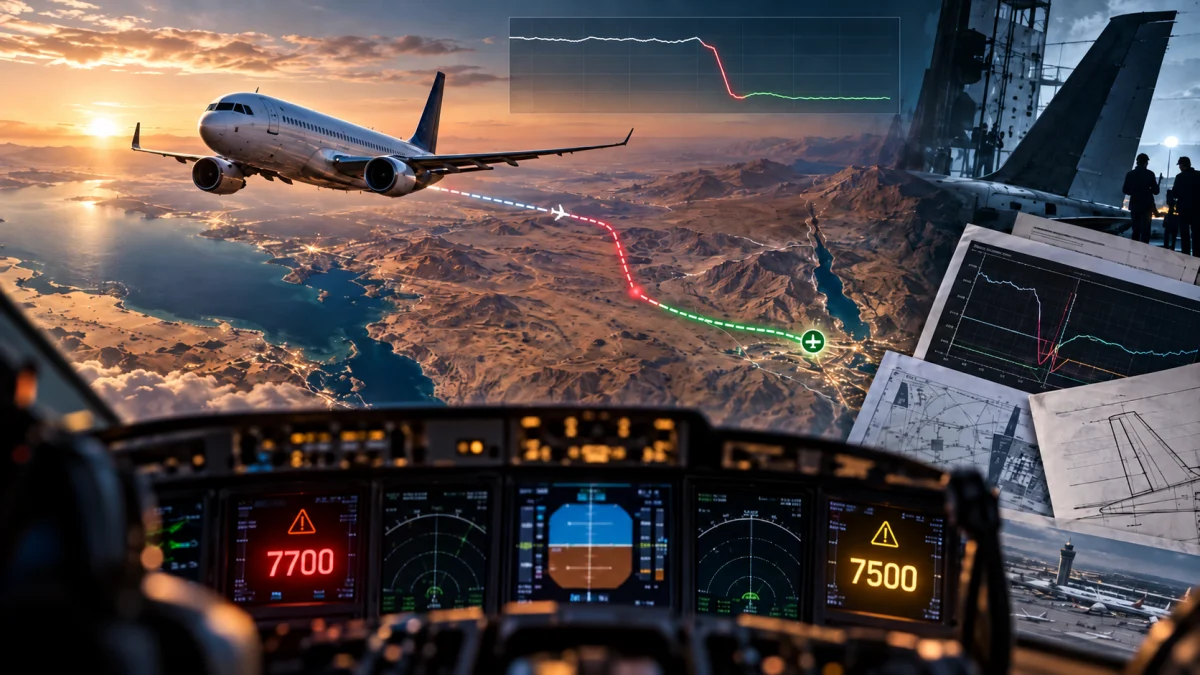
Public flight data show the aircraft undergoing multiple severe altitude changes. One reconstruction using Flightradar24 data measured a fall from approximately 30,875 feet to 16,750 feet in 29 seconds. Other reconstructions using a wider portion of the event describe a roughly 17,000-foot initial descent followed by a climb and another drop. Those figures are not necessarily contradictory; they measure different segments of the same unstable sequence.
The flight transmitted emergency transponder codes including 7700, the general emergency code, and 7500, the code associated with hijacking or unlawful interference. The aircraft ultimately diverted to Tabuk, where it landed safely at about 9:45 a.m. local time. Both operating pilots were hospitalized. The Saudi airport account says the passengers later departed on a replacement aircraft.
The UAE General Civil Aviation Authority says the incident is under investigation for its operational and security causes and circumstances and has warned against pre-empting the findings.
What is confirmed, what is strongly supported, and what remains unresolved
| Claim | Current evidence status |
|---|---|
| A serious security incident occurred on FZ1073 | Confirmed by Flydubai and the UAE GCAA |
| An altercation occurred on the flight deck | Confirmed by Flydubai |
| The flight diverted to Tabuk and landed safely | Confirmed by Flydubai and the Saudi airport account |
| Captain Smit Machchhar was injured and hospitalized | Confirmed by India’s diplomatic mission in Saudi Arabia and multiple reports |
| The alleged attacker is an Omani citizen | Independently corroborated by an Omani official speaking to CBS News |
| One pilot stabbed or otherwise attacked the captain with a sharp object | Strongly supported by passenger accounts, verified video reporting and official statements; the precise weapon is not yet established |
| The aircraft made an extreme descent | Confirmed by public flight-tracking data; exact figures vary with the measurement window |
| FZ1073 transmitted codes 7700 and 7500 | Strongly supported by public flight-data reconstructions |
| Passengers helped restrain the alleged attacker | Strongly supported by passenger accounts and major reporting |
| Additional Flydubai pilots or qualified airline personnel helped take control and land | Strongly supported; Flydubai says traveling on-duty personnel secured and landed the aircraft |
| The co-pilot deliberately attempted to crash or disable the aircraft | Strongly supported, but not yet a completed investigative finding |
| The motive was jihadist or anti-Israeli terrorism | Possible but unresolved; asserted by Israeli officials, not established by released investigative evidence |
| The attacker was directed by Iran | No public evidence currently establishes this; Netanyahu says it is too early to say, and later Israeli reporting said there was no current indication of Iranian direction |
| The attacker was directed by another organized group | No public evidence currently establishes this |
| The attacker acted alone | Current reported Israeli assessment, not a final investigative finding |
| Israel staged or directed the incident as a false flag | No affirmative public evidence currently supports this theory |
| An Omani pilot was prohibited from operating this route | A serious compliance question, not yet fully resolved publicly; an Israeli Transportation Ministry source says Flydubai’s operating agreement contains such a restriction, but the agreement itself has not been publicly produced in the reporting reviewed here |
| The weapon was smuggled through Dubai airport security | Not established |
| Most of the rudder was damaged or missing after landing | Supported by post-landing images and AP reporting; the cause and timing remain under investigation |
That table is the core of the story. The physical incident is increasingly well documented. The attribution narratives are not.
A minute-by-minute reconstruction of FZ1073
Public flight data provide an unusually useful external record of the aircraft’s movements. They cannot tell us what was happening inside the cockpit, and published reconstructions differ by several minutes on some events. Until investigators release the flight-data recorder and air-traffic records, these times should remain approximate.
| Approximate time, UTC | Event |
|---|---|
| 03:05 | FZ1073 departs Dubai International Airport |
| Around 05:21-05:22 | Sharp altitude changes begin; one Flightradar24 analysis records a fall from about 30,875 feet to 16,750 feet in 29 seconds |
| Around 05:28-05:31 | Public reconstructions show code 7700, the general emergency code |
| Around 05:35-05:38 | Public reconstructions show code 7500, associated with hijacking or unlawful interference |
| 05:44 | Tabuk air traffic control receives an emergency-landing request, according to the airport account; 8:44 a.m. local time |
| Later | Public data show the aircraft returning to code 7700 while proceeding toward Tabuk |
| 06:45 | FZ1073 lands at Tabuk; 9:45 a.m. local time |
| Later September 30 | Passengers depart Tabuk on a replacement Flydubai aircraft and continue to Tel Aviv |
India Today’s reconstruction calculated a 14,125-foot loss in 29 seconds during one portion of the descent. Khaleej Times published a similar Flightradar24-based sequence but placed the emergency-code changes a few minutes differently. Al Jazeera’s flight-data timeline also reconstructs the initial descent and emergency signals.
CBS News, citing data analyzed by the BBC, described a broader sequence in which the aircraft fell about 17,000 feet, climbed roughly 5,000 feet and then fell another 7,000 feet before stabilizing. The popular “14,000-foot drop” and “17,000-foot drop” descriptions can therefore both derive from the same event depending on which portion of the altitude trace is being measured.
The important point is not whether the correct viral number is 14,000 or 17,000 feet. It is that the aircraft underwent multiple extreme changes inconsistent with normal cruise flight while a violent cockpit emergency was unfolding.
The plane also briefly entered Jordanian airspace before turning back toward Saudi Arabia. Israeli fighter jets were reportedly scrambled amid fears of a hijacking, but the aircraft diverted toward Tabuk and the immediate interception threat ended.
What happened inside the cockpit?
The cockpit sequence is now considerably clearer than it was in the first hours after the story broke.
Reuters’ passenger reconstruction described passengers experiencing an initial drop, a partial recovery and another descent. Reuters reported verifying video showing two bloodied men after the confrontation. Passenger accounts identified one as the injured captain and the other as the alleged attacker, who appeared to wear first-officer insignia.
The wounded captain appears to have been the person who made passenger intervention possible. Israeli officials and passengers say Machchhar managed to release or unlock the hardened cockpit door despite his injuries. That is an important correction to one of the early online “mysteries.” Passengers did not somehow defeat a post-9/11 cockpit door from the cabin. The door was reportedly opened from inside by the captain.
Once the cockpit became accessible, passengers and crew helped overpower and restrain the other pilot. Two additional Flydubai pilots or qualified airline personnel traveling aboard then took over the flight deck. Flydubai’s own statement, quoted by the Saudi Gazette, says on-duty crew traveling on the flight successfully secured the aircraft, diverted it and landed safely in Tabuk.
Did the co-pilot actually try to crash the plane?
The evidence for a deliberate crash attempt is stronger now than when this article was first published.
The claim still originates partly from Israeli officials and passenger accounts rather than a released final report. But those accounts are becoming more specific. In a CBS News interview, Netanyahu said the alleged attacker was not trying to stabilize the aircraft when others entered the cockpit. He described him as trying to jam equipment between the pilots’ seats. Reuters separately reported accounts that the attacker was interfering with or striking cockpit controls.
Those descriptions matter because they connect the violence to the aircraft’s control state rather than merely placing a fight in the cockpit at the same time as a descent.
The surrounding physical evidence is also difficult to dismiss:
- a reported stabbing or sharp-object attack against the captain;
- extreme and repeated altitude changes;
- the transmission of code 7500 for unlawful interference;
- passengers entering the cockpit and restraining the other pilot;
- additional pilots taking over;
- substantial visible damage to the aircraft’s rudder after landing.
None of that substitutes for the cockpit voice recorder, flight-data recorder and aircraft-system logs. Investigators should be able to determine who moved the controls, when the autopilot was disengaged, what control inputs occurred, whether equipment was intentionally obstructed and how those actions correspond to the descent.
But the evidence has now moved beyond “two pilots got into a fight and the plane happened to drop.” An intentional effort to disable or crash the aircraft is a serious, evidence-supported allegation. It should still be labeled as an allegation until the technical investigation confirms it.
Was this a hijacking?
Possibly in the broad sense of unlawful interference, but not necessarily in the familiar sense of someone trying to redirect an aircraft to a different destination.
The FAA’s published guidance identifies transponder code 7500 with an aircraft being hijacked or subjected to unlawful interference. Public reconstructions show FZ1073 switching from 7700 to 7500 and later back to 7700.
That does not prove the alleged attacker was trying to fly the plane somewhere else. A pilot attempting to seize the controls in order to destroy an aircraft would also be an act of unlawful interference. This is one reason the word “hijacking” can create more confusion than clarity in this case.
Netanyahu himself later told CBS News, “I don’t think it was a hijacking,” and said the event looked more like a possible suicide attempt based on the reported cockpit behavior. That was his interpretation, not a medical or investigative finding.
Was it terrorism?
The evidence is not yet sufficient to answer that responsibly.
Israel’s defense minister, Israel Katz, called the incident a jihadist terrorist attack and said the objective was to crash the aircraft and kill everyone aboard. That is an official allegation, not proof of motive.
A common argument circulating online goes too far in the opposite direction by suggesting that an act cannot be terrorism unless the perpetrator belongs to a group, has a state sponsor or issues a public claim of responsibility. Terrorism definitions vary across legal systems, but organizational membership is not a universal requirement.
For example, the U.S. federal definition of international terrorism in 18 U.S.C. § 2331 focuses on dangerous or violent acts that appear intended to intimidate or coerce civilians, influence government policy through intimidation or coercion, or affect government conduct through mass destruction, assassination or kidnapping. A lone actor can meet a terrorism definition if the required ideological or coercive intent is present.
U.S. law is not the law that will necessarily govern this investigation or prosecution. The point is conceptual: “lone actor” and “terrorist” are not mutually exclusive categories.
The real evidentiary question is motive.
Investigators would want to know whether the alleged attacker left statements, messages, searches, communications or other evidence showing an ideological objective; whether the Israeli destination or passengers were deliberately selected as targets; whether there was planning before the flight; and whether anyone else encouraged, directed or assisted him.
Without that evidence, calling the event “jihadist terrorism” is premature. So is declaring that terrorism has been ruled out.
What about reports that the co-pilot was a “religious extremist”?
Late on September 30, The Times of Israel relayed a Channel 16 report quoting a fellow pilot who described the Omani co-pilot as a religious extremist, saying he prayed frequently and declined to shake hands with women.
That is extremely weak evidence of violent intent.
Religious observance, conservative gender practices or a colleague’s retrospective characterization do not establish terrorism, jihadist ideology or willingness to commit mass murder. If investigators uncover extremist communications, planning, propaganda consumption, threats or connections to violent actors, those would be materially different evidence.
This distinction matters because dramatic events routinely produce retrospective anecdotes that can sound predictive only after the outcome is known.
Was Iran behind FZ1073?
There is currently no public evidence tying Iran to the attack.
No credible public reporting reviewed by sherafy.com has produced communications with Iranian officials, links to the IRGC, payments, tasking, operational support, a proxy-group connection or a claim of responsibility tying the alleged attacker to Iran.
Netanyahu did tell CBS News that Israel had seen signs that Iran and its proxies intended to increase attacks against Israelis abroad. But he immediately added that it was too early to say whether there was Iranian collusion in FZ1073.
Later that evening, The Times of Israel reported that Israel had no current indication the attacker was directed by Iran or another organized entity and that the working assessment was an apparent “lone wolf” or lone-actor attack.
That assessment could change if investigators find new evidence. It is not the same as proving Iran had nothing to do with the event. But as of this update, attributing FZ1073 to Iran goes beyond the public evidence.
Netanyahu did not publicly predict an Iranian attack on this flight the day before
This point has become distorted as the story spread.
On September 29, one day before FZ1073, Netanyahu did make a public warning from the Tel Nof air base. He said Israel had indications that “our enemies” might try to attack ahead of Israel’s October 27 election. The public statement reported at the time did not specifically say Iran was about to attack an aircraft or identify FZ1073, Flydubai, aviation or a similar scenario.
Later that night, Netanyahu briefed opposition leader Yair Lapid. Netanyahu’s office said warnings of possible attacks “on various fronts” had been presented in detail. Lapid subsequently said the briefing contained nothing resembling the Flydubai incident, not even indirectly, according to The Jerusalem Post.
Those accounts are not perfectly harmonious. The prime minister’s office says meaningful threat warnings were discussed; Lapid says nothing resembling this aviation event was among them. What neither public account establishes is specific advance knowledge of FZ1073.
The more accurate chronology is therefore:
- Netanyahu publicly warned on September 29 that unspecified “enemies” could attempt attacks before the election.
- He gave Lapid a security briefing that night concerning possible attacks on various fronts.
- FZ1073 suffered its cockpit attack the next morning.
- Some Israeli officials quickly characterized the flight incident as terrorism.
- Later the same day, Netanyahu publicly said the motive was still unknown and that Iranian involvement was too early to determine.
- Israeli media then reported that the current security assessment found no indication of Iranian or organizational direction.
That chronology is worth examining. It is not evidence that the first statement predicted or caused the second event.
What about the theory that FZ1073 was an Israeli false flag?
No affirmative public evidence currently supports the conclusion that Israel staged, directed or facilitated the FZ1073 attack.
The theory spread for understandable reasons. Netanyahu made an ominous security warning one day before the incident. Israel was in an election campaign. Government officials moved quickly to use terrorism language before a completed investigation. And the presence of an Omani co-pilot on a Tel Aviv route created a separate crew-screening question.
Those are facts and legitimate subjects for scrutiny.
They are not, by themselves, evidence of orchestration.
A useful way to test the theory is to separate suspicion-generating circumstances from causal evidence.
What is real and deserves scrutiny
- Netanyahu really did warn on September 29 that “enemies” might try to attack Israel before the election.
- The warning really did come one day before FZ1073.
- Israeli officials really did call the incident terrorism before a completed investigative report existed.
- Israeli political figures and their opponents really did argue over whether the event vindicated Netanyahu’s warning. The Jerusalem Post documented that political fight.
- An Israeli Transportation Ministry source really did later say Flydubai’s operating agreement was supposed to restrict pilots on the route to nationals of countries with normalized relations with Israel.
What has not been established
There is no public evidence reviewed for this article showing that:
- Israeli officials had specific advance knowledge of an attack on FZ1073;
- Israel selected, recruited, controlled or communicated with the alleged attacker;
- an Israeli intelligence or security service facilitated his assignment to the aircraft;
- Israel supplied or planted the weapon;
- the cockpit violence, injuries or flight-data event were fabricated;
- the flight recorders contradict the passenger accounts;
- Israel created evidence designed to falsely attribute the incident to Iran or another actor.
There is also substantial evidence for the underlying event that does not depend on Israeli government claims. The UAE aviation regulator confirms a serious security incident and injuries. Saudi airport authorities confirm the emergency diversion and hospitalization of both pilots. Independent flight data show the extreme descent and emergency codes. Reuters verified passenger video. The captain’s identity and hospitalization have been confirmed by India’s diplomatic mission.
That does not logically make a false-flag operation impossible. A staged operation could involve a real violent event. It does, however, mean that a false-flag theory now requires evidence of who organized the violence, not merely an argument that Israeli officials later benefited from or exploited it.
That distinction is essential.
Political benefit is not evidence of authorship
A government can politically exploit an event it did not cause. An opponent can also suspect manipulation because of the timing and still be wrong about causation.
The sequence
warning -> attack -> political benefit
is enough to justify asking questions. It is not enough to establish
warning -> planning -> attack.
To cross that evidentiary gap, investigators or journalists would need something more direct: authenticated communications, operational links, payments, tasking, specific foreknowledge, witness testimony, security records, manipulated evidence or other material tying an Israeli actor to the co-pilot or the planning of the attack.
Nothing of that quality has surfaced publicly so far.
This is the same evidentiary principle sherafy.com has applied in other investigations involving allegations of advance knowledge or politically useful crises: motive and benefit can justify deeper investigation, but they do not substitute for the missing causal link. See our separate analysis, Did Netanyahu Let October 7 Happen? What the Evidence Actually Shows.
The strongest competing explanations, tested against the public evidence
The investigation is still early enough that several explanations remain possible. The useful question is not which story feels most politically satisfying. It is what evidence each hypothesis would normally predict.
| Hypothesis | What we would expect to find if true | What the public record currently shows |
|---|---|---|
| Personal or suicidal act by the co-pilot | Evidence of individual crisis, suicidal intent, grievance or personal planning without outside direction | Possible; Netanyahu has raised a suicide-attempt interpretation, but no reliable personal-history evidence has been released |
| Ideological lone-actor terrorism | Evidence the attacker deliberately targeted Israelis or Israel for ideological reasons, but without organizational direction | Possible; destination and passenger composition are consistent with such a theory, but motive evidence has not been released |
| Organized jihadist or other terrorist plot | Communications, handlers, group links, planning support, money, operational coordination or a credible claim of responsibility | No such evidence has been made public |
| Iranian-directed operation | Iranian or proxy communications, tasking, financial or operational links, or corroborated intelligence | No such evidence has been made public; current reported Israeli assessment says there is no indication of Iranian direction |
| Israeli false flag | Specific foreknowledge plus an operational connection to the attacker, facilitation of his access or assignment, manipulated evidence, or another causal link | No such evidence has been made public |
This table can change as evidence emerges. Right now, the physical-event evidence is much stronger than the motive evidence.
Why was an Omani co-pilot on a Tel Aviv flight?
This is a real question, but the strongest version of it is narrower than many social-media posts suggest.
An Omani official has confirmed to CBS News that the alleged attacker was born in Oman and holds Omani citizenship. Oman does not have diplomatic relations with Israel.
After the incident, an Israeli Transportation Ministry source told The Jerusalem Post that Flydubai’s agreement to operate in Israel explicitly requires pilots to come from countries that have normalized relations with Israel. Transportation Minister Miri Regev demanded a review and sought to halt Flydubai flights pending investigation.
If the source accurately describes the agreement and no exception applied, the crew assignment presents a genuine compliance problem.
But several pieces are still missing from the public record:
- the actual text of the operating agreement has not been produced in the reporting reviewed here;
- it is unclear precisely how the rule is written and enforced;
- the public record does not establish whether the co-pilot held another nationality or travel document;
- no publicly released record explains whether any waiver or exception existed;
- it is not yet clear who within the airline approved the crew assignment and what nationality information was used.
It is therefore too strong to state simply that “an Omani was illegally flying a route he was forbidden to fly.” The evidence supports a more precise question:
Did Flydubai’s crew assignment for FZ1073 violate the conditions under which the airline was permitted to operate to Israel, and if so, how did the assignment pass the relevant checks?
That is an important security and regulatory question even if the cockpit attack ultimately turns out to have had no organized political sponsor.
Flydubai later announced that it was temporarily suspending flights to and from Israel while the investigation continues.
Does the timing of the attack argue against an anti-Israeli motive?
Not much.
One argument circulating online notes that the cockpit attack occurred roughly two hours into a flight that normally takes considerably longer to reach Tel Aviv and asks why an attacker targeting Israel would act before the aircraft reached Israeli airspace.
That sounds significant until the objective is separated from the location.
If the objective were simply to destroy the aircraft and kill the people aboard, there would be no operational requirement to wait until Israeli airspace. The aircraft was already carrying many Israeli passengers. A crash over Saudi Arabia or Jordan could still kill everyone on board.
Timing would matter much more if evidence showed that the attacker intended to strike a particular ground target in Israel, redirect the plane to another country or create a specific political spectacle in Israeli airspace. No public evidence currently establishes any of those objectives.
So the fact that the attack occurred before arrival does not meaningfully prove or disprove an anti-Israeli motive. It mainly tells us where the confrontation happened.
How did passengers get through the cockpit door?
The early version of this question made the event sound almost impossible: post-9/11 cockpit doors are hardened specifically to stop passengers from forcing their way in.
The later reporting largely resolves that apparent contradiction.
The wounded captain reportedly released the cockpit door from inside. Passenger and official accounts say Machchhar managed to activate the door release despite being seriously injured, allowing people in the cabin to enter and overpower the other pilot.
That means the intervention does not require anyone to have defeated the aircraft’s hardened cockpit security from the outside.
The exact cockpit-door sequence should still be checked against the voice recorder and aircraft systems, but the basic mechanism is no longer mysterious.
Why were extra Flydubai pilots already aboard?
The presence of additional pilots on the flight also generated suspicion because they happened to be available when both operating pilots became incapacitated or involved in the confrontation.
There is, however, a specific operational explanation.
A person familiar with the arrangement told The Jerusalem Post that two additional pilots were aboard because regional airspace changes or rerouting could lengthen the flight and push the original crew beyond permitted duty-time limits. The source said their presence was unrelated to an advance security warning.
That account is not the same as a released Flydubai crew-planning document, so it remains attributed reporting. But it is operationally coherent and directly addresses why four pilots could be on a flight normally requiring two.
Flydubai independently confirms the more important point: qualified airline personnel traveling aboard were able to secure and land the aircraft after the cockpit crisis.
Where did the weapon come from?
This remains one of the strongest unanswered questions.
Passengers initially described a knife or pocketknife. Associated Press reported that Netanyahu later said the captain may have been struck with an axe. Reuters reported that it could not independently establish exactly what object was used. That uncertainty matters because different objects imply very different security pathways.
It is therefore not responsible to say the co-pilot “smuggled a knife through airport security.” No authority has publicly established that.
Commercial aircraft can contain sharp or heavy equipment not carried aboard as passenger belongings. Cockpit emergency equipment can include a crash axe. Catering operations can also involve metal implements. None of those possibilities should be assumed to be the answer either.
Investigators need to establish:
- what the weapon actually was;
- whether it belonged to the aircraft, crew or catering inventory;
- whether the alleged attacker brought it aboard himself;
- where and when he obtained it;
- whether any screening or inventory rule failed.
Until then, the provenance of the weapon is unknown.
Did passengers save the airplane?
The evidence supports a shared answer: passengers were critical to stopping the attacker, while qualified Flydubai personnel ultimately controlled and landed the aircraft.
Passengers have described entering the cockpit, helping restrain the alleged attacker and removing him from the controls. Flydubai says on-duty personnel traveling on the flight secured the aircraft, diverted it and landed in Tabuk.
Those are not competing accounts. They describe different parts of the rescue.
The captain’s reported decision to open the cockpit door while wounded appears to have enabled the intervention. Passengers then helped neutralize the immediate threat. Additional pilots aboard provided the professional flight crew needed to stabilize and land a badly stressed aircraft.
The aircraft appears to have suffered serious rudder damage
Post-landing photographs show substantial damage to the Boeing 737 MAX 8’s rudder, the movable control surface on the vertical tail. The Associated Press reported that much of the rudder appeared to be missing and cited aviation experts who were struck by the fact that the aircraft remained controllable.
The damage is visible. Its precise cause is not yet established.
FZ1073 underwent an exceptionally violent flight profile, with rapid altitude and speed changes that could produce unusual aerodynamic loads. But it would be premature to state that the alleged attacker “ripped off the rudder” by putting the aircraft into a dive. Investigators need the flight-data recorder, structural inspection and engineering analysis to determine when the damage occurred and what loads caused it.
The defensible statement is simpler:
FZ1073 landed with major visible rudder damage after an extreme in-flight event, and investigators have not yet publicly established the precise cause of that damage.
Why did the plane land in Saudi Arabia?
Once control was restored, the immediate priority was getting the aircraft safely on the ground.
Tabuk was a practical diversion airport in the region. Both operating pilots were injured, the aircraft had undergone violent maneuvers and the crew could not assume the airplane was structurally undamaged.
Saudi Arabia and Israel do not maintain formal diplomatic relations, which made the landing politically notable. Operationally, however, an emergency aircraft needs the safest available airport, not the most diplomatically convenient one.
The Prince Sultan bin Abdulaziz International Airport account says its air traffic control center received the emergency request at 8:44 a.m. local time, activated emergency procedures and received the aircraft at 9:45 a.m. Both operating pilots were taken to hospital. Passengers were cared for in the terminal and later departed aboard a replacement aircraft.
How many people were aboard?
Early reporting ranged from roughly 150 to 180 passengers or people aboard, partly because reports were using different terminology.
Later reporting repeatedly cited 174 people aboard. CBS News attributed that figure to Israeli officials. AP also reported a figure in that range. Flydubai’s initial public statement did not provide a full passenger-and-crew manifest in the material reviewed for this article.
That distinction matters because “174 people aboard” is not necessarily the same as “174 passengers.” The total could include the operating crew and additional Flydubai personnel traveling on the flight.
The safest formulation for now is that approximately 174 people were aboard, many or most of them Israeli passengers according to current reporting.
Who were the pilots?
The injured captain has now been independently identified as Smit Machchhar, an Indian national. India’s embassy in Saudi Arabia said he was hospitalized in Tabuk and reported in stable condition later on September 30.
The alleged attacker has not been publicly named in the authoritative sources reviewed here, but an Omani official confirmed to CBS News that he was born in Oman and holds Omani citizenship.
That is a meaningful upgrade from the earliest reports, when the Omani identification rested primarily on Israeli officials.
It also shows why early nationality claims required caution. In the first hours after the incident, false reports described the pilots as Russian and Ukrainian. Khaleej Times reported that Russia’s consulate in Dubai rejected the claim that a Russian pilot was involved.
Who is investigating FZ1073?
The answer is more complicated than “Israel is investigating it.”
The aircraft is operated by a UAE airline. The UAE GCAA says its investigation teams are working with relevant authorities to determine the causes and circumstances, including operational and security aspects.
The aircraft landed in Saudi Arabia, where the alleged attacker and injured captain were taken into the local system. Saudi authorities therefore control important immediate evidence, witnesses and custody issues arising from the landing.
Israel has a strong security interest because the flight was bound for Tel Aviv and carried many Israeli passengers. Israeli officials have said they want to participate in questioning and have ordered reviews of aviation-security arrangements. But Netanyahu’s expectation that Israel will participate in the interrogation should not be confused with a publicly documented transfer agreement or final division of investigative authority.
The investigation may therefore involve overlapping aviation, criminal and national-security processes in the UAE, Saudi Arabia and Israel.
What investigators should be able to determine
Unlike many aviation disasters, this event left an unusually rich body of surviving evidence.
The aircraft survived. Captain Machchhar survived. The alleged attacker survived. Passengers and additional pilots witnessed key parts of the event. Video was recorded. Flight-tracking systems captured the external flight profile. Investigators should have access to the cockpit voice recorder, flight-data recorder and the aircraft itself.
Those sources should eventually answer questions that political statements cannot:
- when the violence began and what the two operating pilots said;
- what object was used to injure the captain and where it came from;
- who made each major control input during the dives and recoveries;
- whether the autopilot or other systems were intentionally disconnected or obstructed;
- what the alleged attacker was doing to the equipment when passengers entered;
- who selected 7700 and 7500 and at what exact times;
- when and why the cockpit door opened;
- what caused the rudder damage;
- whether the co-pilot planned the act before boarding;
- whether he communicated with any outside person or organization;
- whether evidence supports ideological targeting of Israelis;
- whether evidence supports suicide intent, personal grievance or another motive;
- whether the crew assignment complied with Flydubai’s authorization to operate into Israel; and
- whether any aviation-security or employee-vetting failure contributed to the event.
Those findings will matter far more than the first-day political labels.
What changed after the incident?
Flydubai initially continued working to return the passengers to Tel Aviv on replacement aircraft. Later on September 30, the airline announced a temporary suspension of all flights to and from Israel while authorities investigate.
Israel also began reviewing pilot-security and crew-eligibility procedures for foreign airlines serving the country. The Omani-nationality question has become part of that review.
If investigators confirm that a credentialed airline pilot intentionally tried to destroy a passenger aircraft, FZ1073 will raise a broader aviation-security problem: security systems are built heavily around keeping unauthorized people out of the cockpit, but an insider threat begins with someone already authorized to be there.
That is fundamentally different from a passenger hijacking and may require a different set of safeguards.
Bottom line
The strongest evidence now supports a clear account of what happened aboard Flydubai FZ1073 while leaving the most politically charged question, why, unresolved.
A violent cockpit attack occurred. Captain Smit Machchhar was seriously injured. The aircraft entered an extreme series of descents and climbs and transmitted an unlawful-interference code. The wounded captain reportedly opened the cockpit door, passengers helped restrain the other pilot, and additional Flydubai pilots or qualified airline personnel took control and landed safely in Tabuk. The aircraft showed major rudder damage after landing.
The evidence for an intentional effort by the co-pilot to disable or crash the aircraft is now substantial, although investigators have not yet released the technical findings that would make that conclusion final.
The evidence for motive and sponsorship is much thinner.
There is currently no public evidence establishing Iranian direction. There is no public evidence of another organized group directing the attacker. A reported Israeli security assessment currently points toward a lone actor, but that does not tell us whether the motive was ideological, suicidal, personal or something else. “Lone actor” does not mean “not terrorism.”
And there is currently no affirmative public evidence that Israel staged FZ1073 as a false flag. Netanyahu’s warning about possible pre-election attacks the day before is real and deserves to be preserved in the chronology. So do the rapid terrorism claims, the political arguments that followed and the unanswered question about an Omani co-pilot serving on the route. But those circumstances do not establish an operational connection between Israel and the attack.
The responsible conclusion is neither “Iran definitely did it” nor “Israel definitely staged it.” It is more precise:
FZ1073 appears to have survived a deliberate and potentially catastrophic act of cockpit interference. The public evidence is now strong on the event itself and still incomplete on the motive, ideology and any outside sponsorship. Those claims should rise or fall with the evidence investigators recover next.
References and Further Reading
Primary and authoritative aviation sources
- UAE General Civil Aviation Authority: security incident involving Flydubai FZ1073 — Confirms the security incident, crew injuries, diversion to Tabuk and continuing operational/security investigation. The GCAA explicitly warns against pre-empting the findings.
- Prince Sultan bin Abdulaziz International Airport account via Saudi Gazette — Gives the emergency-call and landing times, reports both operating pilots were taken to hospital and confirms the replacement aircraft.
- FAA guidance on unlawful interference and transponder code 7500 — Explains the meaning and air-traffic handling of code 7500.
- 18 U.S.C. § 2331, terrorism definitions — Useful for explaining why group membership or state sponsorship is not inherently required for an act to fit a terrorism definition; not presented as the controlling law for this incident.
Flight data and aviation reconstruction
- India Today OSINT reconstruction of FZ1073 — Calculates a 14,125-foot loss in 29 seconds from Flightradar24 data.
- Khaleej Times flight-data timeline — Provides an independent Flightradar24-based chronology and documents early misinformation about the pilots’ nationalities.
- Al Jazeera: FZ1073 flight timeline — Reconstructs the aircraft’s route, altitude changes and emergency-code sequence.
- Flightradar24 FZ1073 flight-history page — Public flight-history source underlying several independent reconstructions.
Independent reporting and cockpit reconstruction
- Reuters: passenger accounts and reconstruction of the cockpit crisis, via Investing.com — Includes passenger testimony, Reuters-verified video and reporting on how the cockpit door was opened and the alleged attacker subdued.
- Reuters: passengers foil alleged crash attempt, via Internazionale — Reports the alleged crash attempt, intervention, security response and unresolved motive.
- Associated Press: what is known about the Flydubai flight — Broad independent reconstruction covering the attack, intervention, injuries, aircraft damage and unanswered weapon question.
- CBS News: Netanyahu says motive and possible Iranian involvement remain undetermined — Important later interview in which Netanyahu says it is too early to link Iran, discusses a possible suicide-attempt interpretation and reports independent confirmation from an Omani official of the attacker’s citizenship.
- India’s diplomatic mission says Captain Smit Machchhar was stable in hospital, via Khaleej Times — Independently confirms the injured captain’s identity and Indian nationality.
Motive, Iran and the political chronology
- Netanyahu’s September 29 warning about possible pre-election attacks — Records the actual public wording: Netanyahu referred to unspecified “enemies,” not specifically to an Iranian aviation attack.
- Jerusalem Post: Lapid says the security briefing contained nothing resembling FZ1073 — Documents the opposition leader’s account of the briefing he received after Netanyahu’s warning.
- Times of Israel: current Israeli assessment reportedly sees no Iranian or organizational direction — Reports Channel 12’s account that Israeli security officials currently have no indication the attacker was directed by Iran or another organized entity.
- Times of Israel: fellow pilot describes the co-pilot as a religious extremist — Included because this characterization is circulating; the cited behavior is anecdotal and does not establish violent ideology or motive.
- Jerusalem Post: Israeli political dispute over using FZ1073 as vindication of Netanyahu’s warning — Documents the immediate political argument over what the incident did and did not prove.
Crew assignment and post-incident aviation response
- Jerusalem Post: Transportation Ministry source says Flydubai’s agreement restricted pilot nationalities — Raises the unresolved compliance question surrounding the Omani co-pilot. The underlying agreement itself should be examined if it becomes public.
- Jerusalem Post: why two additional pilots were aboard FZ1073 — Reports that the extra pilots were rostered because regional rerouting could extend duty time, not because of an advance security warning.
- Flydubai suspends Israel service while the investigation continues, via Times of Israel — Records Flydubai’s later decision to suspend flights temporarily while authorities establish the facts.
Related sherafy.com background
- Did Netanyahu Let October 7 Happen? What the Evidence Actually Shows — A separate evidence-chain analysis distinguishing documented warning failures, inference and stronger allegations of deliberate non-action.
- What Did Iran Offer Trump? Iran’s Seven Conditions, Hormuz and the Claim He Must Leave Office — Background on the current Iran-Israel-U.S. conflict and how separate Iranian statements can be inaccurately collapsed into a single claim.
Editorial currency note: This article concerns an active aviation and criminal investigation. The evidence status of motive, sponsorship, weapon provenance, crew-compliance questions and the aircraft’s technical damage may change when Flydubai, the UAE GCAA, Saudi authorities or other investigators release primary findings. The article should be updated when those records become available.