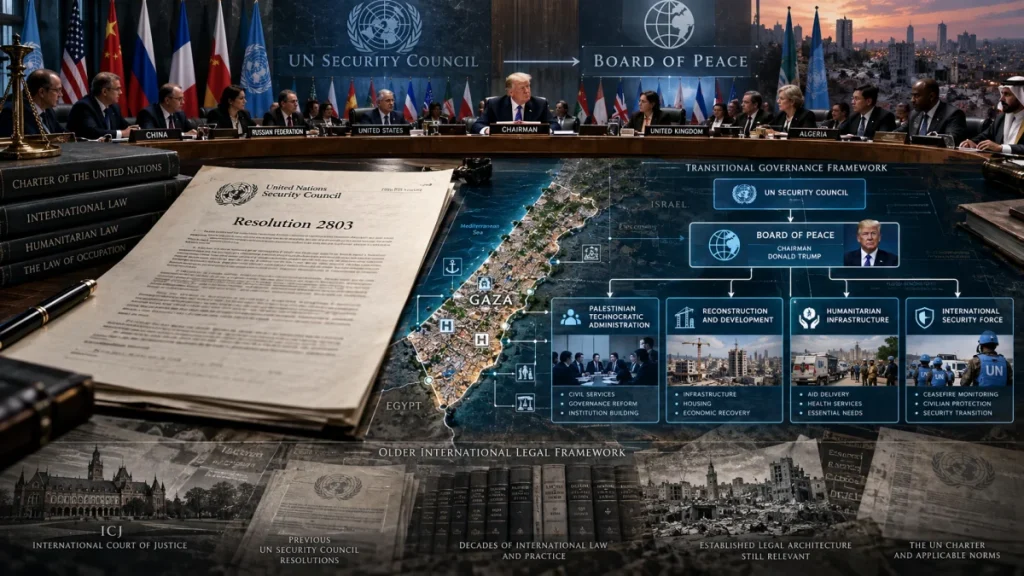
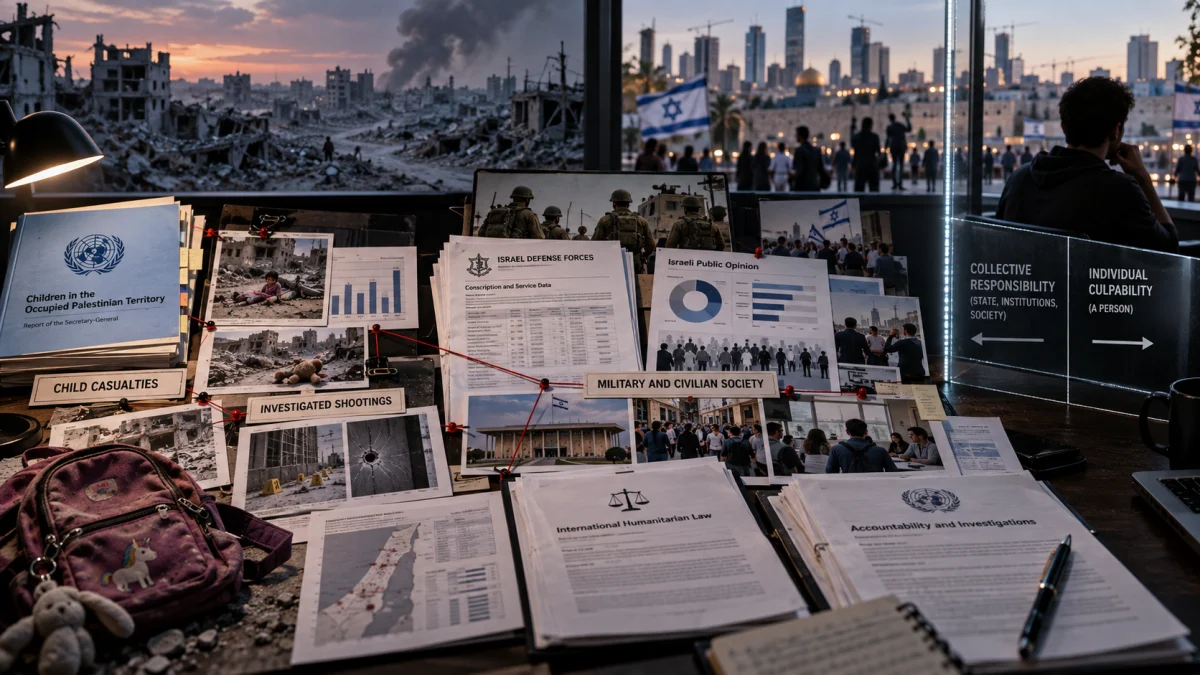
Norman Finkelstein’s description of Israel as a “nation of child killers” combines several very different propositions.
The first is factual: Israeli military operations have killed Palestinian children on an extraordinary scale.
The second is more specific: international investigators have concluded that Israeli forces deliberately or unlawfully shot Palestinian children in particular documented incidents.
The third is an argument about society: because military service is deeply embedded in Israeli Jewish society, and because substantial portions of that society supported or accepted the conduct of the Gaza war, Finkelstein argues that responsibility cannot simply be isolated to Benjamin Netanyahu or a small group of commanders.
And the fourth goes further still: that this collective responsibility can be assigned to individual Israelis, including people who served in the Israel Defense Forces.
Those propositions are not interchangeable.
The first is extensively documented. The second is supported by serious international investigations, although Israel rejects their conclusions and methodology. The third is a disputed argument about collective moral responsibility. The fourth requires evidence about the particular person involved.
That distinction is the part largely missing from the controversy surrounding Finkelstein’s words.
What Finkelstein Is Actually Arguing
Finkelstein, a longtime scholar and writer on Israel and Palestine who received his doctorate in politics from Princeton, used the phrase during a September 2026 discussion in which he was arguing about Israeli societal responsibility rather than merely describing casualty statistics. His publisher’s biography documents his academic background and decades of work on the conflict. Norman Finkelstein — OR Books author biography
His argument can be broken into a chain:
Palestinian children have been killed → some children have been intentionally or unlawfully targeted → the IDF is deeply integrated into Israeli society → large portions of Israeli society supported or accepted the military campaign → responsibility therefore extends beyond the government.
The problem with debating the phrase as a single proposition is that each arrow in that chain requires different evidence.
Casualty records can tell us whether children were killed.
Investigations can address whether particular shootings were intentional or unlawful.
Military-service data can tell us how broadly Israeli society participates in the armed forces.
Polling can tell us what Israelis believed or supported at particular times.
None of those things, by itself, calculates the moral guilt of an entire population or establishes what a particular Israeli personally did.
So the useful question is not simply whether Finkelstein’s phrase is offensive or provocative.
It is:
How much of the argument underneath it can actually be demonstrated?
Palestinian Children Have Been Killed on an Extraordinary Scale
There is little factual uncertainty about the scale of harm to Palestinian children.
The UN Secretary-General’s 2026 Children and Armed Conflict reporting for Israel and the occupied Palestinian territory says the United Nations verified 12,445 grave violations against 5,663 children during 2025.
Of those verified violations, 9,465 were attributed to Israeli armed and security forces.
The UN also verified the killing of 2,668 Palestinian children in Gaza by Israeli armed and security forces during that reporting period. Another 4,588 reported child killings in Gaza remained pending verification because severe access constraints prevented the UN from completing that process.
That distinction matters.
A death that remained pending UN verification is not therefore disproven. It means the UN’s monitoring mechanism had not completed the verification required for inclusion in that particular dataset.
Likewise, these figures should not be casually combined with every other Gaza casualty statistic. Different records use different periods, methodologies and evidentiary standards.
The June 2026 UN Independent International Commission of Inquiry report on Palestinian children, for example, reported at least 20,179 Palestinian children killed and 44,143 injured in the period it examined after October 7, 2023. That is a separate investigative record, not the same verification series as the Secretary-General’s Children and Armed Conflict statistics.
sherafy.com has separately examined that report, its methodology, its allegations and Israel’s objections in our detailed analysis of the UN Commission’s 2026 report on Palestinian children.
The first part of Finkelstein’s factual premise is therefore not difficult to establish:
Israeli military action has killed very large numbers of Palestinian children.
But casualty numbers alone do not answer the harder question.
Were Palestinian Children Deliberately Targeted?
In its formal response to the Commission’s 2026 children report, Israel’s Foreign Ministry attacked the Commission’s composition, mandate and methodology and said the draft contained errors and material omissions.
Yes. There is substantial documented evidence that Israeli forces deliberately targeted Palestinian children in specific incidents.
That conclusion does not come merely from inferring intent from Gaza’s enormous child death toll. In June 2026, the UN Independent International Commission of Inquiry issued a report explicitly examining what it called Israel’s deliberate targeting of Palestinian children between October 7, 2023 and March 31, 2026.
The Commission said it relied on multiple sources, thousands of open-source items that it collected and verified, interviews and group discussions with victims and witnesses, and documentary evidence gathered under the same investigative methodology and standard of proof used in its previous inquiries.
Its conclusion was not vague.
The Commission found that Israel had targeted Palestinian children in Gaza in two distinct ways: first, directly, including by shooting children in vital organs with precision weapons such as sniper rifles and armed quadcopters; and second, through the use of high-impact weapons in widespread and systematic attacks on residential buildings, schools and displacement camps crowded with children.
The report did not stop at general allegations. It identified individual incidents, dates and Israeli military units it found responsible for killing or injuring children.
Among them, the Commission attributed responsibility to the 401st Brigade for the killing of six-year-old Hind Rajab, members of her family and the two Palestine Red Crescent workers sent to rescue her; to the 98th Division for shooting and killing a 15-year-old boy holding a white flag and his brother near Khan Younis; to the IDF’s Unit 888, which operates quadcopters, for shootings that injured a 10-day-old baby and a four-year-old girl; to the 99th Division for the sniper shooting of an eight-year-old boy in Bureij refugee camp; and to the 417th Territorial Brigade for a drone attack that killed two boys, ages eight and ten, along with their adult cousin.
Those are extraordinarily serious investigative findings.
A UN Commission of Inquiry is not a criminal court, and its findings are not criminal convictions. But that distinction should not be distorted into suggesting that deliberate targeting is merely an unsupported allegation. The Commission identified specific incidents, weapons, victims and military units and reached its conclusions using an articulated evidentiary standard.
Its broader finding was similarly explicit: the Commission concluded that the direct shootings formed part of a larger pattern of conduct that inflicted systematic harm on Palestinian children, including attacks on hospitals, schools and other infrastructure essential to children’s survival and development.
Israel rejects the Commission’s conclusions. In its formal response, the Israeli Foreign Ministry challenged the Commission’s composition, mandate and methodology and alleged significant errors and omissions in its work.
That objection belongs in the evidentiary record. It does not, by itself, erase the Commission’s findings or reduce them to a claim with no supporting investigation. A government rejecting an international investigation into its own conduct is a relevant rebuttal; it is not independent evidence that the investigated incidents did not occur.
There is also an important problem with portraying the Commission as though it simply ignored crimes against Israeli children.
The 2026 report expressly refers to the Commission’s previous investigations of October 7, in which it found that 40 Israeli children were killed, hundreds were injured, children were abducted, some were subjected to physical and emotional mistreatment, and Hamas and other Palestinian armed groups committed war crimes and crimes against humanity, including against Israeli children and child hostages.
In other words, the Commission did not need to deny Hamas’s crimes against children in order to reach severe findings about Israeli conduct toward Palestinian children. It investigated both.
The evidentiary line here should therefore be stated plainly:
It is no longer accurate to discuss the deliberate targeting of Palestinian children as though the only evidence is a large civilian death toll from which critics are trying to infer intent. International investigators have documented specific shootings, identified particular Israeli military units and concluded that Palestinian children were deliberately targeted.
That does not prove that every Palestinian child killed by Israel was intentionally targeted. It does not establish that every Israeli soldier participated in such conduct. And it does not determine the personal culpability of every Israeli citizen.
But those limitations should not be allowed to obscure what the evidence does establish.
There are documented cases in which an international investigative body concluded that Israeli forces deliberately shot and killed or injured Palestinian children, including with precision weapons. The serious question is no longer whether such evidence exists. It is how broad the documented pattern is, who bears responsibility for it, and what accountability follows from it.
The Evidence of Intentional Shootings Predates October 7
One reason Finkelstein points to the 2018 Great March of Return is that documented allegations of Israeli forces unlawfully or intentionally shooting Palestinian children long predate the current Gaza war.
The UN Commission investigating those demonstrations examined all 189 fatalities at protest sites between March 30 and December 31, 2018 and tracked more than 300 injuries in detail. It gathered more than 8,000 documents and conducted 325 interviews and meetings. Its evidentiary threshold was “reasonable grounds to believe.” UN Commission of Inquiry report on the 2018 Gaza protests — A/HRC/40/74
The Commission found that at least 189 Palestinians were killed at demonstration sites, including 35 children. Israeli security forces killed 183 people with live ammunition. The Commission also recorded 6,106 live-ammunition injuries, including 940 children.
Not every person at those demonstrations was a peaceful civilian. The Commission identified at least 29 of those killed as members of Palestinian organized armed groups, and demonstrations sometimes included violence.
That did not resolve the individual shootings.
With two specified possible exceptions among the fatalities it investigated, the Commission said it had reasonable grounds to believe the use of live ammunition was unlawful. It found that people hundreds of meters from Israeli forces and visibly engaged in civilian activities were shot, including children, journalists, medical workers and people with disabilities.
Its detailed report also concluded that Israeli snipers intentionally shot clearly marked health workers in investigated cases.
And Finkelstein’s extraordinary-sounding reference to a double amputee roughly 300 meters from the fence corresponds to an actual case in the report.
Fadi Abu Salmi, a 29-year-old double amputee, was sitting in his wheelchair beneath a tree approximately 250 to 300 meters from the separation fence when Israeli forces shot him in the chest and killed him, according to the Commission’s detailed findings. The report noted his previous association with Palestinian Islamic Jihad but also recorded witness evidence that he was no longer a militant and found him seated far from the fence at the time he was shot.
That does not prove every shooting during the protests was deliberate or unlawful.
It does establish that the underlying example Finkelstein invokes is not an invented internet story.
Does the Evidence Establish That Israeli Soldiers “Kill Children for Play”?
This is where the evidentiary boundary becomes important.
The public evidence reviewed for this article does not establish “for play” as a general motive for Israeli soldiers who kill Palestinian children.
There is evidence supporting much narrower and still extremely serious propositions:
- Palestinian children have been killed in very large numbers.
- International investigators have found intentional shootings of children in specific incidents.
- Investigators have concluded that civilians who posed no imminent threat were unlawfully shot in documented cases.
- The 2026 Commission alleges broader deliberate targeting and systematic harm to Palestinian children.
The 2026 Commission also discusses Israeli soldiers mocking or weaponizing symbols of Palestinian childhood, which it considered relevant to the broader treatment of Palestinian children.
But none of that automatically establishes that Israeli soldiers generally kill children recreationally.
Intentional targeting and recreational motive are two different claims.
One may be supported in particular cases without proving the other.
That distinction does not minimize an intentional killing. It simply keeps the conclusion within what the evidence establishes.
Is the IDF Really a “Citizen Army”?
The next step in Finkelstein’s argument concerns who actually makes up the Israeli military.
There is a substantial factual basis for describing Israel as having a citizen army.
According to the IDF’s description of Israeli compulsory service, Jewish, Druze and Circassian citizens generally face compulsory military service after age 18, subject to important exemptions. Other Arab Israelis are generally exempt from compulsory service, as are various other categories of citizens, although some volunteer.
Israel also depends heavily on reservists, meaning military participation continues well beyond initial compulsory service for significant portions of the population.
So the military is far more socially embedded than the all-volunteer professional armed forces of countries such as the United States.
But describing the IDF as a perfect cross-section of Israeli society goes too far.
Service is distributed unevenly.
A recent Israel Democracy Institute analysis of reserve service from 2023 through 2025 found substantial differences among Israeli Jewish groups. In 2025, religious Jewish men were disproportionately represented among reservists, while Haredi men remained almost absent from the reserve burden. Women’s participation followed a different pattern again.
Earlier IDI research likewise found that Haredi and non-Jewish Israelis accounted for very small portions of reservists compared with non-Haredi Jewish citizens.
The more precise conclusion is therefore:
The Israeli military is unusually intertwined with large portions of Jewish Israeli civilian society, but military participation is not evenly distributed and the IDF is not a literal demographic miniature of every group within Israel.
That matters when an argument moves from “the military did this” to “the nation did this.”
What Did Israeli Society Think About the Gaza War?
Public opinion provides another part of Finkelstein’s collective-responsibility argument.
But polling has to be treated carefully because Israeli attitudes changed over time and differed enormously between Jewish and Arab citizens, as well as between ideological groups.
In a representative survey conducted in March and early April 2024, .
The aggregate number hides one of the most important facts in the survey.
Seventy-four percent of Arab Israelis said the military response had gone too far. Only 4% of Israeli Jews said the same.
That alone is enough to show why broad claims about what “Israelis” believed require qualification.
By June 2025, the Jewish People Policy Institute’s Israeli Society Index found that 72% of Jewish Israelis believed Israel was taking all possible or sufficient care to avoid harming uninvolved civilians in Gaza. Twenty-one percent thought Israel was not careful enough, while 7% said Israel was unconcerned about such harm.
JPPI then asked a subtly different question: how important should avoiding harm to uninvolved civilians be?
Among Jewish Israelis, 33% said very important and 27% somewhat important, for a combined 60%.
But 21% said avoiding such harm was “not especially important,” and 18% said it was “not at all important.”
The ideological divide was considerable. Among Jewish respondents on the right, 38% said it was not at all important that Israel avoid harming uninvolved civilians during its Gaza operations. Left-wing respondents overwhelmingly gave the opposite answer.
A separate Israel Democracy Institute survey conducted in July 2025 found that 78% of Jewish Israelis believed Israel was making substantial efforts to avoid unnecessary Palestinian suffering in Gaza, compared with 22.5% of Arab Israelis.
These findings can support a limited conclusion:
Large portions of Jewish Israeli society supported, accepted or defended the conduct of the military campaign at various stages.
They cannot be translated mechanically into:
“Large portions of Jewish Israelis wanted children killed.”
Many respondents who supported the military campaign also believed that their military was trying to protect civilians.
Whether that belief accurately reflected Israeli military conduct is an empirical question.
But the existence of the belief matters when assigning motives to the people answering the poll.
For a broader examination of that divide, sherafy.com has separately looked at why substantial pro-Israel support persisted despite the destruction in Gaza.
Public Support and Collective Responsibility Are Not the Same Question
At this point the argument changes categories.
We are no longer asking what happened.
We are asking who bears moral responsibility for what happened.
There is no universally accepted formula for answering that.
The Stanford Encyclopedia of Philosophy’s review of collective responsibility describes an extensive philosophical dispute over whether responsibility can properly attach to a group, when it can be distributed among individual members, and how factors such as participation, consent, shared attitudes, authority and the ability to resist should affect individual blame.
That distinction is useful here because at least four forms of responsibility can easily be collapsed into one:
State responsibility: responsibility attributed to Israel as a state.
Command or institutional responsibility: responsibility of military and political institutions or their decision-makers.
Collective political or moral responsibility: the argument that members of a society can bear some responsibility for conduct carried out through institutions they support, sustain or fail to oppose.
Individual culpability: responsibility for what a specific person personally did, ordered, assisted, encouraged or otherwise contributed to.
Those categories can overlap.
They are not identical.
A person can reasonably argue that a society bears some collective responsibility for actions carried out openly by its government without thereby proving that every citizen bears equal responsibility.
Likewise, a person’s membership in a society does not tell us whether that person supported the conduct, opposed it, participated in it, attempted to prevent it or had any meaningful power over it.
That information has to be supplied separately.
Criminal Responsibility Is Even More Individualized
The distinction becomes sharper when moving from moral responsibility to criminal liability.
At the International Criminal Court, Article 25 of the Rome Statute expressly concerns individual criminal responsibility.
It allows liability for conduct including committing a crime, ordering or inducing it, assisting it, and under specified conditions intentionally contributing to crimes committed by a group.
That does not mean states, institutions or populations cannot be discussed in other forms of legal, political or moral responsibility.
It means something narrower and crucial:
Evidence that a state or military committed unlawful acts is not automatically evidence that a particular citizen personally committed them.
Nationality is not evidence of an individual’s conduct.
Neither, standing alone, is past military service.
What About Hen Mazzig Specifically?
This distinction became concrete when Israeli writer and activist Hen Mazzig challenged Finkelstein over whether the label applied personally to him.
The available public record establishes quite a bit about Mazzig.
It does not establish that he personally killed a Palestinian child.
An independent University College London account of Mazzig’s military background says he served almost five years in the IDF as a lieutenant in the Coordinator of Government Activities in the Territories, or COGAT, where he worked as an intermediary between the IDF, Palestinian Authority, United Nations and nongovernmental organizations in the West Bank.
Mazzig’s own biography describes the position as a humanitarian role involving medical facilities, schools, infrastructure and coordination with Palestinian institutions. That is his description of his work and should be understood as such, although the basic COGAT role is independently corroborated by UCL. Hen Mazzig’s biography and account of his military service
There is also documentation behind another part of the dispute surrounding Mazzig: his connections to Israeli government advocacy.
A 2018 Forward investigation based on records obtained through an Israeli freedom-of-information request found that Mazzig received more than 180,000 shekels, then approximately $49,000, from Israel’s Government Advertising Agency between February 2017 and April 2018.
Mazzig acknowledged being a paid government contractor but said his work consisted of consulting and that Israeli officials did not direct his American political activity. The records included payment descriptions referring to campus and pro-Israel campaigns, which was why the Forward examined possible implications under the U.S. Foreign Agents Registration Act. The article did not establish a criminal FARA violation.
Separately, in October 2023, Israel’s Foreign Ministry publicly sought help from prominent online advocates for a wartime international-influence campaign, and Mazzig was among the people identified as participating. Jerusalem Post report on the Foreign Ministry’s 2023 influencer initiative
Those facts can establish connections among Mazzig, the Israeli military, government consulting and organized Israeli advocacy.
They do not establish that he personally killed a child.
That requires evidence of the act itself.
So What Does the Evidence Actually Establish?
The simplest way to evaluate Finkelstein’s argument is to separate each proposition.
| Claim | What the evidence establishes |
|---|---|
| Israeli military operations have killed Palestinian children on a very large scale. | Strongly documented. UN monitoring has verified thousands of grave violations against children and thousands of child killings attributed to Israeli forces. |
| Palestinian children have been intentionally or unlawfully shot in specific incidents. | Supported by UN investigative findings. The 2018 Commission and the 2026 Commission both reached findings involving deliberate or unlawful targeting in documented cases. Israel disputes the commissions’ methodology and conclusions. |
| This began only after October 7, 2023. | False. The 2018 Gaza protest investigation documented unlawful shootings of children and other protected civilians years earlier. |
| Israeli military service is deeply embedded in Israeli Jewish society. | Supported, with important qualifications. Israel uses broad compulsory service and reserves, but participation is highly uneven among different sectors of society. |
| Substantial portions of Jewish Israeli society supported or accepted the Gaza campaign. | Supported by time-specific polling. Polls also show major ideological divisions and a stark difference between Jewish and Arab Israelis. |
| Support for the military campaign proves support for intentionally killing children. | Not established. Many supporters simultaneously reported believing the IDF was attempting to reduce civilian harm. |
| Israeli society can therefore bear collective moral responsibility. | A moral and political argument. Evidence can inform it, but no casualty statistic or poll can resolve the philosophical question by itself. |
| Every Israeli or former IDF member is personally culpable for child killings. | Does not follow from group membership alone. Individual culpability requires individual evidence. |
| Hen Mazzig personally killed a Palestinian child. | Not established by the public evidence reviewed for this article. |
| Israeli soldiers generally kill children “for play.” | Not established as a general motive by the evidence reviewed. Investigations documenting intentional killings do not by themselves prove recreational motive. |
The Phrase Contains Both Evidence and an Argument
The controversy around “nation of child killers” becomes much easier to understand once the phrase is disassembled.
The evidence underneath part of it is substantial.
Palestinian children have not merely appeared incidentally in casualty statistics. UN monitoring has verified thousands of grave violations against children. International investigators have documented individual cases in which children and other civilians were intentionally or unlawfully shot. Those findings existed years before October 7, 2023 and became considerably more severe during the Gaza war.
There is also factual support for the structural part of Finkelstein’s argument. Military service is deeply woven into much of Jewish Israeli society, and polling shows that large portions of that society supported, accepted or defended Israeli military conduct in Gaza at different stages of the war.
But then the argument crosses two boundaries.
The first is from social participation to collective moral culpability.
The second is from collective culpability to individual guilt.
Neither transition can be derived automatically from the casualty count.
A society can be asked difficult questions about what its institutions did, what its citizens knew, what they supported and what they tolerated. Those questions do not disappear merely because responsibility is distributed across millions of people.
But the reverse is also true.
The documented actions of a state, military or society cannot substitute for evidence about what a particular person did.
That is the line between investigating collective responsibility and simply assigning individual guilt by nationality.
And it is the line any serious examination of Finkelstein’s phrase has to preserve.
References and Further Reading
Primary UN and International Records
Israel & the Occupied Palestinian Territory — UN Office of the Special Representative for Children and Armed Conflict
UN verification data for grave violations against children during the 2025 reporting year, including attribution and killings pending verification.
“The Essence of Childhood Has Been Destroyed” — UN Independent International Commission of Inquiry, A/HRC/62/CRP.2 (2026)
The Commission’s primary 2026 report on alleged violations and crimes affecting Palestinian children between October 7, 2023 and March 31, 2026.
Report of the Commission of Inquiry on the 2018 Protests in the Occupied Palestinian Territory — A/HRC/40/74
Primary UN investigation into the Great March of Return, including its methodology, casualty statistics and findings concerning children, journalists, medical personnel and people with disabilities.
Israel’s Response to the 2026 Commission of Inquiry Report on Palestinian Children — Ministry of Foreign Affairs
Israel’s formal challenge to the Commission’s mandate, composition, methodology and factual conclusions.
Rome Statute of the International Criminal Court — 2025 edition
Article 25 defines individual criminal responsibility within the ICC framework.
Israeli Military Structure and Public Opinion
Our Soldiers: The Men and Women of the Israeli Defense Forces — IDF
Official overview of Israeli compulsory military service and major exemptions.
Reserve Service During the Swords of Iron War by Religious Self-Definition, 2023–2025 — Israel Democracy Institute
Recent analysis showing the uneven distribution of reserve service among Israeli Jewish social groups.
Israeli Views of the Israel-Hamas War — Pew Research Center, May 2024
Representative polling on whether Israelis thought the Gaza military response had gone too far, not far enough or was about right, including the large Jewish-Arab divide.
JPPI Israeli Society Index — June 2025
Polling on Israeli perceptions of civilian protection and the importance respondents placed on avoiding harm to uninvolved Gazans.
Israel Voice Index — July 2025, Israel Democracy Institute
Independent polling on whether Jewish and Arab Israelis believed Israel was making substantial efforts to minimize Palestinian suffering.
Collective Responsibility
Collective Responsibility — Stanford Encyclopedia of Philosophy
A detailed overview of the philosophical distinction between collective responsibility, shared responsibility and the responsibility of individual group members.
Hen Mazzig
Israeli Speaker Hen Mazzig Returns to UCL — University College London
Independent institutional description of Mazzig’s IDF service as a COGAT lieutenant and intermediary among the IDF, Palestinian Authority, UN and NGOs.
Did Hen Mazzig Work as a Secret Agent on Campuses? — The Forward, 2018
Investigation based on Israeli government payment records documenting Mazzig’s paid government consulting and his explanation of the work.
MFA Launches Online Advocacy Campaign With Israeli Influencers — The Jerusalem Post, 2023
Contemporary reporting on the Israeli Foreign Ministry’s wartime online-advocacy initiative and Mazzig’s participation.
Related sherafy.com Research
UN Commission Says Israel Deliberately Targeted Palestinian Children: What the New Report Alleges, Why It Matters, and What Comes Next
sherafy.com‘s detailed examination of the June 2026 Commission of Inquiry report, evidence, methodology, legal findings and Israeli response.
Iman al-Hams: What Really Happened to the 13-Year-Old Palestinian Girl Killed in Gaza?
A document-driven reconstruction of a separate 2004 child-killing case, including the military investigation, recordings and subsequent legal proceedings.
Israel-Palestine & Gaza Knowledge Hub
sherafy.com‘s reference hub for related investigations, primary-source explainers and recurring Israel-Palestine claims.
Editorial currency note: Casualty verification, military investigations and Israeli public opinion continue to change. Polling in this article is identified by its field period and should not be treated as a measurement of Israeli opinion outside that period. UN figures are attributed to the specific monitoring or investigative system that produced them rather than combined across incompatible datasets.