Executive Summary
In June 2026, the United Nations Independent International Commission of Inquiry on the Occupied Palestinian Territory, including East Jerusalem, and Israel released a major report titled “The essence of childhood has been destroyed”: Israel’s deliberate targeting of Palestinian children in the Occupied Palestinian Territory since 7 October 2023.
The report examines alleged violations against Palestinian children from 7 October 2023 to 31 March 2026. It is one of the most direct and severe UN investigative documents yet on the treatment of children during the Gaza war and the wider occupied Palestinian territory. The Commission alleges that Israeli authorities and Israeli security forces deliberately targeted Palestinian children and damaged the institutions that sustain childhood: families, schools, hospitals, orphanages, food systems, sanitation, and community life.
The Commission concludes that these acts amount to genocide, crimes against humanity, and war crimes in Gaza, and war crimes in the West Bank, including East Jerusalem. It also says the targeting of children further supports its earlier finding that Israel has committed genocide against Palestinians in Gaza.
Israel has rejected the report, calling it defamatory, biased, and unreliable. The Israeli Foreign Ministry argues that the Commission erases Israeli children killed or abducted by Hamas and ignores Hamas’s use of Palestinian civilians and children as human shields.
This article summarizes the Commission’s main findings, explains the legal framing, gives necessary context, and separates what the report claims from what has been adjudicated by courts.
What Is This Report?
The report is formally known as A/HRC/62/CRP.2. It was prepared by the UN Independent International Commission of Inquiry on the Occupied Palestinian Territory, including East Jerusalem, and Israel.
The Commission was created by the UN Human Rights Council in 2021 to investigate alleged violations of international humanitarian law and international human rights law in the occupied Palestinian territory and Israel. Its mandate covers both Israeli and Palestinian actors, including Israel, Hamas, Palestinian armed groups, settlers, and other relevant parties.
This June 2026 report is a thematic report. Rather than focusing only on a single event or military operation, it focuses on one category of victims: children.
The Commission says this is the first specialized report by a UN investigative body devoted specifically to crimes and violations against Palestinian children in the occupied Palestinian territory since 7 October 2023.
The Central Claim: Children Were Not Merely Collateral Victims
The report’s central claim is not simply that Palestinian children died in large numbers. It is that children were repeatedly and deliberately placed in the line of destruction, and that the pattern of harm reflects more than battlefield accident.
According to the Commission, the evidence shows:
- Palestinian children were killed and maimed at massive scale.
- Some children were allegedly shot by snipers or drones in ways that suggested direct targeting.
- Israel’s use of explosive weapons in densely populated areas caused foreseeable mass child casualties.
- Conditions of life imposed on Gaza, including siege, displacement, starvation, and destruction of healthcare, had direct and devastating effects on children.
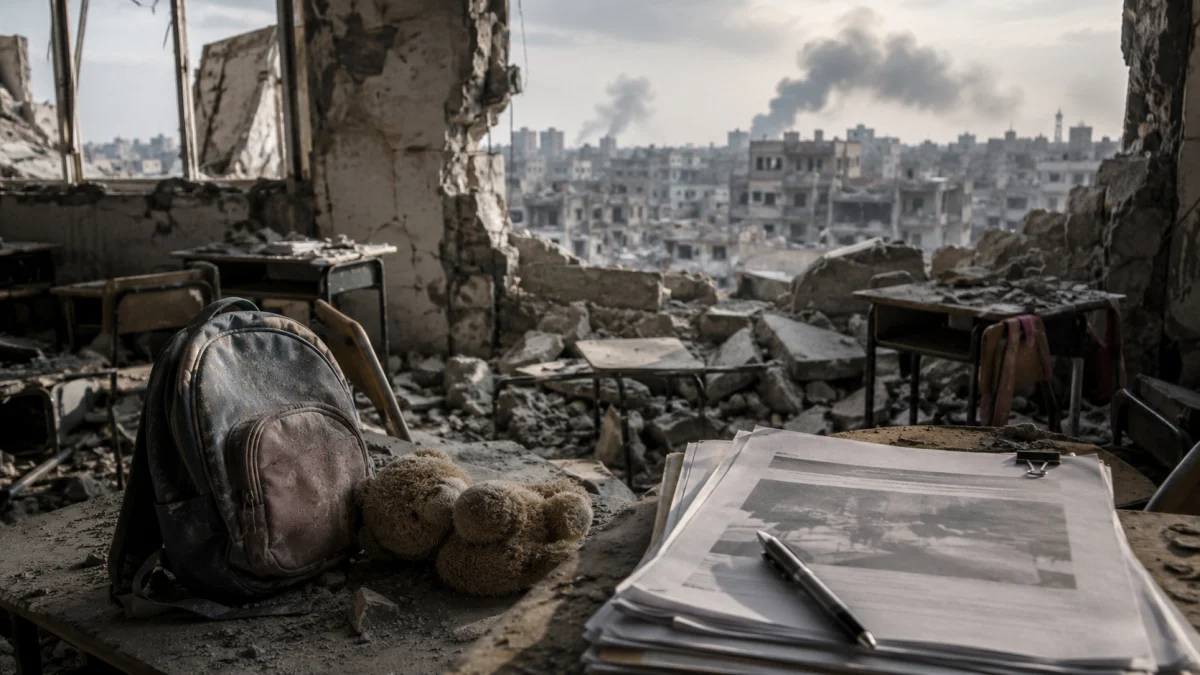
- Schools, universities, hospitals, neonatal units, orphanages, and child-care facilities were attacked, destroyed, or rendered unusable.
- Palestinian children were mistreated during arrests and detention, including through degrading treatment and alleged sexual and gender-based violence.
- Israeli settlers and security forces killed, injured, abused, and intimidated Palestinian children in the West Bank, including East Jerusalem.
The Commission frames these harms not as isolated violations, but as part of a broad pattern affecting the physical, mental, social, educational, and biological future of Palestinian society.
Key Numbers Cited by the Commission
The report and accompanying UN materials cite several headline figures:
| Category | Reported Finding |
|---|---|
| Palestinian children killed in Gaza between 7 Oct. 2023 and 7 Oct. 2025 | More than 20,000 |
| Palestinian children injured in Gaza during that period | More than 44,000 |
| Share of total killed who were children | About 30% |
| Children who lost one or both parents in Gaza | Estimated 58,554 |
| Schools damaged or destroyed in Gaza | Over 97% |
| Universities affected in Gaza | About 95% of campuses, according to education-sector reporting cited in related coverage |
| Children’s malnutrition-related deaths reported by Gaza health authorities by 1 Oct. 2025 | 151 |
| Palestinian children killed by Israeli security forces in the West Bank since 7 Oct. 2023 | At least 213 |
These numbers should be read with care. They are part of the Commission’s evidentiary record and rely on sources including Gaza health authorities, UN agencies, education-sector assessments, forensic review, interviews, medical materials, and open-source verification. Israel disputes the Commission’s reliability and accuses it of relying on biased or unverified sources.
Still, the scale alone is extraordinary. Even if one debates legal classification, the report presents a picture of childhood being destroyed not only by direct killing, but by the collapse of the systems that make childhood survivable.
Gaza: The Commission’s Findings on Killing and Maiming
The report identifies two broad mechanisms by which Palestinian children were killed or injured.
The first is the use of high-yield explosive weapons with wide-area effects in densely populated civilian areas. In practical terms, this means bombs, missiles, artillery, and other weapons whose blast and fragmentation effects are difficult to confine when used in crowded neighborhoods, shelters, schools, camps, or apartment blocks.
The second is more direct: the Commission alleges that some children were intentionally targeted by snipers, drones, and quadcopters, including shots to the head, neck, or upper body.
During the press conference, Commissioners described medical and forensic material they said showed repeated injuries consistent with deliberate targeting. They also referred to accounts from doctors who treated children with gunshot wounds and blast injuries.
One of the most disturbing allegations concerned children shot in ways that appeared intended to kill or permanently disable them. The report also cites Israeli soldiers’ own videos, statements, or social media posts as evidence of dehumanizing attitudes toward Palestinian children and civilian infrastructure.
Starvation, Siege, and “Conditions of Life”
The report does not treat child deaths from hunger, disease, or medical collapse as separate from the war. Instead, it argues that Israel imposed conditions of life that obstructed children’s survival.
That includes:
- Restrictions on food and aid.
- Displacement into unsafe and overcrowded areas.
- Collapse of sanitation and clean water access.
- Destruction of hospitals and pediatric facilities.
- Lack of medicine, anesthesia, surgical supplies, and neonatal care.
- Delayed or denied medical evacuation.
- Malnutrition among children with existing medical needs.
One case described during the press conference involved a 12-year-old girl with celiac disease. The Commission emphasized that celiac disease is normally manageable, but said that siege conditions and lack of suitable food led to severe malnutrition and death. According to the account, Israeli authorities approved her medical evacuation only after she had already died.
This type of case is important to the Commission’s legal theory. It is not only counting children killed by bombs or bullets. It is also arguing that policies affecting food, healthcare, and medical evacuation created preventable child deaths.
Education: The Destruction of a Generation’s Future
A major section of the report concerns education.
The Commission argues that Israel systematically disrupted Palestinian children’s ability to learn, and that this disruption should be understood as more than collateral damage. In Gaza, the physical destruction of schools and universities has been so extensive that normal education has become impossible for many children and students.
The report and related materials describe:
- Widespread destruction or damage to schools.
- Attacks on universities and higher education institutions.
- Military use or occupation of educational facilities.
- Loss of teachers, academics, administrators, and educational records.
- Long-term psychological and developmental harm caused by interrupted schooling.
- The risk of a “lost generation” deprived of stable education, social development, and future professional pathways.
The Commission connects this to the broader question of Palestinian self-determination. Children are not only vulnerable civilians; they are the future adult population of a people. Destroying education, in this framing, weakens the future capacity of Palestinians to sustain their society, institutions, professional class, and political identity.
Healthcare, Neonatal Care, and Reproductive Harm
The report also examines attacks on healthcare and their effect on children and newborns.
According to the Commission, the destruction of hospitals, pediatric wards, neonatal units, reproductive healthcare, vaccination systems, and emergency care has produced both immediate deaths and long-term harm. The Commission links the collapse of healthcare to:
- Preventable neonatal deaths.
- Poor birth outcomes.
- Unsafe pregnancies.
- Lack of incubators and neonatal care.
- Amputations and surgeries performed under extreme conditions.
- Children undergoing procedures without adequate anesthesia or pain relief.
- Re-emergence of preventable diseases due to collapse of immunization and sanitation systems.
This is one of the reasons the Commission ties the report to genocide law. Genocide does not only involve mass killing. Under the Genocide Convention, it can also include causing serious bodily or mental harm, deliberately inflicting conditions of life calculated to bring about destruction, and imposing measures intended to prevent births within the group.
The Commission argues that the treatment of Palestinian children, pregnant women, newborns, and reproductive healthcare in Gaza is relevant to the biological continuity of the Palestinian group.
West Bank and East Jerusalem: War Crimes, Settler Violence, and Detention Abuse
The Commission distinguishes between its findings in Gaza and the West Bank.
For Gaza, it makes findings of genocide, crimes against humanity, and war crimes. For the West Bank, including East Jerusalem, it says it has found war crimes and other serious violations, but it has not yet made a genocide finding for the West Bank.
That distinction matters. During the press conference, the Commissioners explained that they had specifically examined genocide in relation to Gaza. They had not yet conducted the same genocide analysis for the West Bank.
The West Bank section focuses on:
- Children killed or injured by Israeli security forces.
- Settler attacks on children.
- Violence and intimidation near homes, fields, roads, and schools.
- Arrests and detention of Palestinian children.
- Allegations of torture, humiliating treatment, and sexualized abuse.
- Restrictions that make ordinary childhood activity unsafe.
One case described at the press conference involved a 14-year-old Palestinian boy in Al Far’a refugee camp near Tubas. According to Commissioner Chris Sidoti, the boy was shot by Israeli soldiers, left bleeding for roughly 45 minutes, denied assistance, and later had his body taken and not returned to the family. Sidoti said the soldiers involved were members of the paratrooper battalion operating under the Menashe Brigade, also known as the 431st Territorial Brigade.
This case was used by the Commission to illustrate what it described as a culture of impunity: not merely a shooting, but the alleged refusal to provide aid, prevention of family or ambulance access, and withholding of the body afterward.
Hamas and Palestinian Armed Groups: Context the Article Should Not Omit
A credible summary of this report should not erase 7 October 2023 or the crimes committed by Hamas and other Palestinian armed groups.
The Commission itself has previously found that Hamas and other Palestinian armed groups committed war crimes and crimes against humanity during and after the 7 October attacks, including against Israeli children and hostages. In the press conference, Commissioner Sidoti specifically recalled five Israeli teenagers killed at Zikim Beach on 7 October, describing the case as one that stayed with him personally.
The Commission’s 9 June 2026 report also accused Hamas-affiliated forces in Gaza of grave abuses against Palestinians, including repression, torture, and unlawful killings, exploiting the collapse of order caused by the war.
That context matters for accuracy. It also matters morally. The UN Commission is not claiming Palestinian armed groups are innocent. Its argument is that Hamas’s crimes do not legally or morally justify crimes against Palestinian children.
Why the Commission Uses the Word “Genocide”
The most consequential part of the report is its genocide finding.
The Commission argues that Israeli authorities and security forces targeted Palestinian children in a way that demonstrates intent to destroy Palestinians in Gaza, at least in part. It says children are central to the survival of a protected group because they represent biological continuity, future identity, social reproduction, and the long-term ability of the group to sustain itself.
The report connects several categories of conduct to genocide law:
- Killing members of the group.
- Causing serious bodily or mental harm.
- Deliberately inflicting conditions of life calculated to bring about physical destruction.
- Imposing measures affecting births and reproductive continuity.
The Commission does not appear to rely on one single incident. Its legal theory is cumulative. It looks at mass child casualties, direct shootings, starvation, destruction of healthcare, attacks on reproductive care, mental trauma, educational collapse, and official or soldier-level statements that dehumanize Palestinian children.
This is not a court judgment. The Commission is an investigative body, not the International Court of Justice or the International Criminal Court. But its findings may be used by courts, national prosecutors, international bodies, and states considering sanctions, arms restrictions, or universal jurisdiction cases.
Israel’s Response
Israel rejects the Commission’s report.
The Israeli Foreign Ministry called it libelous and defamatory, arguing that the Commission is biased against Israel and lacks credible verification mechanisms. Israel says the report erases Israeli children murdered, kidnapped, and targeted by Hamas, and ignores Hamas’s use of Palestinian children as human shields and pawns of war.
This is the core dispute between Israel and the Commission.
The Commission says its methodology is rigorous and based on interviews, medical records, forensic review, verified open-source material, geolocation, chronolocation, metadata analysis, and consultation with independent forensic pathologists. Israel says the Commission is structurally biased and politically motivated.
Readers should understand the difference between disputing a report’s conclusions and disproving its evidence. Israel’s formal response rejects the Commission’s legitimacy and framing, but the Commission says Israel did not cooperate with its requests for information and did not provide detailed investigative outcomes addressing the incidents cited.
Accountability: What Could Happen Next?
The report makes recommendations to Israel, UN member states, the Security Council, the General Assembly, the UN Secretary-General, the International Criminal Court, and other judicial bodies.
The Commission calls for accountability through several possible paths:
- Domestic investigations.
- Universal jurisdiction cases in national courts.
- Cooperation with the International Criminal Court.
- Arrest and transfer of individuals subject to ICC warrants.
- Arms embargoes or restrictions where weapons may be used to violate international law.
- Sanctions and accountability measures against individuals and entities involved in crimes.
- Reparations and child-responsive justice for victims.
The legal context is already active.
At the International Court of Justice, South Africa’s genocide case against Israel remains a major international proceeding. The ICJ has issued provisional measures, but it has not yet made a final ruling on whether Israel committed genocide.
At the International Criminal Court, arrest warrants were issued in November 2024 for Israeli Prime Minister Benjamin Netanyahu and former Defense Minister Yoav Gallant in relation to alleged war crimes and crimes against humanity. The ICC process is separate from the UN Commission’s report, but the Commission says it has shared information with international judicial bodies and may continue doing so.
The report may therefore function as an evidentiary and political accelerant. It does not itself convict anyone, but it gives governments and prosecutors a detailed investigative framework to act on.
Why This Report Matters
The report matters for three reasons.
First, it narrows the moral lens. Instead of discussing the war only through military strategy, ceasefire politics, or state security, it focuses on children as the clearest measure of social destruction.
Second, it expands the legal argument. The Commission is not only alleging unlawful attacks. It is alleging a broader pattern: direct killing, starvation, reproductive harm, destruction of education, destruction of healthcare, detention abuse, and dehumanization.
Third, it challenges the idea that child deaths are simply tragic byproducts of urban war. The Commission’s claim is more severe: that Palestinian children were deliberately targeted as part of an effort to weaken the future of Palestinian society.
Whether courts ultimately accept that legal theory remains to be seen. But the report is now part of the international record.
The Human Core of the Report
One of the strongest moments from the press conference came near the end, when the Commissioners explained why many children in the report were not named. The reason was not because the children lacked identity, but because naming them could endanger surviving family members.
This is one of the central problems of mass atrocity reporting: victims become numbers because naming them can create further harm. Yet numbers alone can also erase them.
The Commission asks readers to see these children as individuals: children who had families, routines, hopes, illnesses, fears, favorite foods, schoolwork, jokes, and futures.
A serious reading of this report does not require ignoring Israeli victims, excusing Hamas, or pretending the conflict began in a vacuum. It requires accepting a harder principle: no crime against one child justifies a crime against another.
If the Commission’s findings are even substantially correct, then the world is not looking at a series of isolated battlefield tragedies. It is looking at the systematic destruction of childhood as a component of political and military strategy.
That is why the report deserves close attention.
FAQ
What did the UN Commission report say?
The Commission alleged that Israeli authorities and security forces deliberately targeted Palestinian children in the occupied Palestinian territory since 7 October 2023. It found genocide, crimes against humanity, and war crimes in Gaza, and war crimes in the West Bank, including East Jerusalem.
Is this a court ruling?
No. The report is from a UN investigative commission, not a court. It may inform legal proceedings, but it is not itself a criminal conviction or final judicial ruling.
Did the Commission address Hamas crimes?
Yes. The Commission has previously found that Hamas and other Palestinian armed groups committed war crimes and crimes against humanity, including against Israeli children and hostages. Its 9 June 2026 report also accused Hamas-affiliated forces of abuses against Palestinians in Gaza.
What does Israel say?
Israel rejects the report, calling it biased, defamatory, and unreliable. The Israeli Foreign Ministry says the Commission erases Israeli child victims of Hamas and ignores Hamas’s use of Palestinian children as human shields.
Why does the report focus on children?
The Commission argues that children are not only vulnerable civilians but also the future of a people. It says killing, maiming, starving, traumatizing, and depriving children of education and healthcare damages the biological, social, and political continuity of Palestinian society.
What happens next?
Possible next steps include action by UN member states, universal jurisdiction investigations, sanctions, arms restrictions, further ICC cooperation, and use of the report in broader accountability proceedings. The ICJ genocide case and ICC proceedings remain separate but relevant parts of the legal landscape.
Further Reading and Source Integrity
The following sources are provided so readers can review the underlying documents, compare claims, and distinguish between primary evidence, official responses, legal proceedings, humanitarian data, and independent news coverage.
Primary UN Sources
- UN Independent International Commission of Inquiry — Full Report
“The essence of childhood has been destroyed”: Israel’s deliberate targeting of Palestinian children in the Occupied Palestinian Territory since 7 October 2023 — A/HRC/62/CRP.2
This is the central source for the article. It contains the Commission’s full findings, methodology, legal analysis, factual allegations, and recommendations. - UN/OHCHR Press Release on the Children Report
Israel continues to commit genocide and other atrocity crimes by deliberately targeting Palestinian children, UN Commission says
This is the official public-facing summary of the report’s findings. It is useful for confirming the Commission’s headline conclusions and stated legal framing. - UNISPAL Report Page
UN Question of Palestine: A/HRC/62/CRP.2 report page
This page republishes the report information in the UN’s Palestine documentation system and is useful for readers who want a UN-hosted reference outside the PDF. - UN Commission of Inquiry Mandate Page
Independent International Commission of Inquiry on the Occupied Palestinian Territory, including East Jerusalem, and Israel
This page explains the Commission’s mandate, membership, scope, prior reports, and investigative authority. - UN Commission Report on Abuses by All Parties
Palestinian civilians are victims of all sides, trapped between mass atrocities and repression
This source is important for balance. It includes the Commission’s findings on Israeli forces, settlers, and Hamas-affiliated abuses against Palestinian civilians.
Official Israeli Response
- Israel Ministry of Foreign Affairs Response
Israel’s response to the COI report regarding Palestinian children since October 7, 2023
This is the official Israeli government response. It should be included so readers can compare the Commission’s findings with Israel’s objections regarding bias, methodology, omissions, and source reliability.
Legal Context
- International Court of Justice — South Africa v. Israel, Provisional Measures Order
Application of the Genocide Convention in the Gaza Strip: Order of 26 January 2024
This is the official ICJ order in South Africa’s genocide case against Israel. It is essential context because the Commission’s genocide findings are not the same thing as a final court ruling. - International Court of Justice — Summary of the January 2024 Order
Summary of the Order of 26 January 2024
This is a more readable ICJ summary for readers who want the key points without reading the full order. - International Criminal Court — Warrants for Netanyahu and Gallant
ICC: Situation in the State of Palestine — warrants issued for Benjamin Netanyahu and Yoav Gallant
This source explains the separate ICC proceedings involving alleged war crimes and crimes against humanity. It should not be confused with the ICJ genocide case or the UN Commission’s report. - ICC Defendant Page — Benjamin Netanyahu
ICC defendant profile: Benjamin Netanyahu
This provides the ICC’s official defendant-page record and confirms the warrant date and status.
Humanitarian and Child-Focused Context
- UNICEF — Children in Gaza Need Life-Saving Support
Children in Gaza need life-saving support
UNICEF provides child-focused humanitarian context, including protection, health, nutrition, water, sanitation, and emergency needs. - UNICEF State of Palestine — Humanitarian Situation Update
UNICEF in the State of Palestine Humanitarian Situation Update
This source is useful for humanitarian statistics on children killed, injured, displaced, and affected by the collapse of essential services. - OCHA — Gaza Humanitarian Situation Report
OCHA Humanitarian Situation Report — 5 June 2026
OCHA reports are useful for tracking humanitarian access, aid delivery, healthcare disruption, water shortages, food insecurity, displacement, and field conditions. - Human Rights Watch — World Report 2026: Israel and Palestine
World Report 2026: Israel and Palestine
Human Rights Watch provides broader human rights context for events in 2025, including Israeli conduct, Palestinian armed groups, occupation, detention, displacement, and humanitarian conditions. - Save the Children — Gaza Child Casualty Context
Gaza: 20,000 children killed in 23 months of war
Save the Children provides child-centered humanitarian framing and can help readers understand the scale of child casualties in practical terms.
Independent News Coverage
- Associated Press
UN-commissioned experts accuse Israel of targeting Gaza children, repeat genocide claim
AP is useful as a neutral wire-service summary that includes the Commission’s findings, Israel’s denial, and legal context. - The Washington Post
Israel deliberately targeted Palestinian children in Gaza, U.N. commission says
This provides mainstream U.S. coverage and includes Israel’s rejection of the Commission’s findings. - Le Monde
UN commission denounces ongoing “genocide” in Gaza
Le Monde provides international coverage with additional detail on the Commission’s legal theory and the significance of targeting children. - The Guardian
Israel continues to commit genocide by targeting children in Gaza, UN inquiry finds
This source is useful for a more forceful human-rights-oriented summary, but should be read alongside AP, official UN sources, and Israel’s response.
This article relies primarily on official UN documentation and links directly to the Commission’s full report. Israel rejects the Commission’s findings and disputes its methodology, mandate, and conclusions; the official Israeli response is included above for comparison. The UN Commission’s findings are investigative findings, not a final court judgment. Ongoing legal proceedings before the International Court of Justice and International Criminal Court remain separate processes with their own evidentiary standards and timelines.