
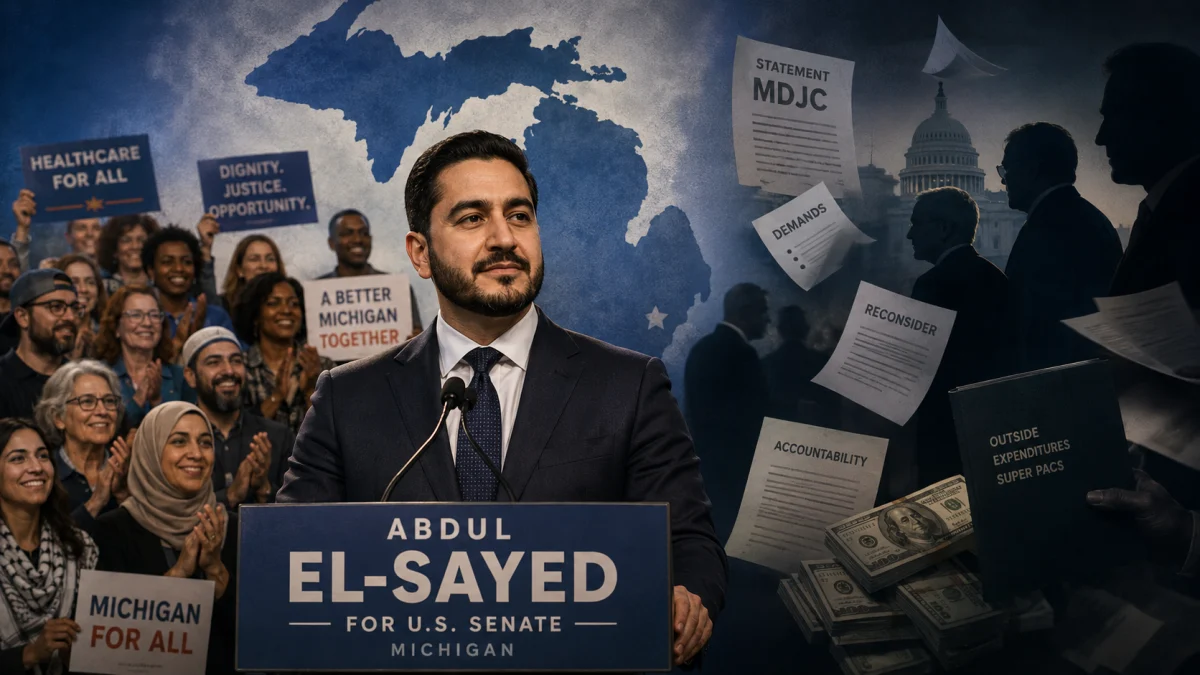
The Michigan Democratic Jewish Caucus responded to Abdul El-Sayed’s victory in the 2026 Democratic Senate primary with what it presented as a call for accountability, healing and coalition building.
That is the charitable interpretation.
The more accurate interpretation is that an organization that endorsed El-Sayed’s opponent is now attempting to convert its electoral defeat into a post-election ideological veto.
The caucus congratulated El-Sayed, but the congratulations quickly gave way to a list of conditions. He must address the supposed harm caused by his campaign. He must engage Michigan’s Jewish community “on its own terms.” He must respect the connection many Jewish Michiganders have to Israel. He must reject rhetoric the caucus believes demonizes Jewish civic identity.
This sounds conciliatory until one identifies the actual demand underneath it:
Now that the candidate we supported has lost, the winner must modify the arguments that helped him win.
That is not reconciliation. It is an effort to renegotiate the primary after the votes have already been counted.
El-Sayed Did Not Conceal the Campaign He Was Running
Abdul El-Sayed did not slip his position on AIPAC into the fine print.
He openly criticized the extraordinary amount of outside money being spent to influence Michigan’s Democratic primary. He condemned continued American military support for Israel’s conduct in Gaza. He argued that domestic needs should take priority over weapons for foreign governments. He repeatedly identified AIPAC and its affiliated political operation as major forces attempting to defeat him.
Michigan Democrats knew this when they voted.
El-Sayed narrowly defeated Rep. Haley Stevens by approximately one percentage point, receiving about 48.5% of the vote to Stevens’ 47.5%. A narrow victory is not a mandate for every sentence a candidate has ever spoken, but it remains a victory—and it came after voters were exposed to an enormous campaign portraying El-Sayed’s views on Israel and AIPAC as dangerous and disqualifying.
AIPAC’s super PAC, United Democracy Project, spent approximately $32 million supporting Stevens and opposing El-Sayed. Federal Election Commission filings showed the organization had already reported more than $30.6 million in Michigan expenditures by July 30, while total outside spending benefiting Stevens exceeded $60 million.
El-Sayed did not win because voters were unaware of the accusations against him.
He won despite a historic financial campaign designed to make those accusations unavoidable.
That does not prove every El-Sayed voter agrees with every aspect of his foreign-policy position. People vote for candidates for many reasons. It does, however, prove something politically significant:
Criticism of AIPAC and opposition to Israeli government policy did not disqualify him in the eyes of a plurality of Michigan Democratic voters.
The caucus is entitled to dislike that result. It is not entitled to reinterpret it out of existence.
A Close Loss Does Not Become a Veto
The strongest defense of the caucus’s statement is that El-Sayed won narrowly and must now expand his coalition for the general election.
That is true.
A primary victory is not a license to ignore nearly half of the electorate. El-Sayed should speak to voters who opposed him, listen to legitimate concerns and make clear that his criticism of Israel and AIPAC will never become hostility toward Jewish people.
But coalition building is not the same as ideological submission.
A losing faction may ask the winner to listen. It may not reasonably demand that he abandon the central distinctions on which he campaigned and then present that abandonment as the minimum standard for communal safety.
The caucus endorsed Haley Stevens in the primary. After El-Sayed won, its chair said she hoped he would focus less on AIPAC during the general election.
That sequence matters.
The organization backed the candidate who benefited from unprecedented pro-Israel outside spending. Its candidate lost. It then declared that the winner’s criticism of that spending had caused harm and should be deemphasized.
That is not neutral conflict resolution.
It is a political faction attempting to retain after the election the influence it failed to exercise through the election.
Criticizing AIPAC Is Not the Same as Attacking Jewish Political Participation
The most manipulative sentence in the caucus statement is its claim that El-Sayed repeatedly singled out “organized Jewish political participation” as a substitute for criticizing special-interest corruption.
That phrasing performs an enormous rhetorical substitution.
El-Sayed named AIPAC.
The caucus renamed AIPAC as organized Jewish civic life.
Those are not the same thing.
AIPAC is a specific political advocacy organization with an explicit policy mission. It works to strengthen the United States–Israel relationship, elect candidates who support that relationship and defeat candidates it considers hostile to it. AIPAC itself describes United Democracy Project as a super PAC that works to defeat detractors of the U.S.-Israel relationship.
AIPAC also says that its millions of members come from different religions, political parties and backgrounds. By its own description, it is not synonymous with Judaism or the Jewish population. It is a multi-faith political organization built around support for a particular foreign-policy relationship.
Therefore:
- Criticizing AIPAC is not criticizing Judaism.
- Investigating AIPAC’s spending is not investigating Jewish citizens as an ethnic group.
- Opposing AIPAC’s preferred policies is not opposing Jewish participation in democracy.
- Believing AIPAC has excessive political influence is not automatically a claim that Jews secretly control the government.
Those distinctions are not technicalities. They are the difference between legitimate democratic scrutiny and antisemitism.
The caucus blurs them because the blur is politically useful.
Once AIPAC’s activity is relabeled as “Jewish civic identity,” criticism of a powerful political organization can be treated as an attack on a vulnerable minority. A lobbying apparatus acquires the moral protections properly owed to human beings.
That is an extraordinary political advantage.
AIPAC may spend tens of millions of dollars influencing an election as a political actor, but its critics are then told that scrutinizing that activity threatens Jewish communal life.
No other political organization should be granted that arrangement.
The Statement Converts Political Disagreement Into Communal Injury
The caucus says El-Sayed’s criticism “functioned as a dog whistle” that demonized mainstream Jewish civic engagement.
But the statement does not identify the decisive words.
It does not explain which specific reference to Jewish people El-Sayed made. It does not show where he attributed collective guilt to Jewish Michiganders. It does not document an accusation of secret Jewish control, inherent Jewish corruption or divided Jewish loyalty.
Instead, it argues that repeatedly focusing on AIPAC produced an antisemitic effect, regardless of whether El-Sayed was discussing a real organization spending a documented amount of money in his election.
That is a dangerous standard.
Under that logic, the greater AIPAC’s spending becomes, the more difficult it becomes to criticize. Repeated criticism can itself be described as suspicious, even when the repeated spending is the reason the subject keeps arising.
A political organization cannot pour approximately $32 million into a race and then act bewildered that the candidate it is trying to defeat repeatedly talks about it.
If the National Rifle Association, a fossil-fuel super PAC or a pharmaceutical lobby spent tens of millions against one candidate, nobody would find it mysterious that the candidate made that spending part of the campaign.
AIPAC does not become immune from that standard because many of its strongest supporters are Jewish.
“Engage With Our Community on Its Own Terms” Is Not Democratic Pluralism
The caucus’s demand that El-Sayed engage the Jewish community “on its own terms” is equally revealing.
Public officials should engage Jewish constituents respectfully. They should combat antisemitism, protect synagogues, prosecute hate crimes, listen to Jewish citizens and recognize that many Jewish families have profound historical, religious and emotional connections to Israel.
But no constituency has the unilateral right to establish the terms under which its preferred political positions may be discussed.
Michigan’s Arab, Muslim and Palestinian communities also have terms grounded in history, trauma, displacement and family experience. Palestinian Americans may have relatives who were killed, displaced, starved or trapped in Gaza. Muslim voters may view American military support for Israel as direct participation in mass civilian suffering.
Anti-Zionist and non-Zionist Jewish voters also have their own terms. So do Jewish voters who support Israel’s existence but oppose its government, its occupation, its settlements or its military conduct.
A candidate representing an entire state must engage all those citizens as citizens.
He cannot allow one organization to declare that a particular relationship with Israel constitutes the authentic Jewish position and that challenges to that position constitute disrespect for Jewish identity.
Dialogue cannot begin with one side claiming the power to define the other side’s acceptable vocabulary.
The Claimed Jewish “Consensus” Does Not Exist
The caucus refers to the values of a “consensus majority of Michigan Jewry.”
No evidence is supplied for that assertion.
There is no public exit polling showing precisely how Michigan’s Jewish voters divided between El-Sayed and Stevens. It would therefore be irresponsible to claim that El-Sayed won because a known percentage of Jewish voters supported him.
What can be established is that Jewish support for El-Sayed existed openly and meaningfully.
Jewish Voice for Peace Action endorsed him, making his campaign its first endorsement in a U.S. Senate race. Former Michigan Rep. Andy Levin supported him. Michigan Jewish organizers created a “Jews for Abdul” effort, while Jewish educators and other local supporters publicly defended his candidacy after the primary.
That does not establish a Jewish majority for El-Sayed.
It establishes that the caucus does not possess a monopoly on Jewish political identity.
National polling makes its language of consensus even harder to defend.
A June 2026 AP-NORC survey found that only about half of religiously affiliated Jewish Americans considered Israel’s ongoing Gaza operations justified. Among religiously unaffiliated Jewish Americans, only about two in ten considered the continuing operations justified. Younger Jewish adults were also less likely than older Jewish adults to view support for Israel as central to Jewish identity.
A separate 2025 survey conducted by SSRS for The Washington Post found that 61% of Jewish Americans believed Israel had committed war crimes in Gaza, while 39% believed it had committed genocide.
These findings do not show that Jewish Americans have abandoned Israel as a country. Many distinguish between Israel’s existence, its people, its government and its military conduct.
They do show that organized pro-Israel institutions can no longer credibly present support for current Israeli policy as the uncomplicated Jewish consensus.
The actual Jewish community is divided.
That division includes Zionists, liberal Zionists, anti-Zionists, non-Zionists, religious Jews, secular Jews, Israeli government critics and Israeli government defenders.
An organization may represent part of that community. It may not erase the rest and call the remainder consensus.
Sincere Fear Does Not Make the Political Framing Accurate
It is important to acknowledge something uncomfortable.
Some Jewish voters probably do sincerely experience aggressive criticism of Israel or AIPAC as threatening.
That fear should not automatically be dismissed as dishonest. Antisemitism is real. Jewish institutions have been attacked. Jewish people have been harassed over actions taken by a government thousands of miles away. Conspiracy theories about Jewish money, power and secret control have a long and murderous history.
But sincerity does not make every interpretation factually correct.
For decades, major political and communal institutions have repeatedly presented Jewish identity, Zionism, Israel, Israeli security and support for the U.S.-Israel alliance as tightly interconnected. When those categories are fused often enough, criticism directed at one can begin to feel like an attack on all of them.
That is political and institutional conditioning.
It does not mean Jewish people are uniquely gullible. Every political community can be conditioned to interpret challenges to its institutions as attacks on its identity. Nationalists do it. Religious movements do it. Political parties do it. Corporations do it when they frame criticism of an industry as criticism of workers or consumers.
The Michigan caucus statement demonstrates the mechanism in real time.
A named political organization spends tens of millions of dollars in an election. A candidate criticizes that organization. The criticism is translated into hostility toward Jewish civic participation. The community is then asked to experience the political challenge as a collective wound.
Some people involved may sincerely believe that translation.
That still does not make it valid.
A feeling of offense deserves to be heard. It does not create a permanent exemption from factual scrutiny.
Antisemitism Must Be Identified Precisely
Rejecting the caucus’s framing does not require pretending antisemitism is imaginary or irrelevant.
The appropriate boundary is clear.
It would be antisemitic to:
- blame Jewish Americans collectively for Israel’s actions;
- claim that Jews secretly control American government or finance;
- describe political corruption as an inherently Jewish behavior;
- accuse Jewish citizens of automatic dual loyalty;
- attack synagogues, Jewish schools or Jewish businesses over Israeli policy;
- use traditional stereotypes about Jewish greed or hidden power;
- treat every Jewish person as an emissary of Israel.
None of those things should be tolerated.
But it is not inherently antisemitic to:
- oppose Israeli military policy;
- describe Israel as an apartheid state;
- argue that its government has committed war crimes or genocide;
- oppose American military assistance;
- investigate AIPAC’s donors and expenditures;
- argue that AIPAC has excessive influence;
- campaign against candidates supported by pro-Israel political organizations.
The question must be what was actually said, what evidence supports it and who was being criticized.
The identity of the people offended by an argument cannot, by itself, determine whether the argument is bigoted.
El-Sayed Is Not Beyond Criticism
A serious rebuttal should not replace one political loyalty test with another.
El-Sayed has made statements that deserve correction or greater precision.
He claimed in July that a poll showing Stevens ahead appeared to have been funded by AIPAC. The polling company said it financed the survey itself, and fact-checkers found no public evidence connecting AIPAC to it. El-Sayed should acknowledge that his claim was unsupported.
He also described Israel as “bloodthirsty” in a post-primary interview. Even when intended as a condemnation of state violence, language aimed at an entire country rather than the government, military leadership or specific policies creates avoidable ambiguity. He would be more accurate—and politically harder to misrepresent—by identifying the responsible institutions and conduct precisely.
Those criticisms are legitimate.
They do not establish that his campaign against AIPAC was an attack on Jewish civic life. Nor do they justify demanding that he stop discussing a political organization that spent approximately $32 million attempting to defeat him.
The appropriate answer to imprecise language is greater precision.
It is not silence.
Real Reconciliation Requires Mutual Recognition
A constructive caucus statement could have acknowledged several truths simultaneously:
AIPAC’s election spending was real and subject to legitimate criticism.
Jewish Michiganders are politically diverse.
Some El-Sayed statements could have been more precise.
Antisemitism must be opposed without being conflated with criticism of Israel.
Palestinian, Arab and Muslim voters also experienced real harm, fear and political exclusion during the campaign.
Candidates should distinguish Jewish people from Israeli government policy.
Jewish institutions should distinguish criticism of a pro-Israel lobbying organization from hostility toward Jews.
That would have been an invitation to pluralism.
Instead, the caucus issued an asymmetric demand. El-Sayed must recognize the community’s relationship with Israel, but the statement offers no comparable recognition of the Palestinian experience. He must engage the caucus on its own terms, but the caucus does not indicate that it will reconsider its own framing. He must answer for the harm allegedly caused by his campaign, but the organizations that spent unprecedented sums trying to defeat him are assigned no responsibility for deepening communal division.
That is not mutual accountability.
It is a defeated political faction placing the burden of reconciliation entirely on the winner.
The Caucus May Request a Conversation. It May Not Demand a Loyalty Oath.
The Michigan Democratic Jewish Caucus has every right to advocate for its members.
It has the right to request meetings, challenge El-Sayed, criticize his language, demand strong policies against antisemitism and decide whether it will endorse him.
What it does not have is the right to define criticism of AIPAC as an attack on Jewish identity and then demand that the Democratic nominee accept that definition as the entrance fee for coalition membership.
El-Sayed won the nomination while openly criticizing AIPAC, American military support for Israel and the Israeli government’s conduct.
He should listen to Jewish constituents.
He should correct unsupported factual claims.
He should choose language that distinguishes governments, institutions and populations.
He should oppose antisemitism unequivocally.
But he should not apologize for naming a political organization that spent approximately $32 million trying to prevent Democratic voters from selecting him.
And he should not pretend that the organization which endorsed his opponent now possesses the authority to rewrite the meaning of his victory.
The caucus says it wants a seat at the table.
It should have one.
But a seat at the table is not ownership of the table, control of the language spoken around it or veto power over the candidate Michigan Democrats selected.
The primary is over.
The candidate they wanted lost.
The candidate they attempted to discipline won.
That result does not entitle El-Sayed to ignore them. But neither does their disappointment entitle them to impose a post-election loyalty test disguised as reconciliation.
Frequently Asked Questions
Did Abdul El-Sayed win the 2026 Michigan Democratic Senate primary?
Yes. El-Sayed was declared the winner after narrowly defeating Rep. Haley Stevens, approximately 48.5% to 47.5%, or by roughly 15,000 votes in the reported count.
How much did AIPAC spend in the Michigan primary?
AIPAC’s affiliated super PAC, United Democracy Project, spent approximately $32 million supporting Stevens and opposing El-Sayed. Other outside organizations also spent heavily, bringing total outside spending benefiting Stevens above $60 million.
Is criticizing AIPAC antisemitic?
Not inherently. AIPAC is a political advocacy organization with explicit policy and electoral goals. Criticism becomes antisemitic when it generalizes from AIPAC to Jewish people, invokes stereotypes about Jewish money or control, or assigns collective responsibility to Jews.
Did Jewish voters support Abdul El-Sayed?
Some Jewish voters, organizers and public figures clearly supported him, and Jewish Voice for Peace Action endorsed his campaign. However, there is no reliable public exit polling establishing what percentage of Michigan’s Jewish electorate voted for El-Sayed.
Do most Jewish Americans support Israel’s ongoing actions in Gaza?
Recent polling shows substantial division rather than a unified consensus. The 2026 AP-NORC survey found that about half of religiously affiliated Jewish adults considered Israel’s continuing operations justified, compared with about one-fifth of religiously unaffiliated Jewish adults. Other polling has found majorities believing Israel committed war crimes.
Should El-Sayed meet with the Michigan Democratic Jewish Caucus?
Meeting with the caucus would be reasonable and potentially constructive. But engagement should not require him to accept the premise that criticism of AIPAC constitutes an attack on Jewish political identity.
References and Further Reading
Election Results and Campaign Spending
- Michigan’s official August 4, 2026 primary election results portal
- Federal Election Commission: United Democracy Project independent expenditures in Michigan
- Vanity Fair: AIPAC spent approximately $32 million trying to defeat Abdul El-Sayed
- The Forward: Michigan Jewish Democrats divided after El-Sayed’s primary victory
- The Guardian: Democratic leaders rally behind El-Sayed following his primary win
AIPAC’s Political Mission
- AIPAC: About the organization, its membership and political objectives
- AIPAC: How its PAC and United Democracy Project support and oppose candidates
Jewish-American Opinion on Israel and Gaza
- Associated Press: New AP-NORC poll reveals sharp divisions among Jewish Americans
- Religion News Service: Major findings from the 2026 AP-NORC survey of Jewish adults
- SSRS: Washington Post survey finds many Jewish Americans sharply critical of Israel’s conduct
Jewish Support for El-Sayed
- Jewish Voice for Peace Action endorses Abdul El-Sayed for the U.S. Senate
- The Forward: Jewish supporters defend El-Sayed and urge Democratic unity