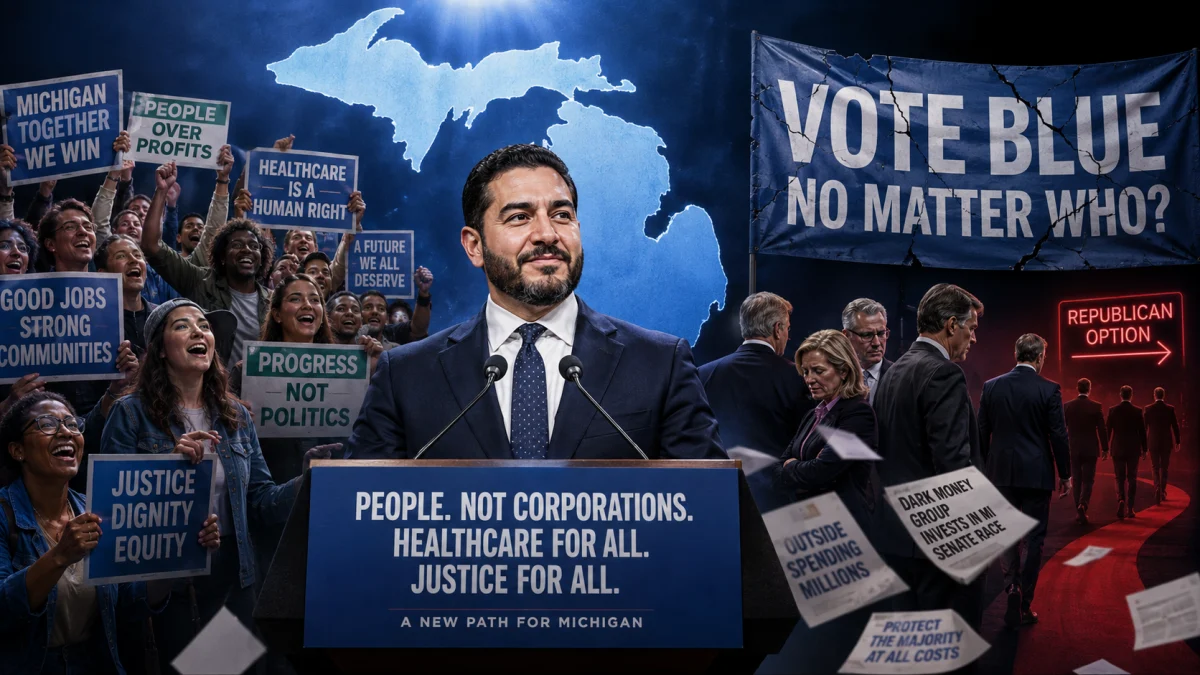
Michigan Democrats held a primary.
Abdul El-Sayed won.
That should make what happens next fairly straightforward under one of the Democratic Party’s most relentlessly repeated political doctrines of the past decade:
Vote blue no matter who.
Your candidate loses. You complain. You regroup. Then you support the Democratic nominee because defeating the Republican matters more than your disappointment over the primary.
Progressives have heard variations of this argument since at least the bitter Hillary Clinton–Bernie Sanders contest of 2016. The exact slogan “vote blue no matter who” became especially prominent during the 2020 presidential primary, but the underlying rule was already unmistakable four years earlier: once Democrats had selected Clinton, Sanders supporters were expected to put aside their objections and help defeat Donald Trump. Sanders himself endorsed Clinton, campaigned for her and urged his supporters not to sit out the election. (Al Jazeera)
Many did exactly that. Pew Research found in July 2016 that 90% of Democratic voters who had consistently supported Sanders during the primary intended to vote for Clinton, despite one of the most antagonistic nomination fights in modern Democratic politics. (Pew Research Center)
And those who refused?
They heard about it for years.
They were accused of enabling Trump. Of being selfish. Of putting ideological purity above democracy. Of treating politics like personal expression instead of collective responsibility.
Which makes the reaction to Abdul El-Sayed’s victory in Michigan extraordinarily revealing.
Because suddenly, for some Democrats, “vote blue no matter who” appears to have acquired terms and conditions.
Haley Stevens Lost the Primary
The first fact is also the one most easily obscured by everything that has happened since:
Haley Stevens lost.
El-Sayed defeated Stevens by roughly 15,000 votes out of nearly 1.5 million cast in one of the most expensive and ideologically charged Democratic Senate primaries in the country. (TIME)
It was close.
It was contentious.
It does not mean every Democrat suddenly agrees with El-Sayed.
But that is what primaries are for.
Stevens presented one vision of the Democratic Party. El-Sayed presented another. Voters were subjected to months of advertising, arguments, endorsements and enormous outside spending before making their decision.
They selected El-Sayed.
That normally is the point at which the “party unity” lecture begins.
And, to Stevens’ credit, she followed it. She endorsed El-Sayed after losing. Democratic Senate leadership also quickly closed ranks behind him, saying Democrats were united around defeating Republicans and retaking the Senate. (The Forward)
Yet some Stevens supporters have decided that the old rules may no longer apply.
Some Democratic Supporters Are Now Considering Mike Rogers
This is not speculation.
Jewish Insider reported on August 6 that several Jewish Democrats who had supported Stevens were considering crossing party lines to Republican nominee Mike Rogers.
Detroit businessman and Stevens supporter Michael Horowitz said he was “leaning strongly to Rogers.” Democratic fundraiser Hannan Lis had previously said he would vote for Rogers if El-Sayed became the nominee. Another Michigan Democratic fundraiser predicted that several large Jewish Democratic donors would support Rogers and said Republican operatives were already contacting potential defectors. (Jewish Insider)
Rabbi Asher Lopatin, another Stevens supporter, told The Forward that he definitely would not vote for El-Sayed, although he had not yet committed to Rogers. (The Forward)
AIPAC went further.
After its affiliated super PAC spent more than $30 million trying to help Stevens defeat El-Sayed, an AIPAC spokesperson said its members remained determined to ensure voters reject El-Sayed in November—effectively signaling that the organization is prepared to work against the Democratic nominee in favor of Rogers. (Jewish Insider)
That is AIPAC’s prerogative. AIPAC is not the Democratic Party and has never pretended that Democratic Party victory outweighs its pro-Israel objectives.
But actual Democratic voters, donors and organizations contemplating the same move present a much more interesting question.
What happened to vote blue no matter who?
Apparently, It Was “Vote Blue No Matter Who We Choose”
There is a distinction worth making here.
Nobody owes the Democratic Party a vote.
Not progressives.
Not centrists.
Not Jewish Americans.
Not Muslim Americans.
Not Black voters, Arab voters, union voters, women, young voters or anyone else routinely described as belonging to some Democratic “coalition.”
Voting is not an oath of fealty.
If a Stevens supporter genuinely believes Mike Rogers would make a better senator than Abdul El-Sayed, that person has every right to vote for Rogers.
But then we need to revisit an enormous amount of moralizing directed at the Democratic left over the last decade.
Because the progressive position was frequently treated very differently.
When Sanders supporters said in 2016 that Clinton did not represent them, the response was not:
Your vote is personal. Follow your conscience.
It was:
Donald Trump is worse.
The Supreme Court is at stake.
Women’s rights are at stake.
Minority rights are at stake.
Democracy is at stake.
You don’t have to love Clinton. You have to stop Trump.
That was the proposition.
And Sanders himself ultimately accepted it.
He had substantive disagreements with Clinton. His supporters had substantive grievances over how the primary had been conducted. Yet Sanders stood before his movement and argued that those disagreements did not erase the enormous policy differences between Clinton and Trump. (Al Jazeera)
Now apply precisely the same reasoning in Michigan.
You don’t have to love Abdul El-Sayed.
You don’t have to agree with him on Israel.
You don’t have to like his rhetoric.
You don’t have to approve of every person who endorsed him.
You do not even have to believe he was the best Democratic candidate.
He won.
If the principle is genuinely “vote blue no matter who,” the inquiry should essentially end there.
Instead, some Democrats appear to have discovered an exception:
Unless the progressive wins.
The 2016 Comparison Is More Damning Than People Remember
There is another reason the Sanders comparison matters.
Progressive anger in 2016 was not entirely imaginary.
Leaked DNC emails revealed hostility toward Sanders among ostensibly neutral party officials. One discussion floated exploiting Sanders’ religious beliefs against him. DNC Chair Debbie Wasserman Schultz resigned amid the controversy, and the Democratic National Committee formally apologized to Sanders and his supporters for what it called inexcusable comments inconsistent with its obligation to remain neutral. (Wikipedia)
That does not establish that Sanders secretly won the primary or that Clinton’s nomination was illegitimate. Clinton received more votes and pledged delegates.
But it does mean progressives had legitimate grounds to believe elements of the party institution preferred their opponent and behaved accordingly.
And after all of that, Sanders still told his supporters to vote for Clinton.
Think about the contrast.
In Michigan, El-Sayed faced tens of millions of dollars in outside spending designed to prevent him from becoming the Democratic nominee. AIPAC’s affiliated super PAC alone spent approximately $32 million backing Stevens and opposing El-Sayed. (The Forward)
It did not work.
The establishment-backed candidate lost.
The candidate targeted by the spending won.
And within roughly 24 hours, some people on the losing side were discussing voting Republican.
If progressives had done the mirror image of this, the condemnations would be deafening.
Imagine that Stevens had won.
Now imagine prominent El-Sayed supporters announcing the next morning:
We opposed Stevens on Gaza and AIPAC. Therefore, we are going to help Mike Rogers become senator.
Would mainstream Democrats respond with detached respect for their individual political autonomy?
Of course not.
They would be accused of handing Michigan to Republicans.
They would be told Senate control was at stake.
They would be reminded about Donald Trump.
They would be told that sitting out—or worse, voting Republican—was an irresponsible act of ideological narcissism.
And they would probably still be hearing about it in 2036.
That hypothetical is useful precisely because almost everyone knows what the reaction would be.
Millions Were Spent Trying to Prevent This Result
There is also something extraordinary about the order of events.
El-Sayed did not sneak through an uncontested race.
Stevens entered the primary with support from major Democratic officials, including Senate Democratic leader Chuck Schumer and Michigan Gov. Gretchen Whitmer. Outside organizations poured tens of millions of dollars into the contest, overwhelmingly benefiting Stevens. AP described the race before Election Day as a major test between El-Sayed’s progressive movement and Stevens’ institutional support. (AP News)
AIPAC’s super PAC alone spent approximately $32 million trying to achieve a particular result.
It failed.
There is nothing illegal or inherently illegitimate about independent political expenditures. Calling the spending “election interference” in the foreign or criminal sense would therefore be inaccurate.
But let us not sanitize what campaign spending exists to do.
The purpose was to influence the election.
Tens of millions were spent trying to persuade Michigan Democrats not to nominate Abdul El-Sayed.
Michigan Democrats nominated him anyway.
At some point, respecting democracy must include accepting outcomes you unsuccessfully spent enormous amounts of money trying to prevent.
Otherwise “respect the voters” becomes another principle applicable only when the voters cooperate.
The Muslim Progressive Wins—and Suddenly the Rules Change
The identity dimension should be discussed carefully.
There is no evidence that every Stevens supporter now considering Rogers is motivated by anti-Muslim prejudice. Many have explicitly described Israel, Zionism, antisemitism and El-Sayed’s rhetoric as their concerns. Those explanations should be represented accurately.
But the political optics are impossible to ignore.
The winner is a Muslim progressive whose campaign rejected longstanding Democratic orthodoxy on Israel and openly challenged AIPAC.
And some people who ordinarily identify with the Democratic Party are considering empowering the Republican Party because Democratic voters chose him.
That deserves scrutiny.
Especially because El-Sayed’s views were not discovered after Election Day.
He ran on them.
Voters knew who they were selecting.
AIPAC certainly knew—hence the $30-million-plus effort to defeat him.
The primary was, in part, explicitly fought over these questions.
You cannot reasonably make Israel policy a defining issue in an election, lose the election on those terms and then declare that the winning candidate must abandon the position because the losing coalition remains uncomfortable with it.
At that point, what was the primary for?
One Jewish Democrat Put the Contradiction Perfectly
The most devastating rebuttal to the emerging argument actually came from within Michigan’s Jewish community.
Roslyn Schindler, a retired Wayne State professor who taught Holocaust studies and supported El-Sayed despite disagreeing with him on some Israel-related questions, told The Forward:
“My motto is and will be: vote blue, no matter who.”
She argued that Democrats abandoning the nominee would be self-destructive. (The Forward)
Former Michigan Democratic Rep. Andy Levin, who is Jewish and also supported El-Sayed, made essentially the same argument, condemning the idea that a Democratic voter should help elect Rogers solely because El-Sayed does not share that voter’s position on Israel and Palestine. (The Forward)
That matters because this should not be framed as Jews versus El-Sayed.
It isn’t.
Jewish Michigan voters supported both candidates. Some Jewish Democrats are considering Rogers. Others are strongly supporting El-Sayed. Still others remain undecided.
The actual dispute is political.
Treating all Jewish Democrats as a single political bloc would reproduce the exact mistake this discussion should avoid.
If Israel Is More Important Than Democratic Control of the Senate, Say So
There is ultimately a respectable position available to those contemplating Rogers.
They can say:
Israel is sufficiently important to me that I am willing to help Republicans control the Senate rather than vote for a Democrat who opposes current U.S.-Israel policy.
That is at least coherent.
Political priorities differ.
Some voters treat abortion as overriding. Others climate change. Others taxation. Immigration. Guns. Labor. LGBTQ rights. Foreign policy.
A voter is permitted to decide that one issue overrides everything else.
But that decision has consequences.
Mike Rogers is not Haley Stevens with a different letter after his name. He is the Republican nominee in a race that national Democrats consider central to determining control of the United States Senate. Rogers has campaigned as an ally of Donald Trump, while Democratic leaders have explicitly described defeating Republicans like Rogers as necessary to check Trump’s presidency. (Bridge Michigan)
So someone crossing from Stevens to Rogers cannot pretend there is no tradeoff.
They are making one.
They are deciding that defeating El-Sayed is more important than electing a Democratic senator.
That is their right.
But everyone else is equally entitled to notice what that reveals about their hierarchy of political priorities.
“Party Unity” Cannot Be a One-Way Obligation
This is the larger problem.
For years, one faction of the Democratic coalition has frequently asked progressives to make compromises in the name of electability and unity.
Nominate the centrist.
Accept incrementalism.
Don’t demand everything at once.
Don’t stay home.
Don’t vote third party.
Don’t punish the nominee because your preferred candidate lost.
Think about the Supreme Court.
Think about Republicans.
Think about the country.
There is a reasonable argument behind some of that advice.
Coalitions necessarily require compromise.
But compromise cannot permanently mean the left compromises when the center wins, while the center defects when the left wins.
That is not a coalition.
That is a hierarchy.
Under that arrangement, progressives are treated as reliable electoral infantry: necessary enough to be ordered into formation every November, but never legitimate enough to lead when they actually win a primary.
If that is how the system works, stop calling it party unity.
Call it what it is:
obedience to one faction of the party.
This Is the Real Test of “Vote Blue No Matter Who”
Principles become meaningful precisely when following them becomes inconvenient.
It is easy to say “respect elections” when your candidate wins.
It is easy to advocate tolerance when nobody challenges your worldview.
And it is very easy to say “vote blue no matter who” when you expect “who” to be your preferred Democrat.
The test comes when voters choose someone you genuinely dislike.
Michigan just administered that test.
Haley Stevens supporters had every right to campaign for her.
AIPAC had every legal right to spend millions supporting her.
Jewish voters who believe El-Sayed’s rhetoric is dangerous have every right to criticize him relentlessly.
El-Sayed should answer legitimate criticism, correct unsupported claims and make clear that hostility toward Israeli government policy will never become hostility toward Jewish Americans.
None of that changes what happened on August 4.
Abdul El-Sayed won the Democratic primary.
If progressives would have been morally obligated to support Haley Stevens after losing, then the same standard applies in reverse.
If it doesn’t, then “vote blue no matter who” was never a principle.
It was an instruction.
And apparently the instruction was meant for somebody else.
The Most Important Caveat: This Is Not Most Stevens Voters
The early reporting should not be exaggerated.
There is currently no evidence that a majority—or even a large percentage—of Stevens voters intend to defect to Rogers.
The reports concern several Democratic donors, activists and Jewish community figures. Some others are undecided. Some may leave the Senate race blank rather than vote Republican. And many Democrats who preferred Stevens have already moved behind El-Sayed. Stevens herself endorsed him. Democratic Senate leadership endorsed the general-election effort almost immediately. (Jewish Insider)
That distinction matters.
This is not an indictment of Haley Stevens’ electorate.
It is a challenge to a particular political behavior and the double standard it exposes.
And because the general election is still months away, some voters currently threatening defection may ultimately return.
Good.
That would actually demonstrate the principle progressives have been told to follow for years:
Fight as hard as you want in the primary.
Then accept that sometimes democracy chooses somebody else.
The Democratic Party Has to Decide Whether Its Primaries Actually Matter
The deeper issue extends beyond El-Sayed.
Political parties cannot endlessly invite progressive voters into primaries while implicitly reserving the right to reject their choices when progressives finally win them.
If moderate Democrats can tell progressives, “Your candidate lost, grow up and vote for ours,” but progressives winning produces, “Perhaps we should elect the Republican instead,” the coalition cannot function indefinitely.
People notice asymmetrical rules.
They particularly notice them after being lectured about those rules for ten years.
The response to El-Sayed’s victory should therefore be simple.
Criticize him.
Pressure him.
Debate him.
Demand specificity.
Challenge his rhetoric.
Organize around policies you oppose.
That is democracy.
But if your political philosophy for the last decade has been that defeating Republicans is an overriding moral obligation, then losing a primary does not suddenly release you from it.
You do not get to spend years telling progressives that democracy itself requires them to swallow their objections—and then decide democracy can survive a Republican Senate just fine because this time your candidate lost.
Abdul El-Sayed won.
For anyone who genuinely believed “vote blue no matter who,” the uncomfortable part is not figuring out what comes next.
It is discovering whether you ever meant it.
Frequently Asked Questions
Did Haley Stevens endorse Abdul El-Sayed?
Yes. Stevens endorsed El-Sayed after he defeated her in the Democratic primary. National Democratic Senate leaders also moved quickly to support his general-election campaign against Republican Mike Rogers. (The Forward)
Are Haley Stevens voters actually switching to Mike Rogers?
Some are considering it, but there is no evidence yet of a mass defection. Current reporting identifies several individual Jewish Democratic donors, community leaders and Stevens supporters considering Rogers, abstaining or withholding support from El-Sayed. (Jewish Insider)
How much did AIPAC spend against Abdul El-Sayed?
AIPAC’s affiliated super PAC, United Democracy Project, spent approximately $32 million supporting Stevens and opposing El-Sayed during the Democratic primary. (The Forward)
Did Bernie Sanders supporters refuse to vote for Hillary Clinton in 2016?
Some did, but the available evidence does not support portraying Sanders voters collectively as refusing to unite. Pew found that 90% of Democratic voters who had consistently supported Sanders during the primary preferred Clinton over Trump by July 2016. Sanders himself endorsed and campaigned for Clinton. (Pew Research Center)
Did the DNC unfairly favor Hillary Clinton in 2016?
Leaked internal emails documented anti-Sanders sentiment among DNC personnel and prompted Chair Debbie Wasserman Schultz’s resignation and a formal DNC apology. That establishes institutional bias among officials; it does not definitively establish that Sanders actually won the primary or that Clinton’s pledged-delegate victory was fabricated.
Is it hypocritical for every Stevens voter to refuse El-Sayed?
No. A voter who never subscribed to “vote blue no matter who” is perfectly consistent in evaluating each general-election candidate independently. The hypocrisy applies specifically to people who demanded unconditional Democratic unity from other factions but abandon that principle when their own faction loses.
More to think on
- Abdul El-Sayed Won the Michigan Primary. His Opponents Do Not Get to Rewrite His Campaign Afterward
- Why Did Nearly Half of Michigan’s Democratic Primary Electorate Still Vote for Haley Stevens?
References and Further Reading
Michigan Democratic Senate Primary
- Associated Press — Michigan Senate primary tests progressive insurgency against Democratic establishment
Background on the El-Sayed–Stevens primary, institutional endorsements, ideological divisions within the Democratic Party, and the scale of outside political spending surrounding the race. - Time — Abdul El-Sayed defeats Haley Stevens in Michigan Democratic Senate primary
Coverage of El-Sayed’s approximately 15,000-vote primary victory and the importance of the Michigan Senate contest to national control of the chamber. - The Guardian — Democrats rally behind Abdul El-Sayed after Michigan primary victory
Reporting on the Democratic Party’s post-primary response and the movement of national party leadership toward supporting El-Sayed in the general election.
Haley Stevens Supporters and Possible Republican Defections
- Jewish Insider — Jewish Democrats in Michigan weigh crossing party lines after El-Sayed’s Senate primary win
Reporting on Democratic donors, activists and former Stevens supporters considering Republican Mike Rogers, abstention, or withholding support from El-Sayed following the primary. - The Forward — Michigan Jewish Democrats divide over whether to support Abdul El-Sayed
A useful look at the range of Jewish Democratic responses to El-Sayed’s victory, including both opposition to his candidacy and Jewish Democrats explicitly invoking the principle of “vote blue, no matter who.”
AIPAC and Outside Spending
- The Forward — Michigan Jewish Democrats react to El-Sayed’s victory after massive pro-Israel spending
Includes reporting on the approximately $32 million spent by AIPAC-affiliated United Democracy Project in support of Stevens and against El-Sayed. - Federal Election Commission — United Democracy Project independent expenditure filings
Primary-source federal campaign-finance records documenting independent expenditures made by the AIPAC-affiliated super PAC during the Michigan Senate race.
“Vote Blue No Matter Who” and the 2016 Democratic Primary
- Pew Research Center — Most Bernie Sanders supporters ultimately backed Hillary Clinton over Donald Trump
Pew found that by July 2016, 90% of Democratic voters who had consistently supported Sanders during the primary preferred Clinton over Trump—important context for claims that Sanders voters broadly refused to support the Democratic nominee. - Al Jazeera — Bernie Sanders urges supporters to vote for Hillary Clinton
Contemporary coverage of Sanders formally urging his movement to support Clinton despite the bitter Democratic primary campaign.
The 2016 DNC Controversy
- Boston.com — Leaked DNC emails overshadow the 2016 Democratic National Convention
Contemporary reporting on internal Democratic National Committee emails showing hostility toward Sanders, the resulting neutrality controversy, and Debbie Wasserman Schultz’s resignation.
Republican Nominee Mike Rogers
Bridge Michigan — Mike Rogers runs again for U.S. Senate while aligning himself with Donald Trump
Background on Rogers’ political positioning, relationship with Trump, and the broader stakes involved when Democratic voters consider crossing party lines in the general election.