
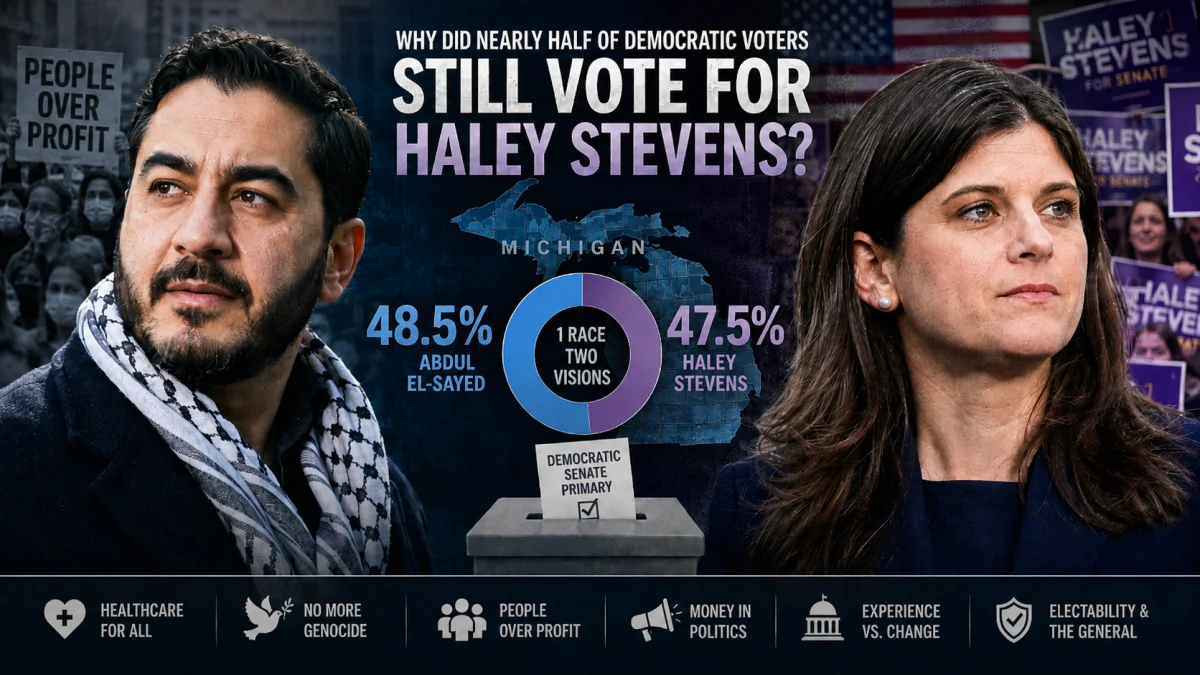
Abdul El-Sayed’s victory showed that a grassroots candidate can survive an extraordinary advertising onslaught. The closeness of the result showed that money was not Haley Stevens’s only source of support.
Abdul El-Sayed appears to have accomplished something that American politics repeatedly tells candidates is nearly impossible: he defeated a well-established member of Congress despite being overwhelmed by outside spending.
Yet the result raises a second question.
Why did Haley Stevens still receive roughly 47 percent of the vote?
On the surface, the result can seem contradictory. Michigan Democratic voters overwhelmingly say government should ensure people have healthcare. Large majorities support some form of Medicare-style universal coverage. Democratic opinion has also turned sharply against Israel’s conduct in Gaza and against additional American military assistance.
El-Sayed offered the more direct version of those positions. Stevens offered a more traditional Democratic platform, defended the existing healthcare system’s basic structure and remained one of Congress’s most outspoken supporters of Israel.
Nevertheless, nearly half of the ballots cast in Michigan’s Democratic Senate primary went to Stevens.
The easiest explanation is that money bought those votes.
Money unquestionably mattered. But that answer is incomplete.
The more accurate explanation is that Stevens assembled a coalition of voters who valued experience, institutional familiarity, perceived electability and incremental government over structural change. Outside spending then magnified those existing preferences, obscured the reason many groups were financing her campaign and repeatedly presented Stevens as the safer and more familiar choice.
Money did not manufacture her entire constituency. It made that constituency larger, more confident and more likely to vote.
The premise needs an important correction
It is reasonable to conclude that many Stevens voters agreed with El-Sayed on broad outcomes.
That does not necessarily mean they were more politically aligned with him overall.
There is no truly “objective” candidate-alignment score unless we first decide how much weight to assign every issue. A voter can support universal healthcare but care more about defeating the Republican nominee. Another can oppose Israel’s campaign in Gaza but regard domestic economic policy as more important. A third can agree with El-Sayed’s destination while distrusting his proposed route for getting there.
Voters do not select candidates from policy spreadsheets. They select what they perceive as packages of benefits, risks, character, competence and political viability.
There is another technical distinction. Michigan conducts open primaries. The people casting Democratic primary ballots are not necessarily registered or committed Democrats. Late Emerson polling found that El-Sayed performed much better among independents participating in the Democratic primary than among self-identified Democrats: 60 percent to 33 percent among independents, compared with 50 percent to 41 percent among Democrats. (AP News)
Therefore, the most precise description is not that nearly half of “Democrats” chose Stevens. Nearly half of the people who selected a Democratic primary ballot did.
That does not make the Stevens vote less significant. It does show that the electorate was more complicated than a single ideological bloc.
Stevens represented institutional trust
The clearest demographic division in the final pre-election Emerson poll was age.
El-Sayed led Stevens 67 percent to 25 percent among voters younger than 50. Among voters over 60, the result reversed: Stevens led 53 percent to 39 percent. The same survey found that voters who approved of Governor Gretchen Whitmer preferred Stevens 49 percent to 42 percent, while voters who disapproved of Whitmer overwhelmingly preferred El-Sayed. (Emerson Polling)
Those numbers suggest that the race was not simply progressive policy versus moderate policy. It was also insurgency versus institutional continuity.
Stevens had served four terms in Congress. She had worked on the Obama administration’s auto-industry rescue and received support from prominent Democratic leaders, including Whitmer and Senate Minority Leader Chuck Schumer. For voters who believe Michigan Democrats have governed reasonably well—or who trust familiar party leaders when evaluating a complicated primary—those endorsements carried information. (The Wall Street Journal)
That kind of voting is often dismissed as blind loyalty. Sometimes it is. But it can also be a rational shortcut.
Most people do not have the time to examine every vote, donor, advertisement, policy paper and feasibility argument. They rely on institutions and people they already trust. An endorsement from Whitmer may mean more to such a voter than ten hours of campaign coverage.
El-Sayed’s message asked those voters to distrust the party’s established decision-makers. Stevens’s message asked them to trust the system that had already placed her in Congress.
Older and institutionally aligned Democrats were more inclined to accept the second argument.
Many voters were choosing what they considered the safer general-election candidate
Michigan is not a safely Democratic state. The nominee will face former Republican congressman Mike Rogers in what is expected to be a competitive general election.
That reality created an electability contest inside the policy contest.
Stevens repeatedly emphasized that she had won competitive elections, represented an important suburban district and possessed a record that could be presented to swing voters. Republicans simultaneously advertised El-Sayed’s support for Medicare for All and his earlier position on abolishing Immigration and Customs Enforcement, apparently hoping to define him before the general election. Political analysts interpreted the timing as evidence that Republicans considered El-Sayed the preferable opponent. (PolitiFact)
Whether that electability argument was correct is a different question.
Political professionals routinely misjudge which candidate is “safe.” Conventional nominees can lose because they fail to motivate the base. Insurgent candidates can lose after being successfully portrayed as extreme. Electability is partly evidence and partly speculation.
But primary voters still act on those perceptions.
A Stevens voter may have agreed with El-Sayed about healthcare or Gaza and nevertheless concluded that Stevens had a better chance of defeating Rogers. That voter was not necessarily choosing different values. The voter was choosing a different theory of how those values could retain representation in Washington.
The repeated message was simple: El-Sayed may be closer to what you believe, but Stevens is less likely to lose.
In a closely divided state, that argument has power.
Healthcare agreement does not eliminate disagreement about healthcare
Healthcare provides perhaps the strongest evidence for the argument that many voters were closer to El-Sayed on policy.
A July WDIV–Detroit News poll found that 82.8 percent of likely Michigan Democratic primary voters supported moving to a Medicare-style single-payer system. Nearly two-thirds strongly supported it. But support declined to 66.5 percent when respondents were told that people with employer or union insurance would be moved into the federal system. (WDIV)
That second result is crucial.
Voters may strongly support universal healthcare in principle while becoming more cautious when the proposal is presented as a transition affecting coverage they already possess.
Nationally, Pew found that 90 percent of Democrats and Democratic-leaning independents believe government has a responsibility to ensure healthcare coverage. But they divide over the method: 52 percent preferred a single national program, while 37 percent preferred a mixture of private insurance and government programs. (Pew Research Center)
El-Sayed made Medicare for All a defining campaign commitment. Stevens emphasized protecting the Affordable Care Act, preserving coverage for preexisting conditions and reducing prescription-drug costs. (Abdul for U.S. Senate)
Those positions are not equivalent. El-Sayed proposed changing the system’s fundamental structure. Stevens proposed improving and protecting the existing structure.
But both can be presented as supporting healthcare access.
A voter who wants everyone covered may still fear the disruption of replacing employer-sponsored insurance. A union household may support universal care but worry about losing a healthcare plan won through collective bargaining. A Medicare recipient may value El-Sayed’s goals but place more trust in someone who promises to defend the current program against Republican cuts.
This is where broad issue polling can be misleading.
“Should everyone have healthcare?” and “Should the United States replace most private insurance with a federal program?” are related questions, but they are not identical. Support for the first does not guarantee support for every mechanism proposed under the second.
Stevens could therefore retain voters who shared El-Sayed’s moral premise but preferred incremental execution.
Gaza mattered enormously—but it was not equally decisive for everyone
Democratic voters have moved substantially on Israel and Palestine.
In a 2025 Quinnipiac national poll, 77 percent of Democrats said they believed Israel was committing genocide in Gaza. Seventy-five percent opposed sending Israel additional military aid. (Quinnipiac University Poll)
Michigan had already provided a prominent warning. In the state’s 2024 Democratic presidential primary, 13.3 percent voted “uncommitted” as part of an organized protest against the Biden administration’s support for Israel’s military campaign. That was more than 100,000 votes—large enough to attract national attention and win convention delegates. (Michigan Public)
Those results demonstrate a serious and politically consequential shift.
They do not, however, establish that Gaza was the decisive issue for a majority of Michigan’s 2026 Democratic primary electorate.
There are at least three separate questions:
- Does a voter oppose what Israel is doing in Gaza?
- Does that voter support ending or conditioning American aid?
- Is that position important enough to determine the voter’s Senate-primary choice?
A person can answer yes to the first question while remaining uncertain about the second. A person can answer yes to both and still vote primarily on healthcare, manufacturing, abortion rights, Donald Trump or perceived general-election viability.
Some Stevens voters may also have accepted her distinction between supporting Israel and supporting its current government. Stevens has criticized Israeli Prime Minister Benjamin Netanyahu even while continuing to describe herself as a proud pro-Israel Democrat. El-Sayed, by contrast, called the campaign in Gaza a genocide and made AIPAC’s political influence central to the race. (The Associated Press)
For voters who considered Gaza morally disqualifying, the choice was clear.
For voters who opposed Netanyahu but did not regard support for Israel as inherently disqualifying, Stevens could remain acceptable.
That is not evidence that those voters endorsed the destruction in Gaza. It is evidence that Americans frequently hold overlapping and sometimes contradictory political positions—and that voters differ dramatically in what they consider a voting threshold.
AIPAC’s advertising did not ask voters to support Israel
This is the central mechanism through which money influenced the race.
AIPAC and its affiliated groups spent close to $30 million supporting Stevens, their largest investment in a single race at that point. All outside organizations supporting her had spent close to $50 million before Election Day, while later estimates placed total pro-Stevens advertising support above $60 million. Stevens’s own campaign had spent only about $1 million on advertising when the Associated Press examined the spending. (The Associated Press)
But the pro-Stevens advertising generally did not say:
Vote for Haley Stevens because she supports Israel.
Instead, the ads highlighted her connection to Barack Obama’s auto rescue, her manufacturing record, her opposition to aggressive immigration enforcement and her support for the $35 Medicare insulin cap. Other ads accused El-Sayed of disrespecting women. Many voters were unlikely to know that the messages were being financed by an organization primarily concerned with U.S.-Israel policy. (The Associated Press)
That distinction explains much of the apparent contradiction.
AIPAC did not need to persuade Stevens voters to agree with it about Gaza. It needed to make Gaza disappear from their immediate voting decision.
An advertisement financed because of Israel could win a vote because of insulin.
An organization seeking to defeat El-Sayed over foreign policy could advertise Stevens as an advocate for Michigan manufacturing.
A voter could oppose further military support for Israel, watch repeated advertisements portraying Stevens as the experienced protector of Michigan jobs, and vote for her without ever fully understanding why the organization purchasing those advertisements cared about the election.
That is a more sophisticated form of political influence than openly changing people’s minds about Israel. It changes what they believe the election is about.
Why political advertising works on some voters
Political advertising is not mind control. Most advertisements probably do not cause an immediate and total ideological conversion.
They do not have to.
Research covering American elections from 2000 through 2018 found that television advertising has significantly larger effects in Senate, House and other down-ballot contests than in presidential races. The primary mechanism was persuasion: voters generally have less information and weaker preexisting opinions about lower-profile candidates, giving advertising more room to shape their knowledge and evaluations. (Cambridge University Press)
A separate study of presidential primaries found that both positive and negative advertising can improve a candidate’s favorability and vote share. Advertising also affects perceptions of viability—whether voters believe a candidate is serious, competitive and capable of winning. (Cambridge University Press)
This means advertising works most effectively when it supplies an answer to a question the voter is already asking.
A voter worried about electability repeatedly hears that Stevens is the proven winner.
A voter worried about Michigan jobs repeatedly sees her associated with the auto rescue.
A voter concerned about healthcare hears about insulin.
A voter who vaguely likes El-Sayed but knows little about him repeatedly sees allegations questioning his judgment or character.
The advertisement does not need to replace the voter’s entire worldview. It only needs to move one consideration higher and push another lower.
In a race decided by a few percentage points, small movements are enough.
Why other voters saw through the same advertising
The advertising encountered much greater resistance among people who already possessed strong opinions about the race.
A voter who considered AIPAC’s involvement disqualifying did not view the ads as neutral information. The ads themselves became evidence for El-Sayed’s argument about money controlling politics.
A voter personally affected by Gaza was unlikely to forget the funding source simply because an advertisement discussed manufacturing.
A voter who had met an El-Sayed organizer, attended a rally or heard about the campaign through a trusted personal network had an alternative source of information.
El-Sayed’s campaign said it recruited more than 10,000 volunteers statewide, compared with the “hundreds” reported by Stevens’s campaign. That grassroots infrastructure gave him something television money cannot automatically purchase: trusted people capable of contextualizing the advertisements and explaining who paid for them. (The Associated Press)
The dramatic age gap also suggests that the two candidates were reaching voters through different political and information environments. Late polling showed El-Sayed dominating among voters younger than 50 while Stevens led among those over 60. It would require voter-level research to determine exactly how much media consumption caused that division, but the difference is too large to ignore. (Emerson Polling)
El-Sayed also turned his financial disadvantage into a story.
Every new outside expenditure reinforced his central message: powerful interests believed they could purchase the election. Instead of merely surviving the attacks, he used the attacks to demonstrate the problem he claimed to be running against.
In that sense, the spending carried two opposing effects. It strengthened Stevens among voters who accepted its messages while strengthening El-Sayed among voters who recognized or distrusted its source.
The money remained powerful. It was no longer invisible to everyone.
Stevens had a real constituency before the money arrived
It would be a mistake to assume that Stevens’s entire vote share was created by political advertisements.
She had represented part of Michigan in Congress since 2019. She could point to work involving the auto industry, manufacturing, prescription-drug costs and federal legislation. She had relationships with state and national Democratic leaders and a recognizable record that outside groups could amplify. (The Wall Street Journal)
Money works best when it attaches itself to something voters already find plausible.
A completely unknown candidate with no résumé, endorsements or natural constituency would not necessarily have received the same support from the same advertising budget. Stevens offered the raw material: experience, familiarity, an Obama connection, a suburban political base and an incremental governing identity.
Outside groups purchased the volume.
They did not invent every underlying reason a person might prefer her.
This distinction matters because describing all Stevens voters as fooled, purchased or politically ignorant would be analytically wrong—and strategically disastrous for El-Sayed.
What the Stevens vote actually represented
There was almost certainly no single Stevens voter.
Her support probably included committed moderates who genuinely disagreed with El-Sayed; older institutional Democrats who trusted Whitmer and the party establishment; voters who prioritized beating Rogers; union or employer-insured households nervous about healthcare transitions; voters who opposed Netanyahu but did not reject the broader U.S.-Israel relationship; people persuaded by the advertising; and people who simply knew Stevens better.
Those categories overlap.
The strongest evidence suggests that money amplified this coalition rather than creating it from nothing.
The Stevens vote was therefore not proof that nearly half the electorate supported AIPAC’s agenda. Nor was it proof that Democratic voters secretly oppose universal healthcare.
It was evidence that issue agreement is only one component of candidate choice.
Voters also ask:
Can this person win?
Can this person govern?
Do people I trust support this candidate?
Will this proposal disrupt something I depend on?
Which issue feels most urgent to my own life?
What have I heard repeatedly enough to believe?
El-Sayed won the voters who were more prepared to prioritize structural change, anti-corporate politics and a decisive break with the Democratic establishment.
Stevens retained voters who placed greater value on continuity, perceived safety and institutional experience—or who were persuaded to do so.
Money lost the election, but it did not fail
El-Sayed’s projected victory should be understood as a major defeat for the theory that enough outside spending can automatically determine a Democratic primary.
But it should not be misread as proof that the spending had no effect.
The late Emerson poll showed El-Sayed leading Stevens 57 percent to 41 percent when undecided voters’ preferences were included. The unofficial election result was considerably closer. Polling error, turnout differences and late decision-making may all have contributed, but it is entirely plausible that the enormous advertising advantage helped Stevens close part of that gap. (Emerson Polling)
Without the spending, Stevens might have lost by a much larger margin.
The campaign therefore produced two truths at once:
Money was not powerful enough to guarantee victory.
Money was powerful enough to keep the race extraordinarily close.
The lesson is not that political money has stopped working. It is that money can be overcome when a candidate has a simple economic message, a credible personal identity, a large volunteer organization and an electorate already suspicious of the interests paying for the advertisements.
The uncomfortable answer
Why did nearly half of Michigan’s Democratic primary electorate vote for Haley Stevens?
Because many of them were not casting a referendum on Medicare for All or Gaza alone.
They were choosing a perceived governing style. They were responding to age, trust, familiarity and endorsements. They were attempting to predict the general election. They were distinguishing between universal healthcare as a goal and single-payer healthcare as a mechanism. They were assigning different levels of importance to Gaza. And some were persuaded by an advertising campaign designed to conceal the foreign-policy reason its largest funders wanted Stevens elected.
The Stevens vote was a mixture of conviction, caution, habit, institutional loyalty and paid persuasion.
That answer is less satisfying than declaring that almost half the electorate was deceived. It is also more useful.
El-Sayed’s next challenge is not to prove that Stevens voters were wrong about everything. It is to convince them that the outcomes they already want—affordable healthcare, economic security, competent government and protection from Republican rule—can be achieved through his approach without accepting an unacceptable level of risk.
He should not insult those voters.
He needs them in November.
His projected primary victory showed that people can see through money.
The narrow margin showed that millions of dollars can still determine what many other people see.
References and Further Reading
- Associated Press: AIPAC’s record spending in the Michigan Senate primary (The Associated Press)
- Emerson College Polling: Final Michigan Democratic primary survey and age breakdown (Emerson Polling)
- WDIV–Detroit News: Michigan Democratic voters’ views on single-payer healthcare (WDIV)
- Pew Research Center: Democratic views on government responsibility for healthcare (Pew Research Center)
- Quinnipiac University: Public opinion on military assistance to Israel and genocide in Gaza (Quinnipiac University Poll)
- American Political Science Review: The effect of television advertising in American elections (Cambridge University Press)
- Political Science Research and Methods: Persuasive effects of primary-election advertising (Cambridge University Press)