The lawsuit against Delta Air Lines over a passenger’s alleged back injury is unusual, but based on the allegations currently available, calling it obviously frivolous goes too far.
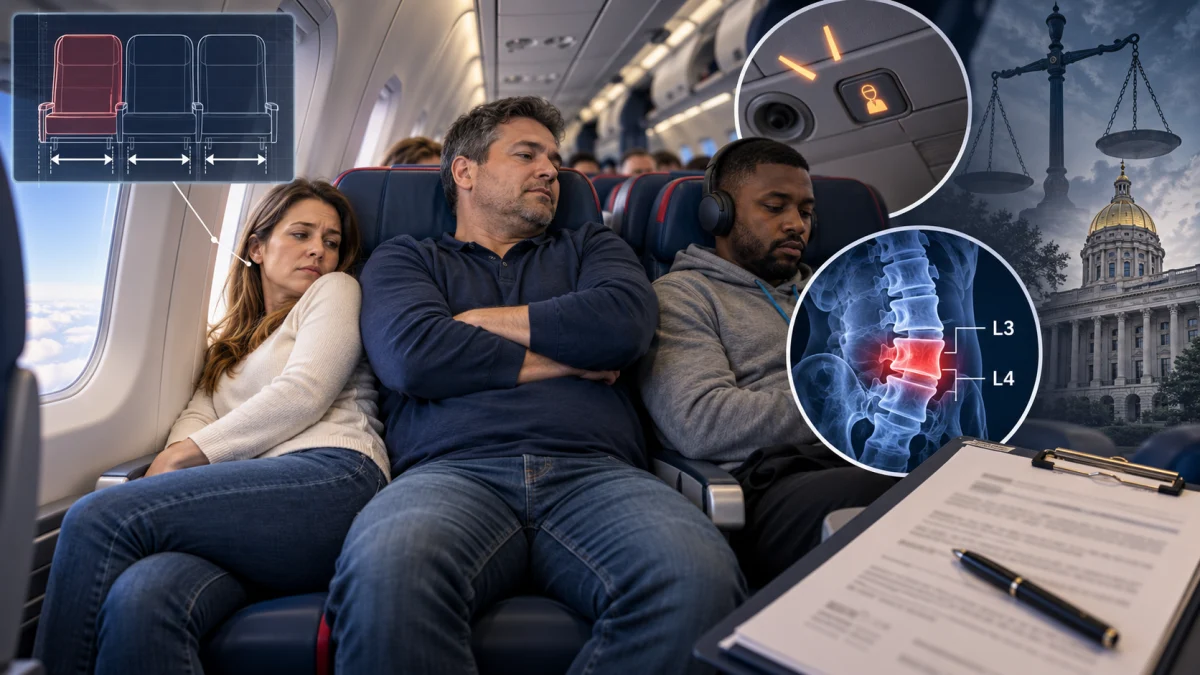
Rolando Jimenez is not merely alleging that an economy-class seat was uncomfortable. According to the lawsuit and reporting about it, he says another passenger extended into his assigned window-seat space during a roughly 5½-hour flight from Atlanta to Seattle, forcing him to remain in a constrained and twisted position against the aircraft wall.
More importantly, Jimenez says he complained to Delta flight attendants during the flight and asked to be moved because of the encroachment and physical discomfort. No alternative seat was provided. He says severe lower-back and left-leg pain appeared when he stood after landing, that he sought medical treatment within two days, and that he subsequently underwent an L3-4 laminectomy on November 8, 2024. FOX 5 Atlanta’s report on the lawsuit
Those allegations have not been proven in court, and Delta has said it does not comment on pending litigation. Jimenez still faces difficult questions about whether the flight actually caused or aggravated the condition that required surgery.
But there is another side of the case that most of the quick coverage misses: Delta itself has a policy addressing passengers who encroach into neighboring seats, and Georgia imposes an unusually demanding duty of care on passenger carriers.
That does not mean Jimenez will win.
It does mean the real legal question is more serious than, "Can someone sue an airline because economy seats are uncomfortable?"
What Rolando Jimenez Says Happened
Jimenez filed Rolando Jimenez v. Delta Air Lines, Inc., docket number 26-C-09516-S6, in Gwinnett County State Court in Georgia.
According to a release issued by his attorney and independently summarized by Atlanta news outlets, the underlying flight occurred in October 2024. Jimenez was a fare-paying Main Cabin passenger on an Airbus A321 traveling from Atlanta to Seattle.
He was seated at the window.
The passenger in the middle seat allegedly extended into Jimenez’s assigned seating space. Jimenez says this left him pressed toward the aircraft wall in a constrained and twisted posture for approximately 5½ hours.
The lawsuit alleges that Jimenez asked Delta flight attendants to relocate him because of the encroachment and his physical discomfort. Reporting from WSB-TV says the flight was full. WSB-TV’s account of the allegations
Jimenez says that when he stood after landing he experienced severe pain radiating from his lower back into his left leg. He reportedly sought medical care within two days.
The plaintiff’s attorney says Jimenez eventually experienced difficulty walking, climbing stairs, bathing and sleeping, and required a cane. He underwent an L3-4 laminectomy on November 8, 2024. The complaint reportedly identifies $44,447.51 in medical expenses and alleges that his symptoms later returned, resulting in a chronic-pain diagnosis and the possibility of further treatment. The plaintiff attorney’s release describing the complaint
The complaint asserts claims involving negligence, common-carrier liability, aggravation of a preexisting condition, punitive damages and litigation expenses.
Again, these are the plaintiff’s allegations. They are not findings of fact.
Is This Legally a "Frivolous" Lawsuit?
There are really two different meanings of frivolous here.
In everyday conversation, people often use the word to mean:
"That sounds ridiculous and I don’t think he should get money."
The legal threshold is much higher.
Georgia law allows courts to impose litigation expenses where a claim presents such a complete absence of a justiciable issue that it could not reasonably be believed a court would accept it, or when litigation is substantially frivolous, groundless or vexatious. Georgia Code § 9-15-14 on frivolous litigation
Nothing located in the public record shows a court has made such a finding against Jimenez.
And once the case is separated into its actual components, it is easy to see why.
There is a potentially disputed injury.
There is an alleged physical condition aboard the aircraft.
There is alleged notice to the airline.
There is an airline policy directly addressing passenger encroachment.
There is a state common-carrier duty.
And there is a contested question of whether Delta’s alleged response contributed to an injury.
That is enough to make the case legally more substantial than its strangest headline suggests.
Whether Jimenez can prove those elements is an entirely different question.
The Stronger Case Is Not Simply "Delta’s Seats Are Too Small"
One reason the lawsuit initially sounds questionable is that the plaintiff’s attorney has placed considerable emphasis on the dimensions of Delta’s economy seats.
That may actually be the weaker part of the case.
There are two different liability theories hiding inside this dispute.
Theory One: Delta should have provided a wider seat
That argument immediately runs into difficult regulatory and preemption questions.
As sherafy.com previously documented in our explainer on the FAA’s unfinished seat-size mandate, the United States still does not have a generally applicable numerical federal minimum requiring ordinary economy seats to be a particular width or pitch. Congress ordered the FAA to establish minimum dimensions where necessary for passenger safety, but the regulatory process never produced a universal minimum. What Happened to the FAA’s Minimum Airline Seat-Size Rule?
That makes a broad argument that Delta was negligent simply because its seat was approximately 17 or 18 inches wide considerably more complicated.
Theory Two: Delta knew Jimenez could not use the seat it assigned him normally and did not resolve the condition
This is the more interesting theory.
The basic sequence becomes:
assigned seat → another passenger allegedly occupies part of that space → Jimenez complains → Delta receives notice → condition continues → alleged injury follows
That is a very different case from a passenger remaining silent throughout a flight and later blaming the airline for routine economy-class discomfort.
And Delta’s own published policies make that distinction especially relevant.
Delta’s Own Policy Specifically Addresses Seat Encroachment
Delta currently tells passengers to make additional seating arrangements in advance when, based on the dimensions of its aircraft seats, they will encroach into the seat next to them or cannot keep the armrests down.
If a customer cannot safely and comfortably fit within one seat in the purchased cabin, Delta lists several possible responses.
A passenger may purchase another seat.
Delta may change the passenger’s seat assignment to a location with additional room.
And Delta says that on a full flight, a passenger who cannot be accommodated can be rebooked onto a later flight with available seating. Delta’s current guidance on requesting additional seat space
That policy does not prove Delta was negligent.
Company policies are not automatically equivalent to the legal standard of care, and we do not yet know whether the neighboring passenger actually met Delta’s criteria.
But the policy matters for a simpler reason:
Delta itself recognizes seat encroachment as a condition that may require action.
The published solution is not simply to tell the neighboring passenger to lean farther into the wall for the rest of the flight.
That makes one currently unresolved fact unusually important.
When Did Jimenez Tell the Flight Crew?
The publicly available reporting says Jimenez asked flight attendants to move him.
What it does not clearly establish is when.
That distinction could dramatically affect the case.
If Jimenez complained while passengers were still boarding, before the aircraft left Atlanta, Delta potentially had considerably more options. Depending on the circumstances, those could have included different seat assignments or dealing directly with a passenger who could not remain within one seat.
If the complaint came after the A321 was already cruising toward Seattle and every seat was occupied, the crew’s practical options would have been far more limited.
The phrase "the flight was full" therefore does not resolve the issue by itself.
The relevant questions are:
- When did Delta receive notice?
- What exactly did Jimenez tell the crew?
- Did he tell them he was merely uncomfortable, or that remaining in the position was causing significant pain?
- Did the crew observe the alleged encroachment?
- Were any seats blocked, unoccupied or otherwise available?
- Had the aircraft already departed?
- What alternatives were realistically available at that moment?
The answers may matter more than whether the seat measured 17.3 or 18 inches.
Georgia Gives Passenger Carriers an Unusually High Duty of Care
Jimenez also has a reason for emphasizing Delta’s status as a common carrier.
Georgia law states that a carrier of passengers must exercise "extraordinary diligence" to protect passengers. Georgia Code § 46-9-132
That is more demanding than ordinary negligence.
Georgia defines extraordinary diligence as the type of extreme care and caution exercised by very prudent and thoughtful people under similar circumstances.
And this is not a rule that Georgia courts have applied only to trains and buses.
In the 1952 case Delta Air Lines v. Millirons, the Georgia Court of Appeals specifically addressed Delta and explained that the heightened carrier duty applies while passengers are being received, carried and discharged. Delta Air Lines v. Millirons
That case does not decide Jimenez’s lawsuit. It involved different facts and predates modern federal airline deregulation.
But it establishes that Georgia’s common-carrier doctrine has historically included airlines.
Why Jimenez’s Complaint to the Crew Could Matter So Much
Georgia common-carrier cases also repeatedly emphasize notice and foreseeability.
In MARTA v. Rouse, the Georgia Supreme Court reiterated that carriers owe passengers extraordinary diligence. In discussing the established rule, the court explained that liability can arise when carrier employees know, or reasonably should know, that a passenger faces a threatened injury and fail to use available means to prevent or mitigate it. Georgia Supreme Court decision in MARTA v. Rouse
Rouse involved an escalator, not an airline passenger occupying another person’s seat.
So it should not be treated as a direct precedent for Jimenez.
The principle is still important.
A common carrier is not automatically responsible whenever a passenger gets hurt. But the analysis can change when employees have actual knowledge of an ongoing condition and an opportunity to respond.
If Jimenez proves that Delta employees were specifically told that he was being forced into a painful abnormal posture because another traveler occupied part of his assigned space, his allegation becomes materially different from:
"I sat in economy for five hours and my back hurt afterward."
The question becomes what a carrier exercising the legally required degree of diligence should reasonably have done after receiving notice.
Georgia Law Even Contains a "Comfortable Seats" Requirement
There is another Georgia statute that sounds almost custom-written for this controversy.
Georgia Code § 46-9-133 states that common carriers doing business in Georgia must furnish passengers comfortable seats and keep the vehicle sufficiently lighted and ventilated. A violation is classified as a misdemeanor. Georgia Code § 46-9-133
That sounds dramatic.
It should also be treated carefully.
The provision dates back to the nineteenth century. I did not find a modern Georgia appellate decision holding that this statute establishes a minimum seat width for commercial airlines, nor does the statute specify dimensions.
There is also a separate question about whether federal aviation law would preempt an attempt to use an old state statute to dictate airline cabin configuration.
So § 46-9-133 is interesting supporting context.
It is not a magic provision establishing that every cramped economy seat violates Georgia law.
"Fitting in the Seat" Is Not the Same as Having Usable Seating Space
This case also illustrates something easily missed when airline-seat debates focus exclusively on a passenger’s hip width.
In our earlier sherafy.com investigation, Can You Actually Not Fit in a Southwest Seat?, we examined human-body dimensions against the roughly 17-inch economy seats that dominate much of commercial aviation.
The important finding was not simply whether someone’s hips can physically pass between two armrests.
It was that hip fit, shoulder fit and usable personal space are different measurements. Read our Southwest airline-seat size analysis
Three passengers can individually "fit" within three seats at hip level while still lacking sufficient combined shoulder space to sit naturally.
The predictable result is defensive positioning.
The window passenger leans toward the fuselage.
The aisle passenger shifts outward.
The middle passenger angles or compresses their shoulders.
That distinction matters here because Jimenez’s alleged injury mechanism is not simply:
"The other passenger’s hips were wider than the seat."
His allegation is that the physical arrangement forced him to maintain an abnormal, twisted posture for hours.
Whether that actually happened is a question of evidence.
But geometrically, it is not the same question as whether the adjacent passenger could lower the armrests.
There Is Also a Problem With the 17.3-Inch Seat Claim
The complaint, as summarized by Jimenez’s attorney and FOX 5, alleges that Delta configured the relevant A321 Main Cabin with seats approximately 17.3 inches wide and 31 to 32 inches in pitch.
Delta’s current published aircraft specifications complicate that number.
Its current A321-200 page lists Main Cabin seat width/pitch at 18 inches and 30 to 31 inches.
Delta’s A321neo page also lists an 18-inch Main Cabin seat width, although a separate child-seat-fit measurement on certain configurations is listed as 17.3 inches.
Another Delta accessibility page describes its standard economy seat more generally as 17.2 inches or greater. Delta’s current A321neo specifications Delta’s additional-assistance seating guidance
Those figures are not necessarily contradictory.
Different A321 variants, cabin configurations, measurement locations and seat products can produce different numbers. Delta’s present specifications also do not necessarily prove the exact configuration aboard Jimenez’s October 2024 flight.
But until the specific aircraft and measurement methodology are established, 17.3 inches should be treated as an allegation in the complaint rather than an independently verified dimension of Jimenez’s particular seat.
That matters because it is one of the suit’s most repeated headline numbers.
Federal Preemption Could Be One of Delta’s Strongest Legal Defenses
There is a substantial complication for Jimenez’s state-law theories.
Congress’s Airline Deregulation Act prevents states from enforcing laws related to an airline’s prices, routes or services.
The Eleventh Circuit, whose federal jurisdiction includes Georgia, has interpreted "services" to include bargained-for aspects of air transportation over which airlines compete. Branche v. AirTran Airways
More directly, an unpublished 2020 Eleventh Circuit decision, Mennella v. American Airlines, held that negligence claims involving wheelchair assistance, flight-attendant accommodations and an airline’s handling of an in-flight situation were preempted because they targeted airline services. Mennella v. American Airlines
That case is not binding published precedent, and it involved very different facts.
But Delta could reasonably argue that decisions about:
- seat assignments,
- accommodating passengers,
- flight-attendant responses, and
- what to do when an aircraft is full
are airline "services" that state tort law cannot regulate indirectly.
On the other hand, Eleventh Circuit law has not treated every tort occurring during airline operations as automatically preempted. In Lu v. AirTran, for example, the court rejected a sufficiently broad preemption theory concerning a passenger’s removal from an aircraft on the record before it. Lu v. AirTran Airways
The precise way Jimenez’s claims are framed could therefore matter enormously.
A claim that effectively says:
"Georgia law requires Delta to redesign its aircraft and install wider seats"
could raise different federal-law problems from a claim that says:
"Delta knew one passenger was experiencing an unsafe physical condition and negligently failed to respond."
Whether either theory survives preemption will ultimately be for the courts to decide.
Could Sitting Twisted for 5½ Hours Actually Cause a Serious Back Problem?
This is where the lawsuit may face its hardest factual problem.
There is legitimate evidence that prolonged sitting can cause short-term lower-back pain and that static sitting changes mechanical loading on lumbar discs.
A 2020 systematic review of objectively measured sitting found that prolonged sitting was associated with immediate increases in reported lower-back pain. But the researchers explicitly said the evidence was not sufficient to conclude that prolonged sitting causes clinical episodes of low-back pain. 2020 systematic review on prolonged sitting and back pain
A 2024 systematic review examining lumbar intervertebral discs similarly reported that static sitting can increase disc pressure and contribute to disc dehydration and decreased disc height. 2024 systematic review of sitting posture and lumbar discs
That establishes biological plausibility.
It does not establish Jimenez’s case.
A study showing that prolonged sitting stresses the lower back cannot tell a jury whether this particular flight caused or worsened the specific L3-4 condition that ultimately led to his surgery.
That will require individual medical evidence.
The Medical Timeline Helps Jimenez, but It Does Not Prove Causation
Jimenez has one fact that will intuitively help his argument: the alleged symptoms appeared very quickly.
He says severe radiating pain occurred when he stood after landing and that he sought treatment within two days.
Temporal proximity can support a causation argument.
It cannot prove one.
A medical expert will likely need to address questions such as:
- Did Jimenez have lower-back symptoms before the flight?
- Did he previously have L3-4 degeneration, stenosis, disc disease or radiculopathy?
- Was there prior spinal imaging?
- What did the first examination after the flight show?
- What did subsequent imaging show?
- What was the exact surgical indication for the November 8 laminectomy?
- Did the treating physicians attribute the condition to the flight?
- Was surgery already likely because of an underlying condition?
- Did the flight cause a new injury or merely aggravate an existing one?
- Could another event between the flight and surgery explain the deterioration?
Those records may ultimately matter far more than the number printed on Delta’s seat map.
A Preexisting Back Problem Would Not Automatically Destroy the Case
The plaintiff’s attorney says the complaint expressly includes aggravation of a preexisting condition.
That is significant.
Georgia law recognizes that a defendant can potentially be liable for making an existing condition worse. The Georgia Supreme Court reiterated in 2026 that a plaintiff may recover damages to the extent negligence worsened or prolonged a preexisting condition. Clark v. Leigh, Georgia Supreme Court
So if discovery eventually shows that Jimenez already had lumbar degeneration, that would not automatically prove the lawsuit false.
It would change the question.
Instead of:
Did Delta create this spinal condition from nothing?
the issue could become:
Did the alleged seating condition materially aggravate an existing spinal problem, and if so, how much of the resulting treatment and impairment is attributable to that aggravation?
That is still a demanding medical-causation question.
It is simply not the same as saying a preexisting condition ends the case.
What Would Make the Lawsuit Stronger or Weaker?
| Issue | Evidence that could help Jimenez | Evidence that could help Delta |
|---|---|---|
| Seat encroachment | Photos, witnesses or crew testimony confirming substantial intrusion into his space | Evidence that both passengers remained substantially within their assigned spaces |
| Notice | Clear evidence Jimenez told crew he was in pain and unable to sit normally | Complaint was vague, minor or made only after meaningful options disappeared |
| Timing | Complaint occurred during boarding or before departure | Complaint occurred well after takeoff on a completely full aircraft |
| Available remedy | Evidence another seat or practical reassignment was available | No empty or usable alternative seating existed |
| Delta policy | Evidence the situation met Delta’s published encroachment criteria | Evidence policy did not apply to the neighboring passenger |
| Symptoms | Immediate documented radicular symptoms after landing | Similar symptoms existed shortly before the flight |
| Medical treatment | Contemporaneous records connecting symptoms to the flight | Intervening event or alternative medical explanation |
| Surgery | Treating physicians attribute surgery or aggravation to the episode | Surgery treated longstanding degeneration unrelated to the flight |
| Preexisting condition | Medical testimony that the flight materially aggravated it | Evidence the same deterioration would have occurred anyway |
| State carrier duty | Georgia’s extraordinary-diligence rule applies to the relevant conduct | Federal law preempts some or all of the state-law theories |
| Seat dimensions | Exact aircraft records confirm the complaint’s measurement and geometry | Actual configuration materially differs from the complaint’s characterization |
This is why neither extreme interpretation is justified yet.
There are plausible facts supporting Jimenez.
There are also major unanswered questions that could substantially weaken his case.
What We Still Do Not Know
The publicly indexed materials do not yet answer several questions that could reshape the case.
The most important are:
Exactly when Jimenez complained.
Before departure and midway through the flight are very different factual circumstances.
Exactly what Delta employees were told.
"Can I move because this is uncomfortable?" is not necessarily equivalent to "I am being forced into a painful posture and believe I am being injured."
The precise Airbus A321 configuration.
The complaint’s 17.3-inch figure does not cleanly match Delta’s current published seat-width specifications.
Jimenez’s pre-flight medical condition.
The complaint itself apparently anticipates a preexisting-condition issue.
The medical basis for the laminectomy.
Public reporting identifies the surgical level but does not provide the operative report, imaging or treating physician’s causation opinion.
Delta’s formal response to the specific allegations.
The company has so far declined public comment because the litigation is pending.
Those are not side issues.
They are likely to determine the case.
So, Is the Delta Back-Surgery Lawsuit Frivolous?
Based on the publicly available evidence, there is not a sound basis to dismiss Rolando Jimenez’s lawsuit as obviously frivolous.
His allegations amount to considerably more than "airline seats are uncomfortable."
He claims another passenger occupied part of the seat space he purchased, that he was consequently forced into an abnormal posture for approximately 5½ hours, that he notified Delta flight attendants of the condition, that he developed severe symptoms immediately afterward, and that he required significant medical treatment.
Delta’s own policy expressly recognizes that a passenger who encroaches into a neighboring seat may require different seating arrangements or rebooking.
Georgia law also imposes extraordinary diligence on passenger carriers and has historically applied that heightened relationship to Delta.
Those facts give the lawsuit a recognizable legal theory.
But recognizable is not the same thing as proven.
Jimenez still has to establish that Delta breached a legally enforceable duty, overcome potentially significant federal-preemption arguments, and persuade medical experts and ultimately a factfinder that the alleged five-and-a-half-hour seating condition caused or materially aggravated the spinal problem for which he underwent surgery.
The seat-width allegation itself may also be less clean than early reporting suggests.
That is why the strongest version of the case is probably not:
Delta made economy seats too small.
It is:
Delta allegedly knew that one paying passenger could not normally use the seat he had been assigned because another passenger was occupying part of it. What, if anything, was Delta legally required to do once it knew?
That is the question worth watching as the case develops.
References and Further Reading
Lawsuit and Reporting
Passenger Sues Delta Air Lines Alleging Narrow Seats Caused Injury — Jonathan W. Johnson LLC
Plaintiff counsel’s release identifies the case number, principal factual allegations, asserted causes of action, surgery date and claimed medical expenses. It is an interested-party source and is used here to establish what Jimenez alleges, not as independent proof of those allegations.
Passenger Sues Delta, Claims Cramped Seat Led to Back Surgery — FOX 5 Atlanta
Independent local reporting confirming the lawsuit, Jimenez’s request to be moved, his reported treatment timeline and Delta’s refusal to comment on pending litigation.
Passenger Had Back Surgery Because of Delta Flight Leg Room, Lawsuit Says — WSB-TV
Additional Atlanta reporting describing the full-flight allegation, claimed immediate symptoms and reported medical expenses.
Delta Seating Policies and Aircraft Specifications
Delta Air Lines: Seats Help and Additional Seat Space
Delta’s current consumer guidance addressing passengers who encroach into neighboring seats, additional-seat purchases, reassignment and rebooking on full flights.
Delta Professional: Extra Seat — Personal Comfort
Delta agency guidance containing substantially the same seat-encroachment and rebooking policy.
Delta Airbus A321neo Seat Specifications
Current aircraft specifications showing seat-width, pitch and child-seat-fit dimensions for A321neo configurations.
Delta Airbus A321-200 Seat Specifications
Current A321-200 specifications listing Main Cabin seat width and pitch, useful for evaluating the complaint’s claimed dimensions.
Georgia Common-Carrier Law
Georgia Code § 46-9-132 — Extraordinary Diligence
Georgia statute imposing extraordinary diligence on carriers of passengers.
Georgia Code § 46-9-133 — Comfortable Seats
Longstanding Georgia statute requiring common carriers doing business in the state to furnish passengers comfortable seats. Its application to modern airline seat dimensions remains uncertain.
Delta Air Lines v. Millirons — Georgia Court of Appeals
Historical Georgia decision applying the passenger-carrier extraordinary-diligence relationship to Delta Air Lines.
MARTA v. Rouse — Supreme Court of Georgia
Discusses Georgia’s extraordinary-diligence standard and the relevance of a carrier’s knowledge and ability to prevent or mitigate a threatened passenger injury.
Georgia Code § 9-15-14 — Frivolous Litigation Sanctions
Provides the Georgia standard for claims so unjustifiable or groundless that litigation sanctions may be appropriate.
Federal Airline Preemption
Branche v. AirTran Airways — Eleventh Circuit
Published Eleventh Circuit precedent discussing what constitutes an airline "service" for purposes of Airline Deregulation Act preemption.
Mennella v. American Airlines — Eleventh Circuit
Unpublished decision finding negligence theories involving passenger accommodations and in-flight airline responses preempted because they targeted airline services.
Lu v. AirTran Airways — Eleventh Circuit
Illustrates that not every tort involving airline operations automatically qualifies as a preempted airline-service claim.
Medical Evidence
Association of Exposures to Seated Postures With Immediate Increases in Back Pain — Systematic Review
Found that prolonged sitting can increase immediate reports of lower-back pain but concluded that existing evidence could not establish that sitting causes clinical low-back-pain episodes.
Biomechanical Repercussion of Sitting Posture on Lumbar Intervertebral Discs — Systematic Review
Reviews evidence that static sitting affects lumbar-disc pressure, hydration and disc height, supporting biological plausibility without establishing causation in an individual case.
Clark v. Leigh — Supreme Court of Georgia
Recent Georgia authority reiterating that a plaintiff can potentially recover for the extent to which negligence aggravates or prolongs a preexisting condition.
Related sherafy.com Coverage
Can You Actually Not Fit in a Southwest Seat? The Complete Truth Behind the Numbers, the Outrage, and What Nobody’s Telling You
Our earlier analysis of airline-seat geometry explains why fitting between the armrests does not necessarily mean three passengers have enough combined shoulder and usable body space to sit naturally.
What Happened to the FAA’s Minimum Airline Seat-Size Rule? There Still Isn’t a Federal Minimum
Explains the federal regulatory history behind airline seat dimensions and why there remains no universal numerical minimum for ordinary economy-seat width or pitch.
Editorial currency note: This article reflects publicly available information and law reviewed through September 25, 2026. Jimenez v. Delta Air Lines is pending litigation. Allegations may change, additional court filings may clarify the facts, and legal rulings could materially alter the analysis.