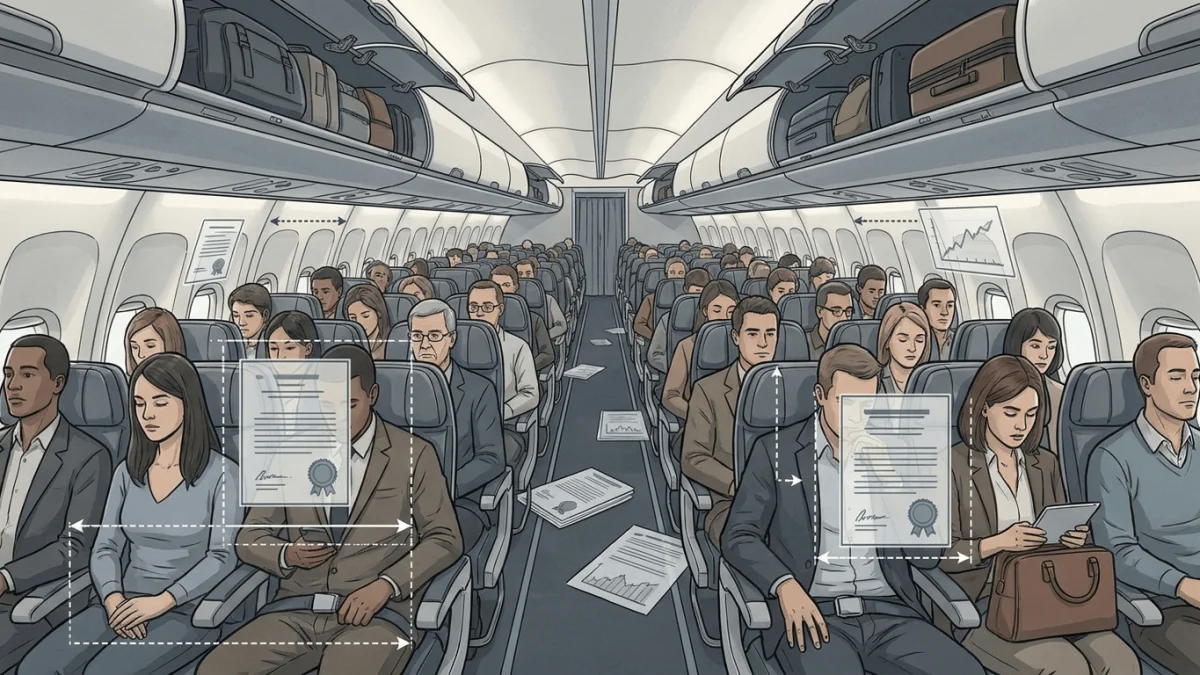
If you have heard that the Federal Aviation Administration was supposed to establish a minimum size for airline seats—and wondered why economy seats can still be extremely tight—you are remembering correctly.
Congress ordered the FAA in 2018 to establish minimum dimensions for airline passenger seats, including minimum seat pitch, width, and length, when those dimensions are necessary for passenger safety. The deadline was October 2019. Nearly seven years later, the United States still has no universal federal minimum seat pitch, seat width, or seat length for ordinary airline passengers.
What happened in between is more complicated than simply “the FAA ignored Congress.”
The FAA conducted evacuation research, studied hundreds of real-world evacuations, solicited tens of thousands of public comments, and argued that the available evidence did not establish a particular seat dimension as necessary for safe evacuation. A federal appeals court then ruled in 2023 that Congress’s safety language mattered: the FAA could not simply be ordered to create an arbitrary minimum unless a minimum could be shown to be necessary for safety. Congress returned to the subject in 2024 and told the FAA either to begin a rulemaking activity based on the 2018 mandate or explain to Congress why it would not.
As of August 14, 2026, no nationwide numerical minimum has emerged.
And one especially persistent claim needs to be cleared up immediately:
No, 28 inches is not the FAA minimum seat pitch. Twenty-eight inches was one of the configurations the FAA tested. It never became a federal minimum.
Does the FAA have a minimum airline seat size?
Not in the way most passengers mean when they ask the question.
There is no general federal regulation saying that an airline passenger seat must be at least, for example, 17 inches wide or have at least 28, 30, or 31 inches of seat pitch.
Airliner interiors are subject to extensive FAA safety requirements involving approved seats, structural strength, restraints, emergency exits, aisle dimensions, and evacuation capability. Airlines also must publish certain seat-width information on their websites. But those requirements are not the same thing as a nationwide minimum passenger-seat size.
That distinction explains much of the confusion surrounding the “FAA seat-size rule.”
What Congress actually required in 2018
Section 577 of the FAA Reauthorization Act of 2018, signed into law on October 5, 2018, told the FAA that within one year—and after public notice and an opportunity for comment—it was to issue regulations establishing minimum passenger-seat dimensions.
Congress specifically named seat pitch, width, and length.
But the statute contained an important qualifier: the dimensions were to be those necessary for passenger safety.
That phrase eventually became central to the entire dispute.
Congress did not write something like, “The FAA shall require a minimum seat pitch of 30 inches.”
Instead, Congress effectively instructed the FAA to determine scientifically and through rulemaking what minimum dimensions were required for safety—and regulate accordingly.
The statutory deadline was October 5, 2019. The FAA did not issue a final minimum-seat-dimensions regulation by that date.
The fight actually began before Congress acted
The modern federal seat-size dispute predates the 2018 law.
In 2015, the passenger-rights organization FlyersRights petitioned the FAA to establish minimum requirements for commercial airline seat size and spacing. The organization argued that declining seat dimensions, combined with larger passengers, could impede emergency evacuation and potentially create other health and safety problems.
The FAA rejected the petition, pointing partly to evacuation demonstrations and tests that had succeeded with seat pitches as low as 28 or 29 inches.
FlyersRights challenged that decision.
In 2017, the U.S. Court of Appeals for the D.C. Circuit issued an opinion that became famous for opening with a reference to the “Case of the Incredible Shrinking Airline Seat.” The court did not order the FAA to impose minimum dimensions, but it concluded that the agency had not adequately supported its position that shrinking seats posed no evacuation concern. It sent the issue back to the FAA for further consideration.
Congress legislated against that background the following year.
What the FAA did after the 2018 law
One major FAA response was to conduct controlled evacuation research at its Civil Aerospace Medical Institute, or CAMI.
The resulting study, Effects of Airplane Cabin Interiors on Egress I: Assessment of Anthropometrics, Seat Pitch, and Seat Width on Egress, involved 718 people participating in simulated evacuations in a mock aircraft cabin.
The evacuation configurations tested:
Seat pitch: 28, 32, and 34 inches.
Seat width: 16 and 18 inches.
Seat pitch is the distance from a point on one seat to the corresponding point on the seat in front of it. It is frequently used as a rough measure of passenger space, but it is not identical to legroom. A thin modern seat and a thick older seat can have the same pitch while providing different usable space between them.
That turns out to matter considerably.
What did the FAA airline-seat evacuation test actually show?
Within the dimensions it tested, the FAA researchers found no statistically significant effect of seat pitch or seat width on evacuation time.
In other words, the mock-cabin evacuations did not demonstrate that moving from 34 inches of pitch to 32 inches or 28 inches—or between 18- and 16-inch-wide seats—meaningfully slowed the evacuation under the study conditions.
That finding became one of the strongest pieces of evidence against the idea that the FAA could simply pick a number such as 30 or 31 inches and declare everything smaller inherently unsafe.
But it did not mean that the FAA proved seats can shrink indefinitely without safety consequences.
The same research examined physical fit. Six of 775 recruited participants—less than 1 percent—could not fit into the mock-up at the 28-inch configuration. When researchers considered a still-tighter 26-inch configuration, 62 of the 775 participants, or about 8 percent, either could not fit or reported that they could not fit. The full evacuation experiments themselves were not conducted at 26-inch pitch.
The report therefore recognized something fairly intuitive: eventually, reducing usable space between seats reaches a point where some people physically cannot occupy or leave the space normally.
The difficult regulatory question is where that point becomes a safety threshold for the flying public as a whole.
Why the FAA study did not prove that 28-inch pitch is “safe”
This is where many summaries of the controversy become misleading.
The CAMI study did not establish 28 inches as an FAA-approved universal safety minimum.
First, 28 inches was merely the smallest seat pitch used in the evacuation trials. The experiment therefore could not demonstrate whether 27 inches, 26 inches, 25 inches, or some other configuration would begin producing significant evacuation delays.
Second, the FAA itself acknowledged an important limitation in its 2022 report to Congress: the testing relied on able-bodied adult participants under age 60, consistent with the human-testing standards being used. That meant the results were useful, the agency said, but were not necessarily definitive for the entire passenger population.
Children, many elderly passengers, and people with disabilities were not adequately represented.
Third, the simulation was designed to isolate cabin-interior effects. A real aircraft emergency can involve smoke, darkness, fire, injuries, damaged exits, luggage, panic, unusual aircraft attitudes, blocked aisles, passengers assisting other passengers, and numerous other factors not recreated simultaneously in a controlled experiment.
And fourth, seat pitch itself is an imperfect measurement.
The FAA researchers discussed a measurement known as “Dimension A”—essentially the usable space between seats. Two aircraft can theoretically have identical seat pitch while providing passengers with different actual clearance because the seats have different thicknesses and shapes.
So even if researchers had identified a precise problematic pitch, regulating pitch alone might not perfectly regulate the space passengers actually have to maneuver.
What about the FAA’s 90-second evacuation rule?
Another common misunderstanding is that every commercial airplane must somehow prove that every real emergency can be evacuated within 90 seconds.
FAA regulations do contain a 90-second evacuation certification standard. For applicable transport-category aircraft, the maximum passenger seating capacity must be demonstrated as capable of evacuation under specified simulated emergency conditions within 90 seconds.
But the FAA explicitly says this is a standardized certification benchmark, not a promise that every real aircraft emergency will be completely evacuated within 90 seconds.
Real emergencies are far less controlled.
Seat size matters to the FAA in this debate because excessively restrictive seating could theoretically make it harder for passengers to stand, reach an aisle, or move toward exits. But the agency’s research suggested that, within the configurations tested, the principal bottleneck could occur farther downstream—for example, where passengers queue in aisles and at exits—rather than during the fraction of time required to get out of a seat.
That helps explain why reducing pitch within the tested range did not produce the dramatic change in overall evacuation times that might seem intuitive.
The FAA finally asked the public in 2022
On August 3, 2022—almost three years after the original congressional deadline—the FAA formally published a Request for Comments on Minimum Seat Dimensions Necessary for Safety of Air Passengers.
The agency specifically asked for evidence concerning seat width, seat pitch, seat length, and other dimensions that might demonstrably affect passenger safety or delay evacuation.
The FAA also explicitly requested information addressing populations underrepresented in the CAMI experiment, including children, people over 60, and individuals with disabilities.
And the agency drew another important boundary: it was primarily asking about safety, not whether airline seats were comfortable or convenient.
That distinction can feel artificial to a passenger whose knees are pressed against the seat in front of them. Legroom, comfort, accessibility, personal space, and safety can overlap.
Legally, however, they are not interchangeable.
Section 577 was tied to the FAA’s safety authority. The agency therefore needed a defensible safety basis for whatever number it selected.
Then the courts changed how the mandate was understood
While that process was underway, FlyersRights asked the D.C. Circuit to force the FAA to complete the seat-size regulation.
In March 2023, the court declined.
The decision is crucial to understanding why there still is no FAA minimum seat size.
The court read Congress’s 2018 statute to mean that the FAA was required to establish minimum dimensions if those dimensions were necessary for safety. The judges did not interpret the law as requiring the agency to select a numerical minimum simply for the sake of having one.
At that point, the court concluded, FlyersRights had not established a “clear and indisputable” safety necessity sufficient for the extraordinary remedy of ordering the FAA to act.
The FAA told the court that its testing and review of nearly 300 real-world evacuations had not revealed a compelling relationship between seat dimensions and evacuation times within the relevant range.
The court did not decide that shrinking airline seats can never become unsafe.
It expressly left room for evidence to change the analysis.
What it rejected was the proposition that the existing record clearly required a particular minimum dimension.
That transformed what sounds like a simple mandate—“Congress told the FAA to set a minimum”—into a much harder regulatory problem:
What scientifically supportable number can the FAA prove is necessary for safety?
Why didn’t the FAA just make 28 inches the minimum?
Because its own evidence did not establish 28 inches as the dividing line between safe and unsafe.
The research showed that the tested evacuations worked at 28 inches. That is evidence about 28 inches. It does not logically establish that 27 inches fails, or that every seat design at 28 inches provides equivalent usable space.
Nor did the FAA’s study establish that 28 inches works equally well for every passenger demographic and every emergency scenario.
A regulatory minimum normally needs a defensible explanation for why the line is drawn there rather than somewhere else.
That evidentiary problem—not simply airline comfort preferences—is at the center of why the expected nationwide number never materialized.
Congress came back in 2024
Congress apparently was not satisfied with where things stood.
The FAA Reauthorization Act of 2024, signed May 16, 2024, addressed seat dimensions again.
Section 519 instructed the FAA that, within 60 days, it had to do one of two things: initiate a rulemaking activity based on the 2018 seat-dimensions provision, or, if the agency decided not to pursue such a regulation, brief the appropriate congressional committees on its justification.
That language is revealing.
The 2024 Congress did not simply impose a numerical minimum itself. Nor did it order the FAA to publish a final rule within 60 days.
Instead, it effectively forced the agency to choose between continuing down the regulatory path and explaining to lawmakers why it would not.
That is substantially different from headlines suggesting Congress ordered the FAA to make seats larger.
So where does the FAA minimum seat-size rule stand in 2026?
For passengers, the practical answer remains straightforward:
There is still no universal federal minimum airline seat pitch, width, or length in force as of August 14, 2026.
The current Part 121 regulations require airlines with websites to disclose the narrowest and widest passenger-seat widths in each class of service for each aircraft make, model, and series they operate. But that provision exists primarily to help travelers determine whether child-restraint systems will fit. It does not establish a minimum passenger seat width.
The FAA also regulates passenger aisle widths. For transport-category airplanes seating 20 or more passengers, for example, the required aisle is generally at least 15 inches wide below 25 inches from the floor and 20 inches wide at or above that height. Again, those are aisle dimensions, not minimum seat dimensions.
Our review of the current federal regulations and FAA/Federal Register rulemaking record found no subsequently published rule establishing the numerical seat-pitch, seat-width, and seat-length minimums contemplated in Section 577.
There is one caveat worth making explicit: the 2024 law allowed the FAA either to initiate a “rulemaking activity” or brief Congress on why it would not proceed. A congressional briefing need not necessarily produce the kind of easily identifiable public rulemaking document that an NPRM or final rule would. The public materials reviewed for this article therefore establish confidently that no numerical nationwide minimum has become law, but they do not justify claiming that the FAA simply ignored the 2024 requirement altogether.
What about the FAA rulemaking happening in 2026?
There is a separate FAA rulemaking currently underway that could create additional confusion.
On June 26, 2026, the FAA published a major proposed rule called Transport Airplane and Propulsion Certification Modernization, with comments currently due August 25, 2026. It proposes broad changes to Part 25 aircraft-certification standards and includes cabin-interior provisions.
That is not the long-awaited rule establishing nationwide numerical minimum airline seat pitch, width, and length under the 2018 mandate.
It is a much broader aircraft-certification modernization project. Travelers seeing a 2026 FAA proposal involving cabin arrangements should therefore not assume that the agency has finally proposed the missing minimum-seat-size rule.
Can airlines legally keep shrinking seats?
There is no single federal number that answers that question.
An airline cannot arrange its cabin however it wants. Aircraft configurations still must comply with applicable FAA certification, structural, restraint, aisle, exit, and evacuation requirements.
But there is presently no general federal rule saying passenger seats may not fall below a specified seat pitch or width simply because that dimension itself is below the federal minimum.
That is the regulatory gap Congress attempted to address in 2018.
It remains a gap in 2026.
Why this debate is harder than “airline seats are too small”
There are really several different questions hiding inside the airline-seat controversy.
Is a seat comfortable? Is it humane for a long flight? Can a large passenger reasonably occupy it? Is it accessible to passengers with mobility limitations? Does restricted movement raise health concerns? And, finally, does the configuration prevent passengers from evacuating an aircraft safely?
Those questions can overlap, but they do not necessarily produce the same minimum dimension.
The 2018 congressional mandate placed the FAA squarely in the last category: safety.
The FAA’s testing then failed to identify a clear evacuation penalty within the dimensions it examined. Its own research also revealed limitations that prevent those results from being treated as the final word for every passenger. And the D.C. Circuit subsequently held that the statutory safety requirement could not simply be skipped because a numerical minimum would be desirable for other reasons.
That combination explains much more of the delay than either of the two simplistic narratives—that “Congress already made 28 inches the minimum” or that “the FAA proved tiny seats are perfectly safe.”
Neither is correct.
The bottom line
Congress really did order the FAA in 2018 to establish minimum passenger-seat dimensions tied to safety. The FAA did not produce the nationwide numerical rule many people expected.
Instead, the agency conducted evacuation research. Within the ranges tested—28 to 34 inches of seat pitch and 16 to 18 inches of seat width—it found no statistically significant evacuation-time effect. But the research had important limitations and did not establish how far seats could shrink before safety would measurably deteriorate.
In 2023, a federal appeals court held that the FAA could not be compelled to choose a number without a demonstrated safety necessity under the wording Congress had used. Congress responded in 2024 by directing the FAA either to initiate rulemaking based on the 2018 provision or explain its decision not to do so.
So if you are searching for the FAA minimum airline seat size, minimum airplane seat width, or minimum airline seat pitch in the United States, the answer as of August 2026 is:
There isn’t one universal numerical minimum. And 28 inches is not the federal minimum—it is a number the FAA tested.
That is what happened to the FAA’s long-awaited airline seat-size rule.
References and Further Reading
-
FAA Reauthorization Act of 2018, Public Law 115-254 — The primary statutory source. Section 577 contains Congress’s original direction to establish safety-based minimum passenger-seat dimensions, including pitch, width, and length.
-
Flyers Rights Education Fund, Inc. v. Federal Aviation Administration, 864 F.3d 738 (D.C. Cir. 2017) — The pre-2018 “shrinking airline seat” case in which the D.C. Circuit found the FAA had inadequately supported parts of its rejection of a seat-size rulemaking petition.
-
FAA Civil Aerospace Medical Institute — Effects of Airplane Cabin Interiors on Egress I: Assessment of Anthropometrics, Seat Pitch, and Seat Width on Egress — The central FAA experimental study of seat pitch, seat width, passenger anthropometrics, and mock-cabin evacuation performance.
-
FAA Report to Congress — Aircraft Cabin Evacuation Standards, March 31, 2022 — Combines the FAA’s evacuation analysis with the work of the Emergency Evacuation Standards Aviation Rulemaking Committee and discusses the limitations of the CAMI passenger sample.
-
Emergency Evacuation Standards Aviation Rulemaking Committee Final Report — FAA-hosted record of the committee that reviewed emergency evacuation certification and nearly 300 real-world evacuation events.
-
Federal Register — Request for Comments in Minimum Seat Dimensions Necessary for Safety of Air Passengers (Emergency Evacuation), 87 FR 47494 — The FAA’s August 2022 public request for evidence on minimum seat pitch, width, length, and other dimensions under Section 577.
-
In re Flyers Rights Education Fund, Inc., No. 22-1004 (D.C. Cir. 2023) — The key 2023 decision interpreting the 2018 mandate’s “necessary for safety” language and declining to compel an immediate seat-size rule on the existing record.
-
FAA Reauthorization Act of 2024, Public Law 118-63 — Section 519 required the FAA within 60 days to initiate rulemaking activity based on the 2018 seat-dimensions provision or brief Congress on its justification for not pursuing the regulation.
-
14 CFR § 121.311 — Seats, Safety Belts, and Shoulder Harnesses — Current operating regulation covering passenger seats and the airline website seat-width disclosure requirement. It does not impose a universal numerical minimum passenger-seat width or pitch.
-
14 CFR § 25.815 — Width of Aisle — Current FAA minimum aisle-width requirements, useful for distinguishing dimensions the FAA already regulates numerically from the unresolved passenger-seat issue.
-
Federal Register — Transport Airplane and Propulsion Certification Modernization, 91 FR 38878 (2026) — A current 2026 Part 25 certification proposal involving numerous aircraft and cabin standards. It should not be confused with a rule establishing the universal passenger-seat minimums contemplated by Section 577.
Editorial note: FAA regulations and pending rulemakings can change. This article reflects the federal statutes, regulations, FAA materials, and publicly identifiable rulemaking record available through August 14, 2026. If the FAA subsequently proposes or finalizes minimum passenger-seat dimensions, the current-status sections should be updated.