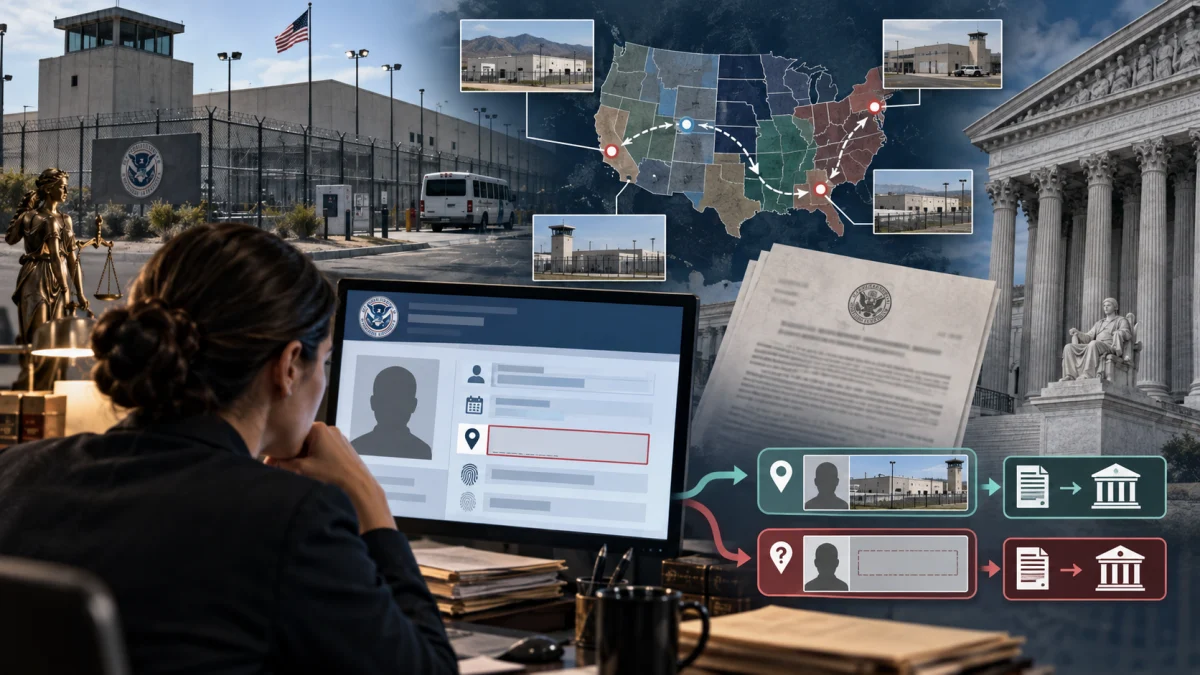
U.S. Immigration and Customs Enforcement reportedly stopped displaying the locations of most detainees with final removal orders in its public Online Detainee Locator System on September 15, 2026.
That change matters for more than family members trying to find someone.
In a traditional federal habeas corpus case challenging a person’s present physical detention, the general rule is that the petition is filed against the person’s immediate custodian in the federal district where the person is confined. In other words, where the government is physically holding someone can help determine which federal court can hear the detention challenge.
But an important qualification has been lost in some of the commentary surrounding the ICE change: making a detainee difficult to locate does not automatically eliminate habeas corpus. Moving someone after a properly filed habeas petition generally does not erase the original court’s jurisdiction, and federal courts have recognized special rules for situations in which the government makes a detainee’s location or custodian genuinely unknowable.
The result is more complicated, and more consequential, than either "this is just a database change" or "ICE can defeat habeas simply by moving people."
The new policy removes public access to information that can have practical and sometimes jurisdictional importance at precisely the stage when a person’s removal may be imminent.
What ICE changed on September 15
The Associated Press investigation published September 21 reported that ICE stopped publicly displaying most detainees with final orders of removal in its Online Detainee Locator System, or ODLS, beginning September 15.
AP based that finding on three current or former ICE officials familiar with the change. Immigration lawyers separately told AP that clients with final removal orders had abruptly vanished from the database, and the American Immigration Lawyers Association had already issued a September 18 practice alert saying members were reporting the same problem.
ICE did not publicly announce the policy. According to AP, the agency did not confirm or deny the change when asked, although it said people with final removal orders were being prioritized for deportation.
AP also reported several court-created exceptions. Detainees at certain facilities in Adelanto, California; Minneapolis; New York City; and suburban Chicago continued to be covered by judicial orders requiring ICE to place detainees into the locator system promptly.
The change potentially affects thousands of people. AP reported that nearly 16,000 people booked into ICE detention in July had final removal orders, based on ICE data obtained by the Deportation Data Project. That number should not be read as evidence that exactly 16,000 people disappeared from the locator on September 15. It shows the scale of the population potentially affected.
The Washington Post subsequently reported an additional restriction: according to two former Homeland Security officials briefed on the policy, immigration officers were also instructed not to disclose affected detainees’ locations to attorneys or relatives by telephone. ICE has not publicly released a directive establishing the precise scope or wording of that rule.
That distinction matters. The database change is strongly corroborated by reporting and practitioner experience. The exact internal policy document, its legal rationale, and all of its operational exceptions were not publicly available as of publication.
ICE itself has described the locator as a tool for lawyers and families
The legal significance of ODLS is easier to understand by looking at what ICE and DHS previously said the system was supposed to accomplish.
A July 2025 Department of Homeland Security Privacy Impact Assessment for ODLS described the system as a public tool allowing family members, legal representatives, and other members of the public to determine whether someone is in ICE or Customs and Border Protection detention and obtain information necessary to locate that person.
ICE’s own Attorney Information and Resources page likewise directs lawyers to ODLS when trying to locate detained clients. ICE has long warned that not everyone will immediately appear in the database and tells attorneys to contact the relevant field office if a detainee cannot be found.
An ICE informational brochure describes the system’s origins even more directly: before ODLS, determining where someone was detained generally required contacting an ICE Enforcement and Removal Operations office. The system was introduced as part of detention reform so attorneys and family members could locate detainees more easily.
So this is not merely a public-relations database that happens to display addresses.
ICE has itself treated the locator as part of the practical infrastructure through which lawyers and families find people in federal immigration custody.
Why physical location matters in habeas corpus
The key legal rule comes from the U.S. Supreme Court’s 2004 decision in Rumsfeld v. Padilla.
For an ordinary habeas petition challenging someone’s present physical custody, the Supreme Court held that the proper respondent is generally the person’s "immediate custodian," usually the official directly responsible for the facility where the person is held.
The Court also reaffirmed the traditional "district of confinement" rule: habeas petitions seeking release from physical custody are ordinarily brought in the federal district where the person is confined. Read Rumsfeld v. Padilla at the Supreme Court
The underlying federal statute, 28 U.S.C. §2241, authorizes federal courts to issue habeas relief "within their respective jurisdictions." Read 28 U.S.C. §2241
That means a detainee’s location is not merely logistical information.
It can help determine the proper federal courthouse and the proper government official to name in a detention challenge.
This is why lawyers sometimes preserve a screenshot or printout from ICE’s locator when preparing an emergency habeas petition. The location shown can help establish where the person was detained when the petition was filed.
What happens if ICE transfers someone before habeas is filed?
This is where the law becomes considerably more complicated than the viral version of the story.
If the attorney knows the detainee has already been moved to another state before the petition is filed, the general district-of-confinement rule may point to the federal district covering the new detention facility.
That can require finding counsel admitted in another federal district, arranging local representation, or asking a court to transfer a case filed in the wrong place.
But if the detainee’s location is genuinely unknowable, the Supreme Court has acknowledged that mechanically applying the immediate-custodian rule becomes impossible.
Recent immigration cases have turned that narrow principle into an increasingly important doctrine.
The "unknown custodian" problem
In Padilla, the Supreme Court noted a special problem that arises when a prisoner is held at an undisclosed location by an unknown custodian.
That scenario became central in the 2025 litigation involving Tufts University doctoral student Rümeysa Öztürk.
ICE arrested Öztürk in Massachusetts and rapidly transported her through multiple states before taking her to Louisiana. Her attorneys filed an emergency habeas petition while trying to determine where the government was physically holding her.
In Öztürk v. Hyde, the U.S. Court of Appeals for the Second Circuit rejected the government’s argument that her petition failed because counsel had not named the correct immediate custodian.
The government had not identified who actually exercised immediate custody over Öztürk while she was in transit. The Second Circuit reasoned that either the official her lawyers named was the relevant custodian or the true custodian remained unknown. The court would not allow that uncertainty, created during the government’s transport of the detainee, to eliminate the habeas proceeding.
The case is important because it shows what the law does not say.
It does not say that a detainee becomes temporarily unreachable by federal courts whenever the government moves that person between facilities.
Courts were already confronting locator failures before the September policy
The new September 15 policy did not create the underlying problem.
Federal courts were already deciding cases in which ICE transferred detainees while ODLS provided incomplete, delayed, or unusable location information.
Cayamcela Caceres v. Mullin
In a July 2026 Eastern District of New York case, ICE moved Juan Gabriel Cayamcela Caceres from New York to New Jersey on the same day his attorney filed a habeas petition.
At the time, the ICE locator listed his detention center simply as "Call ICE for details."
The court held that the unknown-custodian exception applied because counsel could not determine the actual district of confinement from the information available when the petition was filed. His later detention in New Jersey therefore did not deprive the New York court of jurisdiction.
The court ultimately denied his habeas petition on other grounds, an important reminder that establishing jurisdiction does not mean the petitioner automatically wins the underlying case. Read Cayamcela Caceres v. Mullin
Martinez Cachiguango
A Minnesota federal court confronted a similar problem in February 2026.
The petitioner’s attorney did not know the client’s current location, and ICE’s locator displayed only "Call ICE For Details."
The court applied the unknown-custodian exception, retained jurisdiction rather than transferring the case, and ultimately granted the habeas petition and ordered the petitioner’s release. Read Martinez Cachiguango v. Pamela
Duton Bueno
Another Minnesota decision shows the other side of the doctrine.
In Duton Bueno, the attorney knew that the detainee was already being held in New Mexico when the petition was filed.
The Minnesota court therefore concluded that the unknown-custodian exception did not apply and transferred the habeas case to the District of New Mexico.
The judge nevertheless wrote that ICE’s use of locator entries such as "Call ICE For Details" in other cases was "deeply concerning" because it could make habeas proceedings more difficult.
What mattered legally in Duton Bueno was that this particular lawyer actually knew the client’s location. Read Duton Bueno v. Noem
That comparison is important.
The unknown-custodian doctrine is a safeguard for genuine uncertainty. It is not a general right to choose whichever federal district is most favorable.
What happens if ICE moves someone after habeas is filed?
Another common oversimplification is that ICE can simply move a detainee after a habeas petition is filed and thereby destroy the case.
That is generally not how the rule works.
Where jurisdiction properly existed when a habeas petition was filed, a later transfer does not ordinarily strip the original court of jurisdiction. The Second Circuit relied on that principle in Öztürk.
But this also requires a second distinction:
A court retaining jurisdiction after a transfer is not the same thing as ICE being automatically prohibited from transferring the person.
Courts can issue specific orders restricting transfer when necessary to preserve their jurisdiction or proceedings. Federal courts have done so in immigration cases. But merely filing a habeas petition should not be described as creating an automatic nationwide no-transfer order.
Those are two different legal questions:
- Does the original court keep jurisdiction after a transfer?
- Has the court separately prohibited the government from transferring the detainee?
Conflating them makes the legal situation sound simpler than it is.
Which immigration remedies actually depend on location?
This distinction is central to understanding the September locator change.
Not every legal challenge available to someone in immigration custody is a habeas petition, and not every immigration remedy depends on where ICE happens to be holding the person.
| Legal issue | Typical forum | Does current detention location matter? |
|---|---|---|
| Challenge to present physical detention under 28 U.S.C. §2241 | Federal district court | Usually yes. The immediate-custodian and district-of-confinement rules generally apply, subject to exceptions. |
| Judicial review of a final removal order | Federal court of appeals | Not in the same way. Venue generally follows the judicial circuit where the immigration judge completed the proceedings. |
| Motion to reopen or reconsider immigration proceedings | Immigration court or Board of Immigration Appeals, depending on posture | Generally not determined by the detention facility. |
| Request for a stay of removal | Depends on the proceeding and authority being asked | Fact-specific. A stay is not simply determined by detention geography. |
| Attorney-client communication and evidence gathering | Detention facility and legal team | Practically very important. Counsel generally must know where the client is to arrange communication and visitation. |
The distinction between habeas review and review of the removal order itself is especially important.
Habeas is not the normal way to challenge the removal order itself
Federal law channels judicial review of a final removal order primarily through a petition for review in a federal court of appeals, not through an ordinary §2241 petition in district court.
Under 8 U.S.C. §1252, a petition for review generally must be filed within 30 days of the final removal order and is filed in the court of appeals for the judicial circuit where the immigration judge completed the proceedings. The statute describes a petition for review as the sole and exclusive means of judicial review of the removal order, subject to statutory exceptions. Read 8 U.S.C. §1252
That produces an important factual correction:
It is too broad to say that hiding a detainee’s location makes it impossible to challenge the deportation order.
A final-order challenge in the court of appeals operates under a different jurisdictional structure.
What location opacity can directly complicate is a challenge to physical detention, along with the practical ability of an attorney to locate the client, communicate with the client, obtain facts and signatures, determine what ICE is doing, and seek emergency relief before removal occurs.
A final removal order does not necessarily mean every legal avenue is over
The September policy reportedly applies specifically to people with final orders of removal.
That procedural status matters.
Under 8 U.S.C. §1231, when a removal order becomes administratively final, federal law generally establishes a 90-day "removal period" during which the government is directed to carry out the removal, subject to statutory rules and exceptions. Read 8 U.S.C. §1231
But "final removal order" does not mean that every possible legal remedy has necessarily disappeared.
Depending on the facts and procedural history, a person may still be pursuing or eligible to pursue a petition for review, motion to reopen, motion to reconsider, stay request, protection claim, detention challenge, or another form of relief.
Those avenues can also have strict deadlines and procedural restrictions.
For example, the Justice Department’s current EOIR guidance on motions to reopen states that filing a motion to reopen with the Board does not ordinarily create an automatic stay of removal. Separate stay procedures may therefore become crucial when removal is imminent, although particular categories have their own rules and exceptions.
That is one reason speed matters.
A legal remedy that exists on paper may be much harder to use effectively when an attorney cannot determine where the client is or what ICE is preparing to do.
Why habeas litigation has become much more important since 2025
There is a second immigration detention controversy that is related to this story but should not be confused with it.
Beginning in 2025, the federal government adopted a much broader interpretation of mandatory detention for certain people apprehended inside the United States who had entered without formal admission.
The Board of Immigration Appeals adopted that interpretation in Matter of Yajure Hurtado, holding that immigration judges lacked authority to grant bond to people covered by its interpretation of 8 U.S.C. §1225(b)(2)(A).
Notably, the BIA acknowledged that immigration judges had conducted bond hearings for this population for years and cited the government’s earlier position that such people were bond-eligible.
The change generated extensive habeas litigation.
By July 2026, the Ninth Circuit described a substantial split among the federal appellate courts. The Fifth and Eighth Circuits had sided with the government’s broader mandatory-detention interpretation, while the Second, Sixth, Tenth, Eleventh and Ninth Circuits had rejected it; the Seventh Circuit had issued a divided decision without a majority on the statutory question. Read Rodriguez Vazquez v. Bostock
That litigation helps explain why habeas corpus has become increasingly visible in immigration detention cases.
But it involves a crucially different population.
The mandatory-detention dispute largely concerns people whose removal proceedings are still pending.
The September 2026 ODLS change reported by AP concerns detainees who already have final removal orders.
The two developments are related through the broader importance of immigration habeas litigation. They are not the same policy and should not be treated as though one automatically caused the other.
Does the locator change make habeas impossible?
No.
That formulation goes farther than the law supports.
A more accurate answer is:
The policy can make habeas litigation harder because a detainee’s physical location may determine the appropriate court and custodian. But federal law contains mechanisms for dealing with transfers, genuinely unknown custodians, and post-filing moves.
Recent cases demonstrate all three possibilities:
- A court may retain jurisdiction where counsel genuinely could not identify the custodian or detention district.
- A court may transfer a case when the detainee’s actual location was known at filing.
- A properly established habeas case does not ordinarily disappear merely because ICE later transfers the detainee.
Those protections matter.
But requiring attorneys to invoke exceptions, reconstruct transfer timelines, call field offices, seek emergency orders, or litigate jurisdiction is not equivalent to having accurate location information available through a public system in the first place.
That difference is the practical consequence of the September policy.
What about claims that ICE is "disappearing" people?
There are two different meanings being collapsed into the same word.
In an ordinary descriptive sense, affected detainees have disappeared from ICE’s public locator. Lawyers quoted by AP and the Washington Post have described losing track of clients after the change. That is documented reporting.
"Enforced disappearance," however, is also a specific term in international human-rights law with additional legal elements.
The currently public evidence concerning ODLS is not enough, by itself, to establish that every detainee removed from the database meets that legal definition.
Similarly, there is not yet public evidence establishing that ICE adopted the September 15 policy for the specific purpose of preventing habeas petitions.
The legal consequences can be analyzed without claiming knowledge of an intent that has not been documented.
What can be established is narrower and still significant:
- ICE reportedly stopped publishing the detention locations of most people with final removal orders.
- DHS has previously described ODLS as a system designed to help attorneys and families locate detained people.
- Traditional physical-custody habeas doctrine often makes the place of confinement legally important.
- ICE frequently transfers detainees between facilities and federal judicial districts.
- Federal courts were already encountering habeas cases in which lawyers could not determine their clients’ locations from ICE’s locator.
- Courts have developed doctrines to prevent genuine location uncertainty from automatically extinguishing access to habeas review.
Those propositions do not require speculation.
The court cases show why the distinction matters
The easiest way to understand the law is to compare recent cases.
| Case | Location information | What mattered | Result on jurisdiction |
|---|---|---|---|
| Öztürk v. Hyde | Custodian uncertain while detainee was rapidly transported | Government could not identify a different immediate custodian at filing | Habeas case allowed to proceed |
| Cayamcela Caceres v. Mullin | ODLS said "Call ICE for details" during transfer from New York to New Jersey | Counsel reasonably could not identify detention district at filing | Unknown-custodian exception applied |
| Martinez Cachiguango | Current location unknown; locator said "Call ICE For Details" | Court found detention location genuinely unknowable | Court retained jurisdiction |
| Duton Bueno | Counsel knew detainee was in New Mexico | Location was not genuinely unknown | Minnesota court transferred case to New Mexico |
The pattern is more useful than any single anecdote.
Federal courts are not treating location as irrelevant, but they are also not allowing every ICE transfer to become an automatic jurisdictional escape hatch.
The legal question frequently turns on what was known, or reasonably knowable, when the petition was filed.
What the new ICE policy actually changes
ICE’s September locator change does not repeal habeas corpus.
It does not automatically prevent a person with a final removal order from seeking every available form of judicial review.
It does not mean that a transfer after a habeas filing automatically destroys the case.
And the currently available evidence does not establish that the policy was adopted specifically to defeat federal court review.
What it does remove is much simpler:
a government-provided method of quickly determining where many people in federal immigration custody are being held.
For family members, that affects the ability to locate and communicate with someone in detention.
For lawyers, it can affect client communication, emergency case preparation, and, in some physical-custody habeas cases, the ability to determine immediately which federal district and custodian are legally relevant.
Federal courts have tools for dealing with unknown custodians and rapidly transferred detainees. But those tools themselves require litigation, factual investigation, attorney time and judicial intervention.
For someone who may be removed from the United States quickly, that difference can matter even when a legal remedy technically remains available.
That is why the change to ICE’s detainee locator is more than a database-policy story.
It intersects directly with a basic feature of habeas corpus: before a court can review whether the government may lawfully hold a person, it often matters where the government is holding that person.
References and Further Reading
Primary Law and Government Records
Rumsfeld v. Padilla, 542 U.S. 426 (2004) – U.S. Supreme Court
The principal Supreme Court authority on the immediate-custodian and district-of-confinement rules for habeas petitions challenging present physical custody.
28 U.S.C. §2241 – Federal Habeas Corpus Statute
Sets out federal courts’ statutory authority to issue writs of habeas corpus.
8 U.S.C. §1252 – Judicial Review of Removal Orders
Establishes the petition-for-review system for final removal orders, including the court-of-appeals venue rule and limitations on district-court habeas review of the removal order itself.
8 U.S.C. §1231 – Detention and Removal After a Final Removal Order
Governs the removal period and detention framework after an order of removal becomes administratively final.
DHS Privacy Impact Assessment for the Online Detainee Locator System, July 2025
DHS’s own description of ODLS, its purpose, and the intended use of the system by family members, lawyers, and the public.
ICE Attorney Information and Resources
ICE guidance directing attorneys to use ODLS to locate clients and explaining what to do when a detainee cannot be found through the system.
Matter of Yajure Hurtado, 29 I&N Dec. 216 (BIA 2025)
The BIA decision adopting the government’s broader interpretation of mandatory detention under §1225(b)(2)(A), a separate issue that generated extensive habeas litigation.
EOIR Policy Manual: Motions to Reopen
Explains motions to reopen before the Board of Immigration Appeals and clarifies that they generally do not automatically stay removal.
Federal Court Decisions on Transfers and Unknown Custodians
Öztürk v. Hyde, U.S. Court of Appeals for the Second Circuit (2025)
A major recent appellate decision addressing habeas jurisdiction while ICE rapidly transferred a detainee whose immediate custodian was uncertain.
Cayamcela Caceres v. Mullin, E.D.N.Y. (2026)
Applied the unknown-custodian doctrine where ICE’s locator displayed "Call ICE for details" during a same-day interstate transfer.
Martinez Cachiguango v. Pamela, D. Minn. (2026)
A federal habeas decision retaining jurisdiction where counsel could not determine the detainee’s current location and ODLS did not identify a facility.
Duton Bueno v. Noem, D. Minn. (2026)
Provides a useful contrast: the court transferred the case because counsel actually knew the detainee was in New Mexico when the petition was filed.
Rodriguez Vazquez v. Bostock, Ninth Circuit (2026)
Explains the 2025 change in the government’s mandatory-detention interpretation and summarizes the resulting federal circuit split as of July 30, 2026.
Current Reporting
Associated Press: ICE Hides Locations of Thousands of Detainees With Final Removal Orders
The September 21 report establishing the September 15 locator change based on three current and former ICE officials, attorney reports, and detention data.
American Immigration Lawyers Association: Practice Alert on Final-Order Cases Disappearing From ODLS
Documents reports from AILA members beginning in mid-September that people with final removal orders were no longer appearing in the locator.
Washington Post: Immigrants With Final Deportation Orders Disappear From ICE Detainee Locator
Adds reporting that officers were also instructed not to provide affected detainees’ locations to attorneys and relatives by telephone, according to two former DHS officials briefed on the change.
Editorial currency note: Immigration detention law and the September 2026 ODLS policy are developing rapidly. The locator policy had not been accompanied by a publicly available ICE directive as of September 21, 2026, and federal appellate courts remain divided over a separate mandatory-detention issue discussed above. This article should be updated if ICE publishes the governing directive or if new federal litigation directly addresses the September 15 locator change.