Arizona did not categorically ban AI victim impact statements. In State v. Horcasitas, the Arizona Court of Appeals held that one particular AI recreation of a deceased victim could not properly be relied on at sentencing because it presented a living family member’s reconstruction of what the victim might have said through the victim’s own face, cloned voice, and generated expressions.
That distinction matters.
Arizona law already gives victims broad freedom at sentencing. Victims may offer evidence, information, and opinions. They are not treated as ordinary witnesses, their statements are not subject to cross-examination, and Arizona expressly allows video and other digital media. When the direct victim is killed, a sibling can qualify as a statutory victim.
So the problem in Horcasitas was not simply that the statement was emotional, unsworn, untested by cross-examination, or shown on a screen.
The appellate court identified a narrower problem: authorship and attribution had become blurred.
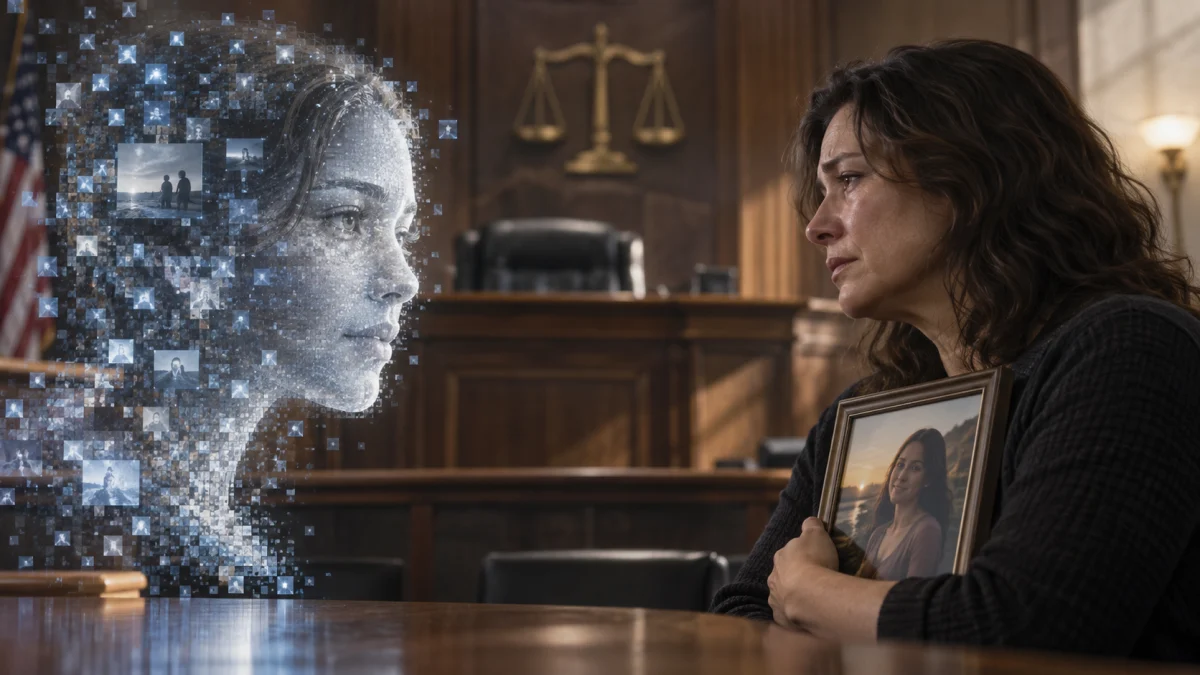
Christopher Pelkey’s sister, Stacey Wales, wrote what she believed her brother would say. The AI presentation then delivered those imagined sentiments as if Pelkey himself were speaking, complete with his likeness, voice, facial expressions, and first-person declarations. The sentencing judge later described Pelkey’s synthetic forgiveness as "genuine" and as coming from his "heart."
The appellate court concluded that the presentation had erased the "interpretive distance" between what Pelkey’s family believed he would have said and what Pelkey himself had actually said.
That is a serious due-process concern. But the decision leaves a harder question open:
If a court knows who wrote the words, knows the presentation is synthetic, and is told to treat it as a survivor’s reconstruction rather than the dead person’s testimony, is AI itself still the constitutional problem?
That question will matter far beyond this Arizona case.
What happened in State v. Horcasitas?
Gabriel Paul Horcasitas shot and killed Christopher Pelkey during a 2021 road-rage confrontation in Arizona. A jury later rejected Horcasitas’s self-defense claim and convicted him of manslaughter, a dangerous offense.
The published September 30, 2026 opinion from the Arizona Court of Appeals affirmed that conviction.
The court did not acquit Horcasitas, reverse the manslaughter verdict, or order a new trial. It vacated only the manslaughter sentence and sent the case back for resentencing.
At the original sentencing hearing, Pelkey’s friends and relatives described him and the damage caused by his death. Several asked for the maximum sentence available on the record. Pelkey’s brother also read a statement Pelkey himself had written before his death describing his beliefs, values, goals, and hopes.
Then Wales addressed the court.
According to the appellate opinion, she explained that her brother was not there to say what he thought and that she constantly imagined what he would have said. She then played an AI-generated video depicting Pelkey speaking to the courtroom.
That sequence is important because the video was not secretly passed off as authentic footage.
The AI video disclosed that it was AI
The synthetic Pelkey opened by explaining that he was a version of Pelkey recreated through artificial intelligence using Pelkey’s image and voice profile.
The presentation also included genuine video of Pelkey discussing his faith and spiritual beliefs.
After that real footage played, the AI recreation returned and described itself as a "true representation" of who Pelkey was. It thanked people who had supported his family, addressed the judge, and addressed Horcasitas directly.
Among the sentiments Wales wrote for the recreation was Pelkey’s supposed forgiveness of the man who killed him.
Detailed NPR reporting from May 2025 documented how Wales developed the script, how her husband and a business partner assembled the video using several AI tools, and how she tried to make the result reflect the brother she remembered.
This was therefore not a conventional deepfake used to trick a court into believing that a dead man had literally recorded a new statement.
Everyone knew Pelkey was dead.
Everyone knew the presentation was AI-generated.
The appellate court ruled against it anyway.
Why the appeals court vacated the sentence
Horcasitas’s defense did not object to the AI video during sentencing. The Court of Appeals therefore reviewed the issue only for fundamental error.
Even under that demanding posture, the three-judge panel found the problem serious enough to require resentencing.
The court began from a principle that strongly favors victim participation. Under the Arizona Victims’ Bill of Rights, victims have a constitutional right to be heard at sentencing.
Under A.R.S. § 13-4426, they may present "evidence, information and opinions" concerning the offense, the defendant, the sentence, or restitution.
But that right is not unlimited.
The appellate court explained that ordinary trial evidence rules are relaxed at sentencing, yet due process still requires information considered by the sentencing court to have at least a minimal level of reliability. A defendant has a constitutional interest in being sentenced on accurate information.
That principle is older than AI. In Townsend v. Burke, the U.S. Supreme Court found a due-process violation where sentencing rested on materially untrue assumptions.
Victim-impact evidence is not unconstitutional merely because it is emotional, either. In Payne v. Tennessee, the Supreme Court rejected a categorical Eighth Amendment bar on victim-impact evidence in capital sentencing while recognizing due process as a backstop against fundamentally unfair prejudice.
The Arizona panel therefore did not ask simply whether the AI video was moving.
It asked whether the information the synthetic Pelkey appeared to communicate was reliable enough to be attributed to Pelkey at all.
The court’s key distinction: the video did not record an actual event
The opinion drew a line between genuine media and generated media.
The authentic clips of Pelkey embedded in the presentation were permissible.
The synthetic portions were not.
The court stressed that the generated material did not document anything Pelkey had actually said or done. Instead, it depicted Pelkey expressing thoughts created from his sister’s imagination about what he would have said.
That is where the opinion introduced its most important concept.
According to the court, the AI presentation erased the "interpretive distance" between the family’s belief about Pelkey and Pelkey’s own voice and opinions.
A family member may say:
I believe Chris would have forgiven him.
But an AI recreation that looks and sounds like Chris can instead communicate:
I forgive him.
Those propositions are related, but they are not identical.
The first identifies the living speaker and the basis of the inference.
The second attributes the belief directly to a person who can no longer confirm, reject, qualify, or contextualize it.
On the appellate court’s reasoning, AI did not merely make the sister’s statement more vivid. It changed who appeared to be making the statement.
The judge’s own words made the appeal much stronger
The court had more than a theoretical concern about attribution.
It had the sentencing judge’s own remarks.
After watching the video, Maricopa County Superior Court Judge Todd Lang said he "loved" the AI presentation and described what he had seen as "genuine." He referred to Pelkey’s "obvious forgiveness" and discussed the family as having allowed Pelkey to speak from his "heart."
Those comments mattered because they suggested that the distinction between:
Wales believes her brother would forgive Horcasitas
and
Pelkey forgives Horcasitas
had not remained purely academic.
The sentencing judge appeared to treat the simulated sentiment as revealing something real about Pelkey himself.
The appellate court therefore found both an attribution problem and evidence that the attribution problem had affected the proceeding.
Did the AI video add 1.5 years to the sentence?
There is no responsible basis to say that.
The prosecutor asked for a slightly mitigated sentence of nine years. Defense counsel asked for seven years. The judge imposed 10.5 years.
Under Arizona’s dangerous-offender sentencing statute, a first dangerous Class 2 felony carries a seven-year minimum, a 10.5-year presumptive term, and a 21-year statutory maximum. But because the State had alleged no aggravating factors in this case, the appellate opinion explains that the presumptive 10.5-year term was the maximum available on the record.
The judge noted that 10.5 years was more than the State had requested.
That makes it tempting to claim the AI video caused the additional 1.5 years.
The Court of Appeals expressly stopped short of that conclusion.
It said the record did not reveal precisely how the AI video factored into the sentencing calculation. The panel found only that there was "no question it played a role."
So the clean distinction is:
Verified: the judge imposed 10.5 years after praising the video.
Verified: prosecutors had requested nine.
Verified: the appellate court found the presentation influenced the sentencing process enough to require resentencing.
Not established: that the AI video itself caused exactly 1.5 additional years.
Arizona victims do not testify like ordinary witnesses
This is where Horcasitas becomes more interesting than the headline "court rejects AI victim statement."
Under A.R.S. § 13-4426.01, a victim exercising the right to be heard at sentencing does not do so as a witness.
The victim is not subject to cross-examination.
Under A.R.S. § 13-4428, a victim may exercise the right to be heard through an oral statement, written statement, audiotape, videotape, or other video or digital media available to the court.
And under A.R.S. § 13-4401, when the direct victim has been killed or incapacitated, the statutory definition of "victim" can include a sibling and other qualifying family members or representatives.
Pelkey’s sister therefore was not merely an outsider asking for special permission to influence the court. She fell within Arizona’s victims-rights framework herself.
That means the decision cannot be reduced to any of these claims:
- victim statements must be sworn;
- victim statements must be cross-examined;
- victim statements cannot contain opinions;
- victim statements cannot be emotional;
- victim statements cannot use video;
- victim statements cannot use digital media.
The constitutional problem arose somewhere else.
So what exactly changed when AI was added?
Consider a series of increasingly synthetic presentations.
A sister tells the judge:
I believe my brother would forgive you.
Then:
If Chris were here, I believe he would say, "I forgive you."
Then she reads a first-person letter she wrote from her brother’s perspective, making clear that it is her reconstruction.
Then an actor reads the same hypothetical letter.
Then an animated illustration reads it.
Then an AI recreation using the dead person’s face and cloned voice reads it.
The underlying idea can remain substantially the same: this is what the survivor believes the deceased would have wanted to say.
But the persuasive form changes.
At some point, the presentation may stop communicating primarily what the survivor believes and begin communicating the apparent proposition that the deceased person himself holds that belief.
That is the line the Arizona court saw Horcasitas as crossing.
The harder question is whether that line should depend on generative AI as such, or on the more specific problem of synthetic attribution.
The strongest argument for the ruling: attribution is part of the message
The appellate court’s reasoning should not be dismissed as judges being uncomfortable with new technology.
A cloned face and voice can do more than decorate a proposition. They can supply identity, apparent intention, emotion, confidence, facial behavior, and other cues that the real person never produced.
In Pelkey’s video, AI created the apparent event of Pelkey addressing his killer, his family, and the judge after years of litigation that Pelkey did not live to see.
A 2026 peer-reviewed article by Graham Meikle and Johanna Sumiala, "Synthetic media and the authority of the dead", examines the Pelkey video as one example of synthetic representations giving deceased people apparent agency in current disputes.
The authors are not announcing a legal rule, and the article predates the appellate decision. But their analysis helps explain the court’s concern: synthetic media can do more than preserve memory. It can stage a dead person as a present participant in a new controversy.
That is materially different from showing a photograph.
The strongest argument against a categorical rule: everyone knew who wrote it
The family nevertheless has a powerful response.
Wales did not claim that Pelkey had recorded the statement before his death.
She explicitly introduced the presentation as her reconstruction of what she imagined he would say.
The synthetic Pelkey itself disclosed that he was recreated through AI.
No one in the courtroom believed a dead man had literally returned to record a new statement.
The State also argued on appeal that Wales and Pelkey had been close, that she believed the sentiments fit his character, and that the AI message was consistent with values reflected in Pelkey’s genuine writings.
The appellate court rejected those arguments because they could establish, at most, that Wales’s inference about her brother may have been reasonable. They could not transform her inference into his actual statement.
That logic is strong.
But the opinion also says "No disclaimer could cure that error."
Read narrowly, that sentence refers to this presentation, which used Pelkey’s face and voice and affirmatively described itself as a true representation of him.
Read broadly, it raises a harder question.
What if every frame carried a notice stating:
Words written by the victim’s sister. The deceased never made this statement.
What if the synthetic figure used conditional language throughout?
What if AI merely read a deceased victim’s authenticated letter verbatim?
Horcasitas does not fully answer those hypotheticals.
A better framework: authorship, attribution, provenance, and judicial use
Courts are likely to encounter AI-assisted victim statements that look nothing like the Pelkey video.
A blanket question such as "Was AI used?" is therefore too crude.
A more useful framework asks four questions.
1. Who authored the substantive words?
There is a major difference between:
- a living victim writing their own words and using an AI voice to read them;
- a deceased victim’s real letter being read by a synthetic voice;
- a family member writing new words they believe the deceased would have used; and
- a generative model extrapolating new beliefs from old material.
AI can participate in all four, but the authorship problem is different in each.
2. To whom are the words attributed?
A survivor saying "I think he would forgive you" preserves attribution to the survivor.
A cloned version of the deceased saying "I forgive you" attributes the proposition to the deceased.
That difference goes directly to the "interpretive distance" the Arizona court found important.
3. What is the provenance?
What authentic material supports the synthetic presentation?
Possible foundations include verbatim writings, authentic recordings, documented statements, family recollections, inference from character, or AI-generated extrapolation with no identifiable human source.
In a different procedural setting, sherafy.com‘s guide to AI evidence in arbitration explains why prompts, outputs, logs, source material, and version history can matter when synthetic output becomes evidence. Criminal sentencing follows different rules, but the provenance problem is similar.
4. How did the decision-maker use it?
This may be the most important factor after Horcasitas.
A judge who says, "I understand this is the sister’s reconstruction," is treating the evidence differently from a judge who describes a generated emotion as the deceased person’s genuine feeling.
In Horcasitas, the appellate court had unusually concrete language showing the latter concern.
Eight AI victim-statement scenarios courts should not treat as identical
The following framework is sherafy.com‘s analysis, not a rule announced by the court.
| Scenario | Who authors the words? | Main reliability concern | Relationship to Horcasitas |
|---|---|---|---|
| Living victim writes a statement and an AI voice reads it | Victim | Voice accuracy and disclosure | Materially different |
| AI translates a living victim’s own statement | Victim | Translation accuracy | Materially different |
| AI restores damaged authentic audio | Victim | Fidelity to original recording | Materially different |
| AI avatar of deceased reads a verbatim authenticated letter | Deceased victim | Whether presentation adds invented expression | Unresolved |
| Survivor says what they believe deceased would have said | Survivor | Basis for survivor’s opinion | Traditional victim-impact issue |
| Actor or animation performs survivor’s hypothetical script with clear attribution | Survivor | Emotional amplification and attribution | Unresolved |
| AI likeness and cloned voice present survivor’s imagined words as the deceased’s own | Survivor | False or blurred attribution | Closest to Horcasitas |
| Synthetic statement is presented as an authentic historical recording | Fabricator/model | Deception and false evidence | Stronger problem than Horcasitas |
This is why Horcasitas should not become shorthand for "AI is banned at sentencing."
The case is better understood as a warning about AI creating apparent personal testimony that never existed.
A 2026 ethics paper reached a similar distinction from another direction
Before the Arizona appellate decision, philosopher Sebastian Jon Holmen published "The ethics of deepfake victim impact statements at sentencing" in AI and Ethics.
The paper uses the Pelkey presentation as its central example and argues against treating every deepfake victim-impact statement as ethically equivalent. Holmen contends that some objections to synthetic victim statements are broader than the underlying concerns justify and that some synthetic presentations could, in particular circumstances, serve legitimate victim-impact functions.
That is an ethical argument, not controlling law.
But it reinforces an important point: the category "AI victim impact statement" is too broad by itself.
An AI system can help a living victim express the victim’s own words.
It can reproduce a deceased person’s authenticated historical words.
Or it can invent new speech for someone who can no longer approve it.
Those uses do not present the same problem.
What if the sister simply reads the same script herself?
This hypothetical is now more than academic.
After the appellate ruling, Wales told ABC News that her family did not regret creating the video and that she was prepared to return for resentencing and read the script herself.
That would sharpen the legal distinction.
If Wales stands before the judge and identifies the words as her own reconstruction of what she believes Pelkey would have said, the apparent speaker is no longer ambiguous.
The court may still regulate victim-impact material that becomes unduly prejudicial or infringes the defendant’s due-process rights, and Horcasitas does not guarantee that every possible formulation of the script must be accepted.
But the central attribution problem identified by the appellate court would be different.
The statement would plainly be:
Wales’s belief about Pelkey.
It would no longer visually and vocally present itself as:
Pelkey’s own new statement.
Did Arizona ban AI victim impact statements?
No.
The Court of Appeals did not announce a categorical rule that artificial intelligence can never assist a victim-impact presentation.
It decided that the AI depiction before it was unreliable because it presented imagined thoughts and generated nonverbal communication as though they came directly from Pelkey.
The court simultaneously held that the genuine footage embedded in the same presentation was permissible.
Arizona statutes also continue to allow victims to use video and other digital media.
The decision therefore leaves many questions open, including:
- AI-assisted translation;
- synthetic reading of a living victim’s own words;
- voice restoration;
- accessibility tools;
- AI avatars created by victims themselves;
- synthetic readings of authenticated writings by deceased victims; and
- clearly attributed reenactments or reconstructions.
Anyone claiming that Horcasitas simply made "AI victim statements illegal" is stating the holding too broadly.
The larger legal issue is attribution
The broader significance of Horcasitas fits a recurring pattern in AI law.
Courts increasingly have to separate:
what a machine technically produced
from
what the law attributes to a human being or organization.
Sherafy.com examined a related attribution problem in Doe v. GitHub and the Ninth Circuit’s ruling on AI code and copyright-management information. The legal issue there was different, but the recurring question is familiar: an AI output does not eliminate the need to identify whose legally significant act, statement, knowledge, or decision is at issue.
The same problem appears in sherafy.com‘s analysis of the OpenAI-Hugging Face lawsuit and AI-agent liability, where an autonomous system performing technical actions does not by itself resolve how those actions should be attributed under the governing law.
Horcasitas brings that problem into criminal sentencing.
The machine can reproduce a face.
It can clone a voice.
It can animate a smile.
What it cannot establish by itself is that the real person adopted the proposition being expressed.
Frequently asked questions
Was Horcasitas’s conviction overturned?
No. The manslaughter conviction was affirmed. The appellate court vacated the manslaughter sentence and remanded the case for resentencing.
Was the AI video presented as authentic footage?
No. Pelkey’s sister introduced the presentation as her conception of what he would have said, and the AI recreation disclosed that it was generated using AI.
The disclosure did not save the presentation because the appellate court found that the video still presented generated words, expressions, and opinions as coming directly from Pelkey.
Are Arizona victim impact statements subject to cross-examination?
Not when victims exercise the statutory right to be heard under A.R.S. § 13-4426.01. Arizona law expressly says the victim is not acting as a witness in that setting and is not subject to cross-examination.
Can Arizona victims use video or digital media?
Yes. A.R.S. § 13-4428 expressly allows oral statements, written statements, audiotape, videotape, or other video or digital media available to the court.
Did the AI video cause the judge to impose 10.5 years instead of nine?
That has not been established. The prosecutor requested nine years and the judge imposed 10.5, but the Court of Appeals said the record did not reveal precisely how the AI video affected the sentencing calculation. It found only that the video unquestionably played a role.
What happens next?
The manslaughter case returns to Maricopa County Superior Court for resentencing.
As of October 11, 2026, ABC News reported that no new sentencing date had been set. Wales said she was prepared to return and read the script herself.
What State v. Horcasitas actually establishes
The easiest lesson from this case is also the least useful one:
AI can be too persuasive for court.
Human testimony, photographs, authentic videos, expert demonstrations, and ordinary victim statements can all be persuasive. Persuasion alone does not make them constitutionally unreliable.
The deeper issue is that synthetic media can obscure who is actually speaking.
The Arizona Court of Appeals had a strong basis for concern on these facts. The video placed newly written words into the mouth of a dead man, added generated nonverbal expression, and was then discussed by the sentencing judge as though the victim’s forgiveness itself had been revealed.
But future cases will not all look like Horcasitas.
Some will involve AI translating a victim’s own words. Some will restore authentic recordings. Some will use avatars controlled by living victims. Others may present exact historical writings in a synthetic voice. Still others will try to invent an entire posthumous position for someone who never expressed it.
Those should not automatically receive the same legal treatment.
The better question is not simply:
Was AI used?
It is:
Who authored the statement, whose statement did the court understand it to be, what evidence supports that attribution, and what did the decision-maker treat the synthetic presentation as proving?
State v. Horcasitas matters because it forces courts to confront that distinction directly.
Its lasting significance may not be that an Arizona court rejected an AI recreation.
It may be that the court identified the point at which a family’s right to speak for itself can become something very different when technology appears to make the dead speak for themselves.
References and Further Reading
Primary Court and Statutory Sources
-
State v. Horcasitas, No. 1 CA-CR 25-0191 — Arizona Court of Appeals, Division One — Published September 30, 2026. The controlling appellate opinion affirming the manslaughter conviction, vacating the manslaughter sentence, and explaining why the AI video failed the court’s reliability and due-process analysis.
-
A.R.S. § 13-4401 — Definitions — Defines "victim" for Arizona’s victims-rights statutes, including qualifying family members when the direct victim has been killed or incapacitated.
-
A.R.S. § 13-4426 — Sentencing — Authorizes victims to present evidence, information, and opinions concerning the offense, defendant, sentence, and restitution.
-
A.R.S. § 13-4426.01 — Victims’ Right to Be Heard — Establishes that the victim exercises the right to be heard not as a witness and is not subject to cross-examination.
-
A.R.S. § 13-4428 — Victim’s Discretion; Form of Statement — Allows victim statements through oral, written, audio, video, and other digital media.
-
A.R.S. § 13-704 — Dangerous Offenders; Sentencing — Provides the sentencing ranges relevant to Horcasitas’s dangerous-offense conviction.
-
Arizona Constitution, Article 2, Section 2.1 — Victims’ Bill of Rights — Establishes Arizona victims’ constitutional right to be heard at sentencing.
Constitutional Background
-
Payne v. Tennessee, 501 U.S. 808 (1991) — U.S. Supreme Court decision rejecting a categorical Eighth Amendment prohibition on victim-impact evidence in capital sentencing while recognizing due process as a safeguard against fundamentally unfair prejudice.
-
Townsend v. Burke, 334 U.S. 736 (1948) — Found a due-process violation where sentencing rested on materially untrue assumptions, an important background principle for the requirement that punishment rest on accurate information.
Research and Analysis
-
Sebastian Jon Holmen, "The ethics of deepfake victim impact statements at sentencing," AI and Ethics (2026) — Peer-reviewed ethical analysis centered on the Pelkey presentation. Argues that different categories of synthetic victim-impact statements should not automatically be treated alike.
-
Graham Meikle and Johanna Sumiala, "’This here is a true representation of who I was’: Synthetic media and the authority of the dead," Media, Culture & Society (2026) — Peer-reviewed analysis of how synthetic representations can give deceased people apparent agency and authority in current disputes, including the Pelkey case.
Reporting and Case Background
-
NPR — "Family shows AI video of slain victim as an impact statement — possibly a legal first" — Detailed reporting on how Wales conceived the presentation, how it was technically assembled, and why the family believed it reflected Pelkey’s character.
-
ABC News — "Manslaughter sentence tossed over AI-generated video of slain victim" — Post-ruling reporting on the resentencing status and Wales’s statement that she is prepared to read the script herself.
Editorial currency note: This article reflects the published appellate decision and publicly available status of the case as of October 11, 2026. Resentencing proceedings, further appellate review, or future Arizona decisions may refine the legal treatment of AI-assisted victim-impact statements.