The immediate answer: Federal immigration agents are carrying out an apparent enforcement surge in multiple California communities. The Washington Examiner reports that ICE internally calls the initiative Operation Safe California and expects it to last at least 45 days. The Daily Wire, citing Homeland Security sources, reports that more than 250 officers were sent to Southern California. Both publications say agents have been directed to arrest people suspected of immigration violations whether or not they have criminal records. DHS has not publicly released an operational order, confirmed those deployment numbers, or provided a California-wide arrest accounting. Meanwhile, local reporting documents detentions, frightened families, and disrupted school attendance.
That is enough to demand answers. It is not enough to declare every arrest illegal or to assert as fact that the operation was ordered to suppress votes. Federal authority is real, but it is limited. The government does not get a presumption of constitutional compliance simply because its agents wear badges.
Executive assessment: What is verified, reported, and still unknown?
| Question | Best available answer | Evidence status |
|---|---|---|
| Is ICE enforcement increasing in California? | Local journalists and community response networks report multiple arrests and heightened activity in Los Angeles, San Diego, Fresno and Madera areas. | Documented locally; no complete statewide count |
| Is there a 45-day operation called Operation Safe California? | The name and duration come from sources cited by the Washington Examiner, with subsequent reporting by the Daily Wire. | Credibly reported; not officially documented in public |
| Were more than 250 agents deployed? | The Daily Wire attributes this figure to Homeland Security sources. | Reported; not independently audited |
| Are people without criminal convictions being targeted? | Both outlets report broad arrest instructions; DHS has given Rep. David Valadao a narrower description of Central Valley operations. | Conflicting accounts of operational priorities |
| Is ICE under pressure to increase arrests nationwide? | CNN reports goals of 3,000 arrests daily and 19,000 weekly. DHS denies having arrest quotas. | Reported goal; disputed characterization |
| Has this specific operation been shown to violate the law? | No operation-wide judicial finding or complete arrest records have been identified in the available reporting. Individual stops, searches and arrests must still meet applicable legal standards. | Not established operation-wide |
| Is the operation designed to suppress voting? | Its reported duration spans the November 3 election, and civil-rights advocates warn of intimidation. No verified directive establishing that objective has surfaced. | Serious allegation; intent unproven |
Our assessment: The California surge is a public-accountability story first. The central question is not whether officials call their mission safe. It is who is being stopped, on what grounds, under whose orders, and with what safeguards against unlawful detention.
What is Operation Safe California, and where is it happening?
On October 7, reporter Anna Giaritelli of the Washington Examiner disclosed the reported 45-day operation. Her sources said it began around San Diego earlier in October and could expand across California. One source characterized the orders as “go after anybody.” That is a source’s description, not an official ICE motto and not a legal authorization to detain any person at will.
On October 8, Jennie Taer of the Daily Wire reported an additional deployment of more than 250 officers to Southern California. Her reporting places activity in San Diego and Los Angeles County and says officers were recruited from other offices around the country. DHS told the outlet it would not discuss operational details, citing officer safety and operational security.
Local coverage provides something the confidential-source stories cannot: evidence of what communities are encountering.
- In Los Angeles County, LA Public Press documented a series of arrests and community reports in neighborhoods including Pacoima, Bellflower, East Los Angeles and the Fashion District. It reported arrest estimates compiled by local observers, while noting that DHS would not provide a regional count.
- In San Diego, NBC 7 interviewed community organizers who described increased enforcement activity, including reported incidents near commercial sites and schools. These accounts establish local alarm and observed activity, not a verified total of federal personnel.
- Around Fresno and Madera, Fresnoland reported that a rapid-response network counted 61 detentions on one Tuesday. That figure is the network’s report, not an independently reconciled federal arrest ledger. Fresnoland also reported that DHS declined to confirm or deny the statewide operation while identifying five people it said had been detained elsewhere in California.
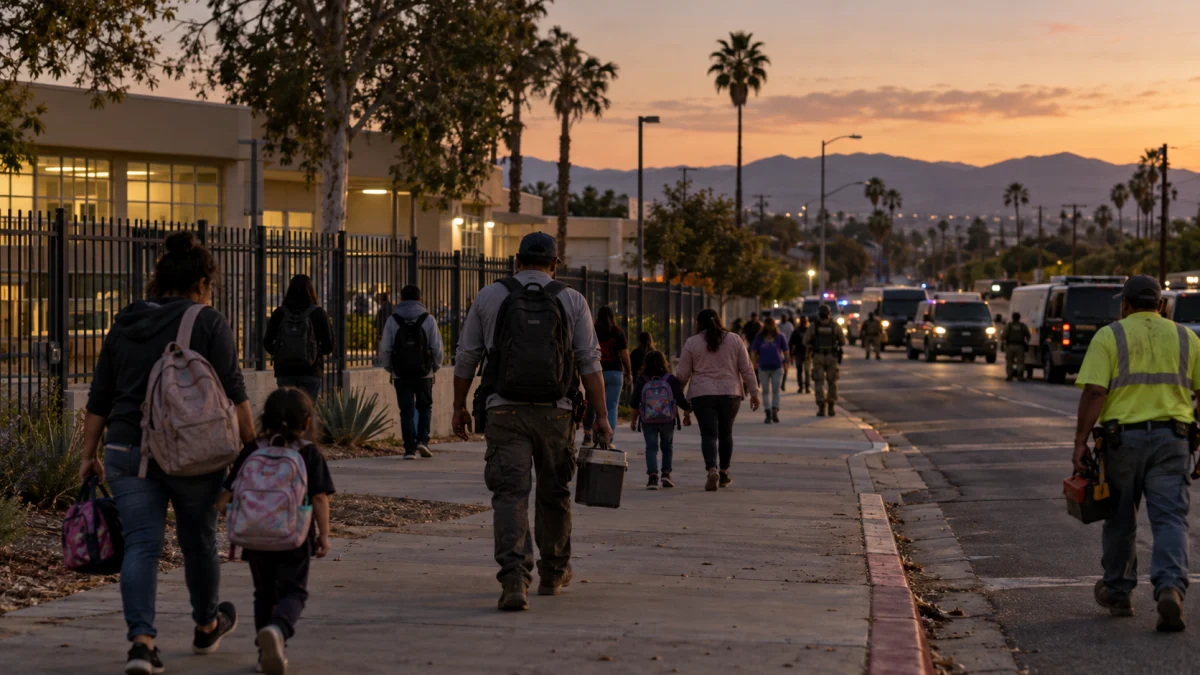
These locations matter because enforcement is not an abstraction to the people encountering it. A detention may mean a child loses a caregiver, a household loses wages, or a family has no immediate information about where someone has been taken. Those consequences deserve scrutiny whether the detention eventually proves lawful or unlawful.
A measurable effect: 130 more students absent in Mendota
The Mendota Unified School District reported 130 more students absent on Wednesday, October 7, than on the previous Wednesday, according to ABC30 reporting carried by KMJ. Local officials connected the concern to immigration-enforcement activity, and the district sent a reassurance letter to families.
This is a documented change in attendance, not proof that every additional absence was caused by ICE. But it is a concrete signal of community disruption, and one the government should not wave away. A child missing school is a public consequence even when the precise cause of each absence remains unknown.
Who is ICE being told to arrest? The central contradiction
The administration’s public emphasis on dangerous criminals is not the same as the arrest criteria described by sources familiar with the California surge. The Washington Examiner and Daily Wire both report that agents may arrest people suspected of being unlawfully present even without criminal histories.
Yet on October 8, Republican Rep. David Valadao said DHS had told his office something narrower: that the Central Valley operations were focused on people with active warrants and known criminal histories. Valadao also voiced concern that working farmworkers should not be living in fear.
These accounts could describe different parts of the same operation. An agency can prioritize named targets and still make additional arrests during encounters. But the distinction is precisely why public records matter. The government should disclose whether personnel were instructed to conduct targeted arrests, opportunistic arrests, or broad area sweeps—and how officers were told to establish a lawful basis for each detention.
No criminal record is not the same thing as no immigration violation. Federal civil immigration law can authorize arrest and removal without a prior criminal conviction. Conversely, a suspected immigration violation is not permission to disregard the Fourth Amendment, due process, or federal arrest regulations. Neither slogans nor political promises replace the facts legally required to justify a stop.
The arrest-number pressure is documented separately from the California operation
On October 8, CNN correspondent Priscilla Alvarez described sources saying ICE leadership had set a national goal of 3,000 arrests per day and 19,000 per week, up from roughly 2,000 daily arrests. DHS responded that there are “no quotas on arrests.”
Those numbers are national, not a proven quota for Operation Safe California. They nevertheless raise a legitimate operational question: when an agency increases pressure to produce arrests, how does it ensure that officers do not substitute volume for individualized legal justification?
The proper test is not whether a target is politically popular. It is whether arrests were supported by lawful grounds, accurately documented, and subject to meaningful review. A high count, by itself, proves neither lawful enforcement nor misconduct.
What makes an ICE stop or arrest unlawful?
The legal framework is more specific than either ICE can arrest anyone or every immigration arrest is illegal.
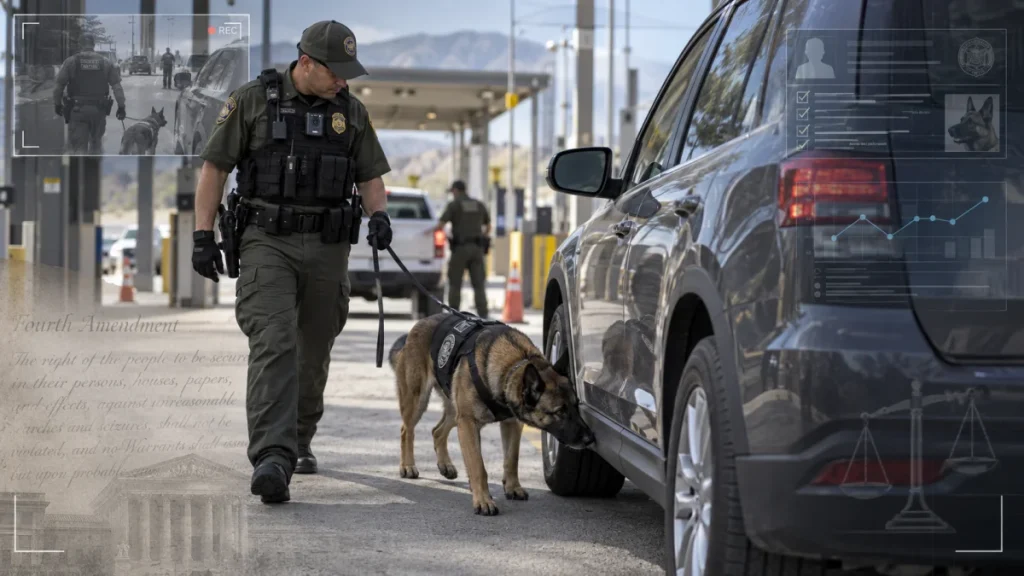
Under 8 C.F.R. § 287.8, immigration officers may briefly detain a person for questioning when they have reasonable suspicion based on specific, articulable facts. The regulation also sets standards for arrests, identification, force and conduct. It directs officers to obtain an arrest warrant except in specified circumstances involving a belief that the person is likely to escape before one can be obtained. The related federal statute, 8 U.S.C. § 1357, defines immigration officers’ authorities and limits.
Those rules create questions that must be answered encounter by encounter:
- Reason for the stop: What individualized facts justified detaining this person rather than merely asking voluntary questions?
- Legal basis for arrest: Did officers possess a warrant, or do the legally defined grounds for a warrantless arrest apply?
- Use of force: Was force necessary and proportional under governing law and regulation?
- Entry and searches: Did agents have lawful authority to enter a home or nonpublic workplace area? Administrative immigration paperwork and judicial warrants are not interchangeable in every setting.
- Process after detention: Was the person informed of the basis for detention and able to seek the legal review available in their circumstances?
An allegation of unlawful enforcement needs the relevant facts; it does not need deference to the officer’s version of events. Body-camera footage, eyewitness video, arrest paperwork, warrants, timestamps and court records are all relevant evidence. The absence of those records should not be filled with imagined certainty in either direction.
Why California’s sanctuary laws are not a license for indiscriminate raids
California’s limits on state and local cooperation do not abolish federal immigration authority. But neither are those limits inherently unlawful. In United States v. California (Ninth Circuit, 2019), the court upheld the state’s ability under anti-commandeering principles to decline substantial participation in federal immigration enforcement. The court addressed some other challenged provisions differently; the ruling was not blanket approval of every state restriction.
That distinction matters when federal officials invoke sanctuary policies to justify an aggressive deployment. A state’s decision not to supply its own officers or resources does not strip residents of constitutional protections. Federal officers still have to obey federal law.
Why the November election timing deserves investigation
California’s general election is November 3, 2026. A campaign reported to have begun in early October and expected to continue for at least 45 days would cover Election Day and extend beyond it. The overlap is real. Overlap alone does not prove intent to suppress voting.
The potential effect is also real enough to investigate. Immigration enforcement can make mixed-status families fearful of routine public activity. The Mendota attendance figures demonstrate one kind of measurable disruption. Whether similar concerns change eligible voters’ behavior is a separate question requiring evidence; it cannot be inferred automatically from arrests or social-media reactions.
The Associated Press reported that DHS says it is not planning operations targeting polling locations. DHS has nevertheless described narrow scenarios in which agents could respond to a threat or pursue a specific target, and legal specialists quoted by AP challenged whether those scenarios would be lawful at a voting site. 18 U.S.C. § 592 restricts deployment of troops or armed men at places where elections are held, and 18 U.S.C. § 594 makes purposeful voter intimidation a federal offense.
Those statutes are meaningful restraints, not proof that this California operation has already violated them. The relevant evidence would include operational orders, election-site deployments, communications about electoral objectives, specific incidents of intimidation and testimony or records establishing prohibited conduct or purpose.
There is a documented history of agents questioning political use of enforcement
A separate 2025 California immigration operation supplies relevant historical context. In a July 2026 sworn deposition filed in Vasquez Perdomo v. Mullin, a federal Homeland Security Investigations agent described agents marching toward a press conference held by Gov. Gavin Newsom. Asked about the reason for that action, the agent testified that “It seemed to be purely political” and said the operational justification did not appear sound. The relevant passage appears on the exhibit’s printed page 234.
This is stronger evidence than an influencer’s impression: it is an agent’s testimony in a federal case. But it concerns a different operation in August 2025, and the witness was describing their own assessment, not producing a signed order from current leadership. It does not establish the motive of Operation Safe California in October 2026.
That prior record justifies asking hard questions now. It does not justify pretending the answers are already in hand.
ICE is separately investigating alleged voter fraud
The election issue cannot be reduced to the California raids alone. The Washington Post reported on an October 1 internal ICE instruction concerning follow-up questions to detained people who acknowledge voting illegally. And WIRED reported on newly released internal emails discussing possible use of the Palantir-supported ELITE enforcement system to handle voter-roll-related investigative leads. Palantir told WIRED that voter-roll data had not been integrated into ELITE.
These are distinct federal activities, not proof that California arrest teams have orders to influence elections. Their relevance is narrower and more concrete: immigration enforcement authorities are being used in election-related investigations during the same political period. Congress and the public can reasonably ask what data is being used, what safeguards apply, and how the missions are separated.
What Californians can do without putting themselves or others at risk
Civil liberties should be practical, not just something invoked after an arrest.
The ACLU’s updated immigrants’ rights guide explains that people have constitutional protections regardless of immigration status. The exact rules vary with the location, type of stop, legal status, and circumstances, but several principles are broadly useful:
- Do not physically interfere with an enforcement action. Stay calm, avoid sudden movements and do not provide false information or documents.
- Know the difference between a question and a detention. Asking whether you are free to leave can help clarify an encounter. Remaining silent and requesting legal counsel may be important; specific obligations vary by circumstance.
- Do not assume paperwork labeled a “warrant” resolves every question about entry. A qualified immigration attorney can explain the limits of administrative versus judge-issued warrants in a particular case.
- Prepare a family emergency plan. Keep contact information for trusted people and legal counsel accessible, and make arrangements for children or other dependents if a caregiver is detained.
- Preserve evidence responsibly. If an encounter is lawfully recorded, retain the original file, time, location and witness details. Avoid publishing personal information that could expose an affected family to further harm.
This is general information, not individualized legal advice. The safest course in a specific case is to contact a qualified attorney or reputable legal-aid organization. Report suspected misconduct through appropriate legal channels rather than confronting armed personnel.
The records DHS should release
The government has a legitimate interest in protecting sensitive tactical details while operations are active. That does not mean the public must accept a permanent information blackout about legality or outcomes. A meaningful accountability report should answer:
- Who authorized the operation, when, and under what written instructions? Is Operation Safe California the actual internal designation, and what is its documented start and projected end date?
- What are the arrest criteria? Are noncriminal immigration targets explicitly included, and do instructions distinguish planned targets from additional arrests made during encounters?
- How many people have been stopped and arrested? Publish geographically aggregated totals, with distinctions for criminal convictions, pending charges, no known criminal history, U.S. citizenship, release and subsequent disposition.
- What was the legal basis for each contested detention? Preserve warrants, stop reports, body-camera material and administrative records for independent legal review, with necessary privacy protections.
- What oversight exists? How are complaints about mistaken identity, discriminatory stops, excessive force and unlawful entry investigated, and are findings made public?
- What, if anything, connects this operation to election-related initiatives? Identify any written directives, data-sharing arrangements or instructions concerning polling places or eligible voters.
None of those questions requires giving the government a free pass. Nor does responsible reporting require declaring guilt before the evidence is examined.
Bottom line: A badge is not a blank check
The available evidence supports a serious conclusion: ICE activity has escalated in multiple California communities; a 45-day statewide plan with broad arrest instructions is credibly reported; and the public still lacks the documents needed to assess its full scale and legality. The impact on families is not theoretical. Local journalists are recording detentions, and one school district has reported a notable attendance disruption.
What the record does not yet prove is that every detention in the operation is illegal or that federal leadership ordered the sweep to suppress votes. Those are consequential claims. Sherafy will not manufacture them—and will not dismiss them merely because an agency denies wrongdoing.
The standard is straightforward: No administration, no agency, no governor, and no armed officer is above the law. Patriotism is not blind loyalty to government power. Public accountability means insisting on lawful grounds for detentions, real oversight, and answers from those exercising authority over people’s lives.
A government operation named Safe California deserves to be judged by what happens to Californians—not by the name printed on its internal paperwork.
References and Further Reading
Original reporting and local impact
- Major ICE operation underway across California — Washington Examiner, October 7, 2026. Original confidential-source reporting identifying Operation Safe California, its reported duration, and broad arrest instructions.
- Trump Unleashes ICE on California for 45-Day Deportation Operation — Daily Wire, October 8, 2026. Adds the reported deployment of more than 250 officers and quotes DHS’s refusal to disclose tactical details.
- ICE arrests surge across LA — LA Public Press, October 8, 2026. Local arrest reporting, community observations, and direct questions to DHS.
- Anger, criticism mount over increasing reports of Fresno ICE raids — Fresnoland, October 8, 2026. Central Valley community reports and preliminary detention figures, explicitly attributed to rapid-response organizations.
- ICE enforcement surge reported in San Diego — NBC 7 San Diego, October 2026. Interviews with local organizers and accounts of increased activity.
- Reported ICE Activity Sparks Protests, Increased School Absences Across the Valley — ABC30/KMJ, October 8, 2026. Reports Mendota Unified’s comparison of student absences and community concerns.
Official statements, legal standards and court records
- Congressman Valadao Releases Statement on ICE Operations in the Central Valley — U.S. House, October 8, 2026. Direct record of DHS’s narrower description to a congressional office.
- 8 C.F.R. § 287.8 — Standards for Enforcement Activities — Federal regulation. Rules concerning immigration stops, arrests, force, and site inspections.
- 8 U.S.C. § 1357 — Powers of Immigration Officers — Federal statute. Governing statutory authorities and limits.
- **United States v. California — Ninth Circuit, 2019. Explains the state’s constitutional authority to decline certain forms of assistance to federal immigration authorities.
- Federal agent deposition, Vasquez Perdomo v. Mullin, Exhibit 20, filed July 27, 2026. Primary sworn testimony concerning a separate 2025 operation near a governor’s press conference; relevant passage at printed page 234.
- 18 U.S.C. § 592 — Troops at Polls and 18 U.S.C. § 594 — Intimidation of Voters. Relevant federal statutory constraints; not evidence that either was violated here.
- ACLU Immigrants’ Rights Guide, updated August 2026. Practical, general civil-liberties information and further legal resources.
Broader policy and election context
- CNN correspondent Priscilla Alvarez on reported ICE arrest goals — CNN transcript, October 8, 2026. Source-attributed national arrest goals and DHS’s denial of quotas.
- Trump Administration Says It Has No Plans for ICE Officers at Polls — Associated Press, October 2026. DHS statements, expert interpretations, and the legal debate surrounding armed agents at election sites.
- In Run-Up to Election, ICE Is Asking Detainees If They Voted Illegally — Washington Post, October 6, 2026. Reports an internal ICE instruction concerning voter-related questioning during booking.
- ICE Emails Discuss Using Palantir-Supported Tool to Investigate Voter Fraud — WIRED, October 8, 2026. Reporting from disclosed emails about a separate election-investigations initiative, with Palantir’s denial that voter rolls were integrated into ELITE.
Editorial currency note: This briefing reflects information available through October 9, 2026. Operation details, detention totals, agency statements, litigation and applicable legal interpretations may change. Source-attributed estimates are not presented as official counts; claims about the 2026 operation are distinguished from documents relating to earlier events.