Updated September 21, 2026.
Prosecutors have presented DNA evidence, surveillance, firearm and toolmark comparisons, and communications they attribute to Tyler Robinson. Those materials have cleared the threshold for a trial. They have not yet established his guilt beyond a reasonable doubt in a criminal trial.
Robinson pleaded not guilty after Judge Tony Graf ordered him to stand trial on all seven charges arising from Charlie Kirk’s September 10, 2025 killing at Utah Valley University. The prosecution is seeking the death penalty. The judge expressly emphasized that his preliminary findings did not determine Robinson’s guilt, the ultimate credibility of witnesses, the weight of the evidence or the admissibility of evidence at trial. The September preliminary-hearing ruling is available in the public hearing transcript.
For readers who suspect Robinson was set up, or that other people were involved, the important question is not whether an official has expressed confidence. It is whether the evidence supports the conclusion being drawn from it.
That requires separating three questions:
Did Robinson fire the shot that killed Charlie Kirk?
Did anyone else knowingly help plan, facilitate or conceal the killing?
Has any evidence been fabricated, mishandled or interpreted in a way that wrongly implicates him?
These questions overlap, but they are not interchangeable. Evidence identifying a shooter does not automatically establish that the shooter acted alone. Evidence of an investigative failure does not automatically identify a different shooter. And Robinson does not have to prove a complete alternative account to challenge the prosecution’s proof.
The examination below distinguishes the public record from allegations and analysis. Its purpose is to explain which conclusions the evidence can support, which require additional steps, and where reasonable doubt could arise.
What does "beyond a reasonable doubt" actually require?
The September ruling answered a preliminary question: whether probable cause justified sending Robinson’s case to trial.
Under Utah Rule of Criminal Procedure 7B, that threshold can be satisfied partly or entirely through qualifying reliable hearsay. It is not a final determination of guilt.
The trial standard is different.
In State v. Reyes, the Utah Supreme Court approved an instruction explaining that proof beyond a reasonable doubt leaves jurors "firmly convinced" of guilt. Absolute certainty is not required. But when the evidence leaves a real possibility that the defendant is not guilty, the instruction requires acquittal.
The Model Utah Jury Instructions similarly place the burden on the prosecution and preserve the presumption of innocence.
For this case, the practical question is:
After the evidence is admitted, authenticated, challenged and considered together, does it reliably establish Robinson’s criminal responsibility, or does a reasonable possibility remain that the prosecution has identified the wrong person or failed to prove a required element?
The question is not whether every exhibit independently proves the whole case. Nor is it whether every imaginable scenario has been disproved.
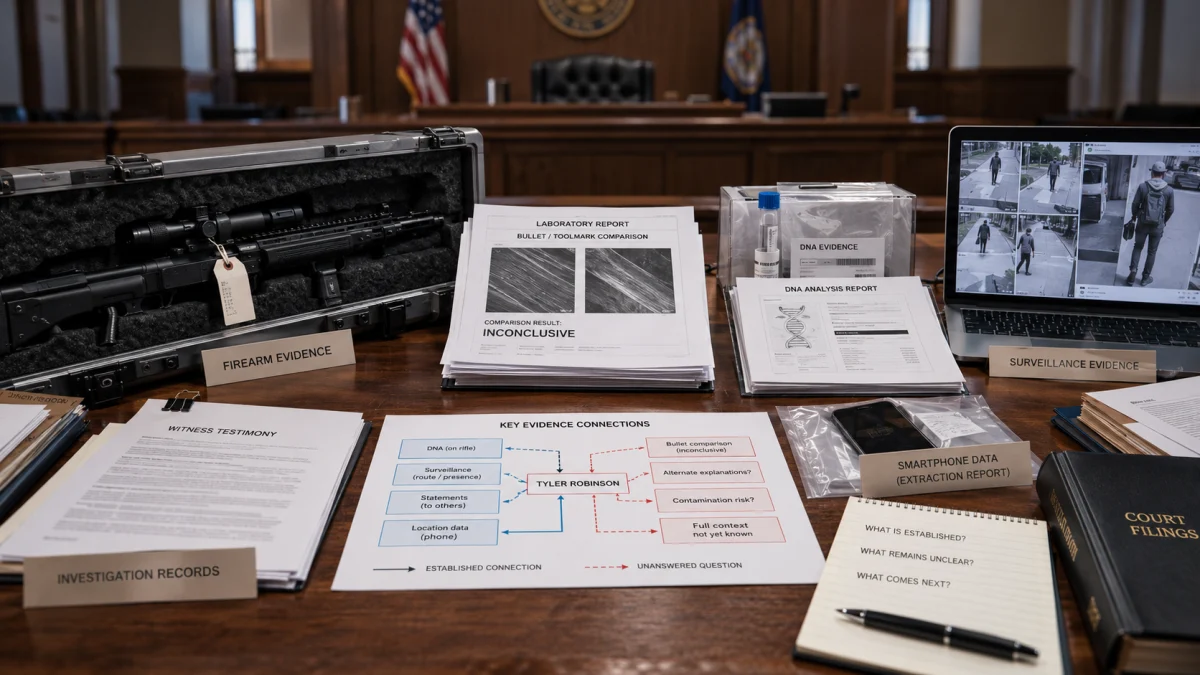
The evidence against Tyler Robinson at a glance
The table describes findings and allegations presented publicly. It does not convert them into a verdict.
| Evidence | Publicly described result | Question the result does not answer by itself |
|---|---|---|
| Rifle and ammunition DNA | Profiles supporting Robinson as a contributor | When or how was the DNA deposited, and who fired? |
| Fatal bullet-jacket fragment | Comparison with the recovered rifle was inconclusive | Did this particular rifle fire the fatal projectile? |
| Cartridge cases and engraving marks | Comparisons associated cases with the rifle and markings with a recovered engraving tool | Who used the rifle or engraving tool, and when? |
| Window fingerprints | A state examiner excluded Robinson from three prints; subsequent FBI examinations were inconclusive | Were those prints deposited during the escape? |
| Surveillance and vehicle evidence | Prosecutors reconstructed movements using cameras, appearance, clothing, gait and vehicle features | How securely does the sequence identify the same person? |
| Note and messages | Prosecutors attribute planning statements and admissions to Robinson | Who authored them, and what does their full context establish? |
| Lance Twiggs’s accounts | Recorded witness statements, including an interview preceded by immunity | Which claims are reliable and independently corroborated? |
The central issue is how these pieces fit together.
An association with a rifle is different from identification as its user. An authenticated admission could help connect those propositions. A demonstrated authorship problem could weaken that connection.
Did the bullet match Robinson’s rifle?
The fatal bullet-jacket fragment was not conclusively matched to the recovered rifle. The comparison was inconclusive, not an exclusion.
The publicly described ATF examination found applicable class characteristics consistent with the rifle, but insufficient individual detail to identify it as the source or rule it out. Other firearms could share those general characteristics.
PolitiFact’s review of the bullet comparison explains the distinction between an inconclusive result and an exclusion.
This is a genuine limit on the prosecution’s forensic evidence.
The fatal fragment does not provide a conclusive microscopic connection to this particular weapon. Calling that comparison a positive match would give it a result the examiner did not reach.
But an inconclusive result also does not establish that a different rifle fired the shot.
The Justice Department’s guidance on firearms and toolmark testimony distinguishes identification, exclusion and inconclusive findings precisely because they mean different things.
The reasonable-doubt question therefore becomes:
Can other reliable evidence establish the weapon’s role and the shooter’s identity despite this unresolved comparison?
The laboratory result does not answer that larger question either way.
Why the cartridge cases are separate evidence
A bullet is the projectile. A cartridge case is the component left after firing.
The hearing included comparisons associating fired cases with the recovered rifle, including cases recovered at the residence. Those findings are distinct from the inconclusive comparison involving the fatal fragment.
Deseret News’ detailed account of the preliminary-hearing forensic evidence reported that investigators presented a firearm comparison involving a fired cartridge case and the recovered rifle while separately acknowledging that the fatal bullet-jacket fragment could not be conclusively tied to that firearm.
A case-to-rifle identification can establish which firearm discharged a particular cartridge. Standing alone, it cannot identify the person who fired it, establish the firing date, or show what the projectile struck.
That distinction matters because the phrase "the ballistics matched" can conceal several separate tests with different results.
What does the engraving-tool evidence establish?
The prosecution also presented a comparison connecting cartridge engravings to a tool recovered at the residence.
Testimony described the engraving tool as belonging to Twiggs, with Twiggs’s DNA associated with its buttons. The same preliminary-hearing reporting details both the toolmark conclusion and the ownership/DNA evidence involving the engraver.
Identifying the tool that made a mark is not the same as identifying its operator.
The comparison could corroborate a connection between the ammunition and the residence. Establishing that Robinson performed the engraving requires additional evidence.
The method itself also deserves scrutiny. DOJ guidance permits qualified toolmark-identification opinions, but restricts claims of infallibility, zero error or absolute certainty.
The relevant questions concern the comparison material, the examiner’s reasoning, the method’s demonstrated reliability and the connection between the tool and a particular person’s conduct.
What does the DNA evidence prove?
The publicly described testing supports an association between Robinson and multiple rifle components and ammunition.
This is not merely an allegation that his name appeared somewhere in an investigative file. It is forensic evidence requiring a serious explanation. Testimony summarized by Deseret News described Robinson’s DNA on numerous portions of the rifle and associated ammunition.
But DNA interpretation involves two different questions:
Whose biological material is represented?
What activity caused it to be there?
The National Institute of Standards and Technology’s scientific review of DNA-mixture interpretation distinguishes contributor-level questions from activity-level questions. Transfer, persistence, prior handling and the nature of an object can affect the second inquiry.
Consider a hypothetical, not an established account of this case: someone handles a household firearm before another person takes it. A reliable DNA association with the earlier handler would not, by itself, identify the later shooter.
The important point is that the DNA finding could be correct while the conclusion about the shooting is wrong.
Challenging that inference does not require alleging that the laboratory fabricated a profile.
Conversely, proposing earlier handling or transfer does not establish that either explanation accounts for these particular samples. That requires examining the objects, access, handling history and surrounding evidence.
Was Robinson’s DNA specifically found on the trigger?
The wording needs care.
During the forensic testimony, the trigger and trigger guard were described as having been swabbed together. The examiner could therefore discuss DNA recovered from the combined sample but could not determine which individual surface supplied the biological material.
The relevant testimony appears in the Day 5 preliminary-hearing transcript.
Accordingly, "DNA from a combined trigger-and-trigger-guard sample" is more precise than claiming that testing isolated Robinson’s DNA specifically from the trigger.
That does not erase the result. It prevents a pooled sample from being presented as a more specific finding than the testing supports.
Why are Robinson’s and Twiggs’s DNA on other objects?
The hearing included mixture evidence concerning a towel associated with the rifle and a screwdriver recovered from the roof, with results supporting contributions from Robinson and Twiggs.
Reporting on the hearing described extremely large likelihood ratios for the Robinson-and-Twiggs contributor proposition. Deseret News summarized the DNA testimony involving the towel and screwdriver.
Their locations make these objects relevant.
A DNA-bearing object at an alleged shooting or escape location raises questions that an object remaining in a shared home would not.
Nevertheless, the presence of two people’s DNA does not independently establish that both visited the scene.
The useful questions are about the objects’ histories: who owned and handled them, who could access them, how they reached the recovery locations, and whether the evidence supports a particular sequence.
The general possibility of transfer is relevant, but it is not a case-specific explanation on its own.
What does "30 quintillion" mean?
For the screwdriver sample, a report read in court compared two contributor propositions: Twiggs and Robinson, versus Twiggs and an unknown unrelated person. The reported likelihood ratio was 30 quintillion in favor of the first proposition.
The relevant testimony appears in the Day 2 preliminary-hearing transcript.
That is not a one-in-30-quintillion chance Robinson is innocent.
A likelihood ratio compares how well specified propositions explain the observed DNA results. It does not calculate the probability that someone committed a murder.
The Justice Department’s guidance on probabilistic-genotyping testimony similarly cautions against converting a likelihood ratio into an absolute identification or probability of guilt.
The statistic can strongly support a contributor proposition while leaving timing, transfer and criminal activity unresolved.
Nor should statistics from several objects simply be multiplied into purported odds of innocence. Such a calculation would require a justified model, including the relationships between the evidence, rather than treating every sample as an independent event.
Does surveillance identify Robinson as the shooter?
The prosecution’s identification theory combines multiple observations rather than relying solely on one unobstructed facial image.
Graf’s ruling described a reconstruction involving physical characteristics, clothing, shoes, gait and a distinctive vehicle. That is the state’s identification argument, not an independent identification performed by this article.
The court’s description of that evidence appears in the final preliminary-hearing transcript and bind-over ruling.
The appropriate examination is camera by camera.
Does the next recording demonstrably show the same person?
Are the timestamps aligned?
How much time passes between appearances?
Does a vehicle feature distinguish one particular vehicle, or a larger group?
Can the driver be identified separately from the vehicle?
These are not demands that every second be filmed. They are the steps needed to understand how the identification was constructed.
A video compilation is not the same as the original recordings
Preliminary-hearing testimony described a compilation prepared by the county attorney’s office using selected surveillance material. It did not contain every recording investigators obtained.
The presentation and its construction were discussed in the Day 2 hearing transcript.
A compilation can make a complex sequence understandable. Its existence is not evidence of improper alteration.
But the underlying clips still matter.
A highlight identifies what the presenter wants viewers to notice; it does not independently establish who the person is. An edit between cameras may connect a well-supported route or bridge a gap that requires explanation.
A persuasive presentation and a reliable identification are not necessarily the same thing.
The window fingerprints deserve particular attention
The parties stipulated that a state examiner excluded Robinson as the source of three usable latent prints on a window near the rooftop landing area. Subsequent FBI examinations of those prints were inconclusive.
The stipulation and testimony appear in the Day 4 preliminary-hearing transcript.
The exclusion findings should not disappear into a summary saying only that "fingerprints were inconclusive."
Equally, the later inconclusive examinations should not be described as confirming the exclusions.
The decisive contextual question is whether the prints can be tied to the person escaping at the relevant time.
If they were reliably shown to have been deposited during the escape, excluding Robinson would carry different implications than excluding him from prints whose timing and origin were unknown.
The public material reviewed here does not establish that timing.
It would be inappropriate to assume the prints were old, and equally inappropriate to assume the stipulation identifies another shooter.
Did Tyler Robinson confess?
Prosecutors attribute several admissions to Robinson. They do not all have the same evidentiary foundation.
The original charging information describes a note allegedly left for Twiggs and messages discussing the killing and the rifle. It attributes the response "I am, I’m sorry" to Robinson after Twiggs asked whether he was responsible.
These are allegations recorded in the charging document. A charging document is not a verdict.
The preliminary hearing added important information about where the digital material came from.
Agent Brian Davis described a Cellebrite extraction of Twiggs’s phone, including the photographed note, and messages obtained through a Discord subpoena return. The relevant testimony appears in the Day 4 preliminary-hearing transcript.
That means the public evidentiary presentation was not limited to screenshots circulating online.
It also means three questions must remain separate:
Did the communication exist?
Was it associated with the attributed account or device?
Did Robinson author it, and was its content truthful?
Evidence addressing one question can support the others without making them identical.
What would establish authorship?
Utah Rule of Evidence 901 requires evidence sufficient to support finding that an item is what its proponent claims.
That foundation can include witnesses, distinctive characteristics, surrounding circumstances and evidence about the process that produced the record.
For these messages, meaningful scrutiny would examine the complete conversations, account and device attribution, timestamps, extraction procedures and corroborating conduct.
A platform return may answer an allegation that someone merely invented a screenshot.
It does not automatically resolve every question about account control or authorship.
Likewise, an authentic photograph of a note establishes what the photograph depicts. It does not independently identify the note’s author.
The allegation that someone else authored a communication is therefore testable. But it should be tested through records and circumstances, not treated as established because the wording seems unusual.
What if an admission was false?
Even proven authorship does not make every statement true.
A false-admission hypothesis would require examining the circumstances, the speaker’s knowledge, the conversation’s purpose and conflicts with independent evidence.
That is an analytical possibility, not a finding that Robinson made a false admission.
Conversely, if reliable evidence establishes that Robinson authored admissions containing accurate, independently corroborated information about his actions, those statements could help connect him to the crime rather than merely to objects.
The critical issue is the demonstrated foundation, not how often a headline repeats "he confessed."
How should Lance Twiggs’s statements and immunity be evaluated?
Twiggs’s account is important, but it should not be treated as either automatically trustworthy or automatically discredited.
The hearing described recorded interviews on September 12, 2025, and April 20, 2026.
Before the April interview, Twiggs received what Agent Davis described as use immunity from the county attorney’s office and the U.S. attorney’s office. The agent distinguished that protection from blanket immunity.
The testimony concerning the interviews and immunity appears in the Day 3 preliminary-hearing transcript.
This review did not inspect the actual immunity agreements, which would determine their precise terms.
The chronology matters: the September interview preceded the immunity described for April.
That does not settle credibility, but it prevents every statement from being inaccurately described as having first emerged after the same deal.
The useful comparison is between the accounts.
What remained consistent?
What changed?
What information did investigators disclose before a particular answer?
Which details can be verified without relying on Twiggs?
The Supreme Court’s decision in Giglio v. United States explains why material government promises affecting a witness’s credibility must be disclosed.
A benefit is information the defense and jury may need. It is not proof by itself that the witness lied.
A recorded witness interview is not a recording of the defendant confessing
The preliminary-hearing presentation included Twiggs’s recorded accounts rather than live testimony from him subjected to defense cross-examination.
A recording can accurately preserve an allegation without independently proving that the alleged conversation occurred.
Trial admissibility presents a separate issue.
Under Crawford v. Washington, testimonial statements generally cannot replace confrontation merely because a judge regards them as reliable. When the witness does not testify, unavailability and a prior opportunity for cross-examination are central requirements, subject to recognized exceptions.
That does not predict which statements will be admitted here.
It explains why material presented at the preliminary hearing cannot simply be assumed to reach a trial jury in the same form.
What about Robinson’s family, surrender and alleged concealment?
The charging information describes identification concerns raised by family members, statements attributed to Robinson through others, his surrender with family and a family friend, and alleged concealment or disposal of evidence.
Those claims are described in the September 2025 charging information.
They are separate claims with separate foundations.
Surrender is not, by itself, a confession.
A relative identifying someone in footage is identification evidence that must be evaluated, not a laboratory determination.
A witness recounting a private admission is different from a recording of the admission.
Alleged disposal or concealment may support an inference of consciousness of guilt, but only after the conduct and circumstances are reliably established.
The relevant question is whether the evidence supports the prosecution’s interpretation, not simply whether a reported action sounds suspicious.
Do the different pieces independently corroborate one another?
This is where an evidence audit becomes more useful than a list of exhibits.
A witness describes a message. An investigator repeats that description. A filing summarizes it. Several articles quote the filing.
That is not four independent confirmations.
Conversely, physical recovery, pre-existing surveillance and authenticated communications can provide support through different mechanisms.
A weakness in one category does not necessarily erase the others.
Why the recovery timeline matters
Preliminary-hearing testimony placed recovery of the rifle on September 10, before later interviews and before the FBI publicly announced its recovery the following morning.
The investigative timeline can be compared in the Day 4 hearing transcript.
On September 11, the FBI publicly announced that investigators had recovered a bolt-action rifle in a wooded area along the suspected escape route.
That chronology matters because it places the recovery before later witness interviews.
It does not, on its own, establish that every detail appearing in a message was information only the shooter could know.
That stronger claim would require establishing when the detail was first recorded, who already knew it, whether it had circulated publicly or privately, and whether the message’s original timestamp is secure.
The public material examined here does not establish that disclosure history for every detail.
The useful test: what happens when a disputed piece is removed?
Temporarily set aside Twiggs’s interpretation.
What do the electronic records themselves establish?
Set aside the fatal-fragment comparison.
What connects the rifle to the killing?
Set aside an uncertain surveillance identification.
Which other observations identify Robinson independently?
These are ways to test the reasoning, not requirements that every remaining fragment prove the case alone.
They help distinguish genuine corroboration from several claims that all depend on one disputed assumption.
Could Tyler Robinson have been set up?
The question deserves a more precise examination than either "obviously" or "impossible."
A setup could mean that genuine evidence was deliberately arranged to implicate someone, that records were fabricated, or that authentic associations were misinterpreted.
Those mechanisms would leave different questions to investigate.
A genuine rifle and genuine DNA would not rule out a setup by themselves
Hypothetically, a person could have innocently handled an object that someone else later used.
The resulting DNA association could be entirely authentic.
This is why the leap from contact with an object to participation in the crime must be established rather than assumed.
But an innocent-contact explanation would address only part of this prosecution.
The alleged communications, surveillance and witness accounts still require examination on their own terms.
That is not a demand that Robinson disprove every allegation.
It is a reminder that explaining one exhibit does not automatically explain the entire record.
A digital-evidence challenge should identify the disputed step
Is the claim that the displayed messages were altered?
That the account belonged to someone else?
That another person controlled the device?
That a genuine statement was misrepresented or untrue?
These are different propositions.
The records needed to test them differ: native message data, platform responses, extraction documentation, account-access evidence, complete conversations and witness testimony.
The public summaries reviewed here do not establish that someone fabricated or impersonated Robinson’s communications.
They also are not a substitute for inspecting the underlying records.
The defense does not have to prove a frame-up
This point is essential.
A jury could have reasonable doubt because identification or attribution failed, even without finding that anyone deliberately framed Robinson.
A failed prosecution does not require a successful conspiracy case in its place.
Under the presumption of innocence, the defendant need not establish the mechanism of an investigative error before an unproved charge remains unproved.
The relevant distinction is between scrutinizing a proposed alternative and making the defendant responsible for proving it.
Could Robinson have been involved without acting alone?
Evidence that identifies Robinson as the shooter would not, by itself, establish that nobody assisted him.
Conversely, evidence that another person helped would not necessarily establish that Robinson was innocent.
A wider-involvement inquiry would examine evidence of knowing coordination: communications about the act, assistance with preparation or movement, provision of resources with knowledge of their intended use, or coordinated concealment.
These are investigative questions, not findings that such evidence exists here.
Mere association with a person, access to a shared object, or agreement on political views would not logically establish participation in a killing.
There is also a legal distinction.
Utah Code §76-2-202 provides that a person acting with the mental state required for an offense can be criminally liable when that person directly commits the offense or intentionally solicits, encourages or aids another person in conduct constituting the offense.
That general rule is not a finding about Robinson or anyone else.
The prosecution’s public identification case portrays Robinson as the shooter. Any alternative theory submitted at trial would require its own lawful foundation and proof.
"Was he the shooter?" and "Was this the complete group of participants?" are separate questions. One cannot substitute for the other.
Do security failures or prosecutorial misconduct support the doubts?
There are documented issues worth distinguishing from unsupported allegations.
The court found a prosecutor violated the publicity order
On June 26, Graf held prosecutor and spokesman Chris Ballard in civil contempt after public comments concerning the strength of the state’s case.
KSL’s report on the contempt ruling explains that the court found Ballard had violated the pretrial publicity order while declining the defense’s request to remove the death penalty as a sanction.
This is a legitimate concern about the prosecution’s conduct and public messaging.
It was not a finding that investigators fabricated a profile, planted a rifle or altered messages.
Both points matter.
A documented violation should not be minimized, but its meaning should not be extended to conduct the ruling did not establish.
Kirk’s family has separately challenged event security
In September 2026, Kirk’s family filed a notice of claim alleging serious security failures by Utah Valley University and state officials.
Associated Press reporting on the notice of claim describes allegations involving security planning, rooftop access and campus preparations. Those allegations are part of a potential civil case, not judicial findings establishing intentional assistance to a killer.
Security failures could help explain how an attack became possible.
Establishing that a failure was intentional, and connected to the attack, would require evidence addressing that additional proposition.
The same discipline applies to a possible cover-up.
Protecting an institution from embarrassment, concealing negligence and knowingly helping conceal a murder are different allegations.
Evidence supporting one does not automatically establish the others.
Can the prosecution prove guilt beyond a reasonable doubt?
The publicly described evidence could support a conviction if its important foundations survive trial scrutiny. The public record reviewed here does not justify announcing that the trial standard has already been met.
That is an assessment of what the evidence would need to accomplish, not a prediction of the verdict.
What would make the identity case persuasive?
The prosecution’s reasoning would gain force if it established that Robinson authored truthful admissions, that the surveillance reliably connects him to the relevant movements, and that the physical evidence independently supports the same sequence.
Under that scenario, an inconclusive projectile comparison would remain a limitation without necessarily defeating proof from the whole record.
This is why the alleged admissions deserve particularly close examination.
If reliably attributed and corroborated, they could address conduct that DNA alone cannot establish.
What could leave reasonable doubt?
The identity case would look different if material attribution problems undermined the admissions, if significant surveillance links failed, or if reliable evidence connected someone else to the relevant conduct in a way inconsistent with Robinson’s alleged role.
In that scenario, evidence of prior contact with shared or accessible objects might not close the resulting gap.
These are conditional examples, not findings that those failures have occurred.
They identify the issues that could materially change the assessment.
A disagreement over a peripheral detail and a demonstrated failure in shooter identification do not have the same significance.
Every charged offense still has to be proved
Even establishing the shooter’s identity would not automatically prove every element of every charge.
Utah’s aggravated-murder statute includes, among several possible aggravating circumstances, knowingly creating a great risk of death to another person besides the victim and the actor.
The relevant language is contained in Utah Code §76-5-202.
The September arguments disputed whether the circumstances established the additional risk required by the prosecution’s theory.
A defense challenge to an aggravating element is not an admission that Robinson fired the shot.
It is a separate challenge to what the state must prove.
Ultimately, jurors must evaluate the offenses submitted to them, not issue a single verdict on whether they trust the entire official account of the event.
What remains unverified in the public record?
Three descriptions should not be confused:
A test produced an inconclusive result.
A test produced a finding unfavorable to the prosecution.
The underlying material was not available for this review.
The first two describe evidence.
The third describes a limit on public access and on this article’s review.
This review did not independently inspect the complete native surveillance collection, full device extractions and Discord platform returns, laboratory bench files, comprehensive evidence-transfer logs or the actual immunity agreements.
It also did not establish a verified public gunshot-residue result.
That is not a finding of a negative test, an omitted test or a concealed result.
Nor does a record’s absence from public coverage establish that the defense lacks it.
Utah Rule of Criminal Procedure 16 governs criminal discovery and requires disclosure of important categories of material to the defense.
Public access and defense access are different questions.
The public can scrutinize what has been presented without pretending it has examined the complete trial record.
What can responsibly be concluded now?
The prosecution has presented more than suspicion.
But several important conclusions still depend on steps that must be demonstrated: connecting a DNA-bearing object to the act, connecting separate camera appearances to the same person, and connecting a communication to its author and to truthful knowledge of events.
Those steps are where the meaningful disputes lie.
This review did not establish that Robinson was framed or that additional organizers participated.
It also did not establish that every possibility of wider involvement has been excluded.
The standard is not whether skeptical readers can prove a conspiracy. It is whether the prosecution can prove Robinson’s criminal responsibility beyond a reasonable doubt.
That burden does not disappear because the allegations are serious, the evidence is numerous or officials sound certain.
And evidence does not disappear because an official account is distrusted.
The most useful examination follows each claim back to its foundation, and stops precisely where the evidence stops.
References and Further Reading
Court Records, Hearings and Utah Law
Original charging information in State of Utah v. Tyler James Robinson
The September 2025 charging document lays out the prosecution’s original allegations, including the alleged note, text messages, family statements and conduct following the shooting. A charging document contains allegations, not trial findings.
UT v. Tyler Robinson Preliminary Hearing: Day 2
Includes portions of the prosecution’s surveillance presentation and DNA evidence, including testimony concerning the towel and screwdriver. Rev provides a third-party transcription rather than a certified court transcript.
UT v. Tyler Robinson Preliminary Hearing: Day 3
Includes testimony concerning Lance Twiggs’s interviews and the immunity described by investigators.
UT v. Tyler Robinson Preliminary Hearing: Day 4
Important for the digital-evidence provenance, Discord material, investigative chronology and fingerprint stipulation.
UT v. Tyler Robinson Preliminary Hearing: Day 5
Includes additional forensic testimony, including details concerning how particular firearm surfaces were sampled.
UT v. Tyler Robinson: Final Preliminary Hearing and Bind-Over Ruling
Contains the September arguments and Judge Tony Graf’s ruling sending Robinson to trial. The court repeatedly emphasizes that its findings are preliminary and do not determine guilt, witness credibility, trial admissibility or ultimate evidentiary weight.
Utah Rule of Criminal Procedure 7B: Preliminary Examination
The governing Utah rule explaining the probable-cause standard and the use of qualifying hearsay at a preliminary hearing.
Model Utah Jury Instructions: Criminal
Includes Utah’s model instructions on proof beyond a reasonable doubt and the presumption of innocence.
State v. Reyes, Utah Supreme Court
Important Utah authority concerning the "firmly convinced" formulation used to explain proof beyond a reasonable doubt.
Utah Rule of Evidence 901: Authenticating or Identifying Evidence
Relevant to authentication of digital communications, photographs and other exhibits.
Utah Rule of Criminal Procedure 16: Discovery
Governs major aspects of criminal discovery and helps distinguish material available to the parties from material available to the general public.
Utah Code §76-2-202: Criminal Responsibility for Direct Commission or Conduct of Another
Utah’s party-liability statute, relevant to the distinction between personally committing an offense and intentionally aiding another person’s offense.
Utah Code §76-5-202: Aggravated Murder
The governing aggravated-murder statute, including aggravating circumstances relevant to the charges.
Scientific and Forensic Standards
NIST: DNA Mixture Interpretation – A Scientific Foundation Review
A major scientific review explaining DNA-mixture interpretation and the distinction between identifying possible contributors and determining how or when DNA was deposited.
U.S. Department of Justice: Uniform Language for Testimony and Reports for Forensic Autosomal DNA Examinations Using Probabilistic Genotyping Systems
Explains appropriate interpretation of likelihood ratios and cautions against presenting them as probabilities of guilt or absolute identification.
U.S. Department of Justice: Uniform Language for Testimony and Reports for the Forensic Firearms/Toolmarks Discipline
Useful for understanding identification, exclusion, inconclusive findings and limits on claims of certainty in firearms and toolmark testimony.
Constitutional and Witness-Credibility Issues
Crawford v. Washington, U.S. Supreme Court
The leading confrontation-clause decision concerning testimonial statements and a defendant’s opportunity to cross-examine witnesses.
Giglio v. United States, U.S. Supreme Court
Relevant to disclosure of promises, benefits or understandings that could materially affect a government witness’s credibility.
Reporting and Independent Context
Deseret News: What We Learned During Tyler Robinson’s Preliminary Hearing
Detailed courtroom reporting on DNA, the recovered rifle, ammunition, the engraving tool and the inconclusive fatal-projectile comparison.
PolitiFact: What an "Inconclusive" Bullet Analysis Actually Means
Useful narrow analysis of the widely misunderstood ATF bullet-fragment result and why "inconclusive" is neither a positive match nor an exclusion.
FBI: September 11, 2025 Remarks on the Utah Valley University Shooting
Provides the FBI’s contemporaneous public account of the rifle recovery and other early investigative developments.
KSL: Utah County Attorney’s Office Found in Civil Contempt in Robinson Case
Reports Judge Graf’s June 2026 ruling that prosecutor and spokesman Chris Ballard violated the court’s pretrial-publicity restrictions.
Associated Press: Charlie Kirk’s Family Alleges Security Failures by Utah Officials
Covers the family’s September 2026 notice of claim alleging failures in security planning at Utah Valley University. The allegations are part of a potential civil case rather than findings concerning Robinson’s guilt.
Additional Document Archive
Charlie Kirk Case Legal Documents Archive
A useful public directory of case materials, including references to the prosecution’s July 28 bind-over memorandum, Robinson’s August 11 response, the prosecution’s August 18 reply and later court documents. Inclusion here is for document discovery; the archive itself is not treated as neutral proof of the underlying claims.
Editorial currency note: This article evaluates the publicly accessible record as of September 21, 2026. Additional discovery, original exhibits, evidentiary rulings and trial testimony could materially change the analysis. Scientific and legal guidance cited above explains how evidence should be interpreted; it does not independently validate the case-specific testing.