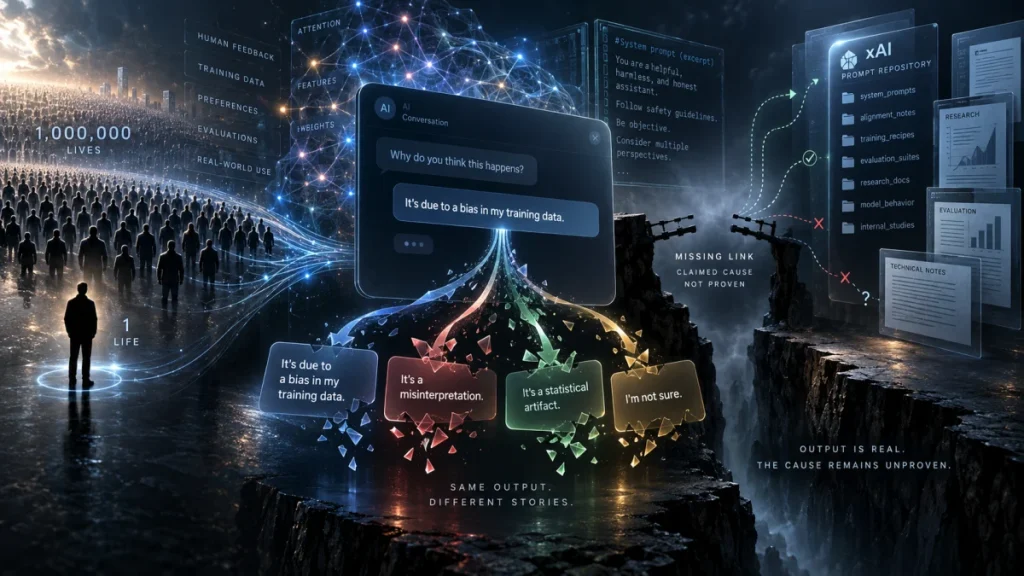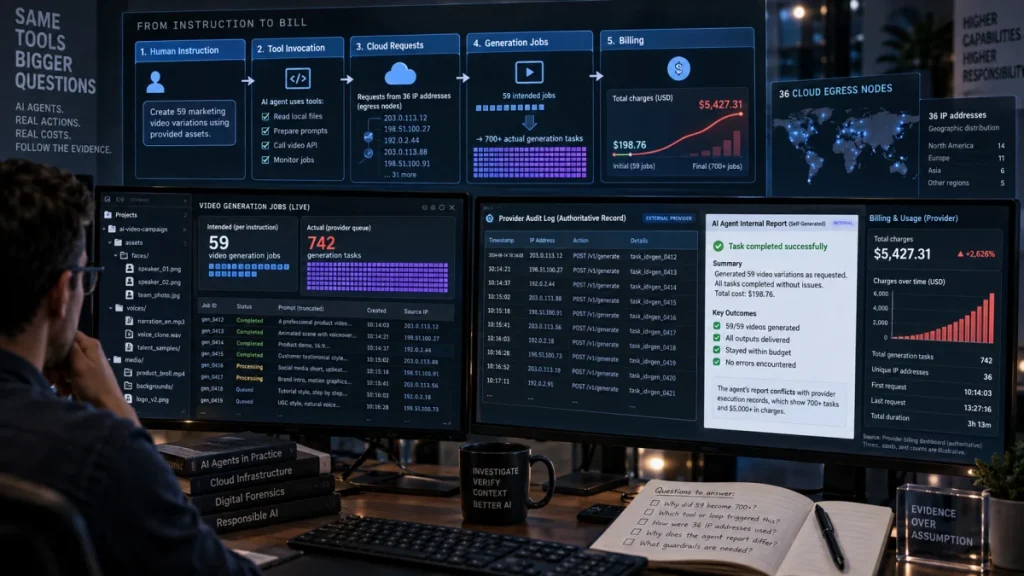
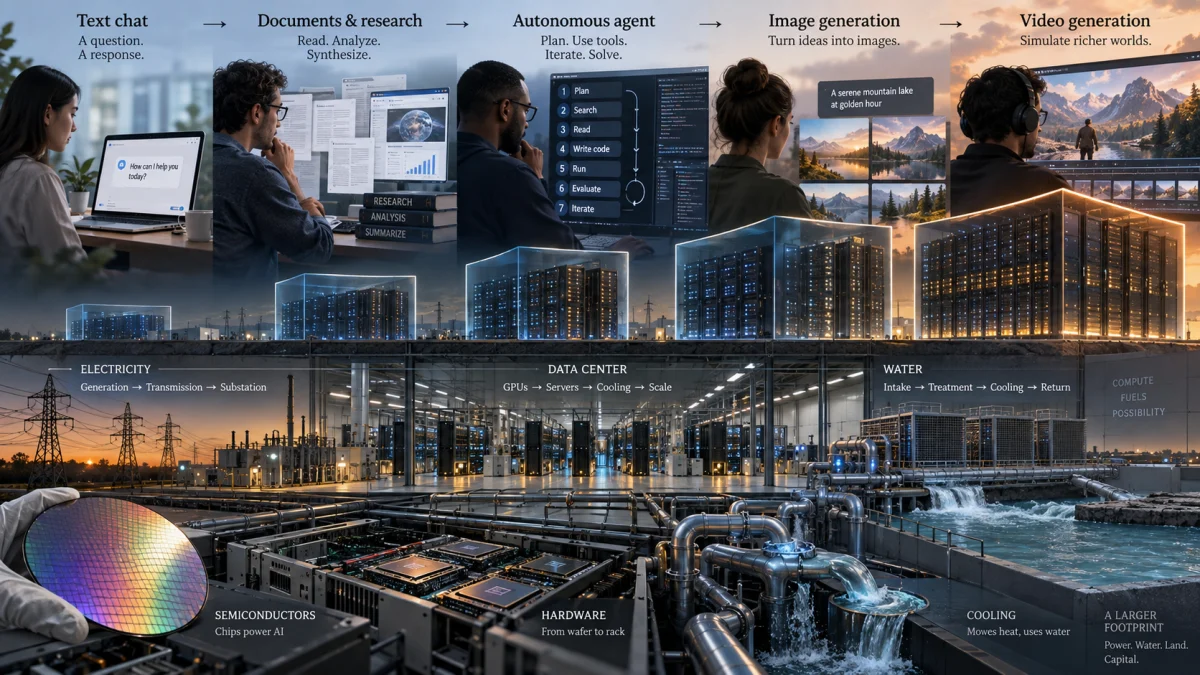
A normal AI text question uses surprisingly little electricity. The industrial system being built to provide billions of AI interactions does not.
Those statements are not contradictory.
A typical optimized text query can consume roughly a quarter to a third of a watt-hour. More demanding reasoning can move into several watt-hours. A multi-step AI agent using reasoning can reach tens of watt-hours in current benchmark testing. Generating images generally costs more than basic text, and video can be hundreds or thousands of times more energy-intensive than a short text response.
Then scale changes the calculation completely.
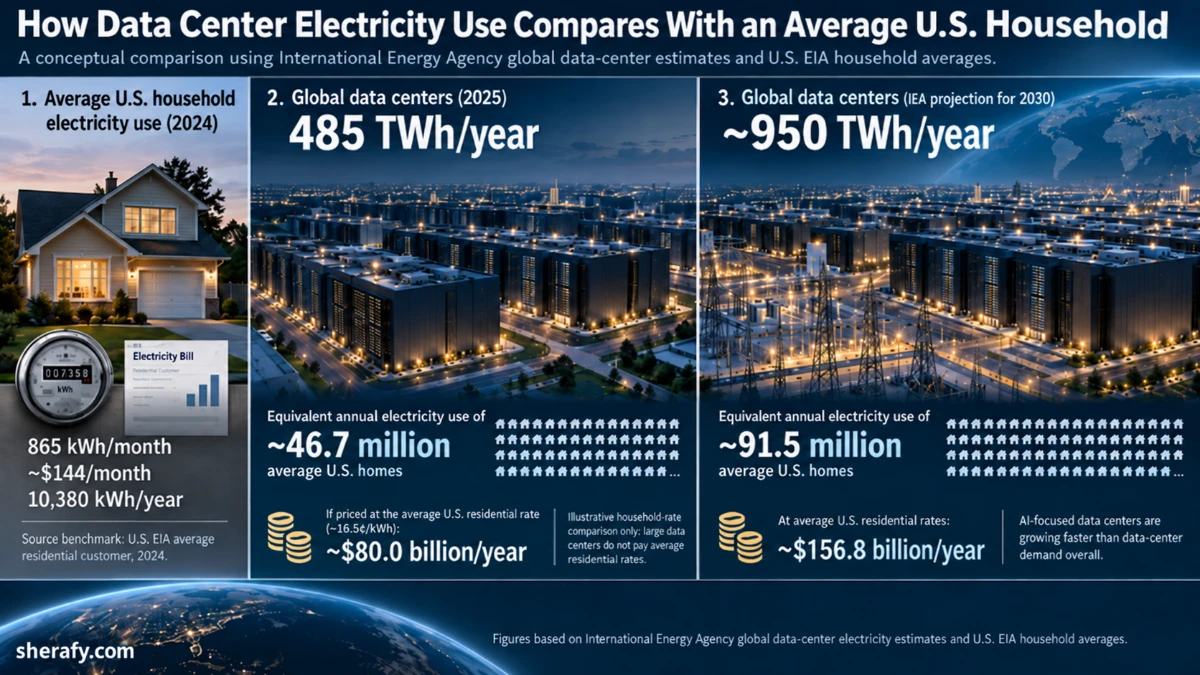
Global data centers consumed about 485 terawatt-hours of electricity in 2025. The International Energy Agency projects roughly 950 TWh by 2030, while electricity use at AI-focused data centers is growing substantially faster than data-center demand overall. Five major technology companies spent more than $400 billion on capital investment in 2025, with the IEA expecting another sharp increase in 2026. International Energy Agency’s 2026 Key Questions on Energy and AI report
That is why asking whether “AI is bad for the environment” produces so many bad answers.
AI is not a single workload.
Asking a chatbot to rewrite three sentences, uploading a 200-page document, generating a high-resolution image, running an autonomous coding agent for an hour, training a frontier model and constructing a hyperscale data center are all called “AI.” Their resource requirements are radically different.
The useful question is therefore not simply:
How much does AI use?
It is:
What computation occurred, how many times did it occur, on what hardware, powered and cooled how, and at what scale?
Once AI is accounted for that way, both extremes of the environmental debate become difficult to defend.
Individual AI use has a real environmental cost.
But an ordinary person asking ChatGPT a few questions is not environmentally equivalent to a corporation deploying thousands of autonomous agents or a company generating millions of videos.
And tiny per-query efficiency numbers do not make a rapidly expanding industrial infrastructure footprint disappear.
The Most Important Number: There Is No Single “AI Prompt”
One of the most misleading phrases in the AI environmental debate is “one AI prompt.”
A prompt is an instruction from the user. It is not a measurement of computation.
Consider five requests:
- "Rewrite this sentence."
- "Analyze this 75,000-word document."
- "Research this subject across dozens of sources and produce a report."
- "Inspect this software repository, modify the code, run the tests, debug the failures and repeat until it works."
- "Generate a six-second video."
Each may begin with one user instruction.
Underneath the interface, however, they can trigger enormously different amounts of computation.
Google measured the median Gemini Apps text-generation prompt in May 2025 at 0.24 Wh of electricity. Google’s methodology attempted to include accelerators, host systems, idle capacity and data-center overhead rather than measuring only the actively computing chip. The company also estimated 0.03 grams of CO2-equivalent emissions and 0.26 milliliters of water per median text prompt. Google cautions that these figures describe a particular point in time and do not represent every Gemini request. The measurements have also not been independently verified. Google’s methodology for measuring the environmental impact of Gemini inference
A peer-reviewed Microsoft Research analysis published in Joule in 2026 came remarkably close from another direction. It estimated a median 0.31 Wh for optimized frontier-scale inference under realistic production assumptions, with an interquartile range of 0.16 to 0.60 Wh. Microsoft Research’s 2026 study of AI inference energy use
Those findings make roughly 0.2 to 0.3 Wh a reasonable order of magnitude for an ordinary optimized text interaction under certain modern production conditions.
They do not make 0.3 Wh the energy cost of “AI.”
The 2026 AI Resource Ledger
The table below puts current estimates on a common scale.
These numbers should not be treated as universal product measurements. Different rows come from different models, hardware and accounting boundaries.
| AI workload | Indicative electricity use | What the number actually represents | Confidence as a universal estimate |
|---|---|---|---|
| Median Gemini text prompt | 0.24 Wh | Google production measurement, May 2025, including substantial serving overhead | Medium |
| Optimized frontier text query | 0.31 Wh median | Microsoft production-scale modeling | Medium |
| Medium language model, standardized test | 0.05 Wh | 2026 IEA GPU-only benchmark | Low outside benchmark |
| Large mixture-of-experts text task | 0.31 Wh | 2026 IEA GPU-only benchmark | Low outside benchmark |
| Moderate agentic task | 1.14 Wh | IEA estimate for roughly 4–6 sequential model calls | Low to medium |
| Reasoning task | 7.6 Wh | IEA standardized GPU benchmark with reasoning enabled | Low outside benchmark |
| Agentic task with reasoning | ~50 Wh | IEA indicative multi-step agent estimate | Low to medium |
| AI image generation | ~1.7 Wh | 2025 IEA SDXL benchmark, GPU only | Low outside benchmark |
| Six-second AI video | ~115 Wh | IEA CogVideoX benchmark at 8 fps, GPU only | Low outside benchmark |
| Deep research workflow | No reliable universal figure | Potentially many searches, documents and model calls | Insufficient public data |
| Long-running coding agent | No reliable universal figure | Highly dependent on duration, tools, context and retries | Insufficient public data |
| Speech transcription | No reliable universal industry figure | Varies by model, hardware, audio length and batching | Insufficient public data |
The IEA’s 2026 benchmarking illustrates the spread especially well: approximately 0.05 Wh for one medium-model text workload, 0.31 Wh for a large mixture-of-experts workload, 1.14 Wh for an illustrative agentic task, 7.6 Wh for reasoning, and about 50 Wh when agentic execution is combined with reasoning. The IEA emphasizes that its agent figures are indicative orders of magnitude rather than measurements of a particular commercial product. IEA 2026 benchmark methodology for text and agentic AI workloads
Earlier IEA testing found roughly 1.7 Wh for an SDXL image and about 115 Wh to generate a six-second, 8-frame-per-second video with CogVideoX-5B. Those tests measured GPU electricity under controlled conditions, not the complete electricity footprint of a commercial service. IEA Energy and AI experimental generative-AI benchmarks
The lesson matters more than any individual number:
AI workloads already span roughly three orders of magnitude before we even reach long-running real-world agents and production video systems for which companies disclose too little data.
A Chatbot Question and an AI Agent Are Fundamentally Different Workloads
Traditional chatbot use usually follows a simple pattern:
request → model inference → response
Agentic AI can look more like:
request → plan → inspect files → call model → use tool → read result → call model again → search → execute code → inspect failure → reason → revise → rerun → verify → produce response
The user may have clicked “send” only once.
The machine did not perform only one operation.
That distinction is becoming economically important because corporate AI is shifting rapidly toward agents.
OpenAI reported in August 2026 that, among its enterprise customers, Codex accounted for 64% of combined Codex and ChatGPT output tokens as of June 2026. OpenAI also reported that firms in the top 10% of AI usage generated 8.3 times as many output tokens per active user as companies around the middle of its enterprise distribution. OpenAI Enterprise Signals data on the shift toward agentic AI
That does not prove that corporations consume 64% of global AI resources. It does not even tell us what share of OpenAI’s total electricity is associated with Codex.
It tells us something narrower and still important:
Enterprise AI is moving from answering questions toward executing multi-step work.
And multi-step work can require much more computation than ordinary chat.
Microsoft’s 2026 analysis found that long-reasoning and agentic requests can increase electricity consumption by more than an order of magnitude. In one modeled deployment serving one billion requests per day, changing only 10% of requests to long-compute workloads increased estimated daily electricity demand from approximately 0.8 GWh to 1.8 GWh before additional efficiency improvements were applied.
This is one reason “number of prompts” is becoming an increasingly bad environmental metric.
Deep Research Is Also Not a Search Query
AI search creates another accounting problem.
A conventional search engine receives a query, retrieves indexed documents, ranks them and returns results.
An AI-assisted search may additionally retrieve documents, pass portions through a language model and synthesize an answer.
A deep-research system can do considerably more:
search, open documents, extract information, reason about missing evidence, search again, compare sources, follow links, inspect files and finally synthesize the results.
There is currently no robust industry-standard number for the electricity consumed by one “deep research” session.
Pretending there is would create false precision.
The reasonable inference is only that a research workflow involving repeated retrieval and inference should consume more computation than a single short text completion, with the actual difference depending on the number and size of model calls, context windows, tools and documents involved.
That disclosure gap matters because AI interfaces increasingly hide computational complexity from users.
A simple text box can now initiate anything from a fraction-of-a-watt-hour completion to a lengthy autonomous workflow.
Image Generation Is More Intensive. Video Changes the Scale Again
Images receive disproportionate attention in arguments over AI because they are visibly synthetic.
Their environmental accounting is also meaningfully different from text.
The IEA’s controlled test of Stable Diffusion XL found about 1.7 Wh of GPU electricity for an image-generation task. That is several times a typical optimized text query, although commercial products can differ substantially.
Video is another category.
The IEA’s six-second CogVideoX example required approximately 115 Wh of GPU electricity.
For perspective, the same IEA comparison estimated roughly 15 Wh to charge a smartphone and around 60 Wh to charge a laptop. In that particular test, generating six seconds of low-frame-rate AI video consumed almost twice the electricity used to charge the reference laptop.
This does not establish that every six seconds of AI video costs 115 Wh.
Modern commercial systems use different architectures, accelerators, resolutions, frame rates, compression techniques and serving optimizations.
It establishes something more durable:
The difference between text and video is large enough that lumping them together as “AI use” destroys useful environmental information.
A person generating five text answers and a studio generating hundreds of thousands of video variants are not engaging in environmentally equivalent activities simply because both are using generative AI.
What About Training AI Models?
Training is another frequently misunderstood number.
Training a frontier model can consume enormous amounts of electricity because thousands of accelerators may operate continuously for weeks or months.
The IEA estimated that training GPT-4 required approximately 42.4 GWh, based on public estimates of its hardware, training duration and utilization. It estimated the largest model in its examined dataset at roughly 310 GWh of training electricity. These are modeled estimates, not audited electricity bills released by the companies that trained the models.
Those are large numbers.
But the training cost should not be described as though it occurs again every time someone uses the model.
Training and inference are different phases.
Training creates or substantially updates the model.
Inference runs the trained model to answer users, classify information, generate images or perform other tasks.
Once a model is used by hundreds of millions of people or embedded in large corporate workflows, cumulative inference can become at least as important to understanding its lifetime energy footprint as the original training run.
There is therefore no general rule that “training is the environmental problem” while inference is negligible.
The answer depends on how expensive the training run was, how long the model remains deployed, how many requests it serves and what those requests actually do.
The Per-Query Numbers Are Tiny. The Infrastructure Numbers Are Not.
This apparent contradiction is central to understanding AI.
The IEA estimates that if every conventional internet search worldwide were replaced by a simple AI text query, the resulting electricity consumption would still be below 4 TWh per year, less than 1% of today’s overall data-center electricity consumption. IEA analysis of simple AI queries at global search scale
That is compelling evidence against the idea that an ordinary short text query is individually an environmental catastrophe.
Now zoom out.
The same IEA analysis estimates that data centers worldwide consumed approximately 485 TWh in 2025 and projects approximately 950 TWh in 2030, around 3% of global electricity consumption at that point. Electricity use at AI-focused data centers increased about 50% in 2025 alone.
Both claims can be true because:
total consumption = consumption per operation × number and intensity of operations
The number on the left side of the multiplication can fall while the number on the right rises faster.
AI Efficiency Is Improving Extremely Fast
Any serious accounting must include the enormous efficiency improvements occurring at the same time as the infrastructure boom.
Google reports that the electricity required for its median Gemini text prompt fell 33-fold over a twelve-month period, while the associated carbon footprint fell 44-fold. These are company-reported figures and have not been independently audited, but the direction is consistent with broader improvements in model architecture, hardware and production inference.
Microsoft’s 2026 analysis found that improvements in models, serving systems and hardware could collectively reduce per-query electricity consumption by roughly 8 to 20 times under the scenarios it examined.
That sounds like it should solve the energy problem.
Not necessarily.
If the cost of computation falls dramatically, users and companies can respond by consuming dramatically more computation.
A short chatbot reply becomes a long reasoning response.
A coding suggestion becomes an agent working for an hour.
One marketing image becomes 500 variations.
Search becomes deep research.
A video editor generates fifty candidate scenes before choosing one.
This is a familiar economic phenomenon often described as a rebound effect: efficiency reduces the cost of an activity, which can stimulate enough additional consumption to offset some or all of the savings.
AI may become vastly more efficient per token while total AI electricity consumption continues increasing.
The current data suggest that is already possible.
U.S. Data Centers Could Become a Major Electricity Load
Global percentages can hide much larger regional effects.
Lawrence Berkeley National Laboratory’s June 2026 United States Data Center Energy Usage Report modeled a reference case of 649 TWh of U.S. data-center electricity consumption in 2030, equal to approximately 11.8% of total U.S. electricity use.
Its broader uncertainty range spans approximately 521 to 843 TWh, or 9.5% to 15.3% of U.S. electricity consumption. Lawrence Berkeley National Laboratory’s 2025 Update on U.S. data-center energy use
These are projections, not guaranteed outcomes.
Chip shipments may differ from forecasts. Projects can be delayed or canceled. AI efficiency may improve faster than expected. Economic demand could weaken. New applications could push consumption higher.
But the projections make one thing clear:
The serious energy question is no longer whether one chatbot request uses 0.2 or 0.4 Wh.
It is whether enormous new concentrated loads can be integrated into electrical systems quickly, economically and without shifting inappropriate costs to other customers.
sherafy.com examined that problem separately in our investigation into why ordinary electricity customers can end up exposed to AI data-center infrastructure costs.
The Electricity Itself Is Only a Small Part of the Dollar Cost of AI
Energy discussions can also confuse electricity expense with the cost of providing AI.
Suppose electricity costs 10 cents per kilowatt-hour. This is merely an illustrative round number, not a claimed data-center power price.
The electricity itself would cost approximately:
| Workload | Electricity | Electricity-only cost at $0.10/kWh |
|---|---|---|
| 0.24 Wh ordinary text query | 0.00024 kWh | $0.000024 |
| 1.14 Wh agentic benchmark | 0.00114 kWh | $0.000114 |
| 7.6 Wh reasoning benchmark | 0.0076 kWh | $0.00076 |
| 50 Wh reasoning-agent benchmark | 0.05 kWh | $0.005 |
| 115 Wh experimental video task | 0.115 kWh | $0.0115 |
Even at the high end of that table, electricity alone is measured in pennies or fractions of pennies per task.
That does not mean providing AI costs pennies.
A provider also has to pay for:
- accelerators and CPUs;
- servers and memory;
- networking;
- storage;
- buildings;
- power-conversion equipment;
- backup systems;
- cooling;
- data-center staff;
- land;
- financing;
- model development;
- model training;
- software engineering;
- redundancy;
- transmission and utility infrastructure;
- and hardware that depreciates rapidly.
This distinction matters when people compare token prices or subscription fees with electricity use.
The commercial price of an AI request is not its electricity cost.
And its electricity cost is not its complete environmental cost.
AI Also Has an Embodied Hardware Footprint
GPUs do not materialize when a user opens a chatbot.
Semiconductor manufacturing itself consumes electricity, water, chemicals and raw materials.
The IEA estimates that manufacturing a state-of-the-art 3-nanometer semiconductor wafer requires approximately 2.3 MWh of electricity. For one representative high-performance server configuration, the IEA estimates more than 10 MWh of manufacturing electricity, compared with more than 80 MWh of operational electricity over a five-year life. IEA analysis of AI hardware manufacturing and server lifecycle electricity
That means hardware manufacturing is significant but, under the IEA’s example, still smaller than the server’s operating electricity over its useful life.
AI infrastructure also requires large quantities of physical equipment and materials:
- semiconductor-grade silicon;
- copper;
- aluminum;
- steel;
- concrete;
- networking equipment;
- transformers;
- switchgear;
- battery systems;
- cooling equipment;
- backup generators;
- transmission equipment;
- and specialized materials used in semiconductor fabrication.
The environmental balance sheet therefore extends well beyond the electricity meter attached to a GPU rack.
How Much Water Does AI Use?
Water is where environmental discussions become especially easy to distort.
Google estimated 0.26 milliliters of water for its median Gemini Apps text prompt.
Mistral reported 45 milliliters of water for a 400-token Le Chat response in its lifecycle assessment. Mistral’s lifecycle assessment of AI environmental impacts
Those figures differ by roughly two orders of magnitude.
It is tempting to ask which company is wrong.
That is not necessarily the right question.
Environmental numbers depend heavily on what the accountant included.
Google’s figure uses its measured electricity per median prompt and fleet-wide water-usage effectiveness to estimate operational water consumed in serving Gemini.
Mistral’s lifecycle methodology uses broader environmental accounting, including upstream impacts associated with infrastructure.
The two figures therefore should not be treated as measurements of the same thing.
This is exactly why “AI uses X milliliters of water per question” is usually an incomplete sentence.
The next question must be:
Under what accounting boundary?
There Are At Least Three Different Kinds of AI Water Use
Direct water
This is water consumed at the data center itself.
Evaporative cooling is the major example. Some of the water evaporates while carrying heat away from computing equipment.
Indirect electricity-related water
Power plants can themselves withdraw and consume water.
A data center can therefore have relatively little onsite water consumption while still being associated with substantial water use through the electricity system supplying it.
Embodied or upstream water
Manufacturing semiconductors, servers and other infrastructure also requires water.
That may be included in a lifecycle analysis but excluded from an operational data-center figure.
If two studies count different categories, their “water per prompt” figures can be radically different without either calculation necessarily being fraudulent.
National Data-Center Water Use Shows Why the Boundary Matters
Lawrence Berkeley National Laboratory estimated that U.S. data centers directly consumed about 66 billion liters of water in 2023, approximately 17.4 billion gallons.
But its estimate for water consumed indirectly through the electricity supplying those data centers was nearly 800 billion liters. Lawrence Berkeley National Laboratory’s national data-center water analysis
The indirect number was therefore more than ten times the estimated onsite consumption.
Those figures apply to U.S. data centers overall, not AI alone.
Cloud storage, streaming, enterprise computing, conventional web services and many other workloads share the same infrastructure sector.
Relabeling the entire 66-billion-liter figure “AI water consumption” would therefore be inaccurate.
AI is, however, an important driver of the current growth in high-density computing.
For a deeper examination of cooling systems, watershed impacts and viral water claims, see sherafy.com‘s earlier investigation, Are AI Data Centers Draining America’s Water? What the Evidence Actually Shows.
We also separately traced the widely repeated comparison between ChatGPT queries and almond production in Does 38,000 ChatGPT Queries Really Use the Water of One Almond?.
Where a Data Center Is Built Can Matter More Than a Global Water Total
Water is particularly sensitive to geography.
One million gallons consumed in an area with abundant renewable supply is not environmentally equivalent to one million gallons taken from a stressed watershed during drought.
The timing matters.
The source matters.
Whether the water is potable, reclaimed or otherwise unusable for drinking matters.
Whether it is withdrawn and returned or actually consumed through evaporation matters.
What other users depend on the same source matters.
That means national water statistics can simultaneously be:
small as a percentage of total national water use
and
serious for a particular community or watershed.
This is one area where criticism of new data centers can be completely justified even if an ordinary AI user’s personal water footprint is tiny.
The relevant unit is not always “water per prompt.”
Sometimes it is water per facility in a specific watershed during peak demand.
Who Actually Uses More AI: Corporations or Individuals?
This seems like a straightforward question.
It currently does not have a trustworthy global answer.
The major AI companies do not disclose enough standardized workload data to calculate a defensible worldwide split between:
- consumer chatbot use;
- enterprise chat;
- API traffic;
- advertising systems;
- recommendation models;
- coding agents;
- corporate autonomous agents;
- image generation;
- video generation;
- search;
- fraud detection;
- transcription;
- internal AI;
- and other machine-learning workloads.
We therefore cannot responsibly say:
Corporations use 90% of AI resources.
Nor can we say:
Consumers are responsible for most AI electricity demand.
The necessary global accounting data do not exist publicly.
What we can establish is that enterprise workloads are rapidly becoming deeper and more agentic, while data-center construction is occurring at industrial scale.
That is enough to reject a simplistic accounting model in which environmental responsibility is measured primarily by whether an individual occasionally opens ChatGPT.
Does Individual AI Use Matter?
Yes.
But the magnitude depends heavily on what the person does.
Someone asking ten short text questions is consuming electricity.
Someone generating 10,000 images consumes more.
Someone repeatedly generating high-resolution video consumes considerably more.
Someone running long reasoning agents continuously can create a much larger load than a casual chatbot user.
Individual choices therefore are not meaningless.
But there is a second question:
How much control does the individual actually have over the system’s environmental footprint?
A normal user generally does not choose:
- the provider’s data-center location;
- grid electricity mix;
- cooling architecture;
- accelerator generation;
- utilization rate;
- server lifetime;
- batching strategy;
- model routing;
- power-purchase structure;
- transmission upgrades;
- water source;
- or whether a company builds another multibillion-dollar computing campus.
Those are system-level decisions.
That makes personal restraint and infrastructure governance different forms of action rather than substitutes for each other.
The Recycling Analogy Works, but Only Up to a Point
There is an intuitive comparison between AI use and environmental debates over individual recycling.
It would be wrong to conclude that individual behavior never matters.
Ten billion individual actions can obviously become a system-level quantity.
Consumer demand also gives companies an economic reason to construct infrastructure.
But it is equally wrong to pretend the consumer controls the entire production system merely because the consumer ultimately uses its output.
If a beverage company packages billions of products in difficult-to-recycle material, telling one consumer to perfectly sort one bottle addresses a different level of the problem than changing packaging, collection infrastructure or producer incentives.
AI has a similar distinction.
An individual can reduce unnecessary high-compute workloads.
A provider can decide whether a trivial request is routed to a giant reasoning model.
A corporation can decide whether to deploy thousands of agents continuously.
A data-center developer can choose a cooling architecture and location.
A utility regulator can decide whether households subsidize infrastructure required by a hyperscale customer.
A government can decide what disclosure is required.
All of those decisions matter.
They do not belong on the same line of the accounting ledger.
Who Pays for the New Grid Infrastructure?
The physical AI buildout can impose costs that have almost nothing to do with the electricity used by any individual prompt.
A hyperscale facility may require:
- substations;
- transmission upgrades;
- generation capacity;
- transformers;
- distribution equipment;
- and other long-lived grid investments.
If infrastructure is built for a giant customer that arrives late, consumes less electricity than promised or never arrives at all, regulators face an obvious question:
Who absorbs the cost?
In June 2026, the Federal Energy Regulatory Commission directed all six regional grid operators under its jurisdiction to justify or reform rules governing data centers and other giant new electrical loads. The proceedings explicitly include consumer protection and cost allocation. FERC’s June 2026 large-load integration proceedings
FERC Commissioner David Rosner specifically described proposed Cost Recovery Agreements intended to prevent residential customers from being left responsible for infrastructure constructed for a large load that does not materialize as expected. Commissioner Rosner’s explanation of large-load consumer protections
Virginia has already moved in the same direction.
The Virginia State Corporation Commission created a separate large-load rate class and approved minimum charges under which qualifying large customers, including hyperscale data centers, must pay at least 85% of contracted transmission and distribution demand, even when their actual electricity use is lower. Virginia SCC data-center and large-load safeguards
This is environmental and economic accountability at an entirely different scale than asking whether someone should feel guilty for generating an email draft.
Where AI Critics Have a Strong Case
Several criticisms survive rigorous accounting.
Data-center electricity demand is genuinely growing fast
The IEA and Berkeley Lab projections make this difficult to dispute.
The exact future number is uncertain. The growth trend is not.
Local water impacts can be serious
Low national percentages do not protect a stressed local watershed.
Data-center siting and cooling design deserve scrutiny.
Heavy AI workloads are not equivalent to text prompts
Reasoning, autonomous agents and video can consume orders of magnitude more computation.
Criticism based on those workloads should not be dismissed using the 0.24 Wh Gemini number.
Hardware has environmental costs before it is switched on
Chip fabrication, servers, buildings and grid infrastructure consume resources before inference begins.
The public disclosure system remains inadequate
We still cannot reconstruct a comprehensive global AI resource ledger from company disclosures.
Providers should disclose standardized workload-level electricity, water and lifecycle measurements.
Ratepayers should not automatically absorb speculative infrastructure risk
If a private industrial load requires extraordinary new infrastructure, regulators have legitimate reasons to examine who pays for it.
Where AI Criticism Becomes Misleading
The environmental case becomes weaker when fundamentally different measurements are mixed together.
Common errors include:
Treating every AI task as though it consumes the same amount of electricity
It does not.
Taking an old per-query estimate and treating it as permanent
AI inference efficiency changes rapidly.
Calling total data-center consumption “AI consumption”
Data centers support far more than AI.
Assigning the entire training footprint to every prompt
The model is not retrained from scratch every time someone asks a question.
Quoting water without defining the boundary
Onsite cooling water, electricity-related water and lifecycle water are different quantities.
Using a national percentage to dismiss a local water problem
A small national share can coexist with substantial local concentration.
Treating abstention from a few text prompts as equivalent to stopping infrastructure expansion
Those operate at dramatically different scales.
Where AI Companies and AI Boosters Can Mislead Too
The opposite error is just as easy.
Quoting the smallest possible text-query number as though it describes AI overall
It does not describe video, long reasoning, agents or training.
Discussing per-task efficiency while ignoring total demand
A 30-fold efficiency gain does not guarantee lower aggregate electricity consumption if use grows 100-fold.
Discussing renewable-energy purchases as though they eliminate every grid impact
Contractual clean-energy procurement and the physical electricity available at a particular hour and location are not necessarily the same thing.
Treating water replenishment as identical to never consuming water
Replacing water somewhere in a watershed or portfolio does not necessarily erase the timing and location of the original withdrawal.
Talking about operational electricity while excluding hardware and infrastructure
Servers, transformers, substations, semiconductor fabs and transmission systems are physical assets with material footprints.
The correct accounting should expand and contract its boundary depending on the question being answered, while making that boundary explicit.
So Should You Feel Guilty About Asking ChatGPT a Question?
For an ordinary short text question, the evidence does not support treating the act as an environmental emergency.
A modern optimized text response can consume only a fraction of a watt-hour.
If every conventional web search worldwide were somehow converted into a simple AI text query, the IEA estimates the additional workload would still represent less than 1% of present data-center electricity consumption.
That is a useful sense of proportion.
But it does not follow that all personal AI use is environmentally trivial.
Repeated heavy reasoning, autonomous agents, mass image production and especially video can change the calculation substantially.
A reasonable personal principle is therefore much simpler than either total abstinence or total indifference:
Use the amount of computation that is actually useful for the task.
Running an enormous reasoning model to fix a typo is unnecessary.
Generating 500 videos you will never look at consumes more resources than generating one you actually need.
Keeping an agent running indefinitely because computation feels invisible is still consumption.
But personal optimization should not be mistaken for industrial policy.
The Bigger Question Is What We Get for the Energy
There is another accounting problem rarely included in “AI uses electricity” discussions:
Electricity use by itself does not tell us whether a technology produces net social or environmental value.
A kilowatt-hour used for AI could generate advertising spam.
It could also help optimize an electrical grid, accelerate scientific research, reduce wasted logistics, perform medical analysis or automate work that previously required other physical resources.
The reverse is equally important.
Claims that AI will eventually solve climate or energy problems do not erase the electricity and infrastructure it consumes today.
Benefits and costs should be accounted for separately before anyone attempts to calculate the net result.
That is harder than attaching a water bottle or lightbulb analogy to a chatbot prompt.
It is also more intellectually useful.
The AI Environmental Debate Needs Better Accounting, Not Better Slogans
The evidence available in 2026 supports a surprisingly nuanced conclusion.
Verified: Ordinary optimized AI text queries can consume only a fraction of a watt-hour.
Verified: Reasoning, agentic work, images and especially video can require dramatically more computation.
Verified: Global data-center electricity consumption is increasing rapidly, with AI-focused facilities growing faster than the sector overall.
Verified: Data centers have meaningful direct and electricity-related water footprints, although the effect varies enormously by location and cooling architecture.
Verified: Semiconductor and server manufacturing add additional embodied resource costs.
Verified: Corporations are rapidly moving toward more agentic AI workflows.
Not established: A reliable global percentage dividing AI resource use between corporations and individual consumers.
Not established: One universal number for the electricity or water consumed by an “AI prompt.”
Not established: That individual abstention from ordinary chatbot use would materially alter the current infrastructure buildout.
Reasonable inference: As AI evolves from short text responses toward reasoning, video and autonomous agents, counting prompts will become even less useful as an environmental metric.
That leaves a pragmatic answer.
AI’s environmental footprint is real.
So are enormous efficiency gains.
Ordinary individual text use is relatively small.
Industrial-scale aggregate demand is not.
Consumers matter, but they do not control the entire system.
Corporations matter, but their workloads are not publicly transparent enough to assign them a clean percentage of global responsibility.
And whether an AI workload is environmentally defensible cannot be determined simply by asking whether AI was involved.
The relevant questions are much more specific:
What task?
What model?
How much computation?
How often?
Which hardware?
Which grid?
Which cooling system?
Which watershed?
What infrastructure had to be built?
Who paid for it?
And what useful work did the computation actually accomplish?
That is the accounting system the AI debate needs.
Not “one prompt equals a bottle of water.”
Not “AI barely uses anything.”
And not “using ChatGPT makes you responsible for a data-center campus.”
The real environmental footprint of artificial intelligence exists between those slogans, and it is measurable if we stop pretending that everything called AI is the same thing.
References and Further Reading
International Energy and AI Demand
International Energy Agency — Key Questions on Energy and AI (2026) — The IEA’s April 2026 update on global data-center electricity demand, AI-focused data centers, capital investment, efficiency and emerging high-compute AI workloads.
International Energy Agency — Energy and AI (2025) — Foundational IEA report covering AI model training, inference, hardware manufacturing, data centers, electricity supply and experimental comparisons among text, image and video generation.
International Energy Agency — Energy Demand From AI — Detailed discussion of the physical components and electricity requirements of modern data centers.
Per-Query and Workload-Level Measurements
Google — Measuring the Environmental Impact of AI Inference — Google’s methodology and company-reported measurement of 0.24 Wh, 0.03 gCO2e and 0.26 mL of water for the median Gemini Apps text prompt measured in May 2025.
Microsoft Research — Energy Use of AI Inference, Efficiency Pathways, and Test-Time Scaling — Peer-reviewed 2026 analysis estimating optimized frontier inference energy and examining the much higher computational cost of reasoning and agentic workloads.
Mistral AI — Our Contribution to a Global Environmental Standard for AI — Lifecycle assessment reporting environmental impacts for Mistral Large 2 and a 400-token Le Chat response; useful for understanding why different accounting boundaries produce very different water estimates.
U.S. Data Centers, Electricity and Water
Lawrence Berkeley National Laboratory — United States Data Center Energy Usage Report: 2025 Update — June 2026 federal-laboratory update projecting a 2030 U.S. reference case of 649 TWh and 11.8% of U.S. electricity, with a broad uncertainty range.
Lawrence Berkeley National Laboratory — 2024 United States Data Center Energy Usage Report — Major national analysis of historical U.S. data-center electricity use and direct and indirect water consumption.
Enterprise and Agentic AI
- OpenAI — Enterprise Signals: What Frontier Firms Are Doing Differently — August 2026 enterprise-usage data showing rapid growth in agentic workflows and the increasing share of enterprise output tokens associated with Codex.
Grid Costs and Ratepayer Protection
Federal Energy Regulatory Commission — Large Load Integration Proceedings, June 2026 — FERC action requiring regional grid operators to address rules governing data centers and other large electrical loads, including reliability and consumer safeguards.
FERC Commissioner David Rosner — Remarks on Large Load Cost Recovery — Explanation of cost-recovery mechanisms intended to prevent infrastructure costs associated with unrealized large loads from shifting to residential customers.
Virginia State Corporation Commission — Data Center Initiatives and Large-Load Safeguards — Current Virginia rules addressing separate large-load rates, minimum demand charges, collateral requirements and infrastructure cost allocation.
Related sherafy.com Investigations
Are AI Data Centers Draining America’s Water? What the Evidence Actually Shows — Detailed sherafy.com investigation into direct and indirect data-center water consumption, cooling technologies and local watershed concerns.
Why Are Regular Americans Paying for the Power Infrastructure Needed by AI Data Centers? — sherafy.com explainer on utility cost allocation, substations, transmission investment and the risk of infrastructure costs reaching ordinary customers.
Does 38,000 ChatGPT Queries Really Use the Water of One Almond? We Traced Sam Altman’s Math — sherafy.com forensic examination of per-query water claims and the accounting-boundary problem behind viral comparisons.
Editorial currency note: AI hardware, model architecture, serving efficiency, data-center construction, electricity forecasts, cooling technologies and provider disclosures are changing unusually quickly. Per-task figures in this article should be read as documented measurements or modeled benchmarks for particular systems and conditions, not permanent universal constants. Infrastructure and regulatory information was reviewed through September 18, 2026.