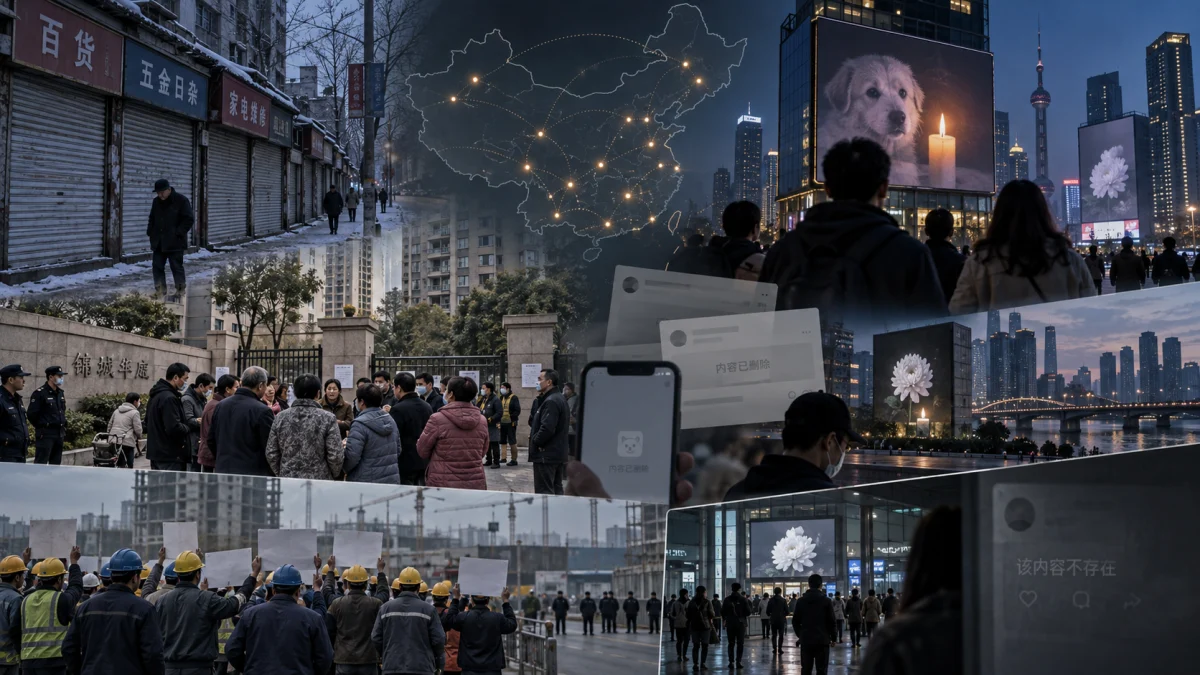
China really is experiencing widespread unrest. But the available evidence does not show one coordinated nationwide uprising against Xi Jinping or the Chinese Communist Party.
Thousands of dissent events have been documented across China, and the number recorded by the best available systematic monitoring project rose sharply through 2025 and the first quarter of 2026. Workers, homeowners, rural residents, small-business owners and other groups have protested over unpaid wages, property disputes, land, regulation, local government decisions and other grievances.
Something potentially important is also happening across provincial lines. Recent campaigns have demonstrated that a protest tactic or emotionally resonant cause can spread rapidly through many cities without an obvious national organization controlling it.
But several of the most dramatic claims circulating online go beyond the evidence.
There is no reliable proof that more than one million Chinese businesses joined an organized political strike. There is no evidence that most current protests are demanding the fall of Xi or the CCP. And because censorship intensified in early 2026, nobody can reliably say that protests have continued increasing nationally every month.
The most accurate description is therefore neither “China is collapsing into revolution” nor “these are just a few isolated incidents.”
China appears to have a large, fragmented and increasingly difficult-to-measure protest ecosystem. What has not yet emerged is a unified national protest movement.
How many protests are actually happening in China?
The strongest public dataset is the China Dissent Monitor (CDM), a Freedom House project that searches Chinese social media, news reports, civil-society sources and other evidence for dissent events.
CDM documented 5,343 events during 2025, compared with 3,704 in 2024—a 44% increase in its observed series. During the fourth quarter of 2025 alone, workers led 54% of documented events, property owners 22%, and rural residents 14%. Labor protests over unpaid wages during the four months preceding the 2026 Lunar New Year were 60% higher than during the comparable period a year earlier.
The trend remained elevated in early 2026. Data CDM provided to the U.S. Congressional-Executive Commission on China showed 1,241 protest events during the first quarter of 2026, up 18.6% from 1,046 during the same period in 2025.
But those numbers need an important qualification.
They are documented events, not a census of every protest in China.
CDM acknowledges that individual cases vary in evidentiary strength. Its strongest verification tier includes dated photos or videos or reporting from a news or civil-society organization. Its middle tier generally requires at least two sources. Its weakest tier can include a single source or confidential partner reporting that readers cannot independently inspect.
That makes CDM extremely useful for understanding patterns. It does not make “5,343” an exact count of every protest that happened in China.
There is even a minor discrepancy in published 2025 totals: Freedom House’s formal report gives 5,343, while a later CECC publication citing data supplied by CDM gives 5,363. We use Freedom House’s formally published 5,343 figure here rather than pretending the dataset has census-level precision.
Documented protest trend
| Period | CDM documented events | Change |
|---|---|---|
| 2024 | 3,704 | — |
| 2025 | 5,343 | +44% |
| Q1 2025 | 1,046 | — |
| Q1 2026 | 1,241 | +18.6% |
| Q2 2026 | 846 | -45% year over year |
The final number creates the biggest interpretive problem in the entire story.
Are protests still increasing in China in 2026?
We do not know.
CDM documented only 846 events in the second quarter of 2026, 45% fewer than during Q2 2025. Taken literally, that would suggest an enormous decline.
But the information environment changed at almost exactly the same time.
Freedom House had previously examined 2,970 Douyin posts concerning protests published between June and December 2025 and found that roughly two-thirds were subsequently deleted. Its 2026 analysis then estimated that approximately 50% fewer protest-related Douyin posts were observable from March through June than before a new censorship campaign began.
China’s Central Cyberspace Affairs Commission did launch a month-long “Clear and Bright” campaign on February 12. The official directive targeted several categories of material, including content deemed to “maliciously stir negative emotions,” misinformation and other undesirable online content. It directed platforms to increase monitoring and removal efforts.
By March 10, authorities said more than 39,000 accounts had been acted against and more than 708,000 pieces of content removed under the campaign.
However, the official directive did not explicitly say “delete protest videos.” Its listed examples concerned issues including gender conflict, marriage and fertility anxiety, conspicuous consumption, online fandom and misinformation.
The strongest conclusion is therefore narrower:
Verified: online enforcement intensified substantially.
Verified: the amount of protest material observable by CDM subsequently fell sharply.
Reasonable inference: censorship probably caused a substantial part of the Q2 decline in documented protests.
Not established: the true number of protests continued rising.
It would also be methodologically wrong simply to double the 846 Q2 events because Freedom House estimated a 50% decline in observable Douyin posts. Those are different measurements with different denominators.
After February 2026, the national protest trend becomes significantly harder to quantify.
What are people in China actually protesting about?
This is where the description of one national “uprising” begins to break down.
In Q2 2026, homeowners represented 36% of the events documented by CDM, workers 24%, and rural residents 18%. The remainder involved parents and students, small-business owners, investors, consumers, petitioners and activists.
These groups frequently have serious grievances, but those grievances are not interchangeable.
Workers may be demanding wages they were not paid.
Homeowners may be protesting a developer or property-management company.
Villagers may dispute land seizures or local decisions.
Small-business owners may object to regulatory enforcement.
Parents may mobilize after a school incident.
People may rally around animal cruelty, environmental concerns or perceived official mishandling of a tragedy.
Explicit opposition to the Communist Party also exists. But the available systematic data do not show anti-CCP or anti-Xi political demands dominating China’s current protest landscape.
That distinction matters.
A country can experience widespread social unrest without experiencing a unified revolutionary movement.
That is the best description of China in 2026 based on presently available evidence.
Is this a nationwide uprising against Xi Jinping?
Not on the evidence we have.
The word uprising implies considerably more than large numbers of individual protests. A genuine national uprising would ordinarily begin showing several of the following features:
- common political demands across unrelated groups;
- recurring national slogans or symbols;
- coordinated demonstrations in multiple major cities;
- solidarity actions in which people protest repression or grievances affecting other groups;
- continued mobilization after local demands are resolved;
- durable networks connecting different protest constituencies;
- anti-government demands at substantial scale;
- signs that ordinary coercive containment is failing;
- eventually, in a much more advanced crisis, meaningful splits within governing or security institutions.
We can see scattered examples of political dissent and increasingly interesting examples of tactical imitation.
We do not see compelling public evidence of the broader combination above.
For now, “protest wave” is defensible. “Nationwide uprising” is premature.
Did one million Chinese businesses really shut down?
This is one of the most dramatic claims circulating in coverage of the current unrest.
The underlying phenomenon is real.
During the spring and early summer, videos and reports showed merchants in parts of Heilongjiang closing their shops amid fear of government inspections and fines.
An overseas protest-monitoring project called Yesterday argues that the shutdowns became a decentralized “nonviolent noncooperation” movement. It says merchants in 34 counties, cities and districts participated between April 25 and June 30 and estimates total participation at more than one million merchants.
That last number is not independently established.
Yesterday is not a neutral statistical agency. Its own description says the project exists not only to document collective resistance in China but also to counter what it regards as the CCP’s false portrayal of social stability and to reduce people’s fear of participating in resistance. That does not make its visual evidence false, but it matters greatly when evaluating extrapolated estimates and political interpretation.
There is also a useful reality check.
According to Heilongjiang’s Fifth National Economic Census, the entire province contained approximately 1.471 million individual business households at the end of 2023. Roughly 724,000 were in wholesale and retail and 197,000 in accommodation and food services.
If “one million merchants” means one million unique businesses, that would represent roughly two-thirds of every individual business household in Heilongjiang—even though Yesterday says the shutdowns occurred in only 34 local jurisdictions.
That does not prove its figure is impossible. “Merchant” could mean people rather than storefronts; corporate businesses may be included; business numbers have changed since 2023; and the claim may represent cumulative participation.
But a figure that large requires a transparent counting method.
Yesterday does not provide enough information to determine whether:
- the same shop was counted again when it closed on multiple days;
- “merchant” means a store, an owner or multiple workers;
- participation outside photographed streets was estimated;
- or how the total was extrapolated to one million.
The responsible conclusion is that a significant multi-city shutdown phenomenon occurred. The claim that more than one million unique merchants participated remains unverified.
Were the merchant shutdowns really political protests?
Not necessarily.
A revealing example comes from Nenjiang, a city in Heilongjiang.
After videos circulated showing shops closed, the local market-supervision authority issued a statement saying merchants had heard rumors that a higher-level inspection team was arriving and would impose large fines.
The government said the rumor was false.
But crucially, it did not deny that businesses had closed.
A reporter subsequently contacted several affected shops, whose owners said they had reopened.
That produces a more complicated picture than either side’s preferred narrative.
Some merchants may have viewed closing as noncooperation.
Some may simply have feared a costly inspection.
Some probably copied neighboring merchants because shutting for a day appeared safer than remaining open.
Those motivations can coexist.
Why would merchants be so afraid of inspectors?
Because the underlying enforcement grievance is not invented.
China’s own Ministry of Justice says it conducted a year-long national campaign against problematic business enforcement, explicitly targeting arbitrary fees, arbitrary fines, excessive inspections, improper property seizures, irregular cross-regional enforcement and “profit-driven enforcement.”
By May 2026, the ministry said authorities had:
- handled more than 66,000 case leads involving problematic enterprise enforcement;
- recovered 30.7 billion yuan in economic losses for businesses;
- reduced administrative inspections by 34%;
- investigated more than 5,900 improper-fee cases;
- corrected more than 440 improper seizure cases;
- and reviewed more than 600 irregular cross-regional enforcement cases.
This is unusually strong evidence because it is effectively an official acknowledgment that the grievance exists.
It does not prove that every rumored inspection was abusive.
It does show that fear of arbitrary or revenue-driven enforcement cannot simply be dismissed as foreign propaganda.
A reasonable inference follows:
If merchants are willing to sacrifice a day’s revenue because they hear that inspectors may be coming, that behavior itself suggests a serious trust problem between at least some small businesses and local regulators.
The Wangwang campaign may tell us more than the merchant closures
The most interesting example of national replication in 2026 may have started with something that was not overtly political at all.
In late June, disturbing footage circulated involving the abuse of a stray dog later widely known as Wangwang and her puppies in Jieyang, Guangdong.
Local authorities confirmed that four people involved were all under 14 and had been sent to specialized schools for education.
Public anger quickly expanded into demands for stronger animal-cruelty protections.
By late August, Kyodo reporting carried by The Straits Times said calls for better animal protection had appeared in more than 100 Chinese cities, including advertisements and public displays. It also reported disappearing social-media posts and warnings to some activists.
Human Rights Watch separately reported paid billboards and other advertisements appearing in more than 100 cities. HRW is an advocacy organization, so this is more useful as corroboration than as a neutral statistical authority.
Yesterday went considerably further and attempted to count the displays.
Unlike its million-merchant estimate, its Wangwang report describes a specific methodology: each included projection or display had photographic or video evidence; material was manually reviewed; duplicate locations were merged; and the same location was counted only once.
The project says it identified 334 distinct screen or projection locations from July 10 through August 3, including 329 that it could geographically locate more precisely. It reported coverage across all 31 mainland provincial-level jurisdictions and 138 prefecture-level areas, based on 522 photos or videos.
Because that dataset has not been independently audited, “334” should still be attributed to Yesterday.
But this claim is materially stronger than the million-merchant estimate because readers can understand how the number was constructed.
Why does Wangwang matter politically if it started as animal welfare?
Because of the way the action spread, not because everyone participating was secretly anti-CCP.
There is no evidence that hundreds of people buying screen advertisements were collectively demanding regime change.
What the campaign demonstrates is that a tactic can be:
- seen in one place;
- copied elsewhere;
- rapidly replicated across distant cities;
- and propagated without an obvious centralized national leadership.
That is a different form of collective action from a traditional organization issuing instructions to local chapters.
Reasonable inference: China is demonstrating the capacity for nationally distributed, leaderless tactical replication even when participants do not share a broader political program.
That deserves attention.
It is not the same thing as a national uprising.
Was someone really arrested for “subversion” over a Wangwang billboard?
A viral claim said so.
The evidence says otherwise.
A purported Hangzhou police notice circulated online claiming that a businessperson responsible for a Wangwang display had been arrested for “inciting subversion of state power.”
The University of Hong Kong’s Annie Lab investigated the document.
It found no corresponding notice on the supposed police branch’s official Weibo or WeChat accounts. More damagingly, the shopping center identified in the alleged notice was located in Shangcheng District, while the document purported to come from the police branch responsible for Xihu District.
There is evidence of real censorship and reported police pressure surrounding Wangwang activism.
That does not make every dramatic story about the crackdown authentic.
This case is a useful warning for following Chinese protest news generally:
Real repression can coexist with fabricated evidence of repression.
Both need to be investigated.
Can protests actually force Chinese authorities to back down?
Sometimes.
On June 27, residents gathered in Hefei, Anhui, to oppose a planned waste-transfer facility near residential areas and schools.
Videos and multiple reports showed hundreds of residents gathering, with some estimates exceeding 1,000, as police moved into the area and confrontations occurred.
Local district officials subsequently appeared before protesters and announced that the project would be cancelled.
There is a caveat: we have not identified a subsequent formal cancellation order publicly documenting that decision, and local authorities did not publish a detailed explanation of the reversal.
So the precise claim should be:
Local officials told protesters the project was cancelled.
The Hefei episode helps explain something important about protest behavior in China.
A narrow protest over one concrete local decision may have a chance of producing a concession without becoming a direct challenge to the political system itself.
That creates an incentive for people to frame grievances locally—even when distrust of government is part of the underlying problem.
Is China’s economy driving the protests?
It is driving some of the pressure, but it cannot explain every protest.
The economic backdrop nevertheless lines up remarkably well with several of the largest protest constituencies.
Official Chinese statistics show that from January through July 2026:
- retail sales increased only 1.2% year over year;
- department-store sales fell 2.4%;
- specialty-store sales fell 1.8%;
- branded exclusive-store sales fell 9.3%.
Fixed-asset investment fell 6.7%, while private investment fell 9.4%.
Real-estate development investment fell 19.2%. New commercial-property sales area dropped 11.8%, sales value fell 13.1%, and new construction starts declined 24%.
Local-government finances also show significant pressure. Local government-fund revenue fell 24.8% through July, while revenue from state-owned land-use-right sales dropped 30.8%. Debt-interest expenditure rose 5.2%.
Those numbers connect naturally to major protest categories:
| Economic pressure | Likely grievance channel |
|---|---|
| Property downturn | Homebuyers, homeowners, developers and property managers |
| Weak small-business conditions | Merchant distress |
| Employer financial problems | Wage arrears |
| Falling land-sale revenue | Greater pressure on local-government finances |
| Weak private investment | Employment and business insecurity |
That does not mean “the economy caused the Wangwang campaign” or every school, land or environmental protest.
It means multiple protest constituencies are operating inside the same difficult economic environment.
Are cash-strapped local governments fining businesses to raise money?
There is enough evidence to ask the question, but not enough to make that nationwide accusation as fact.
Two things are independently established.
First, local governments are under fiscal pressure, including a 30.8% year-over-year decline in land-sale revenue through July.
Second, the Ministry of Justice says authorities discovered and corrected instances of profit-driven enforcement, arbitrary fines and other abuses affecting businesses.
It is tempting to connect those facts into a simple national causal story:
Local governments lost property revenue, so they started fining merchants to replace it.
Public evidence does not justify that conclusion across China.
Some individual cases may fit that pattern. But coexistence is not proof of a single national mechanism or policy.
The defensible conclusion is that fiscal stress and documented revenue-driven enforcement are occurring at the same time, which makes the relationship worth continued investigation.
Why does China’s protest situation look completely different depending on where you look?
Because both Chinese censorship and overseas selection effects distort the picture.
Inside China, a protest may follow a pipeline like this:
event → social-media upload → reduced visibility or removal
That creates an obvious downward bias. People cannot see protests that disappear.
Outside China, however, a different pipeline can form:
surviving video → overseas activist account → compilation with other dramatic incidents → viral “China uprising” narrative
That can create an upward perceptual bias.
The international audience may disproportionately see the largest clashes, most dramatic rumors and most politically charged clips while missing thousands of less spectacular wage, property or land disputes.
This explains how two apparently contradictory impressions can coexist:
“Nobody in China is protesting.”
and
“All of China has risen up against Xi.”
Neither accurately describes the evidence.
The first ignores systematic documentation of widespread dissent.
The second merges thousands of different grievances into a political unity that has not yet been demonstrated.
How does 2026 compare with China’s White Paper protests?
The 2022 White Paper protests are the more useful modern benchmark than Tiananmen.
Those demonstrations followed the deadly Urumqi apartment fire during China’s zero-COVID system. Blank sheets of paper became a recognizable shared symbol. Protesters gathered across multiple cities around the same national policy, and some demonstrations produced unusually explicit political slogans.
A peer-reviewed study published in The China Quarterly in August 2026 describes the White Paper protests as the most geographically expansive mass protests in China since the 1989 Tiananmen uprising. The study analyzed more than 274,000 Weibo messages surrounding the Urumqi fire and subsequent mobilization.
That comparison matters because the current 2026 unrest is different.
2022: more obvious common trigger, common symbolism and national political focus.
2026: numerous grievances, more fragmented constituencies, but intriguing evidence that particular tactics and causes can spread nationally.
In that sense, the current environment may be broader in grievances but less politically unified.
Is this the biggest uprising in China since Tiananmen?
There is no credible basis for that claim.
Older Chinese government statistics are sometimes cited to prove either that present unrest is unprecedented or that it is trivial.
Those comparisons are unreliable.
Chinese authorities historically published figures for categories such as “mass incidents” and “public order disturbances,” including figures in the tens of thousands per year. But definitions changed, datasets were opaque, and those categories do not correspond directly to CDM’s modern methodology.
Putting an old government figure such as “87,000 disturbances” beside Freedom House’s 5,343 documented events and treating them as equivalent would produce a meaningless comparison.
More importantly, recent peer-reviewed scholarship gives the “most geographically expansive since 1989” description to the 2022 White Paper protests, not the events of 2026.
The current wave may eventually develop into something larger.
We are not there yet.
What would show that China’s protest wave is becoming a real national uprising?
The distinction should be based on evidence, not dramatic adjectives.
| Indicator | Evidence in 2026? |
|---|---|
| Many protests in different regions | Yes |
| Shared political demands across unrelated grievances | Limited |
| Common nationwide political symbols or slogans | Limited |
| Tactical imitation across cities | Yes |
| Cross-sector solidarity between unrelated protesters | Limited evidence |
| Coordinated nationwide demonstration dates | Not established |
| Sustained anti-Xi or anti-CCP mobilization at large scale | Not established |
| Major protests continuing after local demands are met | Not established nationally |
| Durable national opposition organization | Not established |
| Security-service or elite defections | No meaningful evidence |
The line to watch is not merely the number of protests.
It is whether protesters with different grievances begin seeing one another as participants in the same political struggle.
That would be a major change.
China protest claim checker
| Claim circulating online | What the evidence shows | Verdict |
|---|---|---|
| “China is experiencing widespread protests.” | Thousands of dissent events have been documented, with a 44% increase in CDM’s observed 2025 series and an 18.6% Q1 2026 year-over-year increase. | Supported |
| “Protests are still increasing every month.” | Post-February censorship makes the current national trend difficult to measure; Q2’s raw count actually fell. | Unknown |
| “One million Chinese businesses went on strike.” | Large-scale closures are documented, but the million-participant figure comes from an activist archive and cannot currently be independently reproduced. | Unverified |
| “The merchant closures were fake.” | False. Shops did close, including cases acknowledged by local authorities. | False |
| “All the closures were political protest.” | Some merchants apparently closed simply because they feared rumored inspections and fines. | Unsupported |
| “China admits abusive enforcement against businesses occurs.” | The Justice Ministry says it corrected more than 66,000 case leads involving problematic enterprise enforcement. | Verified |
| “The Wangwang campaign spread nationally.” | Independent reporting documents activity in more than 100 cities; one visual archive claims 334 distinct display locations. | Strongly supported |
| “Someone was charged with subversion for a Wangwang billboard.” | The viral Hangzhou police document could not be authenticated and contains a jurisdictional inconsistency. | False/unsubstantiated |
| “Most current protesters want Xi Jinping removed.” | Current protest data are dominated by economic and local grievances. | Unsupported |
| “This is the largest Chinese uprising since Tiananmen.” | Current evidence does not establish this; peer-reviewed research gives that modern distinction to the 2022 White Paper protests. | Unsupported |
What is actually happening in China?
The most useful way to understand China’s current unrest may be to distinguish a protest ecosystem from a protest movement.
A movement usually develops a shared identity, common demands, durable organization or recognizable political objective.
An ecosystem can look very different.
Workers can protest unpaid wages.
Homeowners can challenge property managers.
Merchants can close when inspectors are rumored to be coming.
Residents can defeat a local infrastructure proposal.
Animal-welfare advocates can copy a billboard tactic across hundreds of locations.
Those people do not need to know one another or agree on China’s political future.
But they can still learn something from one another:
collective action exists, particular tactics can spread, and authorities sometimes respond.
That is the pattern the evidence presently supports.
Reasonable inference
China may be developing nationally replicable collective action faster than it is developing a nationally unified opposition movement.
That would explain the apparent contradiction at the center of the story.
There are protests everywhere, but no national protest leadership.
A tactic can jump across provinces, while political demands remain local.
Authorities suppress information, but new incidents keep surfacing.
Citizens can win concessions in individual cases without demanding regime change.
None of those facts requires a hidden nationwide revolutionary organization.
They describe a fragmented protest environment capable of rapid imitation.
Whether those fragments eventually develop a shared political identity is the much bigger question.
Bottom line
China is not currently proven to be experiencing one coordinated nationwide uprising against Xi Jinping or the Communist Party. It is experiencing widespread and significant unrest.
Documented dissent rose sharply through 2025 and remained elevated in early 2026. Economic and property pressures are severe. Beijing itself acknowledges major problems with abusive enforcement against businesses. Local demonstrations sometimes produce concessions. And the Wangwang campaign demonstrates that decentralized actions can spread through more than 100 cities even in a heavily censored political environment.
At the same time, the most dramatic viral claims frequently outrun the evidence.
The million-merchant estimate cannot currently be verified. The current protests do not share one national political demand. Censorship prevents reliable measurement of the post-February trend. And fabricated material has entered the same information ecosystem as authentic evidence of repression.
The evidence therefore supports a conclusion more consequential than either extreme:
China has a large, partly hidden ecosystem of social dissent whose components remain politically fragmented but are increasingly capable of copying one another across enormous distances.
If workers, homeowners, merchants, students and other constituencies begin mobilizing not just for their own grievances but for one another’s—and if common political demands start appearing across those actions—the description of the situation would need to change.
That threshold has not yet been crossed.
References and Further Reading
Protest data and methodology
Freedom House — China Dissent Monitor, Issue 11: October–December 2025 The main published source for the 5,343 documented events in 2025, the 44% year-over-year increase, wage-protest trend and Douyin deletion analysis.
Freedom House — China Dissent Monitor, Issue 12: April–June 2026 The principal source for Q2 2026 protest counts, protester composition and the estimated reduction in observable protest posts after intensified censorship.
China Dissent Monitor — Methodology and Verification Tiers Explains CDM’s definition of dissent, source collection and three-tier evidence system.
Congressional-Executive Commission on China — China Monitor #5 Provides CDM’s Q1 2026 figures and documents the project’s 2025 operational interruption.
Chinese censorship policy
Central Cyberspace Affairs Commission — February 2026 “Clear and Bright” Campaign Directive Primary-source description of the campaign targeting material including content characterized as stirring negative emotions.
Cyberspace Administration of China — March 2026 Enforcement Results Primary source reporting actions against more than 39,000 accounts and removal of more than 708,000 pieces of content.
Merchant closures and business enforcement
China Ministry of Justice — 2026 Briefing on the Business Enforcement Rectification Campaign Primary source documenting more than 66,000 problematic enterprise-enforcement leads, 30.7 billion yuan recovered for businesses and official efforts against arbitrary and profit-driven enforcement.
Heilongjiang Statistics Bureau — Fifth National Economic Census, Business Units and Individual Households Primary statistical source showing approximately 1.471 million individual business households in Heilongjiang at the end of 2023.
Yesterday — “The Plague God Is Coming” Heilongjiang Merchant Shutdown Report The original source for the claim that more than one million merchants participated. Useful as a protest archive, but the headline participation estimate remains independently unverified.
Yesterday — About the Project Important for evaluating source provenance and the project’s explicitly activist mission.
Dahe News — Nenjiang Merchants Closed After Inspection Rumors Independent reporting incorporating the local market regulator’s statement and follow-up calls confirming shops had reopened.
Wangwang campaign
China News Service — Jieyang Authorities’ Statement on the Wangwang Case Reports the local government’s confirmation that four people under 14 were involved and sent to specialized schools.
The Straits Times / Kyodo — Wangwang Campaign Spreads Across More Than 100 Chinese Cities Independent reporting corroborating the broad geographic spread of the animal-protection campaign.
Yesterday — Statistical Report on 334 Wangwang Projection Locations Provides the project’s image-based counting methodology, geographic breakdown and underlying evidence totals.
Annie Lab — No Evidence of Hangzhou Police “Subversion” Notice University of Hong Kong fact-check identifying major provenance and jurisdiction problems with a viral purported police document.
Hefei protest
Lianhe Zaobao — Hefei Residents Protest Planned Waste Station Independent regional reporting on the June 27 protest and officials’ announcement that the project would be cancelled.
Radio Free Asia — Hefei Waste-Station Cancellation After Protest Provides additional visual and chronological detail while noting the absence of a later detailed government explanation.
Economic and fiscal context
National Bureau of Statistics of China — Retail Sales, January–July 2026 Primary source for national consumption and retail-format performance.
National Bureau of Statistics of China — Fixed-Asset Investment, January–July 2026 Primary source for national and private investment trends.
National Bureau of Statistics of China — Real-Estate Market, January–July 2026 Primary source for property investment, construction and sales declines.
China Ministry of Finance — Fiscal Revenue and Expenditure, January–July 2026 Primary source documenting the decline in local government-fund and land-sale revenues.
Historical comparison
The China Quarterly — “Subversive Amplification: Online Dissent and the Limits of Information Control in China” Peer-reviewed 2026 study examining 274,721 Weibo messages surrounding the Urumqi fire and describing the 2022 White Paper protests as China’s most geographically expansive mass protests since 1989.
Editorial currency note: This article reflects evidence available through September 8, 2026. China’s protest environment is unusually difficult to measure because online evidence is frequently censored or deleted. Protest totals, government actions and the status of individual movements may change as new evidence becomes available.