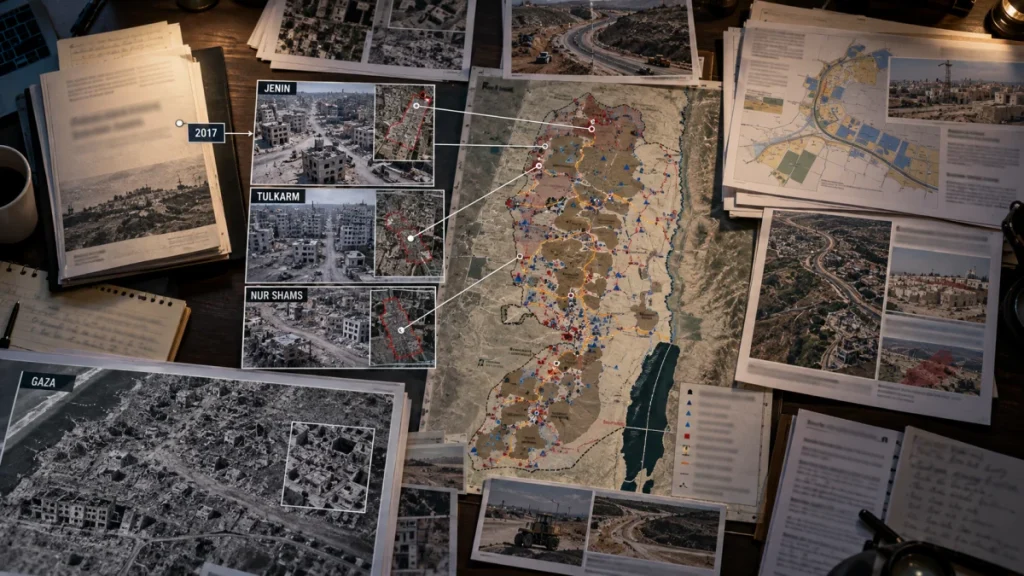
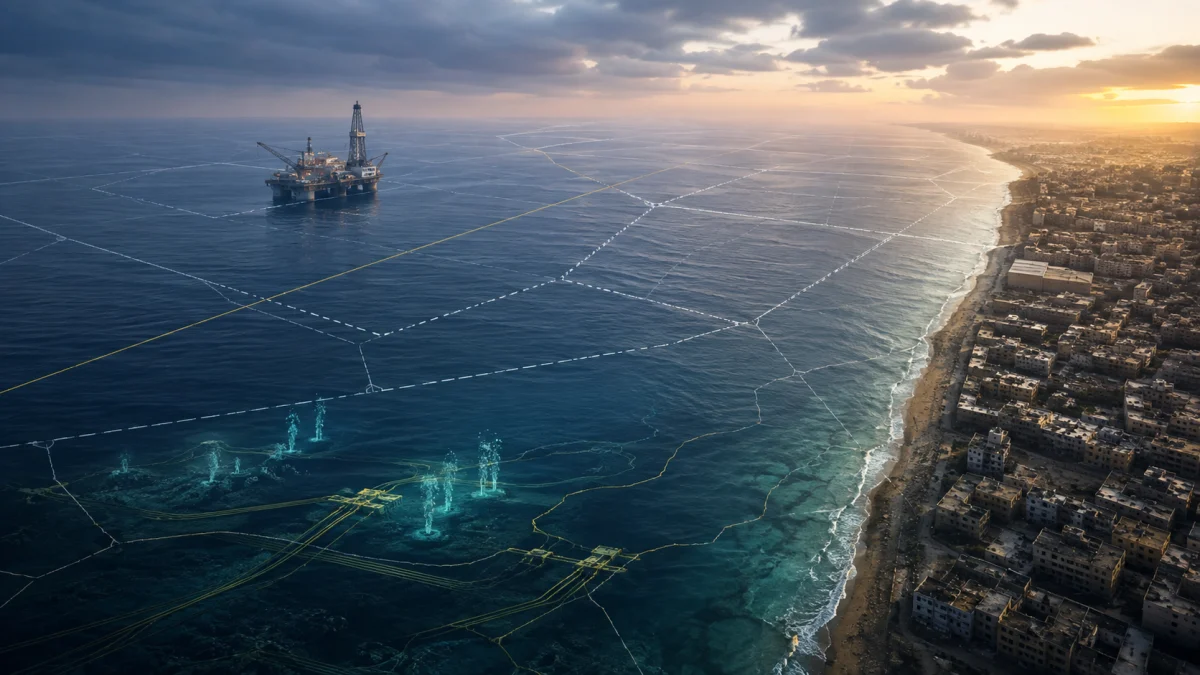
There really is natural gas off the coast of Gaza.
There really has been a decades-long struggle over who can develop it.
And Israel really did select international energy companies for gas exploration in offshore territory that substantially overlaps maritime waters claimed by Palestine.
But those three facts have increasingly been compressed online into a much simpler claim:
“Israel sold Gaza’s natural gas.”
That is not quite what happened.
Israel has not sold the Gaza Marine natural gas field. Gaza Marine is a separately discovered Palestinian offshore field containing approximately 1 trillion cubic feet of recoverable natural gas, or roughly 30–31 billion cubic meters. Palestinian authorities granted its original development rights in 1999, and it has never entered commercial production.
But stopping there would produce a technically correct and deeply incomplete answer.
Israel has exercised decisive practical control over whether Gaza Marine could be developed. And in a completely separate process, Israel selected Eni, Dana Petroleum and Ratio Energies for petroleum exploration rights in Zone G, an offshore area that Palestinian legal organizations say lies approximately 62 percent inside Palestine’s declared maritime boundaries. Eni later confirmed that the formal licenses were never issued, withdrew from the project, and the award remains unresolved as of August 2026.
That is the real story.
To understand it, three things must be kept separate:
| Resource or area | What it is | Current reality |
|---|---|---|
| Gaza Marine | Discovered Palestinian natural-gas field off Gaza | Not sold; still undeveloped |
| Zone G | Separate Israeli exploration zone near Gaza | Winning consortium selected, but licenses were not formally issued |
| Leviathan / Tamar | Major producing Israeli gas fields | Separate resources; not Gaza Marine |
Mixing those together is the source of much of the confusion.
Does Gaza Have Natural Gas?
Yes.
The main known resource is Gaza Marine, located roughly 35 kilometers, or 22 miles, west of the Gaza coast.
The field was discovered around 2000 after British Gas conducted seismic surveys and drilled two exploratory wells under a license granted by Palestinian authorities.
The Palestine Investment Fund, Palestine’s sovereign investment fund and a participant in the project, currently estimates the field at about:
1 trillion cubic feet of natural gas
or approximately:
30–31 billion cubic meters.
That makes Gaza Marine economically significant for Palestine, even though it is small compared with the giant fields elsewhere in the eastern Mediterranean.
Development has been estimated to require approximately $1.3–$1.4 billion in investment. Palestinian plans have envisioned using some of the gas domestically for electricity generation while potentially sending additional production through Egypt.
Who Owns Gaza Marine?
The strongest evidence points to a straightforward answer:
Gaza Marine is a Palestinian resource, not an Israeli gas field.
Palestinian authorities originally granted the development license in 1999 to a consortium led by British Gas. The ownership structure changed over subsequent years as BG was acquired by Shell and Shell later exited the project, leaving the Palestine Investment Fund and Consolidated Contractors Company involved in the Palestinian development consortium.
Palestine also acceded to the United Nations Convention on the Law of the Sea, or UNCLOS, and formally deposited maritime declarations with the United Nations in 2015 and again in 2019. The UN’s Division for Ocean Affairs and the Law of the Sea records both declarations, as well as Israel’s subsequent objection.
There is an important qualification.
Filing maritime coordinates with the United Nations does not itself amount to the UN adjudicating or endorsing every boundary contained in them. The UN Secretariat explicitly warns that publishing such declarations does not constitute a judgment about their validity or the legal status of disputed boundaries.
Israel contests Palestine’s maritime claims.
But that does not convert Gaza Marine into an Israeli field.
International-law scholarship published after the International Court of Justice’s landmark 2024 advisory opinion has become increasingly explicit on this point. A 2025 Leiden Journal of International Law analysis concluded that the State of Palestine possesses the relevant sovereign rights to Gaza Marine under the law of the sea. Even the authors of an earlier controversial article on alternative development models subsequently clarified that the ICJ opinion strengthened the conclusion that Palestinians maintain exclusive rights to develop Gaza Marine.
So Did Israel Sell Gaza Marine?
No evidence shows that Israel sold Gaza Marine.
That distinction matters.
There has been no transfer in which Israel sold the Gaza Marine field to Eni, BP, Chevron or another petroleum company.
There has also been no commercial production from Gaza Marine that Israel could simply have sold to another country as Israeli gas.
In fact, in June 2026, Egyptian Petroleum Minister Karim Badawi was still publicly calling for efforts to revive development of Palestinian offshore gas resources, including Gaza Marine, after years of political and security obstacles.
The field is still waiting to be developed.
But another offshore licensing process occurred nearby.
And that is where the viral claim begins to intersect with something very real.
What Is Zone G?
In December 2022, Israel opened its Fourth Offshore Bid Round, offering petroleum companies several groups of offshore exploration blocks.
One was called Zone G.
In October 2023, Israel announced that a consortium consisting of:
Eni of Italy, Dana Petroleum, a UK-based subsidiary of Korea National Oil Corporation, and Ratio Energies of Israel
had won the competition for six blocks in Zone G.
The announcement came on October 29, 2023, just weeks after the October 7 attacks and the beginning of Israel’s military campaign in Gaza.
That timing understandably attracted attention.
But the chronology matters: the bidding process itself began in December 2022 and companies submitted their bids before the war began.
There is therefore no evidence that Israel created the Fourth Offshore Bid Round after October 7 in order to seize Gaza’s gas.
That does not resolve the separate question of whether Israel had the legal right to offer all of Zone G.
Does Zone G Overlap Palestinian Waters?
According to mapping produced by Palestinian legal organizations, yes—substantially.
Adalah, Al-Haq, Al Mezan and the Palestinian Centre for Human Rights challenged Israel’s licensing process in 2024.
Their geographic analysis concluded that approximately:
62 percent of Zone G falls within maritime boundaries declared by the State of Palestine in 2019.
This does not mean an international court has adjudicated the boundary and declared precisely 62 percent of Zone G Palestinian territory.
It means Israel’s Zone G and Palestine’s formally declared maritime claim geographically overlap by approximately that amount according to the challengers’ mapping.
That distinction matters.
But so does another fact: the dispute was not invented after the licenses were announced. Palestine’s maritime declarations were deposited with the United Nations years earlier, and Israel formally objected to them.
In other words, Israel offered companies exploration territory despite an already-existing competing Palestinian maritime claim.
What Rights Were the Companies Supposed to Receive?
An offshore exploration license is not the same as buying natural gas that has already been discovered.
It can nevertheless be enormously valuable.
Exploration rights allow companies to search for hydrocarbons in the licensed area. If commercially viable gas is discovered and additional regulatory requirements are met, those rights can become the foundation for drilling, development and eventual production.
So describing the Zone G controversy as merely permission to “look around” understates what petroleum exploration rights can lead to.
At the same time, saying Israel simply “sold Gaza’s gas” overstates what actually occurred.
And there is an even more important problem with that wording:
the Zone G licenses apparently never became final.
Eni Says It Never Actually Received the Zone G License
This is one of the most important pieces of the story.
Israel’s October 2023 announcement described Zone G as containing “licenses awarded” to Eni, Dana Petroleum and Ratio.
Many news organizations understandably repeated that wording.
But Eni subsequently made a crucial clarification.
In responses prepared for its 2024 shareholders meeting, Eni said:
no license had yet been issued and no operations were taking place.
Then, in April 2026, Eni made the distinction even more explicit.
The company said that it “never obtained” the Zone G exploration licenses and argued that Israel’s October 2023 announcement represented the result of the selection process rather than completion of the legal process assigning the licenses.
Eni also confirmed that it had withdrawn from the winning consortium.
That materially changes the claim.
Israel did not simply hand Eni ownership of Palestinian gas resources in October 2023.
Israel selected Eni’s consortium to receive exploration rights that were subsequently never formally issued.
Why Did Eni Withdraw?
Eni notified Israel and its partners that it was leaving the consortium and publicly confirmed the withdrawal in March 2026.
The company attributed the move to the rationalization and strategic diversification of its upstream operations.
There has been speculation that political, reputational or security concerns surrounding the project also mattered, but Eni has not publicly established those as its reason.
So they should not be presented as fact.
After Eni left, Dana Petroleum and Ratio attempted to keep the project alive.
That triggered another unusual development.
Israel Then Moved to Cancel the Zone G Award
In May 2026, Israel’s Petroleum Commissioner notified the remaining participants that Eni’s departure would be treated as withdrawal of the consortium and moved toward cancelling its winning status.
Ratio reported that it had identified another international deep-water operator and requested permission to replace Eni.
The deadline was extended.
Then, on June 18, 2026, the Petroleum Commissioner suspended implementation of the cancellation while the matter remained under review. Ratio’s own investor-relations page lists that June 18 filing as its latest Zone G update.
Therefore, as of August 14, 2026, the most defensible description is:
Zone G was awarded at the competitive-selection stage, but the disputed licenses were never formally issued to Eni’s consortium. Eni has withdrawn, and the status of the remaining award is unresolved.
That is very different from saying:
“Israel already sold Gaza’s gas.”
But it is also very different from saying:
“Nothing happened.”
Israel attempted to place a substantial offshore area overlapping Palestine’s declared maritime claim inside its own petroleum licensing system.
That is the underlying controversy.
Israel’s Control Over Gaza Marine Is a Separate Issue
Even though Israel does not own Gaza Marine, Israel has historically possessed enormous practical power over whether Palestinians could develop it.
That difference between legal ownership and effective control is critical.
Development of an offshore field requires drilling vessels, subsea construction, pipelines, security arrangements, financing and access to coastal and maritime infrastructure.
Israel has controlled Gaza’s maritime access for decades.
The Palestine Investment Fund’s history of the project explicitly identifies Israeli restrictions among the obstacles that prevented development. UNCTAD has likewise concluded that Israeli occupation has prevented Palestinians from realizing the economic benefits of their oil and natural-gas resources.
In June 2023, shortly before the current war, Israel announced preliminary approval for Gaza Marine development involving Egypt and the Palestinian Authority.
But even that announcement illustrates the power relationship.
The project was conditioned on Israeli security coordination and what the Israeli government described as protection of its own security and diplomatic interests.
Whatever one thinks those security requirements should have been, the practical consequence is hard to miss:
Palestinians could possess the resource on paper while still requiring Israeli acquiescence to physically develop it.
The war beginning in October 2023 then froze the emerging development arrangement.
As of June 2026, Egypt was again calling for the project to be revived.
Why Has Gaza Marine Sat Unused for More Than 25 Years?
There is no single explanation.
Commercial arrangements changed repeatedly. British Gas became BG Group, BG was acquired by Shell, and Shell eventually exited the project.
Palestinian politics also fractured after Hamas took control of Gaza in 2007.
Security concerns, financing, regional diplomacy and finding purchasers for the gas all complicated development.
But it would be equally misleading to remove Israel from the explanation.
Israeli control over Gaza’s coastline, maritime access and project approvals repeatedly affected whether international developers could proceed.
UNCTAD has gone considerably further, concluding that occupation has prevented Palestinians from exploiting resources that could otherwise contribute to Palestinian energy independence and economic development.
The result is remarkable:
Gaza Marine was discovered around the turn of the millennium, yet more than a quarter-century later, its gas remains underground.
Does Gaza Have Oil Reserves Too?
This is another area where online claims frequently combine unrelated numbers.
Gaza Marine is a natural-gas field.
It is not a proven billion-barrel oil field.
A widely circulated UNCTAD study from 2019 estimated that the broader Levant Basin could contain approximately 122 trillion cubic feet of natural gas and 1.7 billion barrels of recoverable oil.
Those figures describe the wider geological basin shared across the eastern Mediterranean.
They do not mean that Gaza itself contains 1.7 billion barrels of proven oil.
Another number commonly circulated online is approximately 1.5 billion barrels.
That figure has been associated with the Meged oil field, which is connected to the West Bank—not Gaza. UN officials have cited estimates of roughly 1.5 billion barrels in the West Bank while separately discussing more than $2.5 billion worth of natural gas off Gaza’s coast.
There are legitimate arguments over the geological and economic assumptions behind some of those larger oil estimates.
So the safest factual formulation is:
Gaza has a confirmed offshore natural-gas discovery. Claims that Gaza itself has 1.7 billion barrels of proven oil incorrectly relocate broader regional or West Bank estimates to Gaza.
How Much Is Gaza’s Natural Gas Worth?
There is no single correct dollar figure.
That is because gas in the ground does not have a fixed retail value.
Its economic value depends on:
the amount ultimately recoverable, development costs, financing, pipeline and processing expenses, future gas prices, taxes, royalties, operating costs and the terms of long-term sales contracts.
The Palestine Investment Fund itself warns against assigning Gaza Marine a definitive monetary value before a final development plan and long-term gas-sale agreements exist.
Earlier UN estimates have placed the value of offshore Palestinian gas in the billions of dollars, but those figures depend heavily on the gas-price assumptions used at the time.
For Palestine, however, the significance goes beyond the sale price.
A domestic gas supply could reduce dependence on imported energy, support electricity generation, create government revenue and provide a potential export stream.
For a much larger petroleum producer, 1 trillion cubic feet might be a modest field.
For Palestine, it could be transformational.
Is Gaza’s Natural Gas the Reason for the War?
There is not enough evidence to establish that proposition.
Natural resources unquestionably matter geopolitically.
Israel itself describes natural gas as a strategic asset that strengthens its economic and diplomatic position. When launching another offshore licensing round in July 2026, Israeli Energy Minister Eli Cohen explicitly tied natural gas expansion to state revenue, exports, energy security and diplomatic influence.
But strategic importance does not establish causation.
The Fourth Offshore Bid Round began in December 2022, many months before October 7, 2023.
The Zone G companies submitted their bids before the war.
Israel announced the winning consortium after the war began, but the underlying tender was already underway.
That timeline substantially weakens any argument that the Zone G tender itself proves that the Gaza war was launched in order to obtain those exploration blocks.
Likewise, Israel had given preliminary approval for Palestinian development of Gaza Marine in June 2023, months before the war.
None of that means energy resources are irrelevant to the larger history of Gaza.
It means the available evidence supports a narrower conclusion:
Control over Palestinian energy resources has genuine economic and geopolitical significance, but the existence of Gaza Marine does not by itself prove that natural gas was the primary motive for the war.
International Law Matters Here
The International Court of Justice addressed Palestinian natural resources directly in its July 19, 2024 advisory opinion on Israel’s occupation.
The Court concluded that an occupying power is only an administrator and usufructuary of natural resources in occupied territory and that Israel’s exploitation of natural resources in the Occupied Palestinian Territory was inconsistent with its obligations under international law and with Palestinians’ right to permanent sovereignty over their natural resources.
The Court was not specifically deciding the exact maritime boundary of Zone G.
That distinction should not be blurred.
But its reasoning is highly relevant to the broader legal question of whether natural resources associated with occupied Palestinian territory may simply be treated as resources for Israel to commercially allocate for its own benefit.
A later special issue of the Leiden Journal of International Law examined Gaza Marine specifically after controversy over an earlier article.
The journal’s editors acknowledged serious concerns about the original treatment of the field and published extensive responses. Subsequent scholarship concluded that the State of Palestine possesses the relevant rights to Gaza Marine, while even the original authors later stated that the ICJ’s 2024 opinion strengthened their conclusion that Palestinians maintain exclusive rights to develop the field.
Israel Is Opening More Offshore Territory in 2026
The controversy is not purely historical.
On July 6, 2026, Israel launched its Fifth Offshore Bid Round, offering approximately 7,100 square kilometers of additional Mediterranean territory for natural-gas exploration.
The Israeli government says the objective is to increase reserves, expand exports, improve energy security and strengthen Israel’s geopolitical position. Licenses are expected to be granted in 2027.
Palestinian legal organization Adalah had already challenged the planned expansion before the tender was formally launched.
According to its mapping, approximately 1,000 square kilometers of contemplated exploration territory extends into Palestine’s declared exclusive economic zone off Gaza.
Again, that geographic claim is contested by Israel and has not been finally adjudicated by an international maritime tribunal.
But it demonstrates why this issue did not disappear when Eni withdrew from Zone G.
The underlying dispute is larger:
Who has the authority to allocate the natural resources beneath the sea off Gaza?
So What Actually Happened to Gaza’s Gas?
The simplest viral claims fail in opposite directions.
“Israel sold Gaza Marine.”
No. There is no evidence that Israel sold the Gaza Marine field.
“The claim is completely fabricated because Israel never touched Palestinian gas rights.”
That is also misleading.
The documentary record shows that Israel:
controlled whether the Palestinian Gaza Marine project could practically proceed;
required Israeli security and political approval even when development was being negotiated by Palestinian and Egyptian parties;
offered Zone G through its own petroleum bidding system despite substantial overlap with Palestine’s previously declared maritime claim;
selected Eni, Dana Petroleum and Ratio Energies to receive exploration rights there;
and is now pursuing another offshore bid round that Palestinian lawyers say again extends into Palestinian-claimed waters.
Meanwhile, the Zone G story itself did not end the way the original headlines suggested.
Eni never actually received the licenses.
It withdrew.
Israel then moved toward cancelling the consortium’s winning status.
That cancellation was subsequently suspended while Ratio and Dana tried to restructure the project.
So the accurate conclusion is more complicated than the slogan—and more consequential.
The Bottom Line
Gaza has approximately 1 trillion cubic feet of confirmed offshore natural gas in the Gaza Marine field. That field has not been sold by Israel and remains undeveloped.
Palestinian entities, not Israel, originally licensed Gaza Marine, and the strongest contemporary international-law analysis recognizes Palestinian rights to develop it.
But Palestinian legal ownership has existed alongside Israeli practical control over whether development could occur.
Separately, Israel attempted to grant exploration rights in Zone G, an offshore area that substantially overlaps Palestine’s formally declared maritime claim. The winning Eni-Dana-Ratio consortium never received the formal licenses, Eni withdrew, and the project’s status remains unresolved.
And in 2026, Israel opened another major offshore bidding round that Palestinian lawyers say again includes Palestinian-claimed maritime territory.
So if the question is:
“Did Israel sell Gaza’s natural gas?”
the answer is:
No—not Gaza Marine.
But if the question is:
“Has Israel attempted to allocate petroleum rights in waters claimed by Palestine while controlling Palestinians’ ability to develop their own offshore gas?”
the documented answer is:
Yes.
That distinction is not semantic.
It is the difference between repeating an inaccurate viral claim and understanding the much larger dispute underneath it.
References and Further Reading
Palestinian and Primary Project Records
- Palestine Investment Fund — The Palestinian Natural Gas Field: Gaza Marine — Current Palestinian project overview covering the field’s estimated reserves, development cost and Egyptian development discussions.
- Palestine Investment Fund — Gaza Marine: Development Rights, Ownership and Project History — Detailed history of the original Palestinian license, reserve estimates, ownership changes and development obstacles.
- Palestine Investment Fund — New Arrangements for the Gaza Marine Development License — Documents Shell’s withdrawal and restructuring of the Palestinian development consortium.
United Nations and International Law
- United Nations Division for Ocean Affairs and the Law of the Sea — State of Palestine Maritime Declarations — Repository containing Palestine’s 2015 and 2019 maritime declarations, Israel’s objection and subsequent Palestinian communications.
- International Court of Justice — Advisory Opinion of July 19, 2024 — The Court’s opinion addressing occupation, natural-resource exploitation and Palestinian permanent sovereignty over natural resources.
- UNCTAD — The Economic Costs of the Israeli Occupation: The Unrealized Oil and Natural Gas Potential — Detailed UN study of Gaza Marine, Palestinian petroleum resources and wider Levant Basin oil and gas estimates. Important for understanding—and not misusing—the frequently quoted regional reserve numbers.
- UNCTAD — The Impoverishment of Gaza Under Blockade — Economic analysis that specifically recommends enabling Palestinian development of offshore oil and natural-gas resources.
Zone G and Corporate Records
- Eni — April 2026 Statement on the Zone G Exploration Licenses — Eni’s unusually explicit statement that it never obtained the Zone G licenses and that the 2023 announcement represented the outcome of the selection procedure rather than formal assignment.
- Ratio Energies — Immediate Regulatory Disclosures — Company filings documenting Eni’s departure, Israel’s subsequent cancellation decision, deadline extensions and the June 18, 2026 suspension of that cancellation.
- Reuters — Eni Withdraws From Ratio-Dana Offshore Exploration Consortium — Independent reporting confirming Eni’s March 2026 withdrawal and Ratio and Dana’s continuing attempt to obtain the licenses.
Maritime-Overlap Challenges
- Adalah — Challenge to Israeli Gas Exploration Licenses in Palestinian Maritime Areas — Provides the underlying geographic argument and mapping behind the estimate that approximately 62 percent of Zone G overlaps Palestine’s 2019 maritime claim.
- Adalah — 2026 Challenge to Additional Offshore Exploration Near Gaza — Details the claim that roughly 1,000 square kilometers contemplated in Israel’s newest expansion extend into Palestine’s declared EEZ.
Academic Analysis
- Leiden Journal of International Law — “Gaza Marine: The Facts and the Law” — Extensive 2025 legal analysis arguing that the State of Palestine possesses the sovereign rights to Gaza Marine under UNCLOS and examining the history of Israeli restrictions on development.
- Leiden Journal of International Law — Editorial Review of the Gaza Marine Controversy — The journal editors’ examination of factual, legal and editorial concerns raised by an earlier Gaza Marine article.
- Leiden Journal of International Law — Authors’ Reflections on Palestinian Rights to Gaza Marine — Particularly notable because the authors of the earlier disputed analysis subsequently stated that the ICJ’s 2024 opinion strengthens the conclusion that Palestinians retain exclusive development rights.
Current Developments
- Egypt — 2026 East Mediterranean Gas Forum Meeting and Gaza Marine — June 2026 Egyptian government account calling for renewed efforts to develop Palestinian offshore gas resources, including Gaza Marine.
- Israel Ministry of Energy — Fifth Offshore Bid Round, July 2026 — Primary Israeli government record describing the approximately 7,100-square-kilometer new exploration round and its economic, export and geopolitical objectives. It is useful as evidence of Israel’s own stated policy, not as an independent determination of disputed maritime ownership.
Editorial note: Offshore licensing, corporate participation and maritime-boundary disputes remain active matters. This article reflects records available through August 14, 2026. Palestine’s maritime declarations are formally recorded by the United Nations, but publication by the UN Secretariat does not itself adjudicate contested maritime boundaries. Corporate and licensing status should be rechecked if material developments occur after publication.