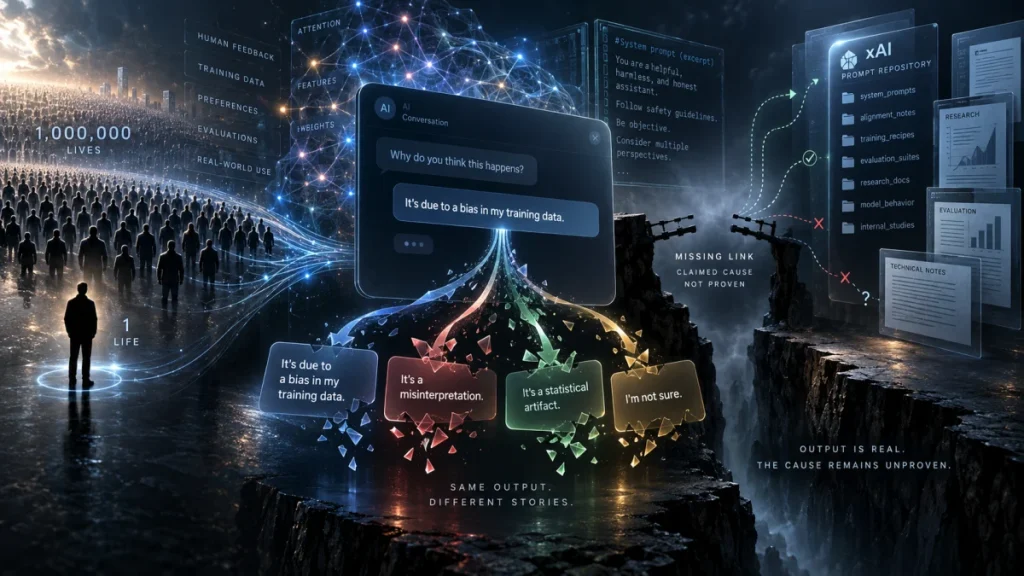
Ghost Murmur is the reported name of a CIA system allegedly used to locate a downed U.S. airman by detecting the magnetic field of his heartbeat from as far as 40 miles away. The rescue happened, and the CIA publicly acknowledged using undisclosed technology. But no public evidence confirms the name, the heartbeat mechanism, the range, or the reported use of diamond quantum sensors. As described in the press, the capability conflicts with the known limits of magnetic sensing.
The intriguing part is that the scientific vocabulary is real. The heart produces a magnetic field. Quantum magnetometers can measure it. Nitrogen-vacancy defects in synthetic diamond can serve as compact magnetic sensors. In January 2026, researchers even reported measuring human cardiac magnetic signals with diamond magnetometers. They did so from about one centimeter away, with extensive noise control and hundreds to thousands of averaged heartbeats—not from an aircraft tens of kilometers away.
Reporting and research status checked July 22, 2026. No official technical description of Ghost Murmur was publicly available at that time.
Short answer
Can the CIA detect a heartbeat from 40 miles away? No publicly demonstrated technology can directly detect the magnetic field of one human heartbeat from that distance. Under a simple magnetic-dipole model, a 100-picotesla cardiac field measured 10 centimeters from the heart would fall to roughly 4 × 10⁻²⁸ tesla at 40 miles. That is far below demonstrated sensor performance and would have to be separated from Earth’s field, geological variation, aircraft noise, electronics, motion, people, animals, and other sources.
The most defensible conclusion is narrower: a classified intelligence capability helped locate the airman, but the public explanation involving long-range heartbeat magnetometry remains unverified and may be incomplete, inaccurate, deliberately misleading, or a cover for a multisensor system.
Key takeaways
- U.S. Central Command confirmed that two F-15E crew members were rescued from Iran in separate operations on April 4, 2026.
- CIA Director John Ratcliffe said the agency used human assets and advanced, undisclosed technology, but he did not publicly identify a heartbeat detector.
- The name Ghost Murmur, its alleged 40-mile range, diamond sensors, and AI heartbeat isolation came primarily from anonymous-source reporting and have not been independently demonstrated.
- The heart’s magnetic field is real and is typically about 50 to 100 picoteslas near the chest.
- Public diamond-sensor experiments have progressed from millimeter-scale animal measurements to human measurements at about one centimeter, still requiring shielding or aggressive noise control and substantial signal averaging.
- Better engineering, sensor arrays, gradiometry, and machine learning can improve a measurement. They do not prevent a magnetic dipole field from weakening approximately with the cube of distance.
What is Ghost Murmur?
On April 5, 2026, U.S. Central Command confirmed that American forces had rescued two service members from Iran after their F-15E was shot down on April 2. The two crew members were recovered in separate search-and-rescue missions.
At a White House briefing the next day, CIA Director John Ratcliffe said the agency had used human assets, deception, and highly advanced undisclosed technologies to locate the second aviator. On April 7, the New York Post reported, citing two unnamed sources, that the capability was called Ghost Murmur. The report attributed to it long-range quantum magnetometry, synthetic-diamond sensors, artificial-intelligence filtering, and the ability to detect a heartbeat at distances approaching 40 miles.
That technical account has not been independently verified. Newsweek said it could not confirm the report, and the Pentagon referred its questions to the CIA. Scientific American interviewed physicists who concluded that the capability, as described, was incompatible with the established behavior of cardiac magnetic fields.
The evidence therefore separates into three layers:
| Claim | Public evidentiary status |
|---|---|
| Two F-15E crew members were rescued | Confirmed by U.S. Central Command |
| The CIA used human assets, deception, and undisclosed technology | Publicly described by the CIA director and reported by major news organizations |
| The system was called Ghost Murmur | Based primarily on anonymous-source reporting |
| It used NV-diamond quantum magnetometers | Unverified publicly |
| It directly detected a heartbeat | Unverified publicly |
| It worked at approximately 40 miles | Unsupported by public technical evidence |
This distinction does not prove that no program named Ghost Murmur exists. It means the specific mechanism and performance claim should not be presented as fact.
The public rescue account already names other ways the airman was found
The official and contemporaneous accounts describe a complex intelligence and rescue operation, not a single magical sensor.
According to Associated Press reporting on the White House briefing, the injured weapons systems officer contacted U.S. forces with what President Donald Trump called a sophisticated beeper-like device. Trump also said intelligence personnel observed movement in the mountains, kept a camera on the suspected person for about 45 minutes, and identified him when he moved again. Ratcliffe described human assets, classified technology, and a deception campaign that misdirected Iranian searchers.
Those details matter. They establish several observable inputs—an emergency transmission, imagery, human intelligence, prior knowledge of the crash area, and enemy-search behavior—that could be fused to narrow and authenticate a location. None proves what the CIA’s classified contribution was. But they show why long-range magnetic detection of the heart is not required to explain the publicly known rescue sequence.
The classified element could still have been extraordinary. It could also have been an improved way to detect or authenticate the survivor’s signal, a surveillance platform, a distributed sensor network, a compromised adversary system, or software that combined multiple imperfect clues. The available evidence does not choose among those possibilities.
Does the human heart produce a magnetic field?
Yes. Heart muscle contracts through coordinated electrical activity. Moving electric charge produces a magnetic field, so the currents that drive each cardiac cycle create a weak field outside the body. Measuring that field is called magnetocardiography, or MCG.
The field is tiny. A 2023 scientific review, Biomagnetism: The First Sixty Years, places the cardiac field near the chest at roughly 50 to 100 picoteslas. One picotesla is 10⁻¹² tesla. By comparison, the National Oceanic and Atmospheric Administration gives Earth’s surface magnetic field as approximately 25,000 to 65,000 nanoteslas—about 25 million to 65 million picoteslas.
The fact that Earth’s field is much larger does not make cardiac measurement impossible. Much of the geomagnetic field changes slowly and can be modeled or subtracted. The problem is that real environments also contain time-varying fields and spatial gradients. A sensor that vibrates or rotates through Earth’s field can turn an otherwise steady background into changing noise in the same frequency range as the heartbeat.
Gerhard Baule and Richard McFee published the first human heart-field measurement in 1963. They worked at a remote outdoor site, used two coils to reject common background signals, and wound about two million turns of wire around their detector. In 1970, David Cohen, Edgar Edelsack, and James Zimmerman recorded clearer magnetocardiograms with a superconducting magnetometer inside a shielded room.
Modern SQUID, optically pumped, and other magnetometers are better and can sometimes operate with less shielding. The recurring design problem remains the same: sensitivity is useful only when the instrument can preserve the desired signal against environmental, thermal, electronic, mechanical, and biological noise.
How a nitrogen-vacancy diamond magnetometer works
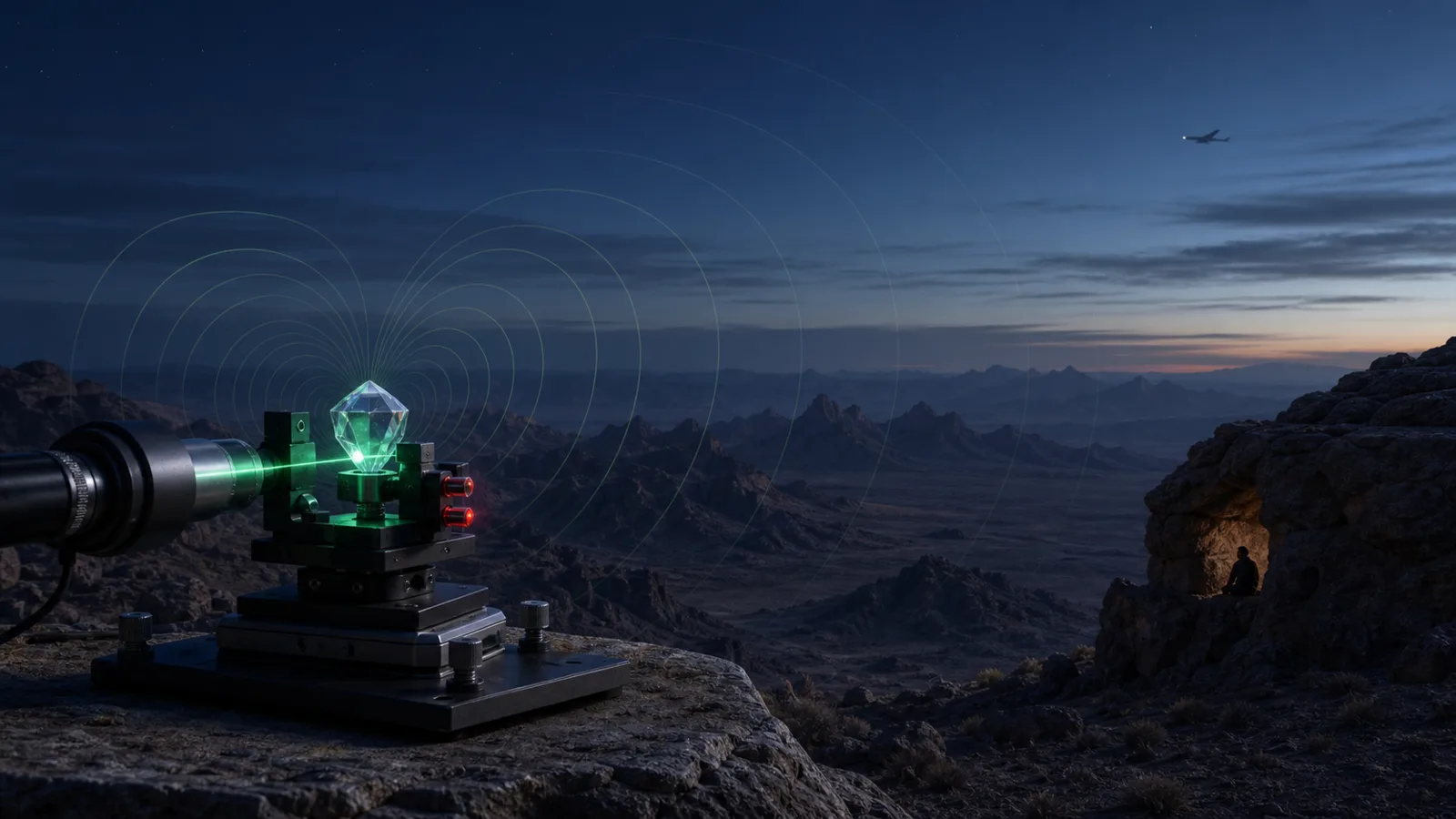
A nitrogen-vacancy, or NV, center is a deliberately useful defect in diamond. One carbon atom in the crystal lattice is replaced by nitrogen, and an adjacent carbon site is left vacant. Electrons associated with that defect have quantum spin states whose energy spacing changes with the local magnetic field.
The measurement process sounds exotic but is conceptually straightforward. As NIST explains:
- Green light prepares the NV centers and makes them emit red fluorescence.
- Microwaves drive transitions between the electron-spin states.
- A magnetic field shifts the microwave frequencies at which those transitions occur.
- The transition changes the red fluorescence.
- Measuring that change reveals the field’s strength and, with suitable geometry, its direction.
This is optically detected magnetic resonance. “Quantum” describes the sensing mechanism; it does not exempt the incoming magnetic field from ordinary spatial attenuation.
NV sensors are genuinely attractive. They can operate at room temperature, tolerate a wide range of conditions, use very small sensing volumes, and be arranged for vector measurements or gradiometry. Their compactness could eventually make some biomagnetic measurements more portable than systems based on cryogenic SQUIDs.
What diamond magnetometers have actually detected
Public research has moved quickly, and the newest human result is especially relevant to Ghost Murmur.
| Demonstration | Sensor-to-source conditions | What it establishes |
|---|---|---|
| 2016 neural action-potential experiment | Biological specimen immediately adjacent to the diamond sensor | NV centers can detect weak, fast biomagnetic signals at close range |
| 2022 living-rat MCG | Thoracotomy; exposed heart positioned about 0.6–2.0 mm from the diamond | Millimeter-scale cardiac magnetic imaging is possible with NV sensors |
| 2024 living-rat MCG | Noninvasive measurement with the sensor about 5 mm above the chest | Diamond MCG can work through the intact chest at millimeter range with flux concentration and averaging |
| January 2026 human MCG preprint | One configuration about 1 cm from the chest; shielded, partially shielded, and unshielded setups | Human cardiac fields can be measured with compact diamond sensors, but current systems still require major noise suppression and averaging |
The 2022 rat study was impressive precisely because the researchers achieved millimeter-scale mapping. It was also invasive: the animals underwent thoracotomy, the heart was exposed and lifted, and the sensor was placed within 0.6 to 2.0 millimeters of its surface.
In 2024, another team reported noninvasive magnetocardiography of a living rat. The sensor sat about five millimeters above the chest and detected an approximately 20-picotesla cardiac signal. The system used magnetic flux concentrators, synchronization with an electrocardiogram, and accumulation of repeated cardiac cycles.
The most revealing benchmark came in January 2026. In a preprint titled Human Cardiac Measurements with Diamond Magnetometers, three research groups reported direct, noncontact human MCG using NV-diamond sensors with sensitivities of 6 to 26 picoteslas per square-root hertz. In one configuration, the sensor was about one centimeter from the chest in a shielded room. The displayed results used 300, 2,000, or 12,000 averaged heartbeats, depending on the sensor. The researchers explicitly identified real-time detection and operation beyond controlled environments as remaining challenges.
That is not evidence against diamond sensing. It is evidence of real progress—and a public yardstick. The gap between a one-centimeter, averaged laboratory measurement and a real-time 40-mile airborne measurement is not a routine classified advantage. It spans an enormous difference in signal strength, noise, motion, source confusion, and localization.
The inverse-cube calculation behind the skepticism
Far enough from the heart, its field can be approximated as a magnetic dipole. A dipole field decreases approximately as the inverse cube of distance:
B(r) = B(r₀) × (r₀ / r)³
For an order-of-magnitude illustration, assume a cardiac field of 100 picoteslas at 10 centimeters. This is a favorable, simplified starting point. It ignores body orientation, source geometry, terrain, and the difference between detecting a field and locating its source.
| Distance from heart | Idealized field | Field in teslas | Drop from 10 cm |
|---|---|---|---|
| 10 cm | 100 pT | 1 × 10⁻¹⁰ T | Reference |
| 1 m | 0.1 pT | 1 × 10⁻¹³ T | 1,000× weaker |
| 10 m | 0.0001 pT | 1 × 10⁻¹⁶ T | 1 million× weaker |
| 100 m | 0.0000001 pT | 1 × 10⁻¹⁹ T | 1 billion× weaker |
| 1 km | 0.0000000001 pT | 1 × 10⁻²² T | 1 trillion× weaker |
| 40 miles, about 64 km | approximately 4 × 10⁻¹⁶ pT | approximately 4 × 10⁻²⁸ T | approximately 260 quadrillion times weaker than at 10 cm |
The exact last digit is not the point. A human body is not a perfect point dipole, and near-field measurements depend on position and orientation. The calculation shows the scale of the problem. Going from centimeters to tens of kilometers removes roughly 18 orders of magnitude from an already weak signal.
More sensors do not automatically restore those orders of magnitude. A large array can collect more information, improve direction estimates, and average independent noise. A flux concentrator can increase the field at the sensing element by gathering flux over a larger area. Gradiometers can reject distant common-mode interference. None makes the original cardiac field decay more slowly in free space.
Why an aircraft makes the measurement harder
The simplified distance table excludes the environment in which Ghost Murmur supposedly operated.
An aircraft or drone carries motors, generators, batteries, power electronics, wiring, radios, current loops, magnetic materials, and moving mechanical parts. Its attitude changes relative to Earth’s field. Vibration moves the sensor through field gradients. Terrain contains magnetic variations. Power systems, vehicles, weapons, rescue personnel, Iranian searchers, wildlife, and the platform itself can all produce signals larger than the cardiac field being sought.
There is also a dynamic-range problem. A sensor must remain responsive in a background tens of millions of picoteslas strong while extracting a target measured near the body in tens of picoteslas—and, under the 40-mile model, vastly smaller still. Shielding, active compensation, calibration, and gradiometry help, but an airborne instrument cannot casually reproduce a stationary laboratory.
Finally, detection is not localization. A periodic magnetic variation does not by itself reveal a unique distance, direction, identity, or position behind terrain. A practical system would need multiple spatial measurements, a source model, motion or triangulation, and enough signal structure to distinguish the target from every other periodic or biological source.
What artificial intelligence can—and cannot—do
Machine learning could materially improve a real sensor system. It can learn recurring platform noise, classify waveforms, combine multiple sensors, detect periodicity, fuse infrared or radio data, and rank likely locations. If an aircraft’s magnetic signature is stable enough to characterize, software may remove part of it.
But AI works on measured information. When a target signal is below the combined sensor and environmental noise floor, a model can still produce an answer; it cannot guarantee that the answer came from the target rather than from assumptions, artifacts, or false correlations. Averaging also has limits when the source moves, the sensor moves, the background changes, and there are not thousands of repeatable cycles available.
The useful rule is simple: machine learning can improve an instrument, but it cannot repeal the inverse-cube law.
Could classified technology be far ahead of public research?
Certainly. Classified programs can use better materials, larger arrays, specialized platforms, superior calibration, undisclosed signal-processing methods, and years of engineering that never appears in journals. Intelligence systems also succeed through integration: several ordinary clues, collected secretly and combined well, can become an extraordinary operational advantage.
That possibility does not validate every public description of a classified tool. Detecting a human heartbeat magnetically from 40 miles would require more than moving a public experiment a generation or two forward. It would have to bridge an immense signal gap while solving platform contamination, real-time measurement, source separation, and geolocation.
The scientifically responsible position is therefore open but skeptical. A classified capability cannot be ruled out merely because it is classified. It also cannot be established merely because officials decline to explain it.
What Ghost Murmur might actually have been
Several explanations fit the public record better than a literal 40-mile cardiac magnetometer. Each remains a hypothesis.
- Advanced beacon geolocation or authentication. The airman used an emergency transmitter. A classified receiver network might detect weak, brief, directional, or low-probability-of-intercept signals and distinguish a real survivor from a trap.
- Multisensor intelligence fusion. Imagery, infrared, radar, radio direction finding, terrain, the crash location, enemy movements, and human reporting could be combined into one narrowing system.
- A different kind of life detection. Radar can infer breathing or heartbeat-related body motion at much shorter ranges. A source could have confused radar micro-motion sensing with direct detection of the heart’s magnetic field.
- A real program described inaccurately. “Ghost Murmur” could be a platform or software suite whose public explanation protects the true source and method.
- A cover story, exaggeration, or source joke that hardened into a technical narrative. Intelligence services benefit when adversaries misunderstand collection methods, and anonymous descriptions containing “quantum,” “AI,” and “synthetic diamond” can acquire credibility through repetition.
The White House account’s transmitter and camera details make the first two possibilities particularly relevant, but they do not prove either one.
The real future of diamond quantum sensors
Rejecting the 40-mile claim does not diminish NV-diamond magnetometry. The technology is advancing toward applications that are both less cinematic and more plausible.
NIST’s current program focuses on precision navigation. An aircraft or drone can compare measurements of Earth’s crustal magnetic field with magnetic maps and inertial data. Unlike GPS, this approach does not depend on a satellite signal that can be jammed or spoofed. DARPA likewise identifies positioning, navigation, timing, and magnetic-field sensing as important military quantum applications.
Other credible directions include:
- portable heart and brain magnetic measurements;
- high-resolution current and material imaging;
- magnetic anomaly detection;
- detection of magnetic tracers in medical procedures;
- compact vector magnetometers and gradiometers;
- equipment monitoring and non-destructive testing; and
- navigation where external radio signals are unreliable.
These uses exploit what diamond sensors actually do well: operate at room temperature, remain compact and robust, measure magnetic-field vectors, and place a sensing element very close to a source.
Verdict: is Ghost Murmur real?
The public record supports a calibrated answer:
| Proposition | Verdict |
|---|---|
| The human heart creates a measurable magnetic field | True |
| Quantum magnetometers can measure cardiac fields | True |
| NV-diamond sensors can measure animal and human cardiac signals | True at close range under controlled or noise-managed conditions |
| The CIA used classified technology during the Iran rescue | Publicly acknowledged in general terms |
| That technology was called Ghost Murmur | Reported but not officially confirmed publicly |
| It directly detected one person’s heartbeat from about 40 miles | Unverified and inconsistent with publicly demonstrated magnetometry |
| A classified system helped locate the airman through some other combination of methods | Plausible, but the mechanism remains undisclosed |
The most interesting truth may not be that an intelligence agency can hear a heartbeat across a desert. It may be how easily several real scientific ideas—biomagnetism, quantum sensing, synthetic diamond, and AI—can make an unsupported capability sound inevitable.
Frequently asked questions
What is Ghost Murmur?
Ghost Murmur is the reported name of a classified CIA capability allegedly used during the April 2026 rescue of a downed U.S. airman in Iran. Its name and technical mechanism have not been publicly confirmed by the CIA.
Can a human heartbeat create a magnetic field?
Yes. Electrical currents in the heart create a weak magnetic field outside the body. Magnetocardiography measures that field, usually with extremely sensitive sensors near the chest.
Can a heartbeat be detected from miles away?
No public demonstration has directly detected the magnetic field of an individual heartbeat from miles away. Published human diamond-sensor work has operated at approximately centimeter range and required extensive averaging and noise control.
What is an NV-diamond magnetometer?
It is a quantum sensor that uses nitrogen-vacancy defects in diamond. Light, microwaves, and changes in electron-spin resonance allow the device to measure magnetic fields at room temperature.
Did diamond sensors really measure a human heartbeat?
Yes, according to a January 2026 preprint from a multi-institution research team. The study used sensors with 6 to 26 picoteslas-per-square-root-hertz sensitivity, close sensor placement, shielding or other noise controls, and hundreds to thousands of averaged heartbeats.
Could AI isolate a heartbeat from background noise?
AI can identify patterns and remove modeled interference when a usable signal reaches the sensor. It cannot reliably recover target information that is absent from the measurements or buried irretrievably below changing physical noise.
What are the most plausible military uses of diamond magnetometers?
Magnetic navigation in GPS-denied environments, compact vector sensing, magnetic anomaly detection, equipment monitoring, and close-range biomagnetic sensing are more consistent with public research and official programs.
References and further reading
Rescue and Ghost Murmur reporting
- U.S. Continues Strikes into Iran After Successful Rescue of F-15E Aircrew — U.S. Central Command, April 5, 2026; official confirmation of the two rescues.
- Trump details rescue of U.S. crew downed in Iran — Associated Press, April 6, 2026; transmitter, imagery, deception, aircraft, and official statements.
- The secret CIA tool that helped find an airman downed in Iran — New York Post, April 7, 2026; original anonymous-source account of Ghost Murmur’s alleged mechanism.
- What Is Ghost Murmur? Secretive CIA Tool Linked to Iran Airman Rescue — Newsweek, April 8, 2026; follow-up reporting and explicit independent-verification caveat.
- Is the “Ghost Murmur” quantum device possible? Scientists are skeptical — Scientific American, April 8, 2026; physicists assess the long-range heartbeat claim.
Biomagnetism and cardiac measurement
- Detection of the Magnetic Field of the Heart — Gerhard Baule and Richard McFee, American Heart Journal, 1963; first published human MCG measurement.
- Magnetocardiograms Taken inside a Shielded Room With a Superconducting Point-Contact Magnetometer — David Cohen, Edgar A. Edelsack, and James E. Zimmerman, Applied Physics Letters, 1970.
- Biomagnetism: The First Sixty Years — Bradley J. Roth, Sensors, 2023; historical and technical review of heart, nerve, and brain magnetic measurements.
Diamond quantum-sensor research
- Sensitivity Optimization for NV-Diamond Magnetometry — John F. Barry and colleagues, Reviews of Modern Physics, 2020.
- Optical Magnetic Detection of Single-Neuron Action Potentials Using Quantum Defects in Diamond — John F. Barry and colleagues, Proceedings of the National Academy of Sciences, 2016.
- Millimetre-Scale Magnetocardiography of Living Rats With Thoracotomy — Keigo Arai and colleagues, Communications Physics, 2022.
- Noninvasive Magnetocardiography of a Living Rat Based on a Diamond Quantum Sensor — Ziyun Yu and colleagues, Physical Review Applied, 2024.
- Human Cardiac Measurements With Diamond Magnetometers — Muhib Omar and colleagues, arXiv preprint, January 2026; not yet treated here as peer-reviewed.
- Nitrogen-Vacancy Center Magnetometry — National Institute of Standards and Technology, updated May 2026; operating principles, advantages, and navigation applications.
For more evidence-led explainers, browse Sherafy’s research and projects archive and read how Sherafy approaches verification and uncertainty.