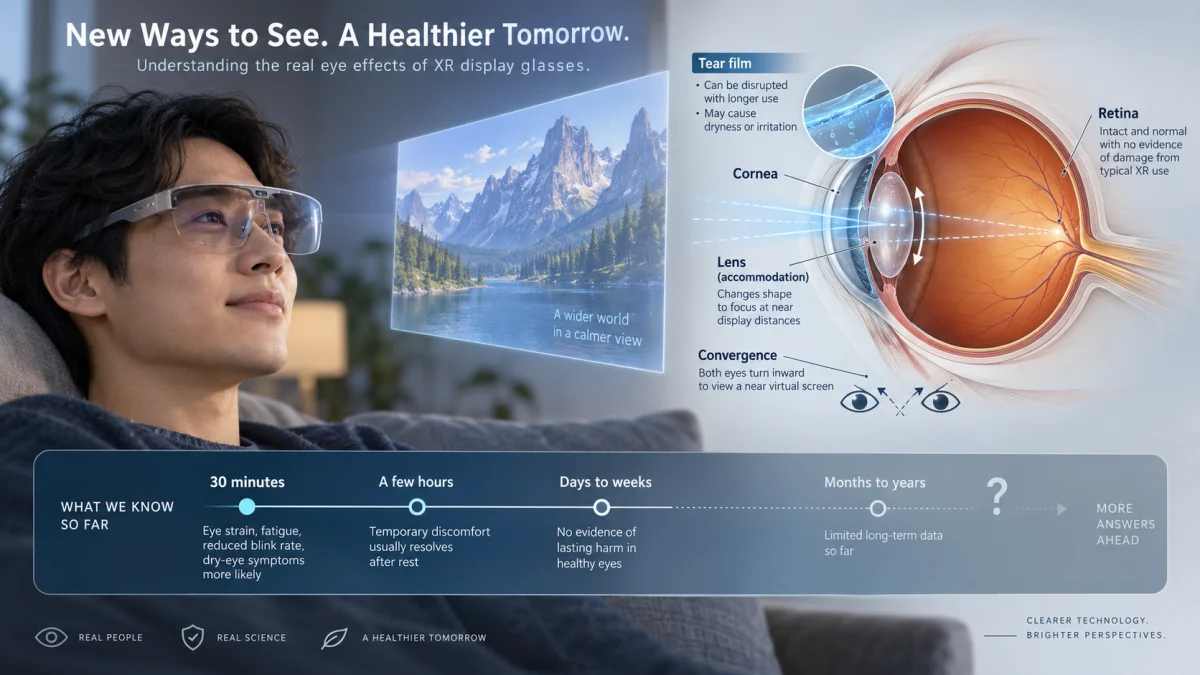
For healthy adults, current human research does not show that normal use of XR display glasses causes permanent eye damage or vision loss.
It does show something less dramatic but much better established: near-eye displays can cause eye strain, headaches, dry-eye symptoms and temporary changes in accommodation—the eye’s focusing system—and vergence, the coordination that points both eyes at the same target. Some measurable changes can appear after as little as 20 to 60 minutes of use. In studies that actually followed recovery, the changes generally moved back toward baseline after the display was removed or the user rested.
What science cannot yet tell us with confidence is what happens when someone wears modern XR glasses for several hours a day, year after year.
A July 2026 review screened 1,170 papers and found just 43 studies meeting its criteria for quantitative visual effects from modern XR. Thirty-six primarily examined short-term changes. Only eight dealt with prolonged, repeated or longitudinal exposure, and just two were genuinely longitudinal, extending from four weeks to six months.
That distinction matters.
No evidence of permanent damage is not the same thing as proof of lifetime safety.
But the reverse is also true: the absence of a 10-year safety trial does not mean XR glasses are probably damaging your eyes.
To get closer to the real answer, we need to separate temporary discomfort, reversible changes in how the visual system is functioning, and actual lasting injury.
What the evidence says at a glance
| Question | Best current answer |
|---|---|
| Can XR glasses cause eye strain? | Yes. Well supported. |
| Can they temporarily affect focusing or eye coordination? | Yes. Demonstrated in human studies. |
| Can they cause temporary blur or refractive changes? | Sometimes. |
| Do these changes usually recover after use? | The limited follow-up evidence generally says yes. |
| Are XR glasses proven to cause permanent myopia? | No. |
| Are ordinary XR displays proven to damage the retina through blue light? | No convincing human evidence establishes this. |
| Can prolonged screen viewing contribute to dry eye? | Yes; this is a much stronger concern. |
| Is there a medically established maximum number of safe XR hours per day? | No. |
| Do we have good evidence about decades of heavy XR use? | No. |
| Are today’s lightweight movie glasses as demanding as immersive VR? | Not necessarily; the visual task matters. |
The most relevant studies are not actually the frightening VR studies
One mistake in discussions of XR safety is treating every head-mounted display as though it exposes the visual system to the same conditions.
It does not.
Someone playing an immersive stereoscopic VR game, with objects apparently moving between different depths, is performing a substantially different visual task from someone watching a flat 2D movie on a virtual rectangular screen through lightweight display glasses.
That does not make movie glasses incapable of causing fatigue. Direct studies suggest they can.
But it means we should start with experiments that resemble watching content through AR or XR glasses, rather than simply importing every negative finding from immersive VR.
Twenty minutes was enough to produce more fatigue than a laptop
A 2024 prospective study published in the Chinese Journal of Ophthalmology recruited 20 healthy young adults at Beijing Tongren Hospital.
Participants used both AR glasses and a laptop on separate occasions. Researchers measured reading performance and visual fatigue, including symptoms after watching a 20-minute video.
Binocular visual acuity did not significantly change after either device.
But the visual-fatigue score increased significantly more after using the AR glasses than after using the laptop. Reading speed and efficiency were also lower with the glasses in that particular setup.
That is good evidence that today’s near-eye displays can be more visually demanding than a conventional screen under some conditions.
It is not evidence of injury.
Nothing in the experiment demonstrated retinal damage, permanent loss of acuity or lasting deterioration of vision.
A 2026 movie study found fatigue—but little change in objective eye measurements
An even more relevant experiment was published in July 2026 by researchers affiliated with institutions including Beijing Tongren Eye Center and Zhongshan Ophthalmic Center.
Fifty-five healthy adults aged 19 to 39 watched VR/AR movies for 30 minutes.
Researchers measured intraocular pressure, tear-film breakup time, eye alignment, accommodation, contrast sensitivity, stereopsis and other parameters.
The result is worth paying attention to.
Participants reported increased visual fatigue, and researchers detected changes in EEG activity associated with that fatigue.
But they found no statistically significant changes in intraocular pressure, tear-film breakup time, phoria, accommodative response, AC/A ratio, contrast-sensitivity measurements or stereopsis after the 30-minute exposure.
In plain English:
People felt more visually tired, but researchers did not find corresponding deterioration across several important measures of eye function after that short session.
That is exactly why “eye strain” should not automatically be translated into “eye damage.”
Longer immersive VR sessions produce more measurable visual changes
The evidence becomes less reassuring when the visual task becomes longer and more demanding.
A randomized controlled study published in Scientific Reports had 58 healthy adults aged 20 to 39 play games for two hours using either a Samsung Gear VR smartphone headset or a conventional smartphone on separate days.
After the VR session, researchers measured significant changes in several visual functions, including near-point accommodation, near-point convergence, accommodative lag, near stereopsis and near exophoric deviation.
Participants also reported more difficulty focusing, headache, dizziness, nausea and dry-eye symptoms with VR than with smartphone gaming.
Yet two measurements particularly relevant to permanent eye-damage claims did not significantly change: refraction and choroidal thickness.
That pattern is important.
The visual system was clearly being stressed and adapting during two hours of immersive VR.
But the experiment did not show that the subjects became permanently more nearsighted or developed structural damage to the back of the eye.
Why accommodation and convergence matter
Your eyes normally perform two related actions when you change viewing distance.
Accommodation changes the shape of the eye’s lens so an object is in focus.
Vergence rotates the two eyes so they point toward the same object.
In natural vision, the two systems are closely linked.
Look at something nearby and your eyes both converge and accommodate for a nearby object. Look across the room and both demands decrease.
Traditional stereoscopic head-mounted displays can break that relationship.
The optical image may remain on a fixed focal plane while stereoscopic disparity tells your brain that virtual objects exist at several different apparent depths.
This is called vergence-accommodation conflict, or VAC.
A 2025 study in Investigative Ophthalmology & Visual Science objectively measured accommodation and vergence before and after a demanding 25-minute 3D AR task in 16 young adults.
Researchers found changes in tonic accommodation and the relationship between vergence-driven accommodation after the AR task that did not occur following the comparable physical task. Their conclusion was appropriately narrow: demanding 3D AR can, at least temporarily, alter the oculomotor system.
That is a real physiological effect.
It still does not establish permanent injury.
Watching a flat virtual television is not the same visual problem as immersive 3D VR
This is where safety discussions often become misleading.
Vergence-accommodation conflict can become especially relevant when virtual objects are being rendered at many stereoscopic depths while the display optics maintain one focal plane.
A flat 2D movie screen is different.
If both eyes are principally viewing a flat image at one apparent depth, the visual task is substantially less complicated than continually interacting with stereoscopic objects moving toward and away from the viewer.
That gives us a reasonable inference:
Watching a conventional 2D movie through display glasses is likely to impose less vergence-accommodation conflict than demanding stereoscopic VR content, all else being equal.
But it should remain labeled as inference.
Different glasses use different optics, focal planes, eye-box geometries and software. We do not yet have enough head-to-head ophthalmic research on current consumer models to turn that inference into a universal rule.
There is another important catch: “the screen is four meters away” does not necessarily tell you where your eyes are focusing
XR advertising can make this especially confusing.
Manufacturers may describe a virtual screen as something like “152 inches at four meters.”
That measurement primarily describes apparent screen size.
It does not automatically mean that the optical system places the virtual image’s focal plane four meters from the eye.
Near-eye displays can have a fixed optical focal distance that differs substantially from the apparent spatial position assigned to virtual content.
That means consumers should not reason:
“The screen looks 12 feet away, so my eyes must be focusing exactly as though I were looking 12 feet away.”
The manufacturer’s virtual-screen-distance figure alone does not establish that.
This is important when discussing myopia, accommodation and eye strain because the actual optical design—not merely the giant-screen marketing number—determines the focusing demand.
Can XR glasses make you permanently nearsighted?
There is currently not enough evidence to say they do.
Some XR experiments have measured temporary shifts in refraction immediately after viewing.
That can sound alarming when described as a “myopic shift.”
But a temporary post-task change in measured refraction is not the same thing as developing permanent myopia.
True progressive myopia, particularly in children, can involve long-term changes including axial elongation of the eye.
Current XR studies have not established that ordinary use of movie glasses causes that process.
The broader screen-time evidence deserves attention, especially for children.
A 2025 JAMA Network Open systematic review and dose-response meta-analysis included 45 studies and 335,524 people, with a mean participant age of 9.3 years. Each additional hour of daily digital screen use was associated with 21% higher odds of myopia in its linear analysis.
But there are crucial limitations.
The overall certainty of the evidence was rated low, statistical heterogeneity was extremely high, and the included exposure was conventional digital media such as smartphones, tablets, computers, game consoles and television—not modern XR glasses.
Screen time may also correlate with other things relevant to myopia, including near work and reduced outdoor activity.
Therefore it would be scientifically unjustified to take that 21% number and apply it directly to XR glasses.
The correct conclusion is narrower:
Conventional screen time is associated with myopia, particularly in children, but we do not yet know whether ordinary XR viewing carries the same risk, a greater risk or a smaller one.
Blue light is probably not the risk people should be most worried about
The phrase “blue light” has become shorthand for virtually every concern about digital displays.
That is not how photobiology works.
High-intensity short-wavelength visible light can cause photochemical retinal injury at sufficient exposure.
But the existence of that mechanism does not mean ordinary consumer displays deliver anything close to the necessary retinal dose.
The International Commission on Illumination, or CIE, explicitly warns that the term blue-light hazard refers to photochemical retinal injury and is principally relevant to sufficiently bright sources such as the sun or welding arcs.
Its position statement says claims linking ordinary blue-light exposure with age-related macular degeneration remain speculative and unsupported by the peer-reviewed evidence.
A 2023 Cochrane review provides a useful reality check from another direction. It found that blue-light-filtering spectacle lenses may offer little or no short-term benefit for computer-related eye strain compared with ordinary lenses, while randomized trials provided no evidence allowing conclusions about macular protection.
So there are two important distinctions.
Eye strain does not prove retinal damage.
And:
The fact that a display contains blue wavelengths does not establish a dangerous retinal dose.
That does not prove that every imaginable XR display under every setting is incapable of phototoxic injury.
But current evidence gives us little reason to treat ordinary screen blue light as the leading health concern from modern XR glasses.
“But the screens are right next to your eyes” is not a retinal-damage calculation
This argument sounds intuitive:
The display is only centimeters from your eyes, therefore it must be more dangerous.
But physical distance alone does not determine retinal light injury.
Near-eye optics redirect light and create a virtual image. Retinal exposure depends on factors including the source’s spectral radiance, optics, apparent angular extent, pupil and exposure duration.
This is why photobiological safety standards evaluate optical exposure, not merely how many centimeters separate a display panel from the user’s face.
A display being physically close to the eye can matter enormously for optical design and visual comfort.
It does not by itself demonstrate that the retina is receiving a dangerous dose of light.
Dry eye may be the more realistic cumulative concern
If we are looking for a plausible problem that could matter after many hours of repeated use, ocular-surface stress deserves more attention than retinal blue-light damage.
There is already substantial ophthalmic evidence connecting prolonged screen use with dry-eye disease.
A 2022 Acta Ophthalmologica review identified 31 relevant studies on display use and dry eye. Reduced blinking and incomplete blinking are important mechanisms because every full blink helps spread and restore the tear film across the ocular surface. The review also found that breaks were associated with fewer symptoms, although none of its included studies actually validated the frequently repeated 20-20-20 rule itself.
Stronger prospective evidence arrived in 2025.
Researchers from Wenzhou Medical University and affiliated eye institutes recruited 30 participants, first limiting their display exposure to less than three hours a day for one week and then increasing it to more than eight hours a day for three weeks.
Over the high-exposure period, ocular-surface symptoms and clinical signs worsened. Researchers found deterioration involving tear-film and eyelid/meibomian-gland measures and changes in conjunctival gene expression involving inflammatory and hormonal pathways.
Their conclusion was that prolonged intense display exposure disrupted ocular-surface homeostasis.
That experiment involved conventional displays, not XR glasses.
So we should not claim that it proves XR causes chronic dry-eye disease.
But now combine the evidence recursively.
Prolonged visual-display use can alter blinking and damage tear-film stability. Direct XR experiments report dry-eye symptoms and changes in blinking. Near-eye displays encourage sustained visual attention. Therefore it is reasonable to infer that heavy XR use could aggravate dry-eye problems in susceptible users, even though we do not yet know the precise XR-specific dose-response relationship.
That is a much stronger inference than saying the glasses are probably damaging the retina.
What about permanent damage from years of XR use?
This is where the research becomes frustratingly thin.
The best recent overview, published in Frontiers in Virtual Reality in July 2026, screened 1,170 records and included 43 studies examining quantitative visual outcomes from XR.
Thirty-six primarily concerned short-term exposure.
Only eight studies qualified for the review’s category involving prolonged, repeated or longitudinal use.
And only two were longitudinal.
One followed repeated VR use for four weeks.
The other followed workers using AR smart glasses for six months.
Neither found evidence of lasting visual impairment on the measurements studied.
That sounds reassuring—but the six-month workplace study shows why we should not overstate it.
It started with 43 workers and had complete six-month follow-up eye examinations for only 17. Those workers were also using Google Glass-style occupational smart glasses rather than modern binocular Micro-OLED cinema glasses. Visual acuity generally did not deteriorate over the six-month period, but eye strain was frequently reported.
That is useful evidence.
It is nowhere near enough to declare a technology people may eventually wear for thousands of hours to be “proven safe long term.”
What does the recovery evidence tell us?
Although long-term research is inadequate, the pattern in shorter studies tells us something.
The 2026 review found that the limited studies with post-exposure follow-up generally showed visual-function changes returning toward baseline.
One VR study comparing shorter and longer exposure reported accommodation and convergence changes returning to baseline within about 40 minutes.
An AR work-rest experiment found that the particular fatigue-related measurements it studied returned to baseline after approximately 20 minutes of rest following a 15-minute task and 25 minutes following a 30-minute task.
These numbers should not be turned into a universal rule that everyone must rest for 25 minutes every half hour.
The review explicitly concluded that the evidence does not establish a single optimal recovery strategy.
What it does suggest is that many measured changes behave more like fatigue and adaptation than irreversible injury.
That distinction becomes important when evaluating long-term plausibility.
A useful long-term question: what would progressive damage look like?
Suppose ordinary XR use were commonly producing progressive ocular injury.
Over time, we would expect some combination of several signals to emerge: persistent rather than recovering abnormalities, progressive visual-acuity loss, structural ocular changes, worsening refraction, a consistent dose-response relationship with repeated exposure, or recognizable clinical disease among frequent users.
That is not the dominant pattern in the literature so far.
Instead, studies repeatedly find subjective fatigue and transient changes in accommodation, vergence or visual performance.
Where researchers have looked for recovery, those changes often move toward baseline.
The limited longitudinal evidence has not revealed progressive deterioration.
One month-long VR training study summarized in the 2026 review even reported improved accommodative amplitude and facility without a change in refraction—an outcome that should not be interpreted as proving VR is good for your eyes, but which is difficult to reconcile with a simplistic theory of steadily accumulating accommodative injury.
This does not prove that long-term harm is impossible.
It does make rapidly accumulating permanent visual-system damage in healthy adult users less consistent with the evidence currently available.
The long-term risk hierarchy is probably not what people expect
Based on direct XR research, broader ophthalmology evidence and plausible biological mechanisms, the concerns can be ranked more intelligently.
Chronic ocular-surface irritation and dry eye currently have the strongest cumulative-risk pathway. We know sustained digital viewing can change blinking and destabilize the tear film, and XR use can produce dry-eye symptoms.
Persistent problems in people with existing accommodation or binocular-vision abnormalities are plausible but poorly quantified. Near-eye displays clearly stress these systems under some conditions, and individuals respond differently.
Permanent myopia caused specifically by XR remains unproven. Short-term refractive changes cannot be treated as evidence of permanent eye growth.
Retinal damage from ordinary XR blue-light exposure is currently the weakest of the commonly repeated major concerns. The injury mechanism exists, but current human evidence does not demonstrate that normal consumer-display exposure reaches the relevant harmful regime.
This ranking may change as long-term studies appear.
As of September 2026, it best fits the evidence we actually have.
Poor fit and incorrect vision correction can make the experience substantially worse
Not everyone looking through the same XR glasses receives exactly the same optical experience.
Interpupillary distance, or IPD, determines how your pupils align with the optics.
Refractive error determines whether the virtual display is properly focused for you.
Astigmatism may not be corrected by the simple myopia-adjustment wheels found on some models.
And some users already have accommodation, convergence or eye-alignment abnormalities before putting on the glasses.
The 2026 XR review specifically identifies pre-existing binocular-vision and accommodation problems as clinically relevant when evaluating XR symptoms.
This is why persistent blur, inability to see the whole image clearly or immediate double vision should not automatically be dismissed as something a new owner merely has to “get used to.”
An optical mismatch may actually exist.
Could heavy screen use affect eye alignment?
There is an emerging but easily sensationalized piece of ophthalmology evidence here.
A 2026 case-control study from the Eye & ENT Hospital of Fudan University examined people with acute acquired concomitant esotropia, a condition involving a newly developed inward eye deviation.
The 48 patients with the condition reported an average of 7.74 hours a day of digital-device use, significantly more than comparison groups. Longer-term electronic-device use was associated with the disorder in the study’s regression analysis, and many affected patients performed near work without appropriate refractive correction.
This does not show that XR glasses cause strabismus.
Conventional phones and computers often involve sustained close near work, whereas the accommodative and vergence demands of XR optics can be quite different.
But it does support a practical rule:
Persistent double vision or a newly noticed eye deviation should not be treated as ordinary harmless “screen fatigue.”
That deserves an eye examination.
What about children?
The answer for children needs to be more cautious because the evidence is considerably weaker.
A 2024 systematic review in the European Journal of Pediatrics examined the safety literature involving VR use in children.
Short supervised exposures generally did not reveal major ophthalmic harm; reported adverse effects were mostly mild and included cybersickness, while some temporary double vision was reported in children with amblyopia.
But safety reporting across studies was inconsistent, and evidence about repeated or long-duration exposure remained inadequate.
Children also have developing visual systems and are much more relevant to the broader myopia question than middle-aged adults.
Given the limited long-term XR evidence and the observational association between conventional screen use and childhood myopia, there is not enough evidence to confidently say that several hours of daily XR use throughout childhood is harmless.
That is not proof of danger.
It is a legitimate evidence gap.
There is no scientifically established “safe number of hours”
Consumers understandably want a number.
Thirty minutes?
Two hours?
Four hours?
The scientific literature cannot currently provide one universal maximum.
The 2026 review explicitly found too little standardized evidence to determine an optimal work-rest schedule. Different studies use different devices, content, visual tasks, outcome measurements and populations.
Manufacturers may provide their own limits or recommended breaks.
Those instructions are worth following, particularly because the manufacturer knows the characteristics of its own hardware.
But a manufacturer’s suggested duration should not be confused with an ophthalmology study demonstrating that minute 119 is safe and minute 121 is harmful.
There is no such threshold.
Even the famous 20-20-20 rule has weaker evidence than most people realize
The 20-20-20 rule tells screen users to look roughly 20 feet away for 20 seconds every 20 minutes.
There is nothing unreasonable about giving your eyes regular breaks.
But the 2022 Acta Ophthalmologica review of display-associated dry eye noted something surprising: although more frequent breaks were associated with fewer symptoms, none of the 31 studies it reviewed had actually evaluated the standard 20-20-20 rule itself.
So we should distinguish a sensible ergonomic habit from a clinically established dosing protocol.
The useful principle is:
Do not wait until significant symptoms accumulate before taking the glasses off.
A practical way to use XR glasses more safely
Current evidence supports a fairly simple approach:
- Get the optics right first. Adjust IPD, nose position, prescription correction and display position until the complete image is comfortably sharp. Do not accept persistent double vision or obvious edge blur as normal.
- Start with shorter sessions. Individual susceptibility varies considerably, and research does not establish one universal safe duration.
- Take breaks before discomfort becomes substantial. The limited recovery studies support rest, even though they do not establish one perfect schedule.
- Blink deliberately during long movies or work sessions. Sustained visual attention can reduce effective blinking and destabilize the tear film.
- Be especially cautious if you already have dry eye, binocular-vision problems or significant refractive error.
- Stop if you develop persistent double vision, significant headache, unusual prolonged blur, dizziness or nausea rather than repeatedly pushing through it.
- Do not use visually obstructive XR modes while driving, cycling or doing anything where diminished awareness can cause an accident.
These precautions are aimed primarily at reducing discomfort and excessive visual load.
They should not be interpreted as evidence that violating one of them causes permanent eye injury.
So are XR glasses safe?
For a healthy adult watching movies or playing games for reasonable periods, the available evidence is more reassuring than alarming.
We have direct evidence that XR can cause visual fatigue.
We have evidence that accommodation, convergence and other components of the visual system can change temporarily during demanding or prolonged use.
We have evidence that symptoms and measured effects can improve after rest.
We have very limited longitudinal evidence, but what exists has not demonstrated lasting deterioration.
And we do not currently have convincing human evidence that ordinary use of consumer XR glasses progressively damages the retina, permanently worsens vision or creates permanent myopia.
The biggest weakness in that reassuring picture is time.
Modern lightweight XR display glasses are too new, and long-duration ophthalmology research is too sparse, to know with confidence what several hours of daily exposure over ten or twenty years will do.
That uncertainty should be stated plainly.
It should not be converted into evidence of damage that researchers have not found.
The bottom line
The best current evidence supports a much more precise conclusion than either “XR glasses are completely safe” or “having screens that close to your eyes must be damaging them.”
XR glasses can strain your eyes. That is established.
They can temporarily change how your eyes focus and coordinate. That is established.
Heavy display use can contribute to ocular-surface problems such as dry eye, making this a plausible concern for frequent XR users.
But:
Permanent retinal damage, permanent myopia or progressive vision loss from ordinary XR use has not been demonstrated in healthy adults.
The unresolved question is long-term exposure.
Most XR eye studies still measure minutes or hours. Only a handful examine repeated exposure, and meaningful multi-year ophthalmology data on today’s lightweight binocular display glasses essentially do not exist.
Until that research catches up, the most rational approach is neither fear nor unlimited use.
Get the optics right, take symptoms seriously, give your eyes breaks and understand what the evidence actually shows.
The screen being two centimeters from your face is easy to photograph.
The biology is more complicated.
References and Further Reading
XR-specific visual health research
Near-Eye Displays and Visual Aftereffects: A Scoping Review — Frontiers in Virtual Reality, 2026 — The most useful current overview of XR visual-function research. Screened 1,170 records and included 43 studies, while highlighting the severe shortage of longitudinal evidence.
The Effects and Mechanism of Watching Virtual Reality on Visual Health — Virtual Reality, 2026 — Study of 55 healthy adults watching VR/AR movies for 30 minutes, with ophthalmic and EEG measurements before and after exposure.
The Impact of Augmented Reality Glasses on Human Visual Efficiency and Digital Eye Fatigue — Chinese Journal of Ophthalmology, 2024 — Prospective comparison of AR glasses and laptop viewing, including a 20-minute video experiment.
Effects of Prolonged Use of Virtual Reality Smartphone-Based Head-Mounted Display on Visual Parameters — Scientific Reports, 2021 — Randomized two-hour VR-versus-smartphone experiment measuring refraction, accommodation, convergence, stereopsis and ocular structure.
Adaptive Responses of Accommodation and Vergence Following Exposure to Augmented Reality — Investigative Ophthalmology & Visual Science, 2025 — Objective experiment demonstrating temporary oculomotor adaptation after a demanding 3D AR task.
Effect of Augmented Reality Glasses on Visual Function in Healthy Adult Individuals — Fudan University Journal of Medical Sciences, 2023 — Direct AR-glasses experiment examining visual fatigue and multiple eye-function measurements after video viewing.
Effects of Smart Glasses on Visual Acuity and Eye Strain of Employees in Logistics and Picking — Sensors, 2024 — Six-month occupational smart-glasses study; useful but limited by a small longitudinal follow-up group and a different class of display.
Dry eye and prolonged screen exposure
A Prospective Self-Controlled Study on Ocular Surface Changes Associated With Prolonged Video-Display Exposure — The Ocular Surface, 2025 — Prospective experiment increasing participants’ daily screen exposure to more than eight hours for three weeks and documenting worsening ocular-surface signs and molecular changes.
Video Display Terminal Use and Dry Eye: Preventive Measures and Future Perspectives — Acta Ophthalmologica, 2022 — Review of 31 studies concerning display use, blinking, tear-film instability and dry-eye prevention.
Dry Eye — U.S. National Eye Institute — Authoritative clinical overview of dry-eye disease, symptoms, risk factors and treatment.
Myopia and binocular vision
Digital Screen Time and Myopia: A Systematic Review and Dose-Response Meta-Analysis — JAMA Network Open, 2025 — Meta-analysis of 45 studies and 335,524 participants; important broader context but not evidence specific to XR glasses.
Unhealthy Overuse of Electronic Devices Is a Risk Factor for Acute Acquired Concomitant Esotropia — Ophthalmic Epidemiology, 2026 — Case-control evidence connecting very heavy conventional digital-device use with acute acquired esotropia; should not be directly generalized to XR.
Blue light and retinal safety
CIE Position Statement on the Blue Light Hazard — International Commission on Illumination explanation of what “blue-light hazard” actually means and why ordinary lighting should not be equated with high-intensity retinal phototoxicity.
Blue-Light Filtering Spectacle Lenses for Visual Performance, Sleep and Macular Health — Cochrane Review, 2023 — Systematic review finding little evidence that blue-filtering lenses improve short-term screen-related eye strain and insufficient evidence concerning macular protection.
Children
Safety of Virtual Reality Use in Children: A Systematic Review — European Journal of Pediatrics, 2024 — Review of pediatric VR safety research finding limited evidence of serious effects from short supervised exposure but substantial uncertainty about repeated or long-term use.
Editorial currency note: XR hardware and the medical literature around near-eye displays are changing quickly. The research and sources in this article were reviewed through September 8, 2026. Findings from immersive VR, conventional screens and occupational smart glasses are identified separately where they are being used to infer—not directly establish—risks from modern lightweight XR movie glasses.