For years, one of the strangest unanswered questions surrounding the Jeffrey Epstein investigation was also one of the simplest:
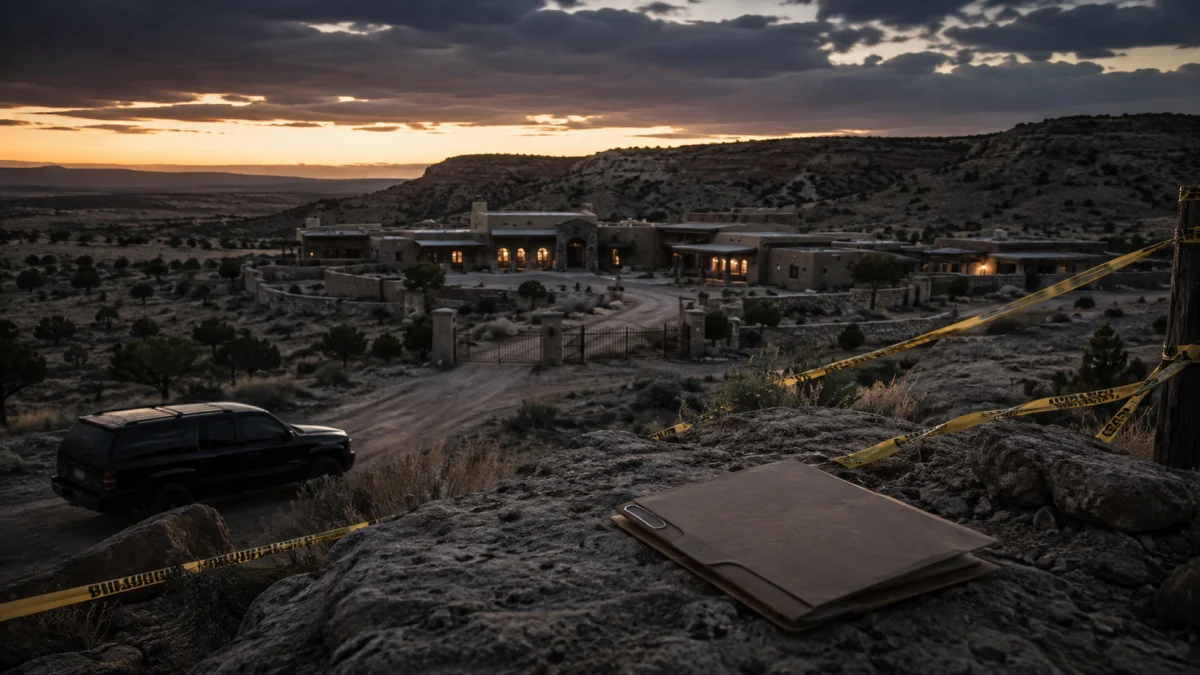
Why did federal investigators search Epstein’s Manhattan townhouse and his private island in the U.S. Virgin Islands, but apparently never search Zorro Ranch, his sprawling estate in New Mexico?
There is now a documented answer—but only a partial one.
The FBI’s New York team said in August 2019 that it did not believe it had probable cause to search Epstein’s New Mexico residence and did not expect useful evidence to still be there. An internal FBI update acknowledged that investigators had a victim who may have been raped at the New Mexico property and planned to interview her again. Yet the team still concluded that a search warrant was not justified at that time.
That explains why the FBI had not searched Zorro Ranch as of August 23, 2019.
It does not fully explain why the ranch remained unsearched afterward.
The FBI made that assessment before New Mexico turned over its complete investigative file, including police reports and recorded witness interviews. Federal investigators continued investigating Epstein-related conduct after his death. They searched Little St. James, his private island, two days after he died. New Mexico later repeatedly asked federal officials to pursue Epstein’s property, and federal prosecutors in New Mexico themselves raised the possibility of seizing or forfeiting the ranch in connection with the Ghislaine Maxwell prosecution. According to New Mexico’s current lawsuit, nothing followed.
So the best-supported answer is more complicated than either “the FBI had no evidence” or “the ranch was deliberately protected.”
The available record points to an initial probable-cause judgment that was followed by a serious federal-state coordination failure and an apparent failure to revisit the search question as additional information accumulated.
There is currently no released evidence proving that federal investigators deliberately avoided Zorro Ranch to protect a politician, celebrity, intelligence operation, wealthy associate, or other influential person. Claims of that kind go beyond what the evidence establishes.
But there is now substantial documentary evidence supporting a much more defensible criticism: New Mexico became an investigative blind spot even though federal authorities knew serious allegations involved the ranch, had assumed control of the overlapping investigation, and continued pursuing Epstein’s associates elsewhere.
That distinction matters.
Last updated: August 9, 2026.
Was Zorro Ranch Actually Never Searched?
According to the New Mexico Department of Justice, the first law-enforcement search of Zorro Ranch did not occur until March 9, 2026—nearly seven years after Epstein’s final federal arrest and more than six years after his death. New Mexico’s August 2026 federal lawsuit specifically alleges that federal law enforcement never searched the property.
That assertion is consistent with the released federal records reviewed for this article. They contain internal FBI discussion about why the New Mexico property had not been searched, but no subsequent federal search has surfaced in the public record.
It is also consistent with what the ranch’s current owners said before the 2026 state search. A spokesperson told the Associated Press that local, state and federal authorities had never approached the new owners seeking access. The property had been sold by Epstein’s estate in 2023 and renamed San Rafael Ranch.
New Mexico investigators eventually searched it on March 9, 2026, with the current owners’ cooperation.
That makes Zorro Ranch fundamentally different from several other major Epstein properties.
The FBI’s Own Explanation: Investigators Said They Lacked Probable Cause
The most important evidence is an FBI email chain dated August 22–23, 2019.
The exchange reached senior officials in the FBI’s New York office and began after FBI Deputy Director David Bowdich asked for an update because the absence of a search in New Mexico was attracting media attention. Michael Driscoll, then a special agent in charge in the FBI’s New York office, asked his team why investigators had not gone to the property, writing that he assumed probable cause was the issue.
The response was explicit:
“At this time we don’t have PC for a search of the NM residence.”
“PC” means probable cause.
The same FBI update said investigators had one victim who may have been raped at the New Mexico residence. She was in California, and the FBI expected to conduct a second interview with her in September. The team additionally reported that it did not believe evidence useful to the investigation remained inside the residence.
New Mexico’s August 2026 federal complaint independently cites the same DOJ-released FBI document and specifically identifies the FBI’s no-probable-cause assessment.
This is the strongest evidence currently available for why the FBI did not raid Zorro Ranch in the immediate aftermath of Epstein’s 2019 arrest.
It is not speculation. It is the FBI’s own contemporaneous explanation.
Why a Victim Allegation Did Not Automatically Produce a Search Warrant
At first glance, the FBI’s reasoning can sound contradictory.
If investigators possessed information that someone may have been raped at the ranch, why would that not establish probable cause to search it?
Because probable cause for a search warrant involves a different question from probable cause to believe a crime occurred.
The Fourth Amendment requires a warrant to be supported by probable cause and to particularly identify the place to be searched and the things to be seized. Under Supreme Court doctrine, the central inquiry is whether there is a fair probability that evidence or contraband will be found in the particular place being searched.
In other words:
“A crime probably occurred at Zorro Ranch” and “evidence of that crime is probably still inside Zorro Ranch” are not legally identical propositions.
That distinction becomes especially important when the alleged conduct occurred years earlier.
The FBI’s August 2019 update appears to reflect precisely this concern. Investigators acknowledged a potentially serious allegation tied to New Mexico but separately concluded that useful evidence was unlikely to remain at the property.
That is a legally plausible rationale.
It should not, however, be confused with a judicial determination that a warrant was impossible.
No judge appears to have rejected a Zorro Ranch warrant
There is an important distinction here that much of the discussion misses.
The released record does not show a federal judge reviewing an affidavit for Zorro Ranch and ruling that probable cause was insufficient.
Instead, the available evidence shows the investigative team itself concluded that it lacked probable cause.
That matters because probable-cause decisions are partly dependent on what investigators know, what they investigate further, what witnesses they interview and what information is ultimately presented to a magistrate.
And this is where the chronology becomes much more troubling.
The FBI Made Its No-Probable-Cause Decision Before Receiving New Mexico’s Complete File
The FBI’s critical email is dated August 23, 2019.
New Mexico did not transfer its complete investigative file to the federal government until September 17, 2019.
That means the statement now frequently cited as the answer to the Zorro Ranch mystery was made roughly three and a half weeks before federal prosecutors received New Mexico’s complete investigative package.
According to New Mexico’s current federal complaint and a June 2026 letter from the state attorney general’s office, that file contained police reports, recorded witness interviews and materials concerning Epstein’s activities involving New Mexico public lands.
New Mexico had been investigating potential criminal activity connected to Zorro Ranch since February 2019 and had interviewed possible victims before Epstein’s July arrest.
So the more important unanswered question is no longer simply:
Why didn’t the FBI have probable cause on August 23?
It is:
After receiving New Mexico’s complete investigative file on September 17, did federal investigators reassess whether they had probable cause to search Zorro Ranch?
No released record located for this article demonstrates that they did.
That is a major difference.
New Mexico Had Already Been Told to Stop Its Own Investigation
The timeline becomes even more consequential because New Mexico was not simultaneously conducting a fully independent investigation while the FBI considered what to do.
According to federal records cited in New Mexico’s lawsuit, on July 23, 2019, federal officials told the New Mexico Department of Justice to stand down from its investigation into potential Epstein-related criminal activity in the state. New Mexico agreed to cease its sex-trafficking investigation and send what it had collected to the Southern District of New York.
The arrangement was supposed to work in both directions. According to the records cited by New Mexico, federal authorities would refer potential state crimes back to New Mexico and transmit information they discovered concerning crimes within the state’s jurisdiction.
New Mexico complied.
On September 17, it transferred its full file and specifically asked federal prosecutors to notify the state if additional survivors of New Mexico crimes were identified.
New Mexico now says that reciprocal information never came. That is an allegation at issue in the state’s current litigation against the Justice Department, rather than a judicially established finding.
But the underlying stand-down arrangement itself is supported by federal records cited in the complaint.
This created a potentially serious structural problem:
The state stopped investigating because the federal government was taking the lead, while the federal investigators taking the lead had already concluded that they did not have enough reason to search the ranch.
If neither side later reopened that question, Zorro Ranch effectively became an investigative orphan.
The Federal Case Was Centered on New York and Florida
Another important part of the explanation is the scope of the 2019 federal prosecution.
When the Southern District of New York charged Epstein in July 2019, the indictment centered primarily on alleged sex trafficking and sexual exploitation in Manhattan and Palm Beach, Florida, between approximately 2002 and 2005.
New Mexico was not the center of the charging document.
That does not mean federal investigators lacked jurisdiction to investigate crimes there. Nor does it mean conduct outside the indictment was irrelevant. In fact, when announcing Epstein’s arrest, the FBI explicitly asked victims to contact investigators regardless of where or when their alleged victimization occurred.
After Epstein died, SDNY publicly stated that the investigation into his conduct continued and again invited information from victims from any time period and any location.
The distinction is therefore important:
- The criminal case against Epstein was geographically and temporally concentrated.
- The broader federal investigation was not supposed to be.
The narrow scope of the indictment helps explain why New Mexico may have received less immediate attention. It does not fully explain why the ranch was never searched as the broader investigation continued.
Epstein’s Death Does Not Explain Why Zorro Ranch Was Left Alone
One seemingly obvious explanation can also be ruled out as insufficient:
Jeffrey Epstein’s death did not cause the FBI to stop searching his properties or investigating his conduct.
Epstein died on August 10, 2019.
An FBI operational plan released by the Justice Department shows that agents executed a federal search warrant at Little St. James, Epstein’s private island in the U.S. Virgin Islands, on August 12, 2019—two days after his death. The document explicitly describes the island as belonging to Epstein and being connected to a child-sex-trafficking investigation.
SDNY also publicly confirmed after the criminal charges against Epstein were formally dismissed that the investigation into his conduct remained ongoing.
Therefore, “Epstein was dead” cannot by itself explain why federal investigators never searched Zorro Ranch.
The government demonstrated, almost immediately, that Epstein’s death did not prevent it from executing search warrants, preserving evidence or continuing investigations involving his associates.
The Zorro Ranch Question Actually Reached Senior FBI Leadership
The failure to search New Mexico was not something nobody at the FBI noticed.
The August 2019 email chain shows FBI leadership was already asking about it.
Deputy Director David Bowdich noted that media attention was beginning to focus on why the New Mexico residence had not been searched. That inquiry traveled through William Sweeney, then head of the FBI’s New York field office, to senior criminal-division officials.
The response was the no-probable-cause assessment.
This is significant because it eliminates another possible explanation: Zorro Ranch was not simply forgotten because nobody thought to ask about it.
Senior officials asked.
The team answered.
What is missing from the public record is evidence that the answer was later reconsidered as additional information arrived.
Federal Authorities Later Used New Mexico Evidence Against Ghislaine Maxwell
The argument that New Mexico simply never became relevant to the federal investigation becomes even harder to sustain when the Maxwell prosecution is considered.
Ghislaine Maxwell was arrested in July 2020 and ultimately convicted in federal court.
Evidence presented in her case included alleged sexual abuse connected to New Mexico. In Maxwell’s appeal, the U.S. Court of Appeals for the Second Circuit discussed trial testimony concerning a witness’s sexual abuse in New Mexico and a jury question involving transportation to New Mexico for sexual activity.
The Associated Press likewise reports that testimony at Maxwell’s trial concerned allegations that Epstein and Maxwell sexually abused women at the New Mexico ranch.
More significantly, New Mexico’s August 2026 complaint cites a July 15, 2020 communication in which federal prosecutors in the District of New Mexico told SDNY that conduct in New Mexico formed the basis of an overt act in Maxwell’s indictment. The New Mexico federal prosecutors requested a discussion about potentially seizing or forfeiting Epstein’s New Mexico property.
According to the state’s complaint, SDNY did not act on that request.
Again, that final characterization currently comes from New Mexico’s lawsuit and should be treated as the state’s allegation unless additional records establish exactly what happened internally.
But the communication itself raises an obvious question:
If New Mexico conduct was significant enough to appear in the federal prosecution of Epstein’s alleged co-conspirator, why was the physical property itself still not being examined?
No publicly released record provides a satisfying answer.
New Mexico Repeatedly Asked Federal Authorities to Act on the Ranch
The record also undermines the idea that New Mexico simply stopped caring about the property after agreeing to defer its criminal investigation.
According to contemporaneous correspondence summarized in New Mexico’s current filings, state officials repeatedly raised the ranch with federal prosecutors.
On October 15, 2019, New Mexico asked federal authorities to explore seizing Epstein’s New Mexico land holdings.
After Maxwell’s July 2020 arrest, the state again offered assistance.
On July 8, 2020, New Mexico renewed its request for action against Epstein’s New Mexico properties and argued that Zorro Ranch appeared to have facilitated criminal activity connected with his trafficking operation.
A week later, federal prosecutors based in New Mexico contacted SDNY about possible seizure or forfeiture because New Mexico conduct was implicated in Maxwell’s case.
New Mexico alleges that these efforts produced acknowledgment but no substantive action.
This is one of the strongest reasons the original probable-cause explanation, while genuine, is no longer a complete explanation for the entire seven-year history.
The Evidence-Weighted Explanations for Why Zorro Ranch Was Never Searched
Several explanations have circulated publicly. They are not equally supported.
1. The FBI believed it lacked probable cause — Strongly supported
This is directly documented.
On August 23, 2019, the FBI team stated that it did not believe it had probable cause for a New Mexico search and did not expect useful evidence to remain at the property.
Evidence strength: Very high.
This is the most defensible answer to why there was no immediate 2019 federal raid.
2. Investigators believed evidence at the ranch would be stale or gone — Strongly supported, but incompletely explained
The FBI explicitly said it did not think items useful to its investigation remained at the residence.
What remains unknown is why investigators reached that conclusion.
The publicly available email does not lay out a detailed evidentiary analysis explaining which items they considered, when those items might have been present, whether the property had been altered, or why agents thought a search was unlikely to recover anything.
Evidence strength: High for the conclusion; low for understanding the basis behind it.
3. The federal prosecution was focused elsewhere — Strongly supported as a contributing factor
The 2019 Epstein indictment centered on New York and Florida. Federal investigators were conducting major searches and processing evidence elsewhere.
New Mexico’s 2026 Survivors’ Truth Commission has similarly criticized the federal investigation for concentrating on New York, Palm Beach and the Virgin Islands while New Mexico remained comparatively unexplored.
Evidence strength: High as an explanation for prioritization, but insufficient by itself to explain seven years of non-action.
4. Epstein died before investigators could search it — Weak explanation
Federal agents searched Little St. James two days after Epstein’s death, and SDNY publicly stated that its investigation continued.
Evidence strength: Low.
His death undoubtedly changed the prosecution. It plainly did not eliminate the government’s ability or willingness to search property connected to the investigation.
5. Federal-state coordination broke down — Strongly supported
New Mexico had an active investigation. SDNY asked the state to stop and provide its evidence. New Mexico complied. The state later sent its entire investigative file and repeatedly sought further cooperation and action involving the ranch.
That arrangement placed substantial responsibility on the federal investigation to ensure New Mexico evidence did not disappear into an institutional gap.
New Mexico now alleges that this is exactly what happened.
Evidence strength: High that the handoff occurred; the full responsibility for what happened afterward remains contested.
6. Powerful people deliberately prevented the ranch from being searched — Not fully established
Epstein associated with powerful and prominent people, and records concerning the ranch include many well-known names. That fact alone proves neither criminal involvement by those individuals nor interference with the investigation.
No released document located for this article shows a political official, wealthy associate, intelligence agency, celebrity or other influential person ordering the FBI or SDNY not to search Zorro Ranch.
Evidence strength: Unsupported as a causal explanation based on the currently public record.
That conclusion should not be confused with saying the government’s conduct deserves no scrutiny. It does.
The documented failures are significant enough without inventing an explanation for which evidence does not presently exist.
The Biggest Unanswered Question Is What Happened After August 23, 2019
The public finally has a reasonable answer for one narrow moment in time.
Why hadn’t Zorro Ranch been searched by August 23, 2019?
Because the FBI team believed it lacked probable cause and thought a search was unlikely to yield useful evidence.
The harder question is what happened next.
Within weeks, the federal government received New Mexico’s full investigative file. Federal investigators continued examining Epstein’s associates. The government pursued Maxwell. New Mexico evidence became relevant to her case. State officials repeatedly asked for federal action involving the property. Federal prosecutors in New Mexico themselves raised potential seizure or forfeiture.
Yet there is no released record showing that federal investigators returned to the original warrant question and conducted a fresh assessment based on everything subsequently learned.
That is the information gap that remains.
It is entirely possible that such an assessment occurred and has not been publicly released.
It is also possible that prosecutors continued to believe probable cause was insufficient.
What cannot responsibly be claimed from the existing record is that we know.
New Mexico Also Bears Some Responsibility for the Gap
A complete examination should not treat the federal government’s involvement as absolving New Mexico of every difficult question.
New Mexico began investigating in February 2019. The first law-enforcement search of the ranch nevertheless did not occur until March 2026.
That means state investigators themselves apparently did not search the property during the months before the July 23 federal stand-down request.
The currently public documents do not adequately explain why.
After the federal request, New Mexico chose to defer its investigation and transfer its materials. The state continued asking federal prosecutors for action, but it did not restart its own full investigation until 2026.
That decision deserves examination alongside SDNY’s conduct.
A federal request to coordinate investigations helps explain the state’s deference. It does not erase the consequence: for years, neither level of government searched a property increasingly associated with serious allegations of abuse.
New Mexico’s legislature is now examining institutional failures on the state side as well. In February 2026, the state House unanimously established a special commission to investigate Zorro Ranch, including whether failures by state or local government allowed potential misconduct to go uninvestigated or become time-barred.
That broader accountability inquiry is appropriate.
What Changed in 2026?
In February 2026, New Mexico Attorney General Raúl Torrez reopened the state’s criminal investigation after reviewing newly released federal material concerning Epstein.
The New Mexico Department of Justice specifically said that information in previously sealed FBI files warranted further examination and noted that the original state investigation had been closed in 2019 at SDNY’s request.
On March 9, New Mexico investigators, assisted by state police and a fire-and-rescue K-9 team, searched the former Zorro Ranch with the cooperation of its current owners.
According to New Mexico’s subsequent federal court filing, this was the first law-enforcement search of the property.
The ranch had meanwhile changed ownership in 2023.
Whatever evidence may have been recoverable in 2019 is therefore not necessarily the same evidence that could remain in 2026.
That loss cannot be quantified because nobody can know what a timely search would have found.
And that is precisely why the original decision matters.
New Mexico Is Now Suing the Justice Department Over the Missing Information
The story is no longer merely historical.
On August 5, 2026, New Mexico sued the U.S. Department of Justice and Acting Attorney General Todd Blanche in federal court, seeking access to unredacted Epstein investigative materials for the state’s reopened criminal investigation.
New Mexico alleges that federal authorities have failed to provide information needed to identify victims, witnesses and potentially prosecutable conduct connected to the ranch. The complaint argues that this is particularly consequential because federal prosecutors previously asked New Mexico to defer its own investigation.
The Justice Department disputes New Mexico’s characterization of its current conduct.
DOJ told the Associated Press that some information cannot be released because federal court orders protect victim-identifying information and said New Mexico had not provided sufficient legal justification for the breadth of disclosures it was seeking. DOJ said it remains willing to assist the state within the limits of applicable law and court orders.
That response concerns the current records dispute, not the original 2019 decision not to search Zorro Ranch.
The underlying question of why the federal investigation never returned to the ranch remains unresolved.
Was Zorro Ranch Deliberately Protected?
There is enough documented irregularity here to justify skepticism.
There is not enough evidence to justify certainty about a cover-up.
Those statements can coexist.
The FBI knew the ranch was attracting scrutiny. Senior FBI leadership explicitly asked why it had not been searched. Investigators knew of at least one serious victim allegation connected to the New Mexico residence. The state had conducted its own interviews. Federal authorities asked that state investigation to stop. The government later received the state’s complete investigative file. New Mexico conduct became relevant in the Maxwell prosecution. Federal officials in New Mexico later raised seizure of the property. Yet the ranch remained unsearched.
Those are legitimate reasons to demand an explanation.
But the evidence currently points more directly toward investigative judgment, prosecutorial prioritization and institutional failure than toward a demonstrated order to protect powerful people.
If evidence of deliberate interference exists, it has not yet been established by the released records reviewed here.
The appropriate response is not to stop asking questions.
It is to ask more precise questions.
What Federal Authorities Still Need to Explain
A genuinely complete accounting would answer several questions that the currently released files do not.
Did the FBI conduct the victim’s planned second interview in September 2019? If it did, what did investigators learn about Zorro Ranch, and did that information change the probable-cause assessment?
What exactly did federal investigators learn when New Mexico transferred its full investigative file on September 17?
Was probable cause for a Zorro Ranch search formally reconsidered after that transfer?
Why did investigators believe in August 2019 that useful evidence was no longer present at the ranch?
Did SDNY prepare or consider a search-warrant affidavit that was abandoned before being submitted to a judge?
Why did the federal government not pursue the New Mexico property after state officials requested seizure in October 2019 and again in July 2020?
What happened after federal prosecutors in New Mexico asked SDNY to discuss seizure or forfeiture in connection with conduct appearing in the Maxwell case?
What information discovered during the federal investigation concerning possible New Mexico state crimes was ever transmitted back to New Mexico?
And perhaps most importantly:
Who ultimately decided that Zorro Ranch would remain outside the physical search effort, and on what evidence was that decision based?
Those questions do not require a conspiracy theory.
They require records.
Why the Failure to Search Zorro Ranch Matters
Searches are not ceremonial acts.
They preserve evidence.
A timely search can document the physical configuration of a property, locate records or electronic media, identify hidden storage areas, recover photographs or correspondence, preserve trace evidence, establish where witnesses stayed or worked and corroborate—or contradict—statements made by victims, employees and suspects.
That does not mean a 2019 search of Zorro Ranch would necessarily have produced incriminating evidence.
Maybe the FBI was right. Perhaps nothing useful remained.
But because the property was not searched, that hypothesis was never tested by a federal physical search.
And years later, after the property had passed through an estate and been sold to new owners, the opportunity to know exactly what would have been found in 2019 was permanently diminished. The ranch was not searched by law enforcement until March 2026.
That is why the issue is more consequential than a dispute over whether investigators technically possessed probable cause on one particular August morning.
The real issue is whether the government adequately responded when a major property connected to a prolific sex offender repeatedly emerged in victim accounts and federal evidence.
Conclusion: We Now Know Why the FBI Initially Did Not Search Zorro Ranch. We Still Do Not Know Why It Never Did.
The mystery surrounding Zorro Ranch is no longer quite as mysterious as it once was.
Federal investigators did not initially search Jeffrey Epstein’s New Mexico ranch because the FBI believed it lacked probable cause for a warrant and did not expect to find useful evidence there.
That conclusion is documented.
But it was made on August 23, 2019—before the federal government received New Mexico’s complete investigative file.
Afterward, federal investigators continued investigating Epstein-related conduct. They searched his private island after his death. New Mexico supplied additional evidence and repeatedly sought action involving the ranch. New Mexico conduct became relevant to the Maxwell prosecution. Federal prosecutors in New Mexico raised possible forfeiture of the property.
Still, no federal search occurred.
There is no currently released evidence definitively proving that Zorro Ranch was deliberately shielded to protect powerful people.
There is substantial evidence, however, that an initial investigative judgment evolved into an institutional failure: New Mexico deferred to the federal government, the federal investigation prioritized other locations, and the ranch fell through the resulting gap.
The most important unanswered question is therefore no longer why the FBI declined to raid Zorro Ranch in August 2019.
It is why nobody appears to have meaningfully revisited that decision after the evidence changed.
Nearly seven years later, New Mexico finally searched the property.
Whatever could have been learned from searching it in 2019 may never be fully recoverable.
Frequently Asked Questions
Did the FBI ever search Jeffrey Epstein’s Zorro Ranch?
According to the New Mexico Department of Justice’s 2026 federal complaint and the available public record, no. New Mexico says the first law-enforcement search of the former Zorro Ranch occurred on March 9, 2026.
Why didn’t the FBI search Zorro Ranch in 2019?
An internal FBI update dated August 23, 2019 said investigators believed they lacked probable cause for a search warrant and did not think evidence valuable to the investigation remained at the New Mexico residence.
Did the FBI know victims alleged abuse at Zorro Ranch?
Yes. The August 2019 FBI update referenced a victim who may have been raped at the New Mexico residence and said a second interview was planned. Other allegations concerning New Mexico subsequently appeared in federal proceedings, including the Maxwell case.
Did a judge refuse to issue a search warrant for Zorro Ranch?
No publicly released record reviewed for this article shows a judge rejecting a Zorro Ranch warrant application. The available document instead shows the FBI investigative team concluding internally that it lacked probable cause.
Did Jeffrey Epstein’s death stop the investigation?
No. Federal investigators searched Little St. James on August 12, 2019, two days after Epstein died, and SDNY later publicly confirmed that the investigation into his conduct continued.
Why did New Mexico stop investigating Zorro Ranch in 2019?
According to federal records cited by New Mexico, SDNY asked state investigators in July 2019 to cease their overlapping sex-trafficking investigation and share their evidence with federal prosecutors. New Mexico agreed.
Did New Mexico give the FBI its evidence?
New Mexico says it transferred its entire investigative file to federal prosecutors on September 17, 2019, including police reports, recorded witness interviews and public-lands materials.
Was Zorro Ranch involved in the Ghislaine Maxwell case?
New Mexico-related conduct appeared in the Maxwell prosecution. Federal prosecutors in New Mexico told SDNY in July 2020 that New Mexico conduct formed the basis of an overt act in Maxwell’s indictment and sought discussion of possible seizure or forfeiture of Epstein’s New Mexico property.
Was Zorro Ranch protected because powerful people visited it?
There is no released evidence definitively establishing that federal investigators declined to search the ranch in order to protect a particular prominent visitor or associate. Association with Epstein or presence in records does not itself establish criminal conduct.
Who owns Zorro Ranch now?
Epstein’s estate sold the property in 2023. The new owners renamed it San Rafael Ranch and cooperated with New Mexico authorities when the property was searched in March 2026.
Is the Zorro Ranch investigation still active?
Yes. New Mexico reopened its criminal investigation in February 2026 and, as of August 2026, says it remains active. The state sued the U.S. Department of Justice on August 5 seeking additional unredacted federal investigative material.
References and Further Reading
Primary Records
- State of New Mexico v. U.S. Department of Justice — Federal Complaint Regarding the Zorro Ranch Investigation (August 5, 2026) — New Mexico’s detailed account of the 2019 federal-state investigation, the FBI’s decision not to search the ranch, subsequent evidence-sharing and the state’s current dispute with DOJ.
- FBI Email EFTA00165502 — August 23, 2019 Zorro Ranch Probable-Cause Discussion — The central federal document explaining that investigators believed they lacked probable cause for a New Mexico search and did not expect useful evidence to remain.
- FBI Operational Plan for the August 12, 2019 Search of Little St. James — Federal record demonstrating that the FBI executed a search warrant at Epstein’s private island after his death.
- U.S. Attorney’s Office, Southern District of New York — Jeffrey Epstein Charged With Sex Trafficking of Minors — Official description of the 2019 federal charges and their primary New York and Florida focus.
- United States v. Jeffrey Epstein — SDNY Case and Victim Information — Includes SDNY’s September 2019 confirmation that the investigation into Epstein’s conduct continued after his death.
- New Mexico DOJ Letter to the U.S. Department of Justice — June 30, 2026 — Details New Mexico’s 2019 file transfer, subsequent requests for federal cooperation and the state’s account of the investigative stand-down.
- New Mexico DOJ — February 19, 2026 Reopening of the Zorro Ranch Criminal Investigation — Official announcement explaining why New Mexico reopened the investigation.
- New Mexico DOJ — March 9, 2026 Search of the Former Zorro Ranch — Official statement concerning New Mexico’s search of the property with the current owners’ cooperation.
- New Mexico DOJ — August 5, 2026 Lawsuit Seeking Unredacted Federal Epstein Records — Summary of New Mexico’s current federal records dispute and ongoing criminal investigation.
- New Mexico House Resolution 1 — Zorro Ranch Investigation and Survivors’ Truth Commission — The bipartisan legislative resolution establishing a formal inquiry into alleged crimes and institutional failures involving Zorro Ranch.
- New Mexico Survivors’ Truth Commission — Interim Report on Jeffrey Epstein and Zorro Ranch (August 5, 2026) — The commission’s interim examination of Epstein’s New Mexico activities and government responses.
Legal and Independent Context
- Congressional Constitution Annotated — Fourth Amendment Probable-Cause Requirement — Explains the constitutional standard governing issuance of search warrants.
- Congressional Constitution Annotated — Text of the Fourth Amendment — Primary constitutional text requiring probable cause for search warrants.
- Associated Press — New Mexico Reopens Investigation Into Epstein’s Former Zorro Ranch — Reporting on the ranch’s history, allegations associated with the property, its new ownership and the reopened investigation.
- Associated Press — State Investigators Search Jeffrey Epstein’s Former New Mexico Ranch — Reporting on the March 2026 law-enforcement search.
- Associated Press — New Mexico Takes Legal Action Against DOJ Over Epstein Investigation — Independent reporting on New Mexico’s August 2026 lawsuit, the state’s allegations and the Justice Department’s response.