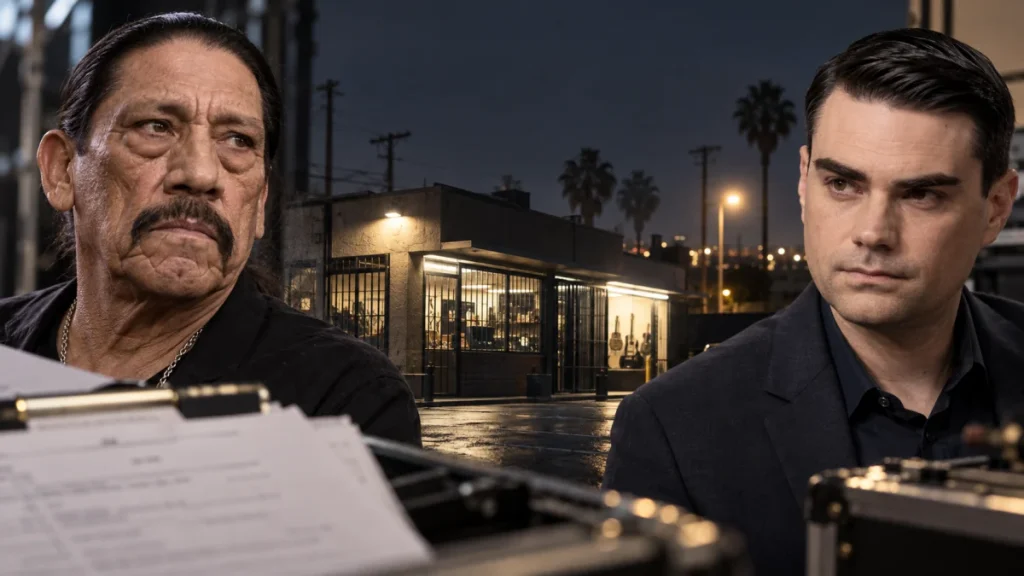

New footage released by Candace Owens appears to raise a legitimate question about what happened after Charlie Kirk was shot at Utah Valley University: why were multiple members of his security detail wearing dark-blue hospital scrubs later that evening?
Part of the answer is already well supported. Brian Harpole and Rick Cutler were directly involved with a catastrophically bleeding Kirk and were covered in his blood. Frank Turek, who rode in the back of the SUV with them, said shortly after the assassination that the three men in the rear of the vehicle changed clothes at Timpanogos Regional Hospital and were given scrubs.
The genuinely unresolved part is different.
Owens says newly released footage from later on September 10, 2025 shows additional members of the security team in scrubs—including people who were not among those three men in the back of the SUV. If those identifications are correct, the earliest public explanation does not tell us why all of them changed clothing.
That is worth investigating.
It is not, by itself, evidence that the security team participated in Kirk’s assassination, that the scrubs came from the military, or that clothing was destroyed to conceal evidence. But neither should the remaining discrepancy be waved away with an imagined innocent explanation. If investigators collected the men’s original clothing, hospital staff supplied replacement garments, or additional team members became blood-contaminated later, those are factual propositions that should be possible to document.
The evidence currently supports scrutiny, not a verdict.
What Candace Owens’ new footage claims to show
In Episode 385 of her podcast, released as the first anniversary of Kirk’s assassination approached, Owens presented footage she says shows members of Kirk’s security team returning to the UVU campus later on September 10. Her episode notes specifically label the segment beginning at 18:08 as footage that “calls into question the surgical scrubs narrative.” (podfollow)
Owens identifies several men in the footage as members of Kirk’s protective detail and focuses on the fact that more than the obviously blood-covered men appear to be wearing dark-blue scrubs.
That distinction matters because an early firsthand account did not describe the entire security team changing clothes.
Six days after the assassination, Frank Turek published a detailed account of the trip to Timpanogos Regional Hospital. He described five people accompanying Kirk in the SUV: Justin Davis driving, Dan in the front with navigation, and Rick Cutler, Brian Harpole and Turek in the rear with Kirk. (CrossExamined)
Later in the same account, Turek specifically referred to “the three of us in the back of the SUV” changing their clothes at the hospital and said “they all gave us scrubs.” (CrossExamined)
That is important evidence because it predates the current controversy by almost a year.
It establishes a contemporaneous explanation for at least three scrub wearers. It does not establish that nobody else changed, nor does it explain why anyone outside that group might have done so.
A necessary limitation
sherafy.com has reviewed Owens’ claims, her episode material and the public record surrounding the security team, but we have not obtained the native UVU surveillance file and its metadata.
Accordingly, the approximately 8:30 p.m. timestamp and the identification of individual men in the newly released footage should presently be attributed to Owens rather than treated as independently authenticated facts.
That distinction becomes especially important because Owens’ Episode 385 itself begins with a correction concerning a previous security-team identification. (podfollow)
The footage can still be significant. But identifying a person from compressed surveillance video is different from establishing identity through original footage, contemporaneous records or the person’s own confirmation.
Three scrub wearers already have a substantial explanation
The strongest way to analyze the new footage is not to ask whether scrubs are suspicious in the abstract. It is to examine each person separately.
| Person | Documented role after the shooting | What is known about the clothing question |
|---|---|---|
| Brian Harpole | Rode in back; performed hemorrhage control and continued assisting Kirk at hospital | Heavy blood exposure is directly documented. Scrubs are readily explained. |
| Rick Cutler | Rode in back beside Harpole and helped stabilize him during transport | Harpole says Cutler was also covered in Kirk’s blood. Scrubs are readily explained. |
| Frank Turek | Rode in back; says he attempted CPR | Turek himself says the three rear occupants changed at the hospital. His exact medical role is disputed, but proximity to the bleeding victim is undisputed. |
| Justin Davis | Drove the SUV to Timpanogos | Turek did not include Davis among the “three” whose clothing change he described. If Owens correctly shows him in scrubs, the public explanation is incomplete. |
| Blake Harruff | Identified by Owens and citizen researchers as part of the detail; not listed by Turek among the SUV occupants | If the identification is correct, the public record reviewed for this article does not yet establish why he changed. It also does not establish that he had no later blood exposure. |
Brian Harpole’s case is the clearest.
In a lengthy interview months after the shooting, Harpole described putting pressure on Kirk’s wound, packing it during the drive and continuing to assist after reaching the hospital. He said Kirk’s blood was on his face, arms, clothing and shoes. A Timpanogos nurse eventually took him aside and washed blood from his face and hands. (KSL)
Harpole also said Rick Cutler was similarly covered in blood. (PodScripts)
Whatever else someone believes about the assassination, Harpole and Cutler changing out of those clothes requires no exotic explanation.
Blood-soaked clothing is a biological-exposure problem. OSHA’s bloodborne-pathogen standard, although written for occupational exposures rather than visitors to an emergency department, illustrates the basic safety principle: garments penetrated by blood should be removed as soon as feasible, and contaminated material should be handled accordingly. (OSHA)
What OSHA does not prove is what Timpanogos specifically did with Kirk’s companions that day.
That still has to come from witnesses or records.
Frank Turek’s scrubs are less mysterious than the CPR dispute makes them sound
Owens has repeatedly questioned why Turek became blood-covered if Brian Harpole remembers doing the principal medical work while Turek was praying.
There is a real difference in emphasis between the accounts.
Harpole describes concentrating intensely on hemorrhage control while Turek prayed aloud. Turek’s September 2025 account says that during the drive he decided CPR should be attempted and says he tried it. (KSL)
That discrepancy deserves to be recorded.
But it does not logically establish that Turek invented the CPR attempt.
A short, chaotic emergency trip can contain both events: Turek could have prayed for much of the ride and attempted CPR briefly. Harpole, focused on controlling catastrophic bleeding, would not necessarily have perceived or later emphasized every action occurring around him.
More fundamentally, Turek did not need to perform CPR to plausibly get blood on himself. He was immediately beside Kirk in the rear of an SUV while Kirk was bleeding heavily and other men were physically manipulating the wound.
The CPR disagreement therefore has evidentiary value, but considerably less than the most dramatic interpretations give it.
Justin Davis is a more important question
Justin Davis presents a different problem.
Both Turek and Harpole identify Davis as the person driving Kirk to Timpanogos. (CrossExamined)
Turek’s original scrub explanation specifically referred to the three men in the rear.
So if Owens’ new footage correctly identifies Davis later wearing hospital scrubs, Turek’s account does not explain that clothing change.
That does not mean Davis had no legitimate reason to change.
He arrived at the hospital with the victim. He could subsequently have assisted the group, contacted contaminated surfaces, been instructed to surrender clothing as evidence, or changed for another mundane reason.
But notice the evidentiary difference:
Those are possible explanations.
They are not presently documented explanations.
A careful investigation should not convert a possible innocent explanation into a fact merely because it is convenient. The proper question is simply: why did Davis change clothes, if the footage indeed shows that he did?
That should be answerable.
Blake Harruff may be the most significant identification—if it is correct
Owens also identifies a man in scrubs as Blake Harruff, who has been identified in recent citizen research as part of Kirk’s protective detail.
Unlike Davis, Harruff does not appear in Turek’s list of the five people in the SUV carrying Kirk to Timpanogos. (CrossExamined)
That makes his apparent clothing change potentially more interesting.
But one viral claim currently goes further than the evidence: that Harruff definitely never touched Kirk and therefore could not have gotten blood on himself.
The public material reviewed by sherafy.com does not establish that.
Footage showing someone relatively clean immediately after the shooting would not resolve what that person did during the following several hours. Nor does Turek’s SUV roster establish everybody who later went to Timpanogos or interacted with Kirk, the vehicle, contaminated equipment or other members of the team.
So the strongest defensible conclusion is narrower:
If Owens has correctly identified Harruff in hospital scrubs later that evening, his reason for changing clothes is not currently explained by the early firsthand account we can verify.
That is a real question.
It is not an accusation.
Did Mikey McCoy give everyone the scrubs?
This is another place where repetition online has hardened a fuzzy claim into something more definite than the underlying evidence.
Owens has previously described Mikey McCoy, Kirk’s chief of staff, as the person who “got them scrubs.” Her July 2026 episode returned to the issue while discussing what may have happened to the security team’s original clothing. (Clipto Community)
Turek’s earlier firsthand account is different in detail.
He says the men changed at the hospital and were given scrubs there. He later describes McCoy arranging ordinary replacement clothes for him after they reached their hotel. (CrossExamined)
Those accounts are not necessarily contradictory. McCoy could have helped arrange clothing inside the hospital.
But the available evidence does not establish the more provocative version now circulating online: that McCoy independently possessed or distributed some unusual set of military-type surgical uniforms.
Until there is evidence of where the garments came from, that claim goes beyond the record.
Do the navy-blue scrubs point to the Department of Defense?
No. The color is not evidence of a DoD connection.
Some military medical facilities certainly use dark scrubs. But that does not make dark-blue scrubs a uniquely military uniform.
The Department of the Air Force’s own dress regulation says the commander of each Military Treatment Facility authorizes and procures surgical scrubs in a solid conservative color. It does not designate navy blue as an identifying DoD scrub color. (Air Force Personnel Center)
More importantly, Timpanogos Regional Hospital itself has publicly posted photographs of its own personnel wearing dark navy-blue scrubs.
See Timpanogos Regional Hospital’s own Nurse Forward photograph
Another hospital post shows an entire Timpanogos cardiac team in dark-blue surgical clothing.
See Timpanogos Regional Hospital’s cardiac-team photograph
That does not prove the men in Owens’ footage were wearing Timpanogos-issued scrubs. The garments would need to be compared directly.
It does establish something narrower and important:
Navy scrubs are not a meaningful fingerprint for the Department of Defense.
Connecting their color to DoD, military intelligence or some larger plot without additional evidence is therefore a weak inference.
The FBI clothing claim could change the entire interpretation
There is a much more consequential unresolved issue.
In July 2026, Owens said she had been told that the FBI collected clothing from certain members of Kirk’s security team, allegedly taking everything they were wearing down to their underwear.
Critically, Owens presented this as information she had received. She did not identify her source, and sherafy.com has not found an FBI property receipt, evidence inventory, court exhibit or agency statement independently confirming the claim. (Who Assassinated Charlie Kirk)
Owens herself initially acknowledged the ordinary interpretation: investigators collecting clothing after a shooting could simply be preserving potential evidence. She then speculated that the clothing may instead have been destroyed, while acknowledging she could not verify that conclusion. (Who Assassinated Charlie Kirk)
This matters enormously to the new scrub footage.
If investigators really took the clothes of additional security personnel, then a man who had no blood on him at all could still have ended the evening wearing hospital scrubs.
His original clothes would be gone.
That produces a perfectly coherent sequence:
security member arrives at hospital → investigators interview him → clothing is collected as potential evidence → he needs replacement clothing → scrubs are available.
There is independent evidence supporting at least one part of that sequence. Turek said shortly after the assassination that “we were all being interviewed by the FBI.” (CrossExamined)
But there is not yet public proof that the FBI actually collected the particular clothing at issue.
This creates an unusual situation in which one of Owens’ earlier allegations could provide a straightforward explanation for the newer footage she considers suspicious.
That doesn’t discredit the question. It makes obtaining the records more important.
If the FBI took those clothes, there should ordinarily be some chain of custody associated with them. If they were preserved, what evidence numbers were assigned? Were they examined? Where are they now? If they were returned, when and to whom?
And if the FBI did not take them, then the explanation must lie somewhere else.
Why the missing clothing records matter regardless of which theory is true
This is where the debate should move beyond “conspiracy” versus “nothing to see here.”
The original clothing was potentially relevant physical evidence.
Some garments were unquestionably soaked in the victim’s blood. Others were worn by people within feet of a political assassination and during its immediate aftermath. Investigators could reasonably have had reasons to document, inspect or preserve at least some of those items.
Whether they actually did is a factual question.
If they were collected and properly preserved, that could reduce suspicion surrounding the scrubs.
If they were collected but their subsequent disposition cannot be established, that would create a chain-of-custody question.
If they were never collected, investigators should be able to explain why particular garments were or were not considered evidentiary.
The important point is that none of these conclusions should be assumed in advance.
An institutional explanation is still an explanation that requires evidence.
The same standard applies to an allegation of misconduct.
The broader context is why people are not dismissing this as a wardrobe question
Scrubs would be a fairly minor curiosity if every surrounding process in the Kirk case had been transparent and comprehensively documented.
That is not what the public record looks like.
For example, sherafy.com previously investigated UVU’s rapid excavation and paving of the location where Kirk was shot. Released records eventually established that the grass was removed and pavers installed within days. The lead state investigator later testified that he did not authorize the excavation or paving and learned of it through news coverage. The public record still has gaps concerning the precise forensic-release chain, excavation authorization and disposition of removed material. (Sherafgan Khan)
That previous investigation did not establish deliberate evidence destruction. It did establish that a highly consequential crime scene was permanently altered extraordinarily quickly while important documentation remained unavailable to the public.
Read sherafy.com’s investigation: Why Did UVU Pave the Charlie Kirk Assassination Site?
That distinction is useful here.
Individual anomalies should not simply be stacked into a pile and declared proof of an inside job. Ten unexplained facts do not automatically prove the same theory if none of them specifically connects a suspect to the crime.
But multiple independently unresolved problems do change how reasonable it is to demand documentation.
When investigators, institutions or interested organizations leave concrete questions unanswered, people naturally become less willing to accept “there is probably a normal explanation” as sufficient.
That is not irrational.
It is also not proof of a conspiracy.
Suspicion should be used to generate tests—not conclusions
There is a useful way to reason through cases like this.
Suppose someone already believes Kirk was killed as part of an inside operation, a foreign intelligence plot, a conspiracy involving people around him, or some other broader scheme.
The scrub footage might feel immediately confirmatory.
But ask a harder question:
Would this same evidence also be reasonably likely to exist if none of those theories were true?
For Harpole and Cutler, yes. Very likely. They were covered in blood.
For Turek, yes. He was riding inches from Kirk and says he attempted CPR.
For somebody whose clothes were collected by investigators, yes. Scrubs could simply be replacement clothing.
For a security member who had no contact with Kirk, whose clothing was not collected, and who nevertheless changed into hospital scrubs for some unexplained reason, the observation becomes more unusual.
That is why identifying exactly who changed and exactly why matters.
The correct evidentiary approach is not to ask whether the scrubs “look suspicious.”
It is to eliminate explanations person by person.
What evidence would actually settle the scrub question?
Rather than asking the public to choose between competing narratives, several pieces of evidence could materially resolve this issue:
- The native UVU footage and metadata establishing the exact timestamp, camera source and identities of the people Owens shows returning to campus.
- Timpanogos records or firsthand staff accounts identifying who was supplied hospital clothing, who authorized it and why.
- FBI or other law-enforcement property receipts and evidence inventories showing whether clothing was collected from Harpole, Cutler, Turek, Davis, Harruff or anyone else.
- Evidence-processing and disposition records showing what testing, if any, was performed and whether the clothing remains preserved, was returned or was disposed of.
- Direct accounts from the additional scrub wearers themselves explaining whether they changed because of blood, evidence collection, hospital procedure or some other reason.
None requires speculation about Israel, Turning Point USA, Erika Kirk, the FBI or the security team.
They are ordinary factual records and witness questions.
If those records provide a simple explanation, that explanation should be reported.
If the records do not exist where competent evidence handling would normally produce them, that absence would itself become relevant.
Does the scrub footage prove a Charlie Kirk assassination conspiracy?
No.
Nothing currently verified about the scrubs establishes that any member of Kirk’s security team helped plan or facilitate his death.
Nothing about the navy color establishes a Department of Defense connection.
Nothing currently establishes that Mikey McCoy supplied military clothing.
And the disputed CPR recollections do not establish that Frank Turek fabricated his presence in the emergency response.
But “doesn’t prove conspiracy” is not the same thing as “nothing remains to investigate.”
The new footage appears to expose a narrower factual gap: Turek’s early account explains why the three men riding in the rear with Kirk changed into scrubs. If Owens has correctly identified additional security personnel wearing scrubs hours later, the reason those additional people changed has not yet been publicly established.
That should be investigated rather than rhetorically dismissed.
The killing is already the subject of an active criminal prosecution. On September 1, 2026, a Utah judge found sufficient probable cause to send Tyler Robinson to trial on all seven charges. That ruling is not a determination of guilt; Robinson has pleaded not guilty, and the evidence remains subject to adversarial testing at trial. (KSL)
Whether investigators already documented the security team’s clothing in detail may eventually emerge through discovery, testimony or released records.
Until then, the honest answer is incomplete.
What the evidence supports right now
The strongest current assessment is neither “the scrubs prove an inside job” nor “the scrubs are obviously meaningless.”
Most of the original scrub story is explainable. The new footage may show that the original public explanation is incomplete.
Harpole and Cutler have a well-documented reason to have changed clothing. Turek’s own early account says the three men in the rear were given scrubs at the hospital. His presence next to a heavily bleeding Kirk makes blood contamination plausible regardless of the precise CPR sequence.
The more interesting question begins with people outside that group.
If Justin Davis and Blake Harruff are correctly identified wearing scrubs later that evening, their reason for changing should be established rather than invented after the fact.
Owens’ earlier, still-unverified report that federal investigators collected clothing from some security-team members could explain the discrepancy. It could also create a new evidentiary question about what happened to those garments.
Either way, the answer should reside in records and witnesses.
There is a larger lesson here about the Kirk investigation. Skepticism is not made unreasonable merely because some people attach unsupported conspiracy theories to the same facts. Investigators and institutions do not earn credibility by telling the public an unexplained event is probably routine. They earn it by documenting what happened.
At the same time, unexplained evidence does not acquire a specific culprit simply because other parts of a case have also been handled poorly or remain opaque.
The responsible position is therefore demanding but straightforward:
Do not dismiss the discrepancy. Do not manufacture a culprit. Follow the evidence until the clothing changes, evidence custody and footage chronology can actually be accounted for.
That is the investigation the new footage warrants.
References and Further Reading
Primary and firsthand accounts
Frank Turek — The Greatness of Charlie Kirk: An Eyewitness Account of His Life and Martyrdom, September 16, 2025 transcript Turek’s earliest detailed public account. It identifies the SUV occupants, says he attempted CPR, confirms FBI interviews at the hospital, and says the three rear occupants changed clothes and received scrubs.
Candace Owens — Episode 385: EXCLUSIVE FOOTAGE: A Crazy Thing Happened On The Way Back From The Hospital The September 2026 episode introducing the new footage. Its published chapter notes identify the security-team correction, Turek dispute and surgical-scrubs segment.
Candace Owens — Episode 369: An Eyewitness At Timpanogos. A Shocking Discovery About The Medical Examiner The earlier episode in which Owens says she was told the FBI collected clothing from certain security-team members. The claim remains independently unverified.
Security-team and hospital accounts
KSL — Security chief recounts harrowing moments after Charlie Kirk was shot Independent reporting on Brian Harpole’s detailed account of the transport, blood exposure, personnel in the vehicle and events at Timpanogos Regional Hospital.
Shawn Ryan Show — Brian Harpole interview transcript Provides Harpole’s fuller first-person account, including his statement that both he and Rick Cutler were covered in Kirk’s blood.
Timpanogos Regional Hospital — nursing information Hospital information useful for identifying the facility and its nursing operations.
Scrub-color and blood-exposure evidence
Department of the Air Force Instruction 36-2903 — Dress and Personal Appearance Section 10.5 governs military medical scrubs and shows that military treatment facilities procure matching scrubs in locally authorized “solid conservative” colors; navy is not a unique DoD identifier.
Timpanogos Regional Hospital — Nurse Forward staff photograph A hospital-posted photograph showing Timpanogos personnel themselves wearing dark navy-blue scrubs.
OSHA — Bloodborne Pathogens Standard, 29 CFR 1910.1030 Authoritative background on handling blood exposure and contaminated clothing. It does not establish Timpanogos’s policy toward nonemployee visitors.
Current criminal case and related sherafy.com reporting
KSL — Tyler Robinson to stand trial on all counts Current procedural status of the criminal case following the September 1, 2026 bind-over ruling.
sherafy.com — Why Did Utah Valley University Pave the Charlie Kirk Assassination Site? Related evidence-weighted investigation into the rapid physical alteration of the UVU shooting site, including unresolved questions about scene release, excavation and authorization.
Editorial currency note: This is an active criminal case and a rapidly developing public-record investigation. The assessment above should be updated if native surveillance footage, hospital records, law-enforcement property receipts, evidence inventories, forensic testing records or sworn testimony concerning the security team’s clothing becomes public.