Article type: analysis
Scope: Evidence-weighted analysis of released records and public statements concerning site cleanup, paving, forensic-release questions, institutional transparency, and competing explanations. It does not assert unproven criminal conduct.
Last updated: October 7, 2026
Update — October 7, 2026: Utah Valley University released its completed independent external review on September 25, 2026. The review examined UVU’s planning, preparedness, response and recovery surrounding Charlie Kirk’s assassination and concluded that the reviewers found no bad faith by UVU employees or agents in the events leading up to or following the killing. That finding does not contradict this article’s existing conclusion: the available evidence does not establish that UVU deliberately destroyed evidence or participated in a criminal cover-up. But the review also does not resolve the narrower questions that prompted this investigation. The released report does not specifically address the excavation of the courtyard, removal of sod or soil, installation or funding of the pavers, or the precise forensic-release and authorization chain preceding that work.
The report does add two important pieces of context. It states that the campus remained closed September 11–14 while law enforcement continued investigative activities, overlapping with the period in which cleanup planning became permanent paving. It also confirms that Utah Department of Public Safety Commissioner Beau Mason said the governor directed him to take the investigative lead and that Utah DPS and the FBI subsequently agreed to co-lead the investigation. Neither fact establishes that the governor, DPS or FBI ordered the paving. The independent review therefore adds important context but does not materially change this article’s evidence-weighted conclusion. The authorization, funding, excavation and forensic-release questions surrounding the paving remain unresolved in the public record reviewed here. (UVU Independent External Review)
Update — August 24, 2026: This article has been updated to incorporate contractor Dan Merrell’s firsthand account of the September 14 paving, July 2026 preliminary-hearing testimony about crime-scene processing and paving authorization, and new information about UVU’s independent after-action review. The new material does not establish deliberate evidence destruction, but it materially sharpens the unresolved questions surrounding the excavation, forensic release, authorization chain, and public transparency.
See also: What Changed After Charlie Kirk Was Killed? A Forensic Audit of Rob McCoy, TPUSA Faith, the Sermon and Google Trends
The direct answer
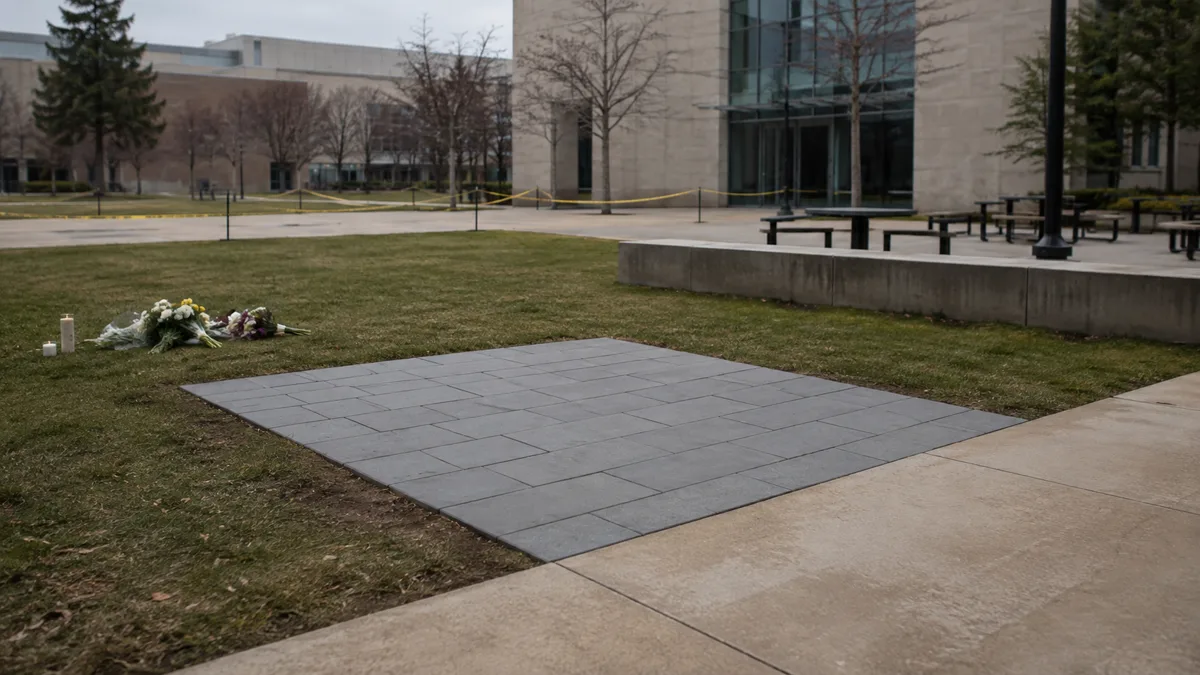
Yes. Utah Valley University rapidly removed grass from the area where Charlie Kirk was shot and installed gray concrete pavers.
An emergency cleanup was commissioned on September 11, 2025, one day after the assassination. Internal communications show that blood remained at the scene on September 12, that personnel were discussing how to alter the surface by September 13, and that the first pavers were being installed on September 14—four days after the killing. Contemporary local reporting that evening independently confirmed that grass was being pulled up from the area where Kirk had fallen.
The material was made of concrete pavers rather than one continuous slab of freshly poured concrete. That distinction matters when describing the construction method. It does not change the central fact that the ground at a nationally significant assassination site was permanently altered within days.
The real question is therefore not whether the paving happened. It did.
The real questions are:
- Why did ordinary blood cleanup become a permanent landscaping project?
- Had every relevant law-enforcement agency formally finished processing the area?
- Who made the final decision?
- Who supplied or paid for the paving?
- Why was the change completed so quickly?
- Why did the university fail to give the public a clear explanation?
The strongest available evidence points to a compressed effort to clean the blood, reopen the campus, replace damaged landscaping and bring a traumatic public location under institutional control. That explanation is more strongly supported than a deliberate evidence-destruction theory.
But describing the entire operation as routine cleanup is also inadequate. Cleaning the site was necessary. Permanently paving it was a separate decision—and that decision remains only partially explained.
Subsequent evidence has sharpened that transparency gap. Contractor Dan Merrell says he was called into an urgent Sunday paving job after the courtyard had already been excavated. At the July 2026 preliminary hearing, David Hull—the Utah State Bureau of Investigation agent who served as lead investigator—testified that he did not authorize the excavation or installation of the pavers and learned about the paving through the news. Neither fact proves evidence destruction. Together, they make the still-unresolved authorization and scene-release chain more important.
What happened at the site?
Charlie Kirk was shot while speaking at an outdoor event at Utah Valley University in Orem on September 10, 2025. According to the prosecution’s charging document, the shot came from an elevated rooftop approximately 160 yards away. Kirk was struck in the neck and collapsed in the event area below. The criminal allegations remain subject to adjudication and should not be treated as a final verdict.
The investigation involved more than the patch of grass where Kirk fell. It encompassed several connected locations:
- the outdoor event area;
- the rooftop believed to have been used as the firing position;
- the suspected escape route;
- and a wooded area where investigators recovered a rifle and ammunition.
The FBI reported collecting shoe impressions, a forearm impression and a palm print from the rooftop. Prosecutors have also described surveillance footage, the recovered weapon and DNA evidence as major elements of the case against the accused defendant. (FBI)
This matters because the phrase “the crime scene” can create the impression that investigators’ entire physical case was located beneath the grass that UVU later removed. It was not.
But the opposite simplification is equally misleading. The area where Kirk was struck and collapsed was still an important component of the overall crime scene. It could have contained blood-pattern information, projectile or fragment evidence, measurements relevant to trajectory, witness-position information and other physical context. Altering that area was not insignificant merely because evidence was also collected elsewhere.
The documented timeline
September 10: The shooting and initial investigation
Kirk was shot on September 10. Law enforcement secured the event area, identified a suspected rooftop firing position and expanded the investigation along the suspected escape route. (FBI)
September 11: Emergency cleanup commissioned
A UVU emergency-payment document records that an order was placed with a vendor on September 11. The invoice amount was $6,090.52, and the description stated: “Clean up for shooting incident.” The vendor’s identity was redacted from the released copy.
This document establishes that cleanup planning began the next day. It does not, by itself, say that paving began that day or that the cleanup vendor performed the later paving work.
September 12: Blood remained, and the FBI was still present
Internal messages released through Utah’s public-records law describe personnel being called into the fountain area to provide water. One participant initially believed that the blood could be washed away without cutting out the sod. After police apparently finished work in that immediate area, the messages described blood or biological material still remaining.
When asked whether the area would be cleaned that night, one participant responded that it would happen later because “the FBI is still there. I guess.” (Judicial Watch)
This is significant for two reasons.
First, it confirms that the work was prompted by an actual and substantial cleanup problem, not an invented post hoc explanation.
Second, it shows that law enforcement activity and facilities planning overlapped in time. The FBI’s continued presence on September 12 does not prove that the specific patch of grass remained under forensic control, but it makes the exact scene-release timeline an important unanswered question.
September 13: Cleanup became a surface-replacement project
The released text-message production shows that university personnel moved beyond discussing how to remove blood. They began considering pavers and concrete, whether the project was a temporary improvement or part of a larger plan, and the maintenance implications of the different surfaces.
That is the point at which the operation stopped being merely a biological cleanup.
Removing contaminated sod may have been necessary. Choosing a permanent hardscape replacement was discretionary. The university could theoretically have replaced the sod, temporarily covered the area, fenced it off longer or postponed a permanent decision until a formal review had been completed.
Instead, it moved rapidly toward paving.
September 14: Grass removed and pavers installed
By the evening of September 14, internal messages indicated that the first pavers were being laid. KUTV reported the same evening that grass was being pulled up where Kirk had been killed and that the area had been fenced. (Judicial Watch)
That timing is difficult to separate from UVU’s reopening schedule. Employees were due to return on September 15, student services on September 16 and classes on September 17. The paving therefore began immediately before the university started bringing people back onto campus. (Utah Valley University)
In a May 2026 interview, Utah contractor Dan Merrell, whose crew helped install the pavers, said he received an unexpected Sunday call for what the caller described as a “paver emergency.” Merrell said he was told the pavers needed to go in that day and the next so the work would be completed by Monday. He assembled a crew and said they arrived within roughly an hour and a half of the call.
Merrell said the area was already excavated when he arrived. He estimated that roughly ten inches of soil had been removed beneath the area that would receive the pavers and said he photographed the condition on arrival. That figure is Merrell’s firsthand estimate, not an official measurement or released excavation record. Merrell also explained that proper paver installation ordinarily involves over-excavation to create a stable base, so the depth alone does not establish an improper purpose.
More controversially, Merrell said one of two on-site coordinators told him the matter was “above our pay grade” and attributed the Monday deadline to the governor and FBI. That distinction is critical: Merrell can directly establish what he says he was told, but he did not describe receiving the instruction directly from Gov. Spencer Cox or the FBI. No written directive or independently corroborated order reviewed for this article establishes that either actually ordered the paving.
The sequence strongly supports the conclusion that reopening pressure materially influenced the speed of the work.
The three decisions that should not be collapsed into one
Public discussion often treats the entire operation as either “crime-scene destruction” or “normal cleanup.” Neither description is precise enough.
There were actually three different decisions.
1. When to release the location from forensic control
This was a law-enforcement question.
Investigators were responsible for securing, photographing, measuring, documenting and collecting evidence from the relevant areas before allowing them to be altered.
2. How to remove blood and biologically contaminated material
This was a health, safety and remediation question.
Human blood must be treated as potentially infectious. OSHA standards require contaminated work surfaces and materials to be cleaned and decontaminated as soon as feasible, using appropriate precautions. OSHA has specifically stated that contractors cleaning blood after homicides are covered by its bloodborne-pathogen requirements. (OSHA)
3. What permanent surface should replace the grass
This was a facilities, landscaping and administrative question.
Nothing in bloodborne-pathogen guidance automatically requires a university to install concrete pavers. Contaminated sod might need removal, but replacing it with a permanent hard surface is a separate choice.
That distinction is fundamental.
The necessity of cleaning the blood does not, by itself, explain the decision to pave.
What explanation is best supported by the evidence?
No single released document provides a complete rationale. The most credible explanation must be reconstructed from the chronology, internal communications and circumstances surrounding the campus reopening.
1. Blood and contaminated landscaping had to be removed
This is the strongest and least controversial part of the explanation.
The messages show that visible blood remained after investigators had worked in the area. Washing grass and soil is not necessarily sufficient to remove biological material that has soaked beneath the surface. Removing affected sod and possibly some underlying soil would have been a reasonable response. (Judicial Watch)
Any analysis suggesting that UVU should simply have left the blood in place indefinitely would be unrealistic. The university had legal, safety, psychological and operational reasons to remediate the location.
But this explains the removal of contaminated material—not the immediate decision to install permanent pavers.
2. UVU faced a hard reopening deadline
The first pavers were reportedly going down on Sunday, September 14. Employees were returning the following morning.
That timing is unlikely to be coincidental.
UVU had to bring thousands of students and employees back to a campus where a public figure had just been killed in front of a crowd. Leaving an excavated, blood-stained or visibly damaged patch of ground in the center of the campus would have created safety problems, attracted continuous attention and intensified the psychological impact of returning. (KUTV)
A stable surface could be installed more quickly and predictably than newly laid sod. Pavers also allowed the university to reopen without waiting for grass to establish itself or deciding how a newly restored lawn would handle visitors, flowers, media crews and memorial activity.
This is not necessarily sinister. It is institutional crisis management.
It is also more than routine cleanup.
3. Facilities personnel used the emergency to make a practical landscaping change
The internal discussions show personnel weighing pavers against concrete and considering maintenance. That indicates that the project became, at least partly, a facilities decision.
Once the affected sod had to be removed, administrators appear to have concluded that a permanent hard surface would be easier to maintain than restoring the grass. A paved area could better accommodate foot traffic, memorial visitors, winter access and future events.
This is probably the most mundane component of the explanation—and one of the most revealing.
Large institutions frequently make permanent decisions during emergencies because the emergency creates both the authority and the opportunity to act quickly. A narrowly justified cleanup can expand into a broader redesign without the consultation, documentation or public process that would ordinarily accompany a permanent change.
That does not prove corrupt intent. It does explain how a biohazard response could become a paving operation within a matter of days.
4. The university wanted to visually normalize and control the location
This element is partly inferential, but the evidence points in that direction.
The assassination site immediately became more than damaged landscaping. It became a place of grief, political expression, public curiosity and national media attention. Visitors were already leaving flowers and messages around the campus. (KUTV)
Internal communications also considered the colors of the pavers and barriers. Personnel rejected conspicuous red barriers, while gray pavers were selected. That suggests the visual presentation of the location mattered.
Turning a blood-stained patch of grass into a clean, neutral hardscape would have helped the university transform the site from an uncontrolled visual reminder of the killing into a managed institutional space.
That motive is understandable. It should also have been acknowledged.
The university’s desire to reduce trauma, restore order and prevent the site from remaining a graphic spectacle may have been legitimate. But institutions should not disguise acts of symbolic control as if they were merely technical maintenance.
5. The paving was probably not originally designed as the formal memorial
UVU later created a memorial committee to consult students, officials, community members and Kirk’s family about a long-term memorial. The committee’s announcement emphasized a deliberate process and community input. (Utah Valley University)
That formal process came after the rapid paving, and as of August 2026 UVU’s memorial page still says the committee is gathering public input before any decision is made. The chronology therefore makes one point increasingly clear: the September 14 paving was not the product of the university’s later formal memorial-design process. The pavers may have served as an interim gathering or memorial surface, but the available evidence points more strongly toward cleanup, reopening and site management than toward a deliberative commemorative design.
Why public skepticism is justified
The absence of proof of a criminal cover-up does not mean the university handled the matter well.
Several facts legitimately warrant scrutiny.
The physical alteration was extraordinarily fast
A nationally consequential political assassination occurred on Wednesday. By Sunday, personnel were laying pavers at the location.
Even if the work was completely innocent, that speed was always going to raise questions. A reasonable institution should have anticipated those questions and documented every stage of the decision.
UVU did not clearly explain the permanent change
UVU issued extensive communications about closure, mental-health support, phased reopening, security reviews and memorial planning. But the publicly available statements reviewed for this article do not provide a direct, comprehensive explanation of why the grass was permanently replaced with pavers.
The public was left to reconstruct the decision months later from records obtained through a government-records request.
That is a transparency failure.
Internal messages show concern about media access
In one September 14 exchange, a person involved with the paving said that the workers were “well trained in keeping quiet” while discussing media attention. (Judicial Watch)
The immediate context appears to involve keeping workers from speaking casually with reporters, not ordering them to deceive investigators or conceal evidence.
Even so, the message is troubling. Rather than giving the public an authorized factual explanation, the institution appears to have emphasized controlling who spoke.
That does not establish a forensic cover-up. It does suggest that UVU treated legitimate questions as a communications problem.
The funding remains unclear
UVU’s legal response states that the university did not pay for the paving and therefore possessed no paving estimates, invoices or purchase orders. The response suggested that Utah’s Division of Facilities and Construction Management might possess relevant records.
This leaves a basic question unanswered:
Who paid for or donated the pavers and labor?
There may be an innocent answer. A state agency, contractor or private donor may have supplied the materials or work. But when an outside party helps permanently alter a politically significant killing site, the identity of that party and the authorization process should not remain obscure.
The exact forensic-release record has not been publicly produced
UVU’s legal filing says that the work occurred after the site was returned to university control and identifies Frank Young, UVU’s associate vice president of facilities planning, as the person who coordinated cleanup, material removal and paving.
That statement is meaningful evidence that investigators had relinquished the location.
It is not the same thing as publishing the formal scene-release documentation.
That gap became more significant at the July 7, 2026 preliminary hearing. David Hull, the State Bureau of Investigation agent who served as lead investigator, testified under defense cross-examination that he did not authorize the excavation or installation of the pavers and learned that the courtyard had been paved through the news. That testimony does not establish that no other law-enforcement official authorized the release or alteration. It does establish that the lead state investigator was not the person who authorized it, making the identity and documentation of the actual release decision more important.
The reviewed records do not clearly provide:
- the exact date and time the affected area was released;
- which agency authorized that release;
- whether the release covered the entire courtyard or only defined portions;
- who confirmed that trajectory, blood-pattern and ground-level evidence had been fully documented;
- or what restrictions, if any, accompanied the release.
Some law-enforcement records remain protected because the criminal investigation and prosecution are ongoing. That may legally justify withholding details. It also means the public cannot independently verify every step of the process.
Could the paving have destroyed evidence?
It could have—if it occurred before the area had been completely processed.
Outdoor shooting scenes may contain blood patterns, bullet fragments, trace material, footprints, displaced objects and spatial relationships useful for reconstructing an event. Federal crime-scene guidance emphasizes preserving locations from contamination or alteration, documenting the original position of victims and objects, and maintaining a permanent record of observations and evidence. (Office of Justice Programs)
However, a crime scene does not have to remain physically frozen forever. Once investigators have photographed it, measured it, collected relevant evidence and formally released it, the property owner can ordinarily begin remediation.
The public evidence currently available still does not demonstrate that paving began while the courtyard remained under active forensic control. UVU says the site had been returned to university control before facilities personnel coordinated the work. (Judicial Watch)
Later sworn testimony adds an important fact: State Bureau of Investigation Sgt. Jennifer Faumuina testified that crime-scene technicians processed the courtyard where Kirk was struck, along with the rooftop and wooded area. That strengthens the evidence that the courtyard itself received forensic processing; it does not establish exactly when that processing was complete or the terms under which the ground was released. (FBI)
The unresolved issue is therefore narrower but more concrete: what happened between forensic processing and excavation? The public record still does not show the precise release time and boundaries, the official who authorized the release, who authorized the excavation, or what became of the removed material. Hull’s testimony that he did not authorize the excavation or paving makes that missing handoff and authorization record more significant.
The correct conclusion is therefore limited:
The paving had the potential to destroy evidence if investigators had not finished processing the location, but the released record does not show that this occurred.
That is different from declaring the matter fully resolved. Without the formal release record and a clearer account of what material was removed, independent observers cannot verify the process with complete confidence.
Does the evidence support a deliberate cover-up?
Not on the current record.
To establish a purposeful evidence-destruction operation, evidence would be needed that:
- relevant physical evidence remained at the location;
- decision-makers knew it remained;
- the paving occurred before investigators had authorized alteration;
- the work was intended to prevent evidence from being found or examined;
- and officials coordinated misleading statements or records to conceal that purpose.
The released documents do not establish any of those propositions.
No message currently available instructs workers to destroy evidence. No released document shows law enforcement objecting to the paving. No evidence has emerged showing that UVU personnel were trying to protect the accused shooter or alter the known trajectory of the shot.
The phrase about workers “keeping quiet” supports criticism of institutional secrecy. It does not, without additional evidence, prove obstruction of justice.
At the same time, the opposite claim—that this was nothing more than an ordinary cleanup—is too dismissive.
Ordinary cleanup explains why blood and contaminated sod were removed. It does not fully explain:
- the immediate permanent paving;
- the absence of a public rationale;
- the unknown source of payment;
- the lack of a released forensic signoff;
- or the emphasis on keeping workers away from reporters.
The evidence supports poorly documented institutional control, not a proven criminal conspiracy.
Evidence-weighted assessment of the main explanations
| Proposed explanation | Evidence assessment |
|---|---|
| Blood and biohazard remediation | Strongly supported. Internal messages describe remaining blood, and an emergency cleanup order was placed the next day. |
| Pressure to reopen the campus | Strongly supported. Pavers were installed immediately before employees and students returned. |
| A maintenance-driven landscaping decision | Strongly supported. Internal discussions considered surface types and practical maintenance. |
| Creating a manageable memorial or gathering surface | Plausible but only partly documented. The location immediately attracted visitors, but the formal memorial process began later. |
| Reducing the site’s traumatic visual impact | Plausible inference. The rapid visual transformation and discussion of colors support this interpretation, though UVU did not clearly state it. |
| Controlling media and public messaging | Moderately supported. Internal messages indicate an effort to keep workers from speaking, but not necessarily to hide forensic misconduct. |
| Deliberate destruction of evidence | Not supported by the released evidence. Important documentation is still absent, but no proof of intent or premature alteration has emerged. |
| FBI or governor direction of the paving | Not established, but not baseless. Dan Merrell is currently the only named participant identified in the public record reviewed for this article who attributes the Monday deadline specifically to the governor and FBI, and he says that information came from an unnamed on-site coordinator rather than from either office directly. Other released records document FBI presence at the scene and unusual urgency and media sensitivity surrounding the work, but no second witness, written directive, email, work order or other record reviewed here independently confirms that Gov. Spencer Cox or the FBI ordered the paving. |
| A fully routine cleanup requiring no further explanation | Not supported. Cleanup was necessary, but permanent paving, outside funding and the authorization chain remain distinct public-interest questions. |
What Judicial Watch’s records establish—and what they do not
The documents became widely known after Judicial Watch obtained them through Utah’s Government Records Access and Management Act.
Judicial Watch is an advocacy organization, not a neutral forensic authority. Its characterization of the records as an effort to “immediately pave over” the assassination site should therefore not be accepted or rejected solely because of the organization publishing it.
The underlying records should be evaluated independently.
Those records establish that:
- emergency cleanup was commissioned one day after the shooting;
- visible blood remained after initial law-enforcement activity;
- the FBI was reportedly still present on September 12;
- facilities personnel coordinated removal and paving;
- grass was pulled up;
- concrete pavers were installed within four days;
- workers were discouraged from speaking with media;
- UVU says it did not pay for the paving;
- and UVU says the site had been returned to university control before the work.
They do not establish that:
- the FBI ordered the paving;
- investigators had left evidence uncollected;
- UVU intended to obstruct the investigation;
- the paving altered the known direction of the shot;
- or the unidentified payer had an improper motive.
Separately, Merrell’s later account introduces an allegation that an on-site coordinator attributed the Monday deadline to the governor and FBI. That account is not part of the Judicial Watch document production and does not independently prove that either issued the directive.
That distinction is what evidence-based analysis requires: taking the records seriously without automatically adopting the publisher’s most incriminating interpretation.
The unanswered questions UVU and law enforcement should address
A credible public accounting would answer the following questions directly:
Who formally released the affected ground?
UVU says the site had been returned to its control. The responsible law-enforcement agency should confirm the precise time, boundaries and conditions of that release.
What forensic work was completed before removal began?
The public does not need every sensitive detail of an ongoing prosecution. It is still reasonable to confirm that photographs, measurements, trajectory analysis, blood evidence and relevant soil or trace samples were completed before the surface was changed.
Who authorized permanent pavers?
UVU records identify Frank Young as coordinating the cleanup, material removal and paving, but coordination is not the same thing as final authorization. Hull later testified that he did not authorize the excavation or paver installation and learned about the paving through the news. Merrell, meanwhile, says an on-site coordinator attributed the Monday deadline to the governor and FBI, but that claim has not been independently corroborated. The public record therefore still does not identify the complete approval chain or the official who made the final decision.
Identifying the two on-site coordinators Merrell describes is therefore particularly important: either could potentially confirm, contradict or clarify his account of where the Monday deadline originated.
Who paid for the paving?
UVU says it did not. The state agency, donor, contractor or other entity that funded or donated the work should be identified.
What happened to the removed sod and soil?
Merrell’s account makes this question more specific. He says the ground had already been excavated when he arrived and estimates that roughly ten inches of material had been removed beneath the future paved area. Who performed that initial excavation, who authorized it, and what happened to the removed soil and sod? Those facts should be documented.
Why was the permanent decision made before the formal memorial process?
The university should explain whether the paving was intended to be temporary, purely functional or part of a future memorial plan.
What does UVU’s completed independent review say about the paving?
UVU released the completed independent external review on September 25, 2026. The 158-page report says its purpose included evaluating the university’s planning, preparedness, decision-making, operational response, interagency coordination and post-incident actions. UVU separately describes the review as examining its planning, preparedness, response and recovery.
That makes what the report does not address relevant here.
The released report does not specifically explain the excavation of the courtyard, removal of sod or soil, installation of the concrete pavers, who authorized that work, who paid for it, what happened to the removed material, or the precise forensic release of the affected ground. Searches of the report’s publicly available text for terms including “paving,” “pavers,” “excavation,” “soil,” “blood” and “biohazard” do not identify a discussion of the paving operation.
The report does establish additional context around the timeline. Its post-incident chronology states that the campus remained closed from September 11 through September 14 while law enforcement continued investigative activities and UVU coordinated recovery operations. That does not establish that the specific courtyard area remained under forensic control until September 14. It does, however, confirm that continuing investigative activity and the university’s recovery work overlapped during the same period in which the paving operation developed.
The review also clarifies the investigative command structure. According to the report, Utah Department of Public Safety Commissioner Beau Mason told officials that the governor had directed him to take the lead on the investigation. Mason then learned that the FBI’s Salt Lake City special agent in charge had separately been instructed to lead. The two ultimately agreed that Utah DPS and the FBI would co-lead the investigation.
That fact gives additional context to contractor Dan Merrell’s later account that an unidentified coordinator attributed the paving deadline to “the governor and FBI.” It does not corroborate that allegation. The independent review contains no identified paving order from the governor, FBI or DPS and does not state that any of those entities authorized the excavation or installation of the pavers.
The report’s broader conclusion is also important: its reviewers said they found no bad faith by UVU employees or agents in the events leading up to or following the assassination. That is consistent with this article’s conclusion that the presently available evidence does not establish deliberate evidence destruction.
But the report does not close the transparency gap. Despite examining post-incident response and recovery, it leaves the central paving questions unanswered.
The objective conclusion
The site where Charlie Kirk was shot was rapidly and permanently altered.
Cleanup was ordered one day after the assassination. Blood remained at the location while law enforcement was still present. Within the next several days, university facilities personnel moved from discussing decontamination to discussing surface replacement. Grass was removed, and gray concrete pavers began going down four days after the killing—immediately before the campus reopened.
The most evidence-supported explanation is not simply “biohazard cleanup.” It is a combination of:
- necessary blood remediation;
- pressure to reopen the university;
- a facilities decision to replace difficult or damaged grass with a durable surface;
- and an institutional desire to visually stabilize and control a traumatic, politically charged location.
That explanation is credible. It is also incomplete because UVU has not publicly supplied the full approval chain, funding source, forensic release record or written justification for the permanent alteration.
The later contractor and preliminary-hearing testimony makes that missing documentation more concrete: Merrell describes arriving after excavation had already occurred, while Hull says he did not authorize that excavation or the paving. Those facts increase the need for a documented approval and release chain without, by themselves, establishing improper intent.
The September 2026 independent review does not materially alter that assessment. Its conclusion that reviewers found no bad faith by UVU personnel weighs against claims of a deliberate institutional evidence-destruction scheme. At the same time, the report does not document the paving authorization, funding source, excavation, disposition of removed material or precise forensic release of the affected ground. It therefore provides additional context without resolving the specific transparency questions examined here.
There is currently no affirmative evidence that the paving was ordered to conceal the shooter’s identity, alter the trajectory evidence or destroy material investigators had failed to collect. Calling it a proven cover-up would go beyond the record.
But dismissing the controversy as a routine cleanup also goes beyond the record.
The paving was real. It was unusually fast. It was permanent. It was handled with an evident concern for media control, and essential details remain undisclosed.
The fairest evidence-based verdict is:
Utah Valley University appears to have folded a permanent landscaping and site-control decision into an urgent cleanup and reopening operation. The existing evidence does not prove deliberate evidence destruction, but the university’s limited transparency has prevented the public from independently ruling it out with the confidence that a political assassination of this magnitude demands.
Frequently asked questions
Did Utah Valley University really pave the area where Charlie Kirk was killed?
Yes. Grass was removed from the area, and gray concrete pavers were installed within days of the assassination.
Was the area paved the next day?
The emergency cleanup was commissioned the next day, September 11. The first pavers were installed approximately four days after the shooting, on September 14. The distinction clarifies the timeline but does not negate that the site was altered extremely quickly.
Why did UVU pave the site?
The evidence points to blood remediation, an imminent campus reopening, maintenance considerations and a desire to transform the location into a stable, manageable public space. UVU has not released one complete public explanation covering all of those factors.
Did the FBI order UVU to pave the site?
That has not been established. Contractor Dan Merrell says an unnamed on-site coordinator told him that the governor and FBI wanted the paving completed by Monday. Merrell is currently the only named participant reviewed for this article making that specific attribution. Separate records document FBI presence at the scene and unusual urgency surrounding the work, but no second witness or documentary record reviewed here independently confirms that Gov. Spencer Cox or the FBI issued the paving order.
Had investigators finished processing the crime scene?
Sworn testimony now confirms that crime-scene technicians processed the courtyard itself. UVU also says the site had been returned to university control before the cleanup and paving were coordinated. However, the formal release record, precise completion and release time, and authorizing official have still not been publicly produced in the records reviewed here. Lead investigator David Hull also testified that he did not authorize the excavation or paving. The public evidence therefore supports that forensic processing occurred, but does not fully document the transition from crime scene to excavation site.
Could the paving have destroyed evidence?
Yes, if it had occurred before forensic processing was completed. The current public record does not show that it did, but the absence of detailed release documentation prevents complete independent verification.
Who paid for the paving?
UVU stated that it did not pay for the work and therefore had no paving estimates, invoices or purchase orders to release. The source of funding or donated labor has not been clearly identified in the records reviewed here.
Does the paving prove a cover-up?
No. The paving and lack of transparency justify investigation and public questioning, but they do not by themselves prove intentional evidence destruction.
How much soil was removed before UVU installed the pavers?
Contractor Dan Merrell estimated that roughly ten inches of soil beneath the paved area had already been excavated when he arrived. That is a firsthand estimate, not an official surveyed measurement. Merrell also explained that over-excavation is a normal part of constructing a proper base for pavers, so the depth by itself does not establish an evidence-destruction motive.
References and Further Reading
Primary UVU records released under GRAMA
- Utah Valley University internal text messages and facilities records obtained through GRAMA — The underlying UVU records documenting internal discussions about blood cleanup, removal of material, surface replacement, pavers, reopening pressures and media attention in the days after the shooting.
- UVU Respondent’s Statement of Facts, Reasons, and Legal Authority in the GRAMA appeal — UVU’s formal legal filing concerning its records search. It states that the site had been returned to UVU control, identifies Associate Vice President Frank Young as coordinating cleanup, material removal and paving, and says UVU did not pay for the paving work.
- UVU Emergency Payment Request for the shooting-incident cleanup — Primary university procurement record showing that an emergency cleanup order was placed September 11, 2025, one day after the assassination, for $6,090.52 and described as “Clean up for shooting incident.”
- Judicial Watch: University Releases Documents on Clean Up of Charlie Kirk Assassination Site — Provides access to the broader UVU records production and explains the GRAMA request that produced it. Judicial Watch is an advocacy organization; this article relies on the underlying university records as evidence rather than adopting the organization’s characterization of them as fact.
Official investigative and court records
- FBI — Utah Valley Shooting Updates — Official FBI updates concerning the investigation, including evidence recovered from the suspected firing position and related investigative locations.
- Utah County Attorney — Charging Information and Probable-Cause Statement — The prosecution’s formal charging document describing the alleged shooting, suspected firing position, escape route, recovered firearm and other evidence. Criminal allegations remain subject to adjudication.
- Utah State Courts — Requesting Audio of a Court Proceeding — Official Utah Courts instructions for obtaining the underlying audio record of district-court proceedings, including hearings in the Fourth Judicial District.
Preliminary-hearing testimony and courtroom reporting
- KSL NewsRadio — Tyler Robinson Preliminary Hearing, Day 2, July 7, 2026 — Includes an unedited recording of the second day of the preliminary hearing and identifies David Hull as the State Bureau of Investigation’s lead investigator. Hull’s cross-examination is relevant to the questions surrounding excavation and authorization of the paving.
- East Idaho News — Tyler Robinson Preliminary Hearing, Day 4, July 9, 2026 — Contemporaneous courtroom reporting on Sgt. Jennifer Faumuina’s testimony that investigators processed multiple connected scenes, specifically including the courtyard where Kirk was killed.
Firsthand contractor account
- The Jimmy Rex Show #689 — Dan Merrell: Contractor Hired to Pave Over Charlie Kirk Death Scene Finally Speaks Out — Extended May 18, 2026 interview with contractor Dan Merrell about the Sunday call, the condition of the site when he arrived, the paving work and what on-site coordinators allegedly told him.
- Listen Notes — Searchable transcript of the Dan Merrell interview — Searchable transcript useful for reviewing Merrell’s exact account, including his estimate of the excavation depth, the urgent Monday deadline and his description of what he says an on-site coordinator told him.
Merrell is a primary source for what he personally saw, did and was told. His account that a coordinator attributed the deadline to the governor and FBI is not, by itself, proof that either the governor or FBI actually issued such an instruction.
Official Utah Valley University statements and memorial process
- UVU — Phased Return to Campus — Establishes the university’s compressed reopening schedule: employees returned September 15, student services September 16 and classes September 17.
- UVU — Utah Valley University Forms Memorial Committee Following Charlie Kirk Tragedy — UVU’s announcement establishing a formal process for considering a permanent memorial after the rapid paving had already occurred.
- UVU — Charlie Kirk Memorial Committee — Current university memorial page stating that the committee is gathering public input and holding discussions before a final memorial decision is made. This helps distinguish the later formal memorial process from the September 2025 paving operation.
- UVU — Utah Valley University Initiating a Comprehensive Independent Review — UVU’s original announcement that an outside organization would conduct a comprehensive independent review of the assassination and university response.
Independent review and after-action report
- Illinois Security Professionals Association — After Action Report for Utah Valley University — September 10, 2026 program description for a presentation by G. Michael Verden of The Lake Forest Group. It describes the UVU review as examining events leading up to and immediately following the assassination and documenting relevant agencies, actions, key decisions and resulting outcomes.
- KUTV — UVU Redacts Costs for Police Audit Tied to Charlie Kirk Killing — Reporting based on records obtained from UVU identifying The Lake Forest Group and Brownstein Hyatt Farber Schreck as entities conducting the outside review and documenting substantial redactions in the released contracts, including the amounts being paid.
- UVU — Independent External Review — Utah Valley University’s official portal for the completed September 2026 external review, including its findings, recommendations and access to the full 158-page After-Action Report.
- UVU — UVU Releases Independent Review of September 10, 2025 Campus Shooting — Official September 25, 2026 announcement describing the review’s scope, methodology, participating organizations and central findings.
Crime-scene preservation and investigation standards
- National Institute of Justice — Crime Scene Investigation: A Guide for Law Enforcement — Foundational federal guidance on securing, documenting, processing and releasing crime scenes while minimizing contamination or loss of evidence.
- National Institute of Justice — Death Investigation: A Guide for the Scene Investigator — Current federal guidance emphasizing scene documentation, preservation of spatial relationships and creation of a permanent investigative record.
- National Institute of Standards and Technology — Crime Scene Investigation: A Guide for Law Enforcement — Expanded crime-scene guidance developed with input from NIST, NIJ and the Bureau of Justice Assistance, covering scene security, documentation, evidence collection and processing.
Biohazard and blood-cleanup standards
- OSHA — Bloodborne Pathogens Standard, 29 CFR 1910.1030 — Federal occupational-safety requirements governing exposure to potentially infectious human blood and other bodily material.
- OSHA — Application of the Bloodborne Pathogens Standard to Contractors Cleaning Blood After Accidents and Homicides — OSHA interpretation confirming that contractors performing this type of cleanup can fall under the bloodborne-pathogens standard. This supports the need for proper remediation but does not establish that permanent paving was required.
Contemporary reporting
- KUTV — Memorial Grows at UVU as Students and Visitors Return to Process Shooting — Published the evening of September 14, 2025, and independently documented that grass was being pulled up from the area where Kirk was killed as the university prepared to reopen.
Source and currency note
This article distinguishes between primary records, sworn testimony, firsthand accounts and secondary reporting. Judicial Watch obtained and hosts important UVU records, but its advocacy framing is not treated as independent evidence. Dan Merrell’s interview is direct evidence of his own observations and of statements he says were made to him; it does not independently establish the truth of claims attributed to unnamed officials or agencies. Preliminary-hearing reporting and publicly available recordings are distinguished from certified court transcripts.
The criminal case and related public-records disclosures remain ongoing. UVU released its completed independent external review on September 25, 2026, and this article has been updated to incorporate its relevant findings. This article should be updated again if additional scene-release documentation, paving authorization or payment records, records concerning the removed sod or soil, official court transcripts, or other materially relevant evidence becomes publicly available.