Some of the anomalies now circulating around Charlie Kirk, Pastor Rob McCoy and TPUSA Faith are real.
A new Rob McCoy section really was inserted into Turning Point USA’s Wikipedia article roughly 32 hours after Kirk was shot. It really did state categorically that McCoy and Kirk had “founded Turning Point USA Faith together.” A YouTube version of McCoy’s July 27 sermon really did become unavailable to Baron Coleman while Coleman says he was analyzing it live. And Turning Point USA spokesman Andrew Kolvet really did confirm the authenticity of a leaked screenshot containing Kirk’s private frustrations about donor pressure and Israel.
But digging deeper changes several parts of the viral version—and those corrections do not make the underlying questions disappear.
McCoy’s “co-founder” title was not invented after Kirk’s death. McCoy himself publicly described himself as “co-founder, co-chair of TPUSA Faith” in a program published more than a year earlier. At other times, however, TPUSA and outside reporting used different descriptions: “Advisory Pastor,” “co-chair,” and “helped launch.” The documentary record of exactly what McCoy’s role was is therefore genuinely inconsistent.
Likewise, the July 27 sermon was not erased from the internet. Full copies remain available through Godspeak’s podcast distribution and Rumble. That does not answer why the YouTube copy changed status while someone was publicly scrutinizing it. It simply narrows the question to something that can potentially be proven: who changed that specific video’s privacy status, when, and why?
And the Google Trends evidence deserves considerably more care than either “this proves foreknowledge” or “Google says it’s noise, case closed.”
Google’s own documentation creates a much more interesting evidentiary problem.
The Wikipedia Edit Happened at 10:34:22 P.M. Eastern
This is one of the cleanest facts in the entire story because Wikipedia preserves revision-level timestamps.
The relevant edit is revision 1310874389.
Wikipedia’s own API records it at:
September 12, 2025 — 02:34:22 UTC
That converts to:
September 11, 2025 — 10:34:22 p.m. Eastern Daylight Time
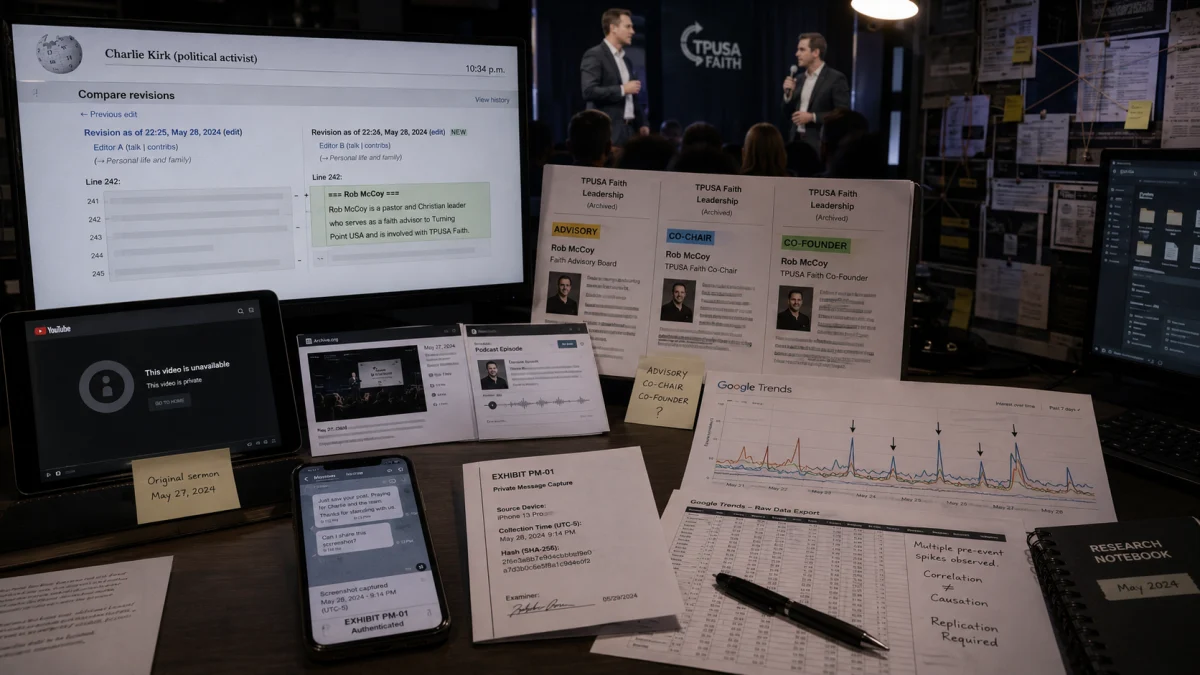
The editor added an entirely new section headed “Rob McCoy.” The previous revision did not contain that section. The new wording said McCoy and Kirk had founded TPUSA Faith together and described McCoy as its co-chairman.
This is important because an earlier version of our own review had identified a later 10:41 p.m. revision as the key edit. That was incorrect. 10:34:22 p.m. is the timestamp that matters.
The FBI says Kirk was shot at 12:23 p.m. local time in Utah on September 10. That is 18:23 UTC. The Wikipedia insertion therefore occurred approximately 32 hours, 11 minutes and 22 seconds after the shooting.
So Candace Owens’ core timing claim—an unusual McCoy addition less than 36 hours later—checks out.
The harder question is what that timing means.
The “Co-Founder” Claim Has a Much Stranger History Than It First Appears
It would be easy to frame the Wikipedia edit as someone simply inventing a new title for McCoy after Kirk could no longer dispute it.
The surviving record does not allow us to say that.
On July 18, 2021, an article published by Turning Point USA itself introduced McCoy as “TPUSA Faith’s Advisory Pastor.”
Religion News Service reported in June 2023 that McCoy “eventually … became co-chair of TPUSA Faith.” That account described McCoy as an important figure in the development of Kirk’s church strategy but did not characterize him there as the original founder.
Then comes a particularly important piece of evidence.
In a WallBuilders program published June 24, 2024, McCoy can be heard describing himself directly:
“I’m the co-founder, co-chair of TPUSA Faith.”
That predates Kirk’s killing by more than a year.
And yet a detailed Los Angeles Times profile published in November 2024 used more cautious language, saying Kirk shared the Turning Point brand with McCoy, “who helped launch TPUSA Faith.” The article also noted that TPUSA and TPUSA Faith did not respond to its requests for comment.
Today, TPUSA Faith’s own website unequivocally calls McCoy “Co-Founder of TPUSA Faith.”
That means the strongest investigative question is no longer:
Who invented the title “co-founder” after Charlie Kirk died?
We can establish that McCoy publicly used the title before Kirk’s death.
The better question is:
Why was McCoy’s institutional status described so differently over time, and what contemporaneous TPUSA records establish his actual role in creating TPUSA Faith?
That is not semantic nitpicking.
“Advisory pastor,” “co-chair,” “helped launch,” and “co-founder” describe overlapping but different relationships to an organization. If McCoy was formally a co-founder from the beginning, there should be contemporaneous evidence of that relationship: launch announcements, early organizational materials, internal leadership records, archived staff biographies, planning correspondence or other records created when TPUSA Faith was formed.
If those documents exist, they could settle the question.
If they do not—or if early TPUSA material consistently assigns McCoy a different role—the changing terminology becomes more significant.
The Wikipedia Sources Were a Separate Problem
Even if McCoy had used “co-founder” elsewhere before Kirk’s death, that does not automatically validate the September 11 Wikipedia edit.
Wikipedia’s revision shows which sources the editor attached to the new claim. One was a November 2024 article concerning McCoy and Kirk. Another was a Fox News article published immediately after Kirk’s death.
The Fox article identifies McCoy as co-chair of Turning Point Faith, not as its co-founder.
The November 2024 reporting available from the same reporting lineage describes McCoy as someone who helped launch TPUSA Faith.
Wikipedia editors subsequently challenged the categorical co-founder language on sourcing grounds, and the current article no longer uses the original sentence. It now says McCoy is “credited with helping launch” TPUSA Faith.
So two things can be true simultaneously:
McCoy had publicly called himself a co-founder before Kirk died.
And the particular Wikipedia edit inserted immediately after Kirk’s death did not clearly establish that claim through the citations attached to it.
That distinction matters.
Did Wikipedia Remove It Because Candace Owens Called Attention to It?
This is still unresolved.
Owens discussed the Wikipedia change in Episode 254 of her show on October 29, 2025. Her description of the original 10:34 p.m. edit substantially matches Wikipedia’s revision history.
But proving that her broadcast caused Wikipedia editors to change the article requires a tighter timestamp comparison.
Wikipedia’s revision history records a challenge to the sourcing at approximately 22:09 UTC on October 29. Apple’s podcast feed timestamps Owens’ episode at 22:49 UTC that day.
That does not settle the issue because Owens’ program was also distributed as a live/video program, and the Apple feed’s publication time does not necessarily equal the beginning of the livestream.
I have not found a sufficiently strong primary record establishing the exact second her livestream began.
Therefore the defensible finding is:
The removal and Candace Owens’ public scrutiny occurred in the same period, but the available timestamps reviewed here do not yet prove that her broadcast caused the edit.
This is an answerable question, not a dead end. The exact YouTube or Rumble livestream start metadata, contemporaneous screenshots, platform notifications or archived stream pages could establish which occurred first.
The Rob McCoy Sermon Really Did Become a Point of Contention
The sermon at the center of the controversy is:
“Has God Cast Away His People | Romans 11:1–36 | Pastor Rob McCoy”
Godspeak’s own sermon archive lists it under July 27, 2025 and still contains a link associated with the service.
That link resolves to YouTube video ID:
4qcwzWKk2Q0
Our current verification pass can resolve that video ID through YouTube, but the resulting public page does not expose the original sermon normally through the retrieved interface.
Baron Coleman documented his account of what happened in Episode 16 of the Real Baron Podcast. His episode notes state that while he was covering McCoy’s July 27 sermon, “the video was marked private, which prevented me from finishing my analysis on air.” The notes identify the original livestream as November 16, 2025.
That establishes what Coleman publicly reported contemporaneously.
It does not, by itself, establish who pressed the privacy button. Coleman did not have access to Godspeak’s YouTube backend.
That distinction is worth preserving because the narrower claim is actually testable.
The Sermon Was Not Erased—and Here Are the Surviving Copies
Calling the sermon “deleted” would be inaccurate.
Godspeak’s own current archive still lists it.
Apple Podcasts carries the complete 1-hour, 14-minute Godspeak episode dated July 27, 2025.
Buzzsprout also hosts the episode through Godspeak’s podcast distribution.
And a full video version remains publicly available through Godspeak’s official Rumble presence.
That does not make the YouTube privacy change meaningless.
If anything, it makes the allegation much more specific.
The question is not, “Did someone successfully erase this sermon from history?”
They did not.
The question is:
Why did the particular YouTube copy Coleman says he was publicly analyzing become private at that moment?
There are innocent explanations. There are also explanations that would be more significant. At present, neither has been demonstrated.
The evidence capable of resolving it would include YouTube Studio activity records, access logs or account audit history; a statement from whoever controlled the Godspeak channel; an independently timestamped recording showing the same video ID accessible immediately before and private immediately afterward; or internal communications discussing the video’s status.
That is where this part of the investigation should go next.
Why the July 27 Sermon Is Relevant
The sermon itself was not an unrelated Sunday service suddenly dragged into the investigation.
Godspeak’s own description says McCoy discussed divisions among Christians over Israel and the Jewish people, reflected on his recent travels to the Student Action Summit, a Faith Wins pastors conference and a Freedom Night event, and warned about what he characterized as rising antisemitism among Gen Z conservatives and replacement theology.
That places the sermon directly inside a political and religious argument that was increasingly important around Kirk during his final months.
The existence of the sermon does not prove a plot.
But the appropriate investigative response to a politically relevant video changing visibility during public scrutiny is not to wave it away because another copy exists. It is to preserve every version, compare them, obtain the platform metadata and determine who controlled the original upload.
The Charlie Kirk Text Messages Are Not Merely an Internet Rumor
This part of the story has unusually strong authentication.
On an October 7, 2025 episode of The Charlie Kirk Show, Andrew Kolvet addressed the group-text screenshot released by Candace Owens.
Kolvet said the screenshot was one he had personally shared and stated:
“So it is authentic.”
He also said he had shared it with some people in government during the early investigation because TPUSA wanted “no stone unturned.”
That is substantially different from an anonymous screenshot circulating without provenance.
Kolvet then discussed Kirk’s Israel position directly. He said Kirk’s private text was consistent with frustrations Kirk had been expressing and described Kirk’s position on Israel as “complicated and nuanced” and something he had been wrestling with for months.
Later in the same discussion, Kolvet specifically acknowledged the text in which Kirk said donor pressure was leaving him “no choice, but to leave the pro-Israel side.” Kolvet’s interpretation was that Kirk was frustrated and venting rather than announcing a settled ideological break.
That interpretation is Kolvet’s.
The text itself is still significant.
The accurate formulation is therefore:
TPUSA did not deny that Kirk wrote the message. Its own spokesman authenticated the screenshot and acknowledged that Kirk had been wrestling with Israel-related disagreements for months. TPUSA disputes the interpretation that the message proves Kirk had made a permanent final break with the pro-Israel movement.
Those are two different questions.
Why Those Texts Matter to the Question of Kirk’s Legacy
An authenticated private communication becomes particularly important when a person’s public legacy is being assembled after death.
It does not tell us why Kirk was killed.
It does show that any posthumous portrayal of Kirk as holding a completely uncomplicated position on Israel during his final months is incomplete.
And that matters because the Wikipedia edits, McCoy’s role, the July sermon and the text messages all intersect with the same broader historical question:
Who gets to define what Charlie Kirk believed and where his movement was heading when he can no longer clarify it himself?
For readers already convinced that the Kirk case contains evidence of a broader conspiracy, this is where evidentiary discipline becomes more important, not less.
A fact that can survive hostile examination is far more valuable than ten suspicious details that collapse under basic verification.
The Google Trends Evidence Should Not Be Dismissed—but It Cannot Be Used the Way Some People Are Using It
Baron Coleman’s Google Trends work is one of the most technically difficult parts of this story.
Coleman has publicly discussed apparent pre-assassination search interest involving Tyler Robinson and other people, locations and terms connected to the later investigation. In more recent interviews, he has argued that some names appeared repeatedly rather than as a single isolated spike. For example, he described “Lance Twiggs” as a substantially more persistent Google Trends result than “Tyler James Robinson.”
That distinction is important because Google’s warning is specifically devastating to one type of argument:
an isolated, low-volume one-off spike.
Google says Trends is based on a sample of actual Google search requests that is anonymized, categorized and aggregated. So it would be wrong to describe the entire product as fabricated data.
But Google also says it deliberately introduces statistical noise to protect privacy. On searches with little or no interest, that noise can appear as fluctuations that do not represent actual behavior.
Google’s warning is unusually explicit:
“These apparent one-off spikes should not be interpreted as real search activity or evidence of individual searches.”
Google also says Trends removes searches made by very few people, normalizes results against all searches within a geography and time period, and does not personally identify searchers.
Therefore a Google Trends value appearing in Washington, D.C. cannot responsibly be translated into:
“Someone in Washington searched this.”
And it certainly cannot be translated into:
“A Washington IP address searched this.”
Public Google Trends does not expose IP addresses or individual identities.
That is an important correction.
It is not the same thing as proving Coleman’s larger pattern is statistical noise.
A Pattern Is a Different Claim From a Single Spike
Suppose an obscure name appears once at a low level in one location before a major event.
Google’s warning alone makes that weak evidence.
Now suppose investigators can reproduce multiple unusual searches involving independently related names, locations, equipment or facilities; the searches occur before those connections became publicly known; they appear across relevant geographies; the effect persists across different sampling runs; and matched control terms do not produce comparable random patterns.
That would be a substantially different evidentiary situation.
Google’s documentation does not say such a pattern must be ignored.
It says Trends should be considered one data point among others and warns specifically against treating apparent one-off low-volume spikes as proof of real individual searches.
So the correct response to Coleman’s work is not “debunked.”
It is:
Show the dataset and replicate it.
There Is Also a Google Trends Time-Zone Trap
Anyone attempting to reproduce this research needs to account for another detail buried in Google’s documentation.
For Trends views spanning 30 days or longer, Google says graph data uses UTC.
For views of seven days or shorter, Google says the graph uses the local time zone configured on the researcher’s browser or device.
That means screenshots from different researchers can appear to place activity on different dates or hours depending on exactly how the query was configured.
Any serious archive of the Kirk-related Trends findings therefore needs the original query terms, whether the researcher selected a “search term” or a Google “topic,” geographic filters, time window, browser time zone, exported CSV files and contemporaneous screen recordings.
Without those materials, outsiders cannot fully reproduce what the original researcher saw.
What Would Turn the Current Anomalies Into Much Stronger Evidence?
The next phase should be about provenance, not more screenshots.
For the Wikipedia question, obtain contemporaneous TPUSA Faith launch material, internal organizational charts, board or advisory records, early archived biographies and communications showing exactly when McCoy became an adviser, co-chair or co-founder.
For the sermon, preserve video ID 4qcwzWKk2Q0 and seek YouTube channel audit records, uploader testimony, archived watch-page captures and Coleman’s complete unedited livestream showing the transition.
For Kirk’s texts, the gold standard would be the complete uncropped conversation export, full participant list, original timestamps, device-level metadata and a documented chain of custody. Kolvet’s authentication is meaningful, but an authenticated screenshot can still omit surrounding context.
For the Google Trends claims, publish the complete query methodology and raw exports, rerun the searches from independent environments, compare repeated samples, use matched low-volume control terms and preserve every failed test as well as every positive one. If the question eventually becomes who actually searched for something, public Trends cannot answer it; that would require underlying Google records obtained through a lawful investigative process.
For the claim that Candace Owens’ broadcast triggered the Wikipedia change, obtain exact livestream-start metadata and compare it second-by-second against Wikipedia’s immutable revision timestamps.
And for any claim that these separate events were coordinated, the evidentiary leap would require something connecting the actors: communications, common instructions, access records, financial records, shared accounts, witness testimony, platform logs or another demonstrable link.
That is the difference between an accumulation of anomalies and evidence of coordination.
The Current Criminal Case Does Not Make Those Questions Off-Limits
Tyler Robinson is the defendant charged in Kirk’s killing, but the criminal proceeding remains unresolved.
As of August 22, 2026, the Utah County Attorney’s Office says the court is scheduled to hear argument on September 1, 2026 over whether prosecutors have demonstrated probable cause sufficient to support the charges and bind Robinson over for trial.
That procedural fact should cut both ways.
It would be premature to treat untested alternative theories as established fact.
It is equally premature to argue that the existence of a charged defendant makes legitimate questions about surrounding people, communications, security, digital records or motive inherently unreasonable.
Even the FBI described its work days after the killing as an ongoing investigation and said it would continue pursuing evidence and any suspects involved.
The public does not owe any institution a presumption that every unanswered question has an innocent explanation.
It does owe the evidence enough discipline not to turn suspicion into certainty before the connecting evidence exists.
Those standards are compatible.
Where the Evidence Actually Stands
The strongest version of this investigation is more interesting than the viral version.
The 10:34:22 p.m. Wikipedia edit is real.
The dedicated Rob McCoy section really appeared roughly 32 hours after Kirk was shot.
The section really presented McCoy as Kirk’s TPUSA Faith co-founder.
But the deeper archive shows that McCoy himself was publicly using the co-founder title by June 2024, so the title was not manufactured only after Kirk died.
At the same time, TPUSA’s own earlier material called him Advisory Pastor, later reporting called him co-chair, and other reporting said he helped launch the initiative. That unresolved title history deserves a documentary explanation.
The July 27 sermon exists, is politically relevant and remains available in full through multiple channels.
Coleman really reported that the YouTube version became private while he was analyzing it.
What has not yet been established is who changed the setting or why.
The Kirk text screenshot is authentic according to TPUSA’s own spokesman, and TPUSA acknowledged that Kirk had been wrestling with Israel-related issues for months.
What remains disputed is what Kirk ultimately intended to do about those disagreements.
And the Google Trends findings cannot be disposed of merely by quoting Google’s noise disclaimer. That disclaimer means isolated low-volume spikes cannot establish individual searches. It does not establish that every repeated multi-term pattern Coleman identified was noise.
The way forward is replication.
This is exactly why an investigation like this should neither begin with “everything is a coincidence” nor end with “everything is connected.”
Both positions skip the work.
The useful question is simpler:
Which anomalies survive increasingly hostile attempts to explain them away—and what records would connect the ones that remain?
Several here survive the first round.
Now they need metadata, archived documents, raw datasets and communications.
That is where the story gets deeper.
References and Further Reading
Primary Records and Current Case Status
FBI — Director Patel’s September 12, 2025 remarks on the Utah Valley University shooting. Establishes the FBI’s 12:23 p.m. shooting timestamp, arrest timeline and statement that the investigation remained ongoing. Read the FBI remarks
Utah County Attorney — Charlie Kirk Case Updates. Current official procedural status of the Tyler Robinson prosecution, including the September 1, 2026 probable-cause argument. View the Utah County case updates
Wikipedia Revision Evidence
Wikipedia MediaWiki API — Difference between revisions 1310845672 and 1310874389. Primary revision-level evidence showing the entire Rob McCoy section being inserted, including the original TPUSA Faith co-founder language. View the exact Wikipedia revision diff
Wikipedia MediaWiki API — Revision 1310874389 metadata. Establishes the immutable timestamp of September 12, 2025 at 02:34:22 UTC. View the revision metadata
Current Turning Point USA Wikipedia entry. Useful for comparing the later “helping launch” wording with the original categorical co-founder language. View the current article
Candace Owens, Episode 254. Primary source for Owens’ argument concerning the Wikipedia edits and her recollection of TPUSA Faith’s origins. Her assertions should be separated from independently verified revision data. Listen to the episode on Apple Podcasts
Rob McCoy’s TPUSA Faith Role
Turning Point USA — 2021 Student Action Summit recap. TPUSA’s own contemporaneous article identifies McCoy as “TPUSA Faith’s Advisory Pastor.” Read TPUSA’s 2021 description
Religion News Service — “With Turning Point Faith, pastors use politics as a church-growth strategy.” A detailed 2023 account describing how McCoy became co-chair and recounting his relationship with Kirk. Read the 2023 RNS investigation
WallBuilders — “Faith, Freedom, and The Ten Commandments: Insights from Pastor Rob McCoy.” Published June 24, 2024; contains McCoy’s own pre-assassination statement identifying himself as TPUSA Faith’s “co-founder, co-chair.” Listen to McCoy’s 2024 statement and transcript
Los Angeles Times — 2024 profile of Rob McCoy. Describes McCoy as having “helped launch” TPUSA Faith and documents his influence on Kirk before the assassination. Read the November 2024 profile
TPUSA Faith — Rob McCoy staff page. The organization’s current page explicitly describes McCoy as “Co-Founder of TPUSA Faith.” View TPUSA Faith’s current McCoy biography
July 27 Rob McCoy Sermon — Surviving Copies
Godspeak Calvary Chapel — Sermon archive. Still lists “Has God Cast Away His People,” Rob McCoy, July 27, 2025, Romans 11:1–36, and preserves the original video link. View Godspeak’s sermon archive
Apple Podcasts — “Has God Cast Away His People | Romans 11:1–36 | Pastor Rob McCoy.” Full 1-hour, 14-minute podcast version published July 27, 2025. Listen to the full sermon on Apple Podcasts
Buzzsprout — Godspeak sermon episode. Independent access point through Godspeak’s podcast distribution. Listen through Buzzsprout
Godspeak on Rumble — Full July 27 sermon. Surviving video copy of the same sermon. Watch the sermon on Rumble
Real Baron Podcast — Episode 16. Coleman’s own contemporaneous account that the YouTube video was marked private while he was covering it. This establishes Coleman’s claim, not the identity or motive of whoever changed the setting. Read or listen to Coleman’s account
Google Trends Methodology
Google Trends Help — FAQ About Google Trends Data. Essential primary documentation explaining sampling, normalization, low-volume queries, statistical noise, one-off spikes and time-zone behavior. Read Google’s full Trends methodology FAQ
Baron Coleman interview — August 2026 discussion of the Kirk investigation. Documents Coleman’s broader claim that his Trends findings involved persistent and repeated results rather than only isolated spikes. These claims still require independent replication using the original query configurations and exports. Review Coleman’s extended discussion
Charlie Kirk’s Authenticated Private Messages
The Charlie Kirk Show — October 7, 2025 response to the leaked text messages. Andrew Kolvet directly confirms that the screenshot was authentic and discusses Kirk’s months-long frustration and evolving position concerning Israel. Read the full episode transcript
Editorial currency note: This investigation was verified through August 22, 2026. The Wikipedia revision IDs and timestamps cited above are historical revision records, but live Wikipedia wording, TPUSA webpages, video availability and the procedural status of the Tyler Robinson criminal case may change. Court developments after August 22, 2026 should be checked before republication or substantial updates.