
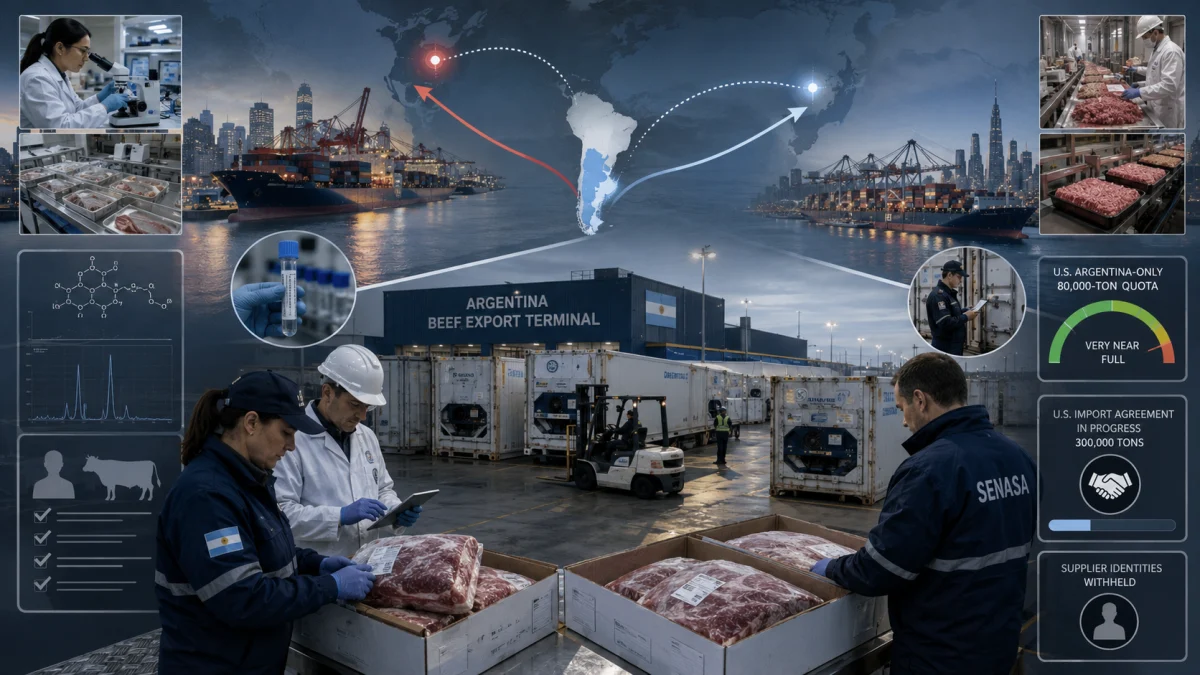
UPDATE — August 27, 2026: After this article was published, President Trump signed the proclamation implementing his separate 300,000-metric-ton beef quota expansion. The final rules allocate that temporary increase to “other countries or areas,” and the White House says it does not apply to countries that already have country-specific beef quotas. Argentina therefore is not part of this separate 300,000-ton expansion; its February 80,000-ton Argentina-only quota remains in effect. Separately, USDA records show that 29,628 pounds of beef from a different Argentine processor were recalled on August 7 after entering the United States without required import reinspection. That recall did not involve ArreBeef or a reported chloramphenicol finding, but it is relevant to the inspection question discussed below.
Yes, there is a documented connection between the Argentine beef producer China suspended and the rapidly expanding flow of Argentine beef into the United States under President Donald Trump. But the evidence does not show that the literal shipment China flagged was simply rerouted to Americans.
The documented story is more complicated—and arguably more interesting.
On March 19, 2026, Chinese authorities suspended Argentine beef establishment No. 2082, ArreBeef S.A., after detecting the prohibited antibiotic chloramphenicol in a bone-in beef shipment during port inspection. Argentina’s subsequent traceability investigation inspected 12 livestock establishments but reported finding neither chloramphenicol nor evidence that the drug had been used. The origin of China’s positive result therefore remains publicly unresolved.
ArreBeef was not some company that appeared suddenly after the Chinese problem. It was already an approved U.S. exporter, and Argentina had allocated it 1,617.717 metric tons of the country’s ordinary 2026 U.S. beef quota before the China incident occurred. Trump had also created an additional 80,000-metric-ton Argentina-only U.S. quota for lean beef trimmings on February 6—six weeks before China’s suspension.
That chronology rules out one simplistic theory: Trump did not open the original 80,000-ton Argentine quota because China rejected ArreBeef’s shipment. His action came first.
What happened afterward, however, establishes a much more meaningful connection.
Within weeks of China’s suspension, ArreBeef CEO Hugo Borrell joined an Argentine government-backed trade mission to the United States specifically intended to expand beef sales under the newly enlarged American quota. The mission brought 15 Argentine meat companies into meetings with more than 40 U.S. importers and distributors. Argentine local reporting at the time explicitly framed ArreBeef’s U.S. push against the backdrop of its China suspension.
Today, ArreBeef is actively shipping beef into the United States. Current bills of lading show ArreBeef supplying American buyers with frozen boneless beef, including loads identified as 90 CL lean manufacturing beef, the kind of lean beef routinely blended into U.S. ground beef.
And Argentina’s special Trump quota is moving quickly. According to U.S. Customs and Border Protection, by August 17, the third-quarter 20,000-metric-ton tranche of Trump’s extra Argentina quota was already 93.94% filled, with approximately 18.79 million kilograms entered. Argentina’s separate ordinary annual U.S. beef quota was 77.6% filled at the same point.
Then, on August 21, Trump announced something even larger: another temporary program allowing as much as 300,000 metric tons of lean beef trimmings to enter over roughly 90 days at the lower in-quota tariff rate, accompanied by what Trump described as a commitment that the beef would be sold 25% below current market prices.
That program has now been formally implemented—and one major question has been resolved.
On August 26, Trump signed a proclamation allocating the entire additional 300,000 metric tons to the tariff-quota category known as “other countries or areas.” The accompanying White House fact sheet states explicitly that the temporary expansion does not apply to countries that already have country-specific beef quotas.
Argentina has its own country-specific quota, and the new proclamation separately states that nothing in it alters the additional 80,000-metric-ton Argentina quota Trump created in February.
Argentina—and therefore Argentine-origin ArreBeef product—is excluded from this separate 300,000-ton expansion.
That does not change the documented expansion of Argentine beef into the United States under the separate February policy examined in this article. It simply establishes that the August 300,000-ton program is a different import channel.
The timeline is the key to understanding this story
The easiest way to get this wrong is to compress several different events into one.
Argentina has long exported beef to the United States. ArreBeef itself already had U.S. access before China detected chloramphenicol.
On January 28, Argentina formally allocated its traditional 20,000-ton U.S. beef tariff-rate quota among approved exporters. ArreBeef received 1,617.717 metric tons, making it one of the more substantial recipients. The allocation was conditioned on establishments being authorized for the U.S. market.
Then Trump dramatically expanded the opportunity.
On February 6, he increased the amount of qualifying beef that could enter at the lower tariff rate by another 80,000 metric tons for 2026, exclusively for Argentina. Unlike the broader traditional quota, this extra volume was limited to specified categories of lean beef trimmings and divided into four quarterly tranches of 20,000 tons.
That distinction matters because lean manufacturing beef is exactly what the U.S. ground-beef industry needs.
American feedlot cattle produce abundant fatty trim alongside steaks and roasts. Imported grass-fed beef is often much leaner. Packers can blend high-lean imported material—commonly around 90 CL—with fattier American trim to produce hamburger at the desired fat percentage.
And even before China’s action against ArreBeef, USDA had already identified a significant commercial shift toward the United States.
In a March 9 report—10 days before China’s suspension of plant 2082—USDA’s Foreign Agricultural Service wrote that the lean products qualifying for Trump’s new quota were similar to products Argentina exported to China. USDA cited higher U.S. prices, lower tariff costs, shorter shipping times and established importer relationships and concluded that Argentine exporters were prioritizing the U.S. market.
So the broader Argentina-to-America pivot was already happening.
China’s action did not create that trend.
It did, however, give ArreBeef itself a powerful additional reason to participate in it.
What China actually found
On March 19, China’s General Administration of Customs notified Argentina that establishment 2082, ArreBeef S.A., had been suspended following the detection of chloramphenicol in a bone-in beef shipment during Chinese port inspection. Secondary Argentine reporting described the affected shipment as approximately 22 metric tons.
The suspension was specific to the establishment. China did not ban Argentine beef generally, and Argentina’s government subsequently told lawmakers that the broader Chinese market remained open and operating.
Chloramphenicol deserves some context because it is not merely an arbitrary Chinese import standard.
The antibiotic can cause serious blood disorders, including aplastic anemia, and regulators have not established a safe human exposure level. The United States also prohibits its use in food-producing animals. In other words, this is not a case in which China rejected beef over a chemical that American regulators consider acceptable.
Argentina responded with a traceability investigation.
SENASA reported inspecting the 12 livestock establishments associated with the animals involved, reviewing veterinary treatments, purchase records, drug storage and other records. According to the government’s account, investigators found no chloramphenicol-containing products, no possession of the drug and no evidence of its use at the establishments inspected.
That finding does not invalidate China’s laboratory result. It means Argentina’s investigation did not identify the source of the residue.
The responsible conclusion is therefore narrow: China reported a chloramphenicol detection; Argentina could not trace an obvious chloramphenicol source; and the discrepancy remains unresolved in the public record.
There is no sound basis for saying ArreBeef knowingly produced contaminated beef.
Then ArreBeef turned toward the United States
This is the strongest evidence connecting the Chinese episode to the American story.
Argentina announced an official “Semana de la Carne Argentina” trade mission to Philadelphia, Chicago and Los Angeles for April 27 through May 1. Its purpose was to capitalize on expanded American market access by connecting Argentine slaughterhouses directly with U.S. importers and distributors.
Among the executives named by the government was ArreBeef CEO Hugo Borrell.
When the mission concluded, Argentina’s Foreign Ministry reported that representatives of 15 Argentine meat companies had met with more than 40 U.S. importers. The ministry explicitly connected the opportunity with the expansion of Argentina’s U.S. beef quota from 20,000 to 100,000 metric tons. It also reported that Argentine boneless-beef shipments to the United States had already reached 21,400 metric tons worth $175 million during the first quarter of 2026.
The timing is particularly difficult to dismiss.
On April 16—28 days after China’s suspension—local reporting from the region where ArreBeef operates described the upcoming American trip with a headline that explicitly placed it “with an eye on” the suspension of exports to China. The underlying facts of that report—the U.S. mission, Borrell’s participation and Trump’s new quota—are independently confirmed by Argentina’s national government.
That does not prove that the meat China tested was redirected.
It does demonstrate that the company affected by China’s action was actively pursuing expanded U.S. sales shortly afterward, through a government-organized initiative designed to exploit the new American market opening.
That is a real connection, not internet pattern-matching.
ArreBeef is now actively shipping manufacturing beef into America
Current trade records provide another piece of the chain.
U.S. bills of lading identify multiple August shipments from Arre Beef S.A. to American buyers, including JBS USA, Gurrentz, Sure Good Foods USA and other meat-market participants. Several are described as frozen boneless “90 CL” beef, with individual loads around 26 to 27 metric tons.
“90 CL” refers to approximately 90% chemical lean beef. It is a standard manufacturing input commonly blended with fattier domestic trimmings to produce ground beef—the same general part of the market targeted by Trump’s import expansion.
There is an important evidentiary limitation here.
ArreBeef operates more than one establishment. Commercial bills of lading generally identify Arre Beef S.A. as the shipper, but they do not necessarily identify the slaughter or processing establishment responsible for each load. Therefore, the manifests establish that ArreBeef as a company is currently exporting manufacturing beef into the United States, but they do not establish that every load originated at plant 2082—the precise plant China suspended.
Likewise, the manifests do not disclose enough customs information to establish whether any specific ArreBeef load entered under Argentina’s ordinary quota, Trump’s extra 80,000-ton quota, or another tariff treatment.
Those distinctions matter.
But the existence of the supply chain itself is not speculative.
Trump’s Argentina quota is almost being consumed as fast as it opens
CBP’s August 17 commodity status report gives us one of the clearest measurements of how aggressively the special quota is being used.
The July-through-September tranche allows 20 million kilograms of qualifying Argentine lean beef.
By August 17, importers had already entered 18,788,630 kilograms—93.94% of the entire quarterly allowance.
That means the third-quarter tranche was nearly exhausted with approximately six weeks still remaining in the quarter.
The separate traditional 20-million-kilogram Argentine annual beef quota was also 77.6% filled, at 15.52 million kilograms.
This is not a hypothetical trade route waiting to be developed.
The additional Argentine access Trump created is being used.
China’s broader beef policy creates another incentive to look elsewhere
The ArreBeef residue episode is only one China-related piece.
Beginning in 2026, China also placed country-specific safeguard quantities on imported beef. Argentina received a 511,000-metric-ton annual safeguard quota. Once imports exceed that amount, qualifying beef faces an additional 55% tariff.
On August 5, China’s Ministry of Commerce announced that Argentina had reached 50% of that safeguard quantity.
That does not mean China has stopped buying Argentine beef. It had not even exhausted half of the remaining quota at that point.
But exporters make decisions prospectively. A high tariff looming after a volume threshold, combined with attractive U.S. pricing and a Trump-created tariff window, gives Argentine producers an obvious incentive to diversify.
The numbers show that diversification occurring.
Argentina’s government reported that during the first half of 2026, China still accounted for approximately 53% of Argentine beef shipments, but the United States had risen to 19.5%, making it Argentina’s second-largest destination.
For perspective, ArreBeef itself reported that in 2023 approximately 65% of its exports went to China and only 5% to the United States. Those older company figures cannot tell us ArreBeef’s current mix, but they illustrate just how China-oriented the company’s business historically was.
Trump has now finalized the separate 300,000-ton program—and Argentina is excluded
On August 21, Trump announced a separate and much larger beef-import intervention.
He said the United States would temporarily allow as much as 300,000 metric tons of product intended for ground-beef production to enter without the normal above-quota tariff and claimed foreign suppliers had committed to selling the beef at 25% below current market prices.
Three hundred thousand metric tons is roughly 661 million pounds.
At the time this article was first published, Trump had not identified the supplying countries, and Agriculture Secretary Brooke Rollins said on August 25 that aspects of the arrangement were still being finalized.
On August 26, Trump signed the formal proclamation.
The final policy increases the 2026 beef tariff-rate quota by 300,000 metric tons specifically for designated categories of lean beef trimmings. The additional quantity will be administered on a first-come, first-served basis in three tranches:
- 100,000 metric tons from September 1 through September 30;
- 100,000 metric tons from October 1 through October 30; and
- 100,000 metric tons from October 31 through November 30, or until the remaining allocation is filled.
Most importantly for this investigation, the proclamation allocates the entire additional quantity to “other countries or areas.”
The White House fact sheet removes any ambiguity about what that means for Argentina: the new expansion does not apply to countries with country-specific beef quotas.
Argentina has a country-specific beef quota. The proclamation also explicitly states that nothing in the August action changes the additional 80,000 metric tons allocated to Argentina under Trump’s February proclamation.
Argentina therefore is not eligible for this separate 300,000-ton expansion.
That closes one branch of the investigation.
The August program cannot be the mechanism through which ArreBeef or other Argentine-origin beef enters the United States.
But it does not change the separate Argentine supply chain documented elsewhere in this article. Trump’s February action remains in force, American importers have been consuming that Argentina-only quota rapidly, ArreBeef participated in the subsequent U.S. trade mission, and ArreBeef continues shipping manufacturing beef to American buyers.
The August proclamation identifies the eligible tariff-quota category but does not identify which individual exporters will ultimately supply the beef entering through the new temporary pool.
The final proclamation explains how the 25% requirement is supposed to work
Trump’s August 21 announcement initially left an important question unanswered: what exactly did “25% below current market prices” mean, and how would the administration enforce it?
The August 26 proclamation provides a much more specific answer.
It directs the secretary of agriculture and the U.S. trade representative to monitor whether lean beef trimmings entering through the temporary 300,000-ton increase are being sold at a price 25% below the market price for lean beef trimmings.
If they determine that imports entering under the program are not being sold at that discount, they must immediately notify the president, who may eliminate whatever remains of the temporary quota increase.
That makes the pricing condition more concrete than Trump’s original announcement suggested.
But it is important to understand what the policy does not guarantee.
The 25% benchmark applies to the market price of lean beef trimmings, an upstream manufacturing input commonly blended with fattier U.S. beef to make ground beef. It is not a requirement that supermarket hamburger, restaurant burgers or other finished beef products be sold to consumers for 25% less.
Processors, distributors and retailers still sit between the imported trimming and the final consumer.
The proclamation therefore establishes a real monitoring and enforcement mechanism for the price of beef entering through the temporary quota, but it does not guarantee a 25% reduction in retail ground-beef prices.
Does the United States test Argentine beef for chloramphenicol?
Yes, the United States has an import-inspection system capable of testing for prohibited residues—but that does not mean every incoming carton is laboratory-tested for chloramphenicol.
Federal law requires commercial shipments of FSIS-regulated imported meat to be presented for U.S. reinspection. FSIS verifies items such as certification, labeling and general product condition. Its Public Health Information System can additionally assign laboratory testing for microbiological hazards, species identification, chemistry and drug or chemical residues. FSIS also conducts random residue sampling and can increase testing based on establishment performance or other risk information.
When imported meat produces a violative laboratory result, FSIS procedures allow the agency to refuse the product and potentially retain related shipments from the same foreign establishment while officials determine whether additional product is implicated.
There is an important real-world caveat to that inspection system.
On August 7, USDA’s Food Safety and Inspection Service announced the recall of 29,628 pounds of raw beef imported from Argentina because the product had entered the United States without the required import reinspection. The beef came from Frigorífico Gorina SAIC, establishment No. 2025, and was imported by Corte Argentino USA LLC for distribution in Florida and Texas.
This was not ArreBeef, and FSIS did not report a chloramphenicol finding or other confirmed contaminant in the recalled product. The recall was triggered because the mandatory U.S. reinspection step had been missed. FSIS reported no confirmed illnesses or injuries and said the problem was discovered during routine inspection activities.
The incident therefore does not establish that any ArreBeef shipment bypassed U.S. inspection. But it is directly relevant to the broader question of regulatory safeguards: although imported meat is legally required to undergo U.S. reinspection, the August recall demonstrates that the required process can fail operationally and that product can enter commerce before the lapse is discovered.
And again, chloramphenicol itself is prohibited for use in American food-producing animals.
A review of publicly accessible and indexed FSIS material for this investigation did not identify a U.S. chloramphenicol violation or refused-entry record specifically tied to ArreBeef establishment 2082 following China’s March finding.
That should not be converted into the claim that no such test or refusal ever occurred. FSIS publishes detailed import datasets, but individual current records are not always readily discoverable through ordinary public web indexing. FSIS itself says its import datasets contain lot-level information and are updated regularly.
More importantly, the public records reviewed do not answer whether FSIS responded to China’s finding by placing plant 2082 under increased or special chloramphenicol sampling.
That is an appropriate question for USDA.
So was China-rejected beef sent to Americans?
Here is where the evidence stands:
That distinction is important because the documented story does not need embellishment.
The real story is about where meat goes when markets change
The viral version of this story is tempting because it is extremely simple:
China rejected Argentine beef, so Trump bought it cheaply for Americans.
The evidence does not currently establish that sequence.
But dismissing the entire connection would be equally misleading.
The records show something more substantial.
Trump opened the U.S. market dramatically wider to Argentine lean beef. USDA documented Argentina shifting industrial beef toward America. China then suspended a major plant belonging to an exporter historically dependent on the Chinese market. Within weeks, that exporter joined an Argentine government-backed campaign to expand U.S. sales. Argentine beef shipments to America accelerated, Trump’s special quota filled rapidly, and ArreBeef itself continues sending lean manufacturing beef to American buyers.
The August 26 proclamation has now resolved one question that remained open when this investigation was first published.
Argentina is not part of Trump’s separate 300,000-ton temporary quota expansion.
That program is allocated to “other countries or areas,” while the White House explicitly says countries with existing country-specific beef quotas are excluded. Argentina’s separate February 80,000-ton expansion remains unchanged.
There are therefore two distinct policies:
Trump’s February action dramatically expanded U.S. access specifically for Argentine lean beef.
Trump’s August action created another 300,000-metric-ton temporary pool for other eligible countries and areas.
The August program cannot be the mechanism through which ArreBeef or other Argentine-origin beef enters the United States.
But that clarification does not erase the documented connection examined in this article.
China suspended ArreBeef establishment 2082 after reporting chloramphenicol in a beef shipment. Argentina’s subsequent investigation could not identify evidence that chloramphenicol had been possessed or used at the 12 livestock establishments it inspected. Within weeks of the Chinese suspension, ArreBeef’s CEO participated in an Argentine government-backed effort to expand U.S. sales under America’s newly enlarged Argentine quota. Argentina’s U.S. beef trade subsequently accelerated, that special quota filled rapidly, and ArreBeef itself continues shipping lean manufacturing beef to American buyers.
The evidence still does not show that the approximately 22-ton lot China flagged was subsequently sent to the United States.
And a separate August USDA recall involving beef from Frigorífico Gorina—not ArreBeef—should not be conflated with the Chinese chloramphenicol incident. It does, however, demonstrate that required U.S. import reinspection is not infallible: nearly 30,000 pounds of Argentine beef entered commerce without completing that mandatory step before the lapse was discovered.
The strongest defensible conclusion remains narrower than the viral claim but more substantial than “nothing to see here”:
China’s ArreBeef suspension and America’s Argentine beef expansion are connected through the same company, a rapidly shifting export market and an explicit post-suspension U.S. sales push. What has not been demonstrated is that the Chinese-rejected lot itself entered the United States.
References and Further Reading
U.S. Trade, Tariff and Quota Records
- White House — Ensuring Affordable Beef for the American Consumer, February 6, 2026 — Presidential proclamation creating an additional 80,000 metric tons of tariff-rate quota access for qualifying Argentine lean beef trimmings in 2026.
- GovInfo — Proclamation 11010: Ensuring Affordable Beef for the American Consumer — Official federal publication record of the February 2026 proclamation.
- Federal Register — Ensuring Affordable Beef for the American Consumer — Published proclamation text and quota provisions.
- U.S. Customs and Border Protection — Quota Bulletin 26-223, Argentina Beef Tranche 1 — CBP implementation instructions for the first tranche of the additional Argentina-only beef quota.
- U.S. Customs and Border Protection — Quota Bulletin 26-224, Argentina Beef Tranche 2 — CBP implementation instructions for the second quarterly tranche.
- U.S. Customs and Border Protection — Commodity Status Report, August 17, 2026 — Weekly quota-utilization record showing the third-quarter Argentina-only tranche approximately 93.94% filled.
- U.S. Customs and Border Protection — Commodity Status Reports — CBP’s official index for current and historical tariff-rate quota utilization reports.
- U.S. Customs and Border Protection — Are My Goods Subject to Quota? — Explanation of U.S. quota administration and tariff-rate quota rules.
- USDA Foreign Agricultural Service — Livestock and Products Semi-annual: Argentina, March 9, 2026 — USDA analysis of Argentina’s expanded U.S. beef access, the 26.4% above-quota tariff, Chinese import safeguards and the commercial incentives pushing Argentine exporters toward the U.S. market.
Argentina’s U.S. Beef Quota and ArreBeef Allocation
- Argentina Ministry of Economy — Resolution 8/2026 — January 2026 resolution allocating Argentina’s traditional U.S. beef tariff-rate quota.
- Argentina Ministry of Economy — Resolution 8/2026, Annex I — Official allocation table listing Arre Beef S.A. for 1,617.717 metric tons, establishing that the company already had U.S. quota access before China’s March suspension.
- Argentina Ministry of Economy — Resolution 8/2026, Annex II — Companion allocation record covering joint-project quota recipients.
China’s Suspension of ArreBeef and Argentina’s Investigation
- Argentine Chief of Cabinet — Report 145 to Congress — Primary Argentine government record confirming China’s March 2026 action against ArreBeef establishment No. 2082 after a chloramphenicol finding and describing SENASA’s subsequent investigation of 12 livestock establishments.
- La Nación — China Suspends Argentine Meatpacker ArreBeef After Chloramphenicol Detection — Contemporary reporting on the Chinese suspension and its immediate commercial consequences.
- La Nación — Investigation Into How Chloramphenicol Reached the ArreBeef Shipment — Follow-up reporting on Argentina’s traceability investigation and the unresolved source of the residue finding.
- Diario Río Negro — China Suspends ArreBeef Over Approximately 22 Tons of Beef — Source for the approximately 22-ton size of the affected shipment and Argentina’s response.
- Diario El Norte — China Suspends ArreBeef Exports After Chloramphenicol Finding — Local reporting from the region surrounding ArreBeef’s Pérez Millán operation.
- Frozen Goods — China Suspension Reporting Concerning ArreBeef Plant No. 2082 — Additional reporting on the Chinese import suspension.
- Misiones Opina — Mirror of Argentine Chief of Cabinet Report 145 — Mirror copy of the Argentine government report; the Chamber of Deputies version above is the preferred primary source.
ArreBeef’s Post-Suspension Push Into the United States
- Argentina Government — Argentine Beef Week in the United States — Primary confirmation that ArreBeef CEO Hugo Borrell participated in a government-backed mission to Philadelphia, Chicago and Los Angeles aimed at expanding Argentine beef sales to U.S. importers.
- Argentina Foreign Ministry — Argentina Expands Beef Exports to the U.S. Market — Reports that 15 Argentine meat companies met with more than 40 U.S. importers and explicitly connects the initiative to expanded U.S. quota access.
- Argentina Agriculture Ministry — Beef Export Value Rose 53.95% in the First Quarter of 2026 — Government data documenting the rapid growth of Argentine beef shipments, including exports to the United States.
- SNR Hoy — ArreBeef’s U.S. Trip in the Context of Its China Suspension — Local reporting explicitly connecting ArreBeef’s U.S. sales effort with the commercial consequences of its suspension in China.
- Diario El Norte — April 14, 2026 Edition — Contemporary local reporting describing the U.S. market as a potential way for ArreBeef to compensate for lost Chinese business.
- La Radio Ramallo — From Pérez Millán to the U.S.: ArreBeef Joins the Export Push — Additional local reporting on ArreBeef’s participation in the American-market expansion.
- ArreBeef — Company LinkedIn Page — ArreBeef’s own contemporaneous communications concerning the U.S. trade mission and expanded American market access.
ArreBeef’s U.S. Eligibility and Current Supply Chain
- Argentine Beef USA — Argentine Beef Exporters — Industry directory identifying Plant No. 2082 — Arre Beef S.A. among Argentine exporters serving the U.S. market.
- Consorcio ABC — Argentine Beef Processing Plant Directory — Industry directory identifying ArreBeef’s Pérez Millán facility as SENASA establishment No. 2082.
- TraceGains Gather — Teys USA / Arre Beef S.A. Establishment 2082 — U.S. supplier-network record specifically identifying Arre Beef S.A. Est. 2082 ARG.
- ImportInfo — Arre Beef S.A. U.S. Import Activity — Bill-of-lading records showing current ArreBeef shipments to U.S. buyers, including frozen boneless 90 CL manufacturing beef.
- ImportKey — Arre Beef S.A. Customs Shipment Records — Additional commercial shipping records corroborating current ArreBeef shipments into the United States.
- ImportInfo — JBS USA Food Company Shipment Records — Import records corroborating ArreBeef-associated shipments received by JBS USA.
- ImportInfo — Endeavour Meats USA Shipment Records — Additional importer records involving Argentine beef suppliers.
ArreBeef’s Historical Dependence on China
- ArreBeef — Sustainability Report 2023, English — Company-reported data showing approximately 65% of ArreBeef exports going to China and 5% to the United States in 2023.
- ArreBeef — Sustainability Report 2023, Spanish — Spanish-language version of the same company sustainability report.
Argentina’s Growing U.S. Beef Trade
- Argentina Government — Beef Exports Increased in the First Half of 2026 — Government statistics showing China accounting for approximately 53% of Argentine beef shipments and the United States rising to approximately 19.5%, making it Argentina’s second-largest destination.
- Informe Ganadero — U.S. Quota Close to Exhausting Its Second-Quarter Allocation — Industry reporting documenting rapid utilization of expanded American quota access.
- APEA — Argentine Beef Exports and Changing U.S.-China Competitiveness — Industry reporting quoting ArreBeef CEO Hugo Borrell on changing commercial conditions in the Chinese and American markets.
China’s Broader 2026 Beef Safeguards
- China Ministry of Commerce — 2026 Imported-Beef Safeguard Measures — Primary Chinese government record establishing country-specific beef import thresholds and an additional 55% tariff once applicable quantities are exceeded.
- China Ministry of Commerce — Argentina Reaches 50% of Its 2026 Beef Safeguard Quantity — Official August 2026 notice stating that Argentina had reached 50% of its prescribed annual safeguard quantity.
- USDA Economic Research Service — Livestock, Dairy and Poultry Outlook — USDA analysis of beef trade conditions and the potential effect of changing Chinese import restrictions on global supply flows.
- S&P Global — Imported Beef Prices Stall as Traders Await China Supply Shift — Commodity-market reporting describing South American beef being redirected toward the United States and Argentina-origin 90CL beef competing in the U.S. market.
90CL Manufacturing Beef
- StockCo — What Is 90CL Beef? — Industry explanation of 90% chemical-lean manufacturing beef and its use in blending ground beef.
- S&P Global Platts — 90CL Beef CIF U.S. Methodology — Formal commodity-market description of the imported 90CL beef category.
U.S. Import Inspection and Chloramphenicol Regulation
- USDA FSIS — Import Guidance — Overview of mandatory U.S. import reinspection, laboratory sampling and chemical-residue controls.
- USDA FSIS — Import Procedures for Meat, Poultry and Egg Products — Detailed federal procedures governing imported meat inspection.
- USDA FSIS Directive 9900.6 — Laboratory Sampling Program for Imported Meat, Poultry and Egg Products — Procedures governing laboratory sampling of imported products for residues and other hazards.
- USDA FSIS Directive 9900.8 — Products Refused Entry Into the United States — Procedures governing imported products that fail U.S. requirements.
- USDA FSIS — Argentina Import and Export Requirements — Country-specific requirements governing Argentine meat exports to the United States.
- USDA FSIS — Eligible Foreign Establishments — Federal database and documentation for foreign establishments eligible to export FSIS-regulated products to the United States.
- FDA — Animal Health and Consumer Protection: Chloramphenicol History — FDA background on chloramphenicol, aplastic anemia risk and its prohibition in U.S. food-producing animals.
- FDA — Laboratory Information Bulletin 4290: Chloramphenicol — FDA laboratory and safety information concerning chloramphenicol residues.
- FDA — Extra-Label Drug Use in Animals — FDA guidance listing chloramphenicol among drugs prohibited from extra-label use in food-producing animals.
- USDA FSIS — Corte Argentino USA LLC Recalls Raw Beef Products Imported Without the Benefit of Import Reinspection, August 7, 2026 — Official USDA recall notice for 29,628 pounds of Argentine beef that entered the United States without required import reinspection. The affected product came from Frigorífico Gorina SAIC, not ArreBeef; FSIS reported no confirmed illnesses or injuries.
Trump’s August 2026 300,000-Ton Beef Announcement
- Donald Trump — Truth Social Post, August 21, 2026 — Trump’s original announcement describing up to 300,000 metric tons of tariff-relieved beef over 90 days and claiming a commitment for the product to be sold at 25% below current market prices.
- UCSB American Presidency Project — Trump Truth Social Posts, August 21, 2026 — Archival record of Trump’s August 21 announcement.
- Roll Call Factbase — Trump Press Gaggle, August 21, 2026 — Transcript in which Trump was asked which countries would supply the beef and declined to identify them.
- Roll Call — Trump Creates Beef With Ranchers Over New Import Plan — Reporting on the 300,000-ton announcement, rancher opposition and unresolved supplier details.
- Roll Call — USDA Comments Suggest Beef Deal Not Quite Cooked, August 25, 2026 — Reports Agriculture Secretary Brooke Rollins’ statement that discussions surrounding the arrangement were still being finalized.
- S&P Global — Trump Announces 90 Days of Tariff-Free Ground-Beef Imports — Commodity-market analysis noting that the announcement did not identify participating origins, exporters, importers or complete quota rules.
- Axios — Trump Moves to Boost Beef Imports to Lower Prices — Reporting on the claimed 25% below-market commitment and unresolved questions about how any discount would be passed through to consumers.
- Reuters — Trump to Ease Ground-Beef Import Quotas for 90 Days — Independent reporting confirming the announcement and the administration’s failure to identify supplying countries.
- Associated Press — Trump’s Beef Import Plan and Its Potential Effect on Prices — Independent context on the scale of the proposed imports and their likely effect on the broader U.S. beef market.
- Congressional Research Service Archive — U.S. Beef Tariff and Quota Context — Background on the U.S. beef tariff-rate quota system and the 26.4% out-of-quota tariff.
- SFN Today — Rollins: Why Import Beef From Argentina? — Agricultural reporting consulted because some coverage had begun associating the August import initiative specifically with Argentina before the administration publicly confirmed participating suppliers.
- White House — Further Ensuring Affordable Beef for the American Consumer, August 26, 2026 — Final presidential proclamation implementing the 300,000-metric-ton temporary increase. It allocates the new volume to “other countries or areas,” establishes three 100,000-ton tranches, directs monitoring of the 25%-below-market condition and explicitly leaves Argentina’s separate February quota unchanged.
- White House — Fact Sheet: President Donald J. Trump Further Ensures Affordable Beef for the American Consumer, August 26, 2026 — White House summary clarifying that the temporary expansion does not apply to countries with country-specific beef quotas and applies only to lean beef trimmings used in ground-beef production.
Editorial currency note: Updated August 27, 2026. President Trump signed the final proclamation implementing the separate 300,000-metric-ton temporary beef quota on August 26. The program is allocated to “other countries or areas” and does not apply to countries with country-specific beef quotas, excluding Argentina from this separate expansion while leaving its February 80,000-ton quota unchanged. This update also incorporates USDA’s August 7 recall of 29,628 pounds of beef from a different Argentine processor that entered the United States without required import reinspection. No evidence reviewed connects that recall to ArreBeef or the Chinese chloramphenicol incident.