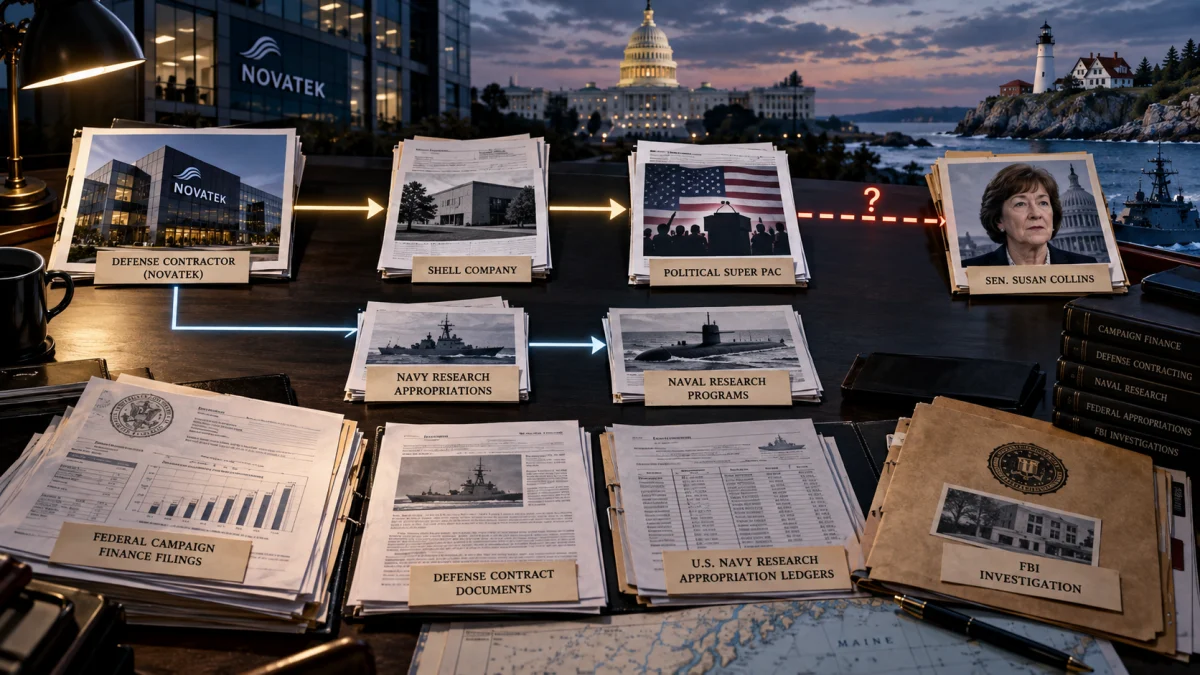
Federal records establish two important facts about the Susan Collins-Navatek story: executives at the defense contractor illegally routed money into political activity supporting Collins, and Collins publicly acknowledged advocating for federal funding that benefited Navatek. What has not been publicly proven is the critical final link: that Collins knowingly agreed to exchange official action for political support.
That distinction is the story.
Former Navatek CEO Martin Kao pleaded guilty in 2022 to federal campaign-finance crimes. According to the Justice Department’s guilty-plea announcement, Kao and co-conspirators created a shell company that was used to make an illegal contribution with government-contractor funds to a political action committee supporting a U.S. Senate candidate. Kao also used family members as conduits for illegal contributions to the same candidate’s campaign and reimbursed those donations with company-connected funds.
Federal Election Commission records later identified the candidate as Susan Collins and confirmed that Navatek, later renamed PacMar Technologies, was the true contributor behind a $150,000 contribution to 1820 PAC, a super PAC supporting Collins. The FEC ultimately accepted a conciliation agreement with PacMar and imposed a $325,000 civil penalty. The complete record is available in FEC Matter Under Review 7690.
Collins, meanwhile, said publicly in 2019 that she had “strongly advocated for the funding” behind an approximately $8 million Navy research contract awarded to Navatek. Kao thanked her support at the same event, according to Collins’ own Senate office announcement.
Those facts do not depend on accepting Kao’s later account of corruption.
What remains unresolved is whether political money and federal assistance were connected by a corrupt agreement. Kao eventually told FBI investigators that they were. Collins and her representatives deny that allegation, and no public court proceeding has established that Collins accepted a bribe or knowingly joined a pay-to-play arrangement.
What is actually established?
| Claim | Evidence status |
|---|---|
| Navatek funded a $150,000 contribution to 1820 PAC through another entity | Established by FEC records |
| The $150,000 used government-contractor funds | Established in the FEC settlement |
| Kao and other Navatek executives carried out a separate conduit-contribution scheme involving Collins for Senator | Established through criminal admissions and FEC records |
| Collins advocated for federal funding that benefited Navatek | Established by Collins’ own public statement |
| Senate appropriators recommended $21.5 million across three research lines ProPublica linked to Navatek requests | Funding established; Navatek linkage independently reported |
| Kao told investigators that political support and federal assistance were part of an explicit exchange | Alleged by Kao |
| FBI records reportedly showed documents corroborating portions of Kao’s account | Reported by ProPublica |
| Collins knowingly agreed to exchange official action for political contributions | Not proven; denied by Collins and her representatives |
| Collins herself was formally designated an FBI target | Not established; ProPublica’s reporter said she was not |
| Collins or her staff were criminally charged in the Navatek matter | No |
The distinction between those categories is essential. The campaign-finance crimes are not hypothetical. The allegation that Collins knowingly joined the bargain remains unresolved.
The $150,000 shell-company contribution is established in federal records
The strongest documentary evidence concerns the money that went to 1820 PAC.
The FEC’s Second General Counsel’s Report says the Commission’s investigation confirmed that Navatek was the true contributor behind a $150,000 contribution made in the name of the Society of Young Women Scientists and Engineers LLC to 1820 PAC.
The same report identifies 1820 PAC as an independent expenditure-only political committee. In other words, it was a super PAC supporting Collins, not Collins for Senator itself.
That distinction matters because a super PAC is legally separate from a candidate’s campaign. Describing 1820 PAC simply as “Collins’ PAC” can imply a direct legal relationship that did not exist.
In February 2025, the FEC formally closed the PacMar portion of the case after accepting a conciliation agreement. The FEC’s settlement letter and conciliation materials state that PacMar settled violations for making a contribution in the Society’s name and using government-contractor funds to make it.
The FEC docket records a $325,000 civil penalty.
So there is no longer a serious factual question about whether Navatek money was routed through another entity into a super PAC supporting Collins.
It was.
The unresolved questions concern who outside Navatek knew the true origin of the money and whether the contribution was connected to an agreement for official action.
There was also a separate illegal contribution scheme involving Collins’ campaign
The super-PAC payment was not the only campaign-finance scheme.
The Justice Department said Kao used family members as conduits to make illegal contributions to the same Senate candidate’s campaign and reimbursed those contributions with company-connected funds.
The FEC’s later investigation identified that campaign as Collins for Senator.
According to the FEC General Counsel’s report, Kao, Lawrence Lum Kee and Clifford Chen conspired to funnel a total of $44,400 through family members to Collins for Senator: $38,800 using personal funds from Kao and Chen and $5,600 from Navatek.
Kao admitted that he acted intentionally while knowing he was circumventing federal rules governing conduit and government-contractor contributions.
But the FEC record also contains a procedural complication that should not be erased.
In June 2024, the Commission rescinded an earlier reason-to-believe finding against PacMar concerning government-contractor contributions directly to Collins for Senator. Commissioners then deadlocked 3-3 on opening a new matter that would have addressed several allegations arising from the direct campaign contributions. That history appears in the FEC’s MUR 7690 disposition.
That does not undo Kao’s guilty plea or the conduit scheme described by federal investigators. It does mean the FEC’s final treatment of the direct campaign contributions was more complicated than its resolution of the $150,000 super-PAC contribution.
Most importantly, none of these records establishes that Collins or her campaign knew the contributions were illegally sourced when they were received.
Collins publicly said she advocated for Navatek’s federal funding
The other side of the chronology is also documented.
On April 19, 2019, the Defense Department announced a $7,998,670 Navy contract for Navatek. The original award appears in the Defense Department’s April 19, 2019 contract announcement.
Four months later, Collins attended an event celebrating the contract at Navatek’s Portland operation.
Her Senate office quoted her saying:
“As a senior member of the Defense Appropriations Subcommittee, I strongly advocated for the funding that made this research possible.”
Kao thanked Collins’ support at the same event. The statement remains available on Collins’ Senate website.
There is nothing inherently criminal about a senator advocating for federal spending that benefits employers, universities or research projects in the senator’s state. Members of Congress routinely do exactly that.
But the statement establishes something important once the campaign-finance evidence is considered:
Collins’ role in advocating for Navatek-related federal funding is not merely an allegation made later by Kao. Collins publicly described that role herself.
The unresolved question is whether the advocacy was ordinary constituent and appropriations work or whether any official action was knowingly conditioned on political financial support.
Then came $21.5 million across three Senate research lines
The next set of numbers requires careful wording.
The Senate Appropriations Committee’s fiscal 2020 defense report recommended increases of:
- $8.5 million for electric propulsion for military craft and advanced planing hulls;
- $5 million for hybrid composite structures research for enhanced mobility;
- $8 million for a test bed for autonomous ship systems.
Together, those increases equal $21.5 million. The amounts appear in the Senate Appropriations Committee’s fiscal 2020 defense report.
The Senate report itself does not name Navatek beside those lines.
ProPublica’s September 2026 investigation, using internal company records and interviews with former employees, reported that the three programs corresponded to projects Navatek had requested.
That is an important evidentiary boundary.
It is accurate to say the Senate committee recommended $21.5 million across three research lines that ProPublica linked to Navatek requests.
It is too strong to reduce that evidence to the statement that “Collins gave Navatek $21.5 million.”
ProPublica also reported that emails showed Collins’ office communicating with Navy officials about Navatek as the interested company for some of the research funding. Those emails are not currently available as independent public records, so that evidence should remain attributed to ProPublica.
What Martin Kao says happened behind the scenes
Kao’s later account goes much further than the public appropriations record.
According to ProPublica’s review of FBI records, internal company communications and interviews, Kao told investigators that Navatek’s political giving and federal funding strategy operated as a pay-to-play system.
One of the central episodes was a late-2019 meeting at a Corner Bakery in Washington involving Kao, other Navatek executives and Scott Reed, the head of 1820 PAC.
Kao told investigators that Reed asked for a $500,000 contribution to the super PAC. Kao said he wanted assurance that Collins would know who was behind the money and that Navatek would receive additional federal assistance. According to Kao’s account, Reed agreed.
Reed has denied communicating with Collins or her staff about Kao or Navatek.
The alleged quid pro quo discussed at the Corner Bakery has not been established in court.
But the meeting is not simply an unsupported story invented years later. ProPublica reported that other Navatek executives confirmed the meeting occurred, although their accounts of what was discussed differed. It also published the substance of emails in which Kao told Reed he planned to route the contribution through a newly created LLC and Reed responded approvingly.
Days after the $150,000 contribution reached 1820 PAC, a Reed subordinate emailed a Navatek lobbyist seeking Kao’s phone number because, according to the email reported by ProPublica, Collins wanted to call Kao and thank him.
Collins’ campaign later said it had no record that such a call occurred.
That email is relevant because it suggests information about Kao’s relationship to the contribution may have moved beyond the name listed on the check.
It still does not establish what Collins herself knew about the contribution’s legal source or whether she knew Navatek funds had been routed through the shell company.
The $32 million claim comes from Kao’s contemporaneous email
A few weeks after the $150,000 contribution cleared, Kao and colleagues met with Collins’ office again.
ProPublica reported that Kao then emailed colleagues describing the meeting as successful and writing that a total of $32 million would be supported. ProPublica further reported that Senate records show at least $10 million was allocated that year based on Navatek proposals.
That email matters because it was written contemporaneously, rather than years later while Kao was cooperating with investigators.
But it still has to be described accurately.
The email establishes what Kao told his own colleagues after the meeting. It is not a written commitment from Collins promising Navatek $32 million.
That is precisely the kind of distinction a criminal corruption investigation would have needed to resolve.
What evidence exists besides Kao’s word?
Kao’s credibility is a major issue, but the case does not reduce entirely to whether investigators trusted him.
The independently established or contemporaneous evidence includes:
- the approximately $8 million Navy contract awarded to Navatek;
- Collins’ public statement that she strongly advocated for the funding;
- the $44,400 conduit-contribution scheme involving Collins for Senator;
- the $150,000 Navatek-funded contribution routed through another entity to 1820 PAC;
- emails reported by ProPublica showing Kao discussing the shell-company mechanism with Reed;
- the reported message seeking Kao’s phone number because Collins wanted to thank him;
- contemporaneous internal Navatek communications describing expectations of additional federal funding;
- Senate appropriations increases corresponding to programs ProPublica says Navatek requested.
There is also evidence concerning what FBI agents themselves believed they had corroborated.
In a September 23 follow-up, ProPublica reported that a December 2024 FBI document said hundreds of thousands of Navatek documents had been obtained and that several emails and other documents corroborated statements Kao made to the FBI.
That is meaningful, but it has limits.
Corroborating that meetings occurred, money moved, funding was requested or certain communications happened is not necessarily the same thing as corroborating the decisive allegation that Collins knowingly entered a corrupt agreement.
Kao has major credibility problems
Kao was not a neutral whistleblower.
He committed federal campaign-finance crimes and was cooperating with investigators while facing serious criminal exposure.
He also committed a separate set of financial crimes. In February 2025, a federal judge sentenced him to 87 months in prison for COVID-relief wire fraud, money laundering and bank fraud. The judge also ordered nearly $12.85 million in restitution, according to the Justice Department’s sentencing announcement.
The 87-month sentence was not his sentence for the Collins campaign-finance scheme. It arose from the separate fraud case.
Kao plainly had incentives to cooperate with prosecutors and to provide information that could help him at sentencing. Those incentives matter when evaluating his allegations.
But credibility is not binary.
The relevant question is not whether Kao is generally a trustworthy person. It is whether each particular claim is independently supported by records, communications or other witnesses.
Some parts of his account clearly are supported.
Others remain disputed or unproven.
Was Susan Collins actually under FBI investigation?
The most precise answer is:
FBI anti-corruption investigators examined allegations involving Collins, her staff and political allies, but the available reporting does not establish that Collins herself was formally designated an FBI target.
That distinction comes directly from Maine Public’s September 22 interview with ProPublica reporter Molly Redden.
Redden said the later investigation was in an early stage and that Collins was not officially a target, although FBI investigators had substantial questions concerning her.
According to ProPublica, Kao continued answering FBI questions through September 2024, when he provided agents with a roughly 50-page account involving multiple lawmakers, staffers and lobbyists. Agents were still examining his interactions with Collins, her staff and people associated with the super PAC in early 2025.
That is enough to say the FBI examined Collins-related corruption allegations.
It is not the same as saying the FBI formally accused Collins of bribery.
Was Susan Collins “cleared” by the FBI?
The earlier FBI investigation did not produce charges against Collins or her campaign. But describing that 2021 outcome as resolving every allegation reported in 2026 leaves out a later phase of the investigation based on information Kao supplied after 2021.
Collins has said the Biden Justice Department and FBI cleared her office, campaign and herself years earlier. An FBI spokesperson likewise told ProPublica that an earlier investigation found nothing implicating Collins or her campaign.
That is relevant evidence in Collins’ favor.
The initial campaign-finance investigation began in 2021. Kao and his co-conspirators were prosecuted, but no one working for Collins was charged.
The chronology becomes more complicated after Kao pleaded guilty.
According to ProPublica’s follow-up reporting, Kao provided broader corruption allegations between 2022 and 2024, including substantial new information during a September 2024 FBI interview. Agents were still examining those later claims in early 2025.
An investigation completed years earlier could not have adjudicated allegations investigators had not yet received.
That does not establish that the newer allegations were true.
It means the earlier campaign-finance investigation and the later public-corruption inquiry should not be collapsed into a single event.
Why did the later FBI inquiry end?
Here the public reporting contains a real disagreement.
ProPublica reports that agents found documentary support for parts of Kao’s account and were pursuing approval for a broader bribery investigation. It also reports that the agents and Justice Department personnel handling public-corruption work were subsequently fired, pushed out or reassigned as the Trump administration restructured those units.
But ProPublica’s reporter also told Maine Public that the newsroom found no evidence that those personnel actions were specifically taken to protect Collins.
A separate New York Times report, syndicated by GV Wire, cited current and former officials who said senior FBI officials questioned Kao’s credibility and believed agents had not uncovered much evidence corroborating his claims against Collins and adviser Scott Reed. Those officials also acknowledged that additional evidence could have emerged if the investigation had continued.
Those accounts are not necessarily mutually exclusive.
Agents could have corroborated individual facts in Kao’s narrative while senior officials still concluded that the evidence was insufficient to support the central bribery theory.
What cannot currently be established from public evidence is whether the later inquiry ended primarily because investigators were failing to build a prosecutable case, because the investigative apparatus was disrupted before the work could mature, or because both factors played a role.
Illegal campaign contributions are not automatically bribery
This legal distinction explains why the documented facts can be serious enough to trigger a corruption investigation without proving a bribery case against Collins.
Federal campaign-finance law can make a contribution illegal for reasons unrelated to bribery. Government contractors, for example, face restrictions on federal political contributions.
Bribery requires a different showing: a corrupt exchange connecting the thing of value to official action.
The Justice Department’s archived guidance on campaign contributions and bribery states that where a transaction is a bona fide campaign contribution, prosecutors ordinarily must be prepared to prove a quid pro quo understanding.
The Congressional Research Service’s analysis of campaign contributions and ethics explains the same basic rule: a contribution followed by official action favorable to the donor does not, without more, establish bribery. There must be evidence of an agreement connecting the contribution to the official act.
That agreement does not necessarily have to be written down. It can be proven with circumstantial evidence.
But timing, access and favorable government action alone are not enough.
That is the central unresolved legal question in the Collins-Navatek story.
The Susan Collins-Navatek timeline
| Date | What happened | Evidence status |
|---|---|---|
| 2018-2019 | Navatek pursued Navy research funding in Maine while Kao and associates became politically active around Collins | Public records + reporting |
| April 2019 | Navy awarded Navatek a $7.998 million research contract | Verified by DOD |
| August 2019 | Collins celebrated the contract and said she had strongly advocated for the funding | Verified by Collins’ office |
| 2019 | Kao, Chen and Lum Kee participated in a $44,400 conduit-contribution scheme involving Collins for Senator | Criminal/FEC record |
| September 2019 | Senate committee recommended $21.5 million across three research lines later connected by ProPublica to Navatek requests | Funding verified; company link independently reported |
| Late 2019 | Kao met Scott Reed and later said they discussed a large super-PAC contribution and additional government assistance | Meeting supported; alleged bargain disputed |
| November 2019 | Emails reported by ProPublica show Kao discussing a new LLC for the contribution with Reed | Documentary reporting |
| December 2019 | $150,000 reached 1820 PAC through the Society of Young Women Scientists and Engineers LLC | Verified by FEC |
| Early 2020 | A Reed subordinate reportedly sought Kao’s number because Collins wanted to thank him | Email reported; whether a call occurred is unknown |
| February 2020 | Kao wrote colleagues after a Collins-office meeting that $32 million would be supported | Contemporaneous Kao email; not a Collins document |
| 2020 | A campaign-finance complaint began exposing the shell-company contribution | Verified |
| 2021 | The initial federal investigation into the contribution activity became public | Verified |
| February 2022 | Kao and two other Navatek executives were indicted | Verified |
| September 2022 | Kao pleaded guilty to campaign-finance offenses | Verified |
| 2022-2024 | Kao supplied investigators with broader corruption allegations | Reported from FBI records |
| September 2024 | Kao provided FBI agents with a lengthy account involving numerous political figures, including allegations involving Collins | Reported from FBI records |
| December 2024 | An FBI document reportedly said several documents corroborated Kao statements | Reported by ProPublica |
| January-February 2025 | FEC resolved the PacMar super-PAC case, including a $325,000 penalty | Verified |
| 2025 | The later FBI inquiry ended without charges against Collins | Outcome established; reasons disputed in reporting |
| September 2026 | ProPublica disclosed the later inquiry and Collins disputed the allegations | Current reporting |
What remains unknown
Despite the amount of evidence now public, several questions remain unresolved.
There is no public evidence establishing that Collins knew Navatek was the true contributor behind the $150,000 super-PAC contribution when the money was received.
There is no public document in which Collins promises federal funding in return for political support.
There is no public proof that Reed communicated Kao’s alleged quid-pro-quo proposal to Collins.
There is evidence, reported by ProPublica, that someone associated with Reed sought Kao’s phone number because Collins wanted to thank him. Whether that call occurred and what Collins knew at the time remain unknown.
Kao’s contemporaneous email saying $32 million would be supported establishes what Kao represented to his colleagues. It does not establish exactly what Collins or her staff said in the meeting.
The public also does not know exactly which Kao allegations FBI agents considered corroborated, which they considered doubtful, or the complete evidentiary basis senior officials used when the later inquiry ended.
And there is no currently public evidence that the Trump administration dismantled federal anti-corruption capacity specifically to protect Collins. ProPublica’s reporter explicitly said the newsroom had not found evidence of that targeted motive.
The bottom line
Two simplified versions of this story should be rejected.
The first is that the entire Collins-Navatek controversy rests on the unsupported word of a convicted fraudster. It does not. Federal records independently establish an illegal $150,000 Navatek-funded contribution to a super PAC supporting Collins, a separate conduit-contribution scheme involving Collins for Senator, and Collins’ own advocacy for federal funding that benefited Navatek. Additional emails and internal records reported by ProPublica support parts of Kao’s broader chronology.
The second is that those facts prove Susan Collins accepted a bribe. They do not. Kao alleged a pay-to-play arrangement, but Collins and her representatives deny it. Collins was not formally identified as an FBI target, no member of her office or campaign has been charged over the alleged quid pro quo, and the later inquiry ended without a public adjudication of the bribery allegation.
The established record is therefore narrower, but still important:
Executives of a federal defense contractor illegally routed political money into activity supporting a senator whose office had helped secure federal defense funding that benefited the company. Federal investigators later examined whether those two streams were connected by a corrupt agreement. The public evidence establishes the money and the government assistance. It does not presently establish that Collins knowingly agreed to trade one for the other.
That unresolved connection is the difference between a documented campaign-finance scandal surrounding a political relationship and a proven bribery case against the senator herself.
References and Further Reading
Primary government and enforcement records
Federal Election Commission — MUR 7690: PacMar Technologies LLC
The complete FEC enforcement docket, including Commission votes, investigative reports, settlement documents and the final disposition.
FEC — PacMar Technologies Settlement and Closing Letter
Primary FEC record confirming settlement of violations involving a contribution made in another entity’s name and government-contractor funds.
FEC — Second General Counsel’s Report in MUR 7690
Detailed investigative record identifying Navatek as the true contributor behind the $150,000 1820 PAC contribution and describing the separate $44,400 family-conduit scheme involving Collins for Senator.
U.S. Department of Justice — Martin Kao Pleads Guilty to Unlawful Campaign Contributions
Primary DOJ account of Kao’s guilty plea, the shell-company contribution and the use of family members as conduit donors.
U.S. Department of Defense — April 19, 2019 Contract Awards
Records the $7,998,670 Navy research contract awarded to Navatek.
Sen. Susan Collins — Celebration of $8 Million Navy Contract Awarded to Navatek
Collins’ own 2019 announcement stating that she strongly advocated for the funding that made the Navatek research possible.
Senate Appropriations Committee — Department of Defense Appropriations Bill, 2020, Report 116-103
Primary appropriations report containing the three research increases totaling $21.5 million.
Justice Department — Martin Kao Sentenced to 87 Months for COVID-Relief and Bank Fraud
Clarifies that Kao’s 87-month prison sentence arose from separate financial-fraud offenses rather than the Collins campaign-finance case.
Bribery law and campaign contributions
Justice Department — Campaign Contributions and the Quid Pro Quo Requirement
Archived DOJ guidance explaining why a bona fide campaign contribution ordinarily requires proof of a quid pro quo before it becomes a bribery offense.
Congressional Research Service — Campaign Contributions and the Ethics of Elected Officials
Legal analysis explaining the distinction between lawful campaign support, generalized expectations of favorable treatment and a corrupt bargain.
Independent reporting on the later FBI investigation
ProPublica — The FBI Anti-Corruption Squad Was Circling Susan Collins
The September 2026 investigation based on FBI records, internal Navatek documents, interviews and contemporaneous communications.
ProPublica — Susan Collins Dismissed Our Reporting as Old News. Some of Her Claims Aren’t True
Follow-up addressing Collins’ response, the distinction between the earlier and later investigations, and reported FBI documentation corroborating portions of Kao’s account.
Maine Public — ProPublica Reporter Shares Key Takeaways From Investigative Story Involving Susan Collins
Clarifies that Collins was not officially an FBI target and discusses how the later investigation ended.
The New York Times, syndicated by GV Wire — FBI Shut Down Inquiry Into Top Ally of Sen. Susan Collins
Provides the competing account from current and former officials who said senior FBI officials questioned Kao’s credibility and believed the central allegations lacked sufficient corroboration.
Editorial currency note: This article reflects publicly available records and reporting through September 24, 2026. Newly released FBI, DOJ, FEC, court or congressional records could materially change what is known.