Yes. If the question is what principally caused the secession crisis that produced the American Civil War, slavery was at the center of it.
That answer does not require pretending every person in the North was an abolitionist, every Confederate soldier personally owned enslaved people, every Southern grievance concerned only slavery, or the Union entered the war in April 1861 with abolition as its immediate war aim. None of those claims is necessary, and several are false.
The stronger historical conclusion is narrower and better supported:
The Civil War began after Southern states seceded, and the primary record shows that the secession movement was driven principally by the protection of slavery, the political power of slaveholders, and the future expansion and security of slavery. The Union initially fought to preserve the United States. Emancipation later became an explicit war aim. Individual soldiers fought for many different reasons.
Those statements are not contradictory. They answer different questions.
And once those questions are separated, most of the supposed mystery disappears.
The most important distinction: cause of secession is not the same as motive of every soldier
A useful way to understand the argument is to separate four questions:
- Why did Southern states secede?
- Why did the United States refuse to accept secession?
- Why did individual Confederate and Union soldiers fight?
- What did the war become about as it continued?
The answers overlap, but they are not identical.
The first question is the most important when asking what caused the Civil War. There could not have been a Civil War in 1861 without secession. So the first place to look is not a modern political slogan, a descendant’s family story, or even Abraham Lincoln’s personal motives.
It is the record left by the governments and political leaders who actually seceded.
That record is unusually direct.
Start with the people who seceded
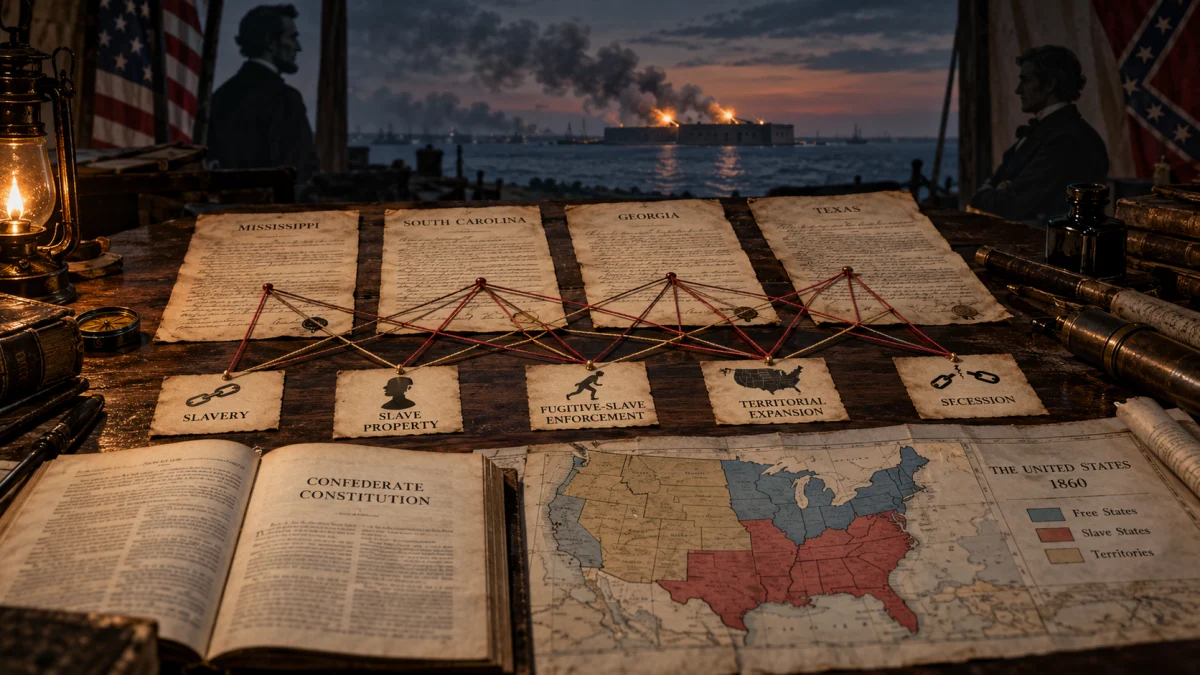
Four seceding states issued detailed declarations explaining their reasons: South Carolina, Mississippi, Georgia, and Texas.
They did not leave the central conflict hidden.
Mississippi: slavery was its “greatest material interest”
Mississippi’s Declaration of the Immediate Causes of Secession opens its substantive explanation with an extraordinary sentence:
“Our position is thoroughly identified with the institution of slavery.”
The declaration then calls slavery the state’s greatest material interest, complains that opposition to slavery threatened slave property, condemns restrictions on slavery in the territories, attacks resistance to the Fugitive Slave Law, denounces racial equality, and says remaining in the Union risked the loss of property worth billions of dollars.
That is not a later historian imposing a slavery-centered interpretation on Mississippi. It is Mississippi explaining Mississippi.
South Carolina: the “states’ rights” complaint immediately leads to slavery
South Carolina’s Declaration of the Immediate Causes of Secession does invoke state sovereignty and constitutional compact theory.
But follow the argument one level deeper.
What constitutional breach does South Carolina emphasize?
It complains that Northern states had resisted federal obligations concerning escaped enslaved people. It condemns Northern hostility toward slavery, attacks antislavery organizations, and argues that the election of a Republican administration threatened the slaveholding states.
That matters because “states’ rights” does not answer the causal question by itself.
States’ rights concerning what?
In South Carolina’s own explanation, one of the central complaints was that Northern states were using their own state authority to obstruct the recovery of people claimed as slave property.
So the argument was not simply that state power should always prevail over federal power. South Carolina objected when Northern state power interfered with protections slaveholders believed the federal Constitution required.
Georgia: tariffs were a grievance, but slavery was the live crisis
Georgia’s Declaration of Causes is especially useful because it prevents an oversimplified answer.
Georgia discusses longstanding economic grievances, including protective tariffs and federal policies that it believed benefited Northern commercial and manufacturing interests.
Those disputes were real.
But Georgia’s declaration then says the country had largely settled the earlier protectionist dispute in favor of lower duties. It identifies the rise of an antislavery political movement, conflict over slavery in the territories, fugitive-slave enforcement, and the election of the Republican Party as the crisis that made separation necessary.
Its opening sentence about the preceding decade identifies Georgia’s complaints against the non-slaveholding states as complaints “with reference to the subject of African slavery.”
This is why “economics” is not a clean alternative to slavery.
Slavery was itself an economic system involving labor, land, wealth, credit, political representation, territorial expansion, and billions of dollars in legally recognized human property.
Saying slavery was central does not mean economics was irrelevant. It means much of the relevant economic conflict ran through slavery.
Texas: the declaration openly defended slavery and white supremacy
Texas was even less ambiguous.
Its Declaration of the Causes of Secession describes Texas as a state “holding, maintaining and protecting” slavery, condemns efforts to restrict slaveholding interests, attacks resistance to fugitive-slave recovery, and explicitly rejects racial equality.
The document does not merely defend an abstract constitutional principle. It defends a racial social order in which Black people were enslaved and treated as subordinate to whites.
That distinction matters.
The institution the Confederacy sought to protect was not an abstract labor policy. It was hereditary racialized chattel slavery.
The 1860 Census counted 3,953,760 enslaved people in the United States on the eve of the war.
The Confederate Constitution makes the “states’ rights” explanation even harder to sustain
The Constitution of the Confederate States largely copied the structure of the U.S. Constitution, but it made protections for slavery substantially more explicit.
Among other provisions, it prohibited laws impairing slave property rights, protected the right to travel within the Confederacy with enslaved people, required the return of escaped enslaved people, and required slavery to be recognized and protected in Confederate territories.
That creates a serious problem for the claim that the Confederacy was principally created to maximize state autonomy.
The Confederate Constitution protected certain slaveholding rights against interference even within the Confederate constitutional system.
In the territories, it did not leave the slavery question entirely to local choice. It required recognition and protection of slavery.
So “states’ rights” is best understood here as a constitutional argument used in service of substantive interests, especially slavery, rather than as a consistent rule that state power always outranked central authority.
The Confederate vice president said the new government rested on slavery and racial inequality
On March 21, 1861, Confederate Vice President Alexander Stephens delivered what became known as the Cornerstone Speech.
Stephens said the new Confederate government rested on the proposition that Black people were not equal to white people and that slavery was their supposedly natural condition.
Stephens had actually opposed immediate secession before Georgia left the Union, which makes his statement especially useful. He was not merely an early fire-eater describing some fringe version of Confederate ideology. He became the vice president of the government that was created.
His speech does not prove what every Confederate believed. No speech could.
It does, however, tell us how one of the Confederacy’s highest officials publicly described the ideological foundation of the new government in March 1861.
So was it “states’ rights”?
Only if the phrase is completed.
The better question is:
A state’s right to do what?
Southern political leaders invoked state sovereignty, compact theory, constitutional limits on federal authority, and the claimed right of secession. Those ideas were real parts of antebellum constitutional thought.
But in the secession crisis, the concrete rights repeatedly identified in the primary documents involved:
- owning enslaved people;
- recovering people who escaped slavery into free states;
- taking enslaved people into federal territories;
- preserving slaveholding political power;
- preventing federal restriction of slavery’s expansion;
- protecting the racial hierarchy on which slave society rested.
South Carolina’s declaration is especially revealing because it condemned Northern states for resisting federal fugitive-slave obligations.
In other words, secessionists could demand strong federal enforcement when federal power protected slavery while invoking state sovereignty when they believed federal power threatened slaveholding interests.
That does not make constitutional federalism irrelevant. It means federalism was not the final answer to the causal question.
Follow the argument recursively:
States’ rights → rights concerning slavery → conflict over slavery’s security, enforcement, and expansion.
The chain keeps returning to the same institution.
What about tariffs?
Tariffs mattered in nineteenth-century American politics. Pretending otherwise would be bad history.
South Carolina’s Nullification Crisis in 1832–1833 had centered on tariffs decades before the Civil War. Georgia’s 1861 declaration discussed older disputes over protectionism. The 1860 Republican platform also supported protective duties alongside its opposition to slavery’s expansion.
But the claim that the Civil War was principally caused by the Morrill Tariff does not fit the chronology.
The Morrill Tariff became law on March 2, 1861. By then, seven Deep South states had already seceded and formed the Confederate States of America.
That does not mean tariff policy was irrelevant to every Southern politician. It means a tariff enacted after the first seven states had already left cannot by itself explain why those states seceded.
More importantly, when the seceding governments explained their immediate crisis, the recurring issue was slavery: its expansion, slave property, fugitive-slave enforcement, antislavery politics, and the election of a party committed to preventing slavery’s extension into the territories.
Even Georgia, while discussing tariff history, describes the decisive contemporary sectional conflict as the struggle over slavery.
So the most defensible conclusion is not “tariffs had nothing to do with sectional conflict.”
It is:
Tariffs were one of several longstanding sectional disputes. The documentary record does not support replacing slavery with tariffs as the principal cause of the 1860–1861 secession crisis.
But Lincoln said he was fighting to save the Union, not to free the slaves
He did.
And this is one of the most important facts to include because it is often presented as if it disproves slavery’s causal role.
In his First Inaugural Address on March 4, 1861, Lincoln said he had no intention or lawful authority to interfere with slavery in states where it already existed.
In an August 22, 1862 letter to Horace Greeley, Lincoln publicly described his paramount objective as saving the Union.
Those statements are real.
They answer the question:
Why was Lincoln’s government fighting?
They do not answer the different question:
Why had the seceding states created the crisis in the first place?
A war can begin because one side secedes for one set of reasons while the opposing government goes to war for a different immediate objective.
The Confederacy could secede principally to protect slavery while the United States initially fought principally to preserve the Union.
There is no contradiction.
The United States even offered extraordinary protection for slavery before the war
The final months before the fighting also destroy a simplistic version in which Washington was already preparing to abolish slavery everywhere.
Congress approved the proposed Corwin Amendment in March 1861. It would have constitutionally barred amendments giving Congress power to abolish or interfere with slavery inside states where it already existed.
Lincoln said in his First Inaugural that he had no objection to making that protection explicit.
The amendment did not reverse the secession crisis.
Why?
Because the conflict was not limited to whether Congress would immediately abolish slavery inside existing slave states.
Southern leaders were also fighting over slavery’s future: whether it could expand into the territories, whether slaveholders could recover escaped people from free states, whether the slaveholding states would retain political power, and whether an explicitly antislavery party could control the federal government.
The Republican Party’s 1860 platform opposed giving slavery legal existence in federal territories while also stopping short of a program of immediate federal abolition inside states where slavery already existed.
To slaveholding secessionists, containment itself threatened the long-term security of the institution.
Then what actually turned secession into war?
Secession created rival claims to sovereignty and control of federal property.
By Lincoln’s inauguration, seven states had declared themselves outside the United States and organized the Confederacy.
The immediate military break came at Fort Sumter.
On April 12, 1861, Confederate batteries opened fire on the U.S. garrison at Fort Sumter in Charleston Harbor. After the fort surrendered, Lincoln called for 75,000 militia to suppress the rebellion.
That call for troops changed the politics of the Upper South. Virginia, Arkansas, Tennessee, and North Carolina then joined the Confederacy.
This matters because the eleven seceding states did not all follow an identical timetable or respond to exactly the same immediate trigger.
Virginia, for example, seceded after Fort Sumter and Lincoln’s call for troops. Its Ordinance of Secession nevertheless described federal oppression in relation to the “Southern slaveholding States.”
The honest answer therefore allows for layers of causation:
- Slavery was the central underlying sectional conflict.
- Lincoln’s election triggered the first wave of Deep South secession.
- Secession created the constitutional and military confrontation.
- The Confederate attack on Fort Sumter initiated open fighting.
- Lincoln’s call for troops triggered a second wave of Upper South secession.
Historical causation does not become more accurate by forcing all eleven states into one identical sentence.
If slavery caused the crisis, why did some slave states stay in the Union?
Because a central cause is not the same thing as a mechanical rule that determines every state’s behavior.
Delaware, Maryland, Kentucky, and Missouri remained in the Union, although slavery existed within them. West Virginia entered the Union in 1863 with gradual emancipation provisions rather than immediate universal freedom.
Their existence is important because it prevents another oversimplification: the Civil War did not begin as a perfectly clean geographic contest between an abolitionist North and a uniformly slaveholding South.
But the border states do not erase the secession documents of the states that left.
The relevant question is not:
Did every slave state secede?
It is:
Why did the states that created the Confederacy say they were seceding, and what did the Confederacy build into its new government?
On those questions, the evidence is overwhelming.
Did every Confederate soldier personally fight for slavery?
No responsible historian can know the personal motive of hundreds of thousands of soldiers from a single statistic or political document.
A Confederate soldier might have enlisted because of loyalty to his state, community pressure, fear of invasion, military conscription, comradeship, adventure, economic need, defense of home, support for slavery, racial ideology, or some combination of motives.
A soldier might also have changed his reasons over four years of war.
But this does not answer why the Confederate government existed.
Personal motive and political causation are different levels of analysis.
Imagine asking why a modern country entered a war and then trying to answer the question solely by interviewing one private in its army. His motive matters, but it does not replace the government’s documents, policies, laws, diplomatic goals, and political decisions.
The same principle applies here.
“Most Confederate soldiers did not own slaves” is therefore not a decisive argument about the cause of secession even if the underlying ownership statistic is framed accurately.
A person does not have to personally own the institution a government is defending in order to fight for that government.
Conversely, it would also be wrong to assume that every Confederate soldier consciously enlisted in order to preserve slavery.
Both claims go beyond what the evidence can establish.
Was the North fighting an antiracist crusade from day one?
No.
This history should not be cleaned up on the Union side either.
Many white Northerners opposed slavery’s expansion without supporting racial equality. Some were openly racist. Northern businesses and financial institutions had profited from slave-produced commodities. Slavery still existed in loyal states when the war began.
Lincoln’s initial federal war aim was preservation of the Union.
That is why the Emancipation Proclamation, issued January 1, 1863, was such a major transformation. It declared enslaved people free in areas still in rebellion, authorized Black military service, and made the destruction of slavery an explicit component of Union victory.
It did not immediately abolish slavery everywhere. Loyal slave states were outside its reach, as were certain areas of the Confederacy already under Union control.
Nationwide constitutional abolition came with the Thirteenth Amendment, ratified in December 1865.
So two statements can both be true:
The Union did not enter the war in 1861 primarily to abolish slavery.
And:
The secession crisis that produced the war was principally driven by slavery.
Confusing those propositions is one of the most common ways the history gets distorted.
The recursive test: keep asking “why?”
The strongest way to test competing explanations is to keep moving backward through the causal chain.
“The war happened because of secession.”
Why did the first seven states secede?
Their documents repeatedly identify the perceived threat to slavery, slave property, slavery’s territorial expansion, fugitive-slave enforcement, and slaveholding political power.
“They seceded over states’ rights.”
Which state rights were in immediate dispute?
Again, the documents repeatedly return to slavery.
And when Northern states exercised their own authority against slave-catching, secessionists demanded stronger enforcement of federal constitutional obligations.
“It was economic.”
What economic system sat at the center of the sectional dispute?
A Southern political economy in which millions of human beings were legally enslaved and treated as property, and in which slave labor, land, credit, agriculture, and political power were deeply intertwined.
“It was about Lincoln.”
Why did Lincoln’s election provoke secession before he took office?
Because the new Republican administration represented a political coalition committed to stopping slavery’s expansion into the federal territories, which secessionists viewed as a mortal threat to slave society.
“It was about Fort Sumter.”
Why was there a Confederate government surrounding a U.S. fort in Charleston Harbor in the first place?
Because South Carolina and six other Deep South states had already seceded.
And why had they seceded?
The chain returns to slavery.
The counterfactual test produces the same result
Counterfactual reasoning cannot prove history by itself, but it is useful as a test of causal importance.
Remove the tariff dispute from 1860. The conflict over slavery remains.
Remove disagreements about federal spending. The conflict over slavery remains.
Remove abstract debates over constitutional theory. The concrete fights over slave property, fugitive-slave enforcement, racial hierarchy, political power, and slavery in the territories remain.
Now remove slavery.
The Fugitive Slave Act conflict disappears.
The struggle over whether new western territories would become slave or free disappears.
The sectional political balance between slave and free states changes fundamentally.
The central reason for the Republican Party’s rise disappears.
The slavery-centered grievances in the secession declarations disappear.
The Confederate Constitution’s special protections for slave property and territorial slavery disappear.
The racial order defended in Texas’s declaration and Stephens’s Cornerstone Speech disappears.
Could the United States still have experienced political conflict over tariffs, federalism, economic development, westward expansion, or regional identity? Of course.
Would those disputes have produced the same secession crisis and the same Civil War in 1861?
The surviving evidence gives us little reason to say yes.
That is an inference, not a directly observable fact. But it is an inference supported by chronology, political behavior, constitutional design, public statements, and the primary documents produced by the secessionists themselves.
So why do people still hear that it was not about slavery?
Part of the answer is what historians call the Lost Cause interpretation.
After Confederate defeat, former Confederates and sympathetic writers increasingly recast the conflict as a noble struggle for local self-government, constitutional liberty, military honor, and defense of home while minimizing or denying slavery’s central role.
The National Park Service’s history of Civil War memory describes how this interpretation helped North and South reconcile around narratives of shared white military valor while the meaning of emancipation and the rights of formerly enslaved people were pushed aside.
That does not mean every person who talks about “heritage” is consciously endorsing slavery.
It means heritage is not evidence of original causation.
To determine why the Confederacy was created, the most reliable approach is still to read what its founders, governments, conventions, constitution, and political leaders said when they were creating it.
Those sources are much harder to reconcile with the later claim that slavery was incidental.
What Abraham Lincoln eventually said about the cause
By his Second Inaugural Address in March 1865, Lincoln described enslaved people as a “peculiar and powerful interest” and said everyone knew that interest was somehow the cause of the war.
He distinguished that cause from the federal government’s original policy: the secessionists sought to strengthen and extend slavery, while the United States initially claimed only the authority to restrict its territorial expansion.
That is very close to what the broader documentary record shows.
The war did not begin because Lincoln entered office announcing nationwide immediate abolition. He explicitly did not.
It began after slaveholding states concluded that losing control of the federal government to a party opposed to slavery’s expansion endangered the future of their social, economic, and political system.
They seceded.
They created a new government with stronger explicit constitutional protections for slavery.
Confederate forces fired on Fort Sumter.
And the war came.
Evidence assessment: the most common claims
| Claim | What the historical record supports |
|---|---|
| “The Civil War was principally caused by slavery.” | Supported. Slavery was the central issue driving the secession crisis that created the Confederacy and led to war. |
| “It was really about states’ rights, not slavery.” | Misleading as a standalone explanation. State-sovereignty arguments were real, but the rights most central to the secession documents repeatedly concerned slavery. |
| “It was really about tariffs.” | Not supported as the principal cause of the 1860–1861 crisis. Tariff disputes existed, but the immediate secession record centers on slavery, and the Morrill Tariff became law after the first seven states had already seceded. |
| “Lincoln went to war in 1861 to free the slaves.” | False as stated. His initial overriding war aim was preserving the Union. |
| “Because Lincoln initially fought for Union, slavery could not have caused the war.” | False logic. Confederate reasons for secession and Union reasons for resisting secession are different questions. |
| “Every Confederate soldier fought personally to preserve slavery.” | Too broad. Individual motives varied and cannot simply be inferred from the government’s purpose. |
| “The Confederacy constitutionally protected slavery.” | Supported directly by the Confederate Constitution. |
| “White supremacy was unrelated to Confederate ideology.” | Contradicted by primary sources. Texas’s declaration and Stephens’s Cornerstone Speech explicitly defended racial hierarchy. |
| “The war became a war of emancipation.” | Supported. Emancipation became an explicit Union war objective in 1863, and slavery was constitutionally abolished in 1865. |
The bottom line
The strongest historical answer is not that every feature of the Civil War can be reduced to slavery.
It cannot.
The war involved constitutional disputes, competing nationalisms, regional identity, economics, military coercion, federal authority, personal loyalties, and millions of individual decisions.
But those facts do not make all causes equally important.
When the question is narrowed to the event that actually produced the war — the secession crisis of 1860–1861 and the creation of the Confederacy — the primary evidence points in one direction with unusual consistency.
Mississippi explicitly identified its position with slavery.
South Carolina centered its constitutional grievances on protections for slaveholding interests.
Georgia described slavery as the live sectional crisis even while acknowledging older economic disputes.
Texas openly defended slavery and racial hierarchy.
The Confederate Constitution protected slave property and required slavery’s protection in the territories.
The Confederate vice president publicly described slavery and racial inequality as foundational to the new government.
The Republican victory that triggered secession was threatening to secessionists principally because Republicans opposed the expansion of slavery.
None of this requires pretending the Union began the war as a pure abolitionist project. It did not.
It requires only reading the record in the order events happened.
Slavery produced the political crisis. The political crisis produced secession. Secession produced the military confrontation. The Confederate attack on Fort Sumter turned that confrontation into open war.
So, was the Civil War actually about slavery?
Yes. More precisely, slavery was the central underlying cause of the secession crisis that produced the Civil War.
The “states’ rights,” tariff, Lincoln, and individual-soldier arguments become useful historical context once they are placed at the correct level of the causal chain.
They do not overturn it.
References and Further Reading
Primary Secession Documents
- Mississippi, Declaration of the Immediate Causes of Secession — Yale Law School Avalon Project — Mississippi’s own explanation directly identifies slavery as its central material interest and lists threats to slave property and expansion.
- South Carolina, Declaration of the Immediate Causes of Secession — Yale Law School Avalon Project — Essential for evaluating the “states’ rights” argument because its complaints focus heavily on Northern resistance to protections for slavery.
- Georgia, Declaration of Causes — Yale Law School Avalon Project — Particularly useful because it discusses both older tariff grievances and the later slavery-centered political crisis.
- Texas, Declaration of the Causes of Secession — Yale Law School Avalon Project — Explicitly defends slavery and racial hierarchy while explaining Texas’s decision to leave the Union.
- Virginia Ordinance of Secession — Library of Virginia — Shows the different timing of Upper South secession while still referring to the “Southern slaveholding States.”
Confederate Government and Leadership
- Constitution of the Confederate States — Yale Law School Avalon Project — Primary constitutional text protecting slave property, fugitive-slave recovery, interstate slaveholding rights, and slavery in Confederate territories.
- Alexander Stephens, Cornerstone Speech — National Park Service — Contemporary public statement by the Confederate vice president describing slavery and racial inequality as foundational to the new government.
- American Historical Association, Primary Sources on Secession and the Confederacy — Curated collection of declarations, Confederate documents, and secession-commissioner material.
Lincoln, Union Policy, and Emancipation
- Abraham Lincoln, First Inaugural Address — Library of Congress — Shows Lincoln explicitly denying an intention to interfere with slavery inside states where it already existed.
- Abraham Lincoln to Horace Greeley, August 22, 1862 — Library of Congress — Primary source for Lincoln’s public statement that his paramount official objective was preserving the Union.
- Abraham Lincoln, Second Inaugural Address — American Presidency Project — Lincoln’s 1865 reflection identifying slavery as the powerful interest at the center of the conflict.
- The Corwin Amendment — U.S. National Archives — Documents the failed 1861 constitutional amendment intended to protect slavery inside states from federal interference.
- Republican Party Platform of 1860 — Library of Congress — Primary evidence of the Republican position against legalizing slavery in the federal territories.
- Emancipation Proclamation — U.S. National Archives — Primary document and historical context for the transformation of emancipation into an explicit Union war objective.
- Thirteenth Amendment — U.S. National Archives — Primary constitutional record of nationwide abolition in 1865.
War, Population, and Historical Context
- Battle of Fort Sumter — National Park Service — Documents the Confederate bombardment that opened the military phase of the Civil War.
- 1860 Enslaved Population — U.S. Census Bureau — Census-based figure showing 3,953,760 enslaved people in the United States in 1860.
- Slavery as a Cause of the Civil War — National Park Service — Useful synthesis distinguishing the cause of secession from Union war aims and individual soldiers’ motives.
- The Civil War in American Memory — National Park Service — Explains the later Lost Cause tradition and how postwar memory often minimized slavery’s central role.
Editorial currency note: The events and primary documents discussed here are historical and fixed. Links to archival presentations may move as institutions redesign their websites; the underlying documents and dates do not change.