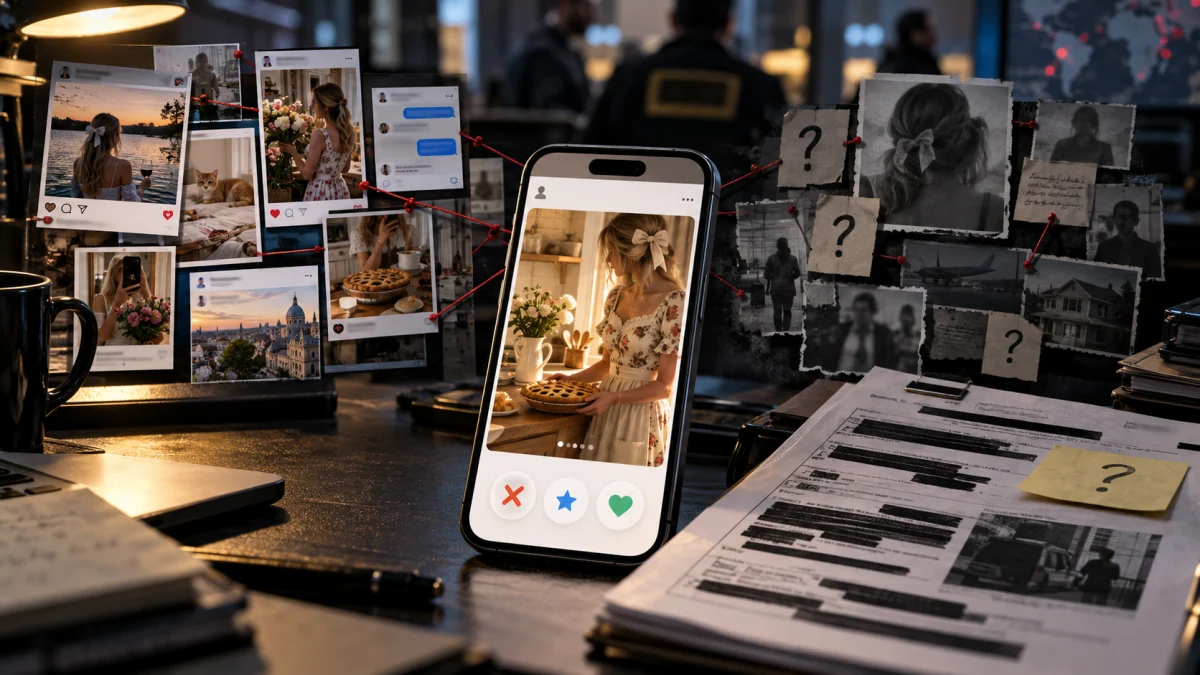
Yes, the FBI memo is real. No, the public evidence does not yet establish that women actually carried out the specific fake-“tradwife” operation described in it.
The FBI’s Chicago field office distributed a Situational Information Report in February 2026 warning that a “small group of women” was allegedly creating fictitious dating profiles designed to appeal to law-enforcement personnel involved in immigration enforcement. The profiles supposedly used a “traditional wife” aesthetic, with the goal of drawing officers into online conversations or in-person dates before exposing them publicly.
The nonprofit Property of the People obtained the memo through a state open-records request. The Guardian first reported it on September 17, and NBC News later reported, in a version syndicated by AOL, that the FBI confirmed the document’s authenticity.
But authenticating the memo is not the same thing as authenticating every allegation inside it.
As of September 23, 2026, the publicly available record reviewed by sherafy.com does not identify an example fake “tradwife” profile, a woman who admits creating one, an immigration officer who was actually lured by one, or a completed doxing incident tied specifically to the tactic. The memo itself reportedly did not identify the dating platforms, the women’s locations or an officer who had been exposed.
There is, however, an important complication: the broader idea of using dating apps to identify immigration officers was not invented by the FBI. Public posts encouraging exactly that kind of activity existed before the February warning.
The real unanswered question is narrower and more interesting:
Where did the FBI get the much more specific claim about fake “tradwife” personas, and how well was that information corroborated before the bureau distributed it to law enforcement?
What the FBI memo actually alleged
According to The Guardian’s review of the February FBI document, the Chicago field office said that beginning in late January a small group of women was allegedly creating fictitious dating accounts intended to attract people participating in immigration enforcement.
The profiles supposedly incorporated imagery associated with a “traditional wife” aesthetic and listed interests intended to appeal to law-enforcement personnel. The alleged objective was to initiate an online or in-person romantic interaction, identify the officer, and then expose that person online. The FBI assessed that the tactic was intended to create embarrassment and discourage immigration-enforcement activity.
One precision is worth making here. Headlines, including this one, naturally refer to ICE agents, because ICE was at the center of the controversy. But the FBI language quoted publicly was broader: it referred to law-enforcement personnel participating in immigration enforcement.
The memo reportedly did not provide:
- names of the women;
- examples of the alleged profiles;
- a specific dating service;
- a geographic location for the group;
- the identity of an officer who interacted with one;
- an example of information obtained during a date;
- or a documented case in which this particular method resulted in an officer being exposed.
NBC’s subsequent reporting likewise said the memo did not state where the profiles appeared or provide examples of them.
That does not prove the underlying intelligence was false. It means the public version of the story stops well short of proving it true.
The dating-app campaign itself was real
The strangest part of the FBI memo should not obscure something the record does establish.
Months before the memo became public, people were openly encouraging dating-app users to identify suspected immigration officers.
A January 26 report by TVA Nouvelles preserved and embedded several of those social-media posts.
In North Carolina, creator Hannah Preston, known online as @healthpolicyprincess, asked people using dating apps to send screenshots of profiles belonging to people who said they worked for ICE or Border Patrol. TVA dated that appeal to November 18, 2025, during immigration enforcement activity in Charlotte.
On January 12, 2026, another creator in Minneapolis urged Grindr users to collect and circulate selfies and other material from suspected immigration officers using the app. The following day, Libs of TikTok amplified claims that groups of women were attempting to obtain dates with ICE agents so their identities and personal information could be exposed.
So there are two conclusions we should not draw.
It would be wrong to say the FBI conjured the entire concept out of nothing.
It would also be wrong to say these posts prove the specific operation described in the FBI memo.
They establish that people publicly discussed using dating apps to identify immigration personnel. They do not establish that a coordinated group subsequently built fictitious “tradwife” personas and successfully deployed them.
The public story then acquired one very specific new detail: “tradwife”
This is where the provenance becomes murky.
The known January material discusses dating apps, screenshots, selfies, identifying officers and, in some accounts, arranging dates.
What it does not appear to discuss is women creating deliberately fabricated personas based around a traditional-wife aesthetic.
The Guardian noticed the same discontinuity. Its investigation found that the earlier news coverage preceding the FBI memo did not contain the “tradwife” component. That left open whether FBI Chicago had obtained additional nonpublic reporting or whether the bureau was synthesizing a broader collection of social-media claims.
In the public material reviewed by sherafy.com, we likewise found no pre-February source establishing that specific detail.
That is significant, but it needs to be interpreted carefully.
There are at least three plausible explanations:
- The FBI had additional nonpublic information. A source may have known about profiles or organizers that were never publicly identified.
- A public source existed but is now unavailable or was never well indexed. Social-media posts routinely disappear, become private or evade conventional search.
- The story changed somewhere in the reporting chain. A more general dating-app tactic may have acquired additional specificity as information passed between people.
The evidence currently available cannot responsibly distinguish among those possibilities.
The memo says its information came from a “collaborative source”
This detail is more important than it initially sounds.
The Guardian reported that the FBI briefing attributed the intelligence to a “collaborative source.” Critics understandably focused on the memo’s lack of visible citations, but “collaborative source” is itself an intelligence-sourcing term rather than a synonym for an anonymous social-media rumor.
An older federal interagency Intelligence Guide for First Responders hosted by GovInfo explains that intelligence consumers should evaluate source information by factors including access, the chain by which the information was acquired, credibility and past reliability.
That guide defines a collaborative source as a relatively new source with whom a formal relationship has been established. Its example source statements combine that label with an assessment of whether the person had direct, indirect, good or excellent access and how much previous reporting had been corroborated.
The guide is older and should not be mistaken for the FBI’s current 2026 internal source manual. But a much more recent Justice Department Inspector General investigation shows that similar terminology remained in actual FBI intelligence reporting.
In its December 2024 review of FBI intelligence collection before January 6, the DOJ Inspector General quoted an FBI intelligence report describing a person as a “collaborative source with good access” and separately describing the source’s access to the reported information as excellent. The OIG also discussed why more detailed information about the source’s placement was omitted: revealing it could have compromised the source’s identity.
That changes how the February “tradwife” memo should be scrutinized.
The most useful question is not simply:
Why didn’t the FBI include footnotes?
It is:
What did the FBI know about this collaborative source’s access to the alleged scheme, previous reliability and corroboration?
None of those answers has become public in the reporting reviewed for this article.
And “collaborative source” does not mean the allegation was corroborated by multiple independent sources. It describes the relationship with a source. The reliability of this particular report is a separate question.
What does “not finally evaluated intelligence” actually mean?
The FBI memo also carried a warning that it contained “not finally evaluated intelligence.”
That phrase can sound like an admission that the bureau did not believe the information. It is not.
The DOJ Inspector General’s 2024 report provides a useful explanation of the FBI’s own terminology.
According to the report, FBI policy describes raw intelligence reports as the bureau’s mechanism for distributing intelligence or data that has not been finally evaluated. Sharing information at that stage can allow analysts and law-enforcement partners to identify patterns or generate hypotheses before the material becomes finished intelligence.
The OIG further explains that a Situational Information Report, or SIR, is a primary FBI mechanism for sharing FBI-gathered raw intelligence with state, local and tribal law-enforcement partners.
That is precisely the type of document involved here.
So the correct interpretation is:
“Not finally evaluated” means raw intelligence, not proven intelligence.
It does not mean false.
It also does not mean established fact.
A useful historical example appears in the same OIG report. On January 5, 2021, the FBI’s Norfolk field office distributed an SIR based on online information about possible violence in Washington. That SIR warned recipients that the information was not fully evaluated and said agencies should coordinate with the FBI before acting on the raw reporting. The underlying warnings later became a major part of congressional and public scrutiny surrounding the January 6 attack.
Raw intelligence can therefore be important and even prescient.
It can also be incomplete, mistaken or uncorroborated.
The label tells us what stage of the intelligence process the information had reached. It does not answer whether this particular “tradwife” allegation was right.
Does the lack of footnotes prove the FBI warning was poorly sourced?
No, not by itself.
Mike German, a former FBI agent and civil-liberties advocate who reviewed the memo for The Guardian, said he found the absence of footnotes or citations unusual. Ryan Shapiro of Property of the People described the alert as “thinly-sourced” and criticized the government for spending resources on what he characterized as possible embarrassment of immigration officers. Those are their assessments, and they deserve to be reported as such.
But a lack of academic-style citations does not establish that the bureau had no source.
The memo reportedly identified a collaborative source, and federal intelligence guidance places substantial emphasis on a source’s access, acquisition chain and reliability.
That leaves a more precise criticism available:
The public cannot currently evaluate how strong the underlying sourcing was because the source’s access, corroboration history and basis for the specific “tradwife” claim have not been disclosed.
There may be legitimate reasons not to publish details that could identify a confidential source. But source protection and evidence quality are different questions. It should be possible to assess the latter without revealing the former.
Did any immigration officer actually get lured by a fake “tradwife” profile?
There is no publicly documented example in the material reviewed for this article.
The FBI memo apparently did not identify one. The Guardian said it did not specify whether agents had actually been exposed, and NBC reported that no examples of the alleged profiles were included.
That is not proof that no such interaction ever happened.
It means that, as of September 23, the following remain publicly unestablished:
| Claim | Evidence status |
|---|---|
| The FBI Chicago memo exists | Verified |
| The FBI confirmed the memo’s authenticity | Verified |
| People publicly encouraged using dating apps to identify immigration officers | Verified |
| The FBI received reporting from what it called a “collaborative source” | Reported in the memo |
| Women created fake profiles specifically using a tradwife aesthetic | Raw FBI intelligence; not publicly corroborated |
| An officer actually interacted with one of those profiles | Not publicly established |
| An officer went on an in-person date produced by the alleged scheme | Not publicly established |
| An officer was doxxed through the alleged tradwife tactic | Not publicly established |
| The tactic actually deterred immigration enforcement | Not demonstrated; described by the FBI as the alleged tactic’s purpose |
| The FBI simply copied a January media story | Possible inference, not established |
That distinction between verified activity, reported intelligence and unproven outcome is the central factual issue.
Is identifying an ICE agent automatically “doxxing”?
No.
“Doxxing” is an informal term that can describe a wide range of conduct online. Federal criminal law is considerably more specific.
For example, 18 U.S.C. §119 prohibits making certain restricted personal information about covered officials publicly available when the required threatening, intimidating or violence-related intent is present. The statute defines that restricted information to include things such as a home address, personal telephone number and personal email address.
A person’s face, name or photograph taken while that person performs official duties in public is not automatically the same thing.
The legal analysis changes substantially when conduct involves following someone home, publishing private residential information, making threats, stalking, encouraging violence or interfering with law enforcement.
sherafy.com has a separate detailed explainer on this distinction: Can You Legally Film and Post ICE Agents? What NSPM-7 and Federal Doxxing Law Actually Say.
None of that determines whether the FBI was justified in circulating a security alert. Law-enforcement intelligence can address concerning conduct before prosecutors possess enough evidence to prove a crime.
It does, however, mean that the word “doxxing” should not substitute for describing exactly what information was allegedly collected or published.
In this case, the public memo coverage does not provide that level of detail.
Did the FBI simply repeat an anti-ICE social-media rumor?
The evidence is insufficient to say that.
The chronology makes the possibility worth investigating.
Public posts about identifying immigration agents through dating apps appeared before the February memo. A January 17 New York Post story amplified claims that women were coordinating dates and background research. The Guardian reported that the FBI alert followed that story by several weeks, and German said he thought the briefing may have been influenced by it.
But chronology is not proof of provenance.
More importantly, the FBI memo contains the “traditional wife” detail that the known January coverage apparently did not.
That additional specificity cuts both ways.
It could indicate that the FBI had a source with access to information unavailable publicly.
Or it could be a detail that entered an uncertain information chain somewhere between online discussion and intelligence dissemination.
Without the source-access and corroboration information, we cannot determine which explanation is better supported.
What the evidence actually supports
The cleanest reading of the available record is neither “the FBI invented the whole thing” nor “women definitely carried out an organized tradwife honeytrap against ICE.”
The broader underlying behavior is documented: people publicly encouraged others to use dating and hookup apps to identify immigration personnel, collect screenshots and circulate information about them.
The FBI document is also authentic.
But the memo’s most distinctive allegation remains one step beyond what the public evidence can independently establish.
The bureau said a small group of women was allegedly using fictitious profiles with a traditional-wife aesthetic. The memo came from raw intelligence attributed to a collaborative source. Yet the public record still does not show the profiles, identify the participants, establish the source’s access, document a victim or demonstrate that the method produced a completed doxing incident.
That is the evidentiary line.
The FBI may possess information on the other side of it.
The public currently does not.
The unanswered question is not whether the memo is real
The FBI has already settled that question.
The memo is authentic.
The more consequential question is how strong the intelligence behind it was.
A “collaborative source” label suggests the report was not simply an unattributed internet screenshot. Federal intelligence materials show that source reporting is ordinarily understood in terms of access, acquisition chain and reliability. But none of those details has been made public for this allegation.
Meanwhile, the known chronology establishes a genuine online campaign to identify immigration officers through dating apps without independently establishing the later, much more colorful tradwife-specific version.
Until an example profile, participant, targeted officer, underlying source description or other corroborating evidence emerges, the strongest supported conclusion is straightforward:
The dating-app tactic was real. The FBI warning was real. The specific fake-“tradwife” operation remains an allegation contained in raw intelligence, not a publicly proven event.
References and Further Reading
The FBI Memo and Original Reporting
The Guardian — “FBI warned ICE agents could be targeted by fake ‘tradwife’ dating profiles, memo reveals”
Sam Levin’s September 17, 2026 report is the original public disclosure of the February FBI Situational Information Report. It includes the memo’s central claims, its “not finally evaluated intelligence” disclaimer, the “collaborative source” description and interviews with Ryan Shapiro and former FBI agent Mike German.
NBC News report syndicated by AOL — “FBI warned immigration authorities about fake tradwife dating profiles”
Important because NBC independently obtained the document from Property of the People and reported that the FBI confirmed the memo’s authenticity. It also notes that the memo did not provide example profiles or identify where they appeared.
FBI Intelligence Reporting and Source Evaluation
U.S. Department of Justice Office of the Inspector General — Review of the FBI’s Handling of Confidential Human Sources and Intelligence Collection Before January 6
Official December 2024 oversight report explaining FBI raw-intelligence reports and Situational Information Reports. It states that SIRs are used to share FBI-gathered raw intelligence with state, local and tribal law-enforcement partners.
DOJ Inspector General discussion of “collaborative source” access in FBI reporting
The same OIG report reproduces an FBI intelligence report’s description of a “collaborative source with good access” and discusses why more specific information about a source’s placement may be withheld to protect identity.
Interagency Threat Assessment and Coordination Group — Intelligence Guide for First Responders
An older federal interagency guide explaining how intelligence consumers evaluate source access, acquisition chains, credibility and reliability. It defines “collaborative source” as an intelligence-source category and illustrates how such a designation can be paired with access and corroboration information. It is useful background, not a claim about the exact wording of current 2026 FBI policy.
Dating-App Activity Before the FBI Memo
TVA Nouvelles — January 26, 2026 report preserving dating-app posts involving suspected ICE personnel
Useful because it embeds or links contemporaneous social-media material from North Carolina and Minneapolis and preserves the January 13 Libs of TikTok post. It establishes that dating-app-based efforts to identify immigration personnel were publicly discussed before the FBI’s February memo.
Federal Doxxing Law and sherafy.com Context
18 U.S.C. §119 — Protection of individuals performing certain official duties
Federal statute covering publication of specifically defined restricted personal information about covered officials when the required threatening, intimidating or violence-related intent is present.
sherafy.com — “Can You Legally Film and Post ICE Agents? What NSPM-7 and Federal Doxxing Law Actually Say”
A detailed companion explainer covering the difference between public recording and identification, private personal information, stalking, threats and federal disclosure offenses.
Editorial currency note: This article reflects the public record available through September 23, 2026. The evidentiary assessment should be updated if the full FBI SIR becomes publicly accessible, if Property of the People releases additional records surrounding its dissemination, or if the FBI or another source produces evidence identifying the alleged profiles, participants or affected officers.