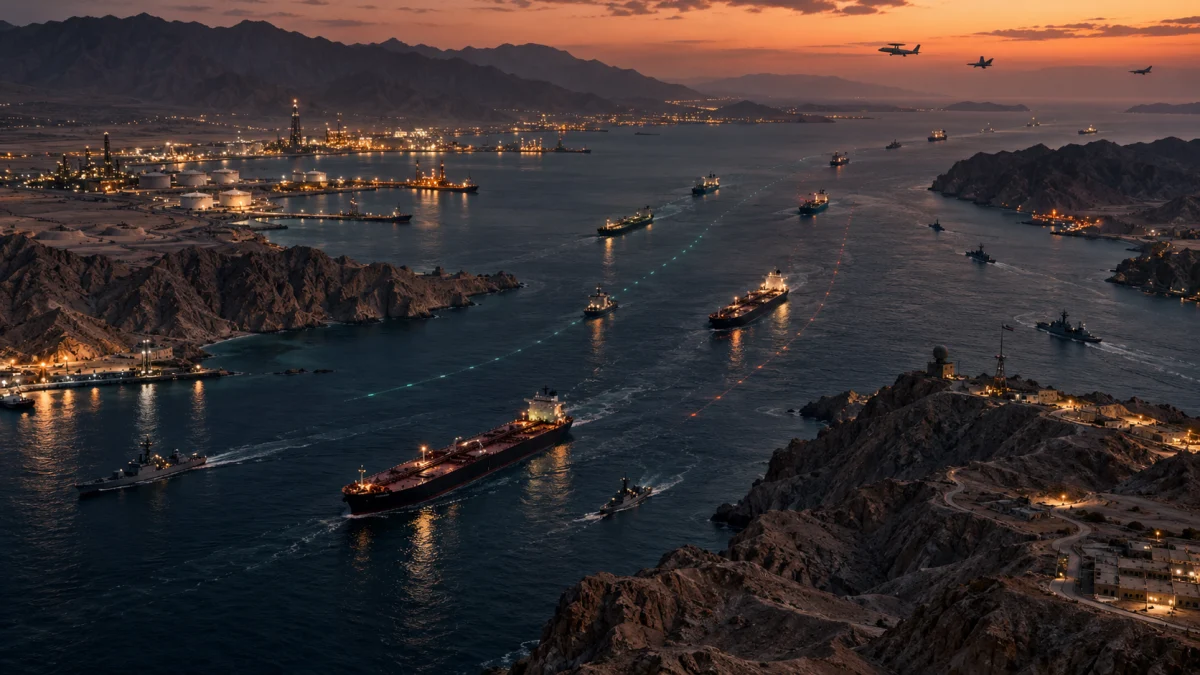
The Strait of Hormuz did not cause the 2026 war with Iran. The 2026 war turned the Strait of Hormuz into a weapon.
That is the single most important fact missing from a great deal of discussion about the shipping crisis.
On February 28, 2026, the United States and Israel launched large-scale coordinated military attacks inside Iran. Iran then retaliated across the region and moved to disrupt one of the few pieces of geography capable of imposing immediate economic costs on the United States and its allies: the Strait of Hormuz.
The sequence is not a matter of interpretation. In his February 28 briefing to the U.N. Security Council, Secretary-General António Guterres described U.S. and Israeli strikes against Iran first and Iran’s attacks across the region as subsequent retaliation. He also noted that U.S.-Iran nuclear negotiations mediated by Oman had already completed a third round and that additional technical and political talks were being prepared when the attacks began. The U.N. record is explicit about that chronology.
The United States later told the Security Council in its own Article 51 notification that it "commenced combat operations" on February 28 in cooperation with Israel. The U.S. letter invoked self-defense as Washington’s legal justification.
That does not mean every Iranian action that followed was lawful. It was not. Neutral commercial ships and civilian seafarers do not become legitimate targets merely because Iran was attacked. International maritime law also places strong limits on the ability of any coastal state to obstruct passage through an international strait.
But a legal judgment about Iranian attacks is not a license to rewrite the chronology.
If the question is "Why is the Strait of Hormuz closed?", beginning the story with Iran attacking ships is beginning in the middle.
The short answer
Iran is restricting and threatening shipping through the Strait of Hormuz because the waterway became one of Tehran’s most powerful forms of leverage after the United States and Israel attacked Iran on February 28.
For Iran, the logic is strategic: the United States possesses overwhelming conventional military power, but Iran sits beside a chokepoint through which, before the war, roughly 21 million barrels per day of oil and petroleum liquids moved. U.S. Energy Information Administration data put Hormuz oil flows at 20.9 to 21.6 million barrels per day through 2025. Large volumes of liquefied natural gas also use the route.
Iran cannot match the United States carrier for carrier or aircraft for aircraft. It can, however, make a war in the Persian Gulf economically painful for countries thousands of miles away.
That explains the strategy.
It does not automatically legalize attacks on merchant vessels or give Iran an unlimited right to suspend international navigation.
Those are separate questions, and treating them as the same question is one reason so much commentary about Hormuz becomes confused.
What happened first: the February 28 attack
The cleanest way to understand Hormuz is to rebuild the timeline.
The United States and Iran were negotiating over Iran’s nuclear program through Omani mediation. According to the U.N. Secretary-General, three rounds of indirect talks had taken place, technical talks in Vienna were being prepared, and another political round was expected.
Then, on February 28, the United States and Israel attacked Iran.
Guterres told the Security Council that approximately 20 Iranian cities had reportedly been struck and that Iran subsequently attacked Israel, U.S. assets, and several Gulf states. He also reported, on that same first day, that Iran was moving to close the Strait of Hormuz.
The United States did not tell the United Nations that Iran had attacked the United States on February 28 and that Washington was simply returning fire. Its later Article 51 letter said that the United States commenced combat operations that day and defended the campaign as necessary self-defense against what it characterized as attacks and ongoing Iranian threats.
That distinction matters.
Iran had a long history of confrontation with the United States, support for armed groups that had attacked U.S. forces, missile and drone capabilities threatening American installations, and a nuclear program that had generated serious international concern. None of that is irrelevant.
But neither is it the same thing as establishing that Iran launched an armed attack requiring the United States to begin a new large-scale war on February 28.
Israel was not incidental to the U.S. decision
This is where a great deal of American political discussion becomes strangely evasive.
Israel was not a random partner that happened to join an independently inevitable American war. Israel had its own longstanding strategic objective of severely weakening Iran, its missile forces, its nuclear infrastructure, the Revolutionary Guards, and ultimately the political system that supported them.
Prime Minister Benjamin Netanyahu had publicly argued for years that Iran represented an existential threat to Israel. On February 28, he announced the new campaign as a joint Israeli-American operation aimed at ending the threat from the Iranian government. His opening statement described Israel and the United States as embarking together on the campaign.
Reporting after the war began showed something more important than rhetorical alignment.
The Washington Post reported that Netanyahu had conducted a months-long campaign to convince President Donald Trump to attack Iran. It also reported that Secretary of State Marco Rubio’s early explanation of the timing acknowledged that Israeli intentions were part of the immediate calculation. The Post’s reporting described Israel as a central driver of the timing and political path to war.
Rubio later disputed the claim that Israel had "forced" the United States to act. His explanation is worth reading carefully rather than reducing it to a slogan.
In a March 2 exchange, Rubio said U.S. officials were aware of Israeli intentions and understood that an Israeli attack would create consequences for American forces in the region, requiring Washington to be prepared to act. He simultaneously insisted that the United States believed an operation against Iran "needed to happen no matter what." The CNN transcript preserves Rubio’s full explanation.
That is evidence of two things at once.
First, Israel’s planned attack materially affected the timing and U.S. operational decision-making.
Second, the Trump administration claims it had independent reasons for wanting to attack Iran.
We should not erase either fact.
But there is another piece of evidence that makes the administration’s "this would have happened anyway" narrative much harder to treat as established fact.
On March 17, National Counterterrorism Center Director Joe Kent resigned from the Trump administration and said directly that Iran posed no imminent threat to the United States and that the war had begun because of pressure from Israel and pro-Israel political forces in the United States. Axios published Kent’s resignation and his stated reasons.
Kent’s accusation is not, by itself, proof of every causal claim he made. It was the judgment of a senior official resigning in protest.
But combined with Netanyahu’s lobbying, Rubio’s acknowledgment of Israeli intentions, the absence of a publicly demonstrated imminent Iranian attack, and the fact that negotiations were still underway, the record supports a conclusion stronger than the sanitized version often presented to the public:
Israel’s strategic campaign against Iran was a central catalyst for the February 28 war, and the United States made a sovereign decision to convert that campaign into a joint American-Israeli war.
It is important to phrase the last part correctly.
The United States was not an automaton. Israel did not possess legal authority to order the U.S. military into Iran. President Trump and the American government were responsible for their own decision.
For the same reason, it is not possible to prove the literal counterfactual that "the United States would never have attacked Iran if Israel had no strategic interest there." History does not give us a second February 28 in which Israel stays home.
What the evidence does show is that Israel’s strategic objective, Netanyahu’s lobbying, and the expected Israeli attack were central components of the path to U.S. entry. Presenting the American war as though it arose independently of Israel’s confrontation with Iran is not supported by the record.
Did the United States have a lawful basis to start the war?
Washington says yes.
The U.S. Article 51 letter to the Security Council said the February 28 combat operations were undertaken in self-defense to protect American forces, maritime commerce, and regional allies from Iran and its proxies.
That is the formal U.S. position and should be taken seriously enough to evaluate.
The problem is that Article 51 is not a general authorization to attack a country because it has dangerous weapons, hostile intentions, a history of supporting armed groups, or the potential to become harder to attack later.
Under the U.N. Charter, states are prohibited from using force against another state’s territorial integrity or political independence except in narrow circumstances, principally Security Council authorization or lawful self-defense.
There was no Security Council authorization for the February 28 operation.
The legal dispute therefore turns heavily on whether the United States could establish the armed attack, continuing attack, or sufficiently imminent attack necessary to justify the scale of force it used.
Publicly available evidence has left that claim on weak ground.
A March analysis by Just Security concluded that the U.S. Article 51 justification did not persuasively establish the legal predicates for the war. Other international-law analyses reached similar conclusions.
Even the administration’s explanations shifted.
The White House initially emphasized an "imminent nuclear threat," ballistic missiles, proxies, and Iranian military capabilities. Rubio emphasized the danger that American forces could be struck after Israel attacked. Trump also argued that Iran had to be hit before it became effectively immune from attack.
Those arguments may explain why U.S. officials thought war was strategically desirable.
They do not all answer the narrower legal question: What armed attack made a massive U.S. attack on Iran lawful on February 28?
That is why the claim that the war was unlawful under the U.N. Charter cannot simply be dismissed as Iranian propaganda. There is a serious and substantial international-law case that the United States and Israel initiated an unlawful use of force.
At the same time, that conclusion does not make every Iranian response lawful. Self-defense has limits. Force must still satisfy necessity and proportionality, and international humanitarian law continues to protect civilians and civilian objects.
Iran’s attacks on Gulf states and merchant shipping do not become legal because Iran was attacked
This distinction is essential.
Iran had a much stronger legal argument for defending itself after being attacked than it would have had if it initiated the war.
But the right of self-defense is not a blank check.
Iranian strikes that unlawfully targeted civilian objects, struck states not legally responsible for the initial attack, or deliberately attacked civilian merchant ships cannot be excused simply by pointing to February 28.
The U.N. Secretary-General condemned both the U.S.-Israeli attack and Iran’s subsequent attacks across the region.
That is not false balance. It is how the law works.
A state can be the victim of an unlawful war and still commit unlawful acts while responding to it.
Likewise, a country can correctly condemn Iranian attacks on civilian shipping while still being dishonest if it describes the shipping crisis as an inexplicable act of Iranian aggression detached from the war that preceded it.
Why Hormuz became Iran’s weapon
The Strait of Hormuz is unusually powerful geography.
It connects the Persian Gulf to the Gulf of Oman and the Arabian Sea. At its narrowest, Iran lies on the northern side and Oman on the southern side. Much of the petroleum exported by Saudi Arabia, the United Arab Emirates, Kuwait, Iraq, Qatar, and Iran itself must either pass through or be diverted to more limited pipeline and alternative-port capacity.
Before the war, EIA data show that roughly 21 million barrels per day of crude oil, condensate, and petroleum products moved through Hormuz. LNG flows were also enormous.
That means an Iranian missile battery, minefield, drone unit, coastal radar site, patrol force, or credible threat to tankers can affect insurance markets and fuel prices far beyond the Gulf.
This is asymmetric power.
The United States can destroy Iranian military infrastructure from aircraft, submarines, bombers, ships, satellites, and bases across the region.
Iran cannot respond symmetrically.
Hormuz gives it another option: make continued war expensive for everyone.
That is coercion. It is also why Iran’s behavior is described as "holding the world to ransom."
But the description becomes selective when it treats Iranian economic coercion as uniquely illegitimate while treating bombing, blockade, sanctions, military encirclement, and destruction of infrastructure as though those are somehow non-coercive tools.
They are all forms of leverage. Their legality depends on different rules. Their morality depends on consequences and circumstances. But they are coercive instruments nonetheless.
Can Iran legally close the Strait of Hormuz?
As a general rule, no.
The Strait of Hormuz is a strait used for international navigation. Under the United Nations Convention on the Law of the Sea, ships and aircraft enjoy a right of transit passage through such straits.
Article 44 of UNCLOS states that countries bordering an international strait "shall not hamper transit passage" and that "there shall be no suspension of transit passage."
The International Maritime Organization has repeatedly reaffirmed that navigational rights through international straits cannot simply be denied or suspended. In July, the IMO Council specifically condemned attacks on civilian commercial ships around Hormuz and reaffirmed that transit passage should not be threatened, impeded, denied, hampered, impaired, or suspended.
There is a legal complication.
Iran signed UNCLOS but never ratified it. Tehran has historically disputed whether every element of UNCLOS’s transit-passage regime binds it in exactly the same way as a treaty party.
That dispute matters at the margins.
It does not create a generally accepted legal right for Iran to close an international shipping chokepoint at will.
So the responsible answer is:
Iran has an understandable strategic reason for using Hormuz as leverage in a war. That is not the same thing as possessing an unrestricted legal right to stop neutral commercial traffic.
What the June U.S.-Iran memorandum actually said
This became even more complicated after the June ceasefire framework.
On June 17, the United States and Iran signed a memorandum of understanding intended to end military operations, remove the U.S. naval blockade, restore shipping, and open a new round of nuclear negotiations.
The text matters because both governments have since accused the other of violating it.
Axios published the full text as read by a senior U.S. administration official. Three provisions are especially important.
Article 1: stop the war
The two sides declared an immediate and permanent termination of military operations and agreed not to initiate new military operations or threaten or use force against one another.
Article 4: the United States was to remove its naval blockade
The United States agreed to begin removing its naval blockade immediately and fully end it within 30 days.
The same paragraph linked that process to restoration of prewar vessel traffic.
Article 5: Iran was to facilitate safe commercial passage
Iran agreed to use its best efforts to arrange safe commercial passage without charge for 60 days, remove technical and military obstacles, conduct demining, and restore traffic.
Article 5 also required Iran to conduct dialogue with Oman and other Gulf states over the future administration and maritime services in the Strait of Hormuz, consistent with applicable international law and coastal-state sovereign rights.
That language is significant.
It gave Iran real operational obligations and a formal role in postwar negotiations over the waterway.
It did not plainly hand Iran unilateral sovereignty over the entire Strait of Hormuz.
That distinction matters in the current dispute.
Iran does not control the whole Strait, and neither does Oman
The geography is bilateral.
Iran borders the northern side. Oman, through the Musandam Peninsula, borders the southern side.
After the June agreement, the International Maritime Organization developed an evacuation and transit framework involving both coastal states.
The IMO operational plan explicitly recognized two routing options:
- a northern route through Iranian waters, operationally coordinated by Iran;
- a southern route through Omani waters, operationally coordinated by Oman.
Vessels were permitted to choose between them after conducting their own risk assessments.
The IMO also made clear that it was providing a framework, not exercising sovereign control over the routes. Operational routing and maritime safety remained responsibilities of the relevant coastal state.
This is important because some current arguments flatten the June agreement into one of two inaccurate claims:
- "Iran controls Hormuz now."
- "Iran has no legitimate role in how Hormuz is administered."
Neither is right.
Iran is a coastal state with substantial sovereign rights and operational responsibilities on its side of the Strait.
Oman is too.
International shipping rights constrain both.
Why Iran objects to the southern route
Iran’s current position is that arrangements developed around the southern, Omani side of the Strait and U.S.-protected shipping routes violated the June memorandum and weakened the negotiated postwar framework.
That is the core of the dispute referenced by Iranian commentators when they talk about "Article 5."
The Iranian argument is not frivolous in the sense that Article 5 really did contemplate Iran-Oman negotiations over future administration and maritime services.
But Iran stretches the provision too far if it treats that language as a unilateral veto over commercial traffic through Omani waters.
The MOU does not say that Iran owns the southern route. It does not erase Oman’s sovereignty. It expressly frames future arrangements around applicable international law and the sovereign rights of the coastal states, plural.
So there is a real treaty-implementation dispute here.
There is not a textual basis for saying Iran was granted exclusive control over all Hormuz traffic.
Was Iran’s nuclear program legal?
This also requires a more precise answer than either side usually gives.
Under Article IV of the Nuclear Non-Proliferation Treaty, states parties possess an "inalienable right" to research, produce, and use nuclear energy for peaceful purposes, provided they comply with the treaty’s nonproliferation requirements. The NPT text is explicit on that right.
Therefore:
Iranian uranium enrichment is not automatically illegal merely because Iran is enriching uranium.
That is an important correction to rhetoric that treats any Iranian enrichment as inherently forbidden.
But the opposite statement — "Iran’s nuclear program was legal" without qualification — is too broad.
In June 2025, the IAEA Board of Governors adopted a resolution calling on Iran to remedy what it described as noncompliance with its safeguards agreement. The IAEA resolution cited unresolved safeguards questions and Iran’s obligations to provide information and access needed for verification.
Later, following Israeli attacks on Iranian nuclear facilities in June 2025, the IAEA lost much of its ability to conduct verification inside Iran. The agency’s September 2025 report documented the interruption of inspections and subsequent Iranian restrictions.
So the clean answer is:
Iran has a treaty right to peaceful nuclear technology. Enrichment is not itself prohibited by the NPT. But Iran had also been found in noncompliance with safeguards obligations, meaning it is inaccurate to describe every aspect of its nuclear program as fully compliant with international requirements.
"Closed" does not mean zero ships are physically passing through
By October 2026, another source of confusion is the word closed.
Iran continues to say the Strait will not fully reopen until the United States satisfies conditions Tehran says arise from the June memorandum. On October 4, Parliament Speaker Mohammad Bagher Ghalibaf said Iran would not reopen Hormuz until its seven conditions were met. Current reporting describes active indirect diplomacy but no final settlement.
Yet ships are moving.
Crude exports had recovered dramatically by September. Reporting based on shipping data put crude flows at roughly 16.5 million barrels per day, close to prewar levels, before a renewed series of late-September and early-October attacks again disrupted traffic. The Guardian reported the September recovery and the continuing weakness in refined-product flows.
That means "closed" should not be read as a physical wall across the Strait.
In practice, the waterway is militarized, selectively passable, contested, dangerous, and politically unresolved.
Tankers may move under escort, through alternative routing arrangements, after coordination with coastal authorities, or through risk-managed convoy and transfer systems.
Other vessels stay away because insurers, owners, crews, or charterers judge the risk unacceptable.
That is still an enormous disruption to a waterway that normally functions as routine global infrastructure.
Why the Strait is still contested in October 2026
The June MOU did not produce a durable settlement.
The war continued. Each side accused the other of violating the agreement. The shipping framework broke down, attacks resumed, and the Strait became entangled again with nuclear negotiations, sanctions, U.S. naval operations, Iranian security demands, and broader regional fighting.
As of early October, mediators are again trying to assemble a package that would link reopening Hormuz with U.S. steps on blockades and sanctions and Iranian concessions involving nuclear inspections and related issues. Associated Press reporting describes the current mediation and the major remaining disagreements.
The United States has rejected Iran’s latest proposal as insufficient and has threatened renewed bombing. Iran says it is prepared to negotiate but is also prepared to fight.
That is why the shipping problem cannot be separated from the war.
The Strait is not a random piracy problem that happened to appear beside Iran.
It is now one of the principal bargaining instruments in an unresolved U.S.-Iran conflict that the United States and Israel chose to escalate into open war on February 28.
So is Iran "holding the world to ransom"?
In one sense, yes.
Iran is deliberately exploiting the vulnerability of global trade to pressure adversaries into changing their behavior.
That is coercion.
If Iran attacks civilian merchant shipping unlawfully, those attacks should be condemned as unlawful without euphemism.
But the phrase becomes analytically useless when it is applied only to Tehran.
The United States has used military strikes, a naval blockade, economic sanctions, asset restrictions, overwhelming naval power, and the threat of renewed bombing to compel Iran to change its conduct.
Israel has used air power, assassination, attacks on military and state infrastructure, and a broader campaign to degrade or potentially transform the Iranian regime.
Those are also forms of coercive pressure.
The important legal and moral questions are which actions are lawful, against whom, for what purpose, and at what cost to civilians.
It is not serious analysis to describe one side’s leverage as "ransom" while treating another side’s bombs and blockade as though they are merely background conditions.
The question journalists should ask before "What right does Iran have?"
A journalist is absolutely entitled to ask:
What right does Iran have to interfere with international shipping?
It is a legitimate question, and Iran does not have an unlimited legal right to close the Strait.
But if that question is asked as though Iran suddenly woke up and decided to menace global trade, it produces a badly distorted picture.
The preceding questions are:
Why is there a war?
Who launched the February 28 attack?
What threat did the United States claim required it to begin combat operations?
How strong was the evidence for an imminent threat?
Why was Israel pressing for the operation?
Why did Washington join it while negotiations were still active?
What does the June ceasefire agreement require from the United States as well as Iran?
Only then does the question about Iranian conduct have its proper context.
Context does not absolve Iran.
It prevents the rest of us from being misled about cause and effect.
Bottom line
The Strait of Hormuz is contested because a regional confrontation was turned into an open U.S.-Israeli war with Iran.
The United States and Israel launched the February 28 strikes. Iran retaliated. Tehran then used the world’s most important oil chokepoint as asymmetric leverage against adversaries that overwhelmingly outgun it.
Israel’s strategic interests were central to the path to that war. Netanyahu had pressed Trump to attack Iran, U.S. officials knew Israel intended to strike, and the expected consequences of Israeli action were part of Washington’s immediate decision-making. A senior U.S. counterterrorism official subsequently resigned while arguing that Iran posed no imminent threat and that Israeli pressure had pulled the United States into war.
The Trump administration disputes the claim that Israel caused the war and says the United States had independent reasons to attack Iran. That claim must also be recorded.
What cannot responsibly be presented as settled fact is the unknowable counterfactual that the United States certainly would or certainly would not have attacked Iran in a world where Israel had no strategic interest in doing so.
What can be said, based on the record, is stronger than the sanitized version:
The United States chose to join and greatly expand a war that aligned with longstanding Israeli strategic goals at a moment when diplomacy with Iran was still active and no publicly demonstrated imminent Iranian attack on the United States had been established.
That decision does not make every Iranian response lawful.
Iran does not gain an unlimited right to attack merchant ships. Civilian seafarers are not bargaining chips. International transit rights do not disappear because Tehran has been attacked.
But neither does condemning Iran require pretending that the shipping crisis appeared from nowhere.
If the United States and Israel had not begun the February 28 war, there is no factual basis for describing the current Hormuz crisis as though the same chain of events simply would have occurred anyway.
The Strait did not start this war.
The war made the Strait a battlefield.
References and Further Reading
War chronology and U.S. legal position
- U.N. Secretary-General: Remarks to the Security Council on the situation in the Middle East, February 28, 2026 — Primary U.N. chronology identifying the U.S.-Israeli strikes, subsequent Iranian retaliation, the emerging Hormuz closure, and the Oman-mediated negotiations underway when the war began.
- United States Article 51 letter to the U.N. Security Council, S/2026/161 — The U.S. government’s formal international-law justification stating that Washington commenced combat operations on February 28 and invoking self-defense.
- Iran Article 51 letter to the U.N. Security Council, S/2026/106 — Iran’s contemporaneous legal position describing the U.S.-Israeli strikes as aggression and claiming a right of self-defense.
Israel, U.S. decision-making, and war aims
- PBS / Associated Press: Netanyahu’s February 28 statement announcing the joint campaign — Primary-adjacent transcript of Netanyahu’s opening explanation of Israel’s objectives.
- CNN transcript: Secretary Marco Rubio on Israeli intentions and U.S. timing — Rubio says Washington knew Israel’s intentions and had to prepare for the consequences while maintaining that the U.S. believed an operation was necessary independently.
- Axios: NCTC Director Joe Kent resigns over the Iran war — Records a senior U.S. counterterrorism official’s claim that Iran posed no imminent threat and that Israeli pressure was central to the war decision.
- Washington Post: U.S.-Israeli rift widens over the war’s endgame — Reporting on Netanyahu’s lobbying, differing U.S.-Israeli objectives, and disputes inside Washington over how the war began and where it should end.
International law and the Strait of Hormuz
- United Nations Convention on the Law of the Sea, Part III — Primary treaty text governing transit passage through straits used for international navigation, including Article 44’s rule against suspending transit passage.
- IMO Council: Protection of vital shipping lanes, July 13, 2026 — Reaffirms navigational rights and condemns attacks on civilian commercial shipping.
- IMO: Operational FAQs for the Strait of Hormuz evacuation plan — Explains the northern Iranian route, southern Omani route, coastal-state responsibilities, and operational framework.
- Just Security: Assessing the U.S. Article 51 justification for the Iran war — Detailed international-law critique of Washington’s stated self-defense rationale.
June memorandum and current negotiations
- Axios: Full text of the June 17 U.S.-Iran Memorandum of Understanding — The most complete public transcript of the agreement governing cessation of hostilities, the U.S. naval blockade, Hormuz shipping, and nuclear negotiations.
- Associated Press: Current U.S.-Iran mediation over Hormuz, September 2026 — Current reporting on efforts to link reopening of the Strait with U.S. and Iranian concessions.
- Al Jazeera: Iran says Hormuz will remain closed until its conditions are met, October 4, 2026 — Current Iranian position and state of the diplomatic dispute.
Energy and shipping data
- U.S. Energy Information Administration: Energy security and Strait of Hormuz flows — Authoritative oil and LNG transit data showing the scale of Hormuz traffic before and during the war.
- The Guardian: Crude exports through Hormuz largely return toward prewar levels, October 1, 2026 — Current shipping data showing recovery in crude flows alongside continuing disruption to refined products.
Iran’s nuclear program
- Treaty on the Non-Proliferation of Nuclear Weapons, Article IV — Primary treaty text establishing the right to peaceful nuclear research, production, and use subject to NPT obligations.
- IAEA Board of Governors Resolution GOV/2025/38 — Primary record of the Board’s finding concerning Iran’s safeguards noncompliance and required corrective actions.
- IAEA Report GOV/2025/50 — Documents the effect of the 2025 attacks on Iranian nuclear facilities and the subsequent breakdown of IAEA verification access.
Editorial currency note: This article reflects publicly available information through October 5, 2026. The military and diplomatic situation around the Strait of Hormuz is changing rapidly. Shipping volumes, routing arrangements, military deployments, negotiations, and the legal positions of the parties may change after publication.