
Yes—but “crypto insider trading” does not necessarily mean securities insider trading. Federal prosecutors can potentially pursue someone who trades crypto-related products using misappropriated confidential information even when they do not charge that the underlying cryptocurrency is a security.
That distinction is at the center of newly unsealed cases against former Robinhood engineers Hefu Chai and Huaisong “Jerry” Xiang.
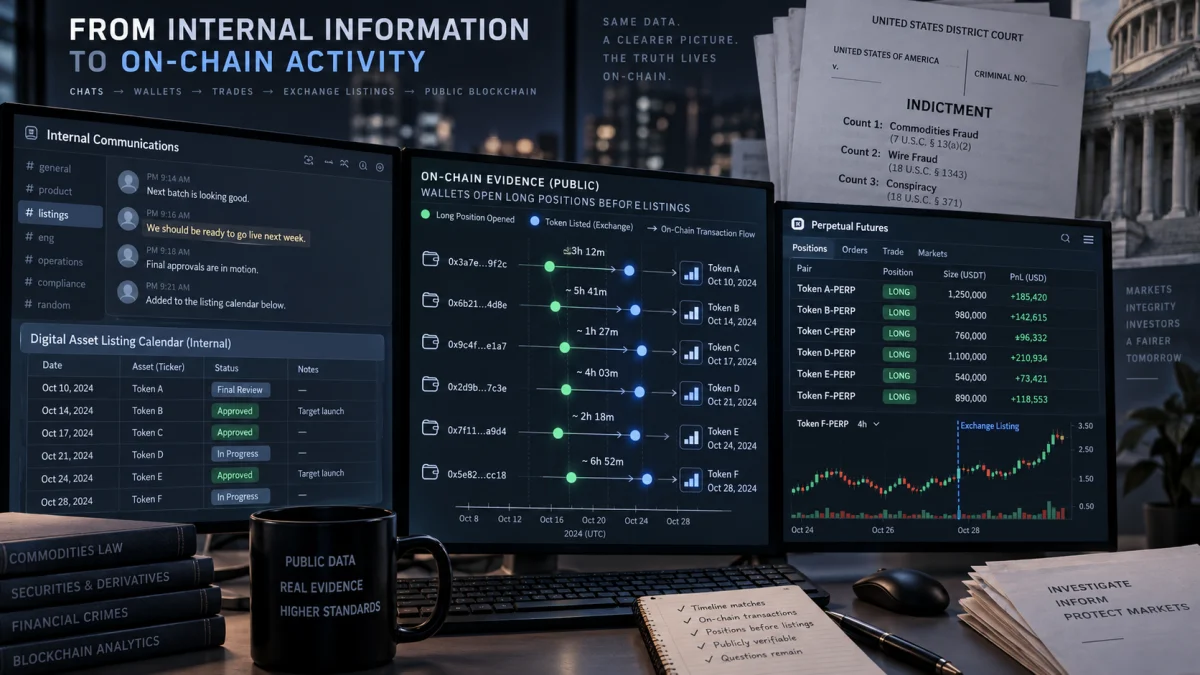
The criminal complaints unsealed by the U.S. Attorney’s Office for the Southern District of New York accuse the engineers of using confidential information about upcoming Robinhood Crypto listings to take long positions in perpetual futures on Hyperliquid before those listings became public. Each is charged with commodities fraud and wire fraud, not a conventional Securities Exchange Act insider-trading count. Prosecutors allege each earned more than $50,000.
The cases remain allegations. Chai and Xiang have not been convicted, and prosecutors will have to prove both the alleged trading scheme and the legal elements of the offenses. Xiang’s attorney told Forbes that his client denies the charges and will “vigorously defend” the case. No comparable public response from Chai was located as of publication. (Forbes)
But the evidence disclosed so far contains an unusual feature: months before the charges became public, an independent on-chain analyst identified the same Hyperliquid wallets and the same suspicious pattern of Robinhood pre-listing trades that later appeared in the federal complaints.
That does not independently prove who controlled the wallets or what information they possessed. It does, however, provide striking outside corroboration that the trading pattern itself was publicly observable well before prosecutors revealed their case.
What are Chai and Xiang actually charged with?
On September 15, 2026, federal prosecutors unsealed separate criminal complaints against Chai, 36, and Xiang, 30.
According to the DOJ announcement, both men worked as engineers involved in Robinhood’s digital-asset listing process and therefore had access to confidential information about which cryptocurrencies Robinhood planned to support and when.
The complaints charge each man with:
- one count of commodities fraud, under the Commodity Exchange Act and CFTC Rule 180.1; and
- one count of wire fraud, under 18 U.S.C. § 1343.
The maximum statutory penalties are 10 years for the Commodity Exchange Act count and 20 years for wire fraud, although statutory maximums are not predictions of any eventual sentence. (Department of Justice)
It is also important to describe the procedural posture accurately: these are criminal complaints, not convictions, and not an indictment disclosed by DOJ at this stage.
Why doesn’t the government have to prove the crypto tokens are securities?
Because the government is not prosecuting these cases solely under federal securities law.
The distinction matters.
The familiar version of insider trading involves Section 10(b) of the Securities Exchange Act and SEC Rule 10b-5. That framework applies to securities.
But Congress gave the Commodity Futures Trading Commission a separate antifraud authority covering certain commodity and derivatives transactions. Section 6(c)(1) of the Commodity Exchange Act prohibits manipulative or deceptive devices in connection with covered transactions including swaps and commodity transactions. CFTC Rule 180.1 implements that prohibition.
The CFTC has repeatedly taken the position that this includes misappropriating confidential information in breach of a pre-existing duty and then using it to trade for personal benefit.
In a 2026 enforcement advisory, the CFTC described that conduct directly as what is “commonly known as insider trading.” (CFTC)
So the crucial question is not simply:
Is this token a security?
It is also:
What instrument was traded, what federal law governs that instrument, how was the information obtained, and did the trader violate a duty by using it?
The Robinhood complaints allege that the Hyperliquid perpetual trades fall within the Commodity Exchange Act’s covered transactions.
That allegation still has to be established in court. The fact that prosecutors do not need to prove that the underlying tokens were securities does not eliminate questions about Commodity Exchange Act jurisdiction or the legal characterization of the perpetual contracts.
Commodity markets do not have a blanket ban on trading with nonpublic information
This is one of the most important distinctions the headlines tend to leave out.
Having information that the rest of the market lacks is not automatically illegal in commodity markets.
When the CFTC adopted Rule 180.1, it specifically recognized that derivatives markets have historically allowed participants to trade using material nonpublic information that they obtained lawfully.
What can turn the conduct into fraud is how the information was obtained or what duty the trader violated.
The CFTC has said Rule 180.1 can apply when someone trades using confidential information:
- in breach of a pre-existing duty of trust or confidence; or
- that was itself obtained through fraud or deception.
A federal court considering the CFTC’s misappropriation theory in CFTC v. EOX Holdings described the elements as including a breach of a pre-existing duty, intentional or reckless conduct, a covered commodity transaction and personal benefit. (Justia Law)
That makes Robinhood’s internal rules particularly important.
Robinhood’s own SEC filing confirms the trading restriction
The government’s description of Robinhood’s policy can be checked against Robinhood’s own public securities filings.
Robinhood’s December 2025 Confidential Information and Insider Trading Policy filed with the SEC identifies employees with direct knowledge of planned crypto listings or delistings as “Coin-Aware Individuals.”
The policy says these employees may not personally trade the affected crypto assets before the announcement or during the following 24 hours. It separately prohibits trading on material nonpublic information involving a crypto asset or a related financial instrument. (SEC)
That last phrase matters in this case because Chai and Xiang allegedly did not simply purchase the tokens.
They allegedly traded perpetual futures tied to them on Hyperliquid.
The policy also explicitly identifies contemplated crypto listings as potentially material information.
This independently establishes that Robinhood had a documented confidentiality and trading regime covering precisely the type of information and related instruments described by prosecutors. It does not, by itself, establish that either defendant violated it.
What prosecutors say Chai did
The criminal complaint against Hefu Chai says Chai worked for Robinhood from approximately 2021 until May 2026 and served as a technical lead responsible for new digital-asset listings.
According to prosecutors, that position gave him access to a private Robinhood Slack channel containing planned listing dates.
The complaint identifies three Hyperliquid wallets that investigators say they connected to Chai through transfers involving a cryptocurrency-exchange account registered in his name.
Prosecutors allege Chai used the wallets to establish long perpetual positions ahead of Robinhood listings on at least ten occasions during 2025 and January 2026. Examples identified in the complaint include:
| Token | Internal information alleged by DOJ | Alleged trade pattern |
|---|---|---|
| MEW / MOODENG | Chai allegedly learned May 21 that Robinhood planned a May 22 listing | Long perpetual positions opened May 22 before the public announcement |
| ASTER / XPL | Planned Oct. 16 listing allegedly disclosed internally Oct. 9 | Longs opened on listing day before announcement |
| HYPE | Planned Oct. 23 listing allegedly disclosed Oct. 16 | Long opened before public announcement |
| ENA | Planned Nov. 6 launch allegedly disclosed Oct. 31 | Long opened Nov. 6 |
| AERO | Planned Dec. 4 launch allegedly disclosed Dec. 1 | Long opened Dec. 4 |
| SYRUP | Planned Dec. 11 launch allegedly disclosed Dec. 5 | Long opened Dec. 11 |
| LDO | Planned Dec. 18 listing allegedly disclosed Dec. 15 | Long opened Dec. 18 |
| DOT | Planned Jan. 13 listing allegedly disclosed Jan. 9 | Long opened Jan. 13 |
| LIT | Planned Jan. 15 listing allegedly disclosed Jan. 9 | Long opened Jan. 15 |
Prosecutors allege the overall strategy generated more than $50,000 for Chai.
The chronology is important because the allegation is not based merely on the existence of profitable crypto trades. Prosecutors say Chai repeatedly received confidential listing information and then traded the corresponding products in advance of those listings.
If proved, the repetition would make an innocent-coincidence explanation progressively harder to sustain.
That is an inference from the alleged pattern—not proof by itself.
What prosecutors say Xiang did
The complaint against Huaisong “Jerry” Xiang says Xiang worked from Robinhood’s Manhattan office beginning around 2024 and remained employed until approximately September 2026.
Prosecutors describe one sequence involving POPCAT in unusual detail.
They allege that:
- Xiang learned on March 10, 2025 that Robinhood was considering listing POPCAT on March 13.
- On March 12, he transferred approximately 18 ETH—then worth about $34,000—to a Hyperliquid wallet prosecutors identify as 0x8081C8c38E6196a906CDa605444d66697E8BaCf9.
- Later that day, the private Robinhood channel allegedly confirmed a March 13 listing time.
- Xiang allegedly opened POPCAT perpetual longs the next day.
- He allegedly closed the position for a profit after POPCAT became tradable on Robinhood but before Robinhood’s public announcement.
Prosecutors say the same wallet was then used on at least ten additional occasions ahead of Robinhood listings between May 2025 and February 2026, including trades tied to MEW, MOODENG, ONDO and RENDER. They allege Xiang made more than $50,000.
Again, the wallet activity alone would not prove Xiang had inside information. The government’s case depends on combining the trading records with Robinhood’s internal communications and records allegedly tying the wallet to him.
The unusual part: these wallets were publicly flagged months ago
This is where the case becomes more interesting than an ordinary DOJ press release.
On February 26, 2026—nearly seven months before the charges were announced—a pseudonymous analyst writing as “arndxt” published an on-chain investigation into suspicious trading around Robinhood listings.
The analysis identified the exact wallet:
0x54838fecefbc608874726bebc90ffdf1cd2dbc7b
That is one of the wallets the federal complaint now alleges Chai controlled.
The February article also identified:
0xf01ec38c7e3aaa447d25e6e406319a4add647191
which is another wallet prosecutors now link to Chai.
And it separately flagged:
0x8081c8c38e6196a906cda605444d66697e8bacf9
which is the wallet federal investigators now attribute to Xiang.
The February 2026 on-chain analysis argued that the wallets repeatedly opened long positions shortly before Robinhood listings and often exited around the resulting price movement. It estimated approximately $18,845 of profit from one Chai-linked wallet, roughly $42,887 from another related wallet, and about $73,787 from the wallet now attributed to Xiang. (Threading on the Edge)
Those estimates are not government findings and sherafy.com has not independently reproduced every historical Hyperliquid trade underlying them.
But the overlap is difficult to dismiss as trivial.
The analyst identified the exact addresses months before the federal cases became public. DOJ later alleged, using private company records and cryptocurrency-company records unavailable to an ordinary blockchain observer, that those same addresses were controlled by Chai and Xiang.
What the public blockchain evidence does prove—and what it does not
The earlier analysis materially strengthens one part of the story:
The unusual pre-listing trading pattern was not invented retrospectively by prosecutors. It was visible on-chain in real time.
What it cannot establish by itself is equally important.
Public blockchain records generally show:
- wallet addresses;
- transfers;
- positions and transactions where the protocol exposes them;
- timing;
- amounts; and
- interactions with other addresses.
They ordinarily do not establish:
- the legal identity of the person controlling a wallet;
- what that person read in a private corporate Slack channel;
- whether another individual had access to the wallet;
- why a trade was placed; or
- whether the trader owed a confidentiality duty.
Those are precisely the gaps prosecutors attempt to fill with Robinhood records, exchange records and internal communications.
The combination is substantially stronger than either category of evidence standing alone, but those government-supplied links remain allegations until tested in court.
Why did some trades close before Robinhood announced the listing?
At first glance, this appears odd.
If the strategy was to profit from a Robinhood announcement, why would someone close the trade before the announcement happened?
The complaints offer an important explanation that much of the breaking coverage glosses over.
According to the FBI agent, a newly supported token can become available for trading on Robinhood up to roughly one hour before Robinhood publicly announces the listing.
Prosecutors say that actual availability can itself generate buying demand and upward price pressure before the public announcement.
That means the alleged informational advantage was not necessarily limited to knowing when a tweet or press release would appear.
Knowing when Robinhood would actually switch trading on could potentially be more valuable.
The complaints expressly cite this timing gap to explain why some alleged positions were closed before the corresponding public announcement.
Did the defendants allegedly use VPNs to get onto Hyperliquid?
The complaints do not say that.
This is an important distinction because some secondary coverage has already blurred it.
The FBI agent states that Hyperliquid was not approved by the CFTC to operate a U.S. futures market, that it geofenced U.S. IP addresses, and that people can bypass geographical restrictions using a VPN.
But the complaints, as currently written, do not specifically allege that Chai or Xiang used a VPN to access Hyperliquid.
The government’s description of how a geofence can be bypassed should therefore not be converted into a factual claim that either defendant actually did so.
How is this different from the Coinbase insider-trading case?
The closest major precedent is the prosecution of former Coinbase product manager Ishan Wahi.
In 2022, DOJ charged Wahi and others over a scheme involving confidential knowledge of upcoming Coinbase listings.
But the criminal prosecution itself used wire-fraud charges. Wahi eventually pleaded guilty to two counts of conspiracy to commit wire fraud. (Department of Justice)
The SEC separately filed a civil insider-trading action alleging that at least nine of the traded crypto assets were securities. (SEC)
That distinction was important because the wire-fraud prosecution did not require DOJ to win the broader argument that every crypto asset involved was a security.
The new Robinhood cases go a step further.
DOJ has again charged wire fraud, but this time prosecutors have also brought Commodity Exchange Act fraud charges based on the perpetual derivatives themselves.
That makes the case potentially important beyond Robinhood: it tests how established misappropriation principles apply when confidential information about a crypto listing is monetized not through the token itself, but through a decentralized derivatives venue.
Why is wire fraud charged too?
Wire fraud provides a separate federal theory.
The complaints allege that Chai and Xiang knowingly misappropriated valuable confidential business information, violated duties owed to Robinhood, and used electronic communications and transactions to obtain money or property from their trading counterparties.
That matters because federal fraud law is not limited to securities.
The Wahi Coinbase prosecution demonstrated that confidential crypto-listing information can support a criminal wire-fraud case without making the criminal case turn entirely on whether the purchased token qualifies as a security.
The Robinhood defendants can challenge the government’s application of the statute, of course. The complaints establish what prosecutors allege, not what a jury has found.
What does the government still have to prove?
Despite the striking chronology, several important questions remain open.
1. Did the defendants actually control the wallets?
For Chai, prosecutors say crypto-company records and transfers link three Hyperliquid wallets to an exchange account registered in his name.
For Xiang, they allege approximately 18 ETH moved from an account registered to him into the Hyperliquid wallet later used for the POPCAT trade.
Those are potentially powerful attribution facts, but the underlying KYC and exchange records have not yet been publicly litigated.
2. Were the trades actually based on Robinhood’s confidential information?
Timing can be compelling circumstantial evidence, particularly when a pattern repeats across many unrelated tokens.
But correlation is not itself proof of intent.
Prosecutors will need to establish the relationship between internal information received by the defendants and the trades they allegedly placed.
3. Was the information legally “material” and confidential?
Robinhood’s policy and the repeated market reaction alleged in the complaints support the government’s position that planned listings were material.
The defense remains free to contest how material a particular listing was or whether specific information had already become effectively public.
4. Do the Hyperliquid perpetual trades fall within the Commodity Exchange Act provisions charged?
This is one of the legally significant questions.
The government does not need to prove that each underlying token was a security.
But it still must establish the required connection between the allegedly deceptive conduct and a transaction covered by the Commodity Exchange Act.
The complaints expressly plead that connection; a complaint is not a final judicial ruling on it.
5. Can the government prove intent?
Rule 180.1 targets intentional or reckless deceptive conduct.
The government’s strongest circumstantial argument appears likely to be the alleged combination of:
confidential access → explicit trading prohibition → repeated positions in precisely the assets scheduled for listing → timing shortly before launch → repeated profitable exits.
If that chronology is proven substantially as alleged, it would provide a much stronger inference of knowing conduct than one isolated lucky trade.
The defense may dispute any or all links in that chain.
Was Robinhood itself accused of wrongdoing?
No.
The complaints portray Robinhood as the owner of the allegedly misappropriated information and thank the company for cooperating with investigators.
Robinhood said in a statement reported by Bloomberg and Forbes that it investigated the matter, reported it to law enforcement and regulators, and has “zero tolerance” for insider trading. (Yahoo Finance)
There is nevertheless a legitimate broader question about how trading patterns apparently persisted across numerous listings before the conduct was stopped.
The currently public record does not provide enough information to determine when Robinhood first detected the activity, when it began investigating, what surveillance systems detected it, or precisely when the government was contacted.
Those questions should not be filled in with speculation.
Is all crypto insider trading illegal?
No—not in the simplistic sense that anyone with better information is prohibited from trading crypto.
The more accurate answer is:
Trading crypto or crypto derivatives using confidential information can be illegal when the information was misappropriated, obtained through deception, or used in breach of a duty, and when the transaction falls within an applicable fraud statute or regulatory framework.
Different facts can produce different laws:
- securities laws may apply if the instrument is a security;
- Commodity Exchange Act provisions may apply to covered commodities, futures or swaps;
- wire fraud can apply to qualifying fraudulent schemes using interstate or foreign communications;
- contractual, employment and state-law duties can also matter.
That is why “crypto isn’t a security” is not a universal defense to conduct commonly described as insider trading.
Nor does the opposite follow: the existence of nonpublic information does not automatically make a commodity trade illegal.
The source of the information, the trader’s duty, the instrument traded, intent and the governing statute all matter.
The most important evidence in this case may be the combination
Taken individually, most pieces of the public record have limitations.
A suspicious Hyperliquid wallet does not identify its owner.
A Robinhood employee’s access to listing information does not prove that employee traded.
A profitable position shortly before a listing could be coincidence.
An internal trading policy proves a duty but not necessarily a violation.
What makes the allegations substantially more significant is the claimed convergence of all four:
- Robinhood records allegedly show the defendants receiving confidential listing information.
- Robinhood’s independently filed policy shows that employees with this access were explicitly restricted from trading.
- Cryptocurrency-company records allegedly connect the defendants to the Hyperliquid wallets.
- Publicly visible blockchain activity shows repeated trades around Robinhood listings—and at least some of those exact wallets were publicly flagged months before the defendants were charged.
That cumulative pattern does not convert allegations into a conviction.
It does explain why this case deserves more scrutiny than a headline saying two employees simply “got lucky” trading meme coins.
And legally, it illustrates a broader point that is likely to matter increasingly as crypto markets overlap with derivatives, prediction markets and tokenized assets:
Federal insider-trading theories do not begin and end with the question “Is this a security?”
References and Further Reading
Primary Court and Government Records
-
United States v. Hefu Chai — Criminal Complaint — The sworn FBI complaint setting out the commodities-fraud and wire-fraud counts, alleged wallet attribution, Robinhood communications and examples of Chai’s alleged pre-listing trades.
-
United States v. Huaisong “Jerry” Xiang — Criminal Complaint — The corresponding complaint describing Xiang’s alleged POPCAT trade, Wallet-0x8081 and additional Robinhood listing trades.
-
U.S. Attorney’s Office, Southern District of New York — Two Robinhood Employees Charged With Fraud — DOJ’s September 15, 2026 announcement summarizing the charges and confirming that both cases remain allegations.
Robinhood Policies
- Robinhood Markets Confidential Information and Insider Trading Policy, updated December 2025 — SEC-filed company policy describing “Coin-Aware Individuals,” restrictions on crypto trading and treatment of related financial instruments.
Commodity Fraud and Insider-Trading Law
-
7 U.S.C. § 9 — Commodity Exchange Act antifraud provision — Statutory prohibition on manipulative or deceptive devices in connection with covered swaps and commodity transactions.
-
17 C.F.R. § 180.1 — CFTC prohibition on manipulative and deceptive devices — The principal CFTC rule invoked in the Robinhood complaints.
-
CFTC Enforcement Division Prediction Markets Advisory, 2026 — Recent CFTC guidance expressly describing misappropriation of confidential information in breach of a duty as conduct commonly known as insider trading.
-
CFTC v. EOX Holdings — 2021 federal district-court opinion — Judicial discussion of the CFTC’s misappropriation theory under Section 6(c)(1) and Rule 180.1.
Earlier Crypto Insider-Trading Precedent
-
DOJ — Ishan Wahi Guilty Plea in Coinbase Cryptocurrency Insider-Trading Case — Shows how federal prosecutors previously used wire fraud to prosecute misuse of confidential crypto-listing information.
-
SEC — Coinbase Crypto Asset Insider-Trading Action — The separate civil securities case in which the SEC alleged that at least nine of the traded crypto assets were securities.
Independent Reporting and On-Chain Evidence
-
February 2026 on-chain analysis identifying the wallets later cited by federal prosecutors — A pre-charge public analysis that identified the exact wallets later attributed by DOJ to Chai and Xiang and documented repeated trading around Robinhood listings. Its claims about identity were speculative at the time and should be distinguished from subsequent government allegations.
-
Forbes — Two Robinhood Employees Charged With Crypto Trading Fraud — Independent reporting containing Xiang attorney Robert Stahl’s denial and Robinhood’s response.
Editorial currency note: This article reflects the complaints, laws, public filings and reporting available as of September 16, 2026. Criminal complaints contain allegations rather than findings of guilt. Charges, legal theories and case status may change as the proceedings develop.