
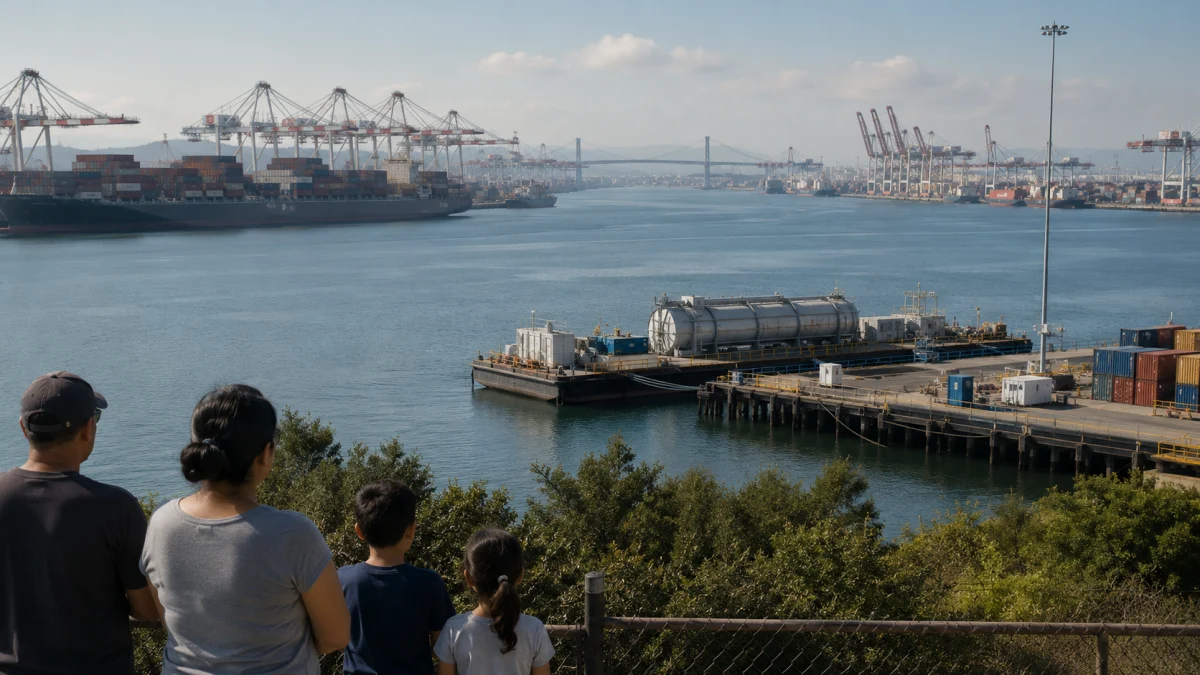
No fueled nuclear reactor has been approved to operate at the Port of Long Beach. But it would also be misleading to tell residents that nothing significant is happening.
Long Beach has already leased city-controlled Port property and submerged harbor space to Bluecore Energy for the development of prototype maritime reactor modules. The project currently authorized at Pier D/Berth D48 is explicitly non-nuclear in operation: California’s environmental filing describes an empty steel reactor vessel used to test sensors and controls, says no nuclear fuel will be used at the site, and states that nuclear-specific testing will occur at Idaho National Laboratory.
At the same time, the Port has become the first U.S. seaport to formally partner with the U.S. Maritime Administration on developing small modular nuclear reactors for maritime use, including possible port power and nuclear-powered commercial vessels. The July 22 agreement calls for cooperation with the Nuclear Regulatory Commission, Coast Guard and Department of Energy to develop safety standards, operational protocols and inspection procedures.
So the accurate answer is neither “Long Beach already has a nuclear reactor” nor “this is just theoretical research.”
Long Beach is becoming a real-world development site for maritime nuclear power. An operating reactor is still several major legal, regulatory and engineering steps away.
That distinction matters—especially for the people who actually live here.
What Has Actually Been Approved at the Port?
The first concrete step happened before most residents had ever heard the name Bluecore Energy.
On May 26, 2026, the Long Beach Board of Harbor Commissioners had Bluecore’s lease on its regular meeting agenda. The proposal covered part of the D48 warehouse, adjacent land and approximately 6,000 square feet of submerged land at Pier D. The lease allows a barge to be moored there and gives Bluecore an initial two-year term with an option for another three years.
The actual lease is more explicit than some of the public-facing language surrounding it. It says Bluecore wants the property for building, assembling and storing “prototype zero emission maritime reactor modules” and permits a barge to be moored for launching those modules.
But this is crucial: that lease is not permission to operate a fueled nuclear reactor.
The subsequent California Environmental Quality Act filing says the prototype consists of an empty steel vessel core. Engineers can install sensors and controls, place the module on a moored barge and collect data on how it behaves as the barge moves. The filing specifically says no nuclear fuel will be used and nuclear-specific testing will occur at Idaho National Laboratory.
That is the project currently covered by the Port’s environmental determination.
No, There Was Not a Full Environmental Impact Report
The Port determined that the current Bluecore project qualifies for categorical exemptions under CEQA for existing facilities and minor construction or conversion of small structures. It therefore concluded that no further environmental review was required for this project as described.
That fact deserves precision in both directions.
It would be misleading to say Long Beach used a minor CEQA exemption to approve a functioning nuclear power plant. It did not. The environmental filing being exempted describes a non-fueled steel prototype.
But it would be equally misleading to present that exemption later as though the environmental questions surrounding an actual operating reactor have already been answered.
They have not.
The current CEQA document does not analyze what would happen if nuclear fuel were brought into Long Beach Harbor. It does not provide an accident analysis for an operating floating reactor. It does not resolve spent-fuel storage, emergency planning, marine collisions, security, decommissioning or the consequences of placing an operating civilian reactor inside one of the busiest port complexes in the country.
Those simply are not the project being evaluated yet.
If Bluecore or the Port eventually seeks to put a fueled reactor into service here, residents should expect a new level of regulatory and environmental scrutiny appropriate to what would then be an entirely different project.
The Public Agenda Was Less Clear Than the Lease Itself
There is also a legitimate transparency question.
The May 26 Harbor Commission agenda described Bluecore’s project as involving “nonhazardous prototype zero emission maritime power modules.” The words nuclear and reactor do not appear in the agenda’s summary of the item.
The attached lease did use the word reactor.
That distinction is important.
This was not literally a secret approval. The Bluecore item was placed on the regular public agenda, the underlying lease was available as an attachment, and the meeting permitted public participation through the Port’s established comment procedures.
But a Long Beach resident casually reviewing an agenda to see what the Harbor Commission was considering would have seen “zero emission maritime power modules,” not a plain-language notice that the tenant was developing technology for floating nuclear reactors.
That is a fair transparency criticism without inventing a conspiracy.
The timing makes the sudden public attention easier to understand. Bluecore publicly announced that it was emerging from stealth on July 21—nearly two months after the Harbor Commission meeting—and announced that it had already delivered its first barge and what it calls an “electric test reactor” to its Port headquarters.
The next day, the Port and federal government announced their maritime nuclear partnership.
For many residents, the first time they are hearing about the project is therefore after the Port lease and the federal partnership are already in place.
That does not make the project illegitimate. It does make early and unusually clear public disclosure more important from here forward.
What Does Bluecore Eventually Want to Build?
Bluecore’s intended product is not merely a laboratory experiment.
The company says it is developing a 10-megawatt-electric water-cooled nuclear reactor mounted on a barge, with possible applications ranging from supplying electricity to ports and other infrastructure to eventually propelling cargo ships. Bluecore says multiple units could be combined where more power is needed.
Bluecore also describes multiple physical barriers, passive safety systems, shutdown systems and water-based cooling as elements of its design.
Those are company design claims, not an independent regulatory finding that a Bluecore reactor has been demonstrated safe for operation in Long Beach Harbor.
That distinction matters.
Bluecore itself says it is still advancing its engineering, regulatory, classification and commercialization pathways.
So when headlines say a nuclear reactor is being “built at the Port,” they compress several very different stages into one sentence.
A physical prototype is being developed.
A barge exists.
A future nuclear design is being developed.
A regulatory pathway is being pursued.
A fueled reactor has not been cleared to operate in Long Beach.
“Offshore Nuclear Reactor” Is Also a Misleading Description of What Exists Today
There is currently no operating nuclear reactor floating several miles off the Long Beach coastline.
The leased site is at Pier D/Berth D48 inside the Port of Long Beach, where Bluecore has access to warehouse space and submerged harbor property for a moored barge.
Bluecore’s eventual technology is designed to be movable on barges and could have offshore or coastal applications. But describing the current situation simply as an “offshore nuclear reactor” blurs the difference between the company’s eventual product and what is physically authorized in Long Beach today.
The thing in Long Beach right now is a non-fueled development prototype associated with a future floating-reactor concept.
The Federal Government Is Building the Rulebook While the Technology Advances
One of the most consequential facts in this story has received comparatively little attention.
The regulatory framework for civilian maritime nuclear power is itself still being worked out.
In May 2026, the Nuclear Regulatory Commission announced that it was beginning work on a white paper explaining how its existing licensing systems could apply to maritime nuclear applications—including floating nuclear power plants and nuclear propulsion. The NRC specifically referred to the “unique regulatory considerations” involved and held a public meeting to gather feedback.
Then came Long Beach.
The Port’s July agreement with MARAD says the agencies will work with the NRC, Coast Guard and Department of Energy to define the operational protocols, safety standards and inspection processes required for SMR-powered vessels.
Read that carefully.
The safety and regulatory framework is not something that has already been completed and merely needs to be applied to Long Beach. Developing that framework is part of the Long Beach partnership itself.
That does not mean maritime nuclear power is inherently unsafe.
It means claims that the regulatory questions have already been settled would be premature. Even the federal regulator is publicly working through how existing nuclear rules apply when the reactor is floating, moving or serving a maritime function.
For residents, that should increase—not decrease—the expectation of transparency.
California’s Nuclear Moratorium Is a Real Barrier
Perhaps the biggest obstacle is California law.
Some coverage has treated it as uncertain whether the state’s long-standing restrictions on new nuclear plants apply to small modular reactors.
California’s own energy agency is considerably less ambiguous.
The California Energy Commission’s adopted July 2026 Integrated Energy Policy Report states that SMRs “cannot be built in California” because of the state’s moratorium on new fission reactors. It later says that without repeal of the moratorium or establishment of a federally sanctioned high-level nuclear-waste disposal pathway, “SMRs cannot be installed in California.”
California Public Resources Code §25524.2 establishes the underlying high-level-waste condition. It prevents a new nuclear fission thermal power plant from being permitted as land use or certified by the Energy Commission until the state determines that the United States has approved a demonstrated means for permanent disposal of high-level nuclear waste and the statutory process that follows has been completed.
A related provision addresses fuel reprocessing and storage conditions.
Putting a reactor on a barge may eventually generate complicated questions over state, federal and maritime jurisdiction. But nothing in the official material reviewed for this article establishes that placing the reactor on a barge automatically bypasses California’s nuclear restrictions.
More importantly, the California Energy Commission’s current published position is straightforward: SMRs cannot currently be installed in California.
That is a much bigger obstacle than many of the headlines suggest.
Why Is the Port Interested in Nuclear Power at All?
There is a legitimate problem underneath the proposal.
Long Beach is simultaneously attempting to expand cargo capacity and eliminate emissions from port operations. The Port expects dramatically higher electrical demand as trucks, cargo-handling equipment, terminals and ships become increasingly electrified, while its long-term plans call for roughly doubling container throughput by 2050.
And the air-pollution issue is not abstract to the people who live around the ports.
South Coast AQMD has documented how heavy-duty freight traffic associated with the Ports of Long Beach and Los Angeles travels through surrounding neighborhoods and exposes residents to harmful air pollutants. Wilmington, Carson and West Long Beach have specifically identified truck pollution as a community air-quality priority.
The Port has made substantial progress reducing diesel particulate matter and other pollutants over the past two decades, while continuing to spend heavily on zero-emission equipment and infrastructure.
So residents do not benefit from pretending Long Beach has no energy problem.
It does.
A cleaner source of reliable electricity capable of replacing combustion is potentially valuable—especially to communities that have spent decades breathing the consequences of the freight economy.
But that is not a blank check for any technology presented as “zero emission.”
Solving one environmental problem does not exempt a project from demonstrating that it will not create another unacceptable public risk.
This Should Not Become a Generic “Nuclear Good vs. Nuclear Bad” Argument
That framing would be a mistake.
A resident does not need to decide whether nuclear power is morally good or bad in the abstract.
The relevant question is much narrower:
Has this specific reactor, at this specific location, under this specific regulatory structure, demonstrated that its safety, waste, emergency-response, security, financial and environmental risks are acceptable to the people being asked to live beside it?
That standard should apply whether the proposed infrastructure is nuclear, hydrogen, battery storage, oil, natural gas or anything else capable of producing serious consequences when something goes wrong.
And because local residents carry the consequences while developers and government agencies receive many of the institutional benefits, the burden of demonstrating safety should remain with the project proponents.
Residents should not be expected to prove a reactor is dangerous before officials explain why it is safe.
What Long Beach Residents Should Get Answers to Before Any Reactor Is Fueled
Before this moves from prototype development to actual nuclear operation, residents deserve clear public answers to questions including:
- Where exactly would a fueled reactor operate? The accident analysis should address earthquakes, tsunami and flooding hazards, ship or barge collisions, fires, loss of cooling, extreme weather and other conditions specific to a major working harbor.
- What reactor design is actually being proposed, and what has the NRC independently concluded about it? Company safety claims and regulatory safety findings are not the same thing.
- What happens during an emergency? Residents should know which agency has command authority, what Long Beach Fire and emergency services would be expected to do, whether evacuation or sheltering plans are contemplated and how surrounding workers and neighborhoods would be notified.
- Where does the spent nuclear fuel go? California’s existing nuclear-waste problem is the reason the state moratorium exists. A floating reactor does not make spent fuel disappear.
- How will physical and cybersecurity be handled? A civilian reactor inside a strategically important commercial port creates security questions that deserve specific answers rather than generic assurances.
- Who carries the financial liability? Residents should know who pays for an accident, contamination, disabled reactor, barge recovery, decommissioning, long-term waste handling and site restoration—and whether taxpayers or the Port would ultimately carry any residual risk.
- What independent environmental review and public process will occur before nuclear fuel enters Long Beach? The current categorical exemption covers a non-fueled prototype. It should not become a substitute for evaluating a future operating reactor.
- How does the proposal compare with alternatives? Nuclear should be compared honestly with grid upgrades, renewable generation, energy storage, geothermal, demand management and other sources on reliability, lifecycle cost, environmental impact and public risk—not simply marketed as the inevitable answer.
Those are not anti-nuclear questions.
They are the minimum questions a community should ask before placing a new class of nuclear facility next to where people live and work.
So Is Long Beach Really Going Nuclear?
Not yet. But the groundwork is real.
As of August 18, 2026:
Long Beach does not have an operating floating nuclear reactor.
The Bluecore equipment currently authorized at the Port contains no nuclear fuel.
But the Port has leased Bluecore physical space specifically for maritime reactor-module development.
Bluecore intends eventually to commercialize nuclear reactors mounted on barges.
And the Port has entered a first-of-its-kind federal partnership designed to help establish the rules under which civilian maritime nuclear systems could operate in U.S. ports and aboard commercial vessels.
Meanwhile, the NRC is still working out maritime-specific regulatory questions, and California’s own Energy Commission says current state law prevents SMRs from being installed in California.
That is where the story actually stands.
For Long Beach residents, the important moment is now, not the day a fueled reactor eventually arrives.
There is nothing inherently unreasonable about studying new ways to produce clean, reliable energy for a port that desperately needs it. But there is also no reason the community should simply trust a startup, a port authority or the federal government to resolve unprecedented safety and regulatory questions behind the scenes and report back after the institutional momentum has become difficult to reverse.
The sensible position is neither panic nor blind reassurance.
It is scrutiny.
If Long Beach is going to become America’s proving ground for civilian maritime nuclear power, the people who live here should be part of proving that it is safe—not merely informed after the decisions have effectively been made.
References and Further Reading
Port of Long Beach — Primary Local Records
Port of Long Beach Board of Harbor Commissioners — May 26, 2026 Meeting Agenda — The official agenda for the meeting at which the Harbor Commission considered and approved Bluecore Energy’s lease. Item 23 describes approximately 10,000 square feet of warehouse space, adjacent land, submerged land, a barge berth and the building, testing and storage of what the agenda called “prototype zero emission maritime power modules.” The agenda also records the Port’s determination that the action qualified for categorical exemptions from further CEQA review.
California CEQAnet — Bluecore Energy, Inc.; New Lease TR-26-06, Harbor Development Permit No. 26-019 — The most important record for understanding what has actually been authorized at Long Beach. The Port’s Notice of Exemption says Bluecore’s current prototype is an empty steel reactor vessel, may be tested aboard a moored barge, will contain no nuclear fuel at the Port, and will have its nuclear-specific components tested at Idaho National Laboratory. It also documents the CEQA exemptions used for the present project.
Port of Long Beach — “Port of Long Beach, MARAD Sign First-of-its-Kind Partnership Agreement on Nuclear Energy in Maritime” — The Port’s official July 22 announcement of its federal maritime-nuclear partnership. It confirms that Long Beach became the first U.S. seaport to formalize this type of cooperation with MARAD and says the parties intend to work with the NRC, Coast Guard and Department of Energy on operational protocols, safety standards and inspection processes. Importantly, the Port also states that the agreement is nonbinding and does not itself commit either party to funding, procurement or adoption of a particular reactor technology.
Federal Maritime and Nuclear Regulatory Records
U.S. Maritime Administration — “Port of Long Beach Sign Agreement to Test Nuclear-Powered Vessels” — MARAD’s account of the July 2026 agreement. The federal agency describes the effort as exploring SMRs, port microgrids, shoreside infrastructure and advanced vessel propulsion systems. This confirms that the broader federal initiative extends beyond Bluecore’s present non-fueled prototype.
Federal Register — “Development of a Commercially Viable System-Centric Small Modular Reactor Concept for Deployment in the Marine Transportation System” — MARAD’s May 7, 2026 Request for Information provides the broader federal policy context. It sought industry and public input on maritime SMR deployment, including liability, insurance, port acceptance, workforce requirements, standards and commercial viability. Those questions remain highly relevant to any future Long Beach deployment.
U.S. Nuclear Regulatory Commission — “Regulatory Considerations for Maritime Nuclear Applications” — NRC documentation showing that maritime nuclear regulation is still an active area of policy development. The agency began work in 2026 on a white paper explaining how existing licensing frameworks could apply to floating nuclear power plants and nuclear propulsion systems and specifically identified “unique regulatory considerations” associated with maritime deployment.
California Nuclear Law and Energy Policy
California Energy Commission — Adopted 2025 Integrated Energy Policy Report — California’s adopted July 2026 statewide energy-policy report. In its section on small modular fission reactors, the Commission states that SMRs cannot currently be built or installed in California because of the state’s moratorium on new fission reactors unless the legal conditions surrounding long-term nuclear-waste disposal are resolved or the law changes. This is the strongest current state-government source for the legal barrier discussed in this article.
California Public Resources Code § 25524.2 — High-Level Nuclear Waste Disposal Requirement — The central California statute restricting new nuclear fission power plants until the California Energy Commission determines that the federal government has approved a demonstrated means for the permanent disposal of high-level nuclear waste and the required legislative process has been completed.
California Public Resources Code § 25524.1 — Nuclear Fuel Reprocessing and Storage Requirements — The related state statute governing fuel-rod reprocessing and storage prerequisites for new nuclear fission power plants. Together, §§ 25524.1 and 25524.2 form the core of California’s longstanding restrictions on new nuclear generation.
California Legislature — AB 305 (2025–2026), Energy: Nuclear Facilities — Useful legislative context because this bill proposed exempting small modular reactors from portions of California’s existing nuclear restrictions. It died in the Assembly in January 2026, meaning that proposal did not become law.
Bluecore Energy — Developer Claims and Project Intent
Bluecore Energy — “Bluecore Energy Emerges from Stealth to Democratize Access to Zero-Emission Maritime Nuclear Energy” — Bluecore’s July 21, 2026 launch announcement. The company says it has delivered a barge and electric test reactor to its Port of Long Beach headquarters and intends to develop a 10 MWe water-cooled nuclear reactor mounted on a barge, initially for power generation and potentially later for ship propulsion. This is an interested-party source and is useful for documenting what Bluecore says it intends to build—not as independent verification that the reactor has been licensed, demonstrated safe or approved for nuclear operation in Long Beach.
Bluecore Energy — Floating Nuclear Power for Ports and Cities — Bluecore’s technical and marketing overview of its proposed system, including its claims regarding passive safety, water cooling, modularity and the ability to combine units for additional power. These descriptions should likewise be treated as developer claims pending independent regulatory review and technical validation.
Community and Environmental Context
South Coast AQMD — Wilmington, Carson and West Long Beach Community Emissions Reduction Plan: Neighborhood Truck Traffic — Provides essential context for why cleaner port energy is a legitimate public-interest issue rather than merely an industry talking point. The regional air-quality agency documents how freight traffic associated with the Ports of Long Beach and Los Angeles exposes surrounding communities to harmful pollutants and identifies heavy-duty diesel traffic as a major community air-quality concern.
Editorial Currency Note
Status current through August 18, 2026. This project sits at the intersection of Port governance, California nuclear law, federal maritime regulation and NRC licensing, all of which could change materially. In particular, future Harbor Commission actions, NRC filings, environmental-review documents, California legislation or federal regulatory decisions could alter whether and under what conditions a fueled maritime reactor could eventually operate in Long Beach.
The critical distinction should remain clear when updating this article: the Port has approved and leased space for Bluecore’s non-fueled prototype-development operation; that is not the same thing as regulatory approval to fuel and operate a nuclear reactor in Long Beach Harbor.