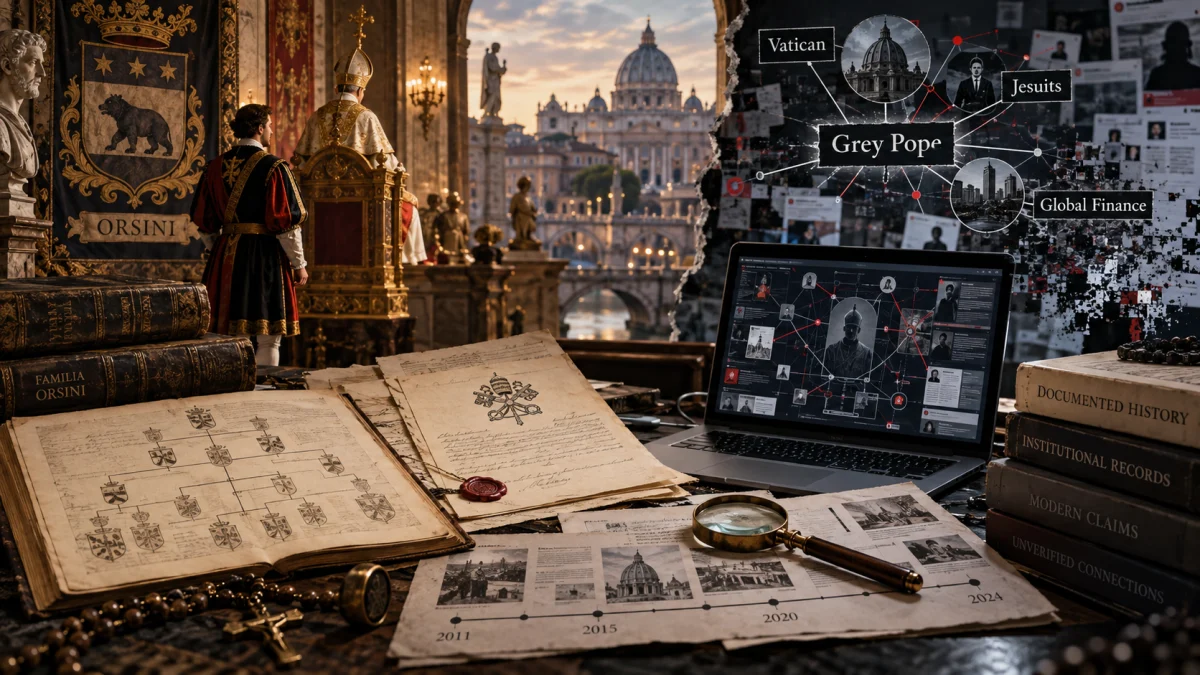
There is a real Prince Domenico Napoleone Orsini, and his family really was one of the most powerful dynasties in the history of Rome and the papacy. What we could not verify is the much larger internet story built around him.
We found no credible documentary evidence establishing that Domenico Napoleone Orsini is known as “Pepe Orsini,” holds an office called the Grey Pope, commands the pope or the Superior General of the Jesuits, controls the Rothschild or Rockefeller families, or secretly rules the world.
That does not mean every historical ingredient behind the story is fictional. Quite the opposite.
The Orsini family’s extraordinary historical power is well documented. The Jesuit superior general really has been nicknamed the “Black Pope.” A class of Roman aristocrats really was called the Black Nobility. And the Orsini really did hold one of the most prestigious hereditary positions in the old papal court.
Those true pieces are precisely what make the larger story sound plausible.
But when the specific “Pepe Orsini is the Grey Pope” claim is traced backward instead of repeated forward, a different picture emerges.
The earliest directly accessible webpage we found containing the characteristic modern claim is dated October 28, 2011. It names “PEPE ORSINI,” calls him “the Grey Pope,” and places him above the Jesuit “Black Pope.” The same page also describes “Reptoid/Greys,” secret Ptolemaic bloodlines and a hidden hierarchy controlling humanity. That page is useful as a provenance artifact, not as reliable evidence that the alleged hierarchy exists.
A July 2012 republication contains substantially the same material and links back to a now-defunct December 2011 “Vatican New World Order” post. It also contains an embedded line saying part of the source text was “Last Edited” on June 15, 2010. Because the original 2010 page has not been recovered and the edit marker does not establish which portions of the later text already existed at that date, we do not treat 2010 as a verified origin date for the Grey Pope claim.
The defensible conclusion is narrower:
The Pepe Orsini/Grey Pope narrative was circulating online by October 2011 at the latest, and perhaps earlier.
That distinction matters because the modern story is often presented as though many independent investigators uncovered the same hidden ruler. The source trail instead shows extensive recycling of a relatively small cluster of claims.
Who Is “Pepe Orsini” Supposed to Be?
Modern Grey Pope posts usually identify “Pepe Orsini” with Prince Domenico Napoleone Orsini, the contemporary head of the Gravina branch of the historic Orsini family.
Domenico Napoleone Orsini is real.
He is also not an entirely hidden person.
A June 2025 interview with Domenico Napoleone Orsini identifies him as head of the Gravina branch and discusses his family, upbringing, wife, children, grandchildren and cultural activities. An earlier 2006 interview in Il Tempo likewise presents him publicly under the name Domenico Napoleone Orsini.
The genealogical database Geneall lists Domenico Napoleone Orsini as the 22nd Duke of Gravina, born in 1948, son of Filippo Napoleone Orsini and Francesca Romana Bonacossi.
What these sources do not establish is equally important.
They do not call him Pepe Orsini.
They do not call him the Grey Pope.
They do not describe him as head of the Vatican.
And they do not document authority over the Jesuits, international banking families or national governments.
A 2025 German research project examining Vatican conspiracy narratives encountered the same identity problem. In its section on the “Grey Pope,” the researchers reported that they found no “Pepe Orsini” in the family’s genealogical records while documenting Telegram posts that simply asserted “Pepe Orsini” was an alias for Domenico Napoleone Orsini. The report is available in full as Verschwörungsmythen über den Vatikan.
That does not prove nobody has ever privately called Domenico “Pepe.”
It establishes a narrower evidentiary problem:
The people making the identification have not shown where the identification came from.
If the central character in a theory is said to operate under an alias, establishing that the alias belongs to the person is not a minor detail. It is step one.
The Orsini Family Really Was Extremely Powerful
This part should not be watered down.
The Orsini were genuinely one of the great political dynasties of medieval and early-modern Rome.
Treccani’s detailed history of the Orsini family describes them as one of the major families of Rome and Italy after the year 1000, distinguished by wealth, political power, royal connections, cardinals, military commanders and popes.
The family’s securely documented rise begins around the end of the tenth century. By the Middle Ages, the Orsini were central players in Roman politics and bitter rivals of the Colonna.
The family produced Pope Celestine III, Pope Nicholas III, and later Benedict XIII of the Gravina branch. Treccani also notes that some still earlier papal connections attributed to the family rest on tradition rather than secure documentation, an important distinction when dealing with a dynasty whose genealogy accumulated legends over many centuries.
The point is not that the Orsini were merely “connected.”
They possessed substantial political, territorial and ecclesiastical power.
But that historical fact does not automatically establish the modern claim.
“The Orsini were extraordinarily powerful” and “a living Orsini secretly commands the world” are separate propositions.
The second requires its own evidence.
Yes, the Orsini Really Did Stand Beside the Papal Throne
One historical fact sounds especially dramatic when stripped of context.
The Orsini held the dignity commonly translated as Prince Assistant to the Papal Throne.
This was not invented by conspiracy writers.
Treccani documents the dignity within the Orsini family’s history, and its biographies describe the Orsini and Colonna sharing this position at major papal ceremonies. A Treccani biography of Flavio Orsini, for example, explains that the dignity gave the Orsini and Colonna the right to sit in turn at the pope’s right during solemn ceremonies.
The Gravina branch inherited this position in the early eighteenth century.
The office was prestigious enough that a 1958 Time report on Filippo Napoleone Orsini, father of the present Domenico, described the Prince Assistant dignity as ranking immediately below a cardinal in ceremonial precedence.
That same report documented something that cuts against the idea of an untouchable hidden ruler: after a public personal scandal, the Vatican State Secretariat announced that Filippo Orsini would no longer fill the role and that Aspreno Colonna would perform it alone.
In other words, the documented institution did give an Orsini extraordinary ceremonial proximity to the pope.
It did not place the Orsini above the pope.
The Vatican Later Ended the Hereditary System
The most useful primary source here is not a modern fact-check.
It is the Vatican’s own law.
In 1968, Pope Paul VI issued Pontificalis Domus, reorganizing the old Papal Court into the modern Papal Household.
The document abolished the old designation “Principi assistenti al Soglio” from the Pontifical Chapel.
It retained a category called “Assistenti al Soglio” within the lay Papal Family, but it also specified their actual duties: assisting the prefect of the Apostolic Palace, performing honors at major civil ceremonies and helping with the orderly functioning of the lay Papal Family.
Most importantly, Paul VI wrote that all members of the Papal Household were appointed by the pope and explicitly declared:
“Nella Casa Pontificia nessuna carica è ereditaria.”
In English: No office in the Papal Household is hereditary.
That does not prove Roman aristocrats suddenly lost their social networks, wealth or informal influence.
It does tell us what happened to the actual institution sometimes invoked as evidence of an inherited secret papacy.
The documented office was part of the papal court.
Its documented duties were ceremonial and institutional.
And the hereditary system was expressly ended.
What Is the “Black Pope”?
The conspiracy narrative builds on another real term.
The Superior General of the Society of Jesus has long been nicknamed the “Black Pope.”
That nickname is not an official alternative papacy.
A Society of Jesus historical publication says the nickname appears to have been applied to the Jesuit superior general in nineteenth-century Rome, partly because of perceptions of his influence and the contrast between the Jesuit’s black clerical clothing and the pope’s white dress.
Arturo Sosa, the Jesuit Superior General elected in 2016, has publicly rejected the implication behind the nickname. In an interview published by Jesuits in Europe, Sosa said he disliked “Black Pope” because it suggested the Superior General possessed power comparable to the pope, which he said was not true.
So the conspiracy theory starts with two pieces that are easy to understand:
- the actual pope becomes the “White Pope”;
- the Jesuit Superior General becomes the “Black Pope.”
Then it adds a third figure above them:
- the “Grey Pope.”
What is missing is a corresponding institution.
We found no official Vatican or Jesuit office called the Grey Pope, no constitutional role resembling the alleged position, and no documented chain of command placing an Orsini above the pope or Jesuit Superior General.
The “Grey Pope” is the conspiracy theory’s title, not a documented Vatican office.
The “Black Nobility” Was Real Too
Another phrase in the Grey Pope story sounds far more mysterious today than it was historically.
Black Nobility, or aristocrazia nera, was a real term.
Treccani defines the Black Aristocracy in its original sense as the portion of the Roman aristocracy that, after September 20, 1870, refused to accept the abolition of the pope’s temporal power and declined to cooperate with the new Kingdom of Italy.
The name reflected allegiance to the papacy after the fall of the Papal States.
It did not originally mean a hidden governing council, occult order or executive committee secretly controlling the planet.
Again, the conspiracy narrative does not invent the historical noun.
It changes what the noun means.
Where Did the Modern “Grey Pope” Story Come From?
This is where the evidence becomes more revealing.
The earliest directly accessible webpage we found containing the characteristic Pepe Orsini story is a WordPress post dated October 28, 2011 titled “Pealing back the onion layers. The Power behind the Power and some more.”
The page lists alleged “Ptolemaic Papal bloodlines,” including Orsini, Breakspear, Aldobrandini, Farnese and Somaglia.
It then names a Roman called “PEPE ORSINI” and describes him as the most powerful figure in the alleged conspiracy and as the “Grey Pope.”
The same source places these supposed papal bloodlines above the Jesuit “Black Pope.”
That is recognizably the modern claim.
But the surrounding material matters.
The page begins by describing hidden human-hybrid families as servants or representatives of “Reptoid/Greys.” It makes sweeping assertions about monarchs, secret bloodlines, the Jesuits, admiralty law, ancient religions and global control.
That context does not logically disprove every sentence on the page.
It does tell us what kind of source produced the earliest directly accessible version of the claim.
This did not emerge, as far as we could establish, from a Vatican archive, leaked banking document, court record, intelligence file, corporate ownership disclosure or authenticated private correspondence.
It appears inside an already expansive conspiracy narrative.
A 2012 Copy Points to an Earlier Source, but Not Cleanly Enough to Backdate the Claim
A July 18, 2012 republication contains substantially the same Pepe Orsini/Grey Pope language.
It also links back to a now-defunct Blogspot page from December 2011 titled around “Ptolemaic Papal Bloodlines — Orsini.”
Inside the reproduced text is a line that reads:
“Last Edited by Open Your Eyes on 6/15/2010 at 12:37 AM.”
That is interesting evidence of an older textual ancestor.
It is not enough to prove that the full Pepe Orsini/Grey Pope claim existed in its later form in June 2010.
The original page carrying that edit history has not been independently recovered in a form that allows us to determine exactly which passages existed at that time. The marker also appears inside a longer block of copied material rather than functioning as a clear publication date for the entire article.
So the responsible chronology is:
- October 28, 2011: earliest directly accessible page we verified containing the Pepe Orsini/Grey Pope formulation.
- December 2011: a now-defunct Vatican New World Order blog appears to have carried a version subsequently copied by other sites.
- July 2012: a surviving republication preserves the claim and an unexplained June 2010 edit marker.
- June 2010: possible earlier textual ancestry, but not a verified publication date for the complete Grey Pope claim.
This is exactly why provenance work requires more than finding the oldest date visible somewhere in copied text.
Karen Hudes Did Not Originate the Story
Former World Bank lawyer Karen Hudes is frequently attached to later versions of the Grey Pope narrative.
Her World Bank employment is real. World Bank project records identify Hudes as a Senior Counsel.
But her professional background does not independently validate every later claim she made.
A reproduced email dated July 16, 2014 attributes to Hudes the statement that she believed “the grey pope, Pepe Orsini” was a human intermediary connected to supposed “big-brained” beings. In the same email, she said she did not have reliable answers to many of the questions under discussion. A surviving reproduction can be read here.
For our purposes, the most important fact is chronology.
The October 2011 Pepe Orsini page predates Hudes’s 2014 email by nearly three years.
So even if the email reproduction is authentic, Hudes cannot be the original source of the modern Grey Pope story.
She appears to have adopted a narrative that was already circulating.
That distinction matters because later websites sometimes cite Hudes as though her status as a former World Bank lawyer independently corroborates the claim.
Chronology shows that it does not.
The Earliest Traceable Source Fails Several Basic Historical Checks
A useful way to evaluate a source claiming access to hidden history is to test the parts of its story that can be checked against ordinary history.
The 2011 Grey Pope page gives us that opportunity.
Claim: the Borgia family created the Jesuits
The page states that “the Borgia crime family created the Jesuits” and describes Francis Borgia as a co-founder.
The chronology does not work.
The Society of Jesus records its formal papal approval on September 27, 1540, when Pope Paul III recognized the order led by Ignatius of Loyola and his companions.
Francis Borgia was certainly a major later Jesuit figure and a descendant of Pope Alexander VI.
But the Jesuits’ biography of Francis Borgia says he entered the Society years after its approval and was elected its third Superior General in 1565.
He could not have founded in 1540 an order he joined later.
Claim: the 1527 Sack of Rome happened to prevent Henry VIII’s divorce
The same page says the Sack of Rome in 1527 occurred “in order to prevent” Henry VIII from ending his marriage to Catherine of Aragon.
Again, the chronology is backwards.
The Sack of Rome occurred during the War of the League of Cognac, after Pope Clement VII joined France and several Italian states against the growing power of Holy Roman Emperor Charles V. Unpaid and increasingly mutinous imperial troops advanced on Rome and devastated the city.
Henry VIII’s marriage problem did become entangled with those events because Catherine of Aragon was Charles V’s aunt.
But the sack made Clement VII more vulnerable to Charles, which in turn made Henry’s requested annulment politically harder for the pope to grant.
The evidence therefore supports:
Sack of Rome → increased Charles V leverage over Clement VII → greater difficulty for Henry’s annulment.
It does not support:
Henry’s desired annulment → Sack of Rome.
This matters beyond a single error.
A source can be wrong about ordinary history and still accidentally be right about something else.
But when a source demonstrates poor reliability on claims that can be checked, its unsupported claims do not become more credible simply because they concern things that are harder to verify.
That is recursive logic applied properly:
If a source performs badly where independent verification is possible, confidence should decrease when the same source makes much larger claims without evidence.
Repetition Is Not the Same as Corroboration
Once the Grey Pope text appears, it gets copied.
Later blogs, forums, videos and social-media posts repeat the same architecture:
White Pope → Black Pope → Grey Pope → papal bloodlines → global banking families → governments.
That repetition creates the appearance of many sources.
But source count and evidence count are not the same thing.
If ten independent researchers uncover ten independent documents showing the same relationship, confidence should increase.
If ten websites copy the same unsupported paragraph from one earlier website, there are now ten webpages but still only one evidentiary path.
That is one of the most important lessons in tracing internet conspiracies.
The claim can become popular without becoming independently corroborated.
This is closely related to the method in our sherafy.com guide, How to Test a Conspiracy Theory With Game Theory: identify the actual actors and mechanism, determine what evidence the alleged arrangement should produce, and then compare those predictions with what we observe.
The Grey Pope Story Was Still Reaching Tens of Thousands of People in 2025
This is not merely an abandoned early-2010s internet curiosity.
The 2025 German report Verschwörungsmythen über den Vatikan analyzed material from more than 2,200 Telegram channels monitored between 2020 and July 2025.
Around the death of Pope Francis and the election of Leo XIV, the researchers documented renewed circulation of Grey Pope material.
Three of the specific Grey Pope posts cited by the report had approximately 20,000, 18,500 and 9,500 views.
The posts called the alleged figure “Pepe Orsini” and included the assertion that Pepe was really Domenico Napoleone Orsini.
That tells us something important about search demand.
People are not searching for a forgotten medieval title.
They are encountering a modern claim that continues to circulate and then trying to work out whether the central character is real.
What About the Rothschild and Rockefeller Claims?
Modern versions frequently say that Pepe Orsini sits above the Rothschilds and Rockefellers or commands them through a hierarchy of “papal bloodlines.”
This is where the theory’s evidentiary problem becomes especially stark.
The sources we traced do not provide the mechanism required to establish that relationship.
There are no cited ownership records demonstrating Orsini control.
No authenticated instructions.
No corporate voting agreements.
No trust documents.
No correspondence showing the supposedly subordinate families receiving orders.
No organizational constitution.
No independently corroborated insider testimony establishing a chain of command.
The relationship is simply asserted.
The Rothschild component also requires additional care because secret-control claims about that Jewish banking family overlap with a much older antisemitic conspiracy tradition.
The U.S. Holocaust Memorial Museum’s overview of antisemitism documents the longstanding trope portraying Jews as secret “puppet masters” who control finance, governments, media or the world.
That does not mean a particular Rothschild individual or institution is beyond factual scrutiny.
It means claims about a Jewish family secretly controlling civilization need evidence like any other allegation and should not inherit credibility from a centuries-old stereotype.
Curiously, some Grey Pope versions try to reverse the traditional trope by placing an Orsini above the Rothschilds.
That does not solve the evidentiary problem.
It merely adds another unsupported level to the hierarchy.
Why the Grey Pope Story Is So Convincing
The Grey Pope narrative has an unusually strong set of real historical ingredients.
There really is a Vatican.
There really is a Society of Jesus.
There really is a Jesuit Superior General.
“Black Pope” really is an old nickname.
The Black Nobility really existed.
The Orsini really are an ancient Roman dynasty.
The family really produced popes and cardinals.
The Orsini really possessed extraordinary political influence.
They really held a privileged position at the papal court.
A living Domenico Napoleone Orsini really does exist.
None of those pieces needs to be invented.
The unsupported part is the chain of arrows connecting them:
ancient Orsini power → modern hereditary command → control of the Jesuit Superior General → control of the pope → control of banking dynasties → control of governments → secret ruler of the world.
Those arrows are the theory.
And those arrows are where the evidence becomes weakest.
This is why dismissing the whole story as nonsense is unsatisfying.
It obscures the genuine history that makes the theory persuasive.
The more useful question is:
Which claimed relationship can actually be demonstrated?
Claim-by-Claim: What the Evidence Supports
| Claim | Evidence status | What the record supports |
|---|---|---|
| The Orsini are an ancient and historically powerful Roman family | Verified | Their political, territorial and ecclesiastical power is extensively documented. |
| Domenico Napoleone Orsini exists | Verified | He appears publicly under that name and is listed as the 22nd Duke of Gravina. |
| Domenico Napoleone Orsini is “Pepe Orsini” | Unverified | Conspiracy posts assert the alias; reliable biographical and genealogical sources reviewed do not establish it. |
| The Orsini held a privileged position beside the pope | Verified | Members of the family historically held the Prince Assistant dignity in the papal court. |
| The Prince Assistant was secretly above the pope | Unsupported | Historical records describe a prestigious ceremonial court role, not superior authority over the pontiff. |
| “Black Pope” is a real nickname | Verified with context | It is an unofficial nickname for the Jesuit Superior General, not a second papacy. |
| A Vatican office called “Grey Pope” exists | Unsupported | No corresponding office appears in the official Vatican or Jesuit structures reviewed. |
| The Grey Pope commands the pope and Jesuits | Unsupported | No documented chain of command establishes this relationship. |
| The Grey Pope controls the Rothschilds and Rockefellers | Unsupported | The sources repeating the claim provide no ownership, financial, organizational or command evidence. |
| Black Nobility is a real historical term | Verified | It referred to Roman aristocrats loyal to the papacy after the loss of the Papal States in 1870. |
| The modern Pepe Orsini story existed by 2011 | Verified | A surviving October 28, 2011 webpage contains the characteristic Grey Pope claim. |
| The story definitely began in 2010 | Not established | A later copy contains a 2010 edit marker, but the original source and exact 2010 text have not been verified. |
What Evidence Would Actually Change the Conclusion?
A hidden hierarchy is not disproved merely because it calls itself hidden.
But “hidden” cannot be a substitute for evidence.
If a modern Grey Pope command structure actually existed, there are several kinds of evidence that could materially change the assessment:
- authenticated correspondence showing instructions moving through the alleged hierarchy;
- financial records establishing ownership or control;
- organizational documents defining the relationship;
- independently corroborated testimony from people positioned to know;
- repeated decisions by supposedly subordinate institutions that can be traced to the alleged controller;
- court records, leaked archives, banking records or government files documenting the chain;
- reliable evidence establishing that “Pepe Orsini” is in fact an alias used by Domenico Napoleone Orsini.
None of this requires simply accepting a Vatican denial.
The evidence could come from enemies of the Vatican, litigation, archives, defectors, journalists, governments, banks, corporate records or private papers.
That is an important distinction.
The problem with the Grey Pope claim is not:
“The Vatican says it isn’t true.”
The problem is:
The people asserting the hierarchy have not produced the evidence that would establish it.
So, Is Pepe Orsini Really the Grey Pope?
Based on the evidence we could verify, there is no responsible basis for stating that as fact.
There is a real Prince Domenico Napoleone Orsini.
He belongs to a dynasty that once possessed extraordinary power in Rome and the papal world.
The Orsini really produced popes and cardinals.
They really competed with other elite Roman families.
They really held an unusually prestigious position beside the papal throne.
The Jesuit Superior General really has been called the Black Pope.
The Black Nobility really existed.
Those facts explain why the story works.
What remains unsupported is the bridge from that history to the modern character called “Pepe Orsini.”
We could not verify from reliable biographical or genealogical sources that “Pepe” is Domenico Napoleone Orsini’s documented alias.
We found no recognized office called the Grey Pope.
We found no documentary chain placing an Orsini above the pope or Jesuit Superior General.
And we found no demonstrated mechanism through which Domenico Napoleone Orsini controls the Rothschilds, Rockefellers, governments or world financial system.
What we can trace is the narrative.
A surviving page dated October 28, 2011 already contains the central Pepe Orsini/Grey Pope claim. Copies proliferated afterward. By 2014, Karen Hudes was repeating the idea. In 2025, versions of the theory were again reaching tens of thousands of Telegram users.
The strongest supported conclusion is therefore not that the history of the Orsini family was fabricated.
It is almost the opposite.
A modern secret-ruler narrative appears to have been built around a family whose real history was already powerful enough to make the unsupported additions feel plausible.
That is what makes the Grey Pope story worth investigating.
The history underneath it is real.
The hierarchy built on top of it still needs evidence.
References and Further Reading
Orsini History and Papal Institutions
Orsini — Treccani, Enciclopedia Italiana
Authoritative historical overview of the Orsini dynasty, its political and ecclesiastical power, papal connections and Prince Assistant dignity.
Orsini — Treccani, Enciclopedia on line
Concise institutional overview tracing the securely documented family history from the late tenth century onward.
Pontificalis Domus — Vatican, March 28, 1968
Primary Vatican document reorganizing the Papal Household, abolishing the old Prince Assistant designation from the Pontifical Chapel and declaring that no Papal Household office was hereditary.
“The Papal Prince” — Time, February 10, 1958
Contemporary reporting on Filippo Napoleone Orsini and the Prince Assistant position, including the Vatican’s decision that he would no longer fill it.
Domenico Napoleone Orsini
Interview with Prince Domenico Napoleone Orsini — Il Bello, June 21, 2025
Recent public interview identifying Domenico as head of the Gravina branch and discussing his family and activities.
Domenico Napoleone Orsini interview — Il Tempo, October 26, 2006
Earlier Italian press interview useful for establishing his public identity and relationship to Filippo Orsini.
Domenico Napoleone Orsini, 22nd Duke of Gravina — Geneall
Genealogical record identifying his parents, title and family line.
Jesuit History and the “Black Pope”
On September 27, 1540, the Society of Jesus Received Papal Approval — Society of Jesus
Jesuit historical account documenting Ignatius of Loyola, his companions and Pope Paul III’s formal recognition of the Society.
Society of Jesus Celebrates the Feast of St. Francis Borgia — Jesuits.org
Establishes that Francis Borgia joined the Society after its founding and became its third Superior General in 1565.
Arturo Sosa on the “Black Pope” nickname — Jesuits in Europe
Interview in which the Jesuit Superior General explicitly rejects the idea that his office carries power comparable to the pope.
Provenance of the Grey Pope Claim
“Pealing back the onion layers. The Power behind the Power and some more.” — sovereignpeople, October 28, 2011
Earliest directly accessible page we located containing the characteristic “Pepe Orsini” and “Grey Pope” formulation. Included as a provenance artifact, not reliable historical evidence.
“The Real 13 Zoroastrian Bloodlines of the Illuminati” — Ascension With Earth, July 18, 2012
Early republication preserving the Grey Pope language, a link to a December 2011 source and the ambiguous June 2010 edit marker.
Verschwörungsmythen über den Vatikan — Der Fabulant / modus|zad, 2025
Research report documenting the 2025 resurgence of Grey Pope claims on Telegram and the asserted “Pepe Orsini = Domenico Napoleone Orsini” identity.
Reproduction of Karen Hudes’s July 2014 email — Biblioteca Pleyades
Used only to establish the chronology and content of Hudes’s later adoption of the Grey Pope narrative, not as evidence that the underlying claim is true.
Historical Cross-Checks
The Sack of Rome in 1527 — Smarthistory
Explains the War of the League of Cognac, imperial advance and circumstances behind the Sack of Rome, contradicting the early Grey Pope source’s claim that the sack was engineered to stop Henry VIII’s marriage annulment.
Aristocrazia — Treccani
Defines the historical “Black Aristocracy” as Roman nobles who remained loyal to papal temporal power after 1870.
Antisemitism — U.S. Holocaust Memorial Museum
Documents the long history of conspiracy narratives portraying Jews as secret controllers of finance, governments and society, relevant to later Grey Pope claims involving the Rothschild family.
Editorial currency note: This article reflects publicly accessible records and sources reviewed through September 28, 2026. Claims concerning living individuals are presented only to the extent supported by available evidence. If authenticated primary evidence establishing the alleged “Pepe Orsini” alias or a modern Grey Pope command structure becomes available, the conclusion should be revisited.