
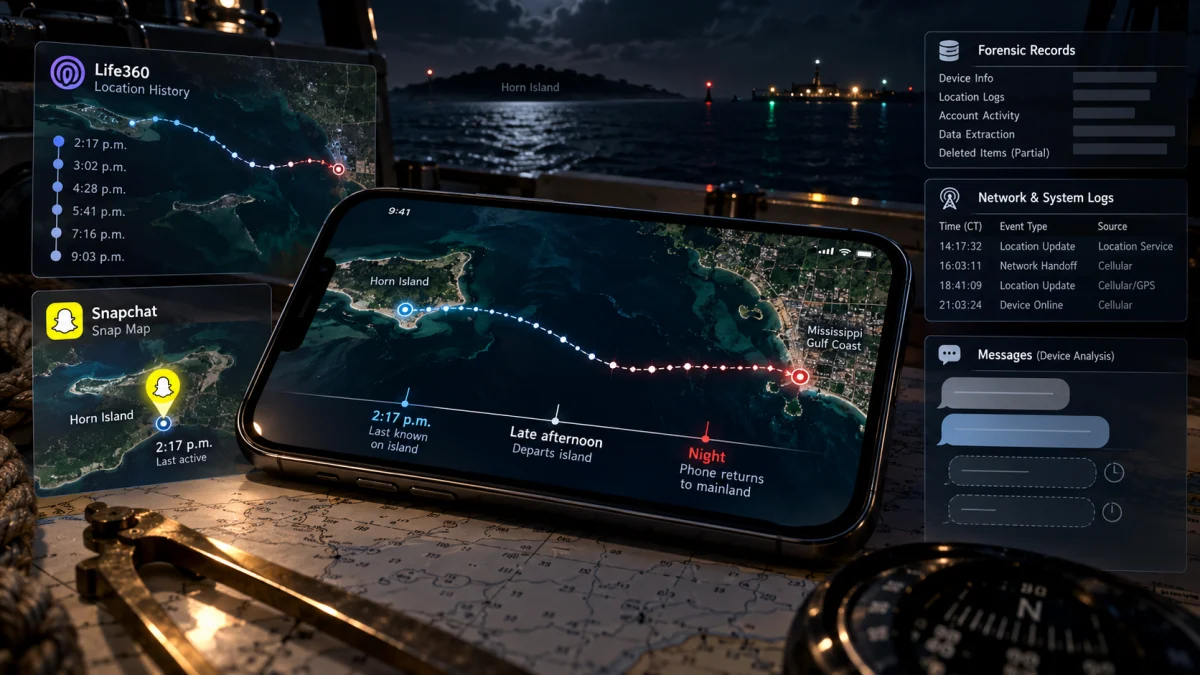
One fact should anchor every discussion of Nolan Wells’s phone: the phone came back from Horn Island. Nolan did not.
Newly disclosed forensic work provides the clearest public reconstruction yet of where Nolan’s phone traveled on July 4, 2026, when he appears to have last personally interacted with it, and what happened to some Snapchat material afterward.
The evidence does not currently establish that someone murdered Nolan or deliberately altered his phone to conceal a crime.
But it also does not justify treating the phone questions as settled simply because prosecutors or a grand jury say they found no criminal conduct.
The distinction matters because Nolan’s parents were questioning the phone almost immediately. His mother, Christine Wonsley, said on July 10 that Life360 showed Nolan’s phone back on the mainland while friends checking Snapchat were seeing something different. She said the family had to track the phone to retrieve it and that, once they obtained it, Snapchat appeared unusually empty for a teenager who routinely documented what he was doing. Those concerns existed weeks before a private forensic examiner announced that Snapchat-related material had in fact been deleted or unsent after Nolan’s last known use of the device.
The most important question is therefore no longer whether Nolan’s parents were unreasonable to question the phone.
They were not.
The real questions are what the underlying digital artifacts prove, what they merely suggest, and what remains hidden inside reports and raw records the public still cannot independently examine.
For the broader evidence surrounding Nolan’s disappearance and death, see sherafy.com’s continuing investigation, Why the Nolan Wells Case Matters—and Why the Public Should Not Forget. The separate legal and transparency issues surrounding the unanimous no true bill are examined in Nolan Wells Grand Jury: Why the No True Bill Raises Serious Questions.
The Most Important Rule: After Nolan’s Last Known Use, We Are Tracking His Phone
The newly disclosed forensic reconstruction attributes Nolan’s last known authenticated interaction with his phone to approximately 2:17 to 2:18 p.m. on July 4.
Digital-forensics examiner Andrew Garrett said device records showed Nolan using Face ID and interacting with applications around that time. The Associated Press similarly reported that Garrett’s analysis showed Nolan opening the phone with his face at approximately 2:17 p.m. The handset was then locked and continued traveling while receiving communications.
That creates an evidentiary dividing line that should be kept clear throughout this case:
Before approximately 2:18 p.m., the available forensic evidence can potentially connect both Nolan and his phone to the same location. After that point, the location evidence primarily tells us where the device went. It does not automatically tell us where Nolan went.
That sounds obvious.
It is also enormously important.
A phone can travel without its owner. In fact, that is unquestionably what ultimately happened here: Nolan’s phone returned to the mainland while Nolan remained missing.
The Jackson County grand jury specifically found that Nolan’s was not the only phone to return without its owner and concluded that people at crowded Horn Island gatherings sometimes moved among boats and left belongings aboard different vessels. That finding may reduce the evidentiary value of the separated phone as proof of a crime. It does not, however, convert the phone’s subsequent movement into proof of Nolan’s movement.
Those are different propositions.
What the New Phone Reconstruction Shows
According to Garrett’s September 24 presentation and subsequent reporting, the family’s forensic team reconstructed a detailed route from location artifacts recovered from Nolan’s phone.
The publicly presented chronology includes approximately:
| Time | What the forensic reconstruction says |
|---|---|
| 11:18 a.m. | Nolan’s phone arrives at Horn Island |
| 2:17–2:18 p.m. | Phone is unlocked using Face ID and applications are accessed; Garrett identifies this as Nolan’s last known use |
| Around 4:30 p.m. | Phone begins moving away from the island |
| Around 4:36 p.m. | Sea Tow call occurs while the phone is traveling |
| Around 6:10 p.m. | Phone reaches a dock |
| 7:24 p.m. | Phone reaches a boat-ramp location |
| Later that evening | Phone travels over land to a residence |
| Around 3 a.m., July 5 | Nolan’s family recovers the phone |
Garrett described the reconstruction as extremely accurate and said his team examined more than a million digital artifacts generated by the device. Reporting on his September 23 letter says investigators examined databases, unified logs, notification records, media caches, Apple Health information, calls, application activity and location records.
The location animation itself has also been publicly released in redacted form. Watch the GPS reconstruction supplied by Garrett Discovery
There is an important limitation, however.
The public has the visual reconstruction. It does not yet have the complete native location dataset showing each coordinate, timestamp, accuracy radius, artifact source and methodology used to construct the animation.
Garrett may be entirely correct that the reconstruction is extremely precise.
But an animation is a presentation of evidence.
It is not the underlying evidence.
For independent verification, another examiner should be able to take the raw records and reproduce the same route without relying on Garrett’s conclusions.
“GPS Data” Is More Complicated Than a Trail of Satellite Coordinates
The phrase phone GPS data makes the reconstruction sound simpler than modern smartphone geolocation really is.
An iPhone does not determine every location point solely by listening to GPS satellites. Apple explains that Location Services can combine GPS, Wi-Fi, cellular networks, Bluetooth and other device sensors to determine location. Different applications can request different levels and frequencies of location information.
That means every important forensic location point ideally needs several fields:
- timestamp;
- latitude and longitude;
- recorded accuracy;
- originating database or log;
- application or system service associated with the location;
- whether the location was GPS-derived, network-assisted or otherwise generated;
- timezone treatment;
- and whether the point represents a fresh measurement or a previously cached location.
This is not an argument that Garrett’s reconstruction is wrong.
It is the opposite.
If the reconstruction is as strong as represented, releasing those fields should make it stronger.
And because this case now involves disagreements over what digital records mean, reproducibility matters more than assurances from either side.
The Life360 and Snapchat Discrepancy Was Raised From the Beginning
The apparent conflict between Life360 and Snapchat is not a theory invented months after Nolan died.
Christine Wonsley described it publicly on July 10.
She said friends were checking Nolan’s location through Snapchat while she looked at Life360. According to Wonsley, the two showed different information, with Life360 showing Nolan’s phone back on land. The family then used the location information to recover the device.
Later that month, Wonsley sought records from multiple technology companies, including Snapchat and Life360.
That history matters because it establishes that the family’s concern about location data predates the present fight between lawyers, prosecutors and forensic experts.
But there is an equally important technical issue:
Snap Map and Life360 are not the same kind of location recorder.
Why Life360 and Snap Map Can Show Different Locations Without Either One Being “Fake”
Snapchat currently describes two basic ways Snap Map can receive location.
With “Only while using” permission, Snap Map updates a person’s location while Snapchat is actively being used. After the app closes, Snapchat can continue showing the last location recorded while the app was in use rather than following the phone continuously.
With “Always” or background permission, Snap Map can continue updating a user’s real-time location after Snapchat closes.
Life360 is designed much more explicitly around continuing background location. Its own support documentation recommends that iPhones give Life360 Always location permission with Precise Location enabled for the most accurate tracking. Its Daily History feature displays points generated when the application updates a person’s location.
That creates a very important hypothetical.
Suppose Nolan’s Snapchat permission was configured as Only While Using, but Life360 had continuous background access.
If Nolan stopped opening Snapchat while still on Horn Island and his phone later traveled back toward shore, Snap Map could continue displaying an older Horn Island location while Life360 updated with the moving phone.
That could produce a dramatic-looking discrepancy without anyone altering either application.
But that explanation has not yet been established in Nolan’s case
This is where an evidence-first investigation has to resist going too far in either direction.
The technical possibility does not prove that this is what happened.
To determine whether it explains Nolan’s actual discrepancy, investigators would need to establish Nolan’s relevant device and application settings at the time:
- What location permission did Snapchat have?
- Was background location enabled?
- Was Precise Location enabled?
- What permission did Life360 have?
- When did Snapchat last generate an actual location update?
- When did Life360 generate its corresponding points?
- What did Snapchat’s provider-side records show?
- Did the two systems disagree even when both were actively updating?
Without those answers, saying “Snapchat and Life360 can differ” is technically correct but incomplete.
It is a hypothesis.
The underlying records have to show whether that hypothesis actually fits Nolan’s phone.
Life360 Is Particularly Important Because Its History Works Differently
There is another reason the family’s early reliance on Life360 deserves careful attention.
Life360 currently says users cannot selectively delete individual location-history or driving events through the application. Turning off location sharing stops future updates but does not erase the history Life360 has already collected. Deleting the entire account is a separate action.
Snapchat operates very differently.
Snapchat is intentionally ephemeral. Depending on content type and conversation settings, messages and Snaps may disappear automatically after viewing or after specified retention periods. Users can also manually delete content they themselves sent.
That does not make Life360 infallible and Snapchat suspicious.
It means forensic investigators should not casually compare the two applications as though each produces the same type of immutable GPS ledger.
They do not.
Something Was Deleted. The Important Question Is What That Means.
The September 24 presentation materially changed one portion of the public record.
Garrett said plainly that his examination found Snapchat-related material that had been deleted between Nolan’s last known use of the phone and the family’s recovery of the device.
But Garrett’s September 23 letter, quoted in reporting by the Clarion Ledger, is more specific.
It says investigators established that certain messages sent to Nolan were unsent or deleted by their senders.
That distinction matters.
A sender deleting a message from their own Snapchat conversation is not the same thing as another person physically unlocking Nolan’s handset and erasing files from it.
Snapchat itself confirms that users can delete messages they sent, and that when this happens the service attempts to remove that material from its servers and the recipient’s device as well. A sender can likewise delete a saved Snap that they originally sent.
So these two propositions can both be true:
Snapchat material was deleted from Nolan’s conversation history.
And:
Nobody necessarily unlocked Nolan’s phone to delete it.
The Associated Press reported that the September 24 presentation did not produce evidence showing someone unlocked the phone after it left Horn Island and before Nolan’s family recovered it.
That is an important limitation.
It is not the end of the inquiry.
“The Senders Deleted It” Answers One Question and Creates Several Others
The district attorney responded to Garrett’s presentation by saying the relevant user actions were performed by other Snapchat users, not someone physically accessing Nolan’s handset.
That is a technically plausible explanation.
It may ultimately be the correct explanation.
But it answers only how a message could disappear from Nolan’s phone while his device remained locked.
It does not answer:
Who deleted the messages?
Exactly which messages were deleted?
When were they deleted?
Were they deleted before or after Nolan was known to be missing?
Were they ordinary messages routinely being removed, or did the deletion involve conversations relevant to July 4?
Does the forensic artifact retain any content, notification text, sender metadata or timestamps?
Were multiple messages deleted by the same person?
Did deletion activity cluster after friends learned that Nolan could not be found?
Those questions are not conspiratorial.
They are the natural next questions created by the forensic finding.
A friend deleting an ordinary Snapchat message hours before anyone knew Nolan was missing may have almost no evidentiary significance.
A person deliberately deleting a relevant conversation after learning that Nolan was missing or dead could have substantially different significance.
The difference is chronology and context.
We currently do not have enough publicly released artifact-level evidence to know which situation applies.
This Is Where “No One Unlocked the Phone” Can Become a Distraction
Whether Nolan’s phone was physically unlocked is important.
But it is not the only question.
A locked modern smartphone remains connected to outside systems. Applications can receive messages and notifications. Server-side account activity can change what the device later displays. Another Snapchat user can take an action from their own phone that affects a conversation associated with Nolan’s account.
So proving that nobody entered Nolan’s passcode or authenticated with Face ID after approximately 2:18 p.m. would significantly weaken one theory:
Someone physically opened Nolan’s phone and manually cleaned it.
It would not automatically resolve another:
Someone communicating with Nolan intentionally removed material from their own side of a conversation after he disappeared.
Those are fundamentally different allegations.
The public discussion should stop treating them as interchangeable.
The Timing of the Deleted Messages Could Be More Important Than Their Deletion
If the complete forensic report identifies sender-side deletions, one field becomes particularly important:
timestamp.
Consider three scenarios.
Scenario 1: Routine deletion before Nolan disappeared
Someone sends Nolan a Snap, later removes it during normal conversation, and no one yet knows anything is wrong.
That has little obvious evidentiary significance.
Scenario 2: Deletion after Nolan becomes unreachable
Someone who communicated with Nolan begins removing messages after realizing he has not returned.
That still does not prove concealment, but investigators should understand what was removed and why.
Scenario 3: Deletion after the missing-person response begins
If relevant communications were intentionally removed after people knew Nolan was officially missing, the timing could become materially more significant.
That would still require context and proof of intent.
But it would be unreasonable to dismiss the action merely by observing that the deletion originated from another person’s Snapchat account rather than from Nolan’s handset.
The location of the delete button is not the same question as the reason it was pressed.
Snapchat Also Deletes Material Automatically, Which Makes the Artifact Classification Critical
There is another technical complication.
Snapchat automatically removes large categories of content under its ordinary retention rules. The platform says most messages are designed to disappear after being viewed or after specified periods. Group chats, one-on-one messages, Snaps and Stories all have different default retention rules.
That means a forensic report needs to distinguish at least:
- ordinary automatic expiration;
- a sender manually deleting a message;
- a sender unsending a Snap;
- conversation-retention setting changes;
- local application-cache changes;
- and deletion performed directly on Nolan’s device.
Garrett’s September 23 wording, specifically attributing some material to messages unsent or deleted by their senders, appears more specific than ordinary automatic expiration.
But the actual artifact table has not been published.
That is precisely why the underlying report matters.
The Viral Explanation of Deleted Phone Storage Is Too Simple
A popular argument circulating around this case says that deleting a file from a phone merely removes a pointer to it and that the underlying file remains recoverable until another file overwrites the same storage.
That explanation comes from older computer-storage models and is too simplistic for modern phones.
Digital forensics can often reconstruct information that appears deleted to an ordinary user, but investigators may recover that evidence from many different places:
- application databases;
- metadata;
- operating-system logs;
- notification records;
- thumbnails or caches;
- synchronized cloud information;
- account-provider records;
- message databases;
- transaction journals;
- and correlated artifacts created elsewhere on the device.
Garrett said his team examined more than one million such artifacts and specifically described using databases, logs, application records and other forensic traces to reconstruct activity.
But deleted information is not guaranteed to remain recoverable forever.
The National Institute of Standards and Technology notes that digital-forensics techniques can be highly reliable when properly applied, while also warning that not all evidence is necessarily recoverable, deleted information can be overwritten or altered, and the meaning of software-generated artifacts can change as operating systems and applications evolve.
That nuance matters here because the important evidence may not be one intact deleted photograph sitting invisibly inside the phone.
It may be a pattern assembled from multiple forensic traces.
Cell Carriers Do Not Simply Keep a Perfect Copy of Your Phone’s GPS
Another claim spreading online is that deleting phone location information would be pointless because the cellular carrier independently records the handset’s exact GPS coordinates.
That is not generally how carrier location records work.
Carriers can maintain cell-site location information, showing which towers or sectors handled calls, messages or some data activity. Those records can be valuable in an investigation.
But they are not the same thing as a continuous archive of a phone’s exact GPS coordinates.
A U.S. Department of Justice geolocation overview explains that carriers generally retain cell-site information associated with certain network activity, do not necessarily keep records for every signal exchanged between a phone and towers, and that historical cell-site information is generally less precise than GPS.
So a comprehensive reconstruction should ideally compare several independent systems rather than treating any one as omniscient:
| Evidence source | What it may establish | Important limitation |
|---|---|---|
| Phone location artifacts | Where the device recorded itself at particular moments | Does not automatically identify who possessed it |
| Life360 | Application-generated movement/history | Depends on permissions, connectivity and update behavior |
| Snap Map | Location displayed through Snapchat | May show last active location rather than continuous movement |
| Vessel GPS | Route taken by a particular boat | Does not identify every passenger aboard |
| Carrier cell-site records | Approximate network-based device location | Generally less precise and less continuous than GPS |
| Photos/video metadata | Location/time associated with particular media | Provides snapshots, not necessarily a continuous route |
| Surveillance footage | Physical observation at specific locations | Only useful if footage exists, was preserved and identifies the relevant people or vessel |
The strongest reconstruction would reconcile all of them.
The Chain of Custody Still Matters Even If the Phone Stayed Locked
Christine Wonsley has said the family located Nolan’s phone through Life360 and had another person retrieve it from a residence. She also described complications in getting Nolan’s belongings returned.
The forensic reconstruction reportedly follows the device from Horn Island, onto the mainland, to a boat ramp, and eventually to a residence before the family recovered it around 3 a.m.
That makes the physical chain of possession worth documenting precisely.
Who carried Nolan’s phone off Horn Island?
Which boat was it on?
Who possessed the phone once that vessel reached land?
Who transported it to the residence?
Where exactly was it between arrival on land and its recovery?
Were multiple people physically near it?
Did investigators obtain contemporaneous surveillance showing those movements?
Again, physical possession is not the same as digital access.
But in any disputed death investigation involving a separated personal device, chain of custody is basic evidence, not gossip.
If the timeline is innocent and well documented, publishing it would strengthen that conclusion.
What the Grand Jury Actually Received
The grand jury report itself provides unusually specific information about the phone material presented to jurors.
It says the grand jury received:
- a 14-page Mobile Device Examination Findings Preliminary Report, provided to the district attorney on August 28;
- a 21-page final Mobile Device Examination Findings report addressing device lock state, screen activity, messages, calls, location and application use;
- and a 261-page Snapchat Conversation Report.
The grand jury also states that it had access to broader investigative material including digital evidence, GPS and location data, cellphone extractions, recordings and subpoena responses.
That is substantial.
But it creates another question because Garrett’s September 23 letter reportedly refers not only to the final report and Snapchat report but also to a full artifact report. Public reporting says Garrett maintains that the final material was transmitted on September 14.
The public record does not yet make completely clear:
- whether the grand jury received that complete artifact-level report;
- whether it received only the summarized findings;
- whether the State possessed the full forensic image generated by Garrett Discovery;
- which native provider records were available;
- and whether jurors or an independent examiner reproduced Garrett’s conclusions from the raw data.
Those are not minor distinctions.
A 21-page summary telling jurors what millions of artifacts mean is not evidentially identical to giving an examiner the underlying artifacts and asking that examiner to reproduce the result.
The DA and Garrett Discovery Now Disagree About What the State Actually Had
This dispute became unusually direct after the September 24 news conference.
Garrett said during the presentation that the district attorney had the underlying data necessary to examine the findings.
District Attorney Angel Myers McIlrath later said the State never received Garrett’s 30-hour digital download, and instead received two emails containing roughly 300 pages of selected findings. She also said the material supplied before the grand jury indicated that nobody physically accessed Nolan’s phone after his last known use.
Garrett, meanwhile, wrote that his preliminary report was delivered August 28 and that the final report, Snapchat report and full artifact report followed September 14.
Those statements are not necessarily impossible to reconcile. A forensic examiner can use the phrase “the data” differently from a prosecutor distinguishing between an extraction image and exported reports.
But the disagreement is exactly why a delivery manifest would be useful.
List every file delivered.
Give its filename.
Give its size.
Give its hash.
Give the delivery timestamp.
Identify whether prosecutors, investigators and jurors received the raw extraction, an artifact report, summary reports or all three.
That would turn an argument into a verifiable record.
The Grand Jury’s Conclusion Deserves Weight. It Does Not End the Technical Inquiry.
The grand jury ultimately found no credible evidence of criminal conduct by the people traveling to or from Horn Island on the three identified boats. It said GPS data and security footage confirmed passenger accounts, found that Nolan chose to remain on Horn Island, and returned a unanimous no true bill.
Those are significant findings.
They are not evidence that should be erased simply because Nolan’s parents distrust the process.
But the reverse is also true:
A grand-jury conclusion does not transform every underlying factual question into something the public must accept on institutional authority.
This is particularly important because the fundamental medical question remains unresolved.
Both the state medical examiner and the forensic pathologist retained by Nolan’s family classified the cause and manner of death as undetermined. The grand jury found the circumstances consistent with drowning, but neither forensic examiner certified drowning as the established cause and manner of death.
And the grand jury itself acknowledged that if credible evidence later indicates Nolan’s death was nonaccidental, the matter should be presented again.
That is why transparency is not an attack on the process.
It is the mechanism by which confidence in the process can be earned.
Nolan’s Parents Did Not Begin With the Grand Jury’s Assumptions
From Nolan’s parents’ perspective, the chronology looks different.
Their son went to Horn Island with friends.
He did not come home.
His phone did.
His mother says she learned that the phone was on the mainland by tracking it herself.
She says Snapchat and Life360 appeared inconsistent.
She says his Snapchat accounts lacked the kind of material she expected him to have created that day.
She questioned whether data had disappeared.
Weeks later, a forensic examination commissioned by the family determined that some Snapchat messages sent to Nolan had in fact been deleted or unsent by their senders.
None of those facts establishes a homicide.
But pretending that none of them provides a rational basis for continued suspicion would be equally irresponsible.
The family is not asking the public to solve Nolan’s death through intuition.
At its strongest, their position is simpler:
Show the evidence that resolves these discrepancies.
That is a reasonable request.
Does the Phone Evidence Show a Cover-Up?
Not on the currently public record.
But that is not the only meaningful conclusion available.
The phone evidence shows several things that would matter in any serious independent review:
Nolan and his phone became separated.
The phone returned to the mainland without him.
His family noticed a discrepancy between two location systems almost immediately.
His family questioned missing Snapchat material before the forensic work was completed.
A later forensic examination identified Snapchat messages that had been manually deleted or unsent by their senders.
The publicly available record does not yet identify all of those senders, deletion times or deleted content.
The full native location and artifact records necessary to independently reproduce the forensic conclusions are not publicly available.
There is now a documented disagreement between the family’s forensic examiner and the district attorney about precisely what digital material prosecutors possessed.
Those facts are not proof of coordinated concealment.
They are also not nothing.
A cover-up theory becomes stronger only if evidence begins showing intentional acts aimed at hiding material facts: deliberately false statements, coordinated deletion after people knew Nolan was missing, suppressed surveillance, manipulated records, unexplained destruction of evidence, or contradictions that cannot reasonably be reconciled.
We do not currently have public proof of that.
But some of the phone evidence now gives investigators concrete places to look.
The correct response is not institutional reassurance.
It is examination.
What Should Be Released Next
The fastest way to reduce speculation would be to publish or make available for qualified independent review, with appropriate privacy redactions:
- The complete 21-page Mobile Device Examination Findings final report.
- The 261-page Snapchat Conversation Report.
- The artifact-level report referenced by Garrett.
- The native location records used to create the GPS reconstruction.
- The complete list of Snapchat deletion/unsend events with timestamps and sender identifiers available to investigators.
- Nolan’s relevant Snapchat and Life360 location-permission settings.
- Provider-side Snapchat and Life360 location records.
- A file manifest showing exactly what Garrett Discovery supplied to prosecutors and when.
- A corresponding inventory showing exactly what digital evidence was presented to the grand jury.
- A clear physical chain-of-custody timeline for Nolan’s phone from approximately 2:18 p.m. until the family recovered it.
The family’s own public evidence page acknowledges that several of these underlying records remain unavailable for independent inspection.
That is the gap that now matters.
The Bottom Line
Nolan Wells’s phone is important precisely because it may be one of the least subjective witnesses in the case.
But phones do not explain themselves.
They leave artifacts.
Experts interpret those artifacts.
Applications behave differently.
Servers change information remotely.
Location records track devices rather than human beings.
And summaries can leave out details contained in raw evidence.
The newly disclosed forensic work gives the public a much clearer picture than it had before.
It appears to place Nolan actively using his phone at approximately 2:17 to 2:18 p.m.
After that, the phone travels.
First over water.
Then onto the mainland.
Then through additional locations.
Eventually, it reaches Nolan’s family.
Nolan does not.
That fact alone does not tell us why Nolan remained on Horn Island or how he died.
But from the last known authenticated interaction forward, one rule should govern every interpretation of the location evidence:
We can follow Nolan Wells’s phone. We cannot simply assume that means we are following Nolan Wells.
The Snapchat findings deserve the same precision.
The available evidence does not currently show that someone secretly unlocked Nolan’s handset and erased its contents.
It does show that certain messages sent to Nolan were later unsent or deleted by their senders.
Whether those actions were mundane or significant depends on information the public still does not have: who deleted what, when they deleted it, and what they knew when they did it.
Those are answerable questions.
And in a case where an 18-year-old died, both forensic examinations still leave his cause and manner of death undetermined, and his parents remain unable to say with confidence what happened to their son, “trust the process” is not an evidentiary answer.
Show the records.
Let qualified people reproduce the findings.
Then follow the evidence wherever it goes.
References and Further Reading
Nolan Wells Primary Records and Forensic Material
Jackson County Grand Jury Report: Death Investigation of Nolan Xavier Wells
Official September 2026 grand-jury report. Identifies the phone-forensics reports received by the grand jury, summarizes GPS and digital evidence considered, records the no-true-bill finding and acknowledges that the case can be reconsidered if credible new evidence emerges.
Nolan Wells Phone Forensics News Conference and Evidence File
Family-side evidence archive containing the September 24 Garrett Discovery presentation, transcript, links to the GPS reconstruction and an inventory of underlying phone records that remain unavailable on the page.
Garrett Discovery GPS Reconstruction of Nolan Wells’s Phone
Publicly released visualization of the phone-location reconstruction presented by the family’s forensic examiner.
Reporting on the September 24 Forensic Findings
Nolan Wells Phone Data and Autopsy Findings Raise New Questions — Clarion Ledger/USA Today Network
Contains detailed reporting on Garrett’s September 23 letter, including the statement that certain messages sent to Nolan were unsent or deleted by their senders, the phone-location chronology and the dispute over what forensic material was supplied to prosecutors.
Lawyers for Nolan Wells Family Highlight Cellphone Data — Associated Press
Independent reporting on the phone presentation, including the approximately 2:17 p.m. Face ID activity and the absence of evidence presented showing that the handset was unlocked after leaving the island.
Jackson County DA Responds to Nolan Wells Phone Findings — WLOX
Full response from District Attorney Angel Myers McIlrath, including her claim that the Snapchat user actions originated with other users and her account of what digital material prosecutors received.
Earlier Phone and Location Concerns
New Details From Nolan Wells Family Press Conference — WLOX, July 10, 2026
Documents Christine Wonsley’s early account that Life360 showed Nolan’s phone back on land while Snapchat showed different location information, and her description of recovering the phone.
Nolan Wells Mother Seeks Social-Media and Life360 Records — ABC News
Covers the family’s efforts to obtain social-media and technology records after questions arose about the phone’s contents and location history.
How Snapchat and Life360 Actually Work
Snap Map Privacy and Location-Sharing Modes — Snapchat Support
Explains the difference between location shared only while Snapchat is in use and continuous background location.
When Snapchat Deletes Snaps and Chats — Snapchat Support
Explains automatic retention and deletion behavior across Snapchat messages, Snaps, group chats and Stories.
How Snapchat Users Can Delete Sent Messages — Snapchat Support
Explains how a sender can manually delete a message and how Snapchat attempts to remove it from recipients’ devices.
Life360 Location and Drive History
Explains Life360’s location-history retention and states that individual history events cannot currently be deleted through the application.
Life360 Location Accuracy Requirements
Documents the background and precise-location permissions recommended for accurate Life360 operation on iOS.
Digital-Forensics and Location Technology
Digital Investigation Techniques: A NIST Scientific Foundation Review
National Institute of Standards and Technology review explaining both the reliability and limitations of digital forensic reconstruction, including deleted-data recovery and changing software artifacts.
Apple Location Services and Privacy
Explains that iPhone location can be derived from GPS, Bluetooth, Wi-Fi and cellular information rather than GPS alone.
Geolocation Technology and Privacy — U.S. Department of Justice
Useful technical background distinguishing carrier cell-site records from more precise GPS-based location information.
sherafy.com Nolan Wells Coverage
Why the Nolan Wells Case Matters—and Why the Public Should Not Forget
The broader sherafy.com evidence file and chronology covering Nolan’s disappearance, the search, autopsy evidence, vessel records, witness accounts and unresolved questions.
Nolan Wells Grand Jury: Why the No True Bill Raises Serious Questions
Separate analysis of what the unanimous no true bill legally means, what the grand jury concluded and why unresolved medical and transparency questions remain.
Editorial currency note: This article reflects public evidence available through September 25, 2026. The underlying phone-forensics record remains incomplete in the public domain. Findings should be updated if the full final report, Snapchat report, native location records, artifact report, provider data or additional investigative evidence is released.