Updated September 23, 2026
The Nolan Wells grand-jury decision deserves more scrutiny than a simple headline saying "no charges."
Not because every unexplained death should produce an indictment. Not because a grand jury is required to charge someone whenever the public is suspicious. And not because the current record proves that prosecutors, investigators or witnesses participated in a cover-up.
The reason is more specific.
Under Mississippi’s grand-jury rules, the panel was not being asked whether anyone was guilty beyond a reasonable doubt. It was being asked whether there was sufficient evidence or probable cause to require an accused person to stand trial. Only 12 grand jurors needed to agree to return an indictment.
Twenty-three grand jurors heard the Nolan Wells matter.
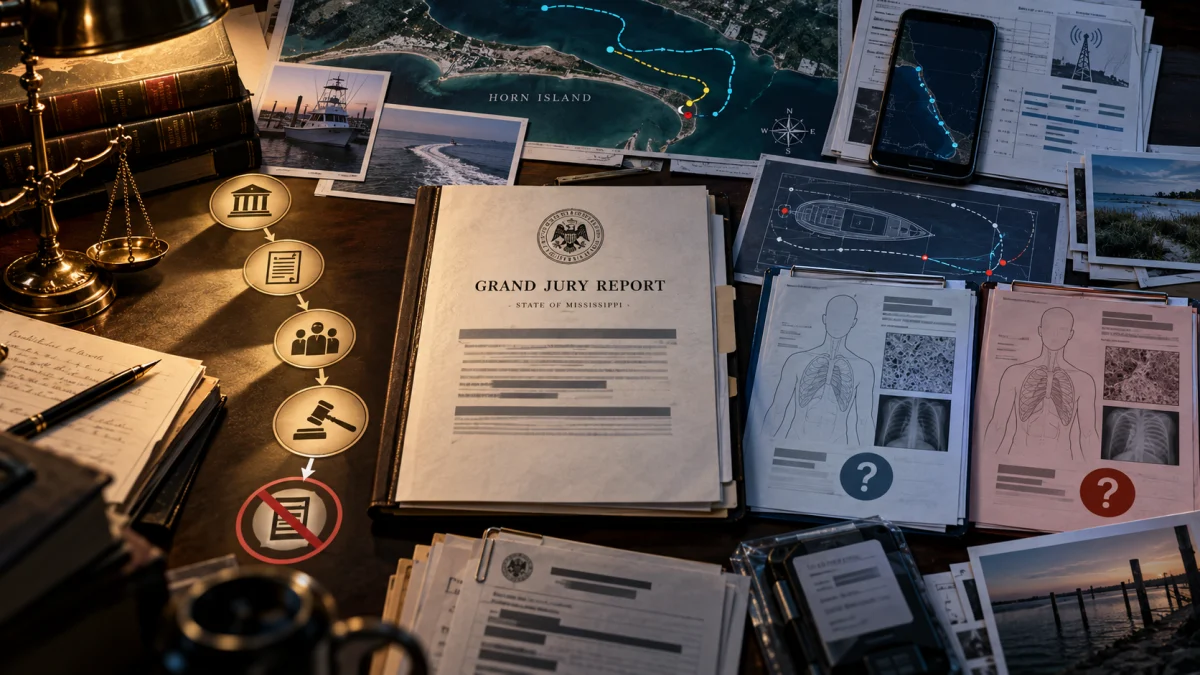
According to the official Jackson County grand-jury report, all 23 ultimately joined a no true bill after the panel issued 132 subpoenas, heard 43 witnesses and reviewed physical evidence, digital evidence, cellphone extractions, GPS and location data, photographs, videos, recorded statements and investigative reports.
At the same time, the same report says both the Mississippi chief medical examiner and the independent forensic pathologist retained by Nolan’s family classify the cause and manner of his death as undetermined.
The state examination documented bruising on the back of Nolan’s head. The grand jury said the injury was not fatal, but also acknowledged that its exact cause remains uncertain. The state examiner and the family’s pathologist also disagreed about the presence of additional bruising on Nolan’s buttocks and shoulder.
The grand jury nevertheless concluded that there was no credible evidence of criminal conduct by the people who traveled to or from Horn Island on the three boats identified in the report.
Those findings are not legally incompatible.
But they are difficult enough to reconcile from the outside that public skepticism is understandable.
That is the issue.
The strongest question is not whether a decimal point in a national grand-jury statistic is perfect.
It is this:
How did an investigation that still cannot medically determine exactly how Nolan Wells died produce such a categorical criminal conclusion under a relatively low charging threshold?
There may be a sound answer.
The public should be able to understand it.
The Grand Jury Was Not Deciding Guilt
This distinction is central.
A trial jury determines whether prosecutors have proved guilt beyond a reasonable doubt.
A grand jury does something much earlier in the process. Mississippi’s own instructions tell grand jurors that it is not their duty to decide guilt or innocence. Their job is to determine whether sufficient evidence or probable cause exists to require someone to stand trial.
Mississippi law requires only 12 grand jurors to concur in an indictment.
That matters because the Nolan Wells panel did not merely fail to reach unanimity for charges.
The released report says the decision was unanimous in the opposite direction.
That is a meaningful result.
It means that after hearing the evidence presented during the proceeding, none of the 23 jurors who heard the matter joined an indictment.
The report also went further than saying prosecutors had not proved enough to charge a particular offense. It affirmatively said there was no credible evidence that people who traveled on the Triton, Palm Beach or Tideline engaged in criminal conduct connected to Nolan’s death.
That deserves substantial evidentiary weight.
It also deserves careful scrutiny because of how broad the conclusion is.
Why the Low Bar Matters
Probable cause is not proof beyond a reasonable doubt.
A prosecutor does not need to prove at the grand-jury stage exactly what happened in every detail.
The grand jury does not need to know precisely how a future trial would end.
And Mississippi does not require every grand juror to vote for an indictment.
That makes a unanimous no true bill notable in a case with this much public uncertainty.
There is useful national context here. Pew Research Center reports that federal grand juries historically have declined to indict very rarely. In fiscal 2016, the latest year for which that particular federal statistic is available, federal grand juries declined to indict just six people nationwide. During the decade from 2007 through 2016, they refused to indict an average of about 15 people per year.
Nolan’s case was a Mississippi state proceeding, not a federal one, so those numbers should not be treated as a statistical prediction for Jackson County.
But the broader point is relevant: grand-jury indictment is intentionally a preliminary threshold, not the final burden of proof required at trial.
That is why people are asking how an unexplained death involving unresolved injuries failed even to cross that threshold.
But a Low Threshold Does Not Mean Someone Had to Be Indicted
This is where the analysis has to stay disciplined.
Probable cause still requires probable cause of a crime, and probable cause connecting that crime to a person who can be charged.
An unexplained death is not automatically a homicide.
An undetermined manner of death is not automatically evidence that another person caused it.
A bruise is not automatically evidence of an assault.
And suspicion about someone’s behavior is not automatically probable cause that the person committed a specific criminal offense.
That distinction may ultimately explain the no true bill.
The grand jury could believe that important aspects of Nolan’s death remain medically unresolved while also concluding that the evidence does not establish probable cause that any identifiable person committed a crime.
Those two findings can coexist.
What makes the case difficult is that the public still cannot independently see enough of the underlying evidence to evaluate how comfortably they coexist.
The Forensic Record Is Still Unresolved
This is the part of the case that keeps the grand-jury decision from functioning as a complete answer.
The official report says both the Mississippi chief medical examiner and the independent pathologist retained by Nolan’s family concluded that the cause and manner of death are undetermined.
The report says drowning is a diagnosis of exclusion and that neither forensic expert ruled out accidental drowning.
It also says:
- there was bruising on the back of Nolan’s head;
- the head injury was not fatal;
- the exact cause of that injury remains uncertain;
- a witness testified that Nolan slipped awkwardly off the side of a boat at about 3:30 p.m.;
- the witness could not say whether Nolan struck his head;
- Nolan reportedly continued socializing and did not appear injured afterward; and
- the two forensic examiners disagreed about whether additional non-deep-tissue bruising was present on Nolan’s buttocks and shoulder.
The grand jury found the body’s position, condition, discovery time and location consistent with drowning.
That may be the strongest available explanation.
It is still not the same thing as a medical examiner certifying an accidental drowning.
That distinction matters because the criminal conclusion is much more definite than the medical conclusion.
The medical record says, in effect: we cannot definitively determine how this death occurred.
The grand-jury report says, in effect: we found no credible evidence that these people committed a crime related to it.
Again, those statements are not contradictory.
But the gap between them is exactly where public scrutiny belongs.
The Evidence That Cuts Against a Criminal Theory Is Substantial
A serious article about this case cannot simply list the suspicious-looking facts and stop there.
The grand-jury report contains substantial evidence that cuts against the most widely circulated criminal theories.
It says Nolan chose to remain on Horn Island after the Triton, Palm Beach and Tideline departed.
It says GPS data and security footage confirmed the accounts of passengers on those boats.
It says Nolan was not involved in a physical altercation or argument.
It says the Triton experienced a real bilge-pump and motor malfunction, was taking on water and was towed for a period.
It says the original Sea Tow recording did not support the viral interpretations circulated online.
It says the people on the three boats cooperated with investigators by providing GPS devices, surveillance footage, phones and statements.
And the report says Nolan’s phone was not the only phone that returned to the mainland without its owner, which gives a noncriminal context to a fact that initially generated enormous suspicion.
These are not minor details.
If the underlying evidence supports those findings, then several theories that looked suspicious from the outside become much weaker.
That is precisely why the grand-jury result cannot simply be dismissed as meaningless.
But the Report Is More Sweeping Than "We Could Not Prove a Crime"
This is one reason the public reaction has remained so intense.
The grand jury did not merely say there was insufficient evidence to indict.
It said there was no credible evidence supporting public allegations of criminal conduct by the occupants of the three boats.
It described allegations against those occupants as the result of public clamor and private malice.
It said public attacks on them and their families were malicious, false and unsupported by fact or evidence.
That is a broad public conclusion for readers who had been following a case in which the medical cause and manner of death remain undetermined.
The report may be correct.
But when a report moves from "probable cause was not established" to a much broader exonerative narrative, the evidentiary basis for that confidence becomes especially important.
The public is being asked to accept not merely that prosecutors cannot prove a case, but that major criminal suspicions are affirmatively unsupported.
That is a stronger claim.
It deserves a correspondingly transparent explanation.
The Grand Jury Saw Much More Than the Public Has Seen
This point cuts both ways.
The grand jury had access to far more evidence than social-media commentators, journalists or ordinary readers.
According to the report, it had full and open access to the complete Jackson County Sheriff’s Office investigative file, including material from other agencies involved in the death investigation.
The panel reviewed witness testimony, physical and digital evidence, reports, recorded interviews, photographs, videos, maps, GPS and location data, cellphone extractions and subpoena responses.
It also received reports generated from the Wells family’s independent forensic examination of Nolan’s phone.
The family’s forensic pathologist testified under oath.
That means outsiders should be cautious about claiming the grand jury ignored evidence merely because that evidence is not visible publicly.
But the same fact creates the transparency problem.
The grand jury saw the evidence. The public mostly sees the grand jury’s description of the evidence.
Those are not the same thing.
Grand-jury secrecy has legitimate purposes. Witness privacy matters. The identities of uncharged people should not be casually exposed.
Still, where records can lawfully be released without compromising those interests, disclosure would allow the public to evaluate the conclusions rather than simply being asked to trust them.
Grand Juries Are Not Adversarial Proceedings
Mississippi’s own grand-jury instructions make another point that matters here:
Grand jurors hear only one side of the case.
A grand jury is not a mini-trial.
There is no defense lawyer cross-examining witnesses in the way people see at trial. There is no opposing party presenting a competing reconstruction of the evidence. The prosecutor and investigators play a central role in organizing what the panel receives and explaining the applicable law.
That does not make the process illegitimate.
It does mean that a grand-jury report should not be treated as though its factual conclusions were produced through the same adversarial testing that occurs at a public trial.
This is particularly important in the Nolan Wells case because the no true bill prevents that later trial stage from occurring.
There will be no public criminal trial on the present evidence.
There will be no public cross-examination of witnesses.
There will be no defense and prosecution exhibits laid out in open court for the public to evaluate.
The grand-jury report may therefore become the most consequential official narrative of the case unless additional evidence emerges or civil litigation produces further discovery.
That makes its transparency especially important.
One Detail in the Report Cuts Strongly Against the Simplest Cover-Up Narrative
The report says the District Attorney’s Office asked Nolan’s family and legal team to provide evidence collected during their independent investigation.
According to the report, the family’s legal team responded that its investigation had revealed no witnesses or evidence that it reasonably believed contained information about potential criminal activity warranting referral to prosecutors.
The report also says the family did not ask that additional documents, recordings, photographs, digital media, reports or other material in its possession be submitted to the grand jury.
That is significant.
It does not mean the family agrees with the grand jury.
They clearly do not.
It does not mean the family’s forensic concerns are invalid.
But it cuts against a simple theory in which the family possessed obvious evidence of a crime and prosecutors refused to let the grand jury see it.
The family’s public response after the decision has instead focused heavily on the unresolved medical questions: the undetermined cause and manner of death, the unexplained bruising and the lack of a complete account of how Nolan entered the water and died.
That is a stronger line of scrutiny than pretending incriminating evidence was necessarily hidden.
The Public’s "Something Doesn’t Add Up" Reaction Is Understandable
There is a difference between saying something does not fully add up in the public record and saying we have proof of a cover-up.
The first is a reasonable conclusion.
The second has not been established.
Here is why the unease persists:
A healthy 18-year-old went to Horn Island and did not come home.
His body was found in the water two days later.
Both forensic examiners still classify the cause and manner of death as undetermined.
There was bruising to the back of his head, and its exact origin remains uncertain.
The independent examiner and state examiner disagreed about additional bruising.
The precise sequence by which Nolan entered the water is still not publicly reconstructed.
The legal threshold for an indictment was probable cause, not proof beyond a reasonable doubt.
Only 12 votes were needed to indict.
Yet the 23 grand jurors who heard the matter reportedly returned a unanimous no true bill and issued a report strongly rejecting allegations of criminal conduct.
That combination is legitimately striking.
It does not tell us which part of the story is wrong.
It tells us why additional transparency matters.
What Would Actually Be Evidence of a Cover-Up?
The word "cover-up" should mean something.
It should not simply mean that an official conclusion feels unsatisfying.
Evidence of a cover-up would involve proof that someone intentionally concealed, destroyed, falsified, manipulated or suppressed material information in order to prevent the truth from emerging.
Examples could include evidence that:
- investigators intentionally withheld materially incriminating evidence from the grand jury;
- digital or physical evidence was knowingly destroyed after its relevance was apparent;
- a witness was pressured to change truthful testimony;
- officials knowingly misrepresented a forensic conclusion;
- an undisclosed conflict directly influenced investigative decisions;
- public descriptions of GPS, phone or video evidence materially contradict the underlying records; or
- credible new evidence establishes a criminal mechanism of death that investigators already knew about and concealed.
The current public record does not establish those things.
That is why "cover-up" should remain an allegation to be tested, not a fact to be announced.
What Still Deserves Independent Scrutiny
The absence of proof of a cover-up does not mean the case should simply disappear.
There are concrete questions worth pursuing.
Why are cause and manner still undetermined?
If accidental drowning is the best explanation, the state should explain as clearly as possible why the evidence supports that inference while still preventing a definitive medical classification.
Those are technical concepts, but they can be explained.
What exactly explains the head injury?
A witnessed fall is a plausible explanation.
The grand jury itself says it cannot determine with absolute certainty that the fall caused the bruising.
That uncertainty is not proof of assault, but it remains a real forensic question.
Why did the forensic examiners disagree about other bruising?
The disagreement over possible bruising to Nolan’s buttocks and shoulder may ultimately have a benign explanation.
The public should know what each examiner saw and why their interpretations differed.
What happened between Nolan’s final confirmed social activity and his entry into the water?
The report says Nolan chose to remain on Horn Island and was not involved in a fight.
That resolves part of the timeline.
It does not reconstruct the event that placed him in the water.
What did authorities know during the first overnight response?
Later evidence may support the account that Nolan voluntarily stayed behind.
A separate question remains about what investigators had independently confirmed at the time the initial missing-person response was being made.
Which underlying records can now be released?
The public does not need private phone contents or the identities of every uncharged witness.
But native GPS records, appropriate portions of forensic reports, evidence inventories, search timelines, dispatch records and technical analyses could potentially clarify the case without turning private citizens into public targets.
The Family’s Objection Is Not Just "We Wanted an Indictment"
Nolan’s parents have continued to say that the grand-jury report does not answer how their son died.
That distinction is important.
At a September 22 press conference, the family and attorney Ben Crump focused heavily on the unresolved bruising and the fact that the forensic cause and manner remain undetermined. Mississippi Today reported that the family intends to keep pressing for answers.
A family can be wrong about whether a crime occurred and still be right that the death has not been fully explained.
Those are not contradictory positions.
The grand jury answered the charging question.
The medical record has not fully answered the death question.
The Most Important Distinction in This Case
The Nolan Wells case now has two different official answers.
The criminal answer
The grand jury found no credible evidence that the identified boat occupants engaged in criminal conduct connected to Nolan’s death.
It returned a unanimous no true bill.
The medical answer
Both forensic examiners classify cause and manner of death as undetermined.
Drowning is consistent with the evidence and remains a plausible, perhaps leading, explanation.
But the exact mechanism and manner have not been definitively established.
Those answers can coexist because the criminal system and the medical examiner are asking different questions.
The danger is allowing one answer to swallow the other.
A no true bill should not be rewritten as a medical finding of accidental drowning.
An undetermined autopsy should not be rewritten as proof of homicide.
The responsible position is to preserve both.
Is the Grand-Jury Decision "Suspicious"?
There is enough here to justify skepticism about whether the public has been given a complete enough explanation.
There is not enough verified evidence to conclude that the grand jury itself was corrupt or that officials intentionally covered up a killing.
The better word is unsettled.
The criminal investigation reached a very strong conclusion.
The forensic investigation did not.
The gap between those two levels of certainty is the central unresolved issue.
If authorities want the public to accept the criminal conclusion with confidence, the best response is not to scold people for asking questions.
It is to show, as far as the law permits, why the evidence supports that conclusion.
Frequently Asked Questions
Did the Nolan Wells grand jury find anyone not guilty?
No.
A grand jury does not determine guilt or innocence. It decides whether sufficient evidence or probable cause exists to indict someone and require that person to stand trial.
How many votes were needed to indict someone in Mississippi?
Twelve grand jurors must concur in an indictment.
Twenty-three grand jurors heard the Nolan Wells matter, and the report says the no true bill was unanimous.
Why is that significant?
Because probable cause is a lower threshold than proof beyond a reasonable doubt, and unanimity was not required to indict.
A unanimous no true bill therefore carries meaningful evidentiary weight.
Does a no true bill prove nobody committed a crime?
No.
It means the grand jury did not find sufficient grounds to indict on the evidence presented.
In this case, the report went further and affirmatively said it found no credible evidence of criminal conduct by the identified boat occupants.
Does "undetermined" mean homicide?
No.
An undetermined cause or manner means the available forensic evidence does not support a definitive classification. It is not another word for murder.
Does the grand-jury result prove Nolan accidentally drowned?
No.
The grand jury found the body’s circumstances consistent with drowning. Both forensic examiners still classify cause and manner as undetermined.
Is it fair to call the case a cover-up?
It is fair to investigate and question whether evidence was handled properly or whether material facts remain undisclosed.
The current public record does not establish intentional concealment or a coordinated cover-up as fact.
Why are federal grand-jury statistics relevant at all?
They provide context showing that grand-jury indictment is generally a preliminary threshold and that federal no-bills historically have been rare.
They do not establish the statistical probability of a no true bill in Jackson County, Mississippi.
Can Nolan Wells’s case be revisited?
Yes.
The grand-jury report states that Mississippi has no statute of limitations for homicide and says that if credible evidence later suggests Nolan’s death was non-accidental, the matter should be presented to a future grand jury.
Conclusion: The Unease Is Justified. The Conclusion Is Not Yet.
There is a reason the Nolan Wells grand-jury decision feels unsatisfying to many people.
The legal bar was not proof beyond a reasonable doubt.
Only 12 votes were needed to indict.
The panel heard from 43 witnesses, issued 132 subpoenas and examined a substantial investigative record.
All 23 jurors who heard the matter reportedly declined to indict.
At the same time, both forensic examiners still say the cause and manner of Nolan’s death are undetermined.
The exact origin of at least one documented injury remains uncertain.
The physical event that placed Nolan in the water has not been publicly reconstructed.
That is a real tension.
It is not irrational to look at those facts and say: this still does not feel fully explained.
But an evidence-first publication has to stop at the edge of what the evidence proves.
The current record supports saying that the case remains medically unresolved in important ways.
It supports saying that the unanimous no true bill is striking given the relatively low threshold for indictment.
It supports asking for more transparency about the evidence that produced such a categorical criminal conclusion.
It does not yet support stating as fact that prosecutors, investigators or Nolan’s companions covered up a killing.
The public does not have to choose between blind trust and an unproven conspiracy.
There is a third position:
Take the grand jury’s evidence seriously. Take the unresolved forensic evidence seriously. And keep asking for enough transparency to understand how both can be true at the same time.
For the full chronology, autopsy issues, first-night response, phone evidence, Sea Tow recording and September case update, see sherafy.com‘s companion investigation: Why the Nolan Wells Case Matters and Why the Public Should Not Forget.
References and Further Reading
Primary Sources
-
Jackson County, Mississippi – Redacted Grand Jury Report: Death Investigation of Nolan Xavier Wells – The primary record for the unanimous no true bill, the 23 jurors who heard the matter, 132 subpoenas, 43 witnesses, forensic findings, evidence reviewed and the grand jury’s substantive conclusions.
-
Mississippi Supreme Court – Mississippi Rules of Criminal Procedure and Sample Charge to the Grand Jury – Explains that the grand jury determines probable cause rather than guilt, hears only one side of a case and requires 12 affirmative votes for an indictment.
-
Mississippi Code Section 99-7-11 – Concurrence of Twelve Grand Jurors Required – Current statutory provision stating that 12 grand jurors must concur in an indictment or presentment.
Grand-Jury Context
- Pew Research Center – What to Know About Federal Grand Juries – Provides historical federal data showing how rarely federal grand juries have declined to indict and explains the difference between grand-jury proceedings and criminal trials. Federal statistics are used here only as general context, not as a Mississippi indictment rate.
Nolan Wells Grand-Jury Decision and Family Response
-
Mississippi Today – Grand Jury Issues No Indictments in Death of Nolan Wells – Independent reporting on the no true bill, evidentiary scope, 132 subpoenas, 43 witnesses and the district attorney’s response.
-
Mississippi Today – Nolan Wells May Have Drowned, but Questions Remain: How? And Why? – Post-decision reporting on the family’s objections, unresolved forensic questions and continued demand for answers.
-
Associated Press – Mississippi Grand Jury Finds No Cause for Charges in the July Death of Nolan Wells – National reporting on the grand-jury decision, undetermined forensic classifications and the possibility of future review if credible new evidence emerges.
-
People – Nolan Wells’s Family Says It Still Has More Questions Than Answers – Documents the family’s continued focus on unexplained bruising and the difference between the grand jury’s criminal conclusion and the unresolved medical findings.
Companion sherafy.com Investigation
- sherafy.com – Why the Nolan Wells Case Matters and Why the Public Should Not Forget – Full chronology and evidence review covering the first-night response, autopsy findings, phone evidence, Sea Tow recording, vessel GPS, family concerns and the September 2026 grand-jury update.
Editorial Evidence Standard
This article distinguishes between three different propositions:
- The death remains medically unresolved in important respects.
- The grand jury found no probable cause for criminal charges and affirmatively rejected major allegations against the identified boat occupants.
- A cover-up has not been established by the evidence currently available to the public.
None of those statements cancels the others.
The purpose of this article is not to defend the official conclusion or attack it.
It is to identify why the result is difficult for many readers to reconcile with the unresolved forensic record, while separating legitimate scrutiny from conclusions the evidence does not yet support.