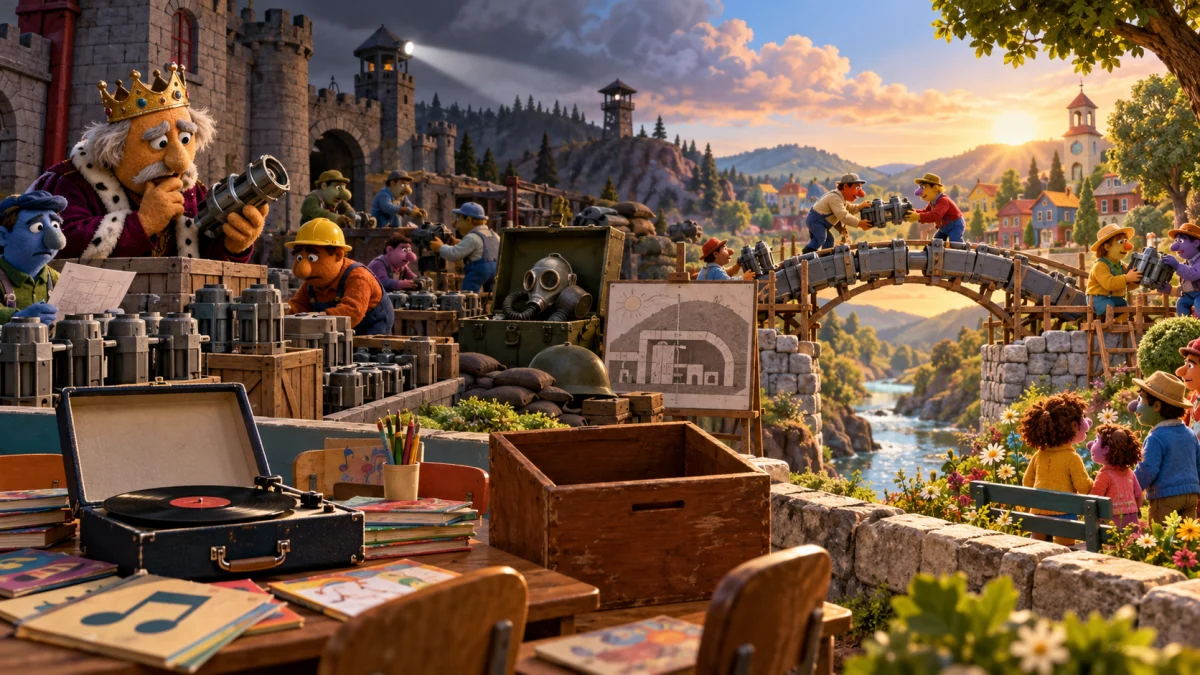
Yes, Fred Rogers really devoted five consecutive episodes of Mister Rogers’ Neighborhood to a frightening arms race caused by suspicion, bad information and fear. King Friday orders his neighborhood to build a million apparent bomb parts, consumes the country’s money in the process, deploys a spy, prepares children for air raids and gas masks, and eventually discovers that the supposedly threatening neighboring community was building a bridge.
Those episodes also really did disappear from normal circulation.
But there is an important correction to the story now spreading online: there is no good evidence that a later publisher, corporate board or government agency suppressed the episodes because Fred Rogers’ antiwar message had become politically inconvenient.
The best available reporting says something more complicated.
In March 2026, the public-media publication Current reported that the five episodes were removed from distribution after their final PBS broadcasts in 1996 and that, according to Fred Rogers Productions, Fred Rogers himself made the decision to withdraw them. The organization says it continues to honor his choice.
What remains surprisingly difficult to establish is why Rogers made that decision.
That unanswered question is important because the content of the episodes is not ambiguous. Fred Rogers was not merely telling children to be nice. He constructed a remarkably direct story about how imagined threats become arms races, how leaders can confuse possibility with evidence, how fear militarizes ordinary life and how money that could benefit children can instead disappear into weapons.
Ms. Rachel brought that history back into the spotlight this week when she argued that the common instruction that she should “be like Mister Rogers” and avoid politics rests on a sanitized memory of what Rogers actually did.
On that larger point, the historical record gives her considerable evidence.
What Ms. Rachel Actually Said About Mister Rogers
During a September 22, 2026 episode of SubwayTakes Uncut, Rachel Griffin Accurso, better known as Ms. Rachel, argued that Mister Rogers addressed politically consequential subjects throughout his program.
She pointed to his famous 1969 pool scene with Black actor François Clemmons, his testimony to the U.S. Senate in support of public broadcasting and the five-part 1983 storyline about King Friday’s escalating conflict with the neighboring land of Southwood.
Her basic description of the “Conflict” episodes is accurate.
One numerical detail was not.
Ms. Rachel recalled King Friday wanting roughly “a hundred million and one” bomb parts. In the actual episode, Cornflake S. Pecially is making one million parts for Southwood. King Friday responds by ordering a million corresponding parts for his own neighborhood, declaring that if Southwood has a million bombs, his side should have a million and one.
That is a small memory error in an otherwise substantially accurate description of a very unusual week of children’s television.
More importantly, Ms. Rachel did not establish that today’s rights holders politically censored the episodes. That is a separate claim now circulating around the story, and the available evidence does not support it.
What Happened in the Five “Conflict” Episodes?
The series ran from November 7 through November 11, 1983, as episodes 1521 through 1525.
The plot begins innocently.
King Friday intends to buy a record player for the Neighborhood school. Then he learns that Cornflake S. Pecially is manufacturing a large quantity of unusual components for Southwood, another community.
Prince Tuesday has recently been learning about countries and wars. The possibility enters the conversation that the mysterious components might be parts of bombs.
There is no proof that they are.
That distinction becomes the engine of the entire story.
In the second episode, Corny acknowledges that the component could theoretically be part of a bomb but doubts that explanation. He is making one million of them for Southwood.
King Friday does not investigate Southwood.
He escalates.
He orders one million equivalent parts for his own neighborhood and instructs Handyman Negri to enlist everyone in assembling what they believe are bombs.
The logic should sound familiar even to an adult who has never seen the program:
They might be arming themselves, therefore we must arm ourselves first.
The Arms Race Starts Consuming Everything Else
Fred Rogers then makes the consequences increasingly difficult to miss.
The original plan to buy equipment for the school gives way to military preparation.
Handyman Negri explains that King Friday’s enormous order will consume the country’s money. In the next episode, Lady Elaine and Lady Aberlin resist the preparations while Bob Dog is appointed a spy in the supposed conflict with Southwood. Children at the school are taught about gas masks and air-raid shelters, while the neighborhood’s newly appointed generals receive their weapons.
This is why reducing the episodes to “Mister Rogers said war is bad” misses what Rogers actually constructed.
The story depicts a process:
uncertainty → assumption → fear → militarization → diverted resources → preparation for war
And the original suspicion has still not been verified.
That makes the storyline much closer to an explanation of an arms-race security dilemma than to a generic lesson about sharing.
One side believes the other might be preparing an attack. Defensive preparations follow. Those preparations create their own logic. Ordinary institutions reorganize around the assumed threat.
Rogers managed to explain that to preschoolers with puppets.
Then Someone Actually Goes to Southwood
Lady Elaine and Lady Aberlin eventually do something King Friday has failed to do.
They investigate.
They travel to Southwood with Bob Dog and discover what the million mysterious components are actually being used to construct.
A bridge.
There are no Southwood bombs.
King Friday has mobilized his community against an enemy that was not preparing to attack him.
The metaphor is hardly buried.
The feared weapons were literally a bridge.
A community preparing for connection was misread as a community preparing for war.
Fred Rogers then turns directly to his young audience and talks about countries needing rules that protect people and reminds children that they will someday participate in creating those rules.
This was children’s television, but it was not politically empty children’s television.
The Final Episode Makes the Resource Argument Explicit
The fifth episode does not simply announce peace and move on.
The useless stockpile now has to be dealt with.
The Neighborhood holds a celebration of peace, Southwood’s residents are invited, and the components that had been treated as bomb parts are repurposed to make a record player for the school.
That brings the story almost exactly back to where it began.
Before King Friday became consumed by the possibility of war, the neighborhood was discussing a record player for children.
Fear redirected the resources.
Peace returned them.
The episode ends unusually. Rogers sings “Peace and Quiet,” and the screen displays a passage from Isaiah describing nations turning weapons into useful tools and no longer learning war.
It is difficult to interpret that narrative architecture as accidental.
Betty Aberlin, who played Lady Aberlin, later described the story’s brilliance in essentially those terms. She told Current that resources capable of supporting art and other things that improve human life had instead been consumed because fear and misunderstanding sent them in a destructive direction.
Was Mister Rogers Actually Criticizing the Arms Race?
There is a difference between saying that Fred Rogers addressed political subjects and assigning him every modern political position someone wishes he held.
The evidence supports the first proposition much more strongly than the second.
The “Conflict” episodes are plainly concerned with war, military escalation, mistaken threat perception and the social costs of weapons accumulation.
Michael G. Long, author of Peaceful Neighbor: Discovering the Countercultural Mister Rogers, devoted an entire section of his book to Rogers’ opposition to war and the arms race. The book’s contents include chapters titled “Against the Arms Race, for Peaceful Imagination” and “Against the Cold War, for Puppet Détente.”
In Current, Long described Rogers as consistently pacifist in his outlook.
The Smithsonian’s National Postal Museum likewise notes that Rogers used Mister Rogers’ Neighborhood from its earliest years to engage with subjects shaped by the Vietnam War, racial conflict and major national events rather than constructing an artificially sealed children’s world in which public life did not exist.
So calling the five-part story antiwar or anti-arms-race is well supported.
Calling it simply “anti-American propaganda,” however, goes further than the evidence.
Rogers himself explained the purpose in more universal terms.
When the episodes originally aired in November 1983, an Associated Press report quoted him explaining that conflicts often emerge from false assumptions, confusion and failures of communication. He said the programs were intended to give families a way to discuss war when children encountered frightening events in the news.
That distinction matters.
Rogers was criticizing a mechanism of conflict, not teaching children that one particular country or political party was uniquely evil.
No, the Episodes Were Not Created Because of The Day After, Grenada or Beirut
Another story has accumulated around these episodes over the years.
The five-part series aired during an extraordinarily tense period of the Cold War. The U.S. invasion of Grenada had occurred only weeks earlier. The Beirut barracks bombing had killed hundreds of American and French servicemen. ABC was preparing to broadcast The Day After, its terrifying television film depicting nuclear war in the United States.
It is therefore tempting to say Rogers produced the episodes in response to those events.
The chronology says otherwise.
The AP report published while “Conflict” was airing noted that the programs had already been taped and scheduled during the previous summer. Rogers said the subsequent real-world conflicts made the episodes more relevant, but they were not created in reaction to those events.
The Neighborhood Archive likewise notes that the timing with The Day After was coincidental.
The episodes therefore tell us something more substantial about Rogers’ thinking than a hurried response to one frightening news cycle.
He had deliberately decided that war and the psychology leading toward it were appropriate subjects to help children understand.
So Why Did the Five Episodes Disappear?
This is where the story becomes less satisfying.
The five “Conflict” episodes eventually vanished from normal official circulation.
The Neighborhood Archive records their final PBS broadcasts as the week of April 1 through April 5, 1996.
For years afterward, they developed a reputation as “lost episodes.” That description is somewhat misleading. The episodes were not destroyed or literally lost. Copies existed.
What disappeared was ordinary authorized access.
They did not appear on the usual commercial releases. They briefly surfaced online unofficially and were subsequently uploaded to the Internet Archive.
Then came an especially revealing moment in 2017.
Twitch, PBS and the Fred Rogers Company announced an enormous marathon containing 886 episodes of Mister Rogers’ Neighborhood, which PBS described as the most comprehensive collection of the program made available.
Contemporary reporting by the Pittsburgh Post-Gazette specifically noted that the five “Conflict” episodes would not be included.
That means the unusual treatment of the episodes is real.
What does not follow is that somebody later buried them because their criticism of militarism became inconvenient.
Fred Rogers Productions Says Fred Rogers Withdrew Them Himself
This is the fact that substantially changes the censorship theory.
In its March 2026 investigation, Current reported:
- the episodes last aired in 1996;
- they were removed from distribution;
- Fred Rogers Productions says Rogers himself made that decision;
- the organization says it continues to respect that decision.
That is the strongest direct explanation currently available from the organization responsible for his work.
It means claims that a later publisher decided to erase Rogers’ politics are unsupported by the available evidence.
It also does not completely resolve the story.
“Fred decided” answers who.
It does not answer why.
The Missing Piece Is Why Fred Rogers Withdrew Them
That question deserves more attention than it has received.
Did Rogers conclude that the episodes were too frightening for the preschool audience?
Did he believe their educational value depended on a particular historical context?
Did his understanding of how to discuss war with young children change?
Did he intend the restriction to be permanent?
Was the decision communicated in writing?
Was it based on advice from child-development specialists associated with the program?
Those are reasonable questions.
They are not established answers.
The public sources reviewed for this article do not provide a contemporaneous memo, interview or statement from Rogers explaining the withdrawal.
That means the responsible conclusion is not to fill the gap with a convenient theory.
The reason remains publicly unresolved.
The Fred Rogers Institute says its archive preserves more than 22,000 items from Rogers’ personal and professional life and makes material available for research. It is possible that additional archival documentation could eventually clarify the decision.
Until then, both sides of the stronger claim should be avoided.
There is no demonstrated evidence that later executives censored Rogers because the episodes were politically inconvenient.
There is also no documented public explanation, at least in the sources presently available, showing exactly why Rogers wanted them withdrawn.
Are These Really the Only Five Mister Rogers Episodes You Cannot Stream?
Not exactly.
That is another place where the viral version gets ahead of the evidence.
Fred Rogers Productions says Rogers hosted 895 episodes of Mister Rogers’ Neighborhood.
The 2017 Twitch marathon streamed 886, meaning nine were absent, although contemporary Pittsburgh reporting specifically identified the five “Conflict” episodes among those excluded.
Current streaming availability is even more selective.
Fred Rogers Productions says PBS KIDS offers select episodes, while the official Mister Rogers website rotates new selections.
And when the first official Mister Rogers’ Neighborhood YouTube channel launched in June 2026, Fred Rogers Productions did not announce a complete 895-episode archive. It launched with five full episodes and planned a rotating selection of ten full episodes alongside clips, compilations and livestreams.
So the statement that “every episode is streaming except these five” is not literally correct.
The better-supported claim is more specific:
The five “Conflict” episodes received unusual treatment for decades and were deliberately excluded from major official distribution efforts, including the extraordinarily broad 2017 Twitch marathon.
That fact is interesting enough without exaggerating it.
Was Mister Rogers “Political”?
The word itself can create more argument than clarity.
If “political” means partisan campaigning, endorsements or turning a preschool program into party messaging, that is a poor description of Fred Rogers.
If it means publicly engaging questions about government, race, war, public spending, social inclusion and how society should treat people, then pretending Rogers avoided politics becomes difficult to reconcile with his actual work.
Consider only three examples.
In 1969, Rogers and Officer François Clemmons, a Black recurring character on the program, shared a small wading pool at a time when racial segregation and resistance to integrated swimming facilities remained living political conflicts. The Fred Rogers Institute describes the scene as an intentional response to the racism surrounding American swimming pools.
That same year, Rogers went before the U.S. Senate and argued for federal support of public television and the kind of children’s programming he was producing. The Fred Rogers Institute identifies that testimony as a major part of his public work.
And in 1983, he gave preschool children a five-day story in which a monarch reacts to an unverified foreign threat by ordering mass weapons production, draining the country’s resources, creating spies and preparing children for war before discovering that the supposed enemy had been building a bridge.
None of that tells a modern viewer what position Fred Rogers would take on every controversy in 2026.
It does tell us that the popular image of Mister Rogers as a man who carefully avoided politically meaningful subjects is incomplete.
Ms. Rachel’s Larger Point Survives the Fact Check
Ms. Rachel did not perfectly remember every detail of the 1983 story.
King Friday’s order involved a million parts, not a hundred million.
The school issue is more precisely described as the money and materials surrounding a record player, not simply a generic “music program.”
But those corrections do not reverse the underlying story.
Fred Rogers really did use children’s television to dramatize:
- an arms race triggered by an unverified threat;
- the conversion of possibility into certainty;
- military mobilization before facts were established;
- spying and civil-defense preparations;
- the diversion of community resources toward weapons;
- dissent from people who questioned the assumptions;
- direct contact with the supposed enemy;
- the discovery that the feared weapons were actually a bridge;
- and the conversion of materials associated with war back into something useful for children.
That is considerably more politically and morally substantive than the harmless cardigan caricature of Fred Rogers that survives in popular memory.
Whether someone agrees with Ms. Rachel’s present-day activism is a separate question.
History does not require agreement with her.
But if the argument is simply that children’s educators should emulate Mister Rogers by never touching politically consequential issues, then the five “Conflict” episodes present a serious problem for that version of his legacy.
He touched them.
He just did it in the language of children.
The Stranger Story Is What We Still Do Not Know
There is an understandable temptation to turn the missing episodes into a clean censorship story.
Fred Rogers criticized an arms race. The episodes disappeared. Therefore somebody later wanted the message buried.
The chronology does not currently justify that conclusion.
According to the organization preserving Rogers’ work, Rogers himself chose to withdraw them.
But that correction produces a more interesting historical question rather than ending the discussion.
Fred Rogers spent an entire week teaching children that fear should not substitute for evidence.
It would be inconsistent to ignore that lesson when investigating his own missing episodes.
We know what he put on television.
We know the episodes stopped airing.
We know they were excluded from later distribution.
We now have an institutional account of who made that decision.
What we still do not have is a satisfactory public record explaining why.
Until that appears, that is where the evidence ends.
And perhaps that is the most faithful way to handle Fred Rogers’ legacy: not by turning him into a politically convenient saint, not by turning the absence of evidence into a conspiracy, and not by pretending that a children’s host who spent five episodes dismantling an imaginary arms race somehow had nothing to say about the world outside his television house.
He plainly did.
References and Further Reading
The “Conflict” Episodes
Episode 1521: Conflict — The Mister Rogers’ Neighborhood Archive
Detailed episode record for the beginning of the storyline, including King Friday’s plan to purchase a school record player, the discovery of Southwood’s mysterious parts and the first speculation about bombs.
Episode 1522: Conflict — The Mister Rogers’ Neighborhood Archive
Documents the one-million-part order, King Friday’s escalation and the neighborhood’s participation in assembling supposed bombs.
Episode 1523: Conflict — The Mister Rogers’ Neighborhood Archive
Documents Bob Dog’s spying role, gas-mask and air-raid-shelter instruction, and resistance to King Friday’s preparations.
Episode 1524: Conflict — The Mister Rogers’ Neighborhood Archive
Documents the trip to Southwood, discovery of the bridge and Rogers’ closing comments about countries and rules.
Episode 1525: Conflict — The Mister Rogers’ Neighborhood Archive
Documents the peace celebration, repurposing of the parts for the school and the unusual biblical closing.
Removal and Distribution History
How Mister Rogers Tackled Cold War Fears and Why It Still Resonates — Current, March 20, 2026
The most important recent reporting on the episodes’ disappearance. Current reports that Fred Rogers Productions says Rogers himself decided to remove the episodes from distribution.
It’s Going to Be a Beautiful Month in the Neighborhood — Twitch, May 11, 2017
Twitch’s announcement of its 886-episode Mister Rogers’ Neighborhood marathon.
Twitch to Stream 800 Episodes of Mister Rogers’ Neighborhood — Pittsburgh Post-Gazette, May 11, 2017
Contemporary reporting specifically noting that the “Conflict” episodes would not be included in the expansive Twitch marathon.
Mister Rogers’ Neighborhood — Fred Rogers Productions
Official production page identifying the complete series as 895 episodes.
First-Ever Mister Rogers’ Neighborhood YouTube Channel — Fred Rogers Productions, June 4, 2026
Explains the current official YouTube distribution model, including rotating full episodes rather than a complete on-demand archive.
Contemporary and Historical Context
War Enters World of Mister Rogers — Associated Press report preserved by the Neighborhood Archive, November 8, 1983
Especially valuable because it was published while the episodes were originally airing and quotes Rogers explaining that conflict can grow from false assumptions, confusion and failures of communication.
Peaceful Neighbor: Discovering the Countercultural Mister Rogers — Michael G. Long
A historical examination of Rogers’ views on war, peace, race and other social questions, including chapters devoted specifically to the arms race and Cold War.
The Story Behind the Stamp: The Timeless Teachings of Fred Rogers — Smithsonian National Postal Museum
Provides broader historical context for Rogers’ willingness to address war, race and major public events through children’s television.
Icons of Black History in the Neighborhood — Fred Rogers Institute
Discusses François Clemmons and the significance of the 1969 wading-pool scene cited by Ms. Rachel.
The Fred Rogers Archive — Fred Rogers Institute
Describes the archive’s collection of more than 22,000 items from Rogers’ personal and professional life and its availability for research.
Ms. Rachel’s 2026 Comments
Ms. Rachel Defends Her 5 Most Controversial Takes — SubwayTakes Uncut, September 22, 2026
Transcript of the interview in which Ms. Rachel discusses Mister Rogers’ pool scene, the “Conflict” episodes and his Senate testimony.
Editorial currency note: Streaming availability changes frequently. This article reflects official and reported availability checked on September 24, 2026. The historical conclusion regarding the withdrawal of the “Conflict” episodes may warrant revision if Fred Rogers Productions or the Fred Rogers Archive releases additional documentation explaining Rogers’ decision.