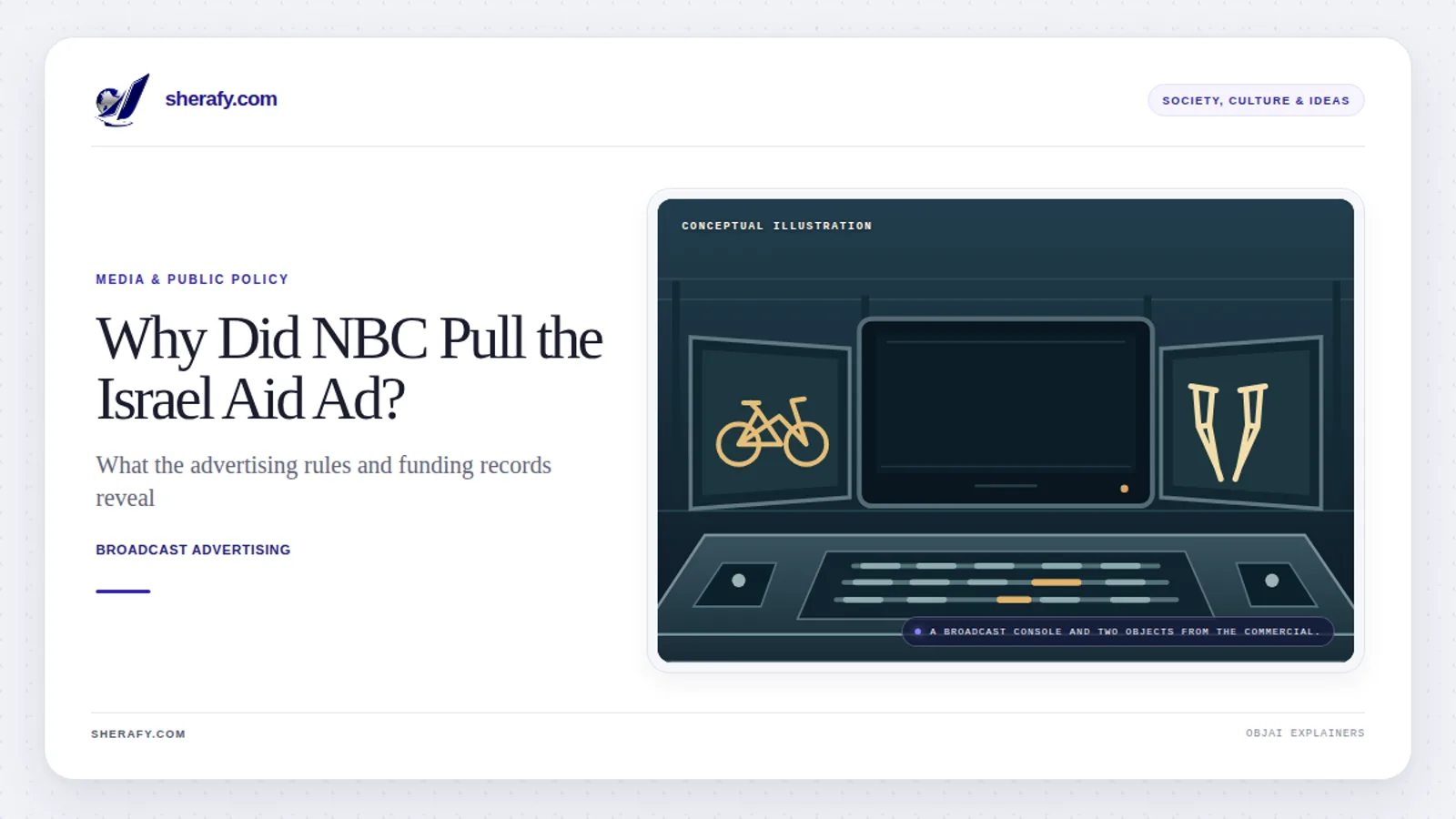
NBC reportedly decided not to air an advertisement opposing U.S. military aid to Israel again after it attracted criticism from pro-Israel advocacy organizations. The commercial, broadcast during Saturday Night Live's Thanksgiving Eve special on November 25, 2026, contrasted an American child's purchase of a bicycle with the injury of a Palestinian child in Gaza.
Two days later, TheWrap and Business Insider reported that NBCUniversal's senior management had not been aware of the advertisement before it aired and that the company intended to reconsider its approval procedures. Whether additional broadcasts had actually been scheduled remains unknown. Neither report identifies a particular factual error or advertising standard that NBC determined the commercial had violated.
The evidence presents a more complicated picture than the political arguments surrounding the advertisement. The Palestinian child's injury was documented by independent journalists long before the campaign. The funding figure is a rounded approximation of a real multibillion-dollar assistance program, rather than an exact payment rate. The implication that American assistance financed the particular attack that injured her, however, has not been independently established.
NBC generally has the legal discretion to reject an advocacy advertisement, even one whose factual claims are substantiated. But its own October 2026 advertising guidelines also describe an approval system intended to accommodate competing political viewpoints.
The central unanswered question is what changed between the advertisement's original acceptance and NBC's reported decision against further broadcasts. Did the company identify an evidentiary problem, reconsider the advertisement's suitability, or respond to political pressure? The chronology makes the last explanation credible, but the public record does not yet establish the company's precise reasoning.
What happened to the NBC Israel aid advertisement?
The advertisement is titled Every Three Seconds. It was purchased by the Institute for Middle East Understanding Policy Project (IMEU Policy Project), a U.S. advocacy organization affiliated with the Institute for Middle East Understanding and focused on Palestinian rights.
The original campaign announcement identifies the November 25 national television placement and its purpose: encouraging Americans to oppose a prospective new military assistance agreement between the United States and Israel.
The commercial follows an American girl who saves $400 over the course of a year to buy a bicycle. It then contrasts her experience with that of a Palestinian girl standing on crutches amid damaged buildings. The narration compares her savings with the amount of American taxpayer money allocated to Israel over an equivalent three-second interval. Viewers are directed to the campaign's No More for Israel website, which offers a way to contact members of Congress.
Contemporary accounts describe a 30-second television spot; the campaign website also describes a 45-second version. An authenticated recording of the exact NBC broadcast cut was not available for this investigation, so the online version should not be assumed to reproduce every detail of the television placement.
It was paid political advocacy, not an NBC News report, an editorial statement by the network or a sketch produced by Saturday Night Live.
Timeline of the advertisement and NBC's reported response
| Date | Development |
|---|---|
| November 24, 2026 | Advance reporting identifies the planned advertisement. The campaign announces its intended broadcast and policy objective. |
| November 25, 2026 | NBC airs the advertisement during its SNL Thanksgiving Eve special. |
| November 25–27, 2026 | Advocacy organizations and other public figures criticize the commercial. Some objections were reportedly raised before it aired. |
| November 27, 2026 | The National Jewish Advocacy Center publishes a letter seeking substantiation and advertising records. |
| November 27, 2026 | News outlets report that the commercial will not run again on NBC and that the network intends to evaluate its approval procedures. |
| November 27, 2026 | IMEU expresses disappointment at the reported decision and defends the accuracy and prior review of its commercial. |
The chronology is supported by the campaign announcement, NJAC's published letter, and Jewish Telegraphic Agency's account of the controversy.
The word pull requires qualification. The available reporting supports a decision against future broadcasts. It does not establish that NBC canceled an existing contract, refused to honor additional paid placements or removed the advertisement from every platform it operates. The original advertising order and total purchase price were not available for review.
Who paid for the NBC Gaza ad, and why did it air now?
The named sponsor is the IMEU Policy Project. That establishes the organization responsible for purchasing the advertisement, not a complete accounting of the donors who ultimately financed its activities. No verified donor-level breakdown for this particular purchase was located.
The timing is connected to negotiations over the future of U.S. military assistance to Israel. The current ten-year memorandum of understanding (MOU) covers fiscal years 2019 through 2028. The Congressional Research Service's June 2026 analysis of prospective changes to military assistance explains that such agreements represent political commitments rather than legally binding treaties. Congress retains authority over appropriations.
Although President Donald Trump had indicated that military aid could end, U.S. Ambassador to Israel Mike Huckabee's November 24 remarks raised questions about whether assistance could cease by year's end without congressional action. Discussions have also involved replacing some traditional financing with cooperative defense programs or joint investments.
The campaign cites reports of a potential five-year agreement worth at least $19 billion. That is a prospective figure, not a finalized agreement independently established in the record reviewed for this article. The distinction is important because the advertisement is aimed at influencing a policy decision that remains open to political debate.
Who is Miral al-Babli, the Palestinian girl in the NBC ad?
The IMEU Policy Project identified the child as Meral al-Babli, saying she lost a leg when an Israeli strike on her home killed her mother and grandmother. Independent reporting spells her name Miral al-Babli.
There is substantial evidence about the child that predates the advertisement and the controversy surrounding it:
- On December 30, 2025, Egyptian independent publication Mada Masr published a field-reporting project about Gaza's child amputees. It reported that Miral survived an Israeli airstrike on her home, lost her right leg and was living with her grandfather after losing family members.
- On August 20, 2026, Associated Press photographer Abdel Kareem Hana documented Miral participating in a swimming rehabilitation program organized by HEAL Palestine in Khan Younis. AP independently identified her by name and documented her limb loss during the war.
These are not merely accounts repeating claims from the November advertising campaign. Both predate it. The injury and the child's existence are independently corroborated, and Mada Masr's original reporting supports the account of the strike on her home.
The reports do not establish every element of the advertiser's account. The precise date of the strike, the identities of all family members killed and the source of the munition have not been independently verified here. The advertiser's identification of her as nine also warrants attribution, since Mada Masr reported the same age nearly a year earlier.
There is no independent authentication of the commercial footage against the original broadcast recording. Nonetheless, the available evidence substantially corroborates the account of the child named by the advertiser.
Does the United States really give Israel $400 every three seconds?
The claim is approximately correct in scale, but it is not mathematically exact under the current baseline assistance agreement.
The Obama administration's original announcement of the 2016 MOU establishes a ten-year commitment of $38 billion, subject to congressional appropriations. This consists of $33 billion in Foreign Military Financing (FMF) grants and $5 billion for missile defense, or $3.8 billion annually.
A 365-day year contains 10,512,000 three-second intervals. Dividing the annual funding amount by that number gives the following equivalents:
| Annual funding basis | Annual amount | Equivalent per three seconds |
|---|---|---|
| Foreign Military Financing | $3.3 billion | $313.93 |
| Missile defense | $500 million | $47.56 |
| Combined MOU baseline | $3.8 billion | $361.49 |
| MOU baseline plus identified FY2026 cooperative programs | $4.002 billion | $380.71 |
| Exact equivalent of the advertisement's claim | $4.2048 billion | $400.00 |
Calculation: annual funding × 3 ÷ (365 × 24 × 60 × 60). Figures are rounded to the nearest cent. The rates represent annual spending averaged over time, not the actual frequency of transfers.
The commercial's $400 figure is approximately 10.65% higher than the existing annual MOU baseline. The broader FY2026 illustration incorporates the additional $202 million for cooperative defense programs outside the MOU identified by the June 4, 2026 CRS report. On that basis, the difference is approximately 5.1%.
The broader calculation is illustrative, not a comprehensive total of all U.S. military assistance for the fiscal year. Cooperative research, procurement, financing grants and direct transfers are distinct forms of support. Some funds are spent on U.S. contractors rather than transferred directly to the Israeli government. The missile-defense component also should not be described as funding offensive operations.
What about the claim that Israel has received more than $330 billion?
The campaign's website uses the three-second comparison on a second basis: its assertion that cumulative assistance since 1948 exceeds $330 billion after adjusting for inflation. Averaged across 78 years, $330 billion is about $402.47 every three seconds, using the same simplified 365-day convention.
However, this calculation only demonstrates that the campaign's arithmetic is approximately consistent with its own historical total. It does not establish the historical total itself.
The May 2025 CRS report on U.S. foreign aid to Israel gives approximately $174.97 billion in nominal obligations from 1946 through FY2025 and cites an estimated $298 billion in inflation-adjusted obligations for 1946–2024, expressed in 2024 dollars. Its historical series includes economic aid as well as military assistance. Different endpoints, inflation base years and definitions of aid can produce different cumulative figures. The campaign's full historical calculation was not available to reproduce its $330 billion figure independently.
Its third basis is a possible future agreement of $19 billion or more over five years. At exactly $19 billion, the annual average is again $3.8 billion, equivalent to $361.49 every three seconds. The actual terms of a successor MOU remain unconfirmed.
The three figures therefore represent different things: historical assistance, the current annual military commitment and an estimate of possible future assistance. They should not be used interchangeably.
The commercial's numerical claim is an imprecise approximation, not an invented order of magnitude. For a more extensive breakdown of the financing arrangements, see sherafy.com's investigation into whether the United States is ending military aid to Israel.
Does U.S. military aid contribute to civilian injuries in Gaza?
Yes, in the broader sense that American financing, equipment and support materially contribute to Israel's military capabilities. American-made weapons have also been independently documented in attacks that harmed Palestinian civilians. But that does not identify the origin of the particular weapon that injured Miral.
The distinction matters because the commercial's imagery links a general funding statistic to one specific human consequence.
The CRS reports establish the purpose and mechanisms of military financing. In separate incidents, Amnesty International's December 2023 investigation identified American-made munitions through physical evidence and investigated the circumstances of the attacks. Amnesty is a human-rights advocacy organization; the evidentiary value here rests on its documented investigative findings, not on automatic acceptance of its broader legal or political conclusions.
A U.S.-manufactured weapon is not necessarily purchased with an American financing grant. Establishing that a specific strike was financed by American taxpayers would require a further chain of evidence about the weapon, procurement and use.
| Proposition | Evidence assessment |
|---|---|
| The United States supports Israel's military capabilities. | Established by government records. |
| American-made weapons have been used in attacks harming Palestinian civilians. | Independently documented in separate incidents. |
| U.S. military assistance contributes materially to Israel's overall operational capacity. | Strongly supported by the structure and purpose of the assistance program. |
| American taxpayer funds financed the attack that injured Miral. | Not independently established. |
| Injuring children is the stated purpose of American assistance. | Not supported by the assistance agreements. |
The lack of incident-specific evidence does not erase the broader documented relationship between American military support and civilian harm. Nor can that relationship substitute for evidence about a particular strike.
How many children in Gaza have lost limbs?
Miral's injury is part of a much larger rehabilitation crisis. The World Health Organization's May 2026 trauma rehabilitation report and its underlying statistical tables provide the following figures:
| Measure | WHO finding |
|---|---|
| People injured from October 2023 through April 1, 2026 | 172,043 |
| Estimated people with potentially life-changing injuries | 43,011 (25%) |
| Estimated children with life-changing injuries | Approximately 10,000 |
| Estimated injuries requiring extended rehabilitation | 49,462–55,914 |
| Estimated limb amputations | 5,161–6,710 |
| Amputees clinically evaluated, September 2024 to May 2026 | 2,277 |
| Children among evaluated amputees | 18% |
| Prosthetics fitted | 502 |
| Lower-limb amputations among evaluated amputations | 76% |
| People needing further surgery to revise an amputated limb | 225 |
| Prosthetists working in Gaza | 8 |
| Patients awaiting specialist rehabilitation beds | More than 400 |
These estimates are not a census of unique patients with every type of disability. The report estimates injury categories and rehabilitation needs, while the age proportion is based on the patients evaluated. An individual may have multiple injuries or amputations. Applying the sample percentage mechanically to the total range would therefore produce an uncertain estimate, not an independently verified count of child amputees.
The WHO summary describes roughly one in five amputees as children. Separately, Mada Masr's December 2025 reporting attributed an estimate of 1,500 child amputees needing long-term rehabilitation to Gaza's Health Ministry. That is an attributed local estimate with a different source and date, not a directly comparable WHO count.
The available data establish a severe crisis involving children and inadequate access to rehabilitation. They do not establish a precise claim that multiple thousands of children have undergone amputations. The figure of approximately 10,000 children with potentially life-changing injuries encompasses many types of injury, not only limb loss.
Was the NBC advertisement misleading or antisemitic?
The strongest factual objection concerns the causal implication of the words "to do this." Those words can suggest more than one proposition:
- American assistance enables military operations that have caused injuries like Miral's.
- American assistance funded the specific attack that injured her.
- American assistance is provided with the deliberate purpose of injuring children.
The first proposition has substantial documentary support. The second has not been independently proven for Miral. The third is a much stronger claim about intent, which the funding records do not establish. The advertisement's emotional juxtaposition invites scrutiny of its causal implication, even when the underlying funding and humanitarian facts are genuine.
The National Jewish Advocacy Center's published November 27 letter adopts the stronger interpretation, alleging that the commercial falsely presents the U.S. government as paying Israel to maim children. It asks NBC to disclose the evidentiary basis for airing the advertisement. The published excerpt acknowledges that debating American military assistance is legitimate and that the advertiser had no statutory entitlement to airtime. The full downloadable letter was not available for inspection here.
That is a more specific objection than simply calling the message offensive. It warrants testing against the evidence, including the independently documented injury, the funding records and the unresolved incident-specific causal link.
Other critics, as reported by Jewish Telegraphic Agency, object to the absence of context about Hamas, the October 7 attacks and Israel's stated security objectives. Those matters are relevant to understanding the war. But a short advertisement advocating a particular funding policy does not become false simply because it fails to summarize the entire conflict. The pertinent question is whether omitted information materially changes the truth or interpretation of its actual claims.
Criticism of Israel's government or opposition to American assistance is not inherently antisemitic. Political criticism can, of course, incorporate antisemitic stereotypes or hostility toward Jewish people. That determination requires examining the actual language and imagery rather than the political identity of either the advertiser or its critics.
The available descriptions identify a message directed at American policy and Israeli military conduct, not Jewish people collectively. They do not establish the allegation of antisemitism. Because the exact broadcast cut remains unauthenticated, that conclusion should not be expanded into a categorical assessment of every detail of every campaign version.
The evidence supports criticism of the advertisement's numerical precision and its strongest causal implication. It does not support dismissing the documented funding or the child's injury as fabrication. Related questions about political advocacy and accusations of antisemitism are examined in sherafy.com's analysis of the Rebellion PAC Israel advertisement.
What do NBC's own advertising standards say?
This is where the controversy moves from a dispute about a commercial to a question about institutional accountability.
NBCUniversal's October 2026 Advertising Guidelines were issued approximately one month before the broadcast. Their sections on approvals, challenges and controversial issue advertising are particularly relevant.
How controversial advertisements are approved
The guidelines assign review responsibility to Advertising Standards. Ordinarily, advertisers submit preliminary creative materials and factual support, with changes and final materials supplied as necessary. Political and controversial issue advertisements are reviewed after an airtime purchase order is placed.
Pages 14–15 describe an approach that accommodates different religious and political views when assertions are factually grounded and within reasonable debate, subject to exceptions. The network can impose scheduling restrictions and reject certain material, including content it considers offensive or unsuitable for its programming.
The rules also give NBC broad discretion to investigate claims, require revisions, decline advertisements and withdraw approval of material inconsistent with its standards in emergency or unusually significant circumstances. They are not an unconditional guarantee of access.
The advertiser says the commercial passed NBC's factual review, and the broadcast itself indicates that it was accepted for airing. Neither establishes precisely what evidence was submitted or which people signed off on the final version.
A provision-by-provision assessment
| NBC policy area | Relevant page | What the public evidence establishes |
|---|---|---|
| Factual support for advertising claims | 3–4, 15 | Funding records and independent field reporting corroborate major underlying claims; incident-specific attribution remains unresolved. The original substantiation file is unavailable. |
| Acceptance of differing political positions | 14–15 | Opposing continued military assistance is a legitimate public-policy position. Its acceptance remains subject to the other guidelines. |
| Suitability for programming and audience | 3, 15 | NBC retains discretion. No specific suitability determination has been publicly identified for this advertisement. |
| Offensive or graphic content | 15 | The company can reject unsuitable material. No published finding establishes that this commercial breached the provision. |
| Withdrawal of approval | 3 | NBC has reserved the authority to reconsider acceptance. The circumstances and specific grounds for its reported decision are not public. |
| Formal advertising challenge | 8–9 | A defined process exists, but there is no evidence it was completed in this case. |
| Sponsor identification | 15 | The named sponsor is known. The exact broadcast recording is needed to check the required visual disclosure. |
One concrete example of the last requirement is the guideline specifying a sponsor identification display lasting at least four seconds and occupying a minimum of 4% of screen height in readable, contrasting type. Knowing which organization bought an advertisement is not the same as independently establishing that the on-screen disclosure complied with this requirement.
Did NBC follow its formal advertising challenge process?
The formal process described on pages 8–9 is more restrictive than an ordinary viewer complaint. It is intended for competitors within the same or a materially related industry, requires prior good-faith efforts to address the matter with the advertiser, involves written submissions shared with the challenged party and generally allows five business days for replies. NBC can seek additional responses.
Reports of the network's reconsideration appeared two calendar days after the advertisement aired. Criticism had also begun before the broadcast, and management had separate discretion to review the advertisement without a formal competitor challenge.
The published record does not show that the formal procedure was invoked or concluded. It would be premature to allege a procedural violation based only on the short interval. The more precise question is whether the decision was made through normal standards review, a management intervention or another process.
NBC generally treats clearance submissions as confidential. The missing information cannot simply be assumed to exist in the public political files required by federal law.
Who pressured NBC to reconsider the Israel aid advertisement?
Several organizations publicly objected to the advertisement or sought action from NBC. Their positions should be attributed to the specific speakers rather than generalized to Jewish Americans, Israelis or any other population.
| Organization or individual | Documented or reported involvement |
|---|---|
| National Jewish Advocacy Center | Published a letter contesting the commercial's factual implication and requesting supporting and advertising records. |
| Israeli-American Council | Reportedly sought corrective action and FCC scrutiny. |
| Jonathan Greenblatt, Anti-Defamation League | Publicly criticized NBC's broadcast decision. |
| Ted Deutch, American Jewish Committee | Objected to the advertisement's portrayal of the conflict and omitted context. |
| Orthodox Union and Union for Reform Judaism | Criticized the presentation or causal framing and called for accountability. |
| B'nai B'rith International and other advocacy organizations | Condemned the advertisement, according to contemporary coverage. |
| Israeli Foreign Ministry | Reportedly criticized the commercial; an original government statement was not independently authenticated for this article. |
| IMEU Policy Project | Defended the advertisement and expressed disappointment with the reported withdrawal. |
The NJAC letter, JTA's reporting and Business Insider's account establish the existence of organized opposition. They do not establish which objections, if any, were determinative inside NBC.
Advocacy organizations have the right to object to advertising, including advertising about Israel. The fact that an organization supports Israel or Palestine is not evidence that its claims are true or false. Nor does the existence of domestic pro-Israel advocacy establish that those organizations were acting on behalf of a foreign government.
Political pressure is a credible contributing explanation given the sequence of events and the reported involvement of senior management. It is not proof of a coordinated directive, a specific organization's control over NBC or an exclusive motive for the decision.
Did the FCC investigate or order NBC to stop airing the advertisement?
No such action has been established in the public record reviewed for this article. Requests for an FCC investigation, threats to file complaints, actual filed complaints, formal agency proceedings and regulatory findings are distinct events.
No FCC order requiring NBC to withdraw this advertisement was located. The Federal Communications Commission regulates broadcasting and sponsorship disclosures, but it is not a general authority for adjudicating the truth of political opinions. Section 326 of the Communications Act also restricts the FCC's censorship powers.
Can television networks legally reject political advertisements?
Generally, yes. American broadcast law distinguishes between advertisements purchased by legally qualified candidates for office and advertisements purchased by outside advocacy organizations. The classification can matter more to a broadcaster's acceptance obligations than the controversy surrounding the content.
47 U.S.C. § 312(a)(7) establishes reasonable-access requirements for legally qualified federal candidates seeking airtime on broadcast stations. 47 U.S.C. § 315 establishes equal-opportunity and no-censorship rules for qualifying candidate uses. The Supreme Court upheld federal candidates' statutory access rights in CBS v. FCC (1981).
Those protections do not automatically extend to every advertisement funded by a political campaign, party, PAC or independent organization. A qualifying candidate use is a specific legal category, generally involving an identifiable appearance or voice of the candidate, subject to statutory exceptions and FCC interpretations.
| Type of advertisement | General broadcast access rule |
|---|---|
| Legally qualified federal candidate seeking airtime for a candidacy | Reasonable access generally required; qualifying uses are protected against broadcaster censorship. |
| State or local candidate | No equivalent general federal reasonable-access entitlement; equal-opportunity and no-censorship rules can apply to qualifying uses. |
| Independent domestic issue advertisement | No general right to airtime; the broadcaster normally retains acceptance and content discretion. |
| Foreign-government-sponsored issue advertisement | No general right to airtime; subject to applicable disclosure requirements and other laws. |
| Ordinary commercial advertisement | No general right to airtime; subject to applicable law and company standards. |
These are principally rules for licensed broadcast stations. National network sales, local affiliates, cable distribution and streaming services are not legally interchangeable, and the same statutory broadcast access rules should not automatically be applied to online platforms.
The IMEU commercial is independent issue advocacy, not a qualifying candidate advertisement. The fact that NBC accepted it once does not create a general statutory obligation to keep accepting it.
The Supreme Court addressed antiwar advertising in 1973
In Columbia Broadcasting System, Inc. v. Democratic National Committee, 412 U.S. 94 (1973), the Supreme Court considered whether broadcasters were required to accept paid editorial advertising. One of the parties, Business Executives' Move for Vietnam Peace, wanted to purchase airtime advocating an end to American involvement in the Vietnam War.
The Court rejected a general right of access to paid editorial advertising under the Communications Act and the First Amendment framework at issue. The case demonstrates that disputes over antiwar advocacy on American airwaves long predate the present controversy.
Is NBC's decision a First Amendment violation?
A private broadcaster ordinarily has its own editorial discretion, and a refusal to sell airtime is not, by itself, a violation of an advertiser's First Amendment rights. A broadcasting license does not turn every advertising decision into government action.
Government coercion of private intermediaries can raise different constitutional questions. In National Rifle Association v. Vullo (2024), the Supreme Court explained that government officials cannot use coercive regulatory pressure on private parties to punish protected speech. The case concerned the sufficiency of allegations, not a final determination of liability.
No evidence reviewed here establishes that an American government official coerced NBC to reject the IMEU advertisement. Criticism from a foreign government, pressure by private advocacy organizations and coercion by an American regulator are legally distinct matters.
An advertising decision can therefore raise serious concerns about the concentration of media power and the consistency of corporate policies without necessarily being unlawful censorship.
Has NBC withdrawn controversial political advertisements before?
Yes. The current decision is not unprecedented, and earlier cases help distinguish what NBC may do from what federal law requires it to do.
| Case | Outcome and significance |
|---|---|
| 1973: Vietnam War opposition advertising | Supreme Court rejects a general legal entitlement to paid editorial airtime. |
| 2018: Trump immigration advertisement | NBC reverses its decision to carry a controversial campaign-sponsored commercial after further review. |
| 2024: Randall Terry presidential campaign | NBC and its affiliates carry graphic political advertising under candidate-access and no-censorship requirements. |
| October 2026: Israeli government advertising in Iowa | Local television airtime is purchased for foreign-government-sponsored issue advocacy. |
| November 2026: IMEU Policy Project | NBC airs a domestic advocacy commercial and reportedly decides against additional broadcasts. |
In November 2018, Reuters reported that NBC withdrew a Trump campaign advertisement concerning immigration after the commercial ran during a football broadcast. NBC attributed the reversal to the nature of the content. Associated Press reporting and NBC's own coverage also documented the decision. Campaign sponsorship by itself does not establish that the commercial was a qualifying candidate use protected from rejection.
By contrast, NBC affiliate WRAL reported in November 2024 that the network notified affiliates that nationally purchased advertisements for Constitution Party presidential candidate Randall Terry would air. The advertisements promoted his opposition to abortion using graphic imagery. WRAL explained that candidate qualification and federal broadcasting law restricted its ability to reject or alter the content; networks provided separate viewer advisories.
The 2018 case weakens any argument that NBC only reconsiders advertisements critical of Israel. The 2024 case illustrates why the carriage of disturbing candidate advertising does not necessarily establish a double standard against ordinary issue advertisements.
A finding of inconsistent enforcement would require a comparison of substantially similar advertisements under comparable standards, legal classifications, programming and decision-makers. The available examples raise that question but cannot answer it definitively.
Can foreign governments purchase political advertising on American television?
Yes, foreign-government-funded issue advocacy is not categorically prohibited, although election-related spending is subject to separate restrictions and sponsorship disclosures may be required.
On October 26, 2026, journalist Hannah Feuer reported in The Forward that the State of Israel purchased more than $50,000 in advertising across three Iowa television stations. The spots appeared during football and news programming and promoted the perceived American security and economic benefits of the U.S.–Israel relationship. The advertisements identified Clock Tower X as distributing the material for the Israeli government.
Two indexed advertising records identify the State of Israel through Clock Tower X as the advertiser:
| Station | Invoice date | Order number |
|---|---|---|
| KCWI | October 25, 2026 | 3350495 |
| WOI | October 31, 2026 | 3350484 |
The records identify Red Eagle Media Group as a billing intermediary. The KCWI invoice and WOI invoice were retrieved directly from the FCC and corroborate the station names, invoice dates, order numbers and billing intermediary. The Forward's document-based reporting remains the principal evidence for the total purchase amount.
The Department of Justice's Foreign Agents Registration Act records for Clock Tower X, registration 7649 provide a separate avenue for examining the firm's declared foreign-principal relationships and informational-material filings involving Israel and Havas Media Germany GmbH. These registrations should not be mistaken for a record of every television placement. See also sherafy.com's investigation of Clock Tower X and Israel's AI-focused communications campaign.
Foreign issue advocacy versus election spending
The Federal Election Commission's foreign national guidance describes prohibitions on foreign-national contributions and expenditures connected with American elections, including certain electioneering communications. Not every advertisement discussing public policy constitutes a prohibited election-related expenditure. The content, timing, legal classification and relevant financial and decision-making arrangements matter.
The FCC's 2024 foreign sponsorship identification rule extended its revised framework to paid issue advertising and certain paid public service announcements. In August 2025, the D.C. Circuit upheld the challenged revised rules in National Association of Broadcasters v. FCC. The rules address identification and reasonable diligence concerning foreign-government sponsorship in covered arrangements, rather than banning every such message.
There is an important contrast here: a foreign government can purchase airtime for policy advocacy while a domestic organization challenging American policy can be refused access. Both remain subject to the applicable broadcaster's discretion and relevant laws.
The Iowa purchase, however, was local television advertising. It is not evidence that NBC's national network approved an equivalent Israeli-government-funded advertisement. The purchase does not independently establish illegality, ideological discrimination by NBC or government control over its advertising decisions.
How can the public investigate who buys political ads on television?
Broadcasting law provides an important accountability mechanism: political advertising files.
Under 47 U.S.C. § 315(e) and 47 C.F.R. § 73.1943, licensed broadcast stations generally must maintain public records concerning qualifying requests to purchase airtime. The requirement extends beyond candidate advertising to messages relating to political matters of national importance. Such records generally remain available for two years.
Depending on the transaction and applicable provisions, the records can identify:
- Whether a qualifying purchase request was accepted or rejected.
- The rate charged, class of airtime and actual broadcast schedule.
- The candidate, election or national political issue addressed.
- The organization purchasing the advertisement, its contact information and certain officers or directors.
The FCC's 2019 political-file order and 2020 reconsideration order explain how licensees should make reasonable determinations about the issues addressed and disclose required information.
To investigate a specific purchase, visit the FCC Public Inspection Files portal, locate the call sign or licensed station that carried the advertisement, and examine its political files for the relevant year and non-candidate issue advertiser. Compare orders with invoices, revisions, cancellations and broadcast schedules when those records are available. For foreign sponsorship, the DOJ FARA database provides a separate source of registration and informational-material records.
National network inventory and locally purchased affiliate airtime are different. Certain network-originated sponsor-leadership records may be retained at network headquarters or an originating station under 47 C.F.R. § 73.1212(e). Searching a local affiliate will not necessarily reveal the complete national-network contract, much less confidential factual substantiation or internal executive deliberations.
No authenticated political-file record for the national IMEU purchase was located in this investigation. That is a limitation of the available evidence, not proof of a disclosure violation.
Why did NBC reconsider the ad? What is established and what remains unknown?
There are several plausible explanations for NBC's reported decision. They are not necessarily mutually exclusive.
| Possible explanation | Evidence and limitation |
|---|---|
| Political backlash contributed to reconsideration. | Organized criticism and the sequence of events support this inference. Internal decision-making records are unavailable. |
| NBC identified a factual substantiation problem. | The approximate funding claim and unresolved incident-specific attribution provide possible grounds for review. NBC has not publicly identified such a finding. |
| NBC reassessed suitability for its audience. | Its written rules allow such judgments. No specific suitability decision has been disclosed. |
| Senior management sought greater control over controversial ads. | Contemporary reporting indicates management was previously unaware of the commercial and plans to evaluate review procedures. The proposed changes are unknown. |
| There was no additional placement to cancel. | Future booked airings remain unconfirmed. A decision against repeating the ad is not proof of contract cancellation. |
| NBC systematically excludes Palestinian advocacy. | The case merits scrutiny, but establishing a systematic pattern requires comparable evidence across multiple advertising decisions. |
A public explanation from NBC, the final advertisement and its supporting materials, relevant purchase orders, records of subsequent changes, and any communications concerning the decision could materially change the assessment. No direct request for comment was sent by sherafy.com for this article; the accounts of the company's position are attributed to the reporting reviewed.
The evidence supports the conclusion that the advertisement was broadcast, that the underlying humanitarian example is substantially corroborated, that its principal funding figure is approximate and that its strongest incident-specific causal implication remains unverified. Organized criticism is documented. NBC's decision against further broadcasts and planned review are consistently reported, although the internal accounts may originate from the same knowledgeable source rather than multiple independent confirmations.
What remains undisclosed is the specific standard NBC concluded justified its decision, whether it received new evidence and whether comparable advertisements would receive comparable treatment.
This is not an argument that every advocacy organization deserves guaranteed television airtime. It is an argument that institutions claiming to evaluate political advertising on factual and suitability grounds should be judged by the consistency of those standards, rather than by the volume or influence of the objections they receive.
Having the legal right to reject a message is not the same as having a defensible reason to do so.
References and Further Reading
NBC advertising policies and original campaign materials
- NBCUniversal Advertising Guidelines, October 2026 (NBCUniversal). The governing corporate policy document. Pages 3–4 address general approvals and review; pages 8–9 cover formal challenges; pages 14–15 explain controversial issue advertising and disclosures.
- Every Three Seconds (IMEU Policy Project). Original campaign announcement establishing the advertisement's sponsor, scheduled broadcast and policy objective. An interested-party source, not independent verification of its claims.
- No More for Israel (IMEU Policy Project campaign). Presents the campaign's historical, current and prospective funding arguments and the longer advertisement version. The historical calculation was not independently reproduced.
- Every Three Seconds, campaign video (IMEU Policy Project). Original campaign material; not independently authenticated as identical to the 30-second NBC broadcast cut.
- Letter to NBCUniversal, November 27, 2026 (National Jewish Advocacy Center). Primary evidence of the organization's objection and request for records. The publicly accessible excerpt was reviewed; the full downloadable attachment was not independently retrieved.
Contemporary reporting on the advertisement
- NBC Will Not Air Ad Opposing U.S. Military Aid to Israel Again After Backlash (A.J. Katz, TheWrap, November 27, 2026). Entertainment-industry reporting on the decision, management's reported lack of prior awareness and the uncertain booking status.
- NBC Is Reviewing Its Ad Process After a Commercial Calling for an End to U.S. Aid to Israel Drew Backlash (Lara O'Reilly, Business Insider, November 27, 2026). Additional reporting on the company's planned review, criticism and the advertiser's response. Its internal-source account is not necessarily independent of other corporate briefings.
- Groups Criticize NBC Over Advertisement Aired During SNL's Thanksgiving Special (Sharon Udasin, Jewish Telegraphic Agency, November 27, 2026). Documents the advertiser's identification of the child and the positions of several organizations critical of the advertisement.
- Jewish Leaders Criticize NBC Over the SNL Thanksgiving Advertisement (Danielle Cohen-Kanik, Jewish Insider, November 26, 2026). Contemporary record of objections and how critics interpreted the commercial; those interpretations are not independent factual findings.
- Gaza Group to Air Defund Israel Ad During SNL (Semafor, November 24, 2026). Advance reporting identified by the sponsor. The full article could not be independently accessed, so the scheduled placement is established principally through the sponsor's announcement and subsequent coverage.
Government records and military assistance data
- Fact Sheet: Memorandum of Understanding Reached with Israel (White House, September 14, 2016). Primary announcement of the $38 billion ten-year political commitment, including the $33 billion financing and $5 billion missile-defense components.
- Possible Changes in U.S. Military Aid to Israel: Considerations for Congress (Congressional Research Service, IN12695, June 4, 2026). Explains the nonbinding nature of assistance MOUs, their relationship with congressional appropriations, possible replacement arrangements and the $202 million in FY2026 cooperative programs outside the current MOU.
- U.S. Foreign Aid to Israel: Overview and Developments Since October 7, 2023 (Congressional Research Service, RL33222, May 28, 2025). Historical assistance totals, definitions of funding categories and inflation-adjusted estimates; Table 1 is especially relevant.
- U.S. Aid to Israel in Four Charts (Council on Foreign Relations). Supporting synthesis of historical assistance data and the role of inflation adjustment.
- Huckabee Casts Doubt on Trump's Claim That U.S. Aid to Israel Will End This Year (Times of Israel, November 24, 2026). Contemporaneous reporting of the ambassador's remarks concerning congressional authority and the existing agreement.
Humanitarian evidence and independent field reporting
- Gaza's Child Amputees (Belal Abu Amer, Majdi Fathi, Rizek Eldremle, Saeed Jeras and Zuheir Dola, Mada Masr, December 30, 2025). Original field reporting about Miral al-Babli and other injured children that predates the advertising campaign. The indexed article was available; direct access was restricted during the final verification pass.
- Week in Pictures, August 2026 (Associated Press). Photojournalist Abdel Kareem Hana's August 20 photograph and caption independently identify Miral and document her rehabilitation after losing a leg during the war.
- Estimating Trauma Rehabilitation Needs in Gaza: May 2026 Update (World Health Organization). The original report, particularly pages 3–4, provides modeled injury ranges and observed patient-evaluation data. Its indexed tables were reviewed; direct PDF access was intermittent during final verification.
- WHO: Estimating Trauma Rehabilitation Needs in Gaza, May 2026 (WHO report summary hosted by the United Nations, May 12, 2026). Accessible summary and alternate document link explaining long-term rehabilitation needs and service limitations.
- Investigation of U.S.-Made Munitions in Israeli Airstrikes in Gaza (Amnesty International, December 2023). Original investigation based on evidence from separate civilian-harm incidents. It supports the general weapons connection, not an identification of the munition responsible for Miral's injury.
Broadcast law, court decisions and FCC regulations
- 47 U.S.C. § 312. Federal candidate reasonable-access requirements, particularly subsection (a)(7).
- 47 U.S.C. § 315. Equal opportunities, candidate-use censorship protections and political advertising purchase records.
- 47 U.S.C. § 326. Statutory limits on FCC censorship authority.
- 47 C.F.R. § 73.1943. Broadcast political-file obligations and record retention.
- 47 C.F.R. § 73.1212. Sponsorship identification, foreign sponsorship requirements and certain network-originated record provisions.
- Columbia Broadcasting System, Inc. v. Democratic National Committee, 412 U.S. 94 (1973). Supreme Court precedent rejecting a general entitlement to paid editorial broadcast advertising, including the Vietnam War opposition advertising dispute.
- CBS, Inc. v. FCC, 453 U.S. 367 (1981). Supreme Court decision upholding statutory reasonable-access protections for federal candidates.
- National Rifle Association of America v. Vullo (2024). Supreme Court opinion on the First Amendment limits of government coercion directed at private intermediaries; distinct from ordinary private advertising discretion.
- FCC Political File Order, FCC 19-100. Primary agency decision addressing disclosures concerning qualifying national political issues.
- FCC Order on Reconsideration, FCC 20-49. Further guidance on reasonable and good-faith political-file determinations.
- 2024 Foreign Sponsorship Identification Rule (Federal Register, July 16, 2024). Published regulatory text of the revised rules addressing issue advertisements and paid public service announcements.
- National Association of Broadcasters v. FCC, No. 24-1296 (D.C. Cir. 2025). August 1, 2025 appellate decision upholding the challenged revised foreign sponsorship identification framework.
- Foreign Nationals (Federal Election Commission). Guidance on restrictions on foreign election-related contributions and expenditures.
- FCC Public Inspection Files. Official repository for public broadcast records, including qualifying political advertising purchases.
Historical comparisons and foreign-government-sponsored advertising
- NBC and Fox News Pull Trump Campaign Advertisement (Reuters, November 5, 2018). Contemporary reporting on NBC's earlier reversal of an advertising decision and the stated basis for it.
- Fox News and NBC Stop Airing Trump Immigration Advertisement (Associated Press, via CBS News, November 5, 2018). Additional contemporaneous documentation of the withdrawal.
- NBC and Fox News Pull Trump Immigration Advertisement (NBC News, 2018). NBC's own news reporting on the earlier advertising controversy.
- NBC Stations, Including WRAL, Air Graphic Ad for Third-Party Presidential Candidate (WRAL, November 1, 2024). Affiliate reporting illustrating how statutory candidate access constrains a broadcaster's ability to reject or modify campaign advertisements.
- TV Ads for Israel Are Airing During NFL Games in Iowa. Why? (Hannah Feuer, The Forward, October 26, 2026). Original document-based reporting on the Israeli government's local television advertising purchases.
- Clock Tower X, Registration No. 7649 (Department of Justice, FARA database). Official foreign-agent registration and informational-material records associated with the Israeli government. The registration number is a required URL parameter, not tracking information.
- KCWI advertising invoice, order 3350495 (FCC public-file document). The FCC-hosted invoice confirms the station, order number and October 25, 2026 invoice date.
- WOI advertising invoice, order 3350484 (FCC public-file document). The FCC-hosted invoice confirms the station, order number and October 31, 2026 invoice date.
Related sherafy.com research
- Is the U.S. Ending Military Aid to Israel? What Happens Next. Companion analysis of military assistance, the memorandum of understanding and the funding arithmetic.
- Rebellion PAC Israel Ad: Antisemitism, Aid and Political Money Explained. Related investigation into political advertising, economic claims and accusations of antisemitism.
- How Israel's AI Propaganda Campaign Targets Chatbots. Additional context on Clock Tower X and foreign-government-funded communications.
Editorial Currency Note: This article reflects research available through November 27, 2026. NBC's reported review, possible complaints or regulatory proceedings, military assistance negotiations and humanitarian estimates may develop. The exact broadcast recording, complete internal clearance file, original IMEU advertising contract, complete NJAC letter attachment, and original Israeli government response remain unavailable or incomplete in the research reviewed. Statements about NBC's internal motives are explicitly distinguished from the established chronology. No direct requests for comment were sent. The historical aid calculation uses the specified CRS reporting period, and WHO statistics are dated to their underlying assessment. Material new evidence should be incorporated in accordance with sherafy.com's Editorial Standards and Source Evaluation & Evidence policy.