Laura Loomer cannot legally be imprisoned for being anti-Muslim, for attacking Rashida Tlaib, or for demanding that a political event be canceled. The First Amendment protects even ugly, discriminatory and deeply offensive political speech.
But Florida law draws a different line when someone maliciously threatens harm to another person’s reputation, property or interests in order to force that person to do—or stop doing—something against their will.
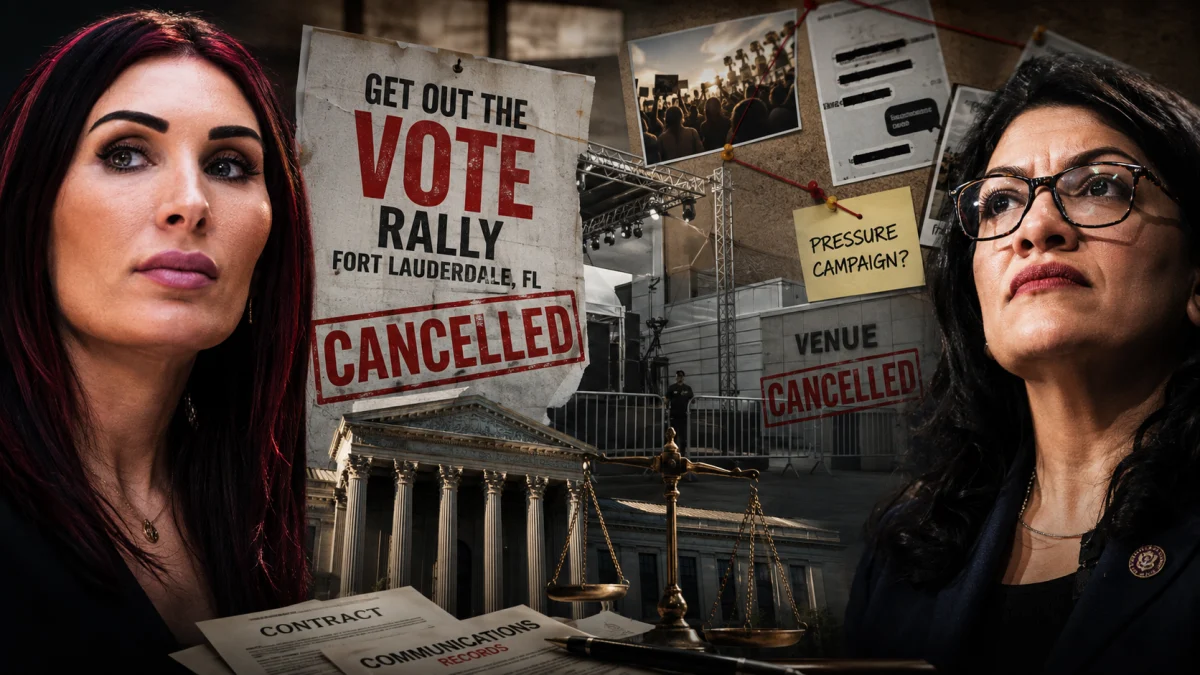
That distinction makes the August 2026 cancellation of a Fort Lauderdale get-out-the-vote rally featuring Rep. Rashida Tlaib more legally interesting than the partisan shouting surrounding it suggests.
Florida’s extortion statute does not require a demand for money. It expressly covers certain threats made with the intent to compel another person to act or refrain from acting against their will. Extortion under the statute is a second-degree felony carrying a maximum sentence of 15 years in prison.
There is currently no public evidence proving Laura Loomer committed that crime.
There is, however, enough documented evidence to identify a remarkably specific unanswered question:
What, exactly, did Laura Loomer—or anyone acting with her—communicate to the venue before it canceled the event?
That question becomes especially important because Loomer publicly celebrated the cancellation, described the candidates in explicitly Islamic terms, has previously argued that Muslims including Tlaib should not be permitted to hold public office, and has separately explained that her political pressure campaigns sometimes begin privately before she turns to her massive public platform.
If the communications show nothing more than protected political persuasion, the criminal theory largely collapses.
If they contain a conditional threat of reputational or other covered harm designed to force the venue to remove Tlaib or cancel the rally, Florida prosecutors could have a much more serious question on their hands.
That is why the messages matter.
What happened to Rashida Tlaib’s Florida rally?
The controversy centered on “Chomp the Oligarchy,” an August 14 get-out-the-vote rally organized by groups including Gen-Z for Change and the Florida Youth Justice Coalition ahead of Florida’s August 18 Democratic primary.
The event featured Democratic Rep. Rashida Tlaib and was intended to support three candidates seeking federal office: Angie Nixon for the U.S. Senate and Elijah Manley and Oliver Larkin for the U.S. House.
It was originally scheduled for The Venue Fort Lauderdale.
Florida Democratic state Rep. Michael Gottlieb, chairman of the Florida Legislative Jewish Caucus, publicly attacked the event, describing it as “anti-Jew” and criticizing Tlaib and the participating political coalition over their positions regarding Israel and Palestine. The Venue subsequently canceled.
The organizers and the venue provide significantly different accounts of why.
Gen-Z for Change said the venue demanded that organizers remove Tlaib from the event or lose the booking. According to Miami New Times, the organizers refused, after which the already-paid reservation was canceled.
The Venue’s attorney offered another explanation. He told Local 10 that Tlaib’s participation had not been disclosed when the venue was booked, that the business learned about her appearance through social media less than 24 hours before the event, and that police subsequently raised security concerns. He said the venue did not have enough time to make adequate security arrangements and denied that the cancellation was politically motivated.
That factual dispute is important. Any serious legal analysis has to include it.
Then there was Laura Loomer.
Miami New Times reported that Loomer had complained about the gathering and subsequently celebrated its cancellation. In a post highlighted by the newspaper, she referred to the participants as “DSA Islamic Communist Candidates,” announced that the event had been “Loomered,” and said it had been shut down after she publicly exposed it.
That is evidence that Loomer wanted the original gathering stopped and believed she played some role in accomplishing it.
It is not evidence, by itself, of extortion.
The legally important question is what happened before the victory lap.
Florida’s extortion law is much broader than most people realize
When Americans hear “extortion,” they generally imagine someone saying: Give me $100,000 or I release your secret.
Florida Statute §836.05 goes considerably further.
The law covers a malicious threat communicated verbally or in writing to injure another person, their property or their reputation, expose them to disgrace, expose certain secrets, or make specified accusations when the threat is made either to obtain money or to compel someone to perform or refrain from performing an act against their will.
That second branch is crucial.
Money does not have to change hands. Money does not even have to be requested.
Florida courts have applied the statute to attempts to force someone to stop doing something.
In McKee v. State, for example, a Florida appellate court upheld an extortion conviction involving a defendant who threatened to “destroy” another man and his business if the man continued contacting the defendant’s wife. The objective was not obtaining money; it was compelling another person to refrain from an act.
Florida’s standard extortion elements similarly recognize two alternative objectives: obtaining money or pecuniary advantage, or compelling someone to act or refrain from acting against their will.
A conviction under §836.05 is ordinarily a second-degree felony. Florida law permits imprisonment for a second-degree felony for up to 15 years.
None of that establishes that Loomer violated the statute.
It does establish why the contents of any private communications cannot simply be dismissed as irrelevant political gossip.
The entire case could turn on the difference between a demand and a threat
Consider two hypothetical messages.
The first says:
I think hosting Rashida Tlaib is disgraceful. You should cancel this event. I intend to criticize you publicly if you do not.
That presents formidable First Amendment protection. Political activists routinely organize boycotts, criticize businesses and urge them to change their behavior.
Now imagine materially different evidence:
Remove Rashida Tlaib or cancel this event, or I will use my platform to portray your business as supporting antisemitism and mobilize my audience against your reputation and business.
That does not automatically establish extortion either.
But it creates a dramatically different legal question because it contains the features prosecutors would be looking for: a communicated threat, threatened reputational or potentially economic harm, a conditional demand and an intent to compel another person to perform an act against their will.
The exact wording, context, intent and surrounding conduct would matter enormously.
This is why declaring either “obviously protected speech” or “obviously extortion” before seeing the communications is premature.
Laura Loomer has already described how her pressure campaigns work
There is another fact that makes preservation of those communications particularly important.
In a 2025 investigation into Loomer’s influence over personnel decisions in the Trump administration, ABC News documented a recurring pattern in which Loomer targeted officials she considered disloyal and exerted pressure on people capable of removing them. ABC found that her campaigns had been associated with numerous personnel departures.
More importantly, Loomer described her method herself.
“Sometimes I go private, and then sometimes I post,” she told ABC.
That statement does not prove she privately contacted The Venue Fort Lauderdale.
It does something narrower but significant: it makes asking whether she did so an evidence-based investigative question rather than speculation.
Loomer has publicly acknowledged that private approaches followed by public pressure can be part of her political strategy. She subsequently claimed credit for the cancellation of this particular event.
A prosecutor—or investigative journalist—would logically want to know what occurred between those two points.
The First Amendment is a serious defense, but not an automatic answer
This analysis should not minimize Loomer’s constitutional rights.
Political criticism, advocacy, organized pressure and boycotts sit close to the core of the First Amendment.
The U.S. Supreme Court’s landmark decision in NAACP v. Claiborne Hardware Co. afforded substantial constitutional protection to nonviolent political boycotting, advocacy and social pressure. Government cannot simply turn controversial political organizing into unlawful coercion because powerful targets dislike being pressured.
That principle strongly protects Loomer’s right to say that Tlaib should not appear, to condemn the venue, to encourage people not to patronize it and to urge its owners to cancel.
But protected objectives and protected speech do not give someone blanket immunity for independently criminal conduct.
Florida confronted a related argument in Carricarte v. State. There, a defendant threatened a developer with various forms of pressure—including newspaper publicity and organized opposition—while seeking to obtain a financial benefit. The Florida Supreme Court rejected the argument that the lawful character of those threatened activities automatically insulated the conduct from the extortion statute, warning against turning the First Amendment into an “instrument of leverage for the influential.”
Carricarte is not a perfect factual match for the Loomer situation. It involved a demand for financial benefit, and political organizing deserves extremely strong constitutional protection.
But the case undermines an overly simplistic defense that goes like this:
“Public criticism is legal, therefore threatening public criticism can never form part of extortion.”
Florida law is more complicated than that.
Loomer’s statements about Muslims and Rashida Tlaib could matter to intent
The strongest article about this incident does not need to speculate about whether Laura Loomer secretly dislikes Muslims.
She has publicly explained her position.
At the India Today Conclave in March 2026, Loomer argued that Muslims should not hold public office in the United States and specifically criticized Muslim American officials including Rashida Tlaib. India Today reported her position as advocating that Muslim officeholding should be illegal.
Her own publication has separately characterized Tlaib and Rep. Ilhan Omar as “Jihadist Reps.”
Those statements do not themselves establish a crime, and political or religious prejudice is not a substitute for proving the elements of one.
But if prosecutors were examining whether an effort to remove Tlaib from a political event was intentional, Loomer’s previous statements specifically identifying Tlaib as one of the Muslim politicians she believes should not hold office would be obvious contextual evidence to examine, subject to normal evidentiary rules.
And Florida prosecutors would not necessarily need to prove that Loomer personally “hated” anyone.
In the Florida Supreme Court’s 2023 Tomlinson v. State decision, the court held that the word “maliciously” in §836.05 refers to conduct undertaken intentionally and without lawful justification; the state does not have to establish personal hatred or ill will as a separate element.
That distinction matters.
A prosecution would have to prove conduct and intent—not win a philosophical argument about whether Loomer qualifies as an Islamophobe.
There is also a federal get-out-the-vote question
Florida extortion law is the clearest potential avenue raised by the public evidence.
There is also a narrower federal question worth examining.
The canceled gathering was explicitly promoted as a “Get out the Vote Rally,” and the candidates it supported were seeking seats in the U.S. Senate and House.
Under 52 U.S.C. §20511, a person can face criminal penalties if, in an election involving federal office, they knowingly and willfully intimidate, threaten or coerce—or attempt to intimidate, threaten or coerce—someone for registering or voting or for urging or aiding another person to register or vote. The statute carries a maximum prison term of five years.
That does not mean interfering with any campaign rally becomes federal voter intimidation.
A prosecutor would need evidence connecting the alleged intimidation or coercion to the protected voting or voter-assistance activity covered by the statute. Opposition to Tlaib’s politics, standing alone, would not establish that connection.
Still, the federal-election component cannot simply be ignored when the event itself was advertised as GOTV activity supporting congressional and Senate candidates days before a primary.
It is a legitimate secondary line of inquiry.
The venue’s own explanation could seriously weaken any criminal case
A responsible investigation also has to follow evidence that may exonerate Loomer.
The Venue says Tlaib’s participation was not properly disclosed, that it discovered her scheduled appearance shortly before the event, that police became involved over security concerns and that there was insufficient time to make appropriate security arrangements.
If contemporaneous emails, booking records and police communications substantiate that explanation—and show the venue independently decided to cancel regardless of outside pressure—the theory that Loomer coerced the business becomes substantially weaker.
Similarly, if Loomer never privately contacted the venue and did nothing beyond publishing criticism and asking publicly for cancellation, an extortion prosecution would face enormous factual and constitutional problems.
Those possibilities are not minor caveats.
They are precisely why the records should be examined instead of assuming guilt or innocence based on political allegiance.
What should investigators preserve?
The investigation practically writes its own evidence-preservation plan.
The first priority would be communications between Loomer, Loomer Unleashed, The Venue Fort Lauderdale, its owners or employees, and anyone communicating on Loomer’s behalf during the period immediately before the cancellation.
The second would be The Venue’s internal communications showing when management first learned Tlaib would attend, when the decision to cancel was made, what role outside complaints played, and whether organizers were actually given an ultimatum to remove Tlaib.
The booking agreement and any speaker-disclosure requirements would help test the venue’s explanation.
Law-enforcement records would establish when police were contacted, by whom, what threats or intelligence—if any—were reported, what security concerns officers identified, and whether officers recommended cancellation or merely discussed security precautions.
Investigators should also preserve Loomer’s posts, publication records, direct messages and relevant call metadata rather than relying on screenshots circulating after the fact.
And if evidence identifies another replacement venue that withdrew after similar outside pressure, the communications surrounding that cancellation should be examined independently rather than assuming the same people were responsible.
None of this requires beginning with an assumption that Loomer committed a felony.
It requires preserving the evidence capable of answering the question.
What would make the case collapse—and what would change everything?
The distinction is unusually clean.
If the evidence shows Loomer said, in substance, “I oppose this gathering, I think you should cancel it, and I am going to tell people what I think,” the criminal theory is weak. That is the type of political advocacy the First Amendment robustly protects.
If there was no private communication at all, that further weakens the theory.
If The Venue’s records show an independent security decision unrelated to Loomer’s pressure, causation becomes harder still.
But if authenticated communications instead show a conditional demand—remove Tlaib or cancel the rally, or I will inflict specified reputational, business or other covered harm on you—the legal analysis changes.
At that point prosecutors would have a communication, a threatened harm, an intended compelled act and Florida precedent establishing that extortion is not limited to demands for cash.
Whether those facts ultimately satisfy §836.05 beyond a reasonable doubt would be for prosecutors, a judge and potentially a jury—not social media—to determine.
The most important question is no longer whether Laura Loomer is Islamophobic
That debate almost misses the point.
Loomer is legally entitled to oppose Islam. She is legally entitled to despise Rashida Tlaib’s politics. She can argue that voters should defeat Tlaib and every candidate Tlaib supports. She can criticize businesses that host them.
The Constitution protects those rights precisely because political speech cannot depend on whether most Americans consider the speaker decent, fair or tolerant.
But constitutional protection for political opinion is not a license to commit otherwise prosecutable acts.
The public record now establishes several facts worth putting beside one another: Loomer has publicly argued that Muslims including Tlaib should not hold American political office; she has acknowledged a political pressure method that sometimes begins privately; a venue canceled an event after outside pressure; organizers say they were told to remove Tlaib or lose the venue; and Loomer subsequently celebrated the cancellation as something she had helped accomplish.
What the public record does not establish is the fact that would potentially transform this from controversial advocacy into a criminal case:
Did anyone threaten The Venue with covered harm in order to force it to cancel the rally or remove Rashida Tlaib?
That question can be answered.
The relevant people, devices, records and communications exist.
The proper demand is therefore not “put Laura Loomer in prison because we dislike her politics.”
It is considerably harder to dismiss:
Preserve the messages. Establish the timeline. Apply the statute to what actually happened. And if the evidence establishes every element of a felony, apply the same law that would apply to anyone else.
References and Further Reading
- Florida Statutes §836.05 — Threats; extortion — Official text of Florida’s extortion statute, including the provision covering threats intended to compel another person to act or refrain from acting against their will.
- Florida Statutes §775.082 — Penalties — Official Florida sentencing statute establishing a maximum term of 15 years for an ordinary second-degree felony.
- Tomlinson v. State, No. SC2021-1204 — Florida Supreme Court — Florida Supreme Court decision explaining the meaning of “maliciously” under the extortion statute and rejecting a requirement of personal hatred or ill will.
- Carricarte v. State — Florida Supreme Court — Important Florida extortion decision addressing threats involving publicity and organized opposition and the relationship between extortion law and First Amendment activity.
- McKee v. State — Florida Fifth District Court of Appeal — Illustrates that §836.05 can apply when the objective is compelling someone to refrain from conduct rather than obtaining money.
- NAACP v. Claiborne Hardware Co., 458 U.S. 886 (1982) — U.S. Government Publishing Office — Landmark U.S. Supreme Court decision protecting nonviolent political boycotts, advocacy and collective social pressure under the First Amendment.
- 52 U.S.C. §20511 — Criminal Penalties — Federal statute addressing knowing and willful intimidation, threats or coercion involving voting and activity urging or aiding others to vote in federal elections.
- After outcry, Broward venue cancels rally featuring Rep. Rashida Tlaib — Local 10 — Local reporting containing the venue’s explanation, its attorney’s account of the speaker-disclosure issue and reported security concerns.
- Fort Lauderdale venue cancels Democrat rally after Laura Loomer complaint — Miami New Times — Reports the organizers’ allegation that Tlaib’s removal was demanded and documents Loomer’s public celebration of the cancellation.
- Florida venue cancels rally with Palestinian American lawmaker Rashida Tlaib — Reuters — Independent reporting establishing the federal candidates involved, the GOTV context, the competing claims surrounding the cancellation and the August 18 primary.
- How Laura Loomer’s pressure campaigns are reshaping the Trump administration — ABC News — Detailed investigation of Loomer’s political pressure campaigns, including her own description of sometimes approaching matters privately before posting publicly.
- They put Islam before US: Donald Trump loyalist Laura Loomer on Zohran Mamdani, Ilhan Omar — India Today — Reporting from Loomer’s March 2026 appearance in which she argued against Muslims holding U.S. public office while identifying Rashida Tlaib among the Muslim officials she criticized.
Editorial note: This article analyzes publicly available evidence and potential legal issues; it does not assert that Laura Loomer has committed extortion, voter intimidation or any other criminal offense. No criminal charge identified in the sources reviewed establishes such a finding. Legal standards, investigative facts and available reporting may change as additional information becomes public.