Article type: analysis
Scope: Ontario defamation and anti-SLAPP analysis based on public materials available through 2026-09-09; no statement of claim, statement of defence, discovery record, or litigation-funding agreement was reviewed.
Last updated: September 9, 2026
Correction / Update — September 9, 2026: An earlier version of this analysis described the Benotto external review’s statement that Jonathan Karten obtained clinic owner Luke Chao’s “permission” to remove protesters as directly conflicting with The Grind’s statement that Karten did not appear to be acting on the owner’s “instruction.” On further review of the underlying wording, that characterization was too strong. Permission and instruction are related but not necessarily equivalent: a person can permit an action without having instructed another person to take it. Chao’s own public comments shortly after the November 5 incident provide additional context. In a podcast published November 13, 2025, before the defamation lawsuit, Chao criticized conduct on both sides. He criticized the physical handling of protesters while also criticizing the protesters’ conduct, and said he did not know whether the broken glass had been damaged intentionally or accidentally. In subsequent correspondence with sherafy.com, Chao further clarified that any permission he may have given Karten should not be understood as an instruction to use force. That clarification is consistent with the narrower distinction between “permission” in the Benotto report and “instruction” in The Grind’s article. The article has therefore been revised to distinguish permission from instruction or broader authorization and to avoid overstating what Chao’s evidence establishes. This correction does not change the separate evidence concerning who broke the glass, the alleged assault on Karten, or the broader legal analysis of the pending defamation case.
Update — August 27, 2026: On August 14, Toronto Metropolitan University released an external review led by former Ontario Court of Appeal Justice Mary Lou Benotto and lawyer Margot Finley. The report materially changes the public factual record surrounding the November 5 confrontation. It rejects the claim that Jonathan Karten broke the glass door, states that he obtained clinic owner Luke Chao’s permission before removing protesters, and rejects the characterization that Karten’s conduct was the only violence that occurred. The review does not decide Karten’s defamation lawsuit or establish criminal liability, but the analysis below has been revised to account for the new evidence.
On the public record available as of September 9, 2026, Jonathan Karten’s reported $1.3 million defamation lawsuit against Toronto publication The Grind still faces serious obstacles under Ontario’s anti-SLAPP law. But the factual record is now materially more favorable to Karten than it was when this analysis was first published.
An August 2026 external review commissioned by Toronto Metropolitan University rejects several propositions that had been central to competing accounts of the November 5 confrontation. The review says Karten did not break the shattered glass door, records that protesters repeatedly refused instructions to leave, and says Karten obtained the clinic owner’s permission before physically removing them.
None of that erases the videos showing Karten pushing and physically removing protesters, nor does it establish that every use of force was lawful or reasonable. But it substantially strengthens Karten’s argument that some factual statements surrounding that conduct went further than the available evidence justified.
The central conduct described in the disputed article—Karten forcibly removing pro-Palestinian protesters from an off-campus event—is documented on video and was independently reported by other publications. The story also concerns political protest, campus organizing, policing, alleged violence, and the Israel-Palestine conflict, placing it near the core of the public-interest expression that Ontario’s anti-SLAPP law was enacted to protect.
The lawsuit can therefore have a serious chilling effect even before a judge decides whether it has merit. A small publication must still retain lawyers, preserve evidence, respond to pleadings, and potentially endure years of litigation. When the requested damages exceed what an independent newsroom could realistically pay, the process itself can become a form of pressure.
That does not establish that Karten filed the case in bad faith, nor does it mean every statement in The Grind’s reporting is legally safe. A later Ontario court ruling records police evidence supporting an important part of Karten’s account: that one protester allegedly broke the glass door with a drill bit and struck him. That evidence complicates categorical statements in The Grind’s article suggesting there was no indication Karten had been attacked and that he probably injured himself on the broken glass.
The most defensible assessment is consequently narrower than either side’s public narrative. A sweeping victory for Karten—including recovery of anything close to $1.3 million—appears unlikely on the record now available. But a limited claim based on particular factual statements cannot responsibly be dismissed as frivolous without seeing the pleadings and evidence.
The strongest criticism of the lawsuit is functional rather than psychological: whatever Karten’s private motive, litigation of this scale can suppress reporting and discourage future criticism. Ontario law was designed to make courts confront that effect early.
What is actually known about the case
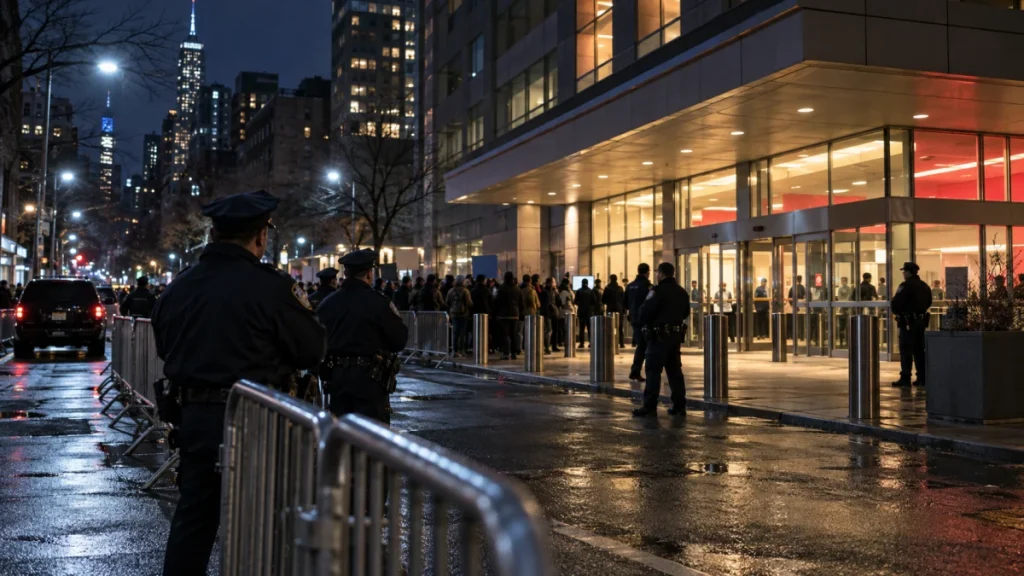
On November 5, 2025, Students Supporting Israel’s Toronto Metropolitan University chapter planned an off-campus event featuring Karten and another former Israel Defense Forces member. The event was held in rented space at the Morpheus Clinic for Hypnosis near Bay and Elm streets after TMU had declined to host it on campus.
Pro-Palestinian protesters entered the premises and disrupted preparations for the event. Videos published afterward show Karten holding an interior door shut while protesters were in or around the event room. The door’s glass panel shattered. Karten then moved through the broken opening, physically removed protesters from the room and lobby, and helped barricade the building’s entrance.
The videos do not clearly show the moment the glass was broken. Early accounts sharply diverged over who broke it, whether Karten was attacked, why he used force, and whether the force was reasonable.
On November 11, The Grind published an article titled “IDF Soldier Manhandles Toronto Students Who Disrupted Event.” It described Karten as locking protesters inside, becoming violent after the glass broke, shoving two women over furniture, and throwing protesters into a stairway. It also questioned his account that he had been attacked.
According to The Grind’s July 28, 2026 account of the litigation, Karten’s lawyer sent a notice of libel on December 16, demanding that the article be deleted and an apology published. The outlet says it reviewed the story, offered to investigate specified errors, offered to add comments from Karten, and continued to stand behind its reporting.
The Grind says Karten filed suit in February 2026 against the publication, publisher David Gray-Donald, former senior editor Fernando Arce, and senior editor Saima Desai, who the outlet says was on leave when the story appeared. It reports that Karten is seeking at least $1.3 million in damages.
Sherafy did not locate or review the filed statement of claim. That is a significant limitation. Without the pleading, the public cannot reliably know:
- the exact words Karten alleges are defamatory;
- the meanings he says readers would take from them;
- how the $1.3 million demand is divided among general, aggravated, punitive, or economic damages;
- whether he seeks an injunction or article removal in addition to damages;
- what evidence of reputational or financial injury he has pleaded; or
- which defenses The Grind has formally raised.
For now, even basic descriptions of the lawsuit come largely from one of the defendants. They should be treated as an informed but interested account, not as a substitute for the court record.
The core event is documented more strongly than many defamation disputes
This is not a case in which an outlet’s entire account depends on an anonymous source or an unrecorded private conversation.
Multiple recordings show Karten physically moving protesters. The Varsity reported that videos showed him grabbing two protesters, moving them through the shattered doorway, pushing the protesters into the lobby, and barricading the entrance. TorontoToday similarly reported that he could be seen grabbing and pushing protesters, including two who went over a chair and through the broken door opening.
Karten himself can be heard in video saying that he was going to physically remove them.
Those recordings give The Grind substantial support for the factual core of its story. Whether the headline term “manhandles” is legally treated as fact, opinion, or a combination of both will depend on how a court understands the article as a whole. But it is an evaluative description attached to conduct readers can largely observe for themselves.
Canadian defamation law also does not require a defendant invoking truth to prove every incidental detail with mathematical precision. The defense of justification generally concerns the substantial truth of the defamatory “sting.” If the essential sting is that Karten used significant physical force to remove protesters, the recordings and independent reporting provide The Grind with a meaningful defense.
That does not decide whether the force was criminal, lawful, excessive, defensive, or justified. Those are distinct propositions. Reporting that someone shoved protesters is not identical to asserting that the person committed a criminal assault.
The later court record exposes the danger of categorical reporting
Although the central removal is well documented, some of The Grind’s surrounding factual assertions are more vulnerable.
The original article stated that there was no indication in the videos that Karten was attacked and inferred that he probably cut his arm on the broken doorway. It also said, in categorical language, that Karten “gets violent” after the glass breaks.
A June 2026 Ontario Superior Court decision, R. v. Ibrahim, 2026 ONSC 3504, records a materially different evidentiary picture.
The decision concerned a protester’s challenge to warrants authorizing searches of his cellphone. It was not Karten’s defamation case and was not a criminal trial. Nevertheless, the judge summarized the police Information to Obtain, which was based on witness statements, supplied images, fingerprints, and surveillance recordings.
According to that record, six protesters followed Karten into the building. The police alleged that the applicant broke the interior door, then headbutted or punched Karten before fleeing. The judge found that the warrant record had a solid evidentiary basis connecting the applicant to the alleged incident, although the judge ultimately quashed the cellphone warrants because there were insufficient grounds to believe the phone contained relevant evidence and because the warrants were insufficiently particularized.
The distinction matters. The decision did not find the accused guilty. The underlying allegations remain untested at trial, and the accused is presumed innocent. But the ruling does show that Karten’s claim of having been attacked was not supported only by his own word or partisan media coverage. Police presented witness, fingerprint, image, and surveillance evidence supporting an alleged assault.
That creates a potential problem for any categorical suggestion that no attack occurred or that Karten simply invented a defensive explanation after the fact.
At the same time, the later record does not erase what happened next. Even if a protester broke the glass and struck Karten, a court would still have to distinguish that alleged encounter from Karten’s subsequent removal of several other people. An initial assault would provide important context, but it would not automatically establish that every later use of force was reasonable or legally justified.
The strongest version of Karten’s case may therefore concern specific statements minimizing or denying the alleged attack—not the publication’s entire account of him physically removing protesters.
The August 2026 Benotto review materially changes the factual record
On August 14, 2026, Toronto Metropolitan University released the final report of an external review led by retired Ontario Court of Appeal Justice Mary Lou Benotto, who worked with lawyer Margot Finley. The review examined, among other things, the November 5 confrontation at the Morpheus Clinic.
The report is important, but its evidentiary status requires some care. The reviewers received approximately 70 oral submissions and 40 written submissions from students, faculty, staff, security personnel, event organizers, advocacy organizations and others. The review says it sought input from approximately equal numbers of participants identifying with Jewish/Israeli and Palestinian/pro-Palestinian perspectives. It also expressly cautions that, when summarizing participant testimony, its purpose was to synthesize what it heard rather than adjudicate every contested factual question.
Even with that limitation, the report makes several unusually specific findings about the November 5 incident.
First, it says five protesters followed Karten and the SSI organizers into the premises, with two entering the lecture room itself. According to the report, Karten repeatedly told them to leave and they refused.
Second, the review addresses one of the most disputed facts surrounding the confrontation: who broke the glass door. It states, “We do not accept that Karten broke the door.” The reviewers say the glass was pushed inward while Karten was attempting to get the protesters inside the lecture space to leave. They also note that a drill bit was subsequently found near the shattered doorway. The report does not independently establish which particular protester broke the glass, so that narrower allegation should still be treated as unresolved unless established through the criminal proceedings.
Third, and particularly important to the defamation dispute, the report says clinic owner Luke Chao, who had been with a client, emerged as the glass door shattered and told people to “Get out.” It then states that Karten repeatedly directed the protesters to leave and, after obtaining Chao’s permission to remove them from the clinic space, began pushing them toward the exit. The reviewers say the protesters resisted his efforts.
The wording of the two sources is narrower than this article previously suggested. The Grind wrote that Karten did not appear to be acting on the “instruction” of the clinic owner to remove trespassers. The Benotto review, by contrast, says Karten obtained Chao’s “permission” to remove them from the clinic space. Those statements are not necessarily contradictory. Permission can exist without the property owner having instructed Karten to act.
The public sources do not establish the precise terms of the conversation that produced that permission, nor do they establish that permission to remove the protesters amounted to approval of every use of physical force that followed. The safer conclusion is therefore that Benotto establishes permission to remove the protesters, while The Grind’s published sentence addresses the narrower question of whether Chao instructed Karten to do so.
The review separately rejects the claim presented to it that Karten’s conduct represented the only violence during the incident and says the evidence pointed to the contrary, including evidence from Chao, whom it describes as an independent witness. That statement should not be read more broadly than the report establishes. The report says Chao had been with a client and emerged as the glass was shattering; it does not specify in that passage which particular part of Chao’s evidence supported its broader conclusion about violence.
Nor does Benotto’s account establish that every later push or physical removal by Karten was lawful, necessary or proportionate. The recordings remain independently relevant to those questions.
Chao’s own public comments shortly after the incident also resist a simple one-sided characterization of his position. In a November 13, 2025 episode of his podcast, released before Karten’s defamation lawsuit, Chao criticized conduct on both sides. He criticized putting hands on protesters while also criticizing the protesters’ conduct around the event, and he expressly said he did not know whether the broken glass had been damaged intentionally or accidentally. The episode does not describe the permission conversation between Chao and Karten, so it should not be used as evidence of the precise terms or scope of that exchange.
None of these findings decide Karten’s defamation lawsuit. The Benotto review is not a judgment in that case, and it was commissioned to examine TMU’s response to campus conflict rather than to determine civil liability between Karten and The Grind. Nor can a report released in August 2026 retroactively establish what The Grind knew or reasonably believed when it published in November 2025.
The report can still provide evidence relevant to whether particular factual statements were substantially true. On the property-owner issue, however, its significance is narrower than this article previously stated. The Grind’s published wording concerns the absence of an instruction from the owner; Benotto records permission to remove the protesters. The two should not be collapsed into a simple authorized-versus-unauthorized dispute.
The legal significance of that distinction will ultimately depend on the precise words Karten pleaded, their meaning in the context of The Grind’s article, and the evidence available to the publication when it reported the story. A report issued in August 2026 also cannot retroactively establish what The Grind knew or reasonably believed in November 2025.
Criminal charges do not settle the defamation case
Several protesters were charged after the incident, and additional charges were announced in 2026. Karten was not reported as having been charged.
Those facts are relevant, but neither is conclusive.
A criminal charge is an allegation, not a finding of guilt. Conversely, the absence of a charge against Karten does not establish that every action he took was lawful, reasonable, or accurately characterized by all observers. Police charging decisions can reflect the available evidence, prosecutorial standards, identification questions, jurisdictional considerations, and enforcement priorities that differ from the issues in a civil defamation trial.
A defamation court would examine the particular words published, the evidence available when they were published, any subsequent corrections, the article’s overall meaning, and the defenses raised. It would not simply treat the criminal charging record as a verdict on the journalism.
Ontario’s anti-SLAPP law is the lawsuit’s largest obstacle
If The Grind brings a motion under section 137.1 of Ontario’s Courts of Justice Act, the public-interest threshold should be comparatively easy to establish.
The proceeding plainly arises from expression about:
- a political protest;
- an event involving Israeli military veterans;
- campus organizing and institutional decision-making;
- alleged physical violence;
- police arrests and charging choices; and
- public debate over Israel, Palestine, antisemitism, and the Gaza war.
Under the Supreme Court of Canada’s decision in 1704604 Ontario Ltd. v. Pointes Protection Association, once defendants show that a proceeding arises from expression relating to a matter of public interest, the burden shifts to the plaintiff.
Karten would then have to establish grounds to believe that his case has substantial merit and that The Grind has no valid defense. He would also have to show that the harm likely suffered is sufficiently serious that the public interest in allowing the case to continue outweighs the public interest in protecting the expression.
This is not a miniature trial, and it is not enough for either side to make bare assertions. The court looks for a real prospect of success and conducts a proportionality analysis.
For Karten, the public record supporting the preliminary merits side of the analysis is now stronger than it was when this article was first published. The June 2026 court decision records police evidence supporting his allegation that he was attacked, while the August 2026 Benotto review rejects the claim that Karten broke the door and records that he obtained clinic owner Luke Chao’s permission before removing protesters. The latter point supports the existence of permission to remove them, but it should not be overstated as evidence that Chao instructed Karten to use force.
Those materials do not prove defamation, but they give Karten considerably more than his own account with which to challenge particular factual statements in The Grind’s reporting.
For The Grind, however, several substantial defenses appear available on the public record.
Truth or justification
The recordings support the central proposition that Karten forcefully removed protesters. A court would examine whether that substantially proves the sting of the words actually pleaded.
Fair comment
Descriptions such as “manhandles,” moral criticism of Karten’s conduct, and conclusions drawn openly from disclosed video may qualify as recognizable opinion based on facts, provided they are views a person could honestly hold and were not published maliciously.
Responsible communication on a matter of public interest
In Grant v. Torstar Corp., the Supreme Court recognized that public-interest journalism may be protected even when a factual allegation cannot ultimately be proved true, provided the publisher acted responsibly.
Relevant considerations include the allegation’s seriousness, the public importance and urgency of the story, source reliability, whether the plaintiff’s side was sought and accurately reported, and whether the public interest justified including the allegation.
The Grind says it attempted to reach Karten before publication. The original article included his and SSI’s claim that a protester broke the glass with a drill bit. In January 2026, it added Karten’s representative’s position that he acted to protect himself and those attending the event. After receiving the libel notice, the outlet says it offered to investigate specified errors and incorporate further comments.
If supported by contemporaneous emails, notes, drafts, and source records, those steps could materially strengthen a responsible-communication defense. If the editorial record instead shows that contradictory evidence was dismissed or that categorical conclusions outran what reporters could verify, the defense would be weaker.
Canadian law does not require Karten to prove “actual malice”
Public discussion of defamation cases often imports American First Amendment language into Canadian law. That can produce misleading predictions.
In Canada, Karten would generally establish a prima facie defamation case by showing that the words would tend to lower his reputation in the eyes of a reasonable person, referred to him, and were communicated to someone other than him. He does not initially have to prove falsity or satisfy the American “actual malice” rule merely because he spoke publicly or was involved in a controversial event.
Defenses such as truth, fair comment, privilege, and responsible communication then become central.
That structure means the case cannot be dismissed simply by saying Karten is a public figure, that the topic was political, or that criticism of military conduct deserves especially strong protection. Public interest is highly important under anti-SLAPP law, but it is not a license to publish serious factual accusations irresponsibly.
The $1.3 million demand is not evidence that $1.3 million was lost
The amount claimed is a demand, not a judicial valuation of harm.
Without the statement of claim, it is impossible to know what forms of damages Karten seeks or what events he says caused them. Even if the article was defamatory, a court would still have to consider the seriousness of the publication, its circulation, republication, corrections, the plaintiff’s existing reputation, the conduct of both sides, and the relationship between the publication and any proven economic or personal loss.
Causation may be particularly difficult here because the incident had already generated videos, social-media commentary, advocacy campaigns, and coverage by numerous other publications. Some outlets presented Karten as an aggressor; others portrayed him as a hero defending Jewish students from an armed mob. His reputation was being shaped by a large, polarized information environment in which The Grind was only one participant.
At the anti-SLAPP weighing stage, a plaintiff cannot necessarily rely on a large number in a pleading as proof of serious harm. The Supreme Court has emphasized that courts should look for evidence connecting the defendant’s expression to the harm alleged.
A court may recognize substantial reputational harm without accepting the full amount demanded. The realistic legal question is not whether criticism had consequences, but which consequences can fairly be attributed to particular false and defamatory statements by these defendants.
A chilling effect can exist without proof of a secret silencing plan
It would be irresponsible to state as fact that Karten filed the lawsuit solely to suppress criticism. His subjective motive is not established by the materials currently available.
It is also unnecessary to prove that motive before recognizing the lawsuit’s effect.
The Grind says it needs to raise $50,000 for its initial legal defense and that the case could force it to close. It expects the litigation may take years. Four defendants have reportedly been named, including individual editors. Those burdens would be significant even if the defendants ultimately prevail.
That is how speech can be chilled through civil litigation. The deterrent is not limited to the publication already sued. Other reporters, freelancers, organizers, and small outlets observe the cost of defending similar work. Future stories may be softened, delayed, abandoned, or never commissioned.
The chilling effect can be especially pronounced when reporting concerns people with access to professional networks and resources that appear far greater than those of a small newsroom. But unequal resources are not, by themselves, proof of abusive litigation. A well-resourced person retains the right to seek a remedy for genuinely false and damaging accusations.
The careful description is therefore that the case has a SLAPP-like effect and appears to be an appropriate candidate for anti-SLAPP scrutiny. Calling it a legally established SLAPP—or asserting bad faith as fact—would get ahead of the court.
Who is funding Karten’s lawsuit?
The honest answer is that the public sources reviewed do not say.
There is no located public crowdfunding campaign in Karten’s name, no publicly available litigation-funding announcement, and no reviewed pleading or retainer agreement identifying who is paying his lawyers. It is not known whether the case is self-funded, supported by another person or organization, handled under a contingent or reduced-fee arrangement, or financed through some other lawful structure.
Two corrections are important.
First, Karten is not publicly listed as a co-founder of “OZ Ventures.” The company is Awz Ventures, and its official team page lists Karten as a principal. It identifies Yaron Ashkenazi as founder and managing partner.
Nothing located in Awz’s public materials connects the firm to Karten’s defamation lawsuit. Employment at an investment firm is not evidence that the employer is paying an employee’s personal legal expenses. Nor should assets managed by investment funds be confused with Karten’s personal wealth or a litigation budget available to him.
Second, The Lawfare Project filed a U.S. Department of Education civil-rights complaint on Karten’s behalf in 2019, when he was a Columbia University student alleging antisemitic discrimination. That historical representation may explain speculation about its possible involvement now, but no public evidence reviewed connects the organization to the 2026 defamation action.
The contrast with The Grind is that the defendants have publicly disclosed their immediate funding strategy. The outlet says it is attempting to raise $50,000 from readers for its legal defense and has identified lawyers from the Community Justice Collective and Iler Campbell LLP as its counsel.
Funding transparency would help the public understand the practical power relationship in the litigation. Its current absence, however, cannot responsibly be filled with insinuation.
Filing a defamation case does not automatically make every document public
It is true that a plaintiff who files a defamation action may place matters under scrutiny that would otherwise remain private.
Under Ontario’s Rules of Civil Procedure, parties generally must disclose relevant documents within their possession, control, or power, subject to privilege and other protections. Parties can also be questioned under oath at examinations for discovery.
If Karten alleges major economic or reputational damage, defendants may seek relevant evidence concerning lost opportunities, communications about the article, prior public controversy, republication, claimed medical consequences, and alternative causes of the alleged harm. He may be questioned about his account of the event, his statements to media outlets, the recordings, and the basis for the damages demanded.
But discovery cuts both ways.
The Grind could be required to disclose nonprivileged reporting notes, source communications, messages among editors, drafts, video files, correction discussions, fact-checking efforts, and records of attempts to contact Karten. Those materials could support the outlet’s defenses—or reveal that its editorial process was less rigorous than its public statement suggests.
It is nevertheless wrong to say that filing a lawsuit means “all the evidence” automatically becomes publicly available.
Documentary discovery and examination transcripts are ordinarily exchanged between the parties rather than published for the world. Ontario’s deemed-undertaking rule generally restricts parties from using discovery material outside the proceeding unless an exception applies or a court grants permission. Solicitor-client communications, litigation-privileged material, confidential-source interests, privacy rights, proportionality limits, and protective orders can further restrict disclosure.
Evidence normally becomes public when it is filed in an open court hearing, relied upon in a motion, introduced at trial, or reproduced in a public judgment—subject to any sealing or confidentiality order.
An anti-SLAPP motion can also occur before full merits discovery. The case could therefore be dismissed, narrowed, settled, or otherwise resolved without the complete evidentiary excavation imagined in popular discussions of defamation litigation.
A lawsuit can create disclosure risks for a plaintiff. It is not an automatic truth machine.
Why some libel threats never become lawsuits
People sometimes infer that a person who threatens to sue but does not follow through must know the reporting is true. That is possible in an individual case, but it is not a sound general rule.
Claims may stop after a demand letter because of legal advice, settlement, corrections, an apology, cost, jurisdiction, insurance decisions, limitation periods, difficulty proving harm, concern about broader publicity, or the risks of discovery. A person may also send a notice simply to preserve legal rights while deciding what to do.
For qualifying Ontario newspaper or broadcast claims, the Libel and Slander Act requires written notice identifying the complained-of material within six weeks after the alleged libel becomes known to the plaintiff. It also establishes a short three-month period for commencing qualifying actions.
Karten’s reported December 16 notice came 35 days after the November 11 article, a timeline consistent with that statutory framework if its provisions apply. A timely notice is therefore not, by itself, evidence of intimidation.
In this case, moreover, Karten did follow through. The relevant questions are no longer why someone might issue an empty threat, but whether the filed claims can survive Ontario’s anti-SLAPP test and whether the evidence supports the exact defamatory meanings pleaded.
Where each side’s case appears strongest
Karten’s strongest publicly visible argument is now broader than the allegation that The Grind improperly discounted his claim of being attacked. Two later public records—the June 2026 R. v. Ibrahim decision and the August 2026 Benotto review—undermine several factual components of the narrative surrounding his use of force.
The June court record shows that police possessed witness, fingerprint, image and surveillance evidence supporting an allegation that a protester broke the glass and struck Karten. The Benotto review goes further on other disputed facts: it rejects the contention that Karten broke the glass door, says protesters repeatedly refused instructions to leave, and states that Karten obtained the clinic owner’s permission before physically removing them.
The permission point does not create the direct contradiction this article previously described. Benotto says Karten obtained Chao’s permission to remove the protesters; The Grind’s published wording says it did not appear Karten was acting on Chao’s instruction. The better reading of the public sources is that they address related but distinct propositions.
Karten’s weaker position would still be an attempt to treat the entire article as false merely because portions of its surrounding narrative are now vulnerable. Recordings document him physically pushing and removing protesters. Those actions remain open to factual description, criticism and opinion. The public record also still does not explain how publication by The Grind, as distinct from the widely circulated videos, social-media commentary and reporting by numerous other outlets, produced losses approaching the damages reportedly demanded.
The Grind’s strongest position remains the combination of video evidence, the obvious public importance of the incident, substantial independently observable conduct, and potential defenses including justification, fair comment and responsible communication. Its weakest position is increasingly the categorical factual material surrounding that conduct. Saying that an assault cannot be seen in a particular video is different from implying that no assault occurred.
Likewise, the property-owner issue needs more precise language. The Benotto review supports the proposition that Karten obtained permission to remove the protesters. The Grind’s published sentence addresses whether he was acting on an instruction from the owner. The public record should not be compressed into a binary claim that Karten either had or lacked all “authorization” for what followed. The legal significance will ultimately depend on the precise defamatory meanings Karten pleaded and the evidence available to the parties.
The best-supported forecast
A complete $1.3 million victory for Karten remains difficult to predict on the public record, particularly because the filed pleadings have not been reviewed, the precise defamatory meanings are unknown, causation and damages remain substantial questions, and Ontario’s anti-SLAPP framework strongly protects expression concerning matters of genuine public interest.
But the factual merits of Karten’s case now appear stronger than they did when this analysis was first published.
Karten no longer has only his own account to counter portions of The Grind’s narrative. The June 2026 court record establishes that police had evidence supporting the alleged assault. The August 2026 Benotto review independently rejects the contention that Karten broke the glass and records that he obtained the clinic owner’s permission to remove the protesters.
Together, those records make it substantially harder to dismiss every disputed statement as merely an inconsequential detail surrounding an otherwise accurate report.
That still does not mean Karten is likely to prevail on the lawsuit as a whole. The Grind can point to videos plainly showing Karten using physical force, and descriptions or opinions based on that visible conduct may remain strongly defensible. The story unquestionably concerned a matter of public interest. The publication may also have a responsible-communication defense depending on what its contemporaneous reporting records show.
The more difficult question is now whether the lawsuit can survive by focusing on a narrower group of factual assertions—particularly statements concerning whether Karten was attacked and how the glass was broken. The property-owner issue is less clear-cut: Benotto supports the existence of permission to remove the protesters, but that does not by itself establish that Chao instructed Karten to use force or make The Grind’s narrower statement about “instruction” false. On the evidence now public, the alleged assault and glass-breaking issues remain the cleaner examples of factual disputes that cannot fairly be brushed aside as frivolous.
The damages question remains separate. Even if Karten ultimately establishes that one or more statements were defamatory and undefended, he would still have to establish compensable harm attributable to The Grind. The confrontation had already become the subject of videos, advocacy campaigns, social-media commentary and extensive outside reporting, making causation potentially difficult.
The strongest forecast is therefore more qualified than before: The Grind continues to have meaningful anti-SLAPP and substantive defenses, and a sweeping $1.3 million recovery remains a significant uphill proposition. But the later evidentiary record has materially strengthened Karten’s position on several specific disputed facts. Any updated analysis should acknowledge that shift rather than treating the case as essentially unchanged since November 2025.
The principled position is to defend The Grind’s right to report and criticize, insist that Karten prove serious falsehood and harm, resist any effort to erase substantially true reporting, and remain equally unwilling to defend categorical factual claims that the available evidence can no longer support.
This article is public-record legal analysis, not legal advice. Sherafy did not review the statement of claim, statement of defence, discovery materials, or any litigation-funding agreement. The August 2026 Benotto review is an external institutional review, not a judgment in Karten’s defamation action or a criminal determination of guilt. All criminal allegations discussed remain unproven unless and until established in court.
References and Further Reading
Primary reporting and case materials
- “The Grind Is Being Sued By an IDF Reservist Soldier” — David Gray-Donald, The Grind, July 28, 2026. The defendants’ account of the notice, parties, damages demand, counsel, and fundraising campaign; it is an interested source and not a substitute for the pleadings.
- “IDF Soldier Manhandles Toronto Students Who Disrupted Event” — David Gray-Donald, The Grind, November 11, 2025; subsequently corrected and updated. The publication at the centre of the defamation dispute.
- R. v. Ibrahim, 2026 ONSC 3504 — Ontario Superior Court of Justice, released June 19, 2026. Summarizes evidence in the police warrant record concerning the broken glass and alleged assault; the ruling quashed cellphone search warrants and did not determine guilt.
- “Student protesters forcibly removed, then arrested after disrupting IDF soldiers’ talk” — Ella MacCormack, The Varsity, November 10, 2025. Independent account of the recordings, physical removal, barricade, arrests, and competing statements.
- “Activists raise concern after video shows former Israeli soldier shoving, pushing student protesters” — Gabe Oatley and Cherise Seucharan, TorontoToday, November 7, 2025. Early independent reporting on the videos and competing accounts of the shattered door.
- “Hate crime charges laid in connection with TMU student protest” — TorontoToday, May 1, 2026. Reports later charges while emphasizing that the allegations had not been tested and the accused remained presumed innocent.
- External Review Report — Toronto Metropolitan University, August 2026 — External review led by retired Ontario Court of Appeal Justice Mary Lou Benotto, working with lawyer Margot Finley. The report examines the November 5, 2025 Morpheus Clinic confrontation and states that Karten did not break the glass door, repeatedly directed protesters to leave, and obtained clinic owner Luke Chao’s permission before removing them. It also explains the review’s methodology and limitations.
- “TMU receives Justice Benotto report, appoints Bob Rae to chair Implementation Task Force” — Toronto Metropolitan University, August 14, 2026 — TMU’s official announcement confirming receipt and publication of the Benotto external review and explaining the institutional purpose of the review.
- “Principles for Effective Protest: Reflections on the TMU SSI–SJP Clash (How to Be an Adult, Ep. 29)” — Luke Chao / The Morpheus Clinic for Hypnosis, November 13, 2025. A contemporaneous public statement from the venue owner, released shortly after the confrontation and before the defamation lawsuit. Chao criticizes aspects of the conduct on both sides and discusses the physical removal of protesters and the broken glass; the episode does not describe the permission conversation between Chao and Karten.
Ontario statutes and court procedure
- Courts of Justice Act, R.S.O. 1990, c. C.43 — Ontario e-Laws. Section 137.1 contains Ontario’s statutory anti-SLAPP procedure.
- Libel and Slander Act, R.S.O. 1990, c. L.12 — Ontario e-Laws. Governs matters including notice, limitation periods, corrections, and damages for qualifying newspaper and broadcast libel.
- Rules of Civil Procedure, R.R.O. 1990, Reg. 194 — Ontario e-Laws. Governs documentary discovery, examinations, privilege claims, proportionality, and the deemed-undertaking rule.
Leading Canadian defamation and anti-SLAPP decisions
- 1704604 Ontario Ltd. v. Pointes Protection Association, 2020 SCC 22 — Supreme Court of Canada, September 10, 2020. Leading interpretation of Ontario’s anti-SLAPP test, including the merits and public-interest weighing stages.
- Bent v. Platnick, 2020 SCC 23 — Supreme Court of Canada, September 10, 2020. Companion anti-SLAPP decision illustrating that protection of public-interest expression must still be balanced against serious reputational harm.
- Grant v. Torstar Corp., 2009 SCC 61 — Supreme Court of Canada, December 22, 2009. Established the responsible-communication defense for factual reporting on matters of public interest.
- WIC Radio Ltd. v. Simpson, 2008 SCC 40 — Supreme Court of Canada, June 27, 2008. Leading modern decision on the defense of fair comment.
- Hansman v. Neufeld, 2023 SCC 14 — Supreme Court of Canada, May 19, 2023. Applies a substantially similar British Columbia anti-SLAPP statute and discusses evidence of harm, causation, counter-speech, and the chilling effect of litigation.
Organizations and biographical verification
- “The Awz Team” — Awz Ventures, accessed August 3, 2026. Official company page listing Jonathan Karten as a principal and Yaron Ashkenazi as founder and managing partner; it does not identify any connection between Awz and the lawsuit.
- “Campus Discrimination” — The Lawfare Project. Confirms that the organization filed a 2019 U.S. Department of Education complaint on Karten’s behalf; it provides no evidence of involvement in the present defamation case.
Editorial currency note: This analysis reflects public materials located through September 9, 2026. The underlying criminal proceedings and Karten’s civil defamation action remain capable of producing additional filings, rulings, testimony or evidence that could materially change the analysis.