
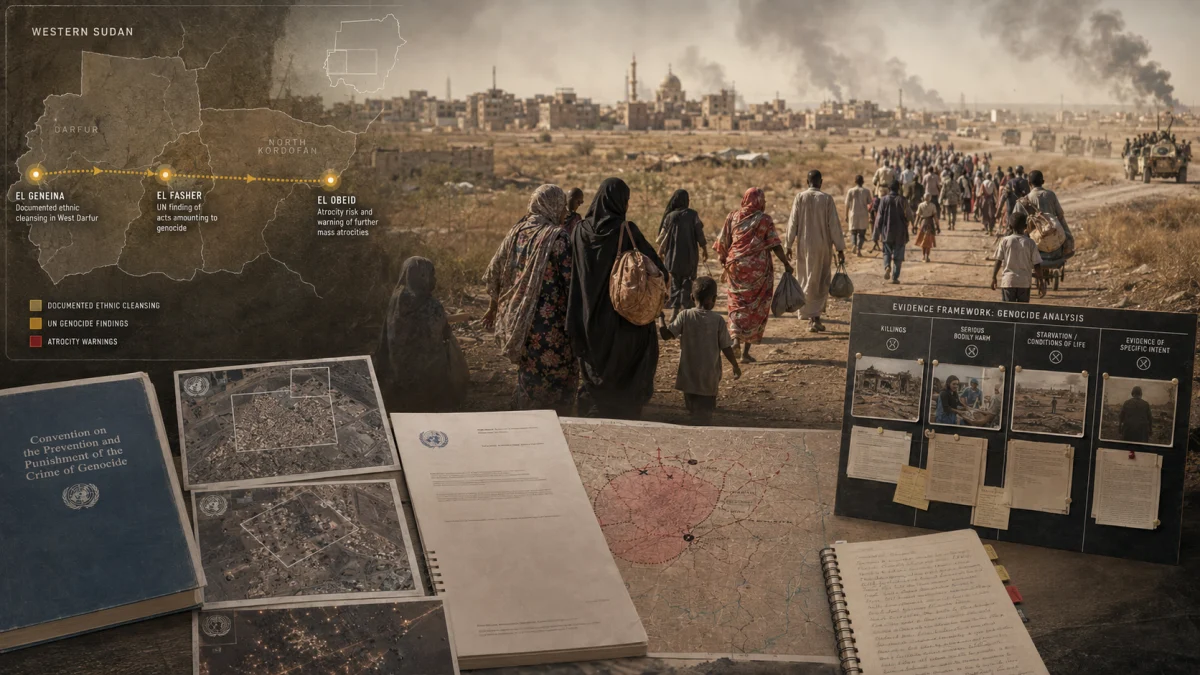
Yes—with an important qualification. There is now strong evidence that genocide has occurred within Sudan’s current war, particularly in Darfur, where the Rapid Support Forces (RSF) have targeted specific non-Arab ethnic communities. But it is too broad to describe every part of Sudan’s civil war, every civilian death, or every crime committed by either side as part of one nationwide genocide.
The strongest current finding concerns the Fur and Zaghawa communities in and around El Fasher, North Darfur.
In a 2026 investigation, the United Nations Independent International Fact-Finding Mission for the Sudan found evidence of killings, serious physical and psychological harm, rape and sexual violence, starvation, destruction of essential infrastructure and other conditions calculated to destroy these communities. After considering other possible explanations for the RSF’s conduct, the mission concluded that genocidal intent was the “only reasonable inference.”
That conclusion did not appear in a vacuum.
In January 2025, the United States had already formally determined that members of the RSF and allied militias had committed genocide, citing ethnically targeted killings, sexual violence, attacks on civilians trying to flee and deliberate interference with access to lifesaving supplies.
Earlier still, Human Rights Watch documented a systematic campaign by the RSF and allied militias to drive the predominantly non-Arab Masalit population from El Geneina in West Darfur in 2023. HRW concluded that the campaign constituted ethnic cleansing and crimes against humanity and said the evidence warranted investigation for possible genocide. It did not simply declare genocide at that stage.
That progression matters.
The evidence did not begin with the label “genocide” and then work backward. Investigators first documented ethnic cleansing, war crimes and crimes against humanity. As additional evidence accumulated—particularly from the siege and fall of El Fasher—the case for the additional element that distinguishes genocide from other mass atrocities became substantially stronger:
intent to destroy a protected group, in whole or in part.
That is the question this article examines.
What is actually established?
The simplest way to understand the evidence is to separate several claims that are often collapsed into one.
| Claim | What the evidence currently supports |
|---|---|
| “The entire Sudan war is a genocide.” | Too broad. The nationwide conflict involves numerous forces, military objectives and different patterns of violations. |
| “The RSF has committed genocide during the current Sudan war.” | Strongly supported. The U.S. made a genocide determination in 2025, and the UN Fact-Finding Mission subsequently found genocidal acts and genocidal intent in El Fasher. |
| “The RSF committed genocide against Fur and Zaghawa communities around El Fasher.” | This is the clearest current finding. The 2026 UN mission concluded that genocidal intent was the only reasonable inference from the cumulative evidence. |
| “The 2023 violence against the Masalit in West Darfur was genocide.” | There is extremely strong evidence of ethnic cleansing and crimes against humanity. HRW said genocide required further investigation. The broader U.S. genocide determination came later. |
| “The Sudanese Armed Forces are therefore the good side.” | False. Independent investigators have found substantial evidence of war crimes and serious abuses by SAF and allied forces as well. |
| “SAF is also committing genocide.” | The evidence reviewed for this article does not establish an equivalent genocide finding against SAF. That is different from saying SAF has not committed grave international crimes. |
| “The UAE has legally been found complicit in genocide.” | No. There is substantial evidence of UAE military assistance to the RSF, which the UAE denies, but no final judicial finding that the UAE is legally responsible for genocide. |
| “The ICJ cleared the UAE.” | Also false. Sudan’s case was removed because of a jurisdictional obstacle; the Court did not decide the underlying allegations on their merits. |
| “Genocide is now established in El Obeid.” | No. UN officials are warning of an acute risk of mass atrocities and patterns reminiscent of El Fasher, but that is a warning, not yet a genocide finding. |
Those distinctions are important because genocide is a legal description, not simply another word for an exceptionally horrible war.
What legally makes something genocide?
Under the 1948 Genocide Convention, genocide requires one or more prohibited acts committed with the intent to destroy, in whole or in part, a national, ethnic, racial or religious group as such.
Those acts include:
- killing members of the group;
- causing serious bodily or mental harm;
- deliberately imposing conditions of life calculated to bring about the group’s physical destruction;
- imposing measures intended to prevent births; or
- forcibly transferring children.
A perpetrator does not have to commit all five. But the physical act alone is not enough.
The central difficulty is specific intent.
Mass killing can be a war crime without being genocide.
Systematic rape can constitute a crime against humanity without necessarily being genocide.
Driving an ethnic population from its homeland can constitute ethnic cleansing without necessarily proving an intention to physically destroy that population.
Genocide requires something additional: evidence that destruction of the protected group, at least in substantial part, was intended.
That is why arguments consisting only of “look how many people died” are legally incomplete.
It is also why the evidence from Darfur has to be examined beyond the death toll.
El Geneina: the first major warning from the current war
When fighting erupted between SAF and the RSF in April 2023, the conflict quickly developed a distinct ethnic dimension in parts of Darfur.
El Geneina, the capital of West Darfur, became one of the clearest examples.
Human Rights Watch conducted more than 220 interviews, examined satellite imagery, authenticated photographs and videos and reviewed other documentary evidence. Its investigators found that the RSF and allied militias systematically attacked predominantly Masalit neighborhoods, killed civilians, raped women and girls, looted property and destroyed entire residential areas.
The scale was extraordinary.
A UN Panel of Experts estimate cited by HRW placed the number killed in El Geneina during 2023 at approximately 10,000 to 15,000 people. Large portions of predominantly Masalit neighborhoods were destroyed, with satellite imagery showing some areas apparently bulldozed after the population had fled.
The violence was also demonstrably ethnic.
Witnesses described people being questioned about their ethnicity, non-Masalit people sometimes being separated or spared, ethnic slurs being used during attacks and statements indicating that the territory belonged to Arabs and that Masalit residents should leave.
This is much stronger evidence than simply observing that one ethnic group suffered disproportionately.
It suggests selection on the basis of ethnicity.
But Human Rights Watch still stopped short of definitively calling the El Geneina campaign genocide.
Its 2024 assessment was that the evidence established ethnic cleansing and crimes against humanity, while the question of whether the perpetrators possessed the additional specific intent necessary for genocide required further investigation.
That restraint is important.
If we want the genocide label to mean something consistently, that is exactly how the evidence should be treated.
There were armed Masalit fighters. That does not erase what happened.
One fact sometimes lost in simplified accounts of El Geneina is that the Masalit population was not composed exclusively of unarmed civilians.
Masalit self-defense groups and armed fighters were present, and fighting occurred between armed groups. Human Rights Watch documented that reality rather than pretending the conflict consisted solely of armed RSF personnel attacking an entirely demilitarized population.
That matters when evaluating individual attacks.
A combatant may lawfully be attacked under the laws of war. A military position may be a legitimate target.
But the existence of Masalit fighters cannot explain the systematic destruction of civilian neighborhoods, ethnic screening of civilians, attacks on people fleeing the city, sexual violence, killings of noncombatants and apparent attempt to permanently remove the wider Masalit population.
“Some members of the ethnic group were armed” is therefore relevant context.
It is not a blanket legal defense for attacking the ethnic group.
El Fasher changed the evidentiary picture
El Fasher presented an even more complicated military situation.
It was the final major capital in Darfur outside RSF control and contained the Sudanese Armed Forces’ 6th Infantry Division as well as armed movements allied with SAF.
There was therefore an obvious military reason for the RSF to seek control of the city.
That fact has to be included in any serious assessment.
If the evidence showed only that the RSF besieged an enemy military stronghold, fought hostile armed groups and caused horrific but incidental civilian casualties, genocide would be much harder to establish.
But that is not the complete evidence.
The RSF siege lasted approximately 18 months. Investigators documented restrictions on food, water, medicine and humanitarian assistance; attacks on markets, hospitals, displacement camps and other civilian infrastructure; restrictions on civilian movement; and conditions that progressively became incompatible with survival.
The city and surrounding displacement camps contained large populations from non-Arab communities, particularly the Zaghawa and Fur, along with Masalit, Berti, Tama and others.
The UN Fact-Finding Mission documented a broader pattern in which these populations were not merely caught between two armies.
They were being identified, selected and attacked as ethnic communities.
Then El Fasher fell
The RSF launched its final offensive on El Fasher on October 26, 2025.
What followed is among the strongest pieces of evidence in the genocide assessment.
A separate investigation by the UN Human Rights Office interviewed more than 140 victims and witnesses and documented more than 6,000 killings during the first three days of the final offensive: at least 4,400 inside El Fasher and more than 1,600 along routes used by people attempting to escape.
OHCHR cautioned that the actual death toll from the week-long offensive was probably substantially higher.
Investigators documented:
- mass killings;
- summary executions;
- killings along escape routes;
- rape and gang rape;
- abductions;
- torture;
- detention in brutal conditions;
- attacks on hospitals and other protected sites;
- widespread pillage;
- and killings in which ethnicity was used as a proxy for presumed allegiance to SAF.
Several thousand people remained missing or unaccounted for when the report was prepared.
Critically, the killing did not stop making sense as ordinary battlefield violence merely because SAF and allied fighters were present.
People attempting to escape were attacked.
Unarmed detainees were killed.
People were selected according to ethnicity.
Women and girls from particular ethnic communities were subjected to sexual violence.
And the destruction continued after the RSF achieved the military objective of taking the city.
The genocide case does not rest on one massacre
The strongest evidence is cumulative.
The 2026 UN Fact-Finding Mission considered not merely the final days of El Fasher but the sequence of conduct surrounding them:
encirclement → deprivation → attacks on surrounding communities → destruction of civilian survival systems → restriction of escape → ethnically selective violence → mass killing during the takeover → continued abuse after military control had been obtained.
Investigators also examined perpetrator statements.
Witnesses described RSF personnel using explicitly racial and ethnic language and discussing the elimination of Zaghawa and other non-Arab communities. The mission documented statements about “cleaning” territory and eliminating particular populations.
But rhetoric alone did not establish genocide.
That is important because soldiers saying monstrous things during a war does not automatically prove an institutional plan to destroy an ethnic group.
The UN mission instead treated those statements as one part of a larger evidentiary pattern alongside:
- the identity of the victims;
- the repeated selection of civilians based on ethnicity;
- the geographic pattern of attacks;
- starvation and deprivation;
- destruction of survival infrastructure;
- sexual violence;
- the treatment of civilians fleeing the city;
- the scale and organization of the operation;
- perpetrator and commander behavior;
- and the continuation of abuses after battlefield objectives had been achieved.
That combination is considerably more probative than inflammatory language by itself.
The siege is particularly important to the genocide question
Killing is the most obvious genocidal act, but the Genocide Convention also covers deliberately imposing conditions of life calculated to bring about the physical destruction of a protected group.
That makes the El Fasher siege legally significant.
Investigators documented civilians reduced to eating animal fodder and leaves as food disappeared. Medical services collapsed. Water access deteriorated. Humanitarian relief was restricted. Essential civilian systems were attacked or destroyed.
Amnesty International’s independent 2026 investigation similarly documented the restriction of food and humanitarian supplies during the siege and described famine conditions in which civilians resorted to eating ambaz, a peanut-processing byproduct ordinarily used as animal feed.
The question is not merely whether people starved.
It is whether those conditions were deliberately imposed as part of a campaign directed at protected communities.
The UN Fact-Finding Mission concluded that the cumulative evidence supported exactly that conclusion with respect to the Zaghawa and Fur.
The hardest question: can we actually prove genocidal intent?
This is where the strongest skeptical argument deserves serious treatment.
The RSF wanted El Fasher for obvious strategic reasons.
It was the last major SAF stronghold in Darfur. Capturing it would consolidate RSF territorial control. Armed Joint Forces were defending it. A brutal siege could therefore have been intended primarily to force a military surrender rather than physically destroy an ethnic population.
That is a plausible alternative explanation.
And if it adequately explained the evidence, the legal case for genocide would weaken substantially.
The UN Fact-Finding Mission explicitly considered alternative explanations rather than ignoring them.
For the genocide question, it applied a more demanding approach than its normal “reasonable grounds to believe” standard. The mission said it paid particular attention to clear and fully convincing evidence and to whether genocidal intent was the sole reasonable explanation of the pattern it documented.
It concluded that the alternative explanations failed.
Why?
Because securing a military victory does not adequately explain:
- selecting civilians according to ethnic identity;
- killing civilians and people no longer participating in hostilities;
- attacking people while they fled;
- mass rape and sexual violence directed disproportionately at particular ethnic communities;
- deliberately reducing civilians’ ability to survive;
- attacks on displacement camps populated by targeted groups;
- exterminatory ethnic rhetoric accompanying the violence;
- or the continuation of large-scale abuses after the city had been captured.
Taken together, the mission concluded that the only reasonable inference was an intention to destroy the Zaghawa and Fur communities, in whole or in part.
That is the central evidence behind the genocide conclusion.
How strong was the UN investigation?
It was substantial, but it was not omniscient.
The Fact-Finding Mission reported conducting 320 interviews with victims and witnesses overall, including 131 during its 2026 investigative period. It reviewed public and confidential materials, authenticated and corroborated video evidence, consulted satellite imagery and met with civil society groups and experts.
There are limitations.
Investigators did not enjoy unrestricted access to every crime scene. Sudanese authorities did not fully cooperate with the mission, and the RSF did not substantively answer the mission’s questions despite publicly indicating that it would cooperate. Investigators necessarily relied heavily on survivors, remote evidence, digital material and corroborating sources.
That means this is not equivalent to a completed criminal trial where witnesses have been cross-examined and individual defendants have been convicted beyond a reasonable doubt.
But that limitation cuts both ways.
Restricted access does not make authenticated videos, satellite evidence, multiple independent witness accounts or physical patterns disappear.
The appropriate response is to qualify the evidentiary status—not pretend the evidence does not exist.
Amnesty International is more cautious—and that is worth noting
There is also no need to pretend every credible institution has reached the identical legal characterization.
In July 2026, Amnesty International published another major El Fasher investigation based on 247 interviews, including 208 survivors, 89 videos and extensive satellite analysis.
Amnesty concluded without qualification that the RSF had committed ethnic persecution, ethnic cleansing and crimes against humanity.
But Amnesty said its investigation into whether the conduct constituted genocide was still ongoing.
This does not invalidate the UN Fact-Finding Mission’s genocide finding.
Different investigators can examine different geographic areas, periods, evidence sets and legal questions and reach different stages of legal characterization.
What would be misleading is to say either:
“Every major organization agrees genocide is conclusively proven,”
or:
“Because Amnesty has not yet made a genocide finding, there is no credible genocide case.”
Neither statement accurately describes the evidence.
Does calling this genocide excuse the Sudanese Armed Forces?
No.
And this point should not be buried in a disclaimer.
The Sudanese Armed Forces and forces allied with SAF have themselves been implicated in serious international crimes.
In September 2025, the UN Fact-Finding Mission concluded that both SAF and the RSF had deliberately attacked civilians and committed large-scale war crimes.
The mission documented killings, arbitrary detention, torture, attacks on civilian infrastructure and other abuses by both sides. It also documented abuses by SAF and allied forces after recaptured territory changed hands, including targeting people accused of collaboration with the RSF. SAF personnel and allied forces were implicated in sexualized torture in detention.
The United States separately sanctioned SAF commander Abdel Fattah al-Burhan in January 2025, citing continued attacks on civilians and civilian infrastructure, executions, obstruction of humanitarian aid and previous findings that SAF members had committed war crimes.
In 2026, drones used by both sides have continued striking civilian areas and infrastructure.
On August 24, 2026, UN political chief Rosemary DiCarlo told the Security Council that approximately 13 million people had fled their homes, including about 8.7 million internally displaced people, and that the UN Human Rights Office had documented around 1,400 civilian deaths between January and June 2026, roughly 1,100 of them from drone strikes.
None of those facts become less serious because the evidence against the RSF additionally satisfies the genocide test in Darfur.
Likewise, documenting SAF crimes does not require artificially downgrading the evidence against the RSF to create symmetry.
Different conduct can support different legal conclusions.
Genocide is not a scoreboard for determining which side is worse
This distinction is easy to lose.
Genocide is sometimes treated in public debate as the ultimate superlative: if one side is committing genocide, that side must be uniquely evil and everyone fighting it becomes comparatively legitimate.
That is not how international criminal law works.
Genocide has specific elements.
Crimes against humanity have specific elements.
War crimes have specific elements.
A force can commit widespread murder, torture or indiscriminate attacks without the evidence establishing the special intent necessary for genocide.
Indeed, the UN commission investigating the original Darfur atrocities made precisely this point in 2005: crimes against humanity and war crimes can be no less serious or heinous simply because the genocide threshold is not met.
The correct standard is therefore not:
“Which label sounds worst?”
It is:
“Which crimes does the available evidence actually establish?”
Is the RSF just the Janjaweed under another name?
That description captures part of the history but oversimplifies it.
The RSF was formally created in 2013 under Omar al-Bashir’s government as a counterinsurgency force. Its membership drew substantially from existing paramilitary and government-backed militia networks, including forces commonly described as Janjaweed.
RSF commander Mohamed Hamdan Dagalo—better known as Hemedti—had himself been a Border Guard commander and Janjaweed militia leader.
The institutional lineage is therefore real.
But the RSF developed into a much larger and more organized paramilitary force with its own command structure, financial networks, political role, territorial ambitions and increasingly sophisticated weaponry.
Calling today’s RSF simply “the Janjaweed” can obscure that evolution.
The more important historical point is that some of the communities targeted during the original Darfur atrocities are again among the communities facing ethnically organized violence today.
Wasn’t Darfur already declared a genocide 20 years ago?
The history is more complicated than that shorthand suggests.
The United States characterized the original Darfur atrocities as genocide.
But in 2005, the UN International Commission of Inquiry on Darfur did not conclude that the Sudanese government had pursued a state policy of genocide.
It found extensive crimes under international law by the government and Janjaweed, including attacks on villages, killing, rape, pillage and forced displacement. It also said individual officials could potentially have possessed genocidal intent and recommended referring Darfur to the International Criminal Court.
The Security Council subsequently referred Darfur to the ICC.
Then, in 2010, the ICC issued a second arrest warrant for President Omar al-Bashir, adding three counts of genocide relating to alleged crimes against the Fur, Masalit and Zaghawa.
That warrant is important—but it is not a conviction.
The ICC found the evidentiary threshold necessary to issue an arrest warrant had been met. Bashir has never been tried at the ICC, and therefore there has never been a final ICC judgment finding him guilty of those genocide charges.
That distinction is exactly the sort of distinction that should also be made when discussing today’s Sudan.
The historical continuity is nevertheless extraordinary
The overlap cannot simply be dismissed.
The Fur, Masalit and Zaghawa appeared in the original Darfur investigations and ICC proceedings.
Two decades later:
- Masalit communities were systematically attacked and expelled from El Geneina;
- Zaghawa communities around El Fasher were targeted and displaced;
- Fur and Zaghawa communities were subjected to conditions the UN Fact-Finding Mission concluded were calculated to physically destroy them;
- and a military organization rooted partly in the earlier Darfur militia system is again centrally implicated.
History by itself does not prove current genocidal intent.
But repeated targeting of the same protected populations by forces with institutional continuity is highly relevant context when evaluating the present evidence.
What about the UAE?
Any serious examination of the RSF eventually reaches the question of outside support.
There is substantial evidence that the RSF’s ability to wage war has depended on foreign supply networks.
A UN Panel of Experts investigating Sudan reported in January 2024 that allegations concerning weapons moving through Amdjarass, Chad, to the RSF were credible. Sources described weapons and ammunition being unloaded from cargo aircraft and transported by truck toward Darfur.
The UAE denied supplying the RSF, saying its flights to Amdjarass supported humanitarian operations.
The evidence did not end there.
Amnesty International later identified Chinese-made guided bombs and AH-4 howitzers being used by the RSF and concluded that the weapons had almost certainly been re-exported by the UAE.
A 2026 Human Rights Watch investigation also traced hundreds of Colombian private military contractors supporting the RSF, finding evidence that contractors passed through or trained at facilities in the UAE before deployment and documenting some contractors fighting around El Fasher.
The UAE has repeatedly denied providing military support to the RSF.
The evidence supporting an RSF-UAE military relationship is therefore considerably stronger than a bare accusation, but another distinction is essential:
Providing weapons or military assistance to a force that commits genocide is not automatically the same legal question as being complicit in genocide.
Legal responsibility for complicity or state responsibility can require additional findings concerning knowledge, assistance and the applicable intent standard.
Those questions should not be shortcut simply because the underlying RSF crimes are grave.
Did the International Court of Justice clear the UAE?
No.
Sudan brought a case against the United Arab Emirates before the International Court of Justice in 2025 under the Genocide Convention.
The Court rejected Sudan’s request for provisional measures and removed the case from its docket.
That result has sometimes been described as though the ICJ examined Sudan’s evidence and found the UAE innocent.
It did not.
The decisive obstacle was jurisdiction arising from the UAE’s reservation to Article IX of the Genocide Convention—the provision used to submit disputes under the Convention to the ICJ.
The case therefore did not produce a merits judgment determining whether the UAE had armed the RSF, whether such assistance contributed to genocide or whether the UAE bore legal responsibility for those crimes.
A jurisdictional dismissal should not be converted into either a guilty verdict or an exoneration.
Foreign support is not solely an RSF issue
It would also be misleading to discuss foreign intervention as though only one Sudanese belligerent receives outside assistance.
Sudan’s war has increasingly become entangled with regional powers and international weapons networks.
SAF has received or reportedly benefited from outside military relationships of its own, including support involving Egypt and weapons or drone relationships involving Iran and other states. Arms manufactured in a range of countries have entered Sudan and been used by competing forces.
As of August 24, 2026, the United States was publicly pushing at the UN Security Council for stronger sanctions and an expansion of the existing Darfur arms embargo, arguing that outside military, financial and political support continues to sustain the war.
The relevant question is not which foreign patron belongs to the preferred geopolitical camp.
It is what assistance was provided, to whom, with what knowledge, and what crimes that assistance enabled.
Is genocide still happening in Sudan in 2026?
This requires another careful distinction.
The UN’s strongest genocide finding centers on the RSF’s campaign against Fur and Zaghawa communities during the siege and takeover of El Fasher, culminating in October 2025.
But the danger did not end when the city fell.
The Fact-Finding Mission said the risk of further genocidal violence remained acute and warned that the conflict was moving into other areas using patterns resembling those already documented in Darfur.
Serious abuses and detention allegations have also continued in and around RSF-controlled El Fasher.
The more immediate warning in 2026 concerns El Obeid, the capital of North Kordofan.
El Obeid may be the next test
By mid-2026, RSF forces had massed around El Obeid while fighting intensified across Kordofan.
On July 3, UN High Commissioner for Human Rights Volker Türk warned that another human-rights catastrophe was unfolding.
His office documented drone attacks against civilian infrastructure and patterns of summary executions, abductions, torture, sexual violence and attacks on people moving through the region.
Importantly, Türk also documented civilian harm from drones launched by both SAF and the RSF rather than assigning every attack to one force.
At the same time, he specifically urged pressure on the RSF to stop a potentially catastrophic offensive on El Obeid and warned against allowing the atrocities of El Fasher to repeat there.
On August 24, 2026, the Security Council was again discussing Sudan amid continuing fighting and mounting pressure around El Obeid.
That does not establish that genocide is already occurring in El Obeid.
Warning signs are not findings.
But after El Geneina and El Fasher, waiting until thousands of civilians have already been killed before treating those signs seriously would make the concept of genocide prevention nearly meaningless.
So, is there a genocide in Sudan?
The most defensible answer is yes, but with geographic, perpetrator and victim-group precision.
Sudan’s entire civil war should not be described as one undifferentiated genocide.
It is a broader armed conflict in which both the Sudanese Armed Forces and the Rapid Support Forces have been implicated in serious violations and war crimes, and in which numerous armed groups and foreign actors have contributed to an enormous civilian catastrophe.
Inside that broader war, however, the evidence concerning the RSF in Darfur goes further.
There is overwhelming evidence of ethnically organized violence against non-Arab communities.
There is extensive evidence of killing, rape, torture, forced displacement, starvation and destruction of the means necessary for civilian survival.
There is evidence of victims being selected according to ethnicity.
There are documented statements indicating an intention to eliminate particular communities.
There is evidence that attacks continued beyond what defeating enemy soldiers can reasonably explain.
The United States formally determined in 2025 that the RSF and allied militias had committed genocide.
And most importantly, the independent UN Fact-Finding Mission examining El Fasher subsequently concluded after applying a heightened evidentiary test that the RSF had committed underlying genocidal acts and that genocidal intent toward the Zaghawa and Fur was the only reasonable inference from the cumulative evidence.
There has not yet been a final international criminal conviction of current RSF commanders for genocide.
That distinction should be stated.
But the absence of a completed criminal trial is not the same as an absence of credible evidence.
The evidence is now sufficiently strong that dismissing the genocide characterization altogether requires ignoring not merely political rhetoric or advocacy reports, but a substantial and increasingly corroborated record of victim selection, mass killing, deprivation, sexual violence, ethnic persecution and perpetrator intent.
At the same time, applying the genocide label to the entire Sudanese war would go beyond what that record currently proves.
Holding Sudan to the same evidentiary standard as any other conflict requires doing both things at once: not lowering the threshold for genocide because the atrocities are horrific, and not raising the threshold beyond recognition because acknowledging genocide is politically uncomfortable.
The evidence—not the identity of the perpetrator, victim, ally or foreign sponsor—has to decide the conclusion.
References and Further Reading
Primary legal and UN findings
-
UN Independent International Fact-Finding Mission — Sudan: Hallmarks of Genocide in El Fasher (A/HRC/61/77) — The most important source for the current genocide assessment. Examines the El Fasher siege, takeover, underlying genocidal acts and evidence of specific intent.
-
United Nations — Definitions of Genocide and Related Crimes — Explains the protected groups, prohibited acts and specific-intent requirement under the Genocide Convention.
-
UN Human Rights Office — RSF Violations During the Capture of El Fasher — Documents more than 6,000 killings during the first three days of the final RSF offensive, along with executions, sexual violence, abduction and detention.
-
UN Fact-Finding Mission — “A War of Atrocities” in Sudan — Establishes large-scale crimes by both SAF and RSF while documenting additional crimes against humanity by the RSF.
-
U.S. Department of State — Genocide Determination in Sudan and Accountability Measures — January 2025 U.S. determination that members of the RSF and allied militias committed genocide. This is an executive government determination, not a criminal-court judgment.
El Geneina, El Fasher and independent investigations
-
Human Rights Watch — The Massalit Will Not Come Home: Ethnic Cleansing and Crimes Against Humanity in El Geneina — Extensive investigation of the 2023 campaign against Masalit civilians and an important example of investigators distinguishing proven ethnic cleansing from the still-developing genocide question.
-
Amnesty International — RSF Atrocities in El Fasher and North Darfur — July 2026 investigation based on 247 interviews, video analysis and satellite imagery. Amnesty finds ethnic cleansing and crimes against humanity while stating that its genocide investigation remains ongoing.
Historical Darfur and international criminal law
-
United Nations — 2005 International Commission of Inquiry on Darfur Findings — Important historical corrective: the UN commission found grave international crimes but did not find that Sudan’s government had pursued a policy of genocide, while leaving open individual genocidal intent.
-
International Criminal Court — Darfur Situation and Cases — Current ICC overview of its jurisdiction and cases concerning Darfur.
-
International Criminal Court — Second Arrest Warrant for Omar al-Bashir — The 2010 warrant added three genocide counts concerning the Fur, Masalit and Zaghawa. An arrest warrant is not a conviction.
Arms, foreign support and the UAE question
-
UN Security Council Panel of Experts on Sudan — Final Report S/2024/65 — Primary UN investigation of RSF military supply routes, including evidence concerning weapons transported through Chad.
-
Amnesty International — Advanced Chinese Weaponry Identified in Sudan — Weapons investigation concluding that Chinese guided bombs and howitzers used by the RSF were almost certainly re-exported through the UAE.
-
Human Rights Watch — From Bogotá to El Fasher: Colombian Fighters and UAE Support to the RSF — Detailed 2026 investigation of Colombian military contractors and evidence linking their deployment to UAE-based infrastructure and companies.
-
International Court of Justice — Sudan v. United Arab Emirates Case Record — Official record of Sudan’s Genocide Convention case against the UAE and its removal from the Court’s list.
Current 2026 warning signs
-
UN Human Rights Office — Türk Calls for Action to Prevent Atrocity Crimes in El Obeid — July 2026 warning documenting the deteriorating situation in North Kordofan while distinguishing violations involving both warring parties.
-
UN Department of Political and Peacebuilding Affairs — Security Council Briefing on Sudan, August 24, 2026 — Current UN assessment of the expanding conflict, displacement and civilian toll.
Editorial currency note: This article reflects evidence and official findings available through August 24, 2026. Investigations by the UN Fact-Finding Mission, ICC, OHCHR and independent human-rights organizations remain active. Legal characterizations, casualty figures, territorial control and evidence concerning foreign support may change as additional information becomes available.