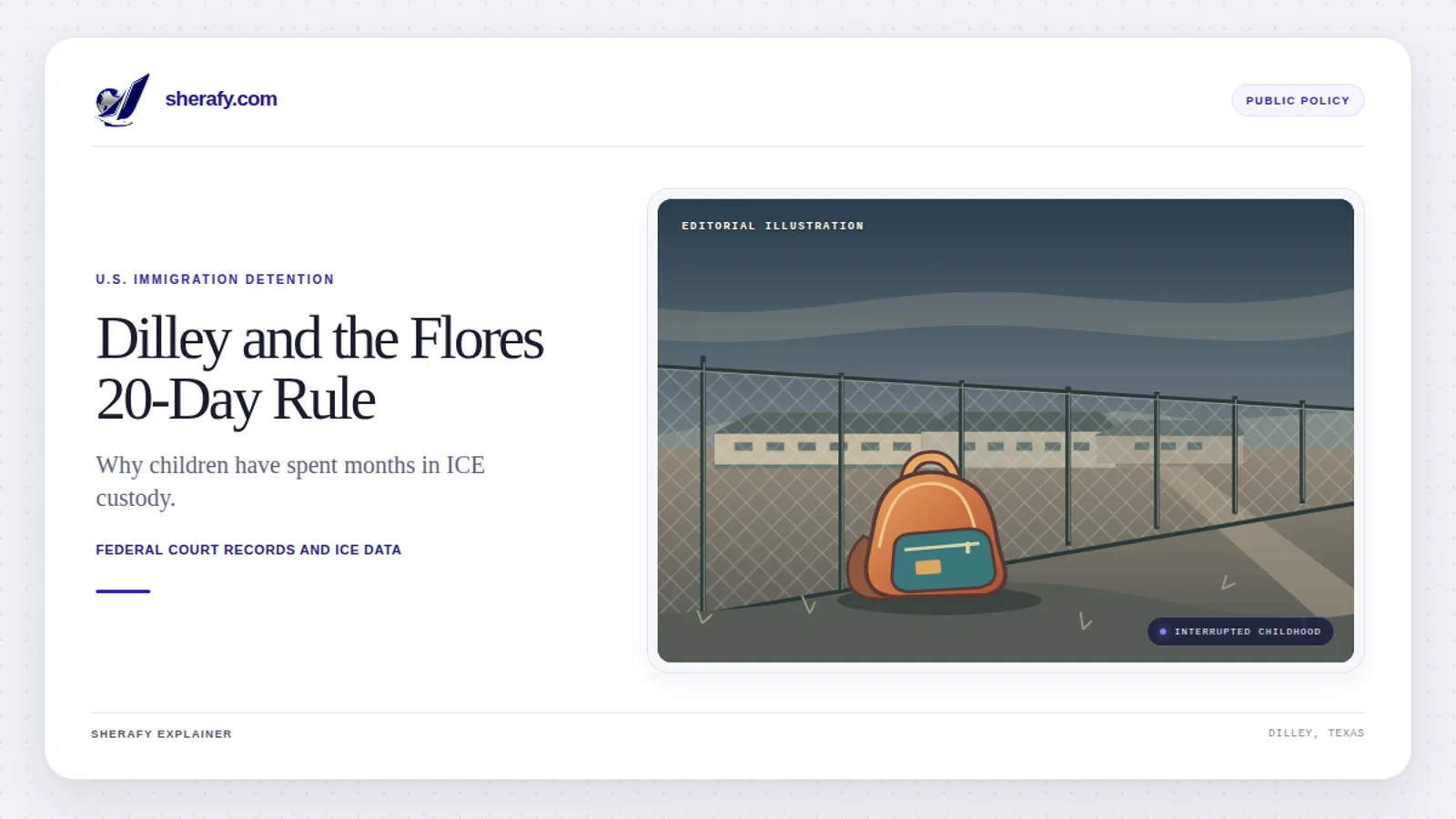
Children in U.S. immigration custody are generally supposed to be released without unnecessary delay or transferred to appropriate licensed facilities. Under longstanding federal court interpretations of the Flores Settlement Agreement, approximately 20 days represents a benchmark for keeping children in temporary, unlicensed family detention facilities under exceptional circumstances.
Yet children at the Dilley Immigration Processing Center in Texas have remained detained for months.
According to the government's own 2026 ICE Juvenile Coordinator Annual Report, the average completed detention period at Dilley reached 47.5 days in February 2026. Separate reporting by the Texas Tribune identified at least 60 children who had been detained there for 100 days or longer.
Federal court records reveal an additional problem: the government's monthly detention averages exclude children whose detention is ongoing and do not capture their entire time in federal immigration custody across different facilities.
A federal judge identified a substantially similar statistical deficiency in 2017.
Nearly a decade later, the court is confronting it again.
In August 2026, Chief U.S. District Judge Dolly Gee ordered renewed independent oversight of immigration detention operations, citing serious concerns about compliance with existing protections. In November, attorneys filed additional motions concerning children's access to confidential legal communication and notification of their rights.
The question is no longer whether protections for immigrant children exist. It is why those protections have repeatedly failed to prevent prolonged detention, and what happens to children while the government and the courts continue debating their enforcement.
How Long Can ICE Legally Detain Children?
There is no universal federal statute establishing an unconditional 20-day maximum for every child in immigration custody.
The commonly cited limit originates from judicial interpretations of the Flores Settlement Agreement, a binding agreement reached in 1997 following litigation challenging the federal government's treatment of immigrant children.
The agreement establishes several fundamental protections:
- Children should be released without unnecessary delay when appropriate arrangements can be made.
- Children remaining in custody should be placed in the least restrictive appropriate setting.
- Temporary detention facilities must provide safe and sanitary conditions.
- Children who cannot be released generally must be transferred promptly to appropriate, nonsecure, licensed facilities, subject to applicable exceptions.
- Children must receive information about their rights under the agreement.
The settlement's ordinary placement requirements contemplate a period of only a few days, with flexibility during emergencies or substantial increases in arrivals.
In 2015, the federal government argued that approximately 20 days could be necessary to process certain families while keeping parents and children together. Judge Gee recognized that such a period might be permissible under exceptional circumstances if authorities were acting diligently.
The resulting benchmark was not intended to create an automatic entitlement for the government to detain every child for 20 days, much less permission to detain children indefinitely.
In 2017, the court found that authorities were holding significant numbers of children substantially longer than 20 days, even after accounting for exceptional circumstances.
The August 17, 2026 federal court order revisited this history and rejected the government's attempt to dismiss the significance of the benchmark.
The legal distinction is important: exceeding 20 days does not automatically establish that every individual detention is unlawful, but neither does the absence of an absolute statutory limit give ICE unrestricted authority to hold children for months.
The government must still comply with its obligations regarding timely release, appropriate placement and individualized custody decisions.
What Is the Dilley Immigration Processing Center?
The Dilley Immigration Processing Center, previously known as the South Texas Family Residential Center, is a large immigration detention facility approximately 75 miles southwest of San Antonio, Texas.
It is designed to accommodate up to 2,400 people and is operated by CoreCivic, one of the largest private detention and correctional services companies in the United States.
Dilley is a civil immigration detention facility, not a conventional criminal prison. People held there are generally in administrative immigration custody rather than serving criminal sentences.
That distinction does not make the loss of liberty any less real.
Children confined at Dilley cannot ordinarily leave, attend their regular schools, return to their homes or participate freely in their communities.
The facility has operated under multiple presidential administrations.
| Year | Development |
|---|---|
| 1985 | The original Flores lawsuit is filed. |
| 1997 | The Flores Settlement Agreement establishes national protections for detained immigrant children. |
| 2014 | Dilley opens under the Obama administration. |
| 2015–2017 | Federal courts intervene over family detention practices and clarify the government's obligations. |
| 2019 | The first Trump administration attempts to replace the Flores agreement through federal regulations. |
| 2021 | The Biden administration stops using Dilley for family detention. |
| 2024 | ICE terminates its existing agreement for the facility. |
| 2025 | The second Trump administration reopens Dilley and resumes family detention. |
| 2026 | Federal courts order renewed independent monitoring following concerns about detention duration, medical care and legal rights. |
The facility's current operation is part of the Trump administration's expanded immigration enforcement and removal program.
Unlike earlier periods when family detention primarily affected recent border arrivals, independent reporting by ProPublica documents the detention of children who had already spent substantial portions of their lives in American communities.
How Many Children Are Being Detained Beyond 20 Days?
ICE's July 2026 annual report provides an unusually detailed look at detention patterns at Dilley.
The following figures are reproduced from the government's court-filed report.
Monthly child detention statistics at Dilley
| Month | Admissions | Recorded releases | Average daily child population | Average completed stay |
|---|---|---|---|---|
| June 2025 | 467 | 288 | 316.8 | 15.2 days |
| July 2025 | 283 | 411 | 237.3 | 24.7 days |
| August 2025 | 277 | 308 | 182.6 | 22.1 days |
| September 2025 | 433 | 374 | 258.3 | 18.8 days |
| October 2025 | 343 | 358 | 226.4 | 18.7 days |
| November 2025 | 226 | 186 | 238.6 | 17.9 days |
| December 2025 | 403 | 193 | 384.9 | 23.2 days |
| January 2026 | 310 | 368 | 477.9 | 40.0 days |
| February 2026 | 71 | 351 | 250.2 | 47.5 days |
| March 2026 | 73 | 139 | 77.4 | 40.2 days |
| April 2026 | 99 | 88 | 84.2 | 37.1 days |
| May 2026 | 30 | 109 | 91.2 | 23.5 days |
| Reported total or average | 3,015 | 3,173 | 235.5 | 27.4 days |
Source: ICE Juvenile Coordinator Annual Report, July 1, 2026, Document 1802-1, pages 2–3. Admissions and releases are administrative events, not necessarily counts of unique children. The reporting period does not begin with an empty facility.
For five consecutive months between January and May 2026, the average completed detention period exceeded 20 days.
In February, it reached nearly two and a half times that benchmark.
However, the averages alone do not reveal how many individual children were detained beyond 20 days or how long the longest detentions lasted.
In its August 2026 order, the court cited plaintiffs' analysis of six months of government census data, estimating approximately 1,560 instances of detention exceeding 20 days.
The underlying monthly records may contain duplication, meaning this figure should not be treated as a confirmed count of 1,560 distinct children.
The court also cited monthly records identifying children detained for more than 80 days:
| Month | Reported children detained longer than 80 days |
|---|---|
| February 2026 | 66 |
| March 2026 | 20 |
| April 2026 | 11 |
| May 2026 | 6 |
These monthly counts may include the same children appearing across multiple reporting periods and should not be added together to calculate a unique total.
Separately, the Texas Tribune's analysis identified at least 60 children who had spent 100 days or more at Dilley.
Prolonged detention is therefore not merely an allegation made by individual families. It is documented in government records and independent analyses.
The Problem With How ICE Counts Detention Days
One of the most consequential findings in the federal court records concerns the government's methodology for calculating detention duration.
ICE defines its Average Length of Stay, or ALOS, using individuals whose detention periods have ended.
Children who remain detained are excluded from those monthly averages.
This creates an important statistical limitation.
Consider a hypothetical detention facility holding five children:
| Child | Time in detention | Status |
|---|---|---|
| Child A | 10 days | Released |
| Child B | 15 days | Released |
| Child C | 20 days | Released |
| Child D | 90 days | Still detained |
| Child E | 100 days | Still detained |
The average completed detention period is 15 days.
That figure is mathematically correct. However, it excludes two children who have already spent approximately three months in custody.
The mean time observed across all five children is 47 days, and the final detention periods of the two remaining children are still unknown.
In statistics, this is related to a problem known as right censoring. Some observations have not reached their final endpoint when the data is collected.
Completed-stay averages can be useful, but they cannot independently establish how long everyone is being held or whether a facility complies with applicable detention restrictions.
ICE separately reported a snapshot of children still detained as of June 18, 2026. That snapshot provides additional information, but it does not resolve the exclusion of ongoing cases from the preceding monthly averages.
Time spent outside Dilley
The court identified a second limitation.
A child's recorded stay at Dilley does not necessarily represent the child's entire time in federal immigration custody.
For example, a family could spend several days in a Customs and Border Protection holding facility before being transferred to Dilley, and additional time in government custody elsewhere afterward.
A hypothetical child who spends eight days in a border holding facility, 25 days at Dilley and four days in another temporary facility has experienced 37 days of confinement.
Reporting only the 25 days at Dilley would omit nearly one-third of that child's detention.
The court consequently directed independent monitoring to examine cumulative detention time across relevant facilities, including those operated by different Department of Homeland Security agencies.
The same problem was identified in 2017
Perhaps the most revealing detail appears in a footnote of the August 2026 court order.
Judge Gee referred directly to her own June 27, 2017 enforcement order, which had identified the same limitation: government detention statistics accounted only for people whose detention had ended.
The recurrence is significant.
Government agencies have had years to develop reporting systems capable of accurately representing prolonged child detention. Yet the court again found it necessary to clarify how detention duration should be measured.
The evidence does not establish that ICE deliberately designed its statistics to conceal prolonged detention. It does establish that a known limitation persisted and that independent verification was deemed necessary.
Why Does ICE Continue Holding Children for Months?
ICE has offered several explanations for prolonged detention in its court filings.
These include:
- National security concerns involving particular families.
- Final removal orders followed by alleged noncooperation with deportation arrangements.
- Transportation and repatriation delays.
- Unavailable or incomplete travel documents.
- Other circumstances affecting individual custody and removal decisions.
These circumstances can complicate immigration enforcement. However, an explanation for why detention continues is not necessarily a sufficient legal justification for continuing to detain a child.
In August 2026, ICE Juvenile Coordinator Dawnisha Helland submitted a supplemental sworn declaration explaining that an earthquake in Venezuela had temporarily disrupted removal flights.
Families with final removal or voluntary departure orders consequently remained in custody.
ICE maintained that these cases were subject to review and that anticipated removal could make release inappropriate.
Judge Gee acknowledged that the explanation was more specific than some of the government's earlier submissions. Nevertheless, the earthquake occurred after the January–May reporting period and therefore could not explain the prolonged detention patterns observed during those months.
The court also questioned whether the government's other explanations adequately accounted for the sustained detention averages.
This reveals a fundamental policy problem.
Children can remain confined because of administrative obstacles, transportation difficulties, the conduct of adults or immigration proceedings that they have little or no ability to influence.
The relevant question is whether continued confinement is actually necessary, particularly when alternatives are available.
What Happens to Children Inside Dilley?
The available evidence comes from several distinct sources: ICE's own reports, family declarations filed in federal court, congressional oversight interviews and independent journalism.
Although the sources differ in authority and methodology, they repeatedly identify concerns involving medical care, nutrition, sleep, education and treatment by staff.
Medical care and the internal complaint system
The August 2026 court order highlighted a striking discrepancy involving medical grievances.
Between August 2025 and May 2026, the government's records identified 64 medical grievances filed at Dilley. None resulted in a finding in favor of the resident.
Meanwhile, according to evidence submitted by plaintiffs, the Refugee and Immigrant Center for Education and Legal Services, commonly known as RAICES, received approximately 1,480 complaints concerning medical issues at Dilley between May 2025 and May 2026.
These figures cover different periods and complaint systems. They cannot be directly compared as equivalent measures or counts of unique patients.
Nevertheless, the discrepancy raises an important question: how reliably does the facility's internal grievance process capture and resolve residents' medical concerns?
The court acknowledged efforts by ICE's Juvenile Coordinator to investigate reported medical problems, while determining that independent oversight was warranted.
The allegations are particularly consequential because detained families cannot ordinarily arrange their own medical appointments or independently seek treatment outside the facility.
Education and children with disabilities
ICE's own annual report acknowledges deficiencies in educational services at Dilley.
Identified problems included limited instructional time, incomplete special education infrastructure, inadequate student assessments and excessive reliance on worksheets.
The report also documented efforts to improve the educational program, including expanded classroom instruction and additional contracted services.
July 15, 2026, was identified as the scheduled milestone for full implementation of an enhanced educational model.
That scheduled milestone is not, by itself, evidence that all deficiencies were subsequently corrected.
For children detained for a few days, interrupted schooling may be temporary. For children detained for several months, the educational consequences become considerably more significant.
Children with disabilities, developmental delays or specialized learning requirements may experience additional difficulties when their established support systems are interrupted.
The relevant standard is not simply whether educational materials exist inside the facility. It is whether children receive appropriate, meaningful educational services during confinement.
Food, drinking water and staff conduct
A July 2026 report from Senate Judiciary Committee Ranking Member Dick Durbin's staff documented interviews with detained families and adult women following an April visit to Dilley.
Families reported concerns involving food quality, drinking water, medical services, disrupted sleep and degrading interactions with staff.
The report also contains allegations that employees deliberately consumed treats in front of detained children who were prohibited from having them.
The report was produced by Democratic congressional staff as part of an oversight investigation. Its conclusions are not equivalent to findings made by a court following an evidentiary hearing.
However, the firsthand accounts are relevant, particularly where they are consistent with separate reporting and sworn declarations.
Did ICE Detention Staff Deny Children Thanksgiving Dinner?
A disturbing account from Dilley resurfaced during the Thanksgiving season in November 2026.
The original incident was reported by NBC News journalist Mike Hixenbaugh on February 13, 2026, in an investigation titled A Family's Nightmare in ICE Detention.
NBC interviewed a Russian family that had fled to the United States and subsequently spent months in immigration detention with their children.
According to the parents, children gathered in a gym in late November 2025, expecting a holiday celebration. Food was displayed, but the families were subsequently informed that it was intended for employees rather than detainees.
The children reportedly watched as it was removed.
NBC also examined medical records and other documentation relating to the family's detention.
The Thanksgiving incident itself remains a firsthand allegation reported by an established news organization. Available evidence does not independently establish that staff intentionally organized the episode to humiliate children.
It is also important to distinguish its timing: the reported incident occurred in November 2025, not Thanksgiving 2026.
Nevertheless, separate accounts documented in congressional interviews and other reporting describe similarly degrading behavior involving food and children's interactions with staff.
These accounts do not independently prove the Thanksgiving episode. They do establish that the broader allegations deserve scrutiny rather than being dismissed as a single isolated complaint.
What Does Immigration Detention Do to Children's Health?
The potential harm associated with child immigration detention extends beyond individual allegations concerning Dilley.
A substantial body of medical research has examined the psychological and physical consequences of confining children in immigration detention facilities.
A 2025 systematic review published in the British Journal of Psychiatry, titled The Impact of Immigration Detention on Children's Mental Health, examined 21 studies involving 9,620 children.
Its meta-analysis reported the following pooled prevalence estimates:
| Mental health outcome | Estimated prevalence | 95% confidence interval |
|---|---|---|
| Depression | 42.2% | 22.9%–64.3% |
| Post-traumatic stress disorder | 32.0% | 19.4%–48.0% |
The researchers also found evidence of more severe psychological difficulties among children exposed to prolonged or indefinite detention.
A separate systematic review and meta-analysis of physical and mental health impacts, published online in August 2025, examined 15 studies involving 4,890 children.
The review identified physical health, nutritional, developmental and psychological concerns associated with detention.
Both reviews have limitations. Much of the underlying research is observational, and children entering immigration detention may already have experienced violence, displacement, poverty, family disruption or other traumatic circumstances.
The studies also cover different countries and detention systems. Their findings cannot be interpreted as direct estimates of depression or PTSD among children currently held at Dilley.
Nevertheless, the research provides substantial evidence that detention can compound existing vulnerabilities and introduce additional psychological and developmental risks.
For children, prolonged uncertainty is itself consequential. They may not understand why they have been detained, when they will leave, whether they will return to their schools or what will happen to their families.
The Flores 20-day benchmark is a legal standard, not a medically established period during which detention is harmless.
Are Children Being Informed of Their Legal Rights?
On November 20, 2026, attorneys representing children covered by the Flores agreement filed a new motion to enforce the government's rights-notification obligations.
The filing argues that detained children and families are not consistently receiving adequate information about the protections available to them.
Attorneys requested that the court require authorities to provide written notification within 24 hours of arrival, in a language families understand, and establish procedures for accessing legal assistance.
The motion followed a separate November 13 filing concerning confidential attorney-client communication.
The November 20 filing is supported by extensive family declarations describing detention conditions, barriers to understanding legal procedures and alleged pressure to agree to departure from the United States.
ABC News reported on the declarations on November 23, 2026, documenting additional allegations of delayed medical treatment and difficulties understanding documents presented to detainees.
These are allegations and requested remedies submitted in ongoing litigation. The filing itself does not establish that the court has granted every requested measure.
However, the underlying obligation to inform children of their Flores rights predates these proceedings.
The distinction between possessing a legal right and being able to exercise it is particularly important in immigration detention.
A child who does not know that protections exist, whose parents cannot understand the paperwork they receive, or whose family cannot communicate privately with an attorney is poorly positioned to challenge unlawful treatment.
Why Are Immigration Court Hearings Being Held Inside Dilley?
In November 2026, another development raised concerns about access to immigration proceedings.
Texas Public Radio reported on November 23 that some families who were not in immigration custody had received instructions to attend hearings inside the Dilley detention facility.
The relocation creates practical difficulties for families without transportation, legal representation or the resources to travel outside San Antonio.
It also introduces a psychological barrier.
Families may fear being detained upon arrival, while failing to attend an immigration hearing can have serious legal consequences, including a removal order issued in their absence.
Texas Public Radio independently confirmed with the facility that immigration hearings were taking place inside Dilley.
The available evidence does not establish that every relocated hearing is intended to facilitate an arrest. However, holding hearings inside a detention facility can create substantial barriers to participation, particularly for families already fearful of immigration enforcement.
Who Owns Dilley, and Who Makes Money From It?
Two publicly traded companies have significant financial interests in the Dilley detention facility: CoreCivic and Target Hospitality.
Their respective roles are documented in corporate filings submitted to the U.S. Securities and Exchange Commission.
CoreCivic
CoreCivic, traded on the New York Stock Exchange under the symbol CXW, operates the detention facility.
According to its 2025 annual report, Dilley generated $118.1 million in revenue during 2025 and $39.1 million in facility-level net operating income.
CoreCivic projected approximately $180 million in annual revenue when the facility was fully activated.
Its September 2026 quarterly report subsequently reported $139.1 million in revenue from Dilley during the first nine months of 2026.
The company also disclosed that Dilley's operating margin exceeded the average operating margin across its facility portfolio.
Target Hospitality
Target Hospitality, traded on Nasdaq under the symbol TH, owns the facility and provides selected services, including catering, management, janitorial work and maintenance.
Its 2025 annual report describes approximately $246 million in cumulative minimum revenue over the anticipated five-year contract period.
The arrangement includes minimum payments regardless of occupancy, subject to contractual terms and continued government funding.
The financial structure
| Entity | Role |
|---|---|
| Department of Homeland Security / ICE | Federal custody authority and government funding. |
| City of Dilley | Municipal participant in the intergovernmental service agreement. |
| CoreCivic | Contracted detention facility operator. |
| Target Hospitality | Facility owner and supporting service provider. |
| Financial metric | Reported amount |
|---|---|
| CoreCivic Dilley revenue, 2025 | $118.1 million |
| CoreCivic Dilley facility net operating income, 2025 | $39.1 million |
| CoreCivic Dilley revenue, January–September 2026 | $139.1 million |
| CoreCivic projected annual revenue at full activation | $180 million |
| Target Hospitality anticipated five-year minimum revenue | Approximately $246 million |
| Anticipated contract expiration | March 2030 |
These figures should not be added together to calculate total government expenditure. Some payments flow between participating companies, and revenue, facility operating income and corporate net profit are different financial measures.
Does CoreCivic profit from keeping individual children detained longer?
The financial evidence does not establish a direct per-child, per-day incentive to extend every individual detention.
CoreCivic describes a fixed monthly payment arrangement, while Target Hospitality reports minimum revenue protections regardless of occupancy.
However, the continued operation of family detention facilities creates substantial commercial value for the participating companies.
This establishes an economic interest in the continuation of detention contracts and capacity, even when occupancy fluctuates.
Responsibility must also be distinguished. ICE determines immigration custody decisions, while contractors are responsible for delivering contracted services and operating facilities within applicable standards.
Neither privatization nor subcontracting eliminates the federal government's obligation to protect children in its custody.
What Happens When ICE Fails to Comply With Flores?
The Flores agreement remains subject to judicial oversight.
When attorneys representing detained children believe the government has violated its obligations, they can submit evidence and ask the overseeing federal court to enforce the agreement.
Available mechanisms include enforcement orders, additional reporting requirements, independent monitoring, individualized litigation and, where legally warranted, contempt proceedings.
In August 2026, Judge Gee appointed a special master and independent monitor following repeated concerns about compliance.
Their responsibilities include verifying detention-duration data and overseeing specified aspects of detention conditions and legal-rights notification.
The court specifically required monitoring of cumulative time in relevant unlicensed facilities rather than simply measuring time spent at Dilley.
This matters because independent oversight can test whether internal government reports accurately reflect what children experience.
However, the appointment of a monitor does not automatically release detained children, establish that every allegation is true or resolve all existing violations.
There is an inherent limitation to enforcement through prolonged litigation: a child may spend months in detention while attorneys, agencies and courts debate whether that detention should have continued.
Even a successful legal challenge cannot return the time a child has already lost.
Are There Alternatives to Detaining Children?
Immigration enforcement does not necessarily require keeping entire families in detention facilities.
The federal government has previously operated community-based alternatives that combine case management, immigration court reminders, monitoring and assistance with navigating legal proceedings.
One example was ICE's Family Case Management Program, which operated between January 2016 and June 2017.
According to a Congressional Research Service analysis of alternatives to detention, ICE's historical evaluation reported high compliance among participating families.
| Historical program metric | Reported result |
|---|---|
| Immigration court attendance among evaluated program completers | Approximately 99% |
| Compliance with ICE monitoring requirements among evaluated completers | Approximately 99% |
| Participants who absconded during the program's operation | Approximately 4% |
| Daily program cost per family in fiscal year 2016 | $38.47 |
The evaluation had important limitations, including its short operating period, the limited number of families completing the program and the absence of final immigration outcomes for many participants.
Court attendance also does not necessarily establish eventual compliance with a removal order.
Nevertheless, the program demonstrates that community-based alternatives are not merely theoretical proposals. ICE has previously implemented them.
The existence of these alternatives makes it reasonable to ask why prolonged child detention is necessary in particular cases, rather than assuming confinement is the only available method of immigration enforcement.
Does the Flores Settlement Agreement Still Exist?
Yes. The most recent enforcement proceedings reviewed for this article continue to apply the Flores Settlement Agreement to children in Department of Homeland Security custody, including ICE and Customs and Border Protection.
However, the government has sought to terminate the agreement.
In August 2025, Judge Gee denied a government motion seeking termination. The administration subsequently appealed that decision.
A separate 2024 ruling largely terminated the agreement's application to the Department of Health and Human Services following new regulations governing its custody of unaccompanied children, while retaining certain protections and judicial oversight.
That partial termination did not eliminate the agreement's application to ICE and Customs and Border Protection.
The distinction matters because immigration custody is not administered through a single agency or legal framework.
The ongoing litigation can be followed through the National Center for Youth Law's Flores case archive and the Civil Rights Litigation Clearinghouse.
If the remaining agreement were terminated, children would still possess applicable statutory and constitutional protections. However, the removal of this particular settlement could substantially change the mechanisms through which detention conditions and release practices are monitored and challenged.
Dilley Detention Center: Evidence and Accountability Summary
The following table distinguishes documented findings from unresolved allegations and identifies the principal areas requiring continued oversight.
| Issue | Evidence | Assessment |
|---|---|---|
| Children detained beyond 20 days | ICE statistics and federal court records | Established |
| Children detained for 100 days or longer | Independent data analysis and court filings | Established |
| Monthly averages excluding ongoing detentions | ICE's reporting methodology | Established |
| Incomplete measurement of cumulative custody time | Federal court findings | Established |
| Inadequate education and special education infrastructure | ICE's annual report | Acknowledged deficiencies during the reporting period |
| Inadequate medical treatment | Family declarations, medical evidence and court review | Substantial concerns warranting independent oversight |
| Poor food and drinking water | Multiple firsthand accounts | Reported allegations; individual incidents require verification |
| Thanksgiving meal incident | Original NBC News interviews | Firsthand allegation reported by NBC |
| Inadequate notification of legal rights | Enforcement motions and court records | Continuing compliance dispute |
| Pressure to agree to departure | Family declarations | Firsthand allegations |
| Private-sector financial benefit | SEC filings | Established |
| Deliberate institutional policy of psychological humiliation | Circumstantial evidence and reported staff behavior | Not established |
This distinction is essential.
The case against prolonged child detention does not depend on proving every individual allegation or establishing a deliberate institutional intent to mistreat children.
The government's own records already document extended detention, acknowledged service deficiencies and unresolved compliance concerns.
Frequently Asked Questions
Is it illegal for ICE to detain children?
Not categorically. Federal immigration authorities possess detention authority, but the detention, placement, treatment and release of children are subject to applicable statutes, court orders and the Flores Settlement Agreement.
Can ICE legally hold children longer than 20 days?
Extended detention may be permissible in particular circumstances. However, authorities must still satisfy applicable legal obligations, and prolonged detention in unlicensed facilities can be challenged.
The 20-day benchmark is not an unrestricted authorization to detain every child for that period.
Can ICE detain children who are seeking asylum?
Yes. Seeking asylum does not automatically prevent immigration detention. Nevertheless, asylum-seeking children remain entitled to applicable legal protections concerning their custody and treatment.
Does the Flores Settlement require ICE to release parents with their children?
No. The Ninth Circuit determined in Flores v. Lynch in 2016 that the settlement applies to accompanied children but does not independently create an automatic release entitlement for their parents.
Family release may still be available under other applicable immigration authorities.
Do children in ICE detention have a right to an attorney?
Children generally have the right to obtain legal representation in immigration proceedings. However, immigration proceedings ordinarily do not provide the same automatic right to a government-funded attorney that applies in many criminal proceedings.
Access to representation and confidential legal communication are central issues in the ongoing Flores litigation.
Is Dilley a private prison?
Dilley is more precisely described as a privately owned and operated civil immigration detention facility. Target Hospitality owns it, CoreCivic operates it and ICE exercises federal immigration custody authority.
How much money does Dilley generate?
CoreCivic projects approximately $180 million in annual facility revenue at full activation. Target Hospitality separately anticipates approximately $246 million in minimum cumulative revenue over its five-year contractual arrangement.
These figures represent different contractual relationships and should not be combined as total taxpayer expenditure.
Did ICE deny children Thanksgiving dinner in 2026?
The widely circulated Thanksgiving account concerns an incident reportedly occurring in November 2025. NBC News published the family's account in February 2026.
The incident's details originate from firsthand testimony, and deliberate intent to humiliate children has not been independently established.
Is there a medically safe duration for child immigration detention?
There is no scientifically established universal period during which immigration detention is harmless to children.
The available medical literature associates detention with significant psychological and physical health risks, particularly when confinement is prolonged or indefinite.
Can families avoid detention through supervised release?
Community-based alternatives to detention exist and have previously been used by ICE. Eligibility depends on individual circumstances, applicable immigration law and agency custody decisions.
The Difference Between Having Rights and Being Protected
The United States has spent more than four decades litigating the treatment of children in immigration custody.
The original Flores lawsuit began in 1985. The settlement was reached in 1997. Federal courts intervened again in 2015 and 2017.
In 2026, a federal judge was still confronting reporting deficiencies substantially similar to those identified nine years earlier.
Children have continued to spend months in detention while attorneys seek enforcement of protections that have existed for decades. Private companies receive substantial revenue from operating the facilities, while courts struggle to obtain a sufficiently accurate picture of how long children are confined and whether their basic needs are being met.
The government has a legitimate interest in administering immigration law. That interest does not eliminate its responsibility toward children placed in its custody.
Children cannot arrange deportation flights, resolve international transportation disruptions, negotiate government contracts or correct deficiencies in federal reporting systems.
Yet they can experience the consequences of all of them.
The central failure is not the absence of rules protecting children. It is the persistent gap between the protections written into those rules and the protection children actually receive.
A childhood cannot be placed on hold while the government works out how to comply with its own obligations.
References and Further Reading
Federal Court Records and Government Documents
- Flores Settlement Agreement (1997): The foundational agreement governing the detention, treatment, placement and release of immigrant children.
- Congressional Research Service: The Flores Settlement and Alien Families Apprehended at the U.S. Border: Explains the settlement's legal history, placement requirements, exceptions and relationship to immigration detention authority.
- Flores v. Lynch, Ninth Circuit Court of Appeals (July 6, 2016): Appellate decision clarifying the agreement's application to accompanied children and the absence of an automatic parental release entitlement.
- Federal Court Enforcement Order, June 27, 2017: Documents earlier judicial findings involving prolonged detention, compliance deficiencies and limitations in government detention statistics.
- ICE Juvenile Coordinator Annual Report, July 1, 2026: Primary source for Dilley's monthly admissions, releases, detention averages, educational services and other operational information.
- Flores Litigation Document Archive, Center for Human Rights and Constitutional Law: Includes the government's July 29, 2026 response, plaintiffs' submissions and the broader record of ongoing litigation.
- Supplemental Declaration of ICE Juvenile Coordinator Dawnisha Helland, August 6, 2026: Documents specific government explanations for prolonged family detention.
- Federal Court Orders Appointing a Special Master and Independent Monitor, August 17, 2026: Central judicial analysis of detention duration, medical concerns, reporting limitations and renewed oversight requirements.
- November 20, 2026 Motion to Enforce Flores Rights Notification: Contains plaintiffs' allegations and requested enforcement measures.
- November 2026 Family Declarations From Dilley: Firsthand accounts submitted in support of ongoing Flores enforcement proceedings.
- ICE Family Residential Standards: Published operational standards concerning family detention, medical care, safety and other services.
- Senate Judiciary Committee Minority Staff: Exclusive Insights From the Dilley Immigration Processing Center: Congressional oversight report containing firsthand accounts of conditions at Dilley.
- Congressional Research Service: Immigration Alternatives to Detention Programs: Historical analysis of community-based supervision, family case management, compliance outcomes and program costs.
- National Center for Youth Law: Flores v. Reno: Litigation archive containing court orders, enforcement motions and government submissions.
- Civil Rights Litigation Clearinghouse: Flores v. Reno: Detailed historical and procedural overview of the federal litigation.
Corporate Financial Disclosures
- CoreCivic 2025 Annual Report (Form 10-K): Establishes Dilley's contractual structure, annual revenue and facility-level operating income.
- CoreCivic September 2026 Quarterly Report (Form 10-Q): Updated financial disclosures concerning Dilley's revenue and operating performance.
- Target Hospitality 2025 Annual Report (Form 10-K): Documents facility ownership, supporting services and anticipated minimum contractual revenue.
Medical and Scientific Research
- The Impact of Immigration Detention on Children's Mental Health: Systematic Review: Examines psychological outcomes across 21 studies involving 9,620 children.
- Immigration Detention of Children: A Systematic Review and Meta-analysis of Physical and Mental Health Impacts: Examines psychological, developmental and physical health outcomes across 15 studies involving 4,890 children.
Independent Reporting
- NBC News: A Russian Family's Nightmare in ICE Detention: Mike Hixenbaugh's original investigation documenting the family's detention experience, including the reported Thanksgiving incident. Also available through NBC's syndicated republication.
- ProPublica: The Children of Dilley: Firsthand reporting on children's experiences in immigration detention.
- Texas Tribune: Migrant Children Held Beyond Court-Ordered Detention Limits: Independent analysis of federal detention data, including children held for 100 days or more.
- ABC News: Families Held at ICE Detention Center Allege Prolonged Detention and Poor Medical Care: November 2026 reporting on family declarations and ongoing Flores enforcement proceedings.
- Texas Public Radio: Immigration Court Hearings Move to Dilley Detention Center: Independent reporting on relocated immigration hearings and concerns affecting non-detained families.
Editorial and research note: This article is based on public court records, government reports, corporate disclosures, scientific literature and attributed independent reporting reviewed through November 25, 2026. Detention populations, immigration policies and litigation outcomes may change. Allegations contained in court declarations are distinguished from judicial findings. Historical detention statistics should not be interpreted as current population counts. This article provides general legal information, not individualized legal advice.