
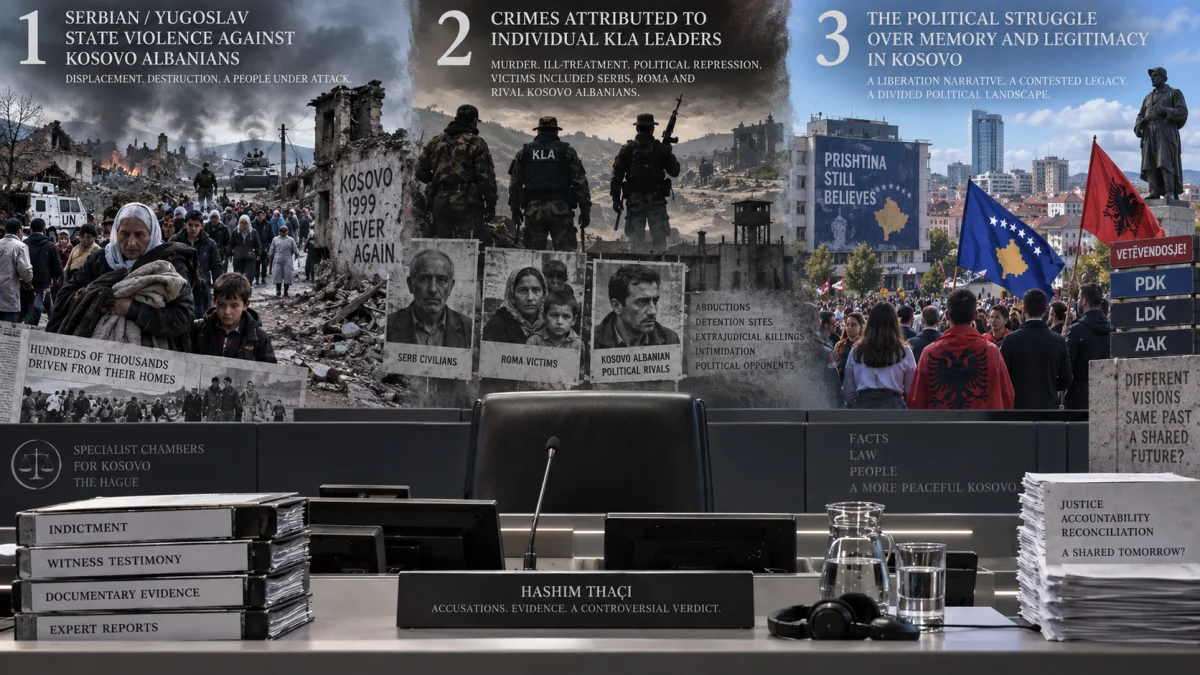
Former Kosovo President Hashim Thaçi was not convicted for fighting Serbia, supporting Kosovo independence or merely being a senior Kosovo Liberation Army leader while other people committed crimes.
On September 16, 2026, a Trial Panel of the Kosovo Specialist Chambers found that Thaçi significantly contributed to a common criminal purpose that targeted people perceived as opponents of the KLA. The judges also found that he personally participated in specific crimes, including the arrest, arbitrary detention and interrogation of 13 parliamentarians and the arrest, detention, transfer and murder of Kosovo Albanian activist Behajdin Allaqi. Thaçi was sentenced to 25 years in prison, with credit for time already served. The Kosovo Specialist Chambers’ judgment announcement details those findings. (Kosovo Specialist Chambers)
At the same time, the broader historical record establishes that Serbian and Yugoslav forces conducted a much larger organized campaign of violence, killing and forced displacement against Kosovo Albanians during the 1998–1999 war. International judges convicted senior Serbian and Yugoslav officials over that campaign. The OSCE concluded that although abuses were committed by both sides, there was “no balance or equivalence” in their nature or scale and that Kosovo Albanians suffered overwhelmingly. The ICTY’s findings on the campaign against Kosovo Albanians and the OSCE’s postwar human-rights assessment are unusually important for understanding this distinction. (ICTY)
Those two facts are not contradictory.
A movement can fight an oppressive state and some of its leaders can still commit war crimes. Recognizing crimes committed by KLA members does not retroactively justify Serbian repression. Recognizing the much greater scale of crimes committed against Kosovo Albanians does not erase the rights of Serbs, Roma or Kosovo Albanian political opponents who were unlawfully imprisoned, tortured or killed.
That distinction is the key to understanding both the Thaçi verdict and the intense reaction to it.
What did Hashim Thaçi actually get convicted of?
Thaçi was tried alongside former senior KLA figures Kadri Veseli, Rexhep Selimi and Jakup Krasniqi.
The Trial Panel found the four criminally responsible for the war crimes of:
arbitrary detention involving 385 people; cruel treatment involving 49; torture involving 303; and murder involving 96.
Thaçi received 25 years. Veseli received 18, Selimi 13 and Krasniqi 25. (Kosovo Specialist Chambers)
An important qualification is frequently lost in headlines: this does not mean the court found that Thaçi personally murdered 96 people.
The 96 figure concerns victims covered by the murder convictions for which the defendants were held criminally responsible under the court’s findings about their participation in a common criminal purpose.
Thaçi’s individual conduct went beyond leadership responsibility, however. The Trial Panel found that he was a member of the KLA General Staff and head of its Political Directorate and was a key participant in formulating and implementing the policy against perceived opponents.
The judges additionally found that Thaçi personally participated in the detention and interrogation of 13 parliamentarians and in the arrest, detention, transfer and murder of Behajdin Allaqi. (Kosovo Specialist Chambers)
That distinction matters. A simplified description that says Thaçi was convicted merely because he “commanded the KLA” understates the judgment.
Who were the victims?
Another common misconception is that this case is simply about KLA fighters killing Serbs during a war against Serbia.
It is not.
The Trial Panel found that the campaign targeted people regarded as opponents of the KLA’s political or military objectives. They included Kosovo Albanians associated with competing political or military movements such as the Democratic League of Kosovo, or LDK, and FARK; people accused of collaborating with Yugoslav or Serbian authorities; and ethnic minorities, including Serbs and Roma. (Kosovo Specialist Chambers)
That makes the political dimension of the case particularly important.
Many victims were themselves Kosovo Albanians.
According to the court, with limited exceptions there was no evidence that the people targeted had committed crimes, were combatants or posed genuine security threats. The judges found that many accusations of being a “collaborator” or “spy” rested on little more than rumor. (Kosovo Specialist Chambers)
That does not mean every KLA detention during the war was unlawful. It means the Trial Panel concluded that the particular system addressed in this case crossed the line from wartime security operations into criminal persecution of perceived opponents.
Thaçi was also acquitted of crimes against humanity
The verdict was not a complete prosecution victory.
Thaçi and his co-defendants were acquitted of the crimes-against-humanity charges.
The prosecution had to prove more than individual murders, torture or unlawful imprisonment. For crimes against humanity, it also had to establish the required broader attack against a civilian population.
The Trial Panel concluded that prosecutors had not proven beyond a reasonable doubt that there was a widespread or systematic attack directed against a civilian population. The defendants were also acquitted in relation to some alleged war-crime incidents. (Kosovo Specialist Chambers)
This is why two statements circulating after the verdict can both be true:
Thaçi was convicted of extremely serious war crimes.
Thaçi was acquitted of crimes against humanity.
The latter does not negate the former. They are separate offenses with different legal requirements.
The court did not declare the KLA itself criminal
Presiding Judge Charles Smith explicitly separated the defendants’ individual conduct from the legitimacy of Kosovo’s struggle.
The judgment was not a ruling that Kosovo Albanians had no right to resist repression. It did not declare the KLA itself a criminal organization. It did not rule that Kosovo’s independence was illegitimate. And it did not absolve Serbian forces of the crimes committed against Kosovo Albanians.
That distinction has also been emphasized in current coverage of the verdict because the judgment has produced considerable anger in Kosovo. (AP News)
This matters because much of the political argument surrounding Thaçi implicitly asks readers to accept one of two sweeping narratives:
If Thaçi committed war crimes, perhaps the entire KLA liberation story was fraudulent.
Or:
If the KLA fought a legitimate struggle against Serbian repression, Thaçi therefore could not have committed the crimes alleged against him.
Neither proposition follows from the evidence.
What was happening to Kosovo Albanians before and during the KLA’s rise?
To understand why the KLA became a liberation symbol, the story has to begin before Thaçi’s prosecution.
For much of the 1990s, Kosovo Albanian resistance was associated more closely with Ibrahim Rugova’s strategy of nonviolent political resistance than armed revolt.
That changed dramatically as Serbian repression intensified.
Human Rights Watch documented a major turning point in early 1998 in the Drenica region, where Serbian special police attacked villages using artillery, helicopters and armored vehicles. At least 83 people were killed, including 24 women and children, according to HRW’s contemporary investigation. Evidence indicated that some people had been executed after detention or surrender. Human Rights Watch’s 1998 investigation of the Kosovo conflict describes the attacks as a watershed. (Human Rights Watch)
The best-known episode occurred at Prekaz, where KLA figure Adem Jashari and most of his extended family were killed.
HRW reported that the Drenica attacks radically changed Kosovo Albanian opinion: thousands who had previously backed Rugova’s nonviolent strategy moved toward the KLA. (Human Rights Watch)
That history helps explain why the KLA occupies such a powerful place in Kosovo’s national memory.
It does not establish that every KLA action was lawful.
It explains why many Kosovo Albanians experienced the movement primarily as resistance to state repression rather than through the crimes now examined in The Hague.
Was violence by the KLA equivalent to what Serbian forces did?
The evidence does not support describing the overall violence as symmetrical.
Human Rights Watch was already documenting KLA abuses in 1998, including hostage-taking and summary executions. But its contemporary assessment said those violations occurred “on a lesser scale” than abuses by Yugoslav government forces. (Human Rights Watch)
The later international judicial record is stronger still.
The International Criminal Tribunal for the former Yugoslavia found that Serbian and Yugoslav forces conducted a widespread, organized campaign of violence against Kosovo Albanians. The tribunal found that deliberate actions by those forces caused at least 700,000 Kosovo Albanians to leave Kosovo between late March and early June 1999.
The purpose of the joint criminal enterprise identified by the ICTY was to use violence and terror to force a significant number of Kosovo Albanians from their homes so Serbian authorities could maintain control over Kosovo. (ICTY)
Killings, sexual violence, property destruction and attacks on religious sites were part of that record.
The OSCE subsequently summarized the evidence particularly clearly: abuses occurred on both sides, but there was no equivalence in their scale or character. After Serbian forces withdrew, however, the OSCE also documented revenge attacks against Serbs, Roma, Muslim Slavs and Kosovo Albanians perceived as collaborators. (OSCE)
That distinction prevents two opposite distortions.
“Both sides committed crimes” can become misleading if it implies comparable scale.
“Serbian forces committed far greater abuses” becomes misleading if it is used to imply that victims of KLA crimes therefore do not count.
Why did so many Kosovars admire Thaçi?
Thaçi’s importance extends well beyond his battlefield-era KLA role.
By 1999, he had become one of the movement’s most important political representatives and chaired the Kosovo Albanian delegation during the Rambouillet peace process.
A March 1999 U.S. State Department statement identified Thaçi as chairman of the Kosovo Albanian delegation and a representative of the KLA when he informed Secretary of State Madeleine Albright that the delegation was prepared to sign the proposed peace agreement. The State Department’s March 1999 record of Thaçi’s Rambouillet role documents that exchange. (State.gov)
By June, Albright was publicly meeting Thaçi alongside Rugova and Rexhep Qosja as part of Kosovo’s political leadership. The KLA committed to demilitarization and transformation following Serbian withdrawal. Albright’s June 8, 1999 meeting with Kosovo Albanian leaders captures how dramatically Thaçi’s international status had changed. (State.gov)
He later became Kosovo’s prime minister during the period surrounding its 2008 declaration of independence and subsequently its president.
For supporters, Thaçi therefore became associated with an extraordinary sequence of events: armed resistance, international negotiations, the withdrawal of Serbian forces, the emergence of Kosovo’s governing institutions and eventual independence.
Thousands were still rallying in his support immediately before the 2026 verdict. Protesters displayed KLA and Albanian symbols, while political figures who opposed the prosecution argued that the tribunal unfairly targeted Kosovo’s liberation struggle. (AP News)
But “many Kosovars regarded Thaçi as a hero” should not be simplified into “Kosovars supported Thaçi.”
Kosovo Albanian politics was never monolithic. Rugova and the LDK represented a competing political tradition, and the new judgment itself concerns crimes against Kosovo Albanians associated with rival movements.
Thaçi could simultaneously be a liberation symbol for one part of Kosovo society and a deeply controversial figure for another.
What did Thaçi’s defense argue?
The defense challenged one of the prosecution’s central premises: that the KLA hierarchy functioned in a way that gave Thaçi the authority and control prosecutors attributed to him.
Former U.S. State Department spokesman James Rubin, who dealt directly with Thaçi during the war and peace negotiations, testified for the defense in 2025 that Thaçi was essentially a political frontman rather than a commander with genuine authority over KLA military decision-making.
Rubin told the court that, in his experience, Thaçi was “not in charge” and lacked the authority to make major decisions independently. Associated Press coverage of Rubin’s defense testimony documents that argument. (AP News)
That was meaningful evidence, not a frivolous defense.
The KLA was an insurgent organization operating during a rapidly changing war, and determining where actual authority rested matters enormously when assigning responsibility to political leaders.
But the Trial Panel ultimately concluded that whatever limitations existed on Thaçi’s formal command authority, the evidence still established his substantial contribution to the common criminal purpose and his personal involvement in specific crimes. (Kosovo Specialist Chambers)
The distinction is important:
The judges did not simply say, “Thaçi was the leader, therefore he is responsible for everything the KLA did.”
They made findings about what he himself did and contributed to.
Those findings are now subject to the appeals process.
Why is the Kosovo Specialist Chambers so controversial?
Criticism of the court cannot simply be dismissed as denial of war crimes.
The institution itself is unusual.
The Kosovo Specialist Chambers grew out of a 2011 Council of Europe report alleging serious crimes committed by KLA members. The European Union subsequently established a Special Investigative Task Force. In 2014, that investigative body said the evidence was sufficient to pursue indictments against some former senior KLA members.
In 2015, Kosovo’s Assembly adopted a constitutional amendment and legislation creating the Specialist Chambers and Specialist Prosecutor’s Office. The court’s official history of how the Specialist Chambers were created explains that legal structure. (Kosovo Specialist Chambers)
The court is therefore neither the International Criminal Court nor simply a foreign tribunal imposed with no Kosovo legal foundation.
It is a Kosovo-law institution, established through Kosovo’s constitutional and legislative framework, but seated in The Hague and staffed by international judges, prosecutors and personnel.
That hybrid structure is one reason both supporters and critics can make statements about the court that sound contradictory while each contains part of the truth.
Why does the court focus so heavily on the KLA?
This is one of the strongest criticisms from Thaçi supporters.
The Specialist Chambers’ jurisdiction is tied to allegations contained in the 2011 Council of Europe report and related investigations. In practical terms, that has produced an institution overwhelmingly associated with prosecutions of former KLA members. (Kosovo Specialist Chambers)
For Kosovo Albanians who lived through Serbian repression, this can look profoundly backwards: the side that suffered the overwhelming share of displacement and violence sees its former liberation leaders sitting in The Hague decades later.
That grievance is understandable as a question about institutional design.
It does not establish that the individual convictions are false.
Nor does the existence of the Specialist Chambers mean Serbian officials escaped international prosecution.
The earlier ICTY prosecuted senior Serbian and Yugoslav officials and convicted several of them for the organized campaign against Kosovo Albanians. (ICTY)
A complete account therefore requires keeping two questions separate:
Was international criminal justice applied evenly and designed consistently across the conflicts?
And:
Did prosecutors prove these defendants committed the particular crimes charged?
Concerns about the first do not automatically answer the second.
Are concerns about the tribunal’s fairness legitimate?
Some deserve serious scrutiny.
In 2026, the Bar Human Rights Committee of England and Wales published an independent preliminary review commissioned by Kosovo’s Ombudsperson. It examined issues including defendants’ rights, judicial independence, evidentiary fairness and equality of arms. The BHRC’s preliminary review of the Kosovo Specialist Chambers expressly describes itself as preliminary rather than a final adjudication that defendants’ rights were violated. (Bar Human Rights Committee)
Kosovo’s Ombudsperson has raised broader concerns about fair-trial guarantees and the operation of the court. (Ombudsperson Institution)
The Specialist Chambers strongly disputes some interpretations of that review. It has emphasized that the BHRC report did not find that any particular KSC judicial decision violated the defendants’ human rights, did not conclude that the court’s jurisprudence conflicted with European Court of Human Rights standards, and did not find that its detention rulings violated human-rights conventions. The Specialist Chambers’ response to the BHRC controversy sets out the court’s position. (Kosovo Specialist Chambers)
The evidence therefore supports neither extreme.
It would be wrong to say there are no credible concerns about the structure or procedures of the tribunal.
It would also be wrong to say the independent review proved the court is illegitimate or that Thaçi did not receive a legally valid trial.
Appeal proceedings are precisely where challenges to the judgment and alleged legal errors can now be tested.
Why is the tribunal in The Hague instead of Kosovo?
Witness intimidation is an important part of the answer.
Concerns about pressure on witnesses in cases involving former KLA members long predate Thaçi’s current trial.
The Specialist Chambers has since prosecuted separate cases involving interference with its proceedings. In the Gucati and Haradinaj case, for example, judges found that confidential information identifying hundreds of witnesses and potential witnesses had been exposed and that witnesses were publicly branded with terms such as “traitors,” “spies” and “collaborators.” The defendants were convicted of offenses including intimidation and revealing protected information. The Specialist Chambers’ judgment summary in the Gucati-Haradinaj witness case describes what occurred. (Kosovo Specialist Chambers)
That record does not prove that every witness in Thaçi’s war-crimes case was intimidated or that every inconsistency in testimony resulted from pressure.
It does establish that witness security was not a hypothetical concern invented to justify moving proceedings abroad.
What about the “organ harvesting” allegations?
This part of the story is frequently mangled online.
The 2011 Council of Europe report associated with Swiss politician Dick Marty included allegations involving secret detention facilities and possible organ removal and trafficking from a small number of prisoners after the Kosovo conflict.
Those allegations were an important reason the later investigation and Specialist Chambers came into existence.
But Thaçi’s 2026 conviction is not an organ-harvesting conviction.
When Special Investigative Task Force prosecutor Clint Williamson announced his investigative findings in 2014, he said the investigation had found indications consistent with allegations involving a handful of possible organ-trafficking cases but did not have sufficient evidence to bring indictments for that crime. Human Rights Watch’s account of the investigation distinguishes those allegations from the abductions, illegal detentions, killings and other crimes for which investigators said sufficient evidence existed. Human Rights Watch’s account of the investigation that preceded the Specialist Chambers explains the distinction. (Human Rights Watch)
The current Thaçi verdict concerns arbitrary detention, cruel treatment, torture and murder.
Treating “Thaçi convicted of war crimes” as confirmation that the historic organ-trafficking allegations were proved would be incorrect.
Was the KLA officially a U.S.-designated terrorist organization?
No.
This claim survives because the underlying history is more complicated than either side usually presents.
In February 1998, U.S. diplomat Robert Gelbard publicly called the KLA a terrorist group. (State.gov)
But the State Department subsequently clarified that it had not formally designated the KLA a terrorist organization. In July 1998, spokesman James Rubin distinguished between condemning violent acts by KLA-associated individuals as terrorist acts and formally designating the organization itself as terrorist. The State Department’s July 1998 clarification on the KLA is unusually explicit on this point. (State.gov)
Human Rights Watch likewise recorded that Gelbard later retreated from the characterization and that the KLA was never placed on the U.S. government’s terrorist-organization list. (Human Rights Watch)
Within a year, U.S. officials were negotiating directly with Thaçi and other Kosovo Albanian representatives at Rambouillet.
So both of these statements require qualification:
“The United States never regarded any KLA conduct as terrorism” is false.
“The KLA was a U.S.-designated terrorist organization” is also false.
Where does NATO fit into this?
NATO’s intervention is another distinct part of the Kosovo war and should not be folded into the Thaçi prosecution.
NATO launched a 78-day air campaign against Yugoslavia in March 1999 after the collapse of negotiations and escalating violence in Kosovo.
The intervention ultimately preceded the withdrawal of Serbian forces, the deployment of international forces and the return of large numbers of Kosovo Albanian refugees.
But NATO’s bombing also killed civilians.
Human Rights Watch documented 90 incidents involving civilian deaths and estimated roughly 500 Yugoslav civilians were killed during the air campaign. It criticized some attacks and targeting decisions as exposing civilians to unacceptable risks. Human Rights Watch’s investigation of civilian deaths in the NATO air campaign provides one of the most detailed independent assessments. (Human Rights Watch)
Those deaths deserve their own factual accounting. They do not determine whether Thaçi committed the crimes adjudicated by the Specialist Chambers any more than Thaçi’s crimes determine whether every NATO strike was lawful.
These are separate questions.
Is this related to the Bosnian genocide and Srebrenica?
Historically, yes.
Legally and factually, they are different conflicts.
The Bosnian War ran from 1992 to 1995. The Srebrenica genocide occurred in July 1995, when Bosnian Serb forces killed thousands of Bosniak Muslim men and boys after taking the UN-designated enclave.
The International Court of Justice concluded that genocide occurred at Srebrenica. It did not find Serbia legally responsible for itself committing the genocide or for complicity in it, but it did find that Serbia violated its obligation under the Genocide Convention to prevent the genocide and later failed fully to cooperate with the ICTY. The International Court of Justice’s Bosnia v. Serbia case record sets out those findings. (International Court of Justice)
The Kosovo conflict escalated several years later, principally in 1998 and 1999.
The conflicts are connected through the violent breakup of Yugoslavia, Serbian nationalism under Slobodan Milošević, regional displacement and many of the same international institutions.
But Thaçi was not prosecuted for the Srebrenica genocide, and the Kosovo Specialist Chambers is not deciding responsibility for Bosnia.
It is also inaccurate to describe Thaçi’s conviction as part of a prosecution for “the Bosnia genocide.”
For readers unfamiliar with Balkan history, keeping Bosnia, Croatia and Kosovo separated chronologically is essential.
Was the Kosovo war itself legally declared a genocide?
That is another question where terminology matters.
International courts have convicted Serbian and Yugoslav officials of extremely serious crimes committed in Kosovo, including crimes against humanity and war crimes. The ICTY found an organized campaign using violence and terror to forcibly remove large numbers of Kosovo Albanians. (ICTY)
That is not the same thing as an international judicial finding of genocide in Kosovo.
“Genocide,” “crimes against humanity,” “war crimes” and “ethnic cleansing” are not interchangeable legal labels even when they describe events involving mass suffering.
The Srebrenica genocide finding therefore should not simply be imported into discussion of Kosovo.
Why does this verdict feel like an attack on Kosovo’s history to some people?
Because national memory is rarely organized like a criminal trial.
For many Kosovo Albanians, the defining experience of the 1990s was not internal KLA politics. It was the loss of autonomy, repression under Serbian rule, state violence, villages attacked, relatives killed or expelled, refugees fleeing across borders and finally the withdrawal of Serbian forces.
Within that memory, the KLA became intertwined with liberation.
Thaçi then became intertwined with the KLA, international diplomacy and the creation of the Kosovo state.
A conviction saying that this same man helped target, imprison, torture and kill people can therefore feel to supporters like an attempt to reverse the moral meaning of the entire war.
But that conclusion is not required by the judgment.
The judges themselves distinguished individual criminal liability from the legitimacy of Kosovo’s broader political struggle. (AP News)
There is a broader lesson here that applies well beyond Kosovo: in conflicts connected to ethnicity, nationality, occupation or collective trauma, acknowledgment of a crime by one’s own side can begin to feel like support for the enemy’s entire historical narrative.
That is an understandable political and psychological reaction.
It is not a sound method for determining whether the crime occurred.
Thaçi also faces a separate witness-interference case
This should not be confused with the conviction announced on September 16.
Thaçi and four other defendants are separately accused of offenses involving the administration of justice.
According to the confirmed indictment, prosecutors allege that during detention-facility visits Thaçi disclosed confidential information concerning prosecution witnesses and instructed others to influence witness testimony. All five defendants pleaded not guilty. Closing statements concluded in September 2026, and judgment remains pending. The Specialist Chambers’ case page for the separate administration-of-justice prosecution provides the current procedural status. (Kosovo Specialist Chambers)
Those allegations have not yet been proven.
They should therefore not be cited as additional evidence that Thaçi committed the war crimes for which he has now been convicted.
Conversely, the war-crimes conviction does not prove the separate obstruction allegations.
Is the 25-year sentence final?
Not yet.
The September 16 decision is a Trial Panel judgment, and the parties have the right to appeal. Thaçi has denied wrongdoing throughout the proceedings. He is entitled to challenge the findings and sentence through the court’s appellate process. (AP News)
That means careful reporting should use language such as “the Trial Panel found” when discussing disputed factual conclusions that may become subjects of appeal.
But the opposite error should also be avoided.
These findings are no longer merely prosecution allegations. A trial was held, evidence was tested, and judges have entered convictions beyond a reasonable doubt at first instance.
Those two evidentiary categories should not be blurred.
What can the evidence support without choosing a national narrative?
The strongest available record supports several conclusions simultaneously.
Serbian and Yugoslav forces conducted an organized campaign of violence, terror and forced displacement against Kosovo Albanians on a much greater overall scale than abuses then attributed to the KLA. Senior Serbian and Yugoslav officials were convicted for crimes arising from that campaign. (ICTY)
The KLA was nevertheless not crime-free. Human-rights organizations documented unlawful killings, abductions and abuses during and after the conflict, including against Serbs, Roma and Kosovo Albanians perceived as collaborators or political opponents. (Human Rights Watch)
The Kosovo Specialist Chambers has now found that Thaçi and three other senior KLA figures were criminally responsible for specific war crimes. In Thaçi’s case, the judges also found personal participation in particular offenses. (Kosovo Specialist Chambers)
The same court acquitted them of crimes against humanity and of responsibility for some alleged incidents. (Kosovo Specialist Chambers)
Thaçi’s defense presented meaningful contrary evidence concerning his actual authority within the KLA, and the judgment remains appealable. (AP News)
There are legitimate questions about the unusual structure, narrow historical mandate and procedures of the Specialist Chambers. Those questions do not, without additional evidence, establish that its factual findings were fabricated or that its convictions are invalid. (Bar Human Rights Committee)
And none of the above requires a reader to decide that either Kosovo Albanians or Serbs were collectively guilty.
International criminal law is supposed to do almost the opposite: move responsibility away from entire peoples and toward identifiable individuals and provable acts.
The part of the Kosovo story that gets lost when people choose sides
The history becomes less accurate when one group of victims has to disappear in order to protect another group’s narrative.
Kosovo Albanians do not need to minimize crimes committed by KLA leaders in order for the Serbian campaign against them to remain historically documented.
Serbian victims do not need to deny the scale of repression against Kosovo Albanians for crimes committed against Serbs to matter.
And the people most easily erased in a binary version of the conflict may be Kosovo Albanians who were themselves targeted by KLA members because they belonged to a rival movement, had Serbian acquaintances, were accused of collaboration or simply became objects of suspicion.
Thaçi’s conviction does not settle every historical argument about the Kosovo war.
It does settle something narrower at the trial level: after years of proceedings, a panel of judges concluded beyond a reasonable doubt that he bore individual criminal responsibility for serious crimes against people the KLA perceived as opponents and that he personally participated in some of those crimes.
Whether those findings survive appeal is the next legal question.
Whether Kosovo’s liberation struggle was legitimate is a different question—and one the Trial Panel expressly did not purport to decide.
References and Further Reading
Trial Judgment and Kosovo Specialist Chambers
Kosovo Specialist Chambers — “Hashim Thaçi and co-defendants found guilty of war crimes” The court’s September 16, 2026 summary of the Trial Panel’s findings, including victim counts, convictions, acquittals, sentences and the defendants’ roles. (Kosovo Specialist Chambers)
Kosovo Specialist Chambers — Background Explains the 2011 Council of Europe allegations, Special Investigative Task Force and Kosovo constitutional and legislative steps that created the court. (Kosovo Specialist Chambers)
Kosovo Specialist Chambers — Thaçi et al., Administration of Justice Case Official case record for the separate pending prosecution involving alleged witness interference and obstruction. (Kosovo Specialist Chambers)
Crimes During the Kosovo War
International Criminal Tribunal for the former Yugoslavia — Five Senior Serb Officials Convicted of Kosovo Crimes Summarizes the ICTY findings concerning the organized campaign of violence and forced displacement against Kosovo Albanians. (ICTY)
Human Rights Watch — Humanitarian Law Violations in Kosovo Contemporary 1998 investigation documenting Serbian government abuses, KLA violations and the Drenica attacks that sharply expanded support for the KLA. (Human Rights Watch)
OSCE — Human-rights findings from the Kosovo conflict and its aftermath Important for distinguishing the unequal scale of abuses during the war from the serious revenge attacks that followed Serbian withdrawal. (OSCE)
Human Rights Watch — Civilian Deaths in the NATO Air Campaign Documents roughly 500 civilian deaths in 90 incidents during NATO’s 78-day bombing campaign and analyzes disputed targeting decisions. (Human Rights Watch)
Thaçi, the KLA and U.S. Diplomacy
U.S. Department of State — Thaçi’s March 1999 letter concerning the Rambouillet agreement Primary-source documentation of Thaçi’s role as chairman of the Kosovo Albanian delegation and KLA representative. (State.gov)
U.S. Department of State — Madeleine Albright meeting with Kosovo Albanian leaders, June 8, 1999 Documents Thaçi’s international political role, the KLA’s planned demilitarization and the transition toward postwar institutions. (State.gov)
U.S. Department of State — 1998 clarification of the KLA and terrorism designation Useful primary evidence distinguishing condemnation of violent KLA acts from formal U.S. designation of the organization as terrorist. (State.gov)
Associated Press — James Rubin’s testimony for the Thaçi defense Explains a central defense argument that Thaçi was a political figurehead without the operational authority prosecutors attributed to him. (AP News)
Origins and Controversies of the Tribunal
Human Rights Watch — Kosovo Special Court: Step Toward Justice Summarizes the investigative history behind the court, including the distinction between prosecutable crimes and the organ-trafficking allegations for which investigators said evidence was insufficient to indict. (Human Rights Watch)
Bar Human Rights Committee — Preliminary Review of the Kosovo Specialist Chambers Independent 2026 preliminary review raising issues involving defendants’ rights, evidentiary fairness, judicial independence and equality of arms. (Bar Human Rights Committee)
Kosovo Specialist Chambers — Response to interpretations of the BHRC report Provides the court’s response and clarifies what the preliminary review did and did not formally conclude. (Kosovo Specialist Chambers)
Bosnia and Srebrenica
International Court of Justice — Bosnia and Herzegovina v. Serbia and Montenegro Primary case record for the ICJ’s findings concerning the Srebrenica genocide, Serbia’s responsibility to prevent genocide and the legal distinction between Serbia and the Bosnian Serb perpetrators. (International Court of Justice)
Editorial currency note: This article reflects the status of the proceedings as of September 16, 2026. Thaçi’s war-crimes conviction is a first-instance judgment and may be appealed. His separate administration-of-justice case has completed closing arguments but has not yet produced a judgment. Those developments could materially change portions of this article.